
Elitech DMG-2SE
4.4Editor score
Supports 88 common refrigerants
Includes three 5-foot charging hoses
Provides R410A adapters and clamps
Our digital manifold gauge set guide compares ten models for accuracy, refrigerant support, pressure range, temperature probes, portability, and field
A digital manifold gauge set combines pressure readings, pipe-temperature measurement, and refrigerant calculations in one diagnostic instrument. A useful model should deliver stable readings, support the refrigerants encountered in your service area, and include the hoses, adapters, probes, and accessories required for real HVAC work.
The ten products in this guide were compared using the supplied specifications, focusing on measurement ranges, accuracy, refrigerant databases, probe compatibility, hose construction, display design, power options, portability, and diagnostic features. The list covers budget kits, professional Bluetooth instruments, rechargeable models, and premium wireless systems.
Each review explains the strongest reason to consider the gauge, along with meaningful limitations or missing accessories. The top selections represent different priorities: a value-focused complete kit, a premium connected system, and an advanced diagnostic platform. Availability, package contents, and pricing can change, so confirm current details before purchasing.
4.4Editor score

4.5Editor score

4.6Editor score
The comparison below organizes all ten digital manifold gauge sets by their core capabilities, including refrigerant breadth, pressure range, temperature measurement, charging hardware, and connected features.




The Elitech DMG-2SE combines an 88-refrigerant database with digital saturation-temperature readings in a kit that includes the essential charging hardware. Its 4.4 rating reflects a practical balance of capability and convenience, particularly for technicians who want to leave chart work behind. The display provides high- and low-side readings while supporting common residential, commercial, and automotive refrigerants.
We may earn a commission when you buy through this link, at no additional cost to you.
Its strongest attraction is completeness at the entry level. The package includes three durable five-foot color-coded hoses, two dedicated R410A adapters, and industry-standard 1/4-inch SAE connections. It can monitor pressure, support leak and charging work, and calculate saturation values for refrigerants such as R410A, R32, R454B, and R1234yf. Data hold helps preserve a reading during setup, while automatic shutoff protects battery life.
The trade-offs are important to understand. The supplied specifications do not state the pressure range, temperature range, measurement accuracy, battery configuration, or whether temperature probes are included. It also lacks the documented app workflow, wireless probes, and data logging associated with higher-end instruments. The one-year warranty is less expansive than the three-year coverage listed for the AUTOOL LM150.
This is a strong match for a technician building a first complete digital kit or an experienced user who wants a capable backup gauge. It offers enough refrigerant breadth and charging accessories to be useful without requiring a separate adapter purchase for R410A. Buyers should still verify probe requirements, measurement limits, and included batteries before ordering.
Support for 88 refrigerants reduces the need to maintain separate instruments for common residential, commercial, and automotive refrigerants. The inclusion of R32, R454B, and R1234yf is particularly relevant as service work involving newer or A2L refrigerants continues to expand.
The included hoses and R410A adapters make this closer to an out-of-box service kit than a bare gauge. That convenience can be valuable for new technicians, although buyers should still inspect connector sizes and probe compatibility for their specific equipment.
We may earn a commission when you buy through this link, at no additional cost to you.
The VIVOHOME Digital HVAC Manifold Gauges provide broad diagnostic capability with two wired clamp probes, a large backlit display, and a three-hose charging set. Its 4.2 rating places it among the more technically detailed conventional digital manifolds here. It supports 88 refrigerants, A2L warning functions, superheat and subcooling calculations, vacuum measurement, and leak testing.
We may earn a commission when you buy through this link, at no additional cost to you.
Measurement specifications are clearly defined. The pressure range extends from negative 14.5 to 500 or 800 psi, depending on the channel, with pressure accuracy stated as ±0.5% of full scale. Temperature measurement covers -58°F to 302°F with ±0.9°F precision. Two wired temperature clamps provide live pipe readings, while the gauge handles dual pressure and temperature measurements simultaneously.
The included accessories are substantial: three locking-valve hoses, two anti-freeze safety valves, temperature clamps, a hanging hook, and a carry case. The hoses use brass connections and have a listed burst pressure of 4,000 psi. One drawback is that three AA batteries are required but not supplied, so owners should keep a spare set available before heading to a job site.
This gauge is a good choice for technicians who value transparent specifications and a ready-to-use bundle. It offers more documented measurement detail than several similarly positioned alternatives, yet it does not offer the documented remote operation and wireless probe ecosystem of the testo 550s. Confirm connector standards, hose working pressure, and battery requirements before purchasing.
The large backlit LCD, automatic unit conversion, and simultaneous pressure-temperature display reduce interpretation time. These features are useful during evening service calls, in mechanical rooms, and anywhere glare or limited light makes a small screen difficult to read.
Brass hose connections, locking valves, and anti-freeze safety valves are designed to improve handling during refrigerant service. Their presence does not replace correct personal protective equipment or careful line-pressure checks, but they make the included kit more service-oriented than a minimal display-only gauge.
We may earn a commission when you buy through this link, at no additional cost to you.
The Fieldpiece SM382V is the most advanced diagnostic platform in this guide, with a 4.5 rating and a feature set aimed at professional HVAC and refrigeration work. It is a wireless three-port SMAN refrigerant manifold with an integrated vacuum gauge, digital low- and high-pressure measurement, and automatic superheat and subcooling calculations.
We may earn a commission when you buy through this link, at no additional cost to you.
The gauge is designed to support deeper service workflows rather than only charging. Protected thermocouple inputs accept pipe and outdoor temperatures, while the ability to connect Job Link Psychrometer probes broadens its diagnostic potential. Data logging and temperature-compensated system-tightness testing are especially relevant for documenting performance and identifying pressure changes that can be masked by temperature fluctuation.
The main limitation is transparency. The supplied information does not state the pressure range, temperature accuracy, refrigerant count, battery life, or which accessories are included with the specific listing. The package may therefore require additional hoses, probes, adapters, or charging leads. Its premium positioning also makes it less compelling for occasional users who only need basic pressure readings.
For service organizations that value repeatable workflows, connected probe expansion, and detailed records, the SM382V is the most capable choice here. It is particularly attractive to technicians who already use the Fieldpiece ecosystem or need more than a straightforward two-channel gauge. Confirm the current package configuration and probe requirements before making a final decision.
A built-in vacuum gauge, protected thermocouple inputs, and psychrometer-probe compatibility make this suitable for system analysis beyond a single pressure snapshot. These capabilities help connect pressure, vacuum, and temperature evidence when diagnosing an air-conditioning or refrigeration circuit.
Data logging and temperature-compensated tightness testing support more structured diagnostic work. A technician can retain test information and compare readings under more meaningful conditions, although the gauge should still be used alongside proper leak-detection procedures.
We may earn a commission when you buy through this link, at no additional cost to you.
The WISSCOOL Digital Gauges stand out for a built-in NIST database of 113 refrigerants, the broadest refrigerant selection listed in this comparison. The gauge has a 4.0 rating and covers common systems such as R454B, R410A, R32, R134a, R1234yf, and R22. It is a practical option for technicians who encounter varied legacy and modern refrigerants.
We may earn a commission when you buy through this link, at no additional cost to you.
Its color LED display presents pressure, vacuum, and temperature data, while three working modes support charging, recovery, evacuation, and leak-test tasks. The stated pressure range is 0 to 6,000 kPa, with pressure accuracy given as ±0.5% full scale plus five digits. Temperature readings cover -40°F to 302°F with ±0.9°F precision, and two clamp probes provide live pipe temperature.
The kit includes three five-foot hoses rated for 600 psi working pressure and 3,000 psi burst pressure, a storage case, temperature clamps, four AA batteries, and a manual. That is an unusually complete inventory. However, the complex accuracy notation may require careful interpretation, and the product data does not describe a mobile app, wireless probes, data export, or advanced recording features.
WISSCOOL is most compelling for a technician who values refrigerant selection breadth and wants the needed hoses, probes, case, and batteries in one package. It is less attractive for users who need connected documentation or sophisticated psychrometer integration. The low overall rating should prompt buyers to weigh customer feedback carefully before committing.
A 113-refrigerant library is a meaningful distinction for shops servicing older R22 equipment alongside R410A, R32, R454B, or R1234yf systems. It reduces the chance of selecting an incorrect pressure-temperature reference when a broader service mix is involved.
Charging hoses, clamps, batteries, and a storage case are all included according to the supplied description. This reduces setup friction and makes the gauge easier to organize for mobile service, particularly for technicians moving between multiple appointments.
We may earn a commission when you buy through this link, at no additional cost to you.
The testo 550s earns the highest customer rating among the listed digital manifold gauges, at 4.6. It combines precise pressure and temperature measurement with wireless probes, Bluetooth operation, and the testo Smart App. It is designed for air-conditioning, refrigeration, and heat-pump service where remote readings and documented results add practical value.
We may earn a commission when you buy through this link, at no additional cost to you.
The measurement range is broad, extending from -58°F to 302°F and up to 870 psi. Stated accuracy is ±0.9°F and ±0.5% of full-scale pressure. The kit includes two wireless temperature probes and one wireless vacuum probe, allowing pipe, outdoor, and vacuum measurements with fewer direct cable connections around the gauge.
App integration is the defining feature. It can visually organize documentation, remotely operate the refrigerant gauge, perform service and maintenance tasks, and send results from the job site. Automatic superheat and subcooling calculations reduce manual lookup. The trade-off is dependence on a connected workflow and the need to manage probe batteries, which may not suit every technician.
The testo 550s is the most polished choice for users who want wireless access, app-supported records, and precise readings from a recognized test-and-measurement platform. It is less compelling for a simple charging kit or when app compatibility cannot be verified for the intended phone. Confirm the current probe set, regional app availability, and service requirements before ordering.
Two wireless temperature clamps and a wireless vacuum probe can reduce cable clutter around service points. Wireless operation also makes it easier to position probes where readings are needed while keeping the main gauge in view, provided the relevant testo app and compatible device are available.
The Smart App supports visualized records, remote gauge operation, maintenance tasks, and job-site result delivery. These features can improve organization when documenting customer work, although technicians should retain independent readings and follow company reporting procedures.
We may earn a commission when you buy through this link, at no additional cost to you.
The Elitech LMG-10 is a two-valve digital manifold with a 4.5 rating, strong feature coverage, and an included heavy-duty hose set. It supports 88 refrigerants, temperature-compensated pressure holding and vacuum leak testing, and automatic superheat and subcooling calculations. The design is aimed at technicians who want a versatile gauge without a premium connected platform.
We may earn a commission when you buy through this link, at no additional cost to you.
The gauge offers five pressure units—psi, kg/cm², kPa, MPa, and bar—plus Celsius and Fahrenheit. Its three hoses are 59 inches, or 1.5 meters, long and use heavy-duty brass-made connections. A listed working pressure of 500 psi and burst pressure of 4,000 psi provides useful context when judging the included charging components.
Unlike several higher-ranked kits, the supplied description does not explicitly say that temperature clamp probes or a carrying case are included. It also does not specify a battery type, measurement accuracy, or connectivity. Those omissions mean this model may need accessories to reach its full diagnostic potential, and it lacks the remote features available from the testo and Fieldpiece options.
The LMG-10 is attractive for a technician who values automatic calculations, leak-testing functions, and established-looking hose hardware. Its 4.5 rating supports confidence in overall customer satisfaction. Before buying, verify probe inclusion, battery requirements, pressure accuracy, and the size of any service kit that is not included in the listing.
Temperature compensation helps distinguish a genuine pressure loss from a pressure change caused by ambient or system-temperature variation. That makes the feature useful during pressure-holding and evacuation checks, where an unqualified pressure difference could otherwise lead to a misleading conclusion.
Five pressure units and two temperature units make the gauge convenient across jobs that use different regional or customer conventions. The automatic superheat and subcooling functions also reduce the need to consult a separate table during common charge verification tasks.
We may earn a commission when you buy through this link, at no additional cost to you.
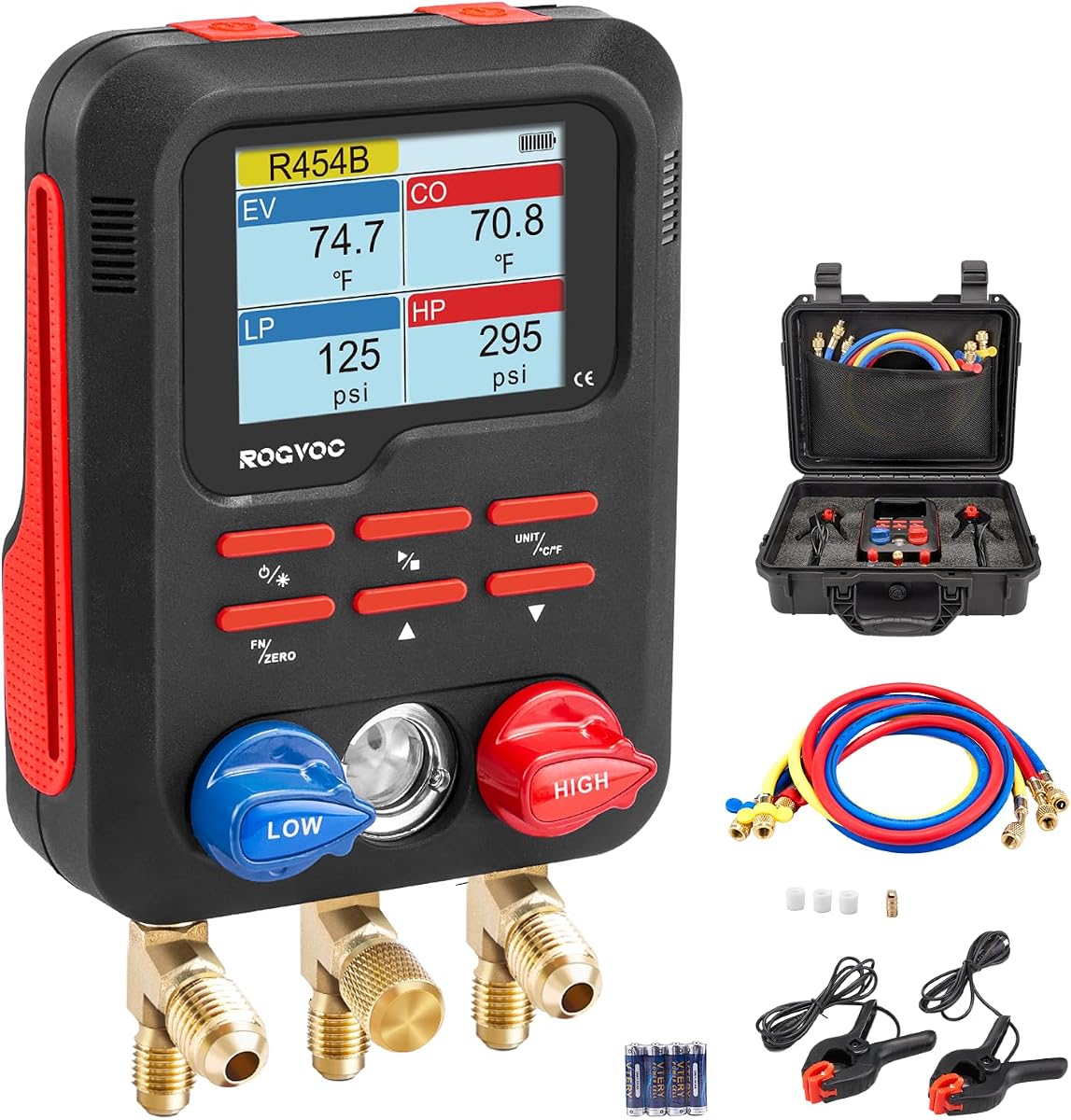
The Rogvoc Digital Gauge is a general-purpose diagnostic set with a 4.0 rating, a 93-refrigerant database, and a TFT display. It supports refrigerant filling, dual-pressure and tightness testing, vacuum measurement, temperature testing, and automatic condensation and evaporation pressure calculations, giving it a broad mix of functions for routine service.
We may earn a commission when you buy through this link, at no additional cost to you.
The pressure range is listed as 0 to 6,000 kPa with 1 kPa resolution and ±0.5% full-scale accuracy. Vacuum testing covers -101 to 0 kPa at the same resolution, and maximum overload is 10,000 kPa, or 10 MPa. A visual window allows the filling status to be observed, while a back hook provides a way to position the unit during testing.
The package includes a digital manifold, three five-foot colored hoses, two thermometer clamps, a replacement valve core, a toolbox, and a battery. Hose working pressure is listed at 600 psi. Its limitations include the lack of documented wireless connectivity, a modest 4.0 rating, and no detailed temperature accuracy specification in the supplied information.
This gauge is a reasonable choice for independent technicians who need many diagnostic modes and a visual charging window without paying for a connected premium system. It is especially convenient as a general-purpose gauge when the included battery, toolbox, clamps, and replacement valve core reduce the need for separate purchases. Verify battery type and temperature specifications before use.
The dedicated vacuum range and recorded pressure-difference information can help evaluate system tightness during evacuation. A time-based test is more meaningful than a single snapshot, so the gauge should be used according to a defined procedure and alongside other leak-detection methods when necessary.
A TFT LCD remains visible in dim service environments, while the visual window adds a quick way to observe filling status. The back hook improves hands-free positioning, making the instrument easier to use when the technician is handling hoses or system connections.
We may earn a commission when you buy through this link, at no additional cost to you.
The Elitech LMG-10Plus is a compact, portable digital manifold kit with a 4.3 rating. Its defining advantage is a stated battery life of up to 200 hours, supported by a replaceable-battery design. That makes it attractive for technicians who want to carry one instrument through long service days without relying on a sealed internal battery.
We may earn a commission when you buy through this link, at no additional cost to you.
The gauge supports 88 refrigerants, five pressure units, and Celsius or Fahrenheit temperature displays. It performs temperature-compensated pressure holding and vacuum leak testing, then calculates superheat and subcooling automatically. Two temperature clamps and a hanging hook are included, while the product title indicates that hoses and an R410A adapter are also part of the kit.
Compared with the original LMG-10, the Plus model emphasizes portability, low power consumption, and longer battery life. Its listed support through email and phone can be useful for setup questions or troubleshooting. The supplied information does not identify the battery chemistry, state pressure and temperature accuracy, mention a smart-app connection, or describe the exact hose dimensions and working pressure.
The LMG-10Plus makes sense for mobile technicians who value a replaceable power source and broad refrigerant coverage. It is less suitable for users whose workflow depends on wireless probes or automatic documentation export. Before buying, confirm the battery type, charger requirements, full package contents, and whether the included R410A adapter matches the fittings used in your service area.
A stated 200-hour runtime is useful for technicians who work long shifts, travel frequently between sites, or use the gauge for repeated leak tests. Automatic shutoff can further reduce unnecessary consumption when the instrument is left idle.
A replaceable battery is more serviceable than a permanently sealed cell because it can be replaced when capacity declines. Users should follow the manufacturer’s battery and charging guidance and confirm the availability of compatible replacement cells.
We may earn a commission when you buy through this link, at no additional cost to you.
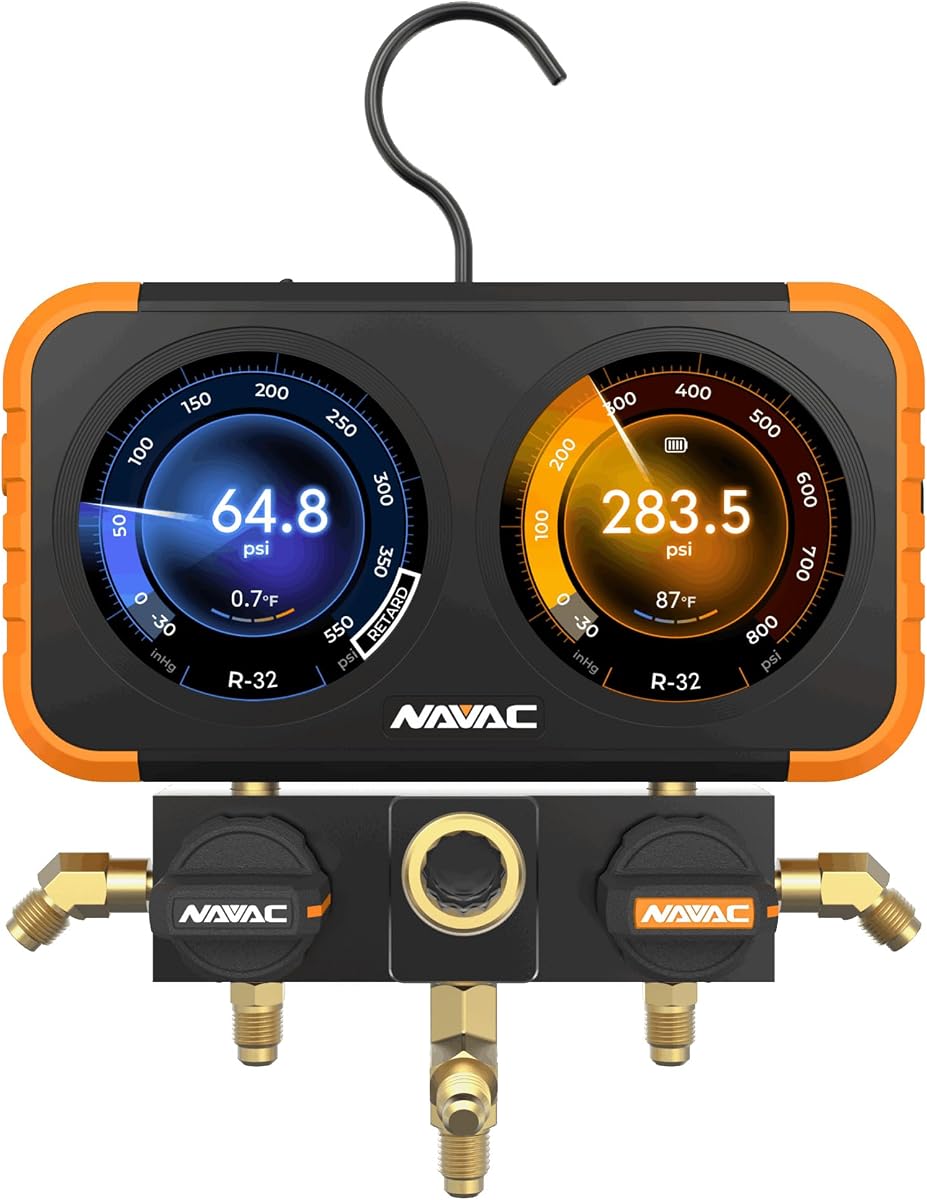
The NAVAC N2DX Flex-X prioritizes a rugged, easy-to-operate design with a full-color HD display and one-knob control. It has a 4.3 rating, supports 72 refrigerants including A2L types, and offers Class 0.4 accuracy. For technicians who prefer a modern interface over a dense traditional keypad, its animated graphics and visual controls are a notable feature.
We may earn a commission when you buy through this link, at no additional cost to you.
The physical design is built for field work. It uses a durable aluminum body, an IP54 protective cover, a compact foldable hook, and an included protective carry case. Its rechargeable lithium battery is rated for up to 100 hours and charges through USB-C, removing the need for routine disposable-battery replacement.
The main limitation is refrigerant breadth. Seventy-two refrigerants may cover many common systems, but it trails the 93-refrigerant and 113-refrigerant databases offered by two other selections. The supplied specifications also omit temperature range, temperature accuracy, pressure limits, probe quantity, hose inclusion, and data-export capabilities, so buyers must verify the package carefully.
The Flex-X is a strong fit for technicians who value a readable display, simple one-knob operation, rechargeable power, and a durable body. It is less compelling for a shop needing a very large refrigerant database or a fully documented mobile workflow. Confirm the exact hose, clamp, adapter, and carrying accessories included with the current listing.
The full-color display, graphics, animations, and one-knob control can reduce menu navigation. This approach may be especially approachable for newer technicians while still giving experienced users quick access to common operating functions.
Aluminum construction, an IP54 cover, a foldable hook, and a compact case make the Flex-X oriented toward transport and field handling. The protective cover should remain properly installed during demanding work to help preserve the instrument against dust and incidental moisture exposure.
We may earn a commission when you buy through this link, at no additional cost to you.
The AUTOOL LM150 has a 5.0 customer rating, the highest numerical score in the guide. It offers dual pressure and dual temperature measurement, a 93-refrigerant database, and automatic superheat and subcooling calculations. Two clamp thermometers and three hoses make it a practical combined charging and diagnostic package.
We may earn a commission when you buy through this link, at no additional cost to you.
Its most approachable feature is one-touch manual zeroing at startup. Correcting sensor drift to a zero point can improve confidence in subsequent pressure readings. The built-in leak-test mode records the starting pressure, live pressure, pressure differential, and test duration, providing more useful evidence than a momentary pressure display alone.
Pressure accuracy is stated as ±0.5% full scale, and the overload capacity is 100 bar. The included hoses are rated at 41.3 bar, which is substantially below the gauge overload limit; users must therefore verify hose suitability for the actual test pressure. The listing also does not specify battery type, temperature accuracy, or connectivity.
The LM150 is well suited to technicians who prioritize an intuitive zeroing procedure, a straightforward leak-test timer, broad refrigerant support, and a three-year warranty. It lacks the documented wireless probes, mobile app, and data logging of the premium models, but it covers the core tasks with a straightforward layout. Confirm connector sizing and pressure requirements before charging a system.
A single-button zero operation creates a clean baseline before connecting the gauge. Technicians should allow the instrument to stabilize as directed and repeat the zero procedure whenever prompted or after a substantial change in conditions.
Recording the initial pressure, live value, differential, and duration makes slow leaks easier to evaluate. The result should still be interpreted alongside temperature stabilization and the manufacturer’s recommended pressure-holding procedure for the refrigerant and system involved.
We may earn a commission when you buy through this link, at no additional cost to you.
Choosing a digital manifold gauge set requires balancing refrigerant coverage, documented accuracy, diagnostic functions, included hardware, and the connectivity level that suits your service workflow. The most important starting point is the equipment and refrigerants you actually service.
A refrigerant database determines the saturation pressure and temperature references used for superheat, subcooling, charging, and other calculations. A broad list can simplify mixed-service work, but the number alone is not enough. Confirm that the refrigerants common in your region are represented and that A2L models such as R32 are supported when relevant.
Choose a database broad enough for your current and anticipated service mix rather than simply the largest number available.
Accuracy specifications should be checked for both pressure and temperature. Full-scale pressure accuracy and temperature precision give a more meaningful comparison than vague claims about digital sensors. Also examine maximum overload, vacuum capability, and the working pressure of any included hoses, because those values are not interchangeable.
Prioritize documented accuracy and a pressure range suited to the systems you diagnose, then confirm that the hoses are rated appropriately.
Temperature clamps allow the gauge to calculate superheat and subcooling from live pipe readings. Wired probes are dependable and straightforward, while wireless probes reduce cable clutter and can improve positioning around pipes and service points. Check whether the probes are included, whether they are calibrated or paired automatically, and what battery maintenance they require.
Choose the probe style that balances positioning freedom with reliable connectivity and simple charging.
A service-ready gauge should support the tasks encountered during installation, maintenance, charging, recovery, evacuation, and leak testing. Vacuum measurement, temperature compensation, and a pressure-holding timer are more valuable than a long collection of secondary functions. Confirm whether the unit measures true vacuum, records test duration, and calculates pressure differentials.
Favor core diagnostic functions that match your actual service process over numerous modes you are unlikely to use.
The included charging set should have the correct connector sizes, refrigerant ratings, and working pressures for your equipment. Look for color-coded hoses, locking valves, durable fittings, and adequate burst ratings. A packaged R410A adapter is useful, but adapters are not substitutes for checking every fitting before attaching a hose to a system.
Match hose pressure ratings, connector sizes, and adapter needs to the systems and service standards used in your area.
Power management affects whether a gauge is ready when a service call begins. Rechargeable models with USB-C are convenient for daily use, while replaceable cells simplify longevity. Disposable-battery gauges can be dependable but should be stocked with spares. A carry case, compact body, and secure back hook make transport and hands-free positioning easier.
Choose a power system and carrying design that suit the length of your workday and the amount of equipment you move between sites.
Bluetooth and app-based gauges can support remote readings, visualized service records, calculated results, and easier documentation. These features are most valuable to shops that need consistent reporting or technicians who want less manual data entry. They also introduce dependencies involving compatible devices, software, wireless range, and probe batteries.
Use connected features when documentation and remote operation materially improve your workflow; otherwise, a dependable standalone gauge may be sufficient.
A large, backlit display is important in mechanical rooms, attics, and outdoor service. Consider whether high and low pressure, both temperatures, vacuum, and calculation results can be viewed without excessive menu navigation. A one-knob interface may speed operation, while a color screen can make warnings and trends easier to interpret.
Choose a display that remains readable in poor light and presents the measurements you need during active service.
Begin by inspecting the gauge, probes, hoses, valves, adapters, and connectors for visible damage. Confirm the refrigerant, fitting size, hose working pressure, and system requirements before connecting anything. Install the batteries or charging the unit according to its instructions, allow the display to stabilize, and perform the specified zeroing procedure before taking readings.
Connect the gauge to the appropriate system ports and attach the temperature clamps to the required pipe locations. Select the correct refrigerant and confirm the displayed pressure units, temperature units, and operating mode. For superheat and subcooling, use the correct reference points and take measurements at a stable operating condition rather than during rapid system startup or recovery.
For a leak or pressure-holding test, follow the system manufacturer’s required procedure, record the starting conditions, and monitor the gauge for the specified duration. Afterward, close and disconnect valves properly, depressurize lines as required, cap or protect connections, and clean any oil or moisture from the equipment. Store the gauge in its case with probes and hoses arranged to prevent kinks, impacts, and pinches.
A digital manifold gauge set measures refrigerant-side pressure and pipe temperature while supporting tasks such as charging, recovery, evacuation, and leak testing. Many models also calculate superheat and subcooling using a built-in refrigerant database. This replaces much of the manual chart lookup and calculation associated with analog gauges.
Temperature clamps are needed for accurate live pipe-temperature measurements and most superheat or subcooling calculations. Without probes, a digital manifold can still be useful for pressure, vacuum, and pressure-holding work. Confirm whether clamps are included because some listings feature them while others treat them as optional accessories.
The right number depends on the systems you service. A broad database is useful when handling residential, commercial, automotive, legacy, and A2L refrigerants. Rather than focusing only on the count, verify that the exact refrigerants in your workload are covered and that the instrument recognizes them correctly.
A Bluetooth model can be worthwhile when remote probe operation, phone-based calculations, service records, or digital documentation are important to your workflow. It can reduce cable clutter and simplify reporting. However, app compatibility, device support, wireless reliability, and probe charging add considerations that a standalone gauge avoids.
The correct range should match the equipment and refrigerants you diagnose, with safe headroom for normal operating and test pressures. Pay attention to vacuum capability if performing evacuation and to maximum overload when comparing specifications. Always follow the working-pressure rating of the included hoses rather than relying on the gauge’s overload limit.
Store it in a dry, temperature-appropriate case with the display protected and hoses loosely arranged. Remove batteries from a non-rechargeable model during long storage, and recharge rechargeable models according to the manufacturer’s instructions. Keep probes dry, connectors capped, and the unit away from impact, excessive heat, and moisture.
Many digital gauges can record pressure changes over time, calculate a pressure differential, or operate a vacuum test, but these functions support rather than replace a complete leak-detection process. A technician should use the proper test procedure, allow temperatures to stabilize, and use additional methods when a small or intermittent leak is suspected.
Follow the manufacturer’s instructions, but many digital gauges benefit from a startup zero procedure to remove sensor offset or drift. The AUTOOL LM150 specifically offers one-touch zeroing, while other models may use a menu-based method. Zero before connecting to a system and repeat when instructed or when readings appear questionable.
The Elitech DMG-2SE is the strongest budget-oriented choice, combining 88-refrigerant support with hoses and R410A adapters in a compact package. The Fieldpiece SM382V is the editor’s choice for advanced professional work because of its vacuum gauge, wireless probe expansion, data logging, and temperature-compensated tightness testing. The testo 550s is the premium selection, with wireless probes, Bluetooth operation, and Smart App documentation.
For most buyers, begin with the refrigerants, measurements, and workflow you use every day. A complete hose-and-probe package may matter more than a slightly longer database, while app connectivity is most useful when it solves a genuine documentation problem. Always verify probe inclusion, battery requirements, accuracy, pressure limits, adapters, and warranty terms before ordering.
Product packages and availability can change over time, and pricing also varies between sellers. Review the current listing and manufacturer instructions, compare the included accessories, and confirm that the gauge is appropriate for the specific refrigerant and service procedure you will perform.
