
MZEIBO 50W Smart TV Sound Bar
4.4Editor score
50W audio output
Bluetooth 5.3 connectivity
Three tailored sound modes
A Bluetooth soundbar for your phone can turn everyday listening into a much more immersive experience, whether you are streaming music, watching videos, joining calls, or playing mobile games. The best model balances clear sound, convenient wireless pairing, and a compact design that works well on a desk, shelf, or entertainment console.
This guide compares 10 soundbars based on the information supplied for each product, including Bluetooth support, wired connection options, output, speaker configuration, equalizer controls, dialogue features, dimensions, and room-filling technologies. The list covers compact budget models, app-controlled systems, established TV soundbars, and premium home-theater options.
Each review explains the product's most useful features, practical limitations, and ideal buyer. The leading choices vary by need: one prioritizes balanced everyday performance, another offers extensive sound customization, and the premium option delivers the most advanced cinema features. Product availability and prices can change, so check current listings before purchasing.
4.4Editor score

4.2Editor score

4.5Editor score
As an Amazon Associate we earn from qualifying purchases.
This side-by-side comparison highlights the principal differences in phone connectivity, audio configuration, sound customization, physical size, and room-filling capabilities across all 10 products.



This 2-in-1 detachable soundbar has a 4.1 rating and stands out through its unusual flexibility. Rated at 80W and powered by four high-performance drivers, it combines Bluetooth 5.0 with ARC, optical, and AUX connections. That makes it equally suitable for a phone, computer, television, gaming setup, or projector.
We may earn a commission when you buy through this link, at no additional cost to you.
Its most distinctive feature is the ability to use the enclosure in horizontal, vertical, tabletop, or wall-mounted configurations. The supplied information specifically highlights horizontal placement for distortion-free audio, vertical placement for room-filling sound, tabletop use for clarity, and wall mounting for a cinematic presentation. Automatic volume boost is also useful when source audio is played quietly.
Three equalizer modes—movie, music, and news—make it adaptable without complicated setup. The trade-offs are that Bluetooth 5.0 is an older standard, and there is no specified subwoofer output. It also lacks the app-based fine-tuning and advanced spatial processing found in higher-end models, so listeners seeking deep customization may prefer another option.
This is an appealing choice for renters, students, gamers, and anyone who wants one speaker to serve both phone music and television audio. Its detachable construction, broad input selection, and strong output justify its place at the top for versatility, particularly if the ability to reposition the system matters more than app control or object-based audio.
The detachable, four-way placement design is unusually practical. You can move the speakers as needed, experiment with tabletop and wall-mounted positions, and tailor the apparent sound coverage to the room rather than accepting one fixed configuration.
Movie, music, and news presets cover the most common listening situations. Combined with automatic volume boost, these controls make the system practical for sources that vary considerably in loudness.
We may earn a commission when you buy through this link, at no additional cost to you.
The Saiyin 11.7-inch sound bar pairs a notably compact enclosure with 48W of peak power. It is designed for phones, computers, and televisions, with Bluetooth, optical, and 3.5mm AUX connections. A dedicated subwoofer output gives buyers an optional path to stronger bass without replacing the whole system.
We may earn a commission when you buy through this link, at no additional cost to you.
The center-channel-oriented design is intended to provide balanced sound with tuned bass and treble rather than exaggerated highs or muddy low frequencies. Soft side indicators help avoid distracting light during viewing, while standby mode keeps the unit ready for use. The package also includes a remote, power adapter, AUX and optical cables, and wall-mounting hardware.
The important setup caveat is that the source must use a standard PCM, stereo, or non-surround signal. The supplied instructions specifically warn that an unsuitable digital output setting may produce cracking or no sound. There is also no app mentioned, and an active subwoofer must be purchased separately for the lowest-frequency upgrade.
The Saiyin is an excellent fit for a small apartment, dorm, office, or compact TV stand where every inch matters. It offers better bass-expansion potential than many similarly sized competitors, broad compatibility with streaming-device remotes, and a straightforward way to improve phone and television audio.
At 11.7 inches wide, the sound bar can sit beneath a display or on a narrow shelf. Its sub-out jack also means you do not have to settle for the built-in low-frequency response if you later decide to add an active subwoofer.
The system supports remotes from Fire TV, Fire TV Cube, Roku boxes or Roku TVs when suitable remotes are requested, Google Chromecast, and Apple TV. Check the exact device and remote combination before purchasing, as compatibility is not universal across every streaming stick.
We may earn a commission when you buy through this link, at no additional cost to you.
The ULTIMEA 2.1ch soundbar combines dual speakers, a three-inch subwoofer, and side-firing bass ports in one compact enclosure. Its 4.2 rating reflects a generally positive reception, while the built-in low-frequency hardware differentiates it from conventional 2.0-channel compact systems.
We may earn a commission when you buy through this link, at no additional cost to you.
App control is the centerpiece. The Ultimea app provides six tailored modes, a 10-band equalizer, adjustable bass, and 121 preset matrices divided among bass, pop, classical, and rock preferences. Regular over-the-air updates are also specified, making this a more adjustable option for listeners who enjoy changing settings to match music, games, or films.
Connectivity is comprehensive, with optical, AUX, Bluetooth 5.4, and USB inputs. The sub-out port allows another powered subwoofer to be added, although the built-in subwoofer already provides a meaningful bass foundation. Compared with simpler bars, the app introduces another device and setup step, and the product does not claim Dolby Atmos or a dedicated height channel.
Choose this model for phone listeners who want more control than a standard movie or music preset can offer. It is also strong for gamers, music fans, and owners of small home-theater systems who appreciate a 2.1-channel design without needing a separate subwoofer.
A 10-band equalizer and extensive matrix library provide much more control than the three-mode setup found on many compact soundbars. Users can move from restrained dialogue to energetic music while retaining bass adjustment for the room.
Bluetooth 5.4 offers current wireless performance, while optical, AUX, and USB inputs cover TVs, computers, and other sources. The additional sub-out connection preserves flexibility if stronger bass is needed later.
We may earn a commission when you buy through this link, at no additional cost to you.
The Amazon Fire TV Soundbar has a 4.3 rating and focuses on a strong combination of simple setup, TV-oriented sound, and wireless phone playback. Its dual speakers are designed to improve dialogue clarity, fuller low end, and overall volume compared with the built-in audio found in many televisions.
We may earn a commission when you buy through this link, at no additional cost to you.
DTS Virtual:X creates a three-dimensional virtual surround effect, while Dolby Audio adds another layer of processing. Setup is streamlined through the included HDMI cable and a compatible television's HDMI eARC or ARC port. The bar is also designed and tested to work smoothly with Fire TV, allowing one remote to control both television and soundbar functions.
Bluetooth connectivity lets a phone or tablet become a music source, which makes the product more versatile than a TV-only bar. The trade-off is its 2.0-speaker configuration, which cannot match the built-in subwoofer and processing of the ULTIMEA or JBL options. Its 24-inch width is also less compact than the Saiyin, LARKSOUND, and 17-inch alternatives.
This is a particularly attractive choice for Amazon-based households and anyone who wants a simple, recognizable ecosystem with strong virtual-surround processing. Phone users get a dependable Bluetooth route for music and podcasts, while TV viewers benefit from easier control and synchronized cinematic audio.
DTS Virtual:X and Dolby Audio are designed to make a slim two-speaker enclosure feel more dimensional. The result is particularly useful for films and television, where wider effects and clearer dialogue can create a more convincing presentation.
The soundbar was designed and tested for Fire TV operation. That focus makes it a natural fit for users who want the soundbar, streaming device, and television to function together with minimal operating complexity.
We may earn a commission when you buy through this link, at no additional cost to you.
The Sony S100F has a 4.2 rating and provides a balanced combination of compact proportions, clear dialogue, and straightforward wireless playback. Its two-channel system includes a built-in tweeter, a Bass Reflex speaker, and S-Force Pro Front Surround for a wider presentation than the basic dimensions might suggest.
We may earn a commission when you buy through this link, at no additional cost to you.
Voice enhancement is one of the most important features for phone users who regularly watch spoken content. It is designed to improve quiet dialogue and also helps make conference-call participants easier to hear. Bluetooth adds convenient access to music and other audio from a phone, while HDMI ARC offers a simple television connection.
The unit is slim enough for smaller living spaces and can be placed on a stand or mounted to a wall using the included template. Its limitations are modest customization and the lack of a stated subwoofer output. It also does not offer app-based equalization, height channels, or the advanced room analysis found in the JBL model.
For most buyers, the S100F offers the most balanced package in this guide: recognizable brand, useful dialogue processing, bass support, virtual surround, and uncomplicated phone pairing. It is a strong recommendation for small rooms, home offices, secondary TVs, and listeners who value clarity over extensive controls.
The voice-enhancement feature is useful for movies, news, podcasts, and conference calls. It can make speech easier to distinguish without requiring the user to switch among complicated surround or gaming profiles.
A slim body, wall-mount template, and simple source controls make this model easy to integrate into a compact entertainment area. It can serve a phone, television, or computer without requiring a large installation.
We may earn a commission when you buy through this link, at no additional cost to you.
The Bose TV Speaker carries a 4.3 rating and is built around a clear objective: making television audio and spoken content easier to understand. Two angled full-range drivers create a wider, more natural sound field, while the tuning specifically focuses on vocals and pronunciation.
We may earn a commission when you buy through this link, at no additional cost to you.
Bluetooth allows a phone to stream music or podcasts wirelessly. For wired sources, HDMI, optical, and AUX inputs are provided, and the first powered device can connect automatically. The included remote adds a dialogue mode and bass boost, making it easy to adjust the most important characteristics without navigating a complex menu.
The enclosure stands just over two inches tall and can sit in front of a television or be wall-mounted with separately sold brackets. It can also work with the Bose Bass Module 500 or 700 using the appropriate connection cable, though those modules are not included. That expansion path is useful, but the standard configuration remains a straightforward 2.0-channel system.
This Bose is a strong recommendation for viewers and phone users who place a high priority on intelligible speech. It suits conference calls, news, podcasts, and films where voices matter, while its compact footprint and optional bass expansion keep it relevant for both small and medium rooms.
The angled drivers and dedicated dialogue mode work together to improve vocal clarity. This is especially useful when a phone is used for calls or when streamed programs mix quiet speech with louder background effects.
The speaker can operate as a complete compact system or connect to a compatible Bose Bass Module. The required module and connection cable are separate purchases, so budget for them only if deeper low-frequency impact is important.
We may earn a commission when you buy through this link, at no additional cost to you.
The RIOWOIS 17-inch sound bar has a 4.1 rating and emphasizes clear dialogue, flexible placement, and uncomplicated operation. Its DSP system provides movie, music, and news presets, allowing the same compact speaker to handle cinematic content, phone playlists, and spoken programming.
We may earn a commission when you buy through this link, at no additional cost to you.
At a little over 2.5 inches high, the bar is designed to avoid blocking a television's lower edge or infrared remote sensor. It can sit in front of a display or be mounted on a wall. Installation instructions are included, and the product supports Fire TV remotes, with suitable Roku box or Roku TV remotes available by request.
The product information does not identify a Bluetooth version, app support, advanced codec decoding, or a subwoofer output, so buyers should not expect the same customization found with the ULTIMEA or JBL. Its strongest advantages are its easy setup, selectable sound profiles, and approachable physical design.
This model is best for a user who wants a straightforward soundbar to improve a television and provide phone music without navigating complicated software. Its long after-sales support and replacement policy for accessories also make it a reassuring choice for buyers who value ongoing assistance.
The three DSP profiles adapt the presentation to movies, music, and news. While less granular than a multi-band equalizer, they cover the situations most listeners need and reduce setup time.
The low-profile body is intended to fit below a television without obstructing the bottom edge or IR sensor. Wall mounting provides another way to keep the viewing area uncluttered.
We may earn a commission when you buy through this link, at no additional cost to you.
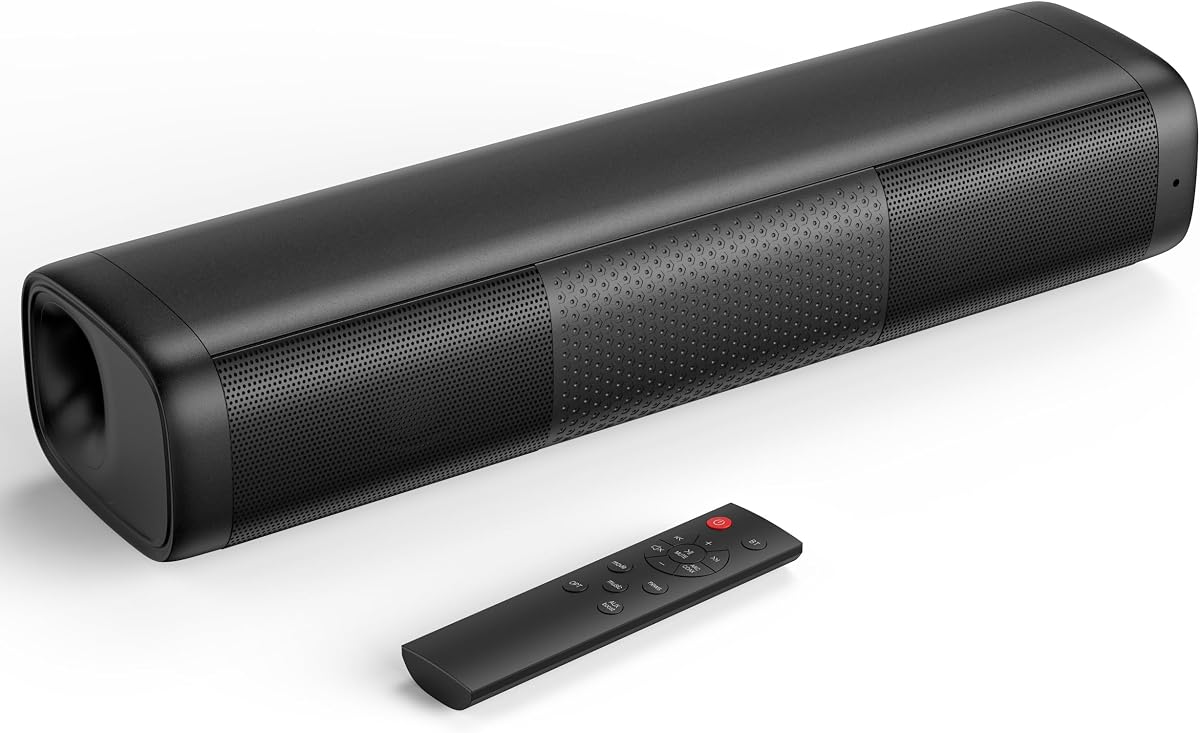
The MZEIBO 50W sound bar has a 4.4 rating, the highest among the compact and midrange options in this roundup. It combines four speakers and a built-in bass system with 50W of output, aiming to deliver a lively presentation for music, films, gaming, streaming, and video calls.
We may earn a commission when you buy through this link, at no additional cost to you.
Bluetooth 5.3 provides a current wireless standard for phone and tablet streaming, while HDMI ARC, optical, and AUX connections cover televisions, laptops, projectors, and other sources. Music, movie, and news modes allow quick adjustments depending on the content being played.
The 17-inch enclosure is designed to fit on a desk or shelf, which makes it particularly useful in a home office, study area, or small apartment. Its limitations are the lack of app-based equalization, a specified subwoofer output, and more advanced spatial-audio processing. It is better viewed as a powerful all-purpose speaker than a home-theater system.
Among non-premium choices, this is a particularly strong recommendation because it balances output, compact size, modern Bluetooth, and broad wired connectivity. Phone users who want more volume and bass than a portable speaker provides will appreciate the 50W system, while the straightforward presets keep daily operation simple.
Four speakers and a built-in bass system give the bar more visual and acoustic presence than a basic desktop speaker. The 17-inch format keeps it manageable while supporting music and gaming at higher levels.
Bluetooth 5.3 serves phones and tablets, while HDMI ARC, optical, and AUX cover common television and projector arrangements. This flexibility makes switching between mobile media and a larger display straightforward.
We may earn a commission when you buy through this link, at no additional cost to you.
The LARKSOUND mini soundbar has a 4 rating and focuses on a remarkably small footprint. Measuring 16 inches long and roughly the width of a keyboard, it is designed for PCs, gaming areas, compact televisions, and other spaces where a traditional soundbar would be intrusive.
We may earn a commission when you buy through this link, at no additional cost to you.
Four listening modes—music, movie, voice, and normal—cover common content, while the special Night Mode can immediately reduce volume by 50 percent. That feature is useful late at night or when other household members are sleeping. Bluetooth 5.0 supports wireless streaming with a stated transmission range of up to 33 feet.
USB, AUX, HDMI, and optical connections give the unit more source flexibility than its small size suggests. HDMI ARC can also allow TV-remote volume control. The package includes a remote, optical cable, AUX cable, wall-mounting kit, and template, although an HDMI cable must be purchased separately if needed.
The lower rating means the LARKSOUND may not satisfy every listener, particularly those seeking advanced surround processing or deep, controlled bass. Even so, it is a practical choice for a phone-first user who wants a dedicated speaker at a desk or needs a night-friendly volume reduction without leaving the couch.
The dedicated night mode immediately lowers the volume by 50 percent. It is a simple but meaningful feature for shared rooms, bedrooms, and homes where background noise needs to remain controlled.
Bluetooth, USB, AUX, HDMI, and optical inputs make the mini enclosure useful beyond a single phone. The low-profile body and included mounting hardware also help it fit into a computer or gaming setup.
We may earn a commission when you buy through this link, at no additional cost to you.
The JBL Bar 300MK2 has a 4.5 rating, the highest in the roundup, and represents the premium end of the selection. Its five-channel all-in-one system delivers 450W of maximum output, built-in bass ports, Dolby Atmos, and MultiBeam 3.0 without requiring a separate subwoofer.
We may earn a commission when you buy through this link, at no additional cost to you.
PureVoice 2.0 automatically raises or optimizes dialogue based on scene ambience and overall volume. This is particularly valuable for movies, but it also helps podcasts, broadcasts, and spoken content played through a phone. The JBL ONE app provides precise equalization, setup assistance, music-app browsing, and software upgrades.
Streaming support includes AirPlay, Google Cast, Spotify Connect, Tidal Connect, and Roon Ready. HDMI eARC supports uncompressed Dolby Atmos and 4K Dolby Vision passthrough from compatible devices. The soundbar can also link with voice-assistant-enabled speakers for hands-free control. Automatic calibration analyzes reflections from walls and furniture to tune the presentation for the room.
This is the most complete choice for a large television, dedicated home theater, or connected entertainment system. It is overkill for a small desk and depends on compatible source equipment for some of its headline features. For users who want advanced spatial audio, intelligent dialogue handling, extensive streaming options, and room-aware setup, it is the most ambitious recommendation here.
Dolby Atmos and MultiBeam 3.0 create a wide, dimensional soundstage, while built-in bass ports supply impact without a separate subwoofer. The result is designed for larger screens and rooms where dialogue, music, and effects can occupy distinct layers.
The calibration process accounts for reflections from walls and furniture. This helps the soundbar reproduce its intended effects more accurately than a fixed setup, making the feature especially useful in rooms with challenging reflective surfaces.
The JBL ONE app centralizes equalizer controls, setup, streaming applications, and software updates. It also supports widely used wireless platforms, making the soundbar practical for listeners who move between television content and phone-based music.
We may earn a commission when you buy through this link, at no additional cost to you.
The right Bluetooth soundbar for a phone depends on how you listen, where the speaker will sit, and how much control you want. Output, wireless standards, dialogue processing, input options, and room scale are the most important factors to compare.
Begin by confirming that the soundbar supports Bluetooth streaming from the phone you own and want to use. All ten products include Bluetooth support, but they use different standards, from Bluetooth 5.0 to Bluetooth 5.4. A newer version can provide a more up-to-date wireless foundation, while every listed option supports the basic task of playing phone audio wirelessly. Consider whether automatic reconnection, Bluetooth 5.4, or a separately stated transmission range is important to your routine.
In short, verify Bluetooth compatibility first, then decide whether the newest available version adds meaningful value for your particular setup.
Output power alone does not determine sound quality, but it provides a useful indication of how loudly and confidently a system can play music, films, or games. The list ranges from compact products without a stated wattage to the Saiyin's 48W peak power, the detachable model's 80W output, the MZEIBO's 50W system, and the JBL's 450W maximum output. Built-in subwoofers, tweeters, and multiple drivers can also affect bass, clarity, and spatial presentation.
Prioritize the driver and channel configuration rather than looking only at the largest number, and make sure the product is physically large enough to sound powerful in your intended room.
Phone listeners use soundbars for more than music. Video calls, podcasts, news, audiobooks, and streaming video all benefit from intelligible speech. The Sony offers voice enhancement, the Bose includes a dedicated dialogue mode, and the JBL uses PureVoice 2.0 to optimize dialogue automatically. Other models provide voice or news presets that may perform a similar role in a simpler form.
Choose a dedicated dialogue feature when speech is a frequent priority; choose broader equalization when you also want to shape music and cinematic effects yourself.
A simple preset system is convenient when you want to switch quickly between music, movies, and news. More advanced equalization is useful when your room, phone content, or personal preferences require finer changes. The ULTIMEA provides a 10-band equalizer, 121 preset matrices, six tailored modes, and app-based adjustments, while the JBL adds precise equalization through the JBL ONE app. The LARKSOUND, MZEIBO, and RIOWOIS rely primarily on built-in modes.
Think about whether you value immediate simplicity or deeper customization, and account for the extra setup and app involvement that advanced control generally requires.
The physical scale of the soundbar affects both placement and expected performance. The Saiyin is only 11.7 inches wide, the LARKSOUND is approximately keyboard-sized, and the MZEIBO and RIOWOIS use 17-inch designs. Larger systems may provide more internal volume and drivers, while the JBL is built for a more expansive home-theater presentation. Wall mounting is supported or mentioned for several models, and compact bodies are especially useful on desks and narrow shelves.
Measure the intended area before ordering, leave room for cables, and choose a size you will actually be willing to position rather than one that merely looks impressive in a listing.
Bluetooth is convenient, but a stable wired connection remains important for television viewing and lossless audio where supported by the source. Look for HDMI ARC, optical, AUX, and USB according to the devices you own. ARC or HDMI eARC can also provide convenient volume control through a television remote. The Amazon Fire TV Soundbar and Sony are particularly focused on television integration, while several budget models provide a broader mixture of wired inputs.
Match the available port to your source, and check whether the necessary cable is included before purchase; several systems do not include every cable that may be required.
Virtual surround processing can make a compact speaker feel wider and more cinematic without adding separate rear speakers. The JBL adds Dolby Atmos, MultiBeam 3.0, and a five-channel arrangement, while the Amazon Fire TV Soundbar uses DTS Virtual:X and Dolby Audio. The Sony provides S-Force Pro Front Surround, and the ULTIMEA uses side-firing bass ports to expand its 2.1-channel presentation. These technologies can be impressive, but source content and room acoustics still influence the result.
Choose advanced processing when a large display and cinematic content are central to the system; prioritize clear dialogue and simple phone streaming when your use is more casual.
Built-in bass can be sufficient for a desk or moderately sized living room, but a subwoofer output creates an upgrade path for deeper impact. The Saiyin and ULTIMEA both include a dedicated SUB OUT for a powered subwoofer, and the Bose is compatible with Bose Bass Module 500 or 700 units. Most of the remaining products rely on their built-in drivers and bass systems. Note that an active subwoofer and any required connection cable are generally separate purchases.
Check for a sub-out connection if movie action and deep bass matter, but confirm that you are prepared to purchase the additional subwoofer and manage another component.
Begin by placing the soundbar on a stable surface or using the supplied mounting hardware where appropriate. Keep it near the intended listening area, leave access to its rear connections, and avoid blocking ventilation openings. Connect power, select the correct input, and consult the quick-start guide before changing television audio settings.
For Bluetooth playback, put the soundbar into pairing mode using its controls, open Bluetooth settings on the phone, and select the speaker from the available-device list. Once connected, adjust the phone's media volume and use the soundbar's own volume or remote where available. For a wired television source, set the television to output audio through the soundbar and use PCM, stereo, or non-surround mode when required by the product instructions.
To keep the system working well, clean the grille gently with a soft dry cloth, keep liquids away from the openings, and avoid placing the unit in direct sunlight or near excessive heat. Do not push objects into the ports, and check that cables are not pinched. Periodically review the app and firmware updates when applicable, and use the supplied or correctly specified cables to maintain reliable connections.
Yes, and several options in this guide are well suited to that role. The MZEIBO combines Bluetooth 5.3, four speakers, 50W output, and a built-in bass system, while the JBL offers the most advanced sound and streaming features. The compact Saiyin and LARKSOUND are better for desks and smaller spaces, and the Bose is especially useful when you also value speech clarity.
Not always. Bluetooth introduces wireless compression and can be affected by interference, while a wired digital connection may preserve more source detail. For casual phone listening, modern Bluetooth is usually convenient and sufficient. For television movies with high-quality audio, HDMI ARC, HDMI eARC, or optical can provide a more direct path when the source and soundbar support it.
The Saiyin is the most compact option listed at 11.7 inches wide and 2.5 inches high. The LARKSOUND is also designed around a keyboard-sized footprint, while the MZEIBO uses a 17-inch body. Sony and Bose are similarly oriented toward smaller spaces, whereas the JBL is intended for a more expansive home-theater environment.
The Bose TV Speaker places the strongest emphasis on vocals and pronunciation, with a dedicated dialogue mode on its remote. The Sony offers voice enhancement, while the JBL uses PureVoice 2.0 to optimize dialogue based on ambient conditions and volume. If you also want to control music equalization, the ULTIMEA provides a dedicated 10-band app equalizer and voice mode.
Yes. The Saiyin and ULTIMEA include dedicated subwoofer outputs for compatible powered subwoofers. The Bose TV Speaker can also work with the Bose Bass Module 500 or 700 using the appropriate cable. These add-ons are not included and should be considered separate purchases. Most other models rely entirely on their built-in bass systems.
The source device may be sending an incompatible digital audio format. The Saiyin instructions specifically call for changing the television output to optical and using PCM, stereo, or non-surround audio. Confirm the selected output, reconnect the cable, and lower both device volumes before troubleshooting further. Other models can have similar format requirements, so their setup instructions are worth checking.
Most can serve as the central speaker in a television or gaming setup, and the JBL provides the most extensive home-theater technology with Dolby Atmos, MultiBeam 3.0, HDMI eARC, and 4K Dolby Vision passthrough. The ULTIMEA and detachable model also support gaming and projector use. Additional rear channels or a separate subwoofer are not included unless specifically noted.
No. Higher output can provide more volume and impact, but sound quality also depends on driver design, tuning, enclosure size, processing, and room characteristics. A smaller bar with strong dialogue tuning may be more satisfying for podcasts than a powerful model intended for cinema. Consider your content, room, and preferred amount of control before focusing on output alone.
The Sony S100F is the most balanced overall recommendation because it combines slim proportions, clear voice enhancement, Bluetooth, bass support, and front virtual surround in an uncomplicated package. The MZEIBO stands out among budget-oriented options with its 4.4 rating, 50W output, modern Bluetooth 5.3, and four-speaker design. For buyers seeking the highest level of cinema technology, the JBL Bar 300MK2 offers Dolby Atmos, automatic calibration, extensive streaming support, and intelligent dialogue processing.
Prioritize the features that match your actual use. Phone-only listeners may need little more than stable Bluetooth, clear sound, and a suitable size. A mixed television and mobile setup benefits from ARC or optical connectivity and remote control, while movie enthusiasts should examine surround processing, subwoofer expansion, and room size. App-based equalization is worth prioritizing only if you enjoy adjusting the sound for different music, games, and spoken content.
Before purchasing, verify the dimensions, required input, included accessories, and source-device compatibility. Ratings and features provide a useful starting point, but the soundbar should also fit your room and support the content you actually use. Product availability, configurations, and prices can change, so confirm the current listing and included components at the time of purchase.