
HQST 100W 12V Solar Panel
4.8Editor score
Compact 31.8-inch square design
23% conversion efficiency
Grade A+ 166mm cells
This guide compares 100 Watt 12 Volt Monocrystalline Solar Panels by efficiency, durability, installation, warranties, and uses for RVs, boats, cabins, and
A 100-watt monocrystalline solar panel offers a practical balance of usable charging capacity, manageable dimensions, and straightforward installation for 12-volt systems. The best option depends on cell technology, weather resistance, connector design, mounting flexibility, and long-term output guarantees rather than headline efficiency alone.
This guide compares ten panels using the information supplied for each product, including conversion efficiency, cell and busbar construction, environmental ratings, installation features, low-light behavior, warranty coverage, and intended applications. It also distinguishes single panels from multipack options and highlights models designed for 12-volt, 24-volt, or dual-voltage systems.
The featured selections range from compact panels for RVs and camper vans to broader modules for rooftops, boats, cabins, farms, and remote installations. Each review explains who benefits from its particular design, while noting trade-offs such as included cable length, mounting complexity, certification, or the need for additional charge-control equipment. Prices and availability can change.
4.8Editor score

4.9Editor score

4.4Editor score
The table below compares all ten panels across the most important practical factors: cell efficiency, busbar configuration, environmental protection, and installation details. It is intended to help readers identify a suitable balance of output, durability, physical footprint, and system compatibility.


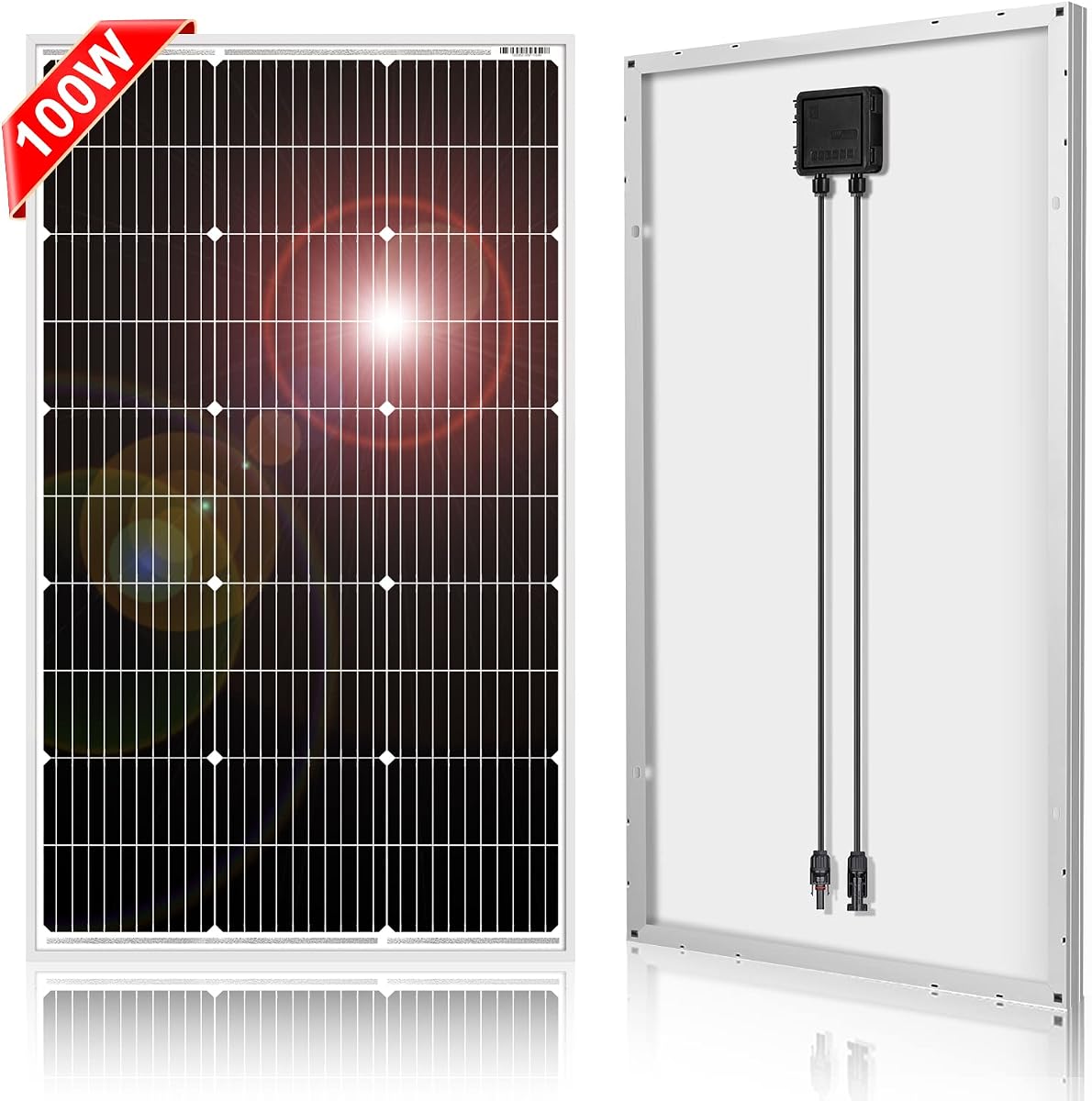


The JJN 100 Watt Solar Panels combine a 12-volt monocrystalline design with a stated 23% conversion rate and a customer rating of 4.6. Its defining strength is broad suitability: the listing identifies residential rooftops, RVs, boats, and other off-grid systems as viable installations. Pre-drilled mounting holes make it approachable for both permanent and portable arrangements.
We may earn a commission when you buy through this link, at no additional cost to you.
The panel uses Grade A+ monocrystalline cells with 10BB technology, a configuration intended to improve current collection and support consistent output. JJN states that it can generate up to 500Wh per day under five hours of direct sunlight. That figure represents ideal operating conditions rather than guaranteed daily production, so orientation, weather, shading, and system losses remain important.
Outdoor protection is another strength. The black aluminum frame is rated for 2,100Pa wind loads and 5,100Pa snow loads, while the IP65 junction box and IP67 connectors provide ingress protection. A potential limitation is that the stated 23% efficiency trails several N-type and PERC-based alternatives in this comparison, although the difference may not dominate a well-designed installation.
This is a strong recommendation for someone who values long-term coverage and flexible mounting over having the highest stated conversion rate. The transferable 30-year power-output warranty is particularly notable for buyers planning a permanent rooftop, cabin, or marine installation. For compact mobile use, buyers should still verify available roof area and the clearance needed around the mounting hardware.
The 23% conversion rate makes this a capable single-panel source for maintaining a 12-volt battery bank. Under the seller-stated conditions of five hours of direct sunlight, output can reach 500Wh per day, making it especially relevant to users who want meaningful daily replenishment without a large array.
The aluminum frame, protected junction box, and sealed connectors are suited to exposed roofs and remote systems. The 2,100Pa wind and 5,100Pa snow ratings also indicate a design intended to handle substantial outdoor loads, although secure mounting remains essential.
We may earn a commission when you buy through this link, at no additional cost to you.
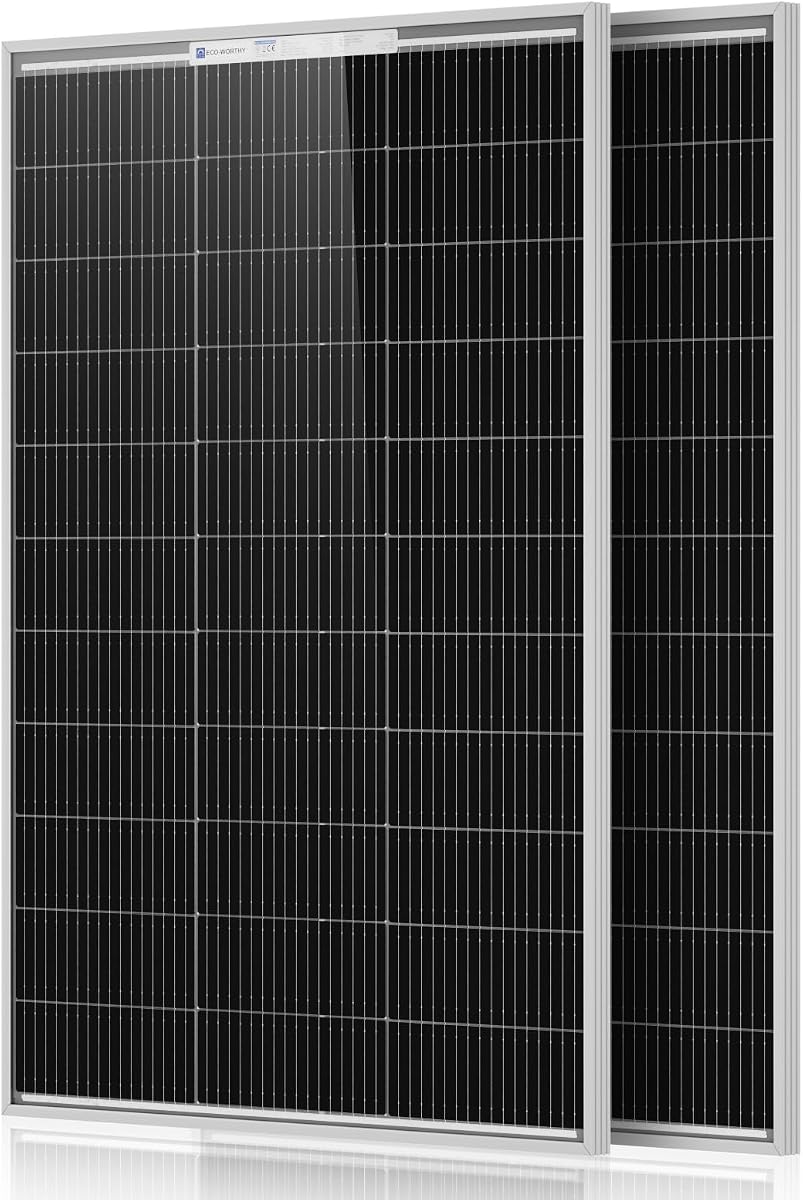
The ECO-WORTHY two-pack includes two 100-watt monocrystalline panels and carries a 4.6 customer rating. It stands apart from single-panel choices by providing a matched pair for RV, marine, home, garden, agricultural, and other off-grid applications. The panels can support 12V or 24V battery-charging arrangements and can extend an existing system.
We may earn a commission when you buy through this link, at no additional cost to you.
PERC technology is credited with improving sunlight reflection and raising cell efficiency to 25%. The stated daily output is up to 800Wh under four hours of sunlight for the pair, subject to the same real-world conditions that affect every panel. Each module includes 35-inch cables, while pre-installed bypass diodes in an IP68 junction box are designed to reduce losses caused by partial shading.
Durability is well addressed through tempered glass, waterproof components, a corrosion-resistant aluminum frame, 2,400Pa wind resistance, and a 5,400Pa snow-load rating. The listed 25-year lifespan reflects the panel's intended service life, and reinforced packaging with corner protectors and pearl cotton helps protect it during delivery. The trade-off is physical: installing two full-size modules demands more roof or mounting space and correct parallel or series wiring.
This pack is an attractive option for a builder who can use both panels or wants matched modules for expansion. It may be less convenient for a single lightweight application where space is limited and only one module is needed. Buyers should match their configuration to the controller and battery bank, using the included plug-and-play connectors and following the wiring arrangement appropriate for the selected system voltage.
Two matched modules can increase total collection capacity when roof space and orientation permit. Connecting them appropriately for the intended battery system also gives installers a scalable foundation for a larger off-grid installation.
Pre-installed bypass diodes are intended to minimize power loss when one section of a panel is shaded. Combined with the claimed low-light performance, this makes the pair more practical for mobile installations where temporary shadows are likely.
We may earn a commission when you buy through this link, at no additional cost to you.
The Traver Force 100W 12V Monocrystalline Solar Panel has the highest customer rating in this group at 4.9 and a stated 25% cell conversion efficiency. It is designed for RVs, vans, motorhomes, rooftops, cabins, yachts, boats, and other off-grid power systems, giving it broad appeal among mobile and stationary users.
We may earn a commission when you buy through this link, at no additional cost to you.
Its core technology combines Grade A+ monocrystalline cells, 182mm cell dimensions, and 10-busbar current collection. Every panel reportedly passes electroluminescence testing to identify cracks, while the busbar design is intended to improve current collection, reduce micro-crack risk, and maintain lower operating temperatures. These are meaningful technical distinctions for buyers who want more than a nominal power label.
Environmental protection includes an IP65-rated junction box, IP68-rated solar connectors, and a corrosion-resistant aluminum alloy frame. The panel is backed by a five-year product assurance and an output-retention claim of 80% after 25 years. That long-term statement is valuable, but users should distinguish it from a blanket guarantee covering every component or every installation condition.
This is our leading general recommendation for buyers who want high efficiency in a conventional 100-watt 12-volt format. It is particularly compelling for RV and boat installations where roof area matters and durable connector protection is valuable. Purchase the appropriate charge controller, observe polarity, confirm wiring requirements, and mount the panel where it can receive the longest practical period of unobstructed sunlight.
The 182mm cells and ten conductive paths are designed to collect current more effectively than simpler layouts. The claimed reduction in operating temperature can also help preserve output when the panel is operating in a warm environment.
EL testing provides an added quality-control measure by checking each cell for visible defects. Combined with protected connectors and a corrosion-resistant frame, it supports the panel's positioning as a durable option for exposed installations.
We may earn a commission when you buy through this link, at no additional cost to you.
This 100-watt panel uses N-type monocrystalline silicon and an 18BB configuration to achieve a stated 25% conversion efficiency. It has a 4.2 customer rating and is positioned for grid-independent or grid-connected use, including emergency supply, caravans, boats, balconies, gardens, and camping. The panel also supports 12-volt charging systems.
We may earn a commission when you buy through this link, at no additional cost to you.
Multi-layer lamination and 18-busbar technology are the panel's main technical attractions. The junction box is IP68 rated, while the laminated construction is described as improving tightness and vacuum integrity. The surface uses weather-resistant solar glass, and the product is rated for 2,400Pa wind loads and 5,400Pa snow loads across an operating temperature range of -40°C to 85°C.
Installation is straightforward: pre-installed junction-box diodes, two preinstalled wires, and rear mounting holes reduce the work required. The seller also provides explicit cautions about obstructions, current capacity, and physical impacts. A key consideration is the stated limit of no more than three panels in series or three in parallel, which means larger arrays may need revised wiring and protection planning.
This is a credible high-efficiency option for a compact 12-volt system, particularly where the installer values an 18BB N-type design and broad temperature tolerance. Its lower customer rating and narrower stated array limitation deserve attention, but the technical specification makes it appealing for campers, boat owners, and users building a small dedicated power system.
The higher busbar count is intended to improve electrical collection and cell performance. In a properly wired installation, this technology helps the module make effective use of the available sunlight.
An IP68 junction box and advanced lamination improve resistance to dust, rain, snow, and low-pressure water exposure. The stated temperature range also makes the panel suitable for widely varying outdoor environments.
We may earn a commission when you buy through this link, at no additional cost to you.
The HQST 100W 12V Solar Panel is built around a compact square format measuring 31.8 by 27.5 by 1.18 inches, making it smaller than many traditional rectangular alternatives. Its 4.8 rating and 23% conversion efficiency make it an appealing budget-oriented choice for campers, motorhomes, RVs, roofs, cabins, and yachts.
We may earn a commission when you buy through this link, at no additional cost to you.
The panel uses 166mm Grade A+ monocrystalline cells with a nine-busbar configuration, and every cell is stated to pass EL testing. Its frame is described as anti-corrosion aluminum alloy, while the junction box and solar connectors carry IP65 ratings. The listed load limits are 2,400Pa for wind and 5,400Pa for snow, giving it a credible outdoor construction profile.
The main advantage is efficient use of limited space. HQST says the square design is 11% smaller than a traditional layout while preserving a 100-watt rating. That can make installation easier on a small RV roof, van rack, or boat. The trade-off is a nine-busbar layout and 23% efficiency rather than the 25% or 25.8% claimed by several alternatives, although real output still depends on installation quality and sunlight.
This panel is a strong recommendation for buyers who need a 12-volt module with a manageable footprint and dependable long-term coverage. It includes a five-year product assurance and states 80% output power retention after 25 years. HQST brackets and tilt mounts are compatible, but they are not included, so plan the mounting system separately.
The square layout uses the available mounting area efficiently, which is especially valuable on compact vehicles and recreational boats. Four pre-drilled rear holes make the basic mounting process straightforward.
IP65 protection for the junction box and connectors, a corrosion-resistant frame, and substantial wind and snow ratings make the panel suitable for exposed use. Routine cleaning and secure mounting remain essential to long-term performance.
We may earn a commission when you buy through this link, at no additional cost to you.
The DOKIO 100W 18V Monocrystalline Solar Panel is designed to charge 12-volt systems while using standard MC4 connections. It carries a 4.1 customer rating and targets rooftops, RVs, boats, cabins, farms, and general off-grid battery charging. The panel's 18V nominal output is appropriate to the application but should be managed through a compatible controller.
We may earn a commission when you buy through this link, at no additional cost to you.
Pre-drilled holes allow fast installation with Z-brackets, tilt mounts, or pole mounts, while MC4 plugs simplify electrical connections and future system growth. A half-cell design and bypass diodes are intended to reduce shading losses, limit heat buildup, and support more consistent charging when part of the panel is shaded.
The outdoor construction combines tempered glass, a corrosion-resistant aluminum frame, and waterproof MC4 connectors. Reinforced cartons with foam corner protection add protection during shipping, while the product is described as engineered for a 25-year designed service life with low degradation. One important limitation is that a 4.1 rating is the lowest among the listed selections, giving less visible customer feedback than the leading options.
DOKIO is most compelling for builders who want a conventional module with familiar connectors and straightforward expansion. It can work well on a boat, farm, cabin, or mobile system, provided the installer selects the proper 12-volt charge controller and observes polarity. For buyers who place more emphasis on the newest N-type cell technology, one of the higher-efficiency alternatives may be a closer fit.
Standard MC4 plugs make it easier to add compatible modules or connect the panel to a conventional charge controller. The design is particularly useful for owners who expect their off-grid system to grow.
The half-cell configuration and bypass diodes help limit the effect of localized shadows. They do not eliminate shading losses, but they can make partially obstructed installations more productive than a panel without segmented cell and diode design.
We may earn a commission when you buy through this link, at no additional cost to you.
The Renogy 100 Watt N-Type Solar Panel delivers a stated 25% conversion efficiency and carries a 4.6 customer rating. It uses A-grade N-type cells with 16BB technology, positioning it as a high-performance 12-volt option for tight spaces, including mini-van living and other mobile applications.
We may earn a commission when you buy through this link, at no additional cost to you.
The 16BB arrangement is designed to improve photoelectric conversion, reduce hot spots, and minimize the risk of hidden cracks. Renogy states that the module is 11% smaller and 8% lighter than its predecessor while preserving the same 100-watt output. A particularly relevant specification is the -0.29% per degree Celsius temperature coefficient, which can reduce power loss in hot conditions.
The panel has an IP65 rating, low-iron tempered glass, and a corrosion-resistant aluminum frame. These features support long-term outdoor use in rain, snow, and heat. A tradeoff is that the supplied product information does not state a specific long-term performance-retention figure or product warranty duration, so buyers seeking a clearly documented output warranty may prefer one of the models that lists both.
This is a good match for a buyer who prioritizes N-type cells, compactness, and hot-weather performance. It should appeal particularly to van and RV owners who cannot accommodate a larger module. Verify the required controller, use suitable mounting hardware, and position the panel to minimize midday obstruction to obtain the most consistent charging.
The low temperature coefficient helps the panel maintain output as operating temperature rises. This makes the module particularly relevant to summer travel, sun-exposed roofs, and installations in warmer climates.
The stated reductions in size and weight make the panel easier to integrate into compact mobile installations. Buyers still need adequate clearance and secure support, but the smaller format reduces the amount of roof area demanded for a 100-watt rating.
We may earn a commission when you buy through this link, at no additional cost to you.
The 100W TÜV Certification Solar Panel combines N-type monocrystalline cells with a stated 25.8% conversion efficiency, the highest efficiency figure in this comparison. Its 4.4 rating reflects a solid customer reception, while TÜV certification to IEC 61215, IEC 61730, and UL 61730 adds documented scrutiny for durability, electrical safety, and mechanical safety.
We may earn a commission when you buy through this link, at no additional cost to you.
The 16BB architecture is designed to reduce resistance, micro-cracks, and hot spots. A low temperature coefficient supports output during hot weather, while N-type cells are presented as dependable in morning, evening, and cloudy conditions. The panel uses 3.2mm anti-reflective tempered glass, a corrosion-resistant aluminum frame, and an IP68 junction box.
Mechanical specifications include 2,400Pa wind resistance and 5,400Pa snow-load resistance. The product also states that it can work with most 12V batteries, MPPT or PWM charge controllers, and portable power stations. As with the other products, the information provided does not specify a comprehensive long-term performance warranty, which is the main point to investigate before purchase.
This is our premium pick for buyers who want independent certification alongside advanced cell technology. It is well suited to RVs, boats, rooftops, cabins, farms, and remote installations where product documentation and consistent performance carry extra importance. Its 25.8% rating should be treated as a laboratory cell-conversion figure, not a promise of equivalent real-world daily output.
TÜV certification to recognized photovoltaic standards provides a stronger documented basis for assessing module design, electrical safety, and mechanical durability. That is useful for professional installers, integrators, and buyers who prioritize traceability.
N-type cells and a low temperature coefficient are intended to support stable output in hot conditions and weaker light. The benefits are most useful when the panel receives several hours of direct sun but also faces warm temperatures or intermittent cloud cover.
We may earn a commission when you buy through this link, at no additional cost to you.
The RICH SOLAR 100 Watt 12 Volt 9BB panel is a straightforward 12-volt module with a 4.7 customer rating. It measures 39 by 21.3 by 1.2 inches, generates 5.38 amps under the listed conditions, and includes a three-foot cable with connectors. Its intended uses include RV, trailer, camper, marine, and other off-grid battery systems.
We may earn a commission when you buy through this link, at no additional cost to you.
The strongest installation feature is the set of 14 pre-drilled holes, which provides broad compatibility with standard Z-brackets, ground mounts, side pole mounts, and tilt mounts. Quick-connect cables also simplify series and parallel arrangements, giving owners flexibility when building a larger array. The three-foot lead length, however, may be short for some panel-to-controller layouts.
The panel uses anti-reflective coated tempered glass and an anodized aluminum frame, both intended to withstand demanding outdoor conditions. Its listed strengths also include good low-light performance during mornings, evenings, and cloudy days. A 25-year limited power-output warranty and a five-year limited material-and-craftsmanship warranty provide a clear two-part coverage structure.
This is a compelling option for installers who prioritize flexible mounting and explicit warranty coverage. The nine-busbar format is less advanced than the 16BB and 18BB designs in the group, but that does not make it unsuitable for a 100-watt system. It is best suited to buyers who want broad mechanical compatibility, straightforward expansion, and dependable low-light collection.
Fourteen mounting holes allow installers to select a position that works with several standard bracket styles. Series and parallel compatibility makes the panel useful as the foundation of a larger system.
The separate 25-year output warranty and five-year workmanship warranty make the product's long-term support structure easy to understand. Buyers should retain documentation and follow the manufacturer's care and installation requirements.
We may earn a commission when you buy through this link, at no additional cost to you.
This Traver Force 100-watt monocrystalline panel combines a stated 25% conversion rate with a 4.5 customer rating. Designed for 12-volt systems, it targets homes, RVs, camping setups, cabins, marine installations, motorhomes, and other off-grid applications. The result is a broadly usable module for users who want high efficiency without moving beyond a 100-watt format.
We may earn a commission when you buy through this link, at no additional cost to you.
The panel uses premium 182mm cells with 10-busbar technology. The listing says the Grade A+ mono cells pass EL testing without cracks, while the busbar design improves performance, reduces crack risk, and lowers operating temperature. These are meaningful construction details for buyers comparing the panel with more conventional 9BB products.
Environmental features include IP68-rated solar connectors, an IP65-rated junction box, and an anti-corrosion aluminum alloy frame. Four pre-drilled holes allow secure mounting on a range of roofs and brackets. A five-year product assurance and 80% output retention after 25 years provide useful long-term coverage information, although the mounting system itself is not included.
This panel is a solid all-around recommendation for mobile and permanent systems, particularly where the installer values a 25% cell design and 10BB architecture. Its four mounting holes offer less positional flexibility than the RICH SOLAR model, but they are sufficient for a properly planned mount. Pair it with a suitable charge controller and ensure reliable panel-to-controller connections.
The ten-busbar design is intended to collect current efficiently while lowering operating temperature. The included EL-testing claim adds confidence that the cells were checked for cracks before assembly.
The same module can serve a motorhome, boat, cabin, rooftop, or home battery system. Its protected junction box and connectors make it a practical common component when a builder wants one panel specification across several projects.
We may earn a commission when you buy through this link, at no additional cost to you.
A useful 100-watt panel should fit the available space, charge the intended battery system efficiently, and remain protected through years of outdoor exposure. The following factors help narrow the choice beyond rated wattage and headline efficiency.
Most of the listed panels are designed to charge a nominal 12-volt battery bank, but some explicitly support 24-volt systems as well. The DOKIO model has an 18V panel output intended for 12V systems, while the ECO-WORTHY two-pack can be configured for either 12V or 24V use. Confirm the panel's open-circuit voltage, maximum power voltage, and the controller's input range before connecting any equipment. A nominal 12-volt battery bank may contain multiple deep-cycle batteries in series, so the entire battery configuration must be understood before adding panels.
The panels in this comparison range from 23% stated efficiency to 25.8%. Traver Force models use Grade A+ monocrystalline cells with 10BB architecture, Renogy uses N-type 16BB cells, and the 18BB model uses N-type cells with a stated 25% rate. The TÜV-certified panel also uses N-type 16BB technology and claims 25.8% efficiency. Higher conversion efficiency can be useful where mounting area is limited, but actual daily energy depends on irradiance, orientation, temperature, shading, cable loss, and controller performance.
The HQST panel is notably compact at 31.8 by 27.5 by 1.18 inches, while the RICH SOLAR model measures 39 by 21.3 by 1.2 inches. Renogy states that its panel is 11% smaller and 8% lighter than its predecessor. Measure the intended roof or mounting surface and leave clearance around the frame, cables, and brackets. Also consider whether the panel will create a wind obstruction or interfere with doors, vents, hatches, and maintenance access.
Busbars are conductive paths printed across solar cells, and more busbars can improve current collection while reducing electrical resistance and the risk of micro-cracks. The selections range from nine busbars on the HQST and RICH SOLAR panels to 18 busbars on the 18BB model. Traver Force and Renogy also describe EL testing or crack screening for their cells. These claims do not replace proper handling, but they indicate attention to manufacturing quality and long-term reliability.
Outdoor panels should have protected junction boxes, sealed connectors, tempered glass, and corrosion-resistant frames. Listed wind ratings range from 2,100Pa to 2,400Pa, while snow-load ratings reach 5,400Pa on many models. Junction-box ratings vary between IP65 and IP68. Certification to standards such as IEC 61215, IEC 61730, and UL 61730 is another useful indicator, as highlighted by the TÜV-certified selection. Mounting strength, however, depends on the brackets and attachment method as well as the panel itself.
A 100-watt label represents peak laboratory output, not constant production. Bypass diodes, half-cell designs, and low-light performance claims can reduce the impact of partial shadows. The ECO-WORTHY panels include preinstalled bypass diodes, DOKIO uses a half-cell configuration, and several products explicitly describe improved performance in mornings, evenings, and cloudy weather. None can overcome a fully shaded panel, so choose an unobstructed location whenever possible. For boats, RV roofs, and buildings, inspect likely obstructions such as vents, antennas, trees, and chimneys.
Pre-drilled holes make installation easier, but the number and position matter. HQST, DOKIO, ECO-WORTHY, and both Traver Force panels use four holes, while RICH SOLAR offers 14 for greater compatibility with standard mounting styles. DOKIO, RICH SOLAR, and the ECO-WORTHY pair use convenient connection arrangements, including MC4 or quick-connect leads. Check cable length before ordering: the RICH SOLAR panel includes a three-foot lead, while the ECO-WORTHY panels include 35-inch cables. The controller, brackets, and sometimes cables remain additional system requirements.
Long-term coverage varies substantially. JJN states a transferable 30-year power-output warranty. ECO-WORTHY cites a 25-year lifespan, and DOKIO describes a 25-year designed service life. Traver Force, HQST, and Renogy include or describe five-year product assurance, while HQST and Traver Force state 80% output retention after 25 years. RICH SOLAR provides a 25-year limited output warranty and a five-year limited workmanship warranty. Read the actual warranty terms because coverage for power output, materials, workmanship, and labor are separate issues.
Before installation, identify the panel's voltage and current ratings, confirm compatibility with the charge controller, and decide whether the module will operate alone, in series, or in parallel. Connect the controller according to its instructions, observe polarity, and use outdoor-rated cable and connectors where required. A suitable fuse and grounding arrangement may be necessary depending on the system, while a blocking diode or controller protection can help prevent reverse current when multiple sources are connected.
Mount the panel on a rigid, corrosion-resistant bracket in the clearest available location. The angle should support the target season and location, while the fasteners must be secured into the underlying structure rather than only the thin panel frame. Leave room to clean the surface and inspect wiring. If connecting more than one panel, follow the current limits of the controller and cables, and avoid configurations that could exceed their capacity.
Inspect the glass at least every two weeks when leaves, dust, bird droppings, or other debris are likely, and clean the surface gently as needed. Do not use abrasive tools or harsh chemicals that could damage the protective glass. Check connections for corrosion, looseness, water intrusion, and damaged insulation, and remove the panel for inspection if the output behaves unexpectedly. Periodic maintenance, careful wiring, and uninterrupted sunlight are the simplest ways to preserve charging performance.
A 100-watt panel is rated for 100 watts under specified test conditions, such as strong direct sunlight. Real output varies with solar intensity, panel temperature, angle, shade, dust, wiring loss, and controller efficiency. It is best treated as a peak rating rather than a guaranteed number of watts produced continuously or throughout an entire day.
A panel alone is not usually the ideal way to protect and manage a battery. A charge controller designed for the panel's voltage and current is generally used to regulate charging and prevent overcharging or reverse current. Follow the controller manufacturer's instructions and verify the battery type, series configuration, and panel specifications before connecting anything.
It can produce less peak power for the same illuminated area, but system performance also depends on temperature, orientation, shading, controller quality, and cable losses. A compact 23% panel may fit a limited roof better than a larger 25% alternative. Choose based on the complete system rather than the efficiency number alone.
Two panels can often be connected in series or parallel, but the correct arrangement depends on the charge controller and battery voltage. Parallel connections add current, while series connections increase voltage, subject to each panel's electrical limits. The ECO-WORTHY selection explicitly supports 12V and 24V configurations, while other products provide different series or parallel guidance.
They can still generate power in winter and cloudy conditions, but available sunlight and panel temperature change the result. The listed low-light features may reduce the impact of weak or intermittent light, yet no panel can match its peak rating without sufficient solar energy. Snow, dirt, and shade should be removed when safe and practical.
Most of these panels include pre-drilled holes, but brackets, rails, fasteners, and appropriate seals may need to be purchased separately. Z-brackets, tilt mounts, pole mounts, roof rails, and marine hardware are common options, depending on the installation. The chosen attachment must support the panel securely and transfer wind and snow loads into the vehicle or building structure.
Monocrystalline cells are made from a uniform silicon crystal and are generally suited to compact installations where useful output per unit area matters. The panels here use several cell and busbar generations, including 9BB, 10BB, 16BB, 18BB, PERC, and N-type designs. These technologies influence efficiency, heat behavior, shade response, and construction quality, but proper installation remains essential.
Inspect the panel regularly, particularly every two weeks during periods when leaves, dust, snow, or bird droppings are likely to accumulate. Clean the glass gently with an appropriate soft tool and check the frame, junction box, wires, and connectors for looseness or corrosion. Any unexpected decline in charging output should prompt a system and connection check.
The leading choices serve different priorities. Traver Force's 10BB panel stands out for its 25% efficiency, EL-tested Grade A+ cells, protected connectors, and 4.9 rating. The compact HQST model is a strong budget pick for limited spaces, while the TÜV-certified N-type option offers the highest stated conversion efficiency and independent standards certification.
Before buying, prioritize voltage compatibility, available mounting space, shading, weather protection, connector arrangement, and the suitability of the warranty. A 100-watt panel with a secure mount, appropriate controller, and an unobstructed sun-facing position can be more useful than a nominally superior panel installed poorly. Buyers considering larger systems should also verify series and parallel limits for every cable, controller, and connector in the chain.
Product specifications, promotions, ratings, and prices can change over time, so check the current listing and manufacturer details before ordering. Review the included components, confirm that required brackets and controllers are available, and retain the warranty and care instructions. With those checks completed, one of these ten panels can provide a dependable foundation for a 12-volt off-grid system.