
20 Traps Silverfish Trap
3.3Editor score
Flexible small or large layouts
Wood-grain discreet appearance
Non-toxic odorless adhesive
Read our Silverfish Traps guide comparing 10 indoor options for discreet, non-toxic pest control, and find the right trap for your home's specific needs.
Silverfish traps offer a discreet way to monitor and control these moisture-loving pests without relying on sprays, powders, or airborne insecticides. The best traps combine strong adhesive, an enclosed design, and enough coverage for the rooms, closets, basements, and storage areas where silverfish tend to hide.
We compared the ten products in this guide by examining their ratings, trap counts, placement options, adhesive construction, intended pest coverage, and stated replacement intervals. The list includes silverfish-specific pouches, foldable glue traps, detachable sheet traps, and multipurpose products designed to catch silverfish along with other crawling insects.
Each review explains who the product is best suited for, along with its strongest features and practical limitations. We also cover placement, replacement, and selection in detail. Product prices and availability can change, so compare the current listing information and customer feedback before making your final purchase.
3.3Editor score

4.5Editor score
5.0Editor score
The table below compares trap quantity, configuration, stated duration, and target coverage to help distinguish dedicated silverfish pouches from foldable glue traps and multipurpose insect-catching products.


The D Ekko Silverfish Paks are a strong all-around choice for homeowners who want a straightforward way to address silverfish in concealed indoor locations. Each pack contains multiple small rectangular pouches, so you can distribute them around the areas where activity is most likely instead of concentrating them in one location. Their bait-oriented approach makes them especially relevant for users searching for dedicated silverfish protection rather than a general insect trap.
We may earn a commission when you buy through this link, at no additional cost to you.
The standout feature is the combination of active bait technology and a long stated service life of up to six months. The pouches are designed to attract silverfish and address their eggs while remaining sealed and easy to hide. That makes them different from exposed glue boards, which can collect household dust and show captured insects prominently. Because the pouches require no mixing or spraying, they are also simple to deploy in a busy household.
The main trade-off is that this product focuses narrowly on silverfish. Unlike multipurpose glue traps, it is not presented as a solution for spiders, roaches, crickets, or earwigs, and consumers cannot see the captured insects. It also does not provide a large number of individually identifiable units, which may matter to someone who wants to inspect each trap and map activity precisely. Even so, the sealed pouch design and lengthy replacement interval make those limitations reasonable for a targeted infestation.
This is the best fit for someone who values low-maintenance, dedicated silverfish control in basements, closets, bathrooms, storage rooms, or other sheltered areas. It is also a good choice for households seeking a cleaner-looking option than exposed glue traps. Buy it when a set of discreet, baited pouches with long-lasting coverage fits your placement plan, and pair it with moisture control for the most practical overall strategy.
The sealed pouches can be tucked behind appliances, beneath shelving, inside cupboards, and near other areas where silverfish shelter. Their stated protection period of up to six months means they are best positioned thoughtfully rather than replaced on a short schedule.
Because the active material remains inside a pouch, this option avoids the dust and visible insect accumulation associated with open glue surfaces. That makes it practical for occupied rooms and for users who want the traps to blend into the space.
We may earn a commission when you buy through this link, at no additional cost to you.
The MaxGuard Silverfish + Insect Traps combine a box-style construction with extra-sticky, non-toxic adhesive. The product is aimed at silverfish but is also marketed for centipedes and other crawling insects, making it a useful multipurpose option. Its 12-trap box provides a practical balance between coverage and storage convenience for a single home or several affected rooms.
We may earn a commission when you buy through this link, at no additional cost to you.
A dark-colored interior is used to attract silverfish toward the adhesive without relying on conventional chemical bait. The enclosed box shape helps protect the sticky surface from some environmental exposure, and the manufacturer states that the traps can remain effective for up to six months. Setup follows a familiar peel, fold, and place process, with no spraying, mixing, or refilling required.
The biggest limitation is that the box format takes up more physical space than a flat sticky sheet or compact pouch. That can make placement less convenient inside very narrow gaps. The traps are also primarily a capture tool rather than a treatment for the environmental conditions that attract silverfish, and the product provides no way to distinguish captured pests without opening or examining each trap. Despite these points, the long replacement interval and broad crawling-insect coverage remain useful.
Choose the MaxGuard set when you want a moderate number of enclosed traps that can address silverfish along with occasional centipedes or similar pests. It is a sensible option for basements, utility rooms, kitchens, and storage areas where there is enough space for a small box trap. For extremely narrow crevices, a flat or foldable sheet trap may be easier to position.
The folded structure keeps much of the adhesive surface enclosed, which can reduce direct contact with dust and other airborne debris. It also creates the dark interior described as useful for encouraging silverfish to enter.
The ability to catch centipedes and other crawling insects gives these traps more value in mixed-pest situations. They are particularly useful in utility spaces where several kinds of nuisance insects may travel along walls or floors.
We may earn a commission when you buy through this link, at no additional cost to you.
The 32 Pack Dual-Color Traps are built for households that want to place many small monitoring or trapping stations around a property. Each sheet can be divided into 32 individual traps or combined into 16 larger traps, giving buyers flexibility in how they cover bathrooms, kitchen cabinets, laundry rooms, basements, and storage spaces.
We may earn a commission when you buy through this link, at no additional cost to you.
The design does not depend on a conventional odor or chemical lure. Instead, a silver-gray interior is intended to resemble the damp, dim environment favored by silverfish, while the contrasting exterior and printed pattern help guide insects toward the adhesive. A rear adhesive strip holds each folded trap flat on tiles, wood floors, or slightly damp surfaces, reducing the chance that it will curl and lose contact.
The principal trade-off is the stated duration of up to two months, which is shorter than the six-month intervals claimed by the D Ekko and MaxGuard options. The traps also need more planning because each unit must be installed and later removed individually. Nevertheless, the large number, flexible sizing, and strong surface adhesion make this a practical option when you want to establish broad coverage rather than use only a few placement points.
This pack is well suited to apartments, single-family homes, basements, and shared living spaces where silverfish may move between several zones. Choose it if you prefer visual evidence of trapping and want the freedom to adjust the size and location of each trap. For a smaller number of long-lasting target stations, consider a dedicated pouch or box-trap alternative instead.
Small units work well in narrow corners and under appliances, while connected larger traps can cover broader areas in basements and storage rooms. This adaptability reduces the need to purchase separate trap formats for different parts of a home.
The rear adhesive strip is intended to keep the trap open and flat. That is especially useful in locations where a loose folded trap could shift, collect dust, or fail to make continuous contact with the floor.
We may earn a commission when you buy through this link, at no additional cost to you.
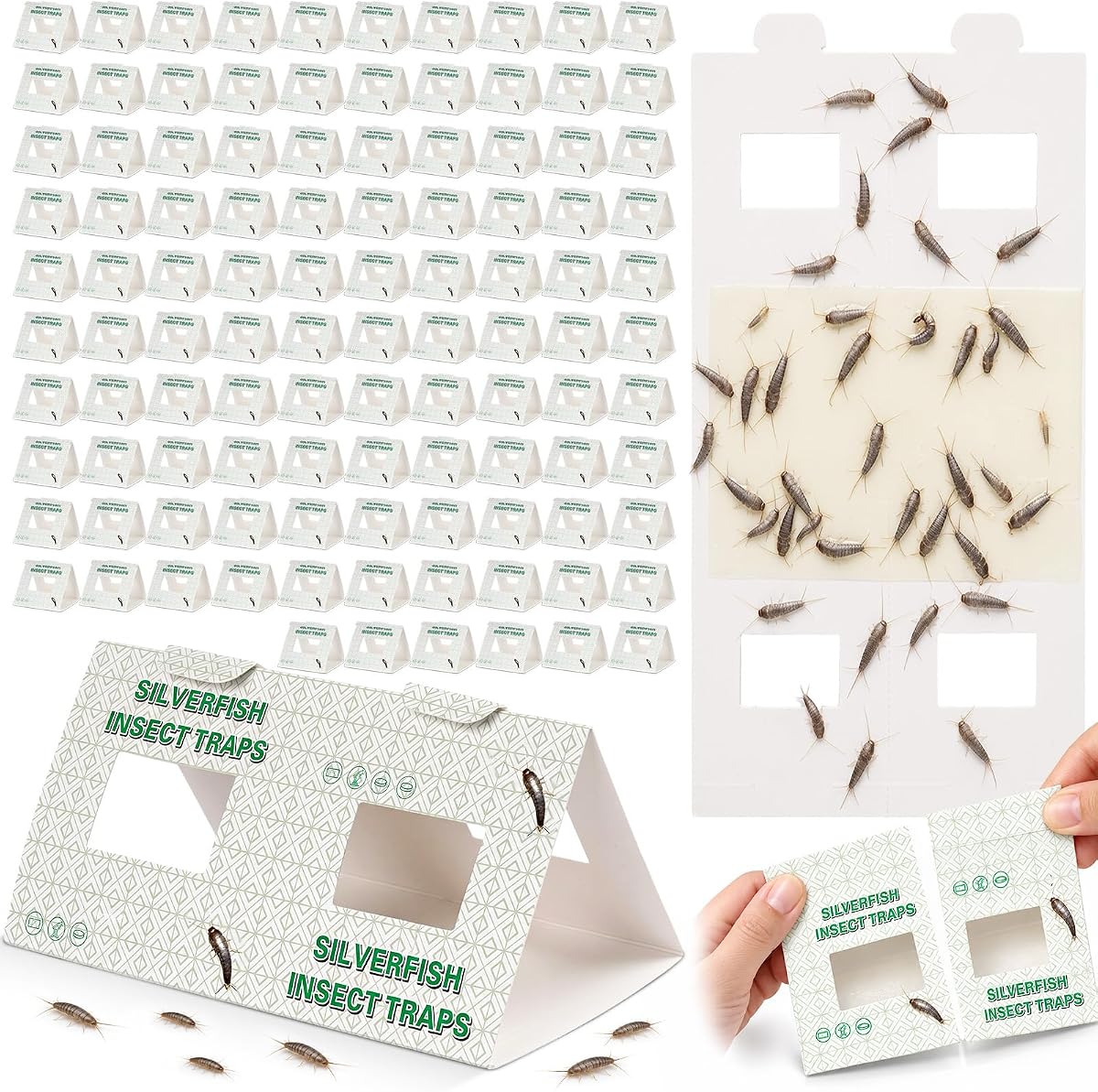
The 96 Pack Dual-Color Traps is a high-volume option for property owners, building managers, or anyone dealing with widespread silverfish activity. The sheets can be separated into 96 small traps or joined into 48 larger ones, allowing the same package to serve both confined hiding places and larger rooms.
We may earn a commission when you buy through this link, at no additional cost to you.
Its lure relies on visual and environmental cues instead of an added attractant. The silver-gray interior resembles the damp, dark conditions silverfish prefer, while the contrasting outer layer and pattern help direct movement toward the glue. The adhesive base holds traps in place on tiles, wood floors, and slightly damp surfaces, and the design is odorless and suitable for placement around pets and in food-storage areas.
The tradeoff is that a large inventory requires careful deployment. Placing 96 units effectively takes time, and many of them will need attention every two months under the stated replacement guidance. The sheet format also offers less of the concealed, hand-off convenience of a bait pouch. Still, for a large home, apartment building, storage facility, or other space with numerous hiding locations, the scale can provide better coverage than a small box of traps.
This product is best for buyers who want to map activity across many areas and inspect the catches. It is especially appropriate for basements, storage rooms, bathrooms, kitchen cabinets, and laundry rooms. If the issue is limited to one or two damp corners, a smaller pack will be easier to manage; if broad coverage is the priority, this high-count format is more convincing.
The quantity provides enough individual units to place several traps in every vulnerable room or to focus on numerous shelving, cabinet, and storage locations. This makes the format practical for shared homes and other broad monitoring projects.
The color and pattern approach supports discreet use in occupied areas. It also avoids the need to add separate bait, simplifying placement in kitchens, bathrooms, and other spaces where extra substances would be inconvenient.
We may earn a commission when you buy through this link, at no additional cost to you.
Catchmaster Sticky Traps are the strongest choice in this guide for users who want one monitoring system to cover several crawling pests. The 30 boards are advertised for spiders, roaches, crickets, silverfish, and earwigs. They can be placed along baseboards, on walls, behind furniture, beneath appliances, or in other locations where insects travel.
We may earn a commission when you buy through this link, at no additional cost to you.
The traps require no bait or liquid insecticide. They are simply peeled, positioned, and optionally folded into a tunnel to help keep dust off the glue. One particularly useful feature is the visible catch: by checking the boards, users can determine which pests are present, how many have been caught, and where activity is concentrated. This makes the product more of a diagnostic and monitoring system than a hidden treatment.
The trade-off is that the design is not dedicated to silverfish, so it lacks a silverfish-specific lure and cannot be marketed as a targeted egg-control product. Open glue surfaces can also become dusty and may be less attractive in highly visible rooms. Nevertheless, the stated indoor life of up to one year is longer than that of the other options here, and the broad pest coverage makes these boards useful even when silverfish are only one part of the problem.
Choose Catchmaster when your priority is long-term, pesticide-free monitoring across multiple rooms or pest species. It is a particularly strong option for people who want to inspect catches and use that information to guide future placement. If appearance and narrow hidden spaces are more important, one of the enclosed pouch or small foldable traps may fit better.
A visible catch makes these boards useful for diagnosis. You can compare the insects found in the bathroom, kitchen, basement, and laundry room to identify where additional traps or environmental corrections may be needed.
No bait, spray, or refill is required, and the manufacturer states that indoor boards may keep working for up to one year. Replacing a board sooner is still advisable when it fills, becomes dusty, or loses adhesion.
We may earn a commission when you buy through this link, at no additional cost to you.
The 60 Pack Dual-Color Traps offer a middle ground between compact monitoring sets and very large property-wide inventories. The package can be divided into 60 small traps or 30 larger traps, allowing the user to place units in tight corners or combine them for broader coverage in basements and storage rooms.
We may earn a commission when you buy through this link, at no additional cost to you.
The traps use a silver-gray interior, contrasting exterior, and pattern design to encourage silverfish toward the adhesive without requiring chemical bait. A rear adhesive strip keeps each unit flat and helps prevent curling on tiles, wood floors, and slightly damp surfaces. The product is odorless and is described for use around pets as well as in kitchens, bathrooms, and food-storage areas.
Its main limitation is the two-month replacement interval, which means checking the traps regularly and planning renewals. As with other exposed sticky traps, dust can reduce appearance and may eventually affect performance. The large count also takes time to place properly, and 60 traps in one property could become excessive if activity is confined to a single damp area. Still, the flexible sizing and broad trap supply make this a balanced choice for medium-to-large homes.
This product is a good match for users who want enough traps to cover several rooms but do not need the maximum quantity. Focus placement around sinks, cabinets, closets, basements, and laundry areas. It is also a sensible choice for landlords or shared-home residents who want to monitor numerous hiding places while avoiding sprays, powders, and separately applied bait.
Small traps are convenient for narrow corners and inside cabinets, while larger connected units provide more surface area for open rooms. One package can therefore cover several kinds of indoor environments without changing products.
The adhesive base is intended to reduce shifting and curling. A stable trap presents a more consistent sticky surface to silverfish traveling across floors, shelves, and cabinet bases.
We may earn a commission when you buy through this link, at no additional cost to you.
The 20 Traps Wood-Grain Design is a budget-conscious choice for smaller homes, apartments, and targeted placements. It includes ten sheets that can be used as 20 individual traps or kept connected as 10 extended traps. The compact format is intended for corners under sinks, inside closets, along baseboards, and in other dark, confined spaces.
We may earn a commission when you buy through this link, at no additional cost to you.
Its visual design is one of the most distinctive in the guide. A wood-grain exterior helps the traps blend into storage areas and domestic interiors, while a silver-gray interior and printed silverfish patterns are intended to guide pests toward the glue. The adhesive is described as industrial grade, non-toxic, and odorless, and the rear strip helps keep each trap flat in damp rooms.
The product's rating is lower than those of the other options, which is worth considering when weighing customer experience. Its stated duration is also up to two months rather than six months or a year. A 20-trap inventory is less suitable for monitoring a very large property, and the connected large configuration may not work in every narrow gap. Even so, the product is straightforward, flexible, and designed to be placed without tools or cleanup.
This is the right pick for a shopper who wants a manageable number of silverfish-focused traps, cares about discreet appearance, and prefers a small or large layout. It works well in closets, under bathroom sinks, kitchen cabinets, and along sheltered baseboards. For a larger building or longer replacement cycle, choose a higher-count or longer-lasting product instead.
The wood-grain print is less conspicuous than a bright contrasting trap. It can be particularly useful on shelves, in cupboards, or near stored clothing where a conventional glue board would stand out.
Separating the sheets into 20 small traps allows focused coverage in a few locations, while keeping sections connected creates 10 broader units. This flexibility helps buyers avoid placing oversized traps in very narrow corners.
We may earn a commission when you buy through this link, at no additional cost to you.
The Greenway Silverfish and Spider Traps are compact indoor traps designed to capture silverfish, spiders, and other crawling insects. Each unit folds into a triangular shape after the paper strip is removed, allowing it to sit in a corner, along a wall, or beneath household fixtures without taking up much floor space.
We may earn a commission when you buy through this link, at no additional cost to you.
The traps use high-strength, non-toxic glue and require no separate bait or chemical treatment. Their stated protection period is up to two months, making regular visual checks important. A six-trap pack is well suited to a few carefully chosen locations, such as a bathroom corner, under the kitchen sink, a basement landing, or a storage closet, but it offers less coverage than the high-count sheet products.
The main limitation is quantity. Users with multiple rooms or a broad infestation may need several packs, while the lack of a dedicated silverfish lure means the adhesive surface does more of the work. Because the catches remain exposed, the traps also serve as a visual indicator of activity. That is useful for monitoring but less attractive where a fully concealed treatment is preferred.
Choose Greenway when you want a simple, low-commitment solution for isolated problem areas and also need to catch occasional spiders. It is convenient for renters and homeowners who want to test whether traps are active before investing in a much larger deployment. For comprehensive coverage, consider a product with a larger trap count and a more explicitly silverfish-focused design.
The triangular profile fits neatly into corners and along walls where insects travel. It is also useful beneath appliances and furniture where a flat sheet trap might be exposed to disturbance.
Peeling away the paper strip exposes the adhesive, after which the trap can be folded and positioned. No spraying, bait mixing, or other preparation is necessary.
We may earn a commission when you buy through this link, at no additional cost to you.
The 96 Pack Home Sticky Traps deliver one of the largest inventories in this guide, with the option to deploy 96 small traps or 48 larger units. That scale is appropriate for extensive monitoring throughout a home, apartment building, basement complex, or storage area where activity could appear in numerous concealed locations.
We may earn a commission when you buy through this link, at no additional cost to you.
The traps use a silver-gray interior intended to evoke the damp, dark environment preferred by silverfish. A contrasting multicolored outer layer and printed pattern help direct pests toward the adhesive without requiring additional attractant. A secure rear strip helps keep each trap flat and open on tiles, wood floors, or slightly damp surfaces, while the adhesive is described as odorless and appropriate around pets, kitchens, bathrooms, and food-storage areas.
Despite the large quantity, the product has some practical limits. Every trap requires placement and later inspection, and the stated service period is only up to two months. A large count can also feel excessive for a single damp corner. However, the flexible configuration, stable base, and broad indoor compatibility make this one of the most complete options for buyers who want to cover many points of entry and hiding places at once.
This product is best for comprehensive monitoring, especially when silverfish have been noticed in more than one part of a property. Place small traps in corners and cabinet interiors and use larger versions along basement edges, shelving, and storage-room floors. If you need only a few concealed, long-lasting stations, choose a pouch or box-trap option instead to reduce routine maintenance.
The 96-unit capacity makes it easy to distribute traps across bathrooms, kitchens, laundry areas, basements, closets, and storage rooms. A smaller number of larger traps can also be used where a broader sticky area is preferable.
The low-profile shape and rear adhesive strip help the traps remain flat while limiting their visual impact. The contrasting lure also allows the units to be identified during routine inspections and replaced efficiently.
We may earn a commission when you buy through this link, at no additional cost to you.
The 36 Traps Green Exterior set provides 18 sheets that can be divided into 36 small traps or kept connected as 18 extended units. Its bright green exterior differentiates it from more neutral wood-grain designs, making the traps easier to notice during placement and routine inspection. The intended locations include dark corners under sinks, inside closets, and along baseboards.
We may earn a commission when you buy through this link, at no additional cost to you.
A silver-gray interior, bright exterior, and printed silverfish pattern are used to draw crawling insects toward the glue without requiring added bait. The rear adhesive strip anchors the traps so they remain flat and open, which is useful in damp bathrooms, kitchens, and basements. The adhesive is described as non-toxic and odorless, with placement around children, pets, and food areas identified as appropriate uses.
The obvious visual contrast may be a disadvantage in a refined living space, where a wood-grain or enclosed pouch would blend in more effectively. The stated duration of up to two months also calls for regular checks. With 36 individual units, coverage is less extensive than the 60-, 96-, and even 32-trap sheet options, although it remains enough for a substantial home or several targeted areas.
Choose this product if you want clearly identifiable traps, a non-toxic adhesive, and the flexibility to make the layout larger or smaller. It is useful for monitoring multiple rooms and for anyone who wants to see where traps have been placed without lifting furniture or cupboards. For appearance-sensitive areas, a more discreet design may be preferable.
The bright exterior makes each trap easy to locate, which is helpful when a household has many hiding places. It also allows old traps to be removed promptly before they become dusty or lose adhesive performance.
Small traps suit narrow corners and cabinet gaps, while connected units cover wider floor sections. This makes the package adaptable without requiring separate products for different rooms.
We may earn a commission when you buy through this link, at no additional cost to you.
The most useful silverfish trap depends on the scale of the problem, the spaces you need to protect, and whether you prefer concealed treatment, visible monitoring, or a long replacement interval. Consider the following factors before choosing a product.
Trap count determines how widely you can distribute devices without buying several separate sets. Small packs are practical for testing a few locations, while 30-, 32-, 36-, 60-, and 96-count products are better suited to placing traps in multiple rooms, cabinets, basements, and storage areas. A larger inventory can also provide a clearer picture of where activity is concentrated. However, more traps require more installation time and regular inspections, so match the quantity to the number of vulnerable spaces rather than simply choosing the biggest pack.
Dedicated silverfish products may use bait, color, pattern, or a dark interior to encourage pests toward the trap. The 32-, 60-, and 96-count dual-color designs imitate the damp, dim conditions silverfish favor, while the D Ekko paks use bait technology. These approaches can be more targeted than a generic glue board. If silverfish are the only concern, a dedicated design is usually preferable; if you also expect spiders, crickets, roaches, or centipedes, a multipurpose trap may deliver more value.
Sealed pouches and small folded traps are less conspicuous and can remain in hidden locations without showing captured insects. Open or sheet-style glue traps are better when visibility is useful because you can inspect what was caught and monitor changes over time. A visible trap also makes it easier to know when it needs replacement. The best choice depends on your priorities: a concealed product suits a finished or high-traffic area, whereas a visible product supports diagnosis.
A strong adhesive is essential, but it is not the only factor that determines whether a trap works. The surface must remain open and in contact with the floor, wall, or shelf where insects travel. Products with rear adhesive strips are designed to reduce curling and shifting. The MaxGuard box construction also helps shield the sticky interior. When comparing any option, consider the surface to which it will be attached and whether moisture, dust, foot traffic, or cleaning could dislodge it before the stated replacement period ends.
Stated service intervals range from up to two months for most sheet and triangular traps to up to six months for the D Ekko and MaxGuard products and up to one year for Catchmaster boards. Longer intervals can reduce maintenance, but actual performance depends on activity, dust, humidity, and whether the trap fills. Inspect exposed traps regularly and replace them when they become dirty, lose adhesion, or no longer show signs of use. A sealed pouch should still be positioned according to its instructions and monitored if silverfish remain active.
Silverfish frequently occupy narrow, damp, and disturbed places, so a trap must fit the location without blocking it. Pouch products are easy to tuck behind objects, while flat sheet traps suit corners, cabinet bases, and under-appliance spaces. Box traps need slightly more room to remain open. Most of the folded products are installed by peeling a backing, folding along marked lines, and pressing them into place. Measure the gap before buying if you plan to use large connected traps in a confined cabinet.
Most options rely on glue and avoid liquid sprays or powders, making them convenient for homes with children and pets when the product directions are followed. The MaxGuard, dual-color, wood-grain, Greenway, and 36-trap products are described as non-toxic and odorless, while the D Ekko paks are sealed and mess-free. Always read the label, keep traps inaccessible to curious children or animals, and place them where they cannot contact food directly even if the adhesive is advertised as suitable around food-storage areas.
A silverfish trap can also be useful for monitoring other crawling insects, but the product names and intended applications vary. The MaxGuard traps list centipedes and other crawling bugs, Catchmaster boards cover spiders, roaches, crickets, silverfish, and earwigs, and Greenway traps include spiders. These multipurpose options make more sense when you have already identified several types of pests. If the goal is a clean, targeted response to silverfish, choose a dedicated design with a more specific lure or bait mechanism.
Begin by identifying the areas most likely to attract silverfish, including bathrooms, basements, laundry rooms, kitchen cabinets, closets, storage rooms, and other damp or poorly ventilated locations. Look for small signs of activity, but avoid disturbing stored papers and fabrics unnecessarily. Wipe away moisture, repair leaks, improve ventilation, and reduce clutter where practical because traps work best when placed in areas that remain relatively dry and undisturbed.
Follow the instructions for the specific product. Pouches can generally be set directly into the selected area, while sheet and box traps usually require removing a backing, folding along marked lines, and securing the trap with its adhesive base. Place traps along edges, in corners, behind appliances, or near known activity. Avoid positioning them where they will be crushed, washed away, or disturbed by frequent movement, and do not place multiple traps directly against one another unless the manufacturer specifically allows it.
Inspect exposed traps regularly and record which rooms contain catches. Replace a trap when it becomes dirty, loses adhesion, fills with debris, or reaches the end of its stated service interval. Keep sealed pouches in place for their recommended period, but monitor the overall area because continued activity may require a new placement. If traps repeatedly fill quickly, combine additional stations with moisture control and consider consulting a pest professional for a broader assessment.
Place traps in damp, sheltered, or dark areas where silverfish are likely to travel, including bathroom corners, under sinks, inside kitchen cabinets, along laundry-room baseboards, in closets, and near basement or storage-room edges. Position them along walls and around pipes or appliances where insects commonly follow edges. Avoid areas exposed to water, heavy foot traffic, or frequent cleaning, and distribute traps rather than clustering all of them in one location.
It depends on the product. The MaxGuard traps are intended for silverfish, centipedes, and other crawling insects, while Catchmaster boards also target spiders, roaches, crickets, and earwigs. Dedicated dual-color and wood-grain traps emphasize silverfish, although they may incidentally catch other small crawling pests. Check the listed target insects before buying if you expect a product to address a mixed infestation.
Several products in this guide use non-toxic, odorless glue and are described as suitable for homes with children and pets when used as directed. Even so, traps should be placed out of reach so nobody touches the adhesive or trapped insects. Follow all label instructions, keep traps away from food and food-preparation surfaces, and replace any trap that becomes damaged, dirty, or partially dislodged.
Stated replacement periods range from up to two months for many sheet and triangular traps to up to six months for the D Ekko and MaxGuard options. Catchmaster boards are advertised to last up to one year indoors. Actual conditions matter, so inspect exposed traps more frequently and replace them when they fill, gather dust, or lose adhesion instead of waiting for the maximum interval.
Traps can reduce and monitor silverfish activity, but they work best as part of a broader approach. Silverfish are associated with damp, dark, undisturbed spaces, so improving ventilation, repairing leaks, lowering indoor humidity where possible, and reducing clutter can make the environment less favorable. A heavy or persistent infestation may require professional identification and a more comprehensive pest-management plan.
Follow the instructions for the exact product. Most sheet traps are folded along marked lines to create a small enclosed tunnel and may need a rear adhesive strip to remain flat. Pouch products are placed without folding. Larger connected configurations are intended for broader spaces, while small individual traps are better for narrow gaps where a folded trap would not fit comfortably.
Visible glue traps make this easier because you can see captured insects and compare catches between locations. Sealed pouches may not offer this direct feedback, so monitor the area for continuing damage or activity and follow the product's replacement guidance. If catches appear repeatedly in the same location, add traps nearby and address moisture or clutter rather than simply increasing the number of units in one place.
Not necessarily. Start with rooms and hiding places that are damp, dark, or have signs of activity, then expand only if monitoring shows a broader problem. A small pack is sufficient for a few targeted locations, while high-count products make sense for large homes, shared buildings, basements, or storage areas with many potential hiding places. Reassess after several weeks of monitoring rather than automatically filling every room.
The D Ekko Silverfish Paks stand out as the most convenient overall option because they combine dedicated bait, concealed pouch placement, and a stated six-month service life. Catchmaster Sticky Traps are the most versatile for long-term, visible multi-pest monitoring, while the 96 Pack Home Sticky Traps offer the strongest scale for comprehensive placement across many vulnerable locations. The MaxGuard boxes are also notable for combining enclosed construction with broad crawling-insect coverage.
Your priority should determine the final choice. Choose a pouch when neatness and low maintenance matter, a small foldable trap when you have only a few problem areas, and a high-count sheet when you want to inspect activity throughout the home. Whichever format you select, place traps where silverfish travel, control moisture and clutter, and check exposed units often so full or dusty traps do not undermine the monitoring effort.
Finally, check the current listing details and customer feedback before ordering, because product availability and prices change over time. Confirm the exact pack configuration, stated replacement period, and placement instructions on the Amazon page. Those details help ensure that the traps you select match the size of the problem and the rooms in which they will be used.