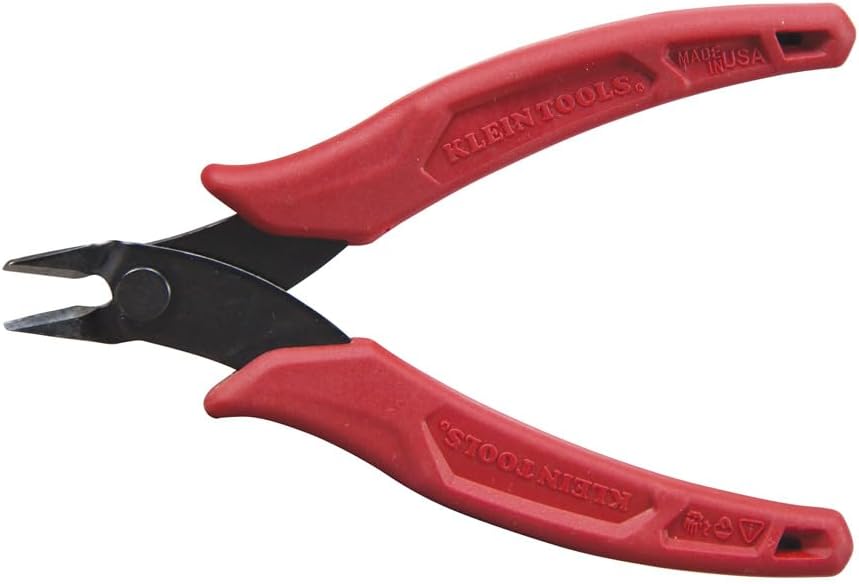
Klein Tools D275-5
4.6Editor score
Flat, flush cutting edges
Cuts wire up to 16 AWG
Slim profile for tight spaces
A micro flush wire cutter is a compact diagonal cutting tool designed to leave soft wire ends nearly flush with a component or work surface. The right model improves precision in electronics, jewelry, model building, floral crafts, and other detailed tasks where long snips would be difficult to control.
The tools in this guide were compared using their listed dimensions, blade designs, cutting capacities, return mechanisms, handle construction, and intended applications. The list covers professional-grade instruments, compact hobby tools, multipacks, and sets that combine flush cutters with standard side cutters.
Each review explains the strongest reasons to consider that model, along with its limitations and ideal user. Ratings reflect the supplied product information, while pricing and availability can change, so readers should confirm current listing details before purchasing.
4.6Editor score

4.8Editor score

4.7Editor score
As an Amazon Associate we earn from qualifying purchases.
The comparison below highlights blade precision, maximum soft-wire capacity, handling features, construction, and best-fit applications across ten leading micro flush cutters.


The Klein Tools D275-5 is a five-inch diagonal flush cutter with a 4.6 rating and a clear focus on practical, everyday precision work. Its side-cutting design produces a flat cut close to the work, while the compact shape gives users better access than full-size pliers. It is especially useful when a long protruding wire end would interfere with assembly.
We may earn a commission when you buy through this link, at no additional cost to you.
The tool's stated strengths include cutting zip ties, small wire, and other fine material. A pinch-cutting feature is intended to minimize fly-off, which can be valuable when trimming leads on a workbench or assembling a delicate project. Its slim profile also makes it more approachable for electronics repairs, model kits, jewelry work, and craft tasks where space around the work is limited.
The primary trade-off is that the supplied specifications do not mention a spring return mechanism. That means the D275-5 may require slightly more deliberate opening and closing than spring-loaded alternatives. Its listed 16 AWG maximum also makes it unsuitable for heavy-gauge wire, hardened steel, or demanding industrial shearing tasks.
This is the strongest general-value choice for electricians, hobbyists, crafters, and technicians who need a recognizable brand and dependable flush cuts without requiring an elaborate set. It is particularly appropriate for users who want one compact tool for zip ties, component leads, soft copper wire, and small model parts.
The flat side-cutting profile minimizes the distance left between the cut wire and its mounting point. This is helpful when component leads must sit neatly or when excess material could interfere with a nearby housing.
Because the cutter handles zip ties and soft wire, it can cover common tasks in electronics, jewelry, artificial flowers, and general repair work. Its five-inch format makes it easier to carry than a full-size electrician's diagonal cutter.
We may earn a commission when you buy through this link, at no additional cost to you.
The KATA Mini Flush Cutters are compact five-inch tools aimed at jewelry making, model kits, crafts, and light electrical work. Their 4.4 rating reflects solid utility, and the detailed specifications emphasize a sharp 10 mm angled jaw, an internal spring, and a five-inch body suited to precision tasks in restricted spaces.
We may earn a commission when you buy through this link, at no additional cost to you.
The cutting blade is described as 2.5 mm-thick 65 manganese steel that has been forged, heat-treated, and given a black electrophoretic parkerized finish. This construction is presented as durable enough for frequent use. The angled head is designed to create clean flush cuts in soft wire up to 16 AWG, while the spring-loaded action opens the jaws automatically after each squeeze.
A major convenience is the supplied safety cap. It closes over the cutting head for storage in a bag or pocket, which is useful when carrying a sharp tool to a class, craft session, repair bench, or job site. The non-slip TPR handle and dolphin-style shape are intended to improve comfort and control during repetitive work.
KATA is a compelling choice for crafters and hobbyists who need a portable micro cutter and value the included cap. It is less appropriate for anyone who routinely cuts hard steel, thick wire, or stainless steel, because the product information explicitly warns against those materials.
The spring-loaded return reduces the need to reopen the jaws manually, which can make repeated trimming less tiring. Combined with the non-slip grip, it supports steady work across jewelry, artificial flowers, component pins, and model assemblies.
The protective cap addresses a common drawback of compact cutters: exposed sharp edges inside a tool bag or pocket. It makes the KATA option especially convenient for mobile crafters and technicians.
We may earn a commission when you buy through this link, at no additional cost to you.
The Hakko CHP-170 Pack of 2 is a high-rated micro cutter set with a 4.7 rating. Its 8 mm angled jaw is built to produce flush cuts in soft wire up to 16 AWG, and the 21-degree head is intended to bring the cutting point close to component leads and other delicate work.
We may earn a commission when you buy through this link, at no additional cost to you.
Heat-treated 2.5 mm carbon steel provides the core cutting structure. Precision-ground holes and surfaces support smooth movement, while the return spring automatically opens the tool after use. This reduces the repetitive opening action associated with many manual flush cutters and can improve comfort during repeated trimming.
The curved dolphin-style handles use nonslip grips to support control, while the parkerized finish helps prevent glare and adds corrosion resistance. The main limitation is scope: this is a micro soft-wire cutter, not a heavy-duty side cutter. Users who occasionally need to cut thicker copper or standard electrical wire may prefer a two-tool set rather than this focused design.
The pack format is worthwhile for technicians who need a spare, for teams sharing equipment, or for users who keep cutters in separate work bags. For detailed electronics and soft-wire applications, the Hakko combines a compact jaw, smooth action, and highly rated construction in a particularly balanced package.
The spring returns the cutter to an open position after every squeeze, while precision-ground internal surfaces are intended to minimize friction. This design supports steady work when many component leads need trimming in succession.
The 8 mm jaw and 21-degree angled head create a short, precise cutting line. That geometry is particularly useful for component leads, copper wire, and other soft-wire terminations where remaining clearance is limited.
We may earn a commission when you buy through this link, at no additional cost to you.
The ARROW 5-inch Precision Micro Wire Cutters offer a modern ergonomic design with a 4.5 rating. Their contoured TPR grips are slip-resistant and shaped for control, while the overall compact format is intended to support detailed work in electronics, models, crafts, and other confined spaces.
We may earn a commission when you buy through this link, at no additional cost to you.
The jaws are made from SK5 steel with a stated hardness of 46-48 HRC. Extra-long, precision-ground jaws and angled tips are designed to make clean cuts through copper and other soft wire up to 12 AWG. The product data also identifies zip ties, electronic components, jewelry wire, craft flowers, and model parts as suitable applications.
A built-in return spring opens the jaws automatically after each squeeze. The stated ergonomic advantages may be especially helpful for users with limited grip strength, although actual comfort and handling will depend on the work and the user's hand. The black phosphate coating is intended to improve rust and corrosion resistance during frequent use.
ARROW is a good fit for hobbyists and professionals who want one micro cutter to address several soft-material tasks. It offers more stated cutting capacity than several 16 AWG alternatives, but the product guidance still warns against steel wire and extra-hard materials because they can damage the edge.
The contoured shape and slip-resistant TPR covering are intended to keep the tool stable during prolonged cutting. Its spring action reduces repeated opening effort, which can be beneficial during model building, PCB trimming, or craft production.
The stated 12 AWG capacity provides more margin than common micro cutters rated to 16 AWG. It can still address copper, aluminum, soft wire, plastic ties, electronic components, and delicate model parts without being marketed as a heavy-duty cutting tool.
We may earn a commission when you buy through this link, at no additional cost to you.
The Small Wire Cutters 2-Pack consists of two five-inch micro 170-style flush cutters and carries a 4.6 rating. Each tool is positioned as a compact diagonal cutter that can enter restricted spaces while producing a flat edge close to the part being trimmed.
We may earn a commission when you buy through this link, at no additional cost to you.
The product specifications highlight a 12 mm long, high-frequency hardened carbon steel jaw with an angled head. This cutter is listed for copper and soft wire up to 18 AWG, giving it one of the higher stated soft-wire capacities in the guide. The flat cutting edge is intended to reduce the need for additional filing after trimming.
An internal spring mechanism limits the jaw opening and returns the tool to a ready position, making repeated use convenient. Lightweight PVC-covered handles provide basic grip and leverage. The cutters are presented as useful for artificial-flower stems, plastic parts, model materials, PC boards, small wire, and zip ties.
The pack is especially practical for users who want two cutters for separate work areas, shared tools, or a replacement. Its trade-off is that the specifications provide fewer details about steel grade and grip geometry than some premium alternatives. It should not be used on hard steel, which could damage the cutting edge.
The stated 18 AWG limit covers relatively light soft wire compared with many micro cutters. That makes the pair useful for fine electrical work as well as artificial stems, plastic ties, and model components.
Keeping one cutter at a bench and another in a portable kit eliminates the inconvenience of moving a single tool. The lightweight design also makes the two-pack convenient for shared craft or repair workspaces.
We may earn a commission when you buy through this link, at no additional cost to you.
This two-piece set combines a five-inch Micro 170 flush cutter with a five-inch standard side cutter, giving it a 4.5 rating and a broader role than a single-purpose micro tool. The pairing is aimed at users who need both extremely close trimming and more conventional wire-cutting capability.
We may earn a commission when you buy through this link, at no additional cost to you.
Both tools use high-carbon steel construction with high-frequency hardened blades rated at 58-62 HRC. The micro cutter is listed for soft wire up to 18 AWG and plastic sprues, while the standard diagonal cutter handles copper and soft metal up to 14 AWG. That division of labor gives the set a clear advantage for mixed workshop tasks.
Internal reset springs open both jaws automatically, and thin, nonslip handles are designed for comfort and precise control. The set's main drawback is simply its larger footprint: two specialized tools require more storage than one. The standard cutter is also not intended for the same close, flush trimming as the micro model.
This is a strong choice for model builders, craft technicians, electronics hobbyists, and repair professionals who regularly move between delicate lead trimming and ordinary soft-metal cutting. It offers more task coverage than a single micro cutter without moving into heavy-duty plier territory.
The micro tool provides a flush cut close to the work, while the standard side cutter offers a broader option for copper and soft metal. That makes the pair useful when a project includes both delicate components and conventional wire.
Both cutters use internal reset springs, so they reopen after each squeeze. This supports quick repetitive work while the nonslip handles maintain a controlled grip during workshop tasks.
We may earn a commission when you buy through this link, at no additional cost to you.
The ENGINEER NS-04 is a 4.75-inch precision mini nipper with a 4.8 rating, the highest listed score in this guide. Made in Japan, it is designed specifically for close flush cutting of electronic components, copper wire, and soft component leads.
We may earn a commission when you buy through this link, at no additional cost to you.
Heat-treated carbon steel provides the cutting structure, while specially designed edges focus on clean termination close to the work. The most distinctive feature is an angle opening adjuster, which changes how far the jaws open when the grips are released. Users can tailor the opening to their workflow, improving control for tiny leads or speeding up repetitive larger cuts.
The handles use oil-resistant thermoplastic elastomer and are described as ESD safe. That combination makes the tool particularly relevant to electronics work, where a comfortable, controlled grip and reduced electrostatic concern matter. The compact size also suits hobbyists, craft work, and anyone working around a crowded circuit board.
ENGINEER is the most compelling precision-first recommendation for serious electronics users, model builders, and technicians who repeatedly trim component leads. It is not intended to replace heavy-duty diagonal cutters, but within soft-wire micro cutting, its adjustable opening and refined edges provide a highly specialized advantage.
The adjustable opening angle lets the user choose between a wider, faster reset and a narrower resting position. That control can improve accuracy around extremely small component leads while still supporting productivity during repetitive trimming.
The 4.75-inch body is compact enough for crowded circuit boards, and the ESD-safe elastomer grips support controlled handling. Together, these features make the NS-04 especially well suited to electronics and fine mechanical work.
We may earn a commission when you buy through this link, at no additional cost to you.
The Hakko CHP-170 Pack of 3 provides three micro cutters with a 4.7 rating. The set is intended for clean cutting in soft wire up to 16 AWG and is geared toward users who need several precision tools available at once.
We may earn a commission when you buy through this link, at no additional cost to you.
The supplied specifications list a Rockwell hardness of 56 and a cutting force of 5 kg, providing useful information about the tool's intended scale. As a micro soft-wire cutter, it is positioned for electronics, hobby work, and light craft applications rather than heavy-gauge cable or hardened metal.
Three cutters can be assigned to separate benches, placed in several tool bags, or used as backups in a classroom, workshop, or service team. Compared with a single-tool purchase, the pack reduces the need to share one cutter and keeps a spare available if a tool is misplaced or damaged.
The main consideration is whether three units are actually necessary. A solo hobbyist with one primary workspace may find the single-tool Hakko pack more efficient. For teams, educators, repair technicians, and users with multiple workstations, however, the three-pack combines the established CHP-170 design with convenient distribution.
Three identical cutters are easy to assign to different work areas or issue to team members. This is useful in training rooms, shared electronics benches, and service kits where a single instrument would create constant contention.
The stated 16 AWG capacity and soft-wire focus make the cutters appropriate for electronics and light hobby work. Users should not assume the hardness specification allows them to cut steel or other very hard materials.
We may earn a commission when you buy through this link, at no additional cost to you.
The KNIPEX 78 13 125 is a five-inch Electronics Super-Knip with a 4.6 rating and a 0.2 mm cutting capability. Its defining feature is the lead catcher, which is intended to retain tiny offcuts so they do not remain loose around a circuit board or delicate mechanism.
We may earn a commission when you buy through this link, at no additional cost to you.
Very sharp, ground cutting edges without a bevel support flush cuts, and the precision-shaped tips can cut close-seating wire from 0.2 mm in diameter. These are useful characteristics for fine electronics and mechanical work where even a short wire stub could matter. The INOX steel body adds corrosion resistance and a durable feel.
An opening spring and restricted opening support smooth, controlled operation while reducing fatigue. The trade-off is specialization: this is not a general-purpose side cutter for heavier copper, cable, or hard metal. Its strengths become most apparent in extremely fine work where tip reach, cut cleanliness, and debris retention matter.
This KNIPEX model is a strong recommendation for experienced electronics users, precision model builders, and fine-mechanics technicians who work with extremely small wire. The lead catcher and fine tip make it more specialized than the general-purpose micro cutters elsewhere in the guide.
The integrated lead catcher helps retain the severed end of very small wire. That can reduce loose debris around sensitive components and make the work area easier to inspect or clean.
The ability to cut from 0.2 mm wire, combined with narrow, ground tips, makes this tool suited to demanding electronic and mechanical assemblies. It is a specialist instrument for users who regularly work below standard hobby wire gauges.
We may earn a commission when you buy through this link, at no additional cost to you.
The KNIPEX 78 03 125 is a five-inch Electronics Super-Knip with a 4.7 rating. It is designed for ultra-fine cutting in electronics and fine mechanics, offering ground, very sharp edges without a bevel and the ability to cut close-seating wire from 0.2 mm in diameter.
We may earn a commission when you buy through this link, at no additional cost to you.
Its stated edge hardness is approximately 54 HRC, while the opening spring and restricted opening are designed to provide smooth movement and reduce operator fatigue. The narrow geometry makes the tool suitable for delicate circuit-board work and other applications where a broad jaw could disturb nearby components.
Compared with the KNIPEX lead-catcher model, this version focuses on the core cutting instrument without that added containment feature. It is therefore a more streamlined option for users who already work in a controlled environment or prefer simpler tool geometry. As with other micro flush cutters, it should be reserved for suitable wire and light component leads.
For serious electronics enthusiasts and technicians seeking a refined premium instrument, the 78 03 125 combines an excellent rating with precise tips, sharp edges, and fatigue-reducing action. It is most attractive to users who regularly work with extremely fine wire and can take advantage of its specialist design.
The ground edges are designed to cut flush without a bevel that might leave a broader finishing mark. This geometry is especially helpful when fine wire must terminate neatly beside a component or connector.
The restricted opening spring supports a controlled operating distance and smooth repeated use. It is intended to reduce fatigue while preserving the close access needed for detailed electronics work.
We may earn a commission when you buy through this link, at no additional cost to you.
Choosing a micro flush wire cutter requires balancing tip precision, cutting capacity, spring action, grip design, and the specific materials involved in your work.
The listed maximum wire gauge is one of the clearest ways to separate light micro cutters from slightly more capable tools. Models in this guide range from 18 AWG soft wire to 12 AWG copper for the ARROW tool, while several precision instruments focus on wires as fine as 0.2 mm. These ratings are not directly interchangeable because some describe general soft wire while others refer to very fine component leads.
Choose a cutter whose stated capacity comfortably exceeds the material you expect to trim. Leaving some capacity margin is useful because wire material, insulation, and cutting conditions can affect performance. Avoid treating a micro flush cutter as a heavy-duty wire snip.
Flush cutting depends on the blade shape, head angle, and tip geometry as much as on the steel itself. Angled heads help position the cutting point close to the work, while flat or bevelless edges are intended to reduce the projecting remnant left behind. Very narrow tips can reach component leads in crowded areas but may be less forgiving when approaching thicker material.
Look for descriptions that explicitly mention flat cuts, flush cutting, or close-seating wire capability. If your work demands an almost invisible protrusion, a precision model such as an ENGINEER or KNIPEX cutter may be more appropriate than a general compact diagonal cutter.
Blade steel influences edge retention, corrosion resistance, and the range of materials a cutter can handle safely. The guide includes manganese steel, carbon steel, SK5 steel, and INOX stainless steel. Many micro cutters are optimized for copper, aluminum, soft wire, plastic ties, and model materials rather than hardened steel.
Prioritize a well-described blade and a warning not to cut very hard materials. Carbon and manganese steel can provide durable, sharp edges in appropriate applications, while stainless steel adds corrosion resistance. The best choice is the material that matches your actual workload, not simply the most aggressive-looking metal.
Jaw length determines how much of the wire can be captured, while head angle influences how closely the cutter can approach a component. The KATA has a stated 10 mm jaw, the Hakko has an 8 mm angled jaw, and the two-pack offers a 12 mm jaw. These dimensions influence both reach and the size of the cut made.
A short angled jaw is valuable for very close component trimming. A somewhat longer jaw may be more convenient when you need to capture a small wire stem or trim plastic. Match jaw geometry to the clearance available around the finished work.
An automatic return spring opens the cutter after each squeeze, reducing the need to reach for or manipulate the handles manually. Internal springs, as found in the KATA, Hakko, ARROW, and KNIPEX models, can also preserve a compact profile. Restricted opening can provide a smaller working distance, while an adjustable angle offers greater control.
For repetitive cutting, a return spring is usually worthwhile. For occasional work, a non-spring cutter may still be perfectly manageable. Users with hand-strength concerns should pay particular attention to the opening force and grip design rather than assuming every spring-equipped model will feel equally easy to use.
Contoured shapes, nonslip TPR, dolphin-style profiles, and elastomer grips are all intended to improve control. These features matter most during repetitive tasks or when a cutter is used above a workbench. A slim five-inch body is generally easier to maneuver around a circuit board, jewelry fixture, or model than a full-size pair of diagonal cutters.
For portable work, consider the KATA's protective cap and the small size of the ENGINEER and Hakko models. For long sessions, prioritize a shape that feels comfortable and provides positive control. A secure grip is particularly valuable when the tool is used with very fine wire.
The phrase micro flush wire cutter covers several overlapping markets. Electronics users may need extremely fine tip reach and ESD-safe grips, while craft users may prioritize handles for artificial stems. Model builders often need to trim plastic sprues and component pins without scratching finished parts. General repair users may value a tool that also handles zip ties.
Choose the model whose specifications directly match your recurring tasks rather than one that merely mentions your application. A PCB-focused precision cutter, a zip-tie-friendly electrician's tool, and a two-tool workshop set solve different problems even though they share a similar cutting style.
Single tools are economical for one workstation, while two- and three-packs offer redundancy and convenient distribution. The Hakko packs are ideal for teams, classrooms, or multiple work areas, and the two-piece mixed set adds a standard side cutter alongside the micro model. Extra tools are helpful only when they will actually be used.
Consider where work happens before choosing a multipack. Separate kits, shared benches, and portable repair bags can benefit from duplicate micro cutters. A mixed set may be more useful if regular soft-metal cutting accompanies delicate flush trimming, while a single precision tool may better serve a specialist.
Before making a cut, identify the wire or material and confirm that it falls within the tool's stated capacity. Position the angled jaws as close to the intended termination point as possible, then use short, controlled squeezes. For the cleanest result, support the component or work piece so it does not move as the cutter closes.
Keep the cutting edges aligned with the material and avoid twisting the tool while squeezing. Do not force the jaws closed, pry against the blade, or cut hardened steel, thick cable, or very hard plastics unless the manufacturer specifically permits it. If the cutter resists, stop and select a tool rated for that material rather than risking damage to the edge or workpiece.
After use, wipe away loose debris with a soft dry cloth or a lightly dampened cloth appropriate for the tool's finish. Do not immerse electrical tools or allow moisture to enter the pivot. Store the cutter in a dry place, use a cap or sheath where provided, and periodically apply a suitable light oil to the pivot if the manufacturer's guidance permits.
A micro flush wire cutter trims small electrical leads, component wires, zip ties, and craft wire close to their attachment point. The narrow angled jaws are especially useful in electronics, jewelry, model building, and artificial-flower projects. It is intended for precision work rather than heavy-gauge cable or hard metal.
It can cut suitable soft electrical wire within its stated AWG limit. The limit varies by model, with examples in this guide ranging from 18 AWG soft wire to 12 AWG copper. Users should check the individual specifications and avoid cutting live wires or any material that exceeds the tool's stated capacity.
Flush cutters are designed to leave the cut end nearly level with the work surface. Diagonal cutters usually create a longer angled end and may be better for general-purpose cutting. Some sets include both types so users can move between close component trimming and more conventional soft-wire cuts.
Most micro flush cutters in this guide are not intended for hardened or very thick steel. Several product descriptions explicitly warn against cutting hard steel because it can damage the cutting edge. Use a suitable dedicated metal cutter for steel, stainless steel, heavy cable, or other demanding materials.
Choose a cutter rated above the gauge you normally use, then check whether the stated limit refers to copper, soft wire, or another material. A 16 AWG rating is common for fine electronics and soft-wire work, while 18 AWG suits lighter applications. The 12 AWG ARROW model offers more capacity for soft copper and aluminum.
A spring-loaded cutter often reduces fatigue because it opens automatically after every squeeze. It is useful for prolonged trimming sessions and one-handed work. Users who prefer to control the jaw opening themselves may appreciate an adjustable-angle tool such as the ENGINEER NS-04.
They are common in electronics because their small jaws can reach component leads without disturbing nearby parts. Models with ESD-safe grips offer additional electrostatic protection. Proper handling, a stable work surface, and careful control remain necessary regardless of the grip material.
Use it only on the materials for which it is rated, and clean away metal fragments after each session. Avoid twisting or prying with the jaws, which can damage the edge. If the tool begins crushing rather than cleanly shearing wire, stop using it on that material and consider professional sharpening or replacement.
The Klein Tools D275-5 offers the strongest general-value option for zip ties, soft wire, and common precision tasks. The ENGINEER NS-04 stands out for its adjustable opening, high rating, and electronics-focused ergonomics, while the KNIPEX 78 03 125 delivers premium precision for extremely fine wire.
Prioritize the application before choosing a model. Light craft and repair users may value portability and a safety cap, electronics technicians may need a tiny angled jaw, and workshop users may prefer a spring, an ergonomic grip, or a multipack. Always check the stated wire capacity and never use a micro flush cutter on material outside its intended range.
Current prices and listing availability can change over time, so readers should review the latest product details before purchasing. Comparing the tool's jaw geometry, materials, spring action, and intended use against the work it will perform is the most reliable route to a satisfying purchase.