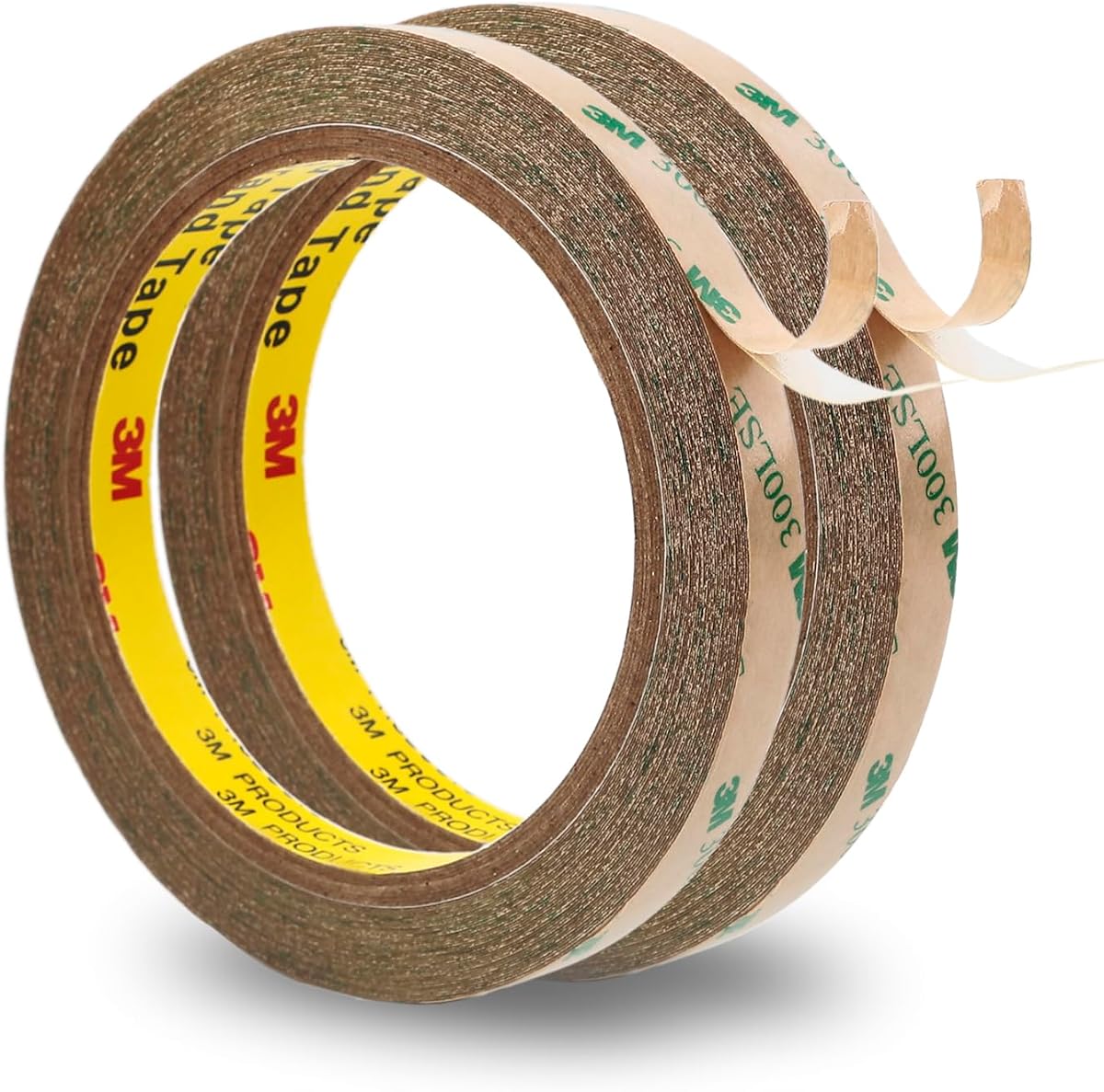
3M 300LSE Double Sided Tape
4.6Editor score
Professional 300LSE acrylic adhesive
170-micron polyester carrier
Low-energy plastic bonding
Detailed application guidance
Adhesive tape for electronics must balance secure bonding, clean application, and compatibility with delicate components. Narrow acrylic tapes are suited to screens and internal assemblies, while polyimide heat-resistant tapes serve soldering, insulation, and high-temperature applications. Tape dimensions, adhesive behavior, and removal characteristics should guide the selection.
The products in this guide were compared using their stated materials, widths, lengths, temperature tolerances, included accessories, and intended repair applications. The list covers clear LCD bonding tapes, precision double-sided rolls, and heat-resistant tapes for circuit boards and manufacturing work, rather than treating every tape as suitable for every electronic job.
Each review explains the product's most useful features, practical trade-offs, and likely audience. The top selections highlight exceptional overall versatility, a premium 3M bonding option, and a convenient two-width budget choice. Product listings and availability can change, so readers should confirm current specifications and compatibility before purchasing.
4.6Editor score

4.6Editor score

4.4Editor score
As an Amazon Associate we earn from qualifying purchases.
The comparison highlights the differences that matter in electronics work: adhesive construction, tape dimensions, temperature tolerance, included tools, and whether the roll is optimized for LCD bonding, high-temperature processing, or broader mounting tasks.


The Kaisiking 2mm LCD Repair Tape combines an exceptionally narrow profile with a long 50-meter roll, making it one of the most practical choices for precision electronics work. Its 4.6 rating reflects a favorable balance of bonding performance, clean handling, and repair-focused design. The clear strip is particularly suitable when a screen, lens, battery cover, or narrow component must be secured without introducing a conspicuous adhesive line.
We may earn a commission when you buy through this link, at no additional cost to you.
The tape is described as waterproof, sealed, and resistant to aging, solvents, softening, and high peel forces. Its ultra-thin 0.1mm construction helps it fit into restricted spaces where a thicker adhesive layer might interfere with alignment, bezels, or nearby components. A 50-meter length also allows a technician or careful hobbyist to cut multiple custom shapes without frequently replacing the roll. The included anti-static tweezers support more controlled placement of narrow strips.
The important caveat is that this is a 2mm roll rather than a mixed-width set, so jobs requiring a broader strip may need another tape. The manufacturer also warns that extended exposure to high temperatures may prevent the adhesive from forming a permanent bond. That limitation makes the product better suited to controlled assembly than to prolonged thermal exposure. Even so, its combination of length, thinness, and repair accessories gives it exceptional utility.
This is the best overall adhesive tape for electronics for screen replacement, compact internal assemblies, and precision DIY repairs. Buyers who repeatedly replace displays or work with narrow flex cables will appreciate the long roll and included tweezers. For high-temperature or die-cut industrial bonding, a more specialized tape may be preferable, but for versatile bench repair this is a strong recommendation.
The 0.1mm profile is the defining advantage for delicate assemblies. It allows the adhesive to occupy a narrow layer without visually or mechanically dominating the repair, making it useful around LCD edges, battery compartments, lenses, and small covers.
A continuous 50-meter roll reduces interruptions, while the anti-static tweezers help position the strip around sensitive components. Together, these details make the product convenient for both first-time repairs and repeated workshop use.
We may earn a commission when you buy through this link, at no additional cost to you.
This LCD Repair Tape set offers two 50-meter rolls measuring 2mm and 3mm wide, providing more placement flexibility than a single-width product. Its 4.5 rating and broad list of intended uses position it as a practical option for phone screens, tablets, laptops, cameras, batteries, and LCD panels. It is especially attractive to repairers who want both a narrow perimeter strip and a slightly wider bonding line.
We may earn a commission when you buy through this link, at no additional cost to you.
The stated acrylic adhesive is described as strong, removable without leaving traces, and effective across low and high temperatures. The product also claims resistance to water, aging, solvents, and softening. Anti-static tweezers are included to help with positioning, which matters when applying a narrow adhesive line to a display frame or another small component. A 50-meter length on each roll is substantial for multiple repair projects.
One uncertainty is that the product information does not identify the tape thickness. That matters because effective bonding depends on fitting the adhesive into the gap between components without preventing closure or alignment. The general performance claims are also broader than those of a specialized industrial product, so the tape should be evaluated against the exact assembly, adhesive compatibility, and environmental demands of the intended job.
The set is best for screen and touch-display repairs where a technician wants both 2mm and 3mm options available. It also suits hobbyists building a repair kit and needing tape for several narrow components. Those requiring a documented carrier thickness or extreme-temperature certification may prefer a tape with more explicit engineering specifications.
The 2mm roll fits tight perimeters, while the 3mm roll offers a larger bonding area when the component can accommodate it. This combination is particularly useful for different screen frames, lens covers, and battery-related assemblies.
Each 50-meter roll provides enough material for numerous custom strips. Including anti-static tweezers further supports controlled placement around compact and potentially sensitive electronic assemblies.
We may earn a commission when you buy through this link, at no additional cost to you.
The Kaisiking 5mm and 10mm acrylic tape set is designed for situations where a narrow perimeter adhesive would not provide enough bonding area. With a 4.6 rating and transparent construction, it is a practical option for screen protectors, LCD panels, camera covers, rubber pads, and general electronics mounting. The pair of 25-meter rolls provides useful flexibility without making the tapes excessively bulky.
We may earn a commission when you buy through this link, at no additional cost to you.
Made from polyester and soft PET with acrylic coating on both sides, the tape is described as having high peel strength, strong initial adhesion, and resistance to aging, shear, solvents, softening, and moisture. Its stated operating range extends from 25 degrees below zero to 150 degrees Celsius. Transparency is especially valuable where the adhesive sits beneath a visible cover, because the product is intended to keep the finished surface visually smooth.
This set is less appropriate for extremely narrow flex-cable routes or tiny display edges that call for a 1mm or 2mm strip. It also differs fundamentally from polyimide heat-masking tape: its strengths concern structural bonding and transparent mounting rather than prolonged soldering protection. Buyers should also verify that broad adhesive surfaces will not interfere with vents, controls, or heat-transfer components in the intended assembly.
This is a good choice for repairers who work with camera covers, display panels, rubber components, or wider bonding areas and value transparency. It may also serve general craft and workshop applications listed by the manufacturer. For delicate phone-screen perimeters, however, the narrower products in this guide offer more appropriate dimensions.
The clear acrylic adhesive is intended to remain visually unobtrusive beneath glass, screens, and camera covers. This makes the wider rolls more useful for appearance-sensitive assemblies than an opaque tape would be.
At 5mm and 10mm wide, the rolls can cover larger contact zones than ultra-narrow screen tapes. The result is useful for rubber pads, display panels, covers, and other components with broader adhesive channels.
We may earn a commission when you buy through this link, at no additional cost to you.
The 2mm Double-Sided Adhesive Sticker Tape is a compact repair kit containing narrow tape, anti-static tweezers, and a microfiber cloth. Its 4.4 rating reflects a straightforward product aimed at smartphone, tablet, PC, laptop, LCD, and digitizer work. It is particularly appealing to buyers who want the essential placement and cleaning tools in the same purchase rather than assembling a separate repair station.
We may earn a commission when you buy through this link, at no additional cost to you.
The ultra-strong acrylic adhesive is described as resistant to heat, moisture, and solvents, with the ability to bond plastic, metal, and other materials. A paper backing makes it possible to handle and cut the double-sided tape more easily, while the tweezers assist with removing old adhesive and placing new strips accurately. Listed applications include lens repairs, camera covers, battery compartments, flex cables, and LCD panel displays.
The principal limitation is that the supplied data does not state the roll length, so buyers cannot directly compare how many repairs one roll will support. It also provides only a 2mm width, which may not be sufficient for broad bonding areas. Because the description discusses general strength and material compatibility, users should still test the adhesive on a noncritical surface when bonding unusual plastics or valuable components.
The set is best for a new repair kit, hobbyist, or technician who values the included tweezers and cleaning cloth. It is also a versatile option for small electronic fixes involving narrow strips and mixed materials. Those seeking documented roll length, multiple widths, or industrial carrier specifications should consider a more explicitly specified alternative.
Anti-static tweezers assist with positioning and old-adhesive removal, while the microfiber cloth helps prepare surfaces. These additions make the package more useful for a complete repair task rather than simply supplying adhesive.
The acrylic adhesive is described as suitable for plastics, metals, lenses, flex cables, and display components. That broad compatibility makes the narrow strip useful for several types of small electronic assemblies.
We may earn a commission when you buy through this link, at no additional cost to you.
The QDiShi LCD Repair Tape set includes 2mm and 3mm rolls, each measuring 25 meters, along with tweezers and three alcohol preparation pads. Its 4.5 rating and focus on touch-screen repair make it a balanced option for technicians who want two standard widths and the basic tools needed to prepare and position the adhesive.
We may earn a commission when you buy through this link, at no additional cost to you.
The clear acrylic tape is described as providing high peel strength, strong initial adhesion, and effective performance from 25 degrees below zero to 150 degrees Celsius. The manufacturer highlights resistance to water, aging, shear, solvents, softening, and moisture. Including alcohol prep pads is a practical detail because clean bonding surfaces help reduce contamination, although users should confirm that alcohol is appropriate for the specific display materials involved.
Compared with 50-meter versions, each 25-meter roll provides less material and may need replacement sooner in a high-volume workshop. The product description also references uses such as posters, signs, and crafts, but the two included widths and repair focus make it most relevant to electronics. As with other permanent adhesives, performance can depend on the surface, pressure, cleanliness, and whether the parts are closed immediately after placement.
This set is well suited to phone, tablet, and laptop screen work where both narrow and slightly wider strips are useful. The tweezers and preparation pads improve convenience, while the two-width arrangement reduces the need to purchase separate rolls. Buyers working on high-volume assemblies may prefer a longer option, and those requiring a specified tape thickness should look for additional manufacturer data.
Three alcohol prep pads support the essential step of removing oils and contaminants before bonding. Combined with the tweezers, they create a more practical repair package than an unsupported roll alone.
The 2mm and 3mm widths accommodate narrow frame edges and broader bonding strips. This combination is useful when working across several devices whose display assemblies have different channel dimensions.
We may earn a commission when you buy through this link, at no additional cost to you.
The 10mm Heat Transfer Tape is one of the strongest-rated products in this guide, with a 4.7 rating, but it serves a fundamentally different role from the clear screen-repair tapes. It is a 10mm-wide polyimide film tape with heat adhesive, intended for electronics, soldering, circuit boards, sublimation, and other thermal processes. The maximum stated heat resistance is 482 degrees Fahrenheit, or 250 degrees Celsius.
We may earn a commission when you buy through this link, at no additional cost to you.
The product comes as two 33-meter rolls, providing a substantial amount of material for masking and thermal protection. Its film construction is designed to withstand heat while peeling away cleanly without leaving residue. That makes it useful for shielding selected areas during soldering or thermal work, where ordinary double-sided acrylic tape could soften, lift, or leave adhesive behind.
This tape is not the right choice for bonding smartphone LCDs or display assemblies because its heat adhesive and 10mm width are designed for a different application. Users should also account for the distinction between maximum heat resistance and installation requirements: because the adhesive is heat activated, it may need a separate activation step to develop the bond. Exact handling should follow the manufacturer's instructions.
The product is best for repairers, fabricators, and manufacturers who require dependable protection during soldering, sublimation, or elevated-temperature processing. Its clean-removal claim makes it particularly useful around circuit boards and finished surfaces. For routine screen replacement, choose one of the narrow clear acrylic options instead.
A narrow heat-resistant strip can mask a connector, trace, or sensitive nearby component while hot work is performed. Polyimide film remains well suited to this purpose because it tolerates much higher temperatures than conventional acrylic tape.
The stated residue-free removal is a major advantage for finished circuit boards and assembled devices. It reduces the cleanup required after a thermal process and helps preserve a clean working surface.
We may earn a commission when you buy through this link, at no additional cost to you.
The 3mm Clear Thin Double Sided Strong Adhesive Acrylic Tape is a well-specified option for mobile phone, laptop, tablet, LCD, lens, battery, and camera work. It carries a 4.5 rating and stands out from many competing products by clearly stating its dimensions: 3mm wide, 25 meters long, and 0.2mm thick. That documentation helps buyers judge fit before starting a repair.
We may earn a commission when you buy through this link, at no additional cost to you.
The transparent tape is built for applications where the adhesive should not visibly interrupt a finished surface. Its stated operating range of -25 to 150 degrees Celsius is accompanied by claims of strong adhesion, high-temperature resistance, and corrosion resistance. The manufacturer's list of uses includes screen-protector installation, LCD panel displays, tablet computers, camera lenses, batteries, camera covers, and general workshop projects.
The 3mm width creates a larger contact area than 1mm or 2mm tape, but it may not fit exceptionally narrow display channels. The stated length of 25 meters is adequate for multiple repairs but is shorter than the longest rolls in this comparison. The description's references to signs, posters, and outdoor surfaces are not central to electronics and should not be confused with tested device compatibility.
This is a good general choice when a technician wants a clearly measured 0.2mm acrylic tape and a standard 3mm width. It is especially relevant to screens and other assemblies with enough room for a moderately narrow adhesive line. Users needing extreme thinness, several widths, or high-temperature polyimide protection should select a more specialized product.
Knowing the tape is 0.2mm thick can prevent avoidable fit problems during a screen or panel repair. The 3mm width is easy to compare against the available bonding channel before cutting.
Transparency allows the adhesive line to remain visually discreet under covers and displays. This makes the roll useful where appearance matters as well as physical attachment.
We may earn a commission when you buy through this link, at no additional cost to you.
The Pimoys Double Sided Phone Repair Tape provides two clear rolls measuring 2mm and 3mm wide by 25 meters each. Its 4.4 rating makes it a strong budget-oriented selection for screen protectors, LCD panels, tablets, cameras, batteries, and general small-electronics assembly. The two-width format provides more convenience than buying a single narrow roll.
We may earn a commission when you buy through this link, at no additional cost to you.
The acrylic adhesive is described as permanent, strong, and transparent. A red release backing makes the tape easier to handle and peel before it is applied, while the material can be cut into custom shapes. The stated operating range extends from 25 degrees below zero to 150 degrees Celsius, with claims of strong peel, initial adhesion, and overall adhesive performance.
Unlike some similarly sized products, the listed information does not state the tape thickness. That omission matters for screen repairs, where a strip that is too thick can interfere with closure. The claim that it can be removed without residue also should be considered surface-dependent; textured plastics, coatings, aged adhesives, and delicate finishes can behave differently. Users should test removal on a hidden area when the result matters.
This set is best for a compact repair kit, display work, and projects requiring both 2mm and 3mm strips. It offers a straightforward way to match different bonding channels without carrying separate rolls. For documented film thickness, industrial bonding performance, or heat-masking duty, a more specialized tape would be a better match.
The 2mm and 3mm rolls cover common narrow bonding routes. This lets a repairer choose the better fit without purchasing a separate narrow tape for every display geometry.
The red release backing provides a visible layer that can be peeled away during placement. The tape can also be cut to shape, allowing users to prepare small custom pieces before opening the device.
We may earn a commission when you buy through this link, at no additional cost to you.
The 3M Double Sided Tape 300LSE is the premium choice in this guide, combining a recognized 300LSE acrylic adhesive with a clear polyester carrier. Its 4.6 rating and detailed specifications distinguish it from general-purpose repair rolls. The product is particularly relevant to manufacturers, advanced hobbyists, and professional repairers who need reliable bonding to plastics, glass, metals, and other demanding surfaces.
We may earn a commission when you buy through this link, at no additional cost to you.
The 300LSE adhesive is specifically described as effective on low-surface-energy plastics such as polypropylene, along with foam, powder-coated surfaces, leather, LED strips, and other substrates. The 170-micron film carrier provides dimensional stability and makes die-cutting and handling easier. Bond strength is stated to improve over time, which is valuable when a component must remain fixed through long-term use rather than only an initial assembly test.
The supplied guidance calls for cleaning with a 50:50 mixture of isopropyl alcohol and water, application between 70 and 100 degrees Fahrenheit, and firm pressure for 30 seconds. It also warns against initial application below 50 degrees Fahrenheit because cold conditions can make the adhesive too firm. These are meaningful procedural requirements rather than minor suggestions, particularly for a permanent structural bond.
This is the best premium adhesive tape for electronics when longevity, low-surface-energy plastic adhesion, and controlled bonding matter more than ultra-narrow dimensions. It is a strong option for lens and LCD bonding, camera modules, battery doors, LED assemblies, and component fixtures. For perimeter phone-screen work, a narrower repair tape may fit more easily.
Many ordinary adhesives struggle to wet out evenly on polypropylene and similar low-energy plastics. The 300LSE formulation is specifically highlighted for these surfaces, making it more appropriate for demanding component assemblies.
The recommended cleaning mixture, application range, pressure time, and low-temperature warning give users a repeatable process. Following those steps is especially important when permanent bond reliability is the priority.
We may earn a commission when you buy through this link, at no additional cost to you.
The APT Polyimide Adhesive Tape is a wide, industrial-style tape for masking, soldering, electrical insulation, manufacturing, 3D printing, and other demanding thermal tasks. With a 4.7 rating, it is one of the highest-rated options here. Its one-inch width and 36-yard length make it a workbench consumable rather than a precision display-bonding strip.
We may earn a commission when you buy through this link, at no additional cost to you.
The one-mil polyimide film uses a high-temperature silicone adhesive and is stated to withstand temperatures up to 400 degrees Fahrenheit, or 260 degrees Celsius. It also provides electrical insulation, minimal shrinkage after baking, clean removal without residue, and resistance to curling and lifted edges. Those properties make it useful for circuit-board insulation, coil grounding barriers, fiber-optic cable work, and thermal sublimation.
Its one-inch width and strong thermal adhesive are not appropriate for a narrow phone bezel or small LCD channel. The tape also requires the silicone adhesive bond to be considered when removing it, particularly from heat-exposed or delicate surfaces. Product compliance claims include RoHS and REACH, and the tape is described as meeting the ASTM D-5213 standard, which may be relevant to professional users.
The APT tape is best for electronics technicians, fabricators, and repairers who regularly perform soldering, insulation, masking, or 3D-printer work around heated components. It is less relevant to routine display replacement, where the clear acrylic rolls are easier to fit. Its combination of heat tolerance, insulation, and clean removal makes it a strong specialist tape outside the screen-repair category.
Polyimide film, minimal shrinkage, and resistance to curled or lifted edges help the tape remain flat during thermal work. This stability is useful around hot tooling, soldering areas, and heated printer components.
Beyond masking, the tape provides electrical insulation for circuit boards, coils, and cable work. Its long roll and wide format suit repetitive workshop and production applications.
We may earn a commission when you buy through this link, at no additional cost to you.
The right electronics tape depends on the component being bonded, the space available, the required bond life, and the temperatures the assembly will encounter. Begin with the job rather than the brand, then narrow the choice by dimensions, adhesive chemistry, carrier construction, and application method.
Adhesive tape for electronics is not one interchangeable category. Clear double-sided acrylic rolls are intended for display frames, lenses, batteries, covers, flex cables, and other bonded components, whereas polyimide heat-resistant tapes are meant to protect or mask areas during soldering and elevated-temperature processes. Using a heat-resistant tape as a screen adhesive or using a clear acrylic tape as a soldering mask can lead to poor fit, unexpected removal issues, or inadequate performance.
Width is often more important than overall roll length. A 2mm or 3mm strip may fit a phone-screen edge, while 5mm and 10mm rolls suit broader panel or cover channels. The one-inch APT tape is useful for wide masking and insulation areas but is rarely appropriate for a narrow display perimeter. Measure the channel, account for curves and corners, and choose a tape that can be cut into the required path without folding.
Thickness affects fit as much as width. The Kaisiking 2mm roll is specified at 0.1mm, the 3mm clear acrylic roll at 0.2mm, and the 3M 300LSE product at 170 microns, or 0.17mm. These differences may seem small but can determine whether a display, lens, or cover closes correctly. Where thickness is not published, ask the manufacturer rather than assuming it matches another roll.
Temperature tolerance has two parts: how well the tape can survive the assembly's normal environment and whether the adhesive can be installed reliably at the current room temperature. Most clear acrylic repair tapes state an operating range from -25 to 150 degrees Celsius. The polyimide options are designed for much higher heat, with stated maxima of 400 and 482 degrees Fahrenheit. Do not interpret survival during soldering as proof that the tape can form its strongest bond when hot.
Acrylic adhesives are widely used because they offer strong bonding, reasonable temperature tolerance, and easier removal than many aggressive permanent systems. The 3M 300LSE option adds a polyester film carrier and a formulation aimed at low-surface-energy plastics. Polyimide heat tapes use different adhesive systems optimized for thermal exposure. A good match also depends on whether the bonded surfaces are smooth, textured, coated, porous, oily, or chemically sensitive.
Residue-free removal is a desirable claim, but it can depend on aging, temperature, surface coating, and how long the tape has remained in place. For example, the 3M 300LSE product warns against painted walls because removal may affect the finish. Screen glass, bare metal, powder-coated plastic, and textured plastic can behave very differently. Test an inconspicuous area and avoid leaving a full strip under a part until the fit and removal behavior are known.
Even a strong adhesive performs poorly on oily or contaminated surfaces. The 3M product specifically recommends a 50:50 isopropyl alcohol and water cleaning mixture, application between 70 and 100 degrees Fahrenheit, and firm pressure for 30 seconds. Other rolls benefit from similar care. A paper or red release liner can make handling easier, while tweezers help place narrow strips without touching bonding surfaces. Cleaning, cutting, and positioning should be prepared before the device is opened.
Accessories can materially improve a tape's usefulness. Anti-static tweezers support precision placement and help with sensitive components. A microfiber cloth and alcohol prep pads help prepare surfaces, while multiple roll widths reduce the need for separate purchases. Accessories do not improve the adhesive itself, so they should complement—not replace—careful surface preparation and compatibility checks.
Begin by identifying the exact bonding surfaces and confirming that the tape's material, width, and thickness suit the assembly. Clean both surfaces thoroughly using a cleaner compatible with the display, coating, plastic, or metal involved. For the 3M 300LSE tape, the recommended cleaning solution is a 50:50 mixture of isopropyl alcohol and water. Allow the surfaces to dry fully, and avoid handling the clean bonding areas with oily fingers.
Measure the required strip and cut it while the release liner is still attached. Apply the tape to one surface, remove the liner carefully, and lower the component rather than sliding it, which can trap air or contaminate the adhesive. Use anti-static tweezers for narrow routes. Follow the product's pressure and temperature instructions; the 3M option calls for firm pressure for 30 seconds and application between 70 and 100 degrees Fahrenheit.
After bonding, allow the assembly to rest before stressing it, particularly if the tape is permanent acrylic. Store unused rolls in their packaging, away from dust, direct heat, and prolonged ultraviolet exposure. For heat-resistant tape, keep the roll clean because residue transferred to a later masking job can interfere with adhesion. When removing tape, work slowly at a low angle and avoid pulling sharply across a display edge or finished surface.
A narrow, clear, double-sided acrylic tape is generally the most practical choice for LCD and touch-screen perimeter bonding. The tape should be thin enough to fit the display channel, strong enough for the expected handling, and compatible with the frame materials. Width matters as much as adhesive strength, so measure the available space before selecting a 2mm, 3mm, or wider roll.
It depends on the tape's construction and the component involved. Household double-sided tape may lack the narrow profile, temperature tolerance, clean removal, or material compatibility required for displays and internal assemblies. Purpose-built acrylic repair tape is generally more predictable for LCD bonding, while polyimide tape is better for soldering, insulation, and other high-temperature work.
Width and strength are separate characteristics. A wider roll generally offers a larger bonding area and can be more resistant to shear, while a narrow roll may conform better to tight channels and fine routes. The best choice depends on the component geometry, required load, adhesive formulation, and the surface area that can safely be covered.
A heat-resistant polyimide tape is designed for this environment because it tolerates temperatures far above those of ordinary acrylic tape. The APT and 10mm heat-transfer options both suit soldering, masking, insulation, and related thermal tasks. They are not necessarily better screen adhesives, so choose them according to whether the primary job is heat protection or permanent component bonding.
Many products claim removable or residue-free behavior, but actual results depend on the surface, temperature, age, and removal method. Bare glass, metal, coated plastic, painted surfaces, and textured finishes can react differently. Test a small section and remove it slowly before applying tape across an entire visible or high-value component.
Remove dust, skin oils, moisture, and old adhesive residue before applying a new strip. The surface should be dry and free of loose particles, while the cleaner must be compatible with the display coatings, plastics, metals, and finishes involved. The 3M 300LSE product specifically recommends cleaning with a 50:50 mixture of isopropyl alcohol and water.
Many acrylic electronics tapes are advertised for multiple substrates, but no adhesive should be assumed to bond every plastic equally. Low-surface-energy plastics such as polypropylene can be more difficult than glass or metal. The 3M 300LSE option is specifically formulated for challenging plastics and provides a strong reason to choose it for demanding assemblies.
Yes, because an overly thick strip can prevent the screen from sitting flat or create an uneven bond line. Products such as the 0.1mm Kaisiking roll and 0.2mm clear acrylic roll document their thickness, allowing comparison with the device's available channel. If a product does not state its thickness, confirm the specification before installation.
The Kaisiking 2mm LCD Repair Tape is the strongest all-around choice for precision screen and internal-component work because it combines a 0.1mm profile, a 50-meter roll, and anti-static tweezers. The 3M 300LSE tape stands apart as the premium option for demanding plastics, controlled bonding, and long-term assembly work, while the Pimoys two-roll set offers a convenient budget choice for common screen repairs.
For heat-intensive tasks, prioritize the APT polyimide tape or the 10mm heat-transfer tape rather than a clear screen-bonding roll. For displays, match width and thickness to the device before purchasing, and choose based on clear bonding channels, surface compatibility, and available accessories. Cleaning the surfaces and following the stated application conditions are just as important as the tape selection itself.
Electronics repair supplies can change in design, availability, and specification, so confirm the current product listing before ordering. Check the roll dimensions, adhesive type, included tools, temperature guidance, and intended applications against the exact repair you plan to perform. That final compatibility check will help you choose the most appropriate adhesive tape for electronics with greater confidence.