
VEVOR Ratcheting Cable Cutter
4.8Editor score
Cuts copper and aluminum cable
Up to 600 MCM capacity
Heat-treated steel construction
Insulated PVC-coated handles
Quick-release reset button
Compare the best ratcheting cable cutter for electricians by capacity, blade design, ratchet mechanism, safety, and handling to find the right tool for the job.
Ratcheting cable cutters help electricians cut substantial copper and aluminum conductors with less hand force than ordinary pliers. A quality ratchet mechanism holds the cable steady while the blade advances in controlled stages, producing straighter, more consistent cuts. Capacity, blade material, grip comfort, and safety features determine which model best fits a given installation workflow.
This guide compares ten cable cutters using the specifications and stated capabilities supplied for each product. The evaluation considers cutting capacity, ratchet construction, blade design, handle ergonomics, release mechanisms, intended materials, and suitability for confined workspaces. It also distinguishes between general-purpose copper and aluminum cable cutters and the armored-cable model included in the list.
Each review identifies the strongest reasons to consider a cutter, along with any limitations visible in the available product information. The top selections represent a budget-oriented option, an all-around professional choice, and a premium tool with substantial capacity. As prices and availability change over time, readers should compare current listings, warranty terms, and specifications before making a purchase.
4.8Editor score

4.7Editor score

4.7Editor score
The comparison below places each cutter's stated capacity, mechanism, construction, and intended applications side by side. It is designed to help electricians distinguish general copper and aluminum cable tools from the dedicated armored-cable cutter without overlooking important material or safety limitations.


The Yangoutool Ratchet Cable Wire Cutter is a heavy-duty option for electricians and installers who regularly prepare large copper or aluminum conductors. It carries a 4.4 rating and advertises capacity up to 240mm², with a maximum listed as 600 MCM. Its defining feature is a ratchet drive that grips the cable before the cutting stroke progresses, helping the user make rapid, straight cuts with less effort.
We may earn a commission when you buy through this link, at no additional cost to you.
The design is particularly useful in larger installation work where a conventional diagonal cutter would require considerable hand force. The ratchet action maintains consistent engagement as the handles close, while the compact format should be more manageable than a full-size manual cable saw in crowded panels or restricted work areas. The product information specifically identifies copper and aluminum as appropriate cable materials, which gives buyers a clear indication of its intended scope.
There are important boundaries to consider. The manufacturer states that the cutter is not suitable for steel, steel wire, or live wires. It should therefore be treated as a dedicated copper and aluminum cable tool rather than a universal cutting solution. The available information also does not identify the exact steel grade, insulated-handle certification, replacement-blade availability, or included accessories, so buyers who prioritize those details may need to confirm them with the seller.
This cutter makes the most sense for electricians who need a capable ratcheting tool for large single conductors or suitable stranded cables and value compact handling. It may be less attractive for technicians whose assignments regularly involve armored cable, ACSR, wire rope, or energized conductors. For those applications, a more specialized tool with clearly documented blade compatibility would be the safer and more appropriate choice.
The ratchet drive progressively closes the jaws and helps hold the conductor in position. That controlled engagement supports straighter cuts and reduces the amount of force required from the user, especially valuable when preparing larger cables as part of repetitive installation work.
A stated capacity of 240mm² makes this model relevant to larger service and infrastructure work. Its compact construction also helps when the cable must be cut inside a panel, enclosure, or other area where a long straight blade or cable saw would be awkward to operate.
We may earn a commission when you buy through this link, at no additional cost to you.
The HKS Ratchet Cable Wire Cutter stands out as the most balanced selection in this guide. It has a 4.7 rating, a stated capacity of 300mm², and compatibility with single and multi-core copper and aluminum cables. The ratchet principle permits one-handed operation, while a high transmission ratio is designed to reduce the force required to complete a cut.
We may earn a commission when you buy through this link, at no additional cost to you.
Its quick-release lever is one of the most useful practical details. According to the product information, the blade can be opened at any time, allowing a cable to be removed or the tool to be reset without forcing the mechanism through a complete cycle. This is valuable when a cut needs to be abandoned, repositioned, or inspected, and it also contributes to controlled operation around a partially installed conductor.
The limitation is that the tool must not be used on live cables, even though the handles carry a stated 1000-volt insulation rating. It also is not designed for steel, steel wire, or iron wire. Those restrictions are reasonable for a cable cutter focused on copper and aluminum, but they make careful material identification essential before the tool reaches a jobsite.
For an electrician seeking one versatile ratcheting cutter for copper and aluminum work, the HKS offers an attractive combination of capacity, compact dimensions, one-handed operation, and a clear release mechanism. It is a particularly sensible choice for technicians who prepare both single conductors and multi-core cable. Those needing armored-cable or ACSR capability should choose a model specifically documented for that task.
The one-handed ratchet system applies force in stages instead of demanding one abrupt squeeze. Combined with the stated high transmission ratio, this approach can reduce fatigue during repeated cable preparation while retaining enough capacity for substantial copper and aluminum conductors.
Opening the blade at any point in the cycle allows a misplaced cable to be repositioned without continuing the stroke. The same feature can make the tool easier to reset between cuts and supports deliberate handling around conductors in confined work areas.
We may earn a commission when you buy through this link, at no additional cost to you.
The Southwire Cable Cutter Tool is built around controlled ratcheting cuts and a generous stated capacity of 750 MCM. Its 4.7 rating reflects a favorable reception, and the hardened steel blades are intended to maintain strength while cutting copper and aluminum wire. The product is positioned for both electrical repair work and general jobsite cable preparation.
We may earn a commission when you buy through this link, at no additional cost to you.
The ratcheting action is the central advantage because it reduces the number of strokes required and gives the user greater control as the blade advances. This can produce a smoother, more deliberate cut than forcing a conventional pair of shears through a thick conductor. The molded grip is also relevant to sustained work, offering a comfortable hand position intended to reduce fatigue during repeated cuts.
Compared with some competing models, the published information provides fewer details about quick release, locking for transport, exact blade treatment, or replacement components. Its material scope is similarly explicit: the cutter is for copper and aluminum wire, not steel wire, wire rope, ACSR, armored cable, or live conductors. The broad 750 MCM figure should therefore be interpreted in the context of the stated copper-and-aluminum application.
Southwire is a compelling option for a professional who prioritizes cut control, a comfortable grip, and high stated capacity. It may suit a contractor cutting repeated large service cables where smooth preparation matters more than a collection of secondary features. Buyers should still verify cable dimensions and material before use and confirm the current warranty and included components with the listing.
The incremental stroke gives the operator more control over how the blade advances through the conductor. That control is especially helpful on large cables, where an abrupt or uneven squeeze can waste material, deform the cut, or make conductor preparation less predictable.
A molded grip is designed to provide a secure, comfortable hold during repeated operations. Although every technician has a different preference, the stated focus on reduced hand fatigue makes this design worth considering for contractors preparing multiple cables throughout the day.
We may earn a commission when you buy through this link, at no additional cost to you.
This Yangoutool heavy-duty ratchet cutter differentiates itself through blade placement, polished edges, and a clearly described manufacturing process. It has a 4.5 rating and a stated capacity of 240mm², with an additional diameter measurement of 17.5mm, or 0.69 inches. The listed material applications include copper and aluminum cables, armoured copper or aluminum cable, SER, and communication cable.
We may earn a commission when you buy through this link, at no additional cost to you.
A centered blade is the most technically interesting feature. According to the product information, this arrangement allows cutting from two directions, which should improve stability when the tool is working around a conductor in an awkward orientation. The ratchet mechanism adds incremental pressure through multiple cuts, while polished edges are intended to produce a smoother severing action and reduce the force required at the final stage.
Material construction details are unusually specific. The jaws and structural steel are described as 60Si2Mn 65# steel that has been CNC machined, heat treated, and surface treated. Those claims suggest attention to hardness and wear resistance, although the listing does not provide a numeric Rockwell hardness rating or a replacement-part program. The cutter is expressly not for live wires, and insulated handles are not mentioned.
This model is most appropriate for electricians who work with large copper or aluminum cable and selected armoured, SER, or communication cable types. Its two-direction blade and ratchet action make it appealing for controlled preparation in variable working positions. Users should confirm the exact cable construction before cutting and avoid relying on the word armoured as permission to cut any armor or unsupported wire type.
With the blade positioned centrally, the cutter can engage the cable from either direction. That design can make the tool easier to align in a panel, conduit, or other confined area where approaching the conductor from only one side would be inconvenient.
The stated combination of 60Si2Mn steel, CNC machining, heat treatment, and surface treatment is intended to provide a hard, wear-resistant cutting edge. Polishing then refines the edge for smoother engagement, while the ratchet reduces the need to apply one sudden burst of force.
We may earn a commission when you buy through this link, at no additional cost to you.
The Klein Tools 63060 is the premium selection in this guide, combining a 4.7 rating with a substantial stated capacity of 600 MCM for copper and 750 MCM for aluminum. Its patented two-step ratchet mechanism is designed to reduce the number of strokes required for a cut, and the product information also emphasizes reduced hand force when handling large-diameter cable.
We may earn a commission when you buy through this link, at no additional cost to you.
Several details distinguish it from more basic ratcheting cutters. A quick-release lever can open the blades in any cutting position, allowing a cable to be removed before a cut is completed. The locking lever keeps the handles closed for transport, and the overall form is designed to fit in a tool box or bag. Hardened steel blades are specified for lasting strength and sharpness.
A replacement-part list is available for reference, which is a meaningful advantage for a professional tool expected to remain in service over time. However, the supplied information does not state that the handles are electrically insulated, so this cutter should not be treated as an insulated hand tool. Its application is also limited to copper and aluminum rather than steel wire, wire rope, armored cable, or energized conductors.
For electricians who repeatedly prepare large copper or aluminum conductors, the Klein 63060 is a strong all-purpose recommendation. The two-step action, quick release, locking feature, and replacement-part support make it feel designed for sustained professional use. Those who need only light-duty preparation may find a smaller cutter easier to manage, while specialized armored-cable work calls for a different blade geometry.
The patented mechanism advances the cutting process in a controlled sequence, reducing the number of hand strokes needed for larger cable. This is especially useful during repetitive preparation work and can make the tool less tiring to operate than a cutter that must be closed continuously from a fully open position.
The quick-release lever, transport lock, and availability of a replacement-part list add practical value for a tool likely to live in a van or jobsite bag. These features support maintenance and transport rather than focusing solely on the cutting stroke, which is a hallmark of a professional-oriented design.
We may earn a commission when you buy through this link, at no additional cost to you.
The VEVOR Ratcheting Cable Cutter offers the highest rating among the ten products, at 4.8, and is a strong value-oriented recommendation for electricians who need frequent cable preparation. It cuts copper and aluminum conductors up to 600 MCM, also stated as 300mm². The tool combines a heat-treated steel body with spring steel blades and PVC-coated handles.
We may earn a commission when you buy through this link, at no additional cost to you.
The construction details are among the more concrete in this category. Blade hardness is stated at 50±3 HRC, and the surface coating is intended to improve long-term wear resistance. Progressively applied ratchet force makes each cut more controlled, while the quick-release button allows the blade to reset efficiently between operations. These characteristics are particularly helpful during continuous work where repetitive setup delays become inconvenient.
The handles have a stated 1000-volt insulation rating, which provides an added layer of protection in appropriate electrical tasks. That does not make the tool suitable for energized work: the manufacturer expressly says never to cut live cables. It also must not be used on steel, steel wire, or iron wire. The safe approach is to isolate and verify the circuit before any cut.
This cutter is best suited to electricians, installers, and maintenance technicians who work regularly with copper and aluminum cable in home wiring, automotive circuits, or telecommunications systems. Its high rating, quick reset, documented blade hardness, and broad capacity make it particularly attractive for regular users. Buyers should still inspect the handles and moving parts for damage and confirm that the cable falls within the stated limits.
The mechanism applies force gradually, allowing the operator to control the cut rather than forcing the handles together. A quick-release button then resets the tool for the next task, improving workflow when several cables need to be prepared in succession.
The 1000-volt handle rating offers useful protection during installation and maintenance work. It should never be confused with permission to cut energized conductors, so the cutter belongs in a de-energized workflow supported by appropriate verification procedures.
We may earn a commission when you buy through this link, at no additional cost to you.
The Sanuke Ratchet Cable Wire Cutter is a heavy-duty option for electricians who regularly cut copper and aluminum cable. Its 4.4 rating reflects solid user reception, and the stated capacity reaches 300 MCM for copper and 600 MCM for aluminum. That range makes it relevant to service work involving large conductors, particularly where the difference between copper and aluminum limits must be respected.
We may earn a commission when you buy through this link, at no additional cost to you.
The cutting jaw is described as heat-treated carbon steel with induction hardening, an approach intended to improve strength and durability at the working edge. A fast ratchet drive advances the blade and reduces the force needed for each cut. The handle uses non-slip PVC, giving the user a secure and comfortable grip while supporting the one-handed operating style common to ratcheting cable tools.
The limitations are clearly stated: this cutter is not for steel, armored cable, steel wire, live wire, or ACSR. It is also described as suitable for single or multi-stranded cable and communication cable. Buyers should be cautious with the word multi-stranded and confirm that the exact construction, diameter, and conductor count fall within the manufacturer's intended use before applying the tool.
Sanuke is a practical selection for technicians whose work centers on conventional copper and aluminum conductors rather than armored or specialty cable. The combination of an induction-hardened jaw, fast ratchet action, and non-slip grip should appeal to users who value straightforward operation. It is less suitable for an electrician whose daily assignments require cutting armored cable, ACSR, or any energized system.
The ratchet drive advances in stages, reducing the force required to sever the conductor and helping preserve a steady cutting action. This is advantageous when the same technician needs to prepare a run of cables without repeatedly resetting a conventional shear.
The PVC handle is intended to provide a firm hold with less dependence on squeezing force. A stable grip can improve alignment around a conductor and is particularly helpful in repetitive work or when the tool is being used in less-than-ideal working positions.
We may earn a commission when you buy through this link, at no additional cost to you.
The haisstronica Ratchet Cable Cutter is a compact, ergonomic choice rated 4.3 by users. It cuts copper and aluminum cable up to 240mm², also listed as 500 Kcmil, and supports single or multi-core cable as well as communication cable. The product information emphasizes upgraded blade technology intended to deliver a faster, sharper cut through suitable conductors.
We may earn a commission when you buy through this link, at no additional cost to you.
Its ratcheting mechanism is designed to stabilize the cable and lock it securely before the cutting stroke advances. That secure engagement can help keep the conductor from shifting, which is important for a relatively clean preparation. The smooth, curved PVC handle follows the shape of the hand and is designed to make one-handed operation more comfortable, particularly during repeated cable cuts.
Dual steel bonding is used throughout the gears, blades, and plier structure to improve resistance to rust and breakage. The listing does not provide a specific alloy designation or numerical hardness value, so the claim is best considered in general terms. The material exclusions are extensive: the cutter is not intended for steel wire, wire rope, armored cable, welding wire, fuel line, or ACSR.
This model suits electricians and technicians who prepare conventional copper or aluminum cable and prefer a smooth, hand-fitting grip. It may be especially comfortable for users who work with the tool at waist height or in confined spaces. Its 240mm² limit makes it less appropriate than 300mm² or 750 MCM models for the largest service conductors in this comparison.
The handle's smooth curvature is intended to sit naturally within the hand, reducing the need to grip excessively hard. That ergonomic shape can improve comfort during one-handed ratchet operation and make the tool easier to control in repetitive cable-preparation tasks.
The ratchet locks the cable before the blade advances, helping prevent the conductor from shifting. This stability supports a more deliberate cut and is useful when the cable is flexible, large in diameter, or not supported by a clean, flat cutting surface.
We may earn a commission when you buy through this link, at no additional cost to you.
The Knipex Tools 95 31 250 SBA is a professional cable cutter focused on clean, precise preparation. It carries a 4.7 rating and is designed for copper and aluminum cables, including both single and multiple wire. The blades are precision ground and hardened, with the stated result being a clean, smooth cut that does not crush or deform the conductor.
We may earn a commission when you buy through this link, at no additional cost to you.
One-handed operation through the ratchet principle makes the tool suitable for controlled cable work. Instead of relying entirely on a powerful closing grip, the mechanism advances the blade in stages, allowing the user to manage the cut with less abrupt hand force. That approach can be valuable when conductor integrity matters, particularly during final stages of panel or service preparation.
The primary limitation is material compatibility. Knipex states that the tool is not suitable for ACSR, steel wire, or wire ropes. No insulated-handle rating is listed, and the available information does not describe a quick-release or transport lock. Users seeking a specialty tool for armored cable or an insulated-handle feature should consider one of the more explicitly specialized options in this guide.
The Knipex is an excellent choice for an electrician who values a clean, low-deformation cut and already recognizes the brand's focus on professional hand tools. It is particularly relevant for repetitive work with copper and aluminum conductors where presentation and preparation quality affect the next installation step. Confirm the conductor dimensions and material before ordering, and keep the cutter dedicated to approved cable types.
Precision-ground blades are designed to pass through the cable with minimal crushing or deformation. A cleaner cut can make conductor installation easier and reduces the need for additional corrective work before fitting lugs, terminals, or connectors.
The one-handed ratchet action applies force progressively as the user closes the handles. This can make large cable preparation more manageable while allowing the operator to control the final cutting stage with greater attention to blade and cable position.
We may earn a commission when you buy through this link, at no additional cost to you.
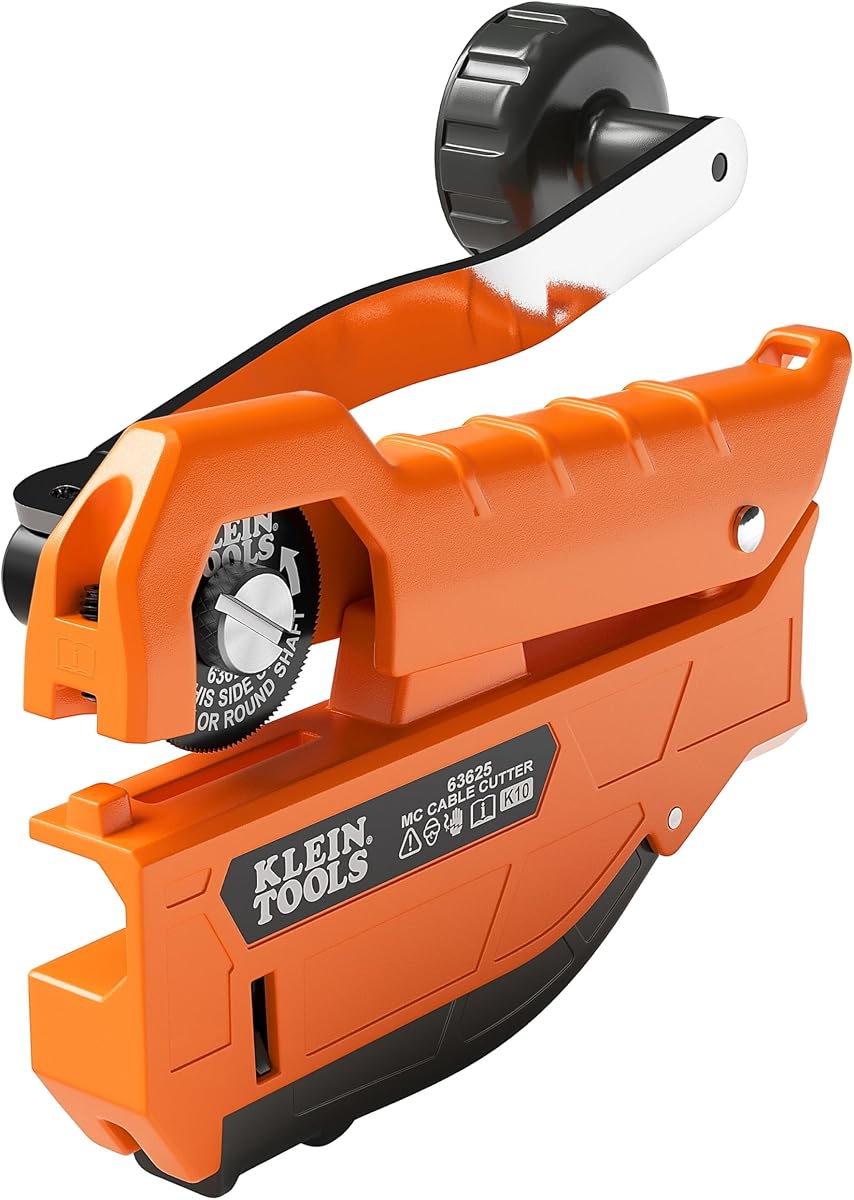
The Klein Tools 63625 is the most specialized product in the list. Rather than serving as a conventional ratcheting cutter for large copper or aluminum conductors, it targets armored cable up to 3/8 inch, including BX, AC, MC, MCAP, and Greenfield cable. Its 4.0 rating is the lowest among the selected tools, but the narrow purpose explains why direct comparison with large ratcheting cable cutters is imperfect.
We may earn a commission when you buy through this link, at no additional cost to you.
A spring-loaded button controls blade pressure so the tool does not excessively compress the cable or risk buckling. The spring also provides the desired amount of pushback, allowing the fine-tooth carbon steel blade to sever the outer jacket without cutting the internal wires. The handle can fold and flip to improve comfort and hand clearance, while a knob doubles as storage for up to six blades.
Tool-free blade replacement is a particularly useful feature. A twist-screw arrangement lets the user remove or replace the blade without requiring a separate tool, while the integrated storage keeps spare blades close at hand. Additional blades are sold separately, so replacement availability should be checked before committing to the cutter for routine work. The product information does not claim a ratchet mechanism or a large-conductor capacity.
This is the right choice for an electrician whose primary requirement is controlled armored-cable jacket removal rather than cutting a large service conductor. It is not the strongest option for the central ratcheting-cutter use case because it uses a different mechanism and addresses a different cable category. Buyers should verify diameter, jacket type, and local installation requirements before use, especially where internal conductors must remain undamaged.
The spring-loaded button limits compression and helps prevent the cable from buckling under excessive pressure. That controlled action allows the fine-tooth blade to focus on the armor and jacket while reducing the risk of cutting conductors concealed inside.
Tool-free blade replacement removes much of the inconvenience associated with changing a worn cutting edge. Integrated storage for as many as six blades helps keep spares organized and readily available, although replacement blades are purchased separately.
We may earn a commission when you buy through this link, at no additional cost to you.
The right cable cutter depends on conductor material, diameter, strand construction, working environment, and how often the tool will be used. Capacity is only the starting point because blade geometry, ratchet action, release design, grip, and safety constraints can determine whether a cutter is practical in daily electrical work.
Cable capacity is often stated in square millimeters, MCM, Kcmil, AWG, or maximum diameter. These measures are not interchangeable without careful conversion, and a product may list different limits for copper and aluminum. The Yangoutool and HKS models are described in square millimeters, while Southwire, Klein, VEVOR, and Sanuke use MCM, and haisstronica also provides a Kcmil figure. Before purchasing, compare the manufacturer's maximum with the largest cable you actually prepare and leave a margin for manufacturing or measurement differences.
Most ratcheting cable cutters in this guide are designed for copper and aluminum, but many explicitly exclude steel, armored cable, ACSR, wire rope, welding wire, fuel line, or live conductors. A large cutting capacity does not mean the blade or jaws can safely handle every material. The Klein 63625 is the deliberate exception in this list because it is built around fine-tooth armored-cable cutting rather than large copper or aluminum conductors. Inspect the cable jacket, identify the conductor construction, and consult the listing before applying a cutter to an unfamiliar type.
A useful ratchet advances the blade in controlled stages, holds the cable securely, and requires less hand force than a direct squeeze. The Klein 63060 adds a patented two-step design intended to reduce strokes, while the HKS describes a high transmission ratio. Other models emphasize fast engagement, stabilized gripping, or progressive pressure. Evaluate not only cutting force but also how readily the tool resets, because a mechanism that cuts effectively but is awkward to reopen can slow repetitive work.
A quick-release mechanism lets the cutter open before the stroke is complete, which is useful when a cable is mispositioned or needs to be removed. The HKS, Klein 63060, VEVOR, and Sanuke all list release or reset features. Their implementations differ, so users should consider whether the control is easy to operate with one hand and whether it releases completely enough to clear the conductor. The Klein also includes a locking lever for transport, a separate benefit that helps prevent accidental opening inside a tool bag.
Blade hardness, edge finish, tooth pattern, and position all influence the cut. The Yangoutool 240mm² model uses polished edges and a centered blade, the Southwire has hardened steel blades, the Knipex uses precision-ground hardened blades, and the Klein 63625 relies on a fine-tooth carbon steel blade for armored jacket work. Larger, general-purpose blades should not be assumed to produce the cleanest armored-cable cut, while a fine-tooth jacket blade should not be used as a substitute for a large ratcheting conductor cutter.
Comfort matters because a ratchet cutter may be operated repeatedly during service preparation. Southwire emphasizes a comfortable molded grip, haisstronica uses a curved ergonomic PVC handle, and Sanuke specifies a non-slip grip. Compact models may be easier to position in panels, conduit, or crowded equipment. At the same time, larger capacity can involve greater hand and wrist force. A balanced purchase should fit comfortably in the user's hand and be easy to orient without forcing the wrist into an awkward angle.
A tool that is difficult to store can be damaged or left behind, while a blade that is difficult to replace can increase downtime. The Klein 63060 has a locking lever for transport, and the Klein 63625 provides built-in storage for up to six blades along with tool-free replacement. The Southwire 63060 also has a published replacement-part list. Consider whether replacement components are available, how the tool fits in a bag, and whether it can be stored without pinching fingers or exposing the blade.
Insulated handles may provide protection during installation and maintenance, but no ratcheting cable cutter should be used on a live conductor. Several products state a 1000-volt handle rating, including the HKS and VEVOR, while the manufacturer warnings still require the cable to be de-energized. Insulated grips do not change the tool's cutting capacity, nor do they make it safe to work on energized wiring. Follow electrical safety procedures, verify the circuit is dead, and use appropriately rated equipment for energized diagnostic work.
Begin by identifying the cable, confirming that it is de-energized, and checking that its material, diameter, and construction fall within the cutter's approved specifications. Inspect the blade, jaw, ratchet mechanism, and handles for damage, corrosion, or excess wear. Position the cable squarely in the cutter's jaw and hold it stable so the ratchet can engage without the conductor twisting or shifting.
Close the handles gradually and allow the ratchet mechanism to advance through its stages. Do not force the tool if the cable is too large or made from an unsupported material. If the cut stops, reset or open the cutter, reposition the cable, and try again rather than twisting the handles or striking the tool. Once the blade passes through, release the mechanism as directed and carefully open the jaws without placing fingers near the cutting edge.
After use, brush or wipe away debris and remove any loose copper or aluminum strands. Keep the blade lightly protected from moisture and corrosive residue, but use only cleaning methods appropriate for the manufacturer's materials and coatings. Store the cutter in a dry tool bag or box, engage any locking mechanism, and inspect the blade regularly. Replace worn blades or damaged parts before they compromise cut quality, and follow the manufacturer's instructions and warranty terms for maintenance.
Only if the manufacturer specifically approves that cable type and size. Most large ratcheting cutters in this guide are limited to copper and aluminum and explicitly exclude armored cable, steel wire, ACSR, and wire rope. The Klein Tools 63625 is a specialized exception designed to cut several armored cable types up to 3/8 inch. Its fine-tooth blade and spring-controlled handle are intended to protect internal conductors while cutting the jacket.
They are different ways of expressing conductor size, so their labels cannot be compared as if they were identical. MCM and Kcmil are related circular mil measures, AWG uses a standardized logarithmic scale, and square millimeters express cross-sectional area. A cutter may list a maximum for copper and a different maximum for aluminum. Check the manufacturer's stated conductor type and dimension rather than relying on a single number.
No. An insulated handle is intended to add protection during appropriate electrical tasks, but every product in this guide carries a warning against cutting live cables. The conductor should be de-energized, locked out where required, and verified with suitable test equipment before cutting. Insulation does not change the blade's material limits, cutting capacity, or mechanical operating requirements.
A ratcheting cutter grips the cable and advances the blade in stages, reducing the hand force needed for larger conductors. The controlled action can produce straighter, cleaner preparation and help prevent the cable from shifting. Ordinary pliers may be adequate for smaller wire, but they offer less control and can crush or deform heavier cable during the cutting stroke.
Look for slower cutting, excessive hand force, a visibly chipped or dull edge, and cuts that become crushed, uneven, or deformed. Some cutters, including the Klein 63625, provide tool-free replacement and onboard storage, while the Klein 63060 listing references an available replacement-part list. Follow the manufacturer's blade compatibility guidance and use genuine or explicitly approved replacement parts where available.
Several models are explicitly approved for aluminum multi-strand or multi-core cable, including the HKS, Sanuke, haisstronica, and products with broad copper-and-aluminum specifications. The correct limit may differ by conductor size and construction. Confirm the exact maximum for aluminum because a stated copper capacity should not automatically be assumed to apply to aluminum or to every strand configuration.
No. Capacity is useful only if it matches the work, and a larger cutter may be heavier, harder to position, or more expensive. Electricians who regularly prepare large service conductors benefit from a 240mm², 300mm², or 750 MCM-class tool, while technicians handling smaller cables may prefer a compact model. Consider material limits, grip, release design, and storage alongside maximum capacity.
Remove debris after every use, keep the jaws and mechanism free of dirt and corrosion, and inspect the blade for chips or uneven wear. Store the cutter dry and use its locking mechanism when available. If a cut becomes difficult, do not force the mechanism; confirm that the cable is within the approved range and inspect the cutter for damage or a dull blade.
The VEVOR Ratcheting Cable Cutter is the leading value-oriented option, combining the highest rating with a stated capacity of 600 MCM, documented blade hardness, insulated handles, and a quick-release button. The HKS is the strongest all-around recommendation for electricians who need up to 300mm² across single and multi-core copper or aluminum cable. The Klein Tools 63060 takes the premium position with a two-step ratchet, 600 MCM copper and 750 MCM aluminum capacity, hardened blades, and transport-focused features.
The right choice ultimately depends on the conductors in your work. Match the maximum diameter and material first, then consider whether you need a quick release, curved grip, transport lock, integrated blade storage, or a specialized armored-cable jaw. Never assume a cutter can handle steel, ACSR, wire rope, or energized wiring. Select the design whose documented material range and mechanism match the task rather than choosing solely by the largest stated capacity.
Prices, promotions, availability, and product configurations can change, so review the current listing before purchasing. Confirm the latest capacity, included components, warranty, replacement-blade options, and safety instructions. With those checks in place, one of these ten cutters can provide a dependable fit for routine electrical work, large-cable preparation, or specialized armored-cable cutting.