
EK-Quantum Vector3 TUF RTX 5080
ASUS TUF RTX 5080 compatibility
Low-restriction split-flow design
Twelve addressable D-RGB LEDs
Explore the best Ek Waterblocks for Nvidia with compatibility, cooling design, lighting, construction, and installation details compared for confident
Ek waterblocks for Nvidia are specialized liquid-cooling components designed to improve heat transfer from compatible graphics cards while creating a cleaner, customizable PC build. The right choice depends on exact board compatibility, cooling coverage, internal flow, installation hardware, lighting, and how well the block integrates with the rest of the loop.
This guide compares ten EK products, including full-cover Nvidia GPU blocks, AMD and Intel CPU waterblocks, a radiator, and a reservoir. Each entry is evaluated from the supplied specifications, with particular attention to supported hardware, coldplate construction, active and passive cooling areas, coolant routing, lighting, and practical installation considerations.
The picks show how a compact CPU block differs from a dedicated Nvidia GPU waterblock, how model-specific designs affect compatibility, and why reservoir and radiator choices can complete a custom loop. Ratings and availability can change over time, and current prices should always be checked before making a final purchase.


This side-by-side comparison covers every product in the guide, distinguishing dedicated Nvidia GPU blocks from CPU blocks, a radiator, and a loop reservoir by compatibility, construction, lighting, and cooling function.



The EK-Quantum Velocity 3 is a high-performance CPU waterblock for AMD AM5 and Intel LGA 1700 and LGA 1851 systems. It carries a 4.6 rating, making it one of the strongest-rated products in this guide. Its standout quality is broad platform coverage within a relatively compact format, followed by an optimized internal design aimed at improving heat transfer.
We may earn a commission when you buy through this link, at no additional cost to you.
The block uses a nickel-plated copper coldplate and an optimized internal geometry intended to move heat efficiently into the coolant. Its mounting system is designed to apply precise pressure for consistent contact. The supplied specifications also state that the Velocity 3 can improve thermal performance by up to 2 degrees Celsius compared with the Velocity 2, while its overall dimensions remain listed at 69 by 69 by 25.1 millimeters.
As a CPU cooler, it does not directly answer the need for a dedicated Nvidia GPU waterblock, and the supplied information does not mention integrated D-RGB lighting. Those limitations are important for builders creating an all-EK showcase loop, but the Velocity 3 remains focused on strong thermal performance and support for three widely used CPU platforms in a relatively compact package.
This is the most versatile choice in the guide for a new liquid-cooled PC that may use either an AM5 processor or an Intel LGA 1700 or 1851 processor. It also makes sense for builders seeking a compact CPU block without giving up copper-coldplate construction. For a dedicated Nvidia card, pair it with one of the model-specific Vector3 GPU blocks covered later in the guide.
Support for AM5, LGA 1700, and LGA 1851 gives the Velocity 3 unusual flexibility. It is particularly useful when the CPU platform is not yet settled or when the same finished waterblock may be reused across different Intel or AMD systems.
The nickel-plated copper coldplate, optimized geometry, and controlled mounting pressure form the core of the block's cooling proposition. Its 69 by 69 millimeter footprint also makes it easier to plan around than many larger CPU blocks.
We may earn a commission when you buy through this link, at no additional cost to you.
The EK-Quantum Velocity 2 D-RGB is a premium CPU waterblock developed for Intel's LGA 1700 platform. Its 4.6 rating reflects favorable customer reception, while the combination of a next-generation cooling engine and extensive D-RGB support gives it appeal for coordinated custom-loop builds.
We may earn a commission when you buy through this link, at no additional cost to you.
Unlike a general-purpose coldplate, this model uses a socket-specific cooling engine. It follows the EK-Matrix7 standard and is mounted through the patented EK Exact Mount system. Lighting can be synchronized with D-RGB software from major motherboard manufacturers, and the package includes Thermal Grizzly Hydronaut thermal paste for the coldplate contact area.
The main limitation is platform focus: the supplied information identifies LGA 1700 compatibility rather than broad AMD or newer Intel support. It also does not cool a discrete Nvidia graphics card. Those restrictions keep the Velocity 2 D-RGB from serving as a universal all-in-one choice, but they are reasonable for a carefully planned LGA 1700 system.
Choose this block when building a polished Intel LGA 1700 loop in which lighting and coolant routing matter alongside CPU cooling. It works especially well for users already familiar with EK's mounting and Matrix7 approach. Builders using another processor socket should first confirm support, while those seeking a GPU upgrade should select a Vector3 block matched to the exact Nvidia card.
Extensive D-RGB compatibility allows the Velocity 2 to join an existing lighting ecosystem rather than remain isolated. This makes it easier to create coordinated effects across the CPU block, GPU block, reservoir, fans, and other connected components.
The cooling engine is designed specifically for LGA 1700, while the EK Exact Mount approach supports controlled installation. The included Hydronaut paste further simplifies preparation of the contact surface.
We may earn a commission when you buy through this link, at no additional cost to you.
The EK-Quantum Vector3 Master RTX 5090 is a dedicated GPU waterblock engineered for the Gigabyte AORUS GeForce RTX 5090 Master 32G and Gigabyte GeForce RTX 5090 Gaming OC 32G. Its most notable quality is broad active coverage of the GPU core, GDDR7 memory, and power stages, backed by a full-coverage backplate for PCB components.
We may earn a commission when you buy through this link, at no additional cost to you.
The expanded next-generation cooling engine uses an open split-flow design, enhanced fin array, and precision coolant paths. A nickel-plated electrolytic copper coldplate handles the main heat-transfer role, while a CNC-machined cast acrylic top provides a clear view of the coolant. A black anodized aluminum backplate adds structural reinforcement and passive cooling, and pre-cut thermal pads simplify installation.
Compatibility is the principal trade-off. The block is specifically designed for the two named Gigabyte models, so it should not be assumed to fit other RTX 5090 designs. The supplied data also contains no customer rating for this newer product. Neither point diminishes its detailed thermal design, but both make exact model verification essential before ordering.
This is the top choice for a Gigabyte RTX 5090 owner who wants active cooling across the core, VRAM, and power stages, plus passive cooling around critical PCB areas. It is also an attractive centerpiece for a visible custom loop, combining clear acrylic, Matrix7 planning, and thirteen individually addressable D-RGB LEDs.
The waterblock actively cools the GPU core, GDDR7 VRAM, and power stages, while the full-coverage L-shaped backplate passively dissipates heat from other PCB components. This broader approach addresses more of the card than a basic chip-only block.
The cast acrylic top reveals coolant flow, and the black anodized aluminum backplate gives the installation a finished appearance. Thirteen addressable LEDs add synchronized lighting while the Matrix7 standard supports planned tube routing.
We may earn a commission when you buy through this link, at no additional cost to you.
The EK-Quantum Velocity 2 White Edition is a CPU waterblock designed for AMD AM5 systems. It holds a 5.0 rating, the highest numerical rating in the guide, and combines a white exterior, digital RGB lighting, and a coldplate made from 99.99 percent pure electrolytic copper.
We may earn a commission when you buy through this link, at no additional cost to you.
Its principal appeal is visual as much as thermal. The white finish and lighting help it stand out in a pale or strongly themed build, while the high-purity copper coldplate provides the material foundation for efficient heat transfer. The listed dimensions are 89 by 113.5 by 34 millimeters, giving builders concrete dimensions to account for during case planning.
The supplied specifications limit this version to AMD AM5, so it is not a universal option for Intel builders. It also addresses processor cooling rather than graphics-card cooling. Neither point is a flaw within its target platform, but they make it more specialized than the multi-platform Velocity 3 listed first.
This is an excellent choice for an AM5 build with a coordinated white theme and a preference for integrated lighting. Its perfect customer rating adds confidence, although that rating should not replace checking case clearance and socket compatibility. A dedicated Nvidia GPU block remains necessary for a complete graphics-card liquid-cooling solution.
The coldplate uses 99.99 percent pure electrolytic copper, providing the high-conductivity surface intended to move processor heat into the coolant. This specification makes the white model's visual finish distinct from its thermal foundation.
Digital RGB lighting and a white enclosure allow the block to blend into a light-themed case. The integrated effect is especially useful when every visible component is expected to share a consistent color treatment.
We may earn a commission when you buy through this link, at no additional cost to you.
The EK-Quantum Vector3 TUF RTX 5080 is purpose-built for the ASUS TUF Gaming GeForce RTX 5080 16GB GDDR7 and OC Edition graphics cards. It combines an open split-flow cooling engine with low hydraulic restriction, active cooling for the core, VRAM, and power stages, and a passive full-coverage backplate.
We may earn a commission when you buy through this link, at no additional cost to you.
Its expanded fin array and improved coolant paths are intended to support heavy gaming, rendering, or overclocking workloads. A nickel-plated electrolytic copper coldplate handles heat transfer, while a CNC-machined cast acrylic top provides coolant visibility. The black anodized aluminum backplate reinforces the assembly and includes captive screws for easier installation.
The block is limited to two clearly identified ASUS TUF variants, and the supplied data does not provide a customer rating. Those are important caveats for a model-specific purchase. Even so, the combination of pre-cut thermal pads, captive screws, low-restriction flow, and a complete thermal solution reduces several common installation variables.
This is a practical choice for an ASUS TUF RTX 5080 owner who wants full-area liquid cooling and synchronized lighting. It is also the most affordable-looking route into the Vector3 range based on relative positioning, although actual current pricing should be checked. Confirm the exact card revision and case clearance before ordering.
The open split-flow layout and improved paths are designed to maintain low hydraulic restriction. This is especially relevant for custom-loop builders who need to balance flow behavior, tubing layout, and overall cooling performance.
Pre-cut thermal pads and captive backplate screws remove some of the repetitive work associated with installing a full-cover GPU block. The result is a design focused as much on practical assembly as on thermal coverage.
We may earn a commission when you buy through this link, at no additional cost to you.
The EK-Quantum Surface S120 in Schwarz is a compact entry in EK's Surface series with a 5.0 customer rating. Its black finish is designed to coordinate with restrained custom-loop aesthetics, while the S120 designation separates it from the larger X-series radiator model in this guide.
We may earn a commission when you buy through this link, at no additional cost to you.
The supplied product information is limited to a numeric reference, so there are no additional details to verify about its internal construction, dimensions, mounting pattern, or lighting. As a result, the most defensible reasons to consider it are its 5.0 rating, Surface-series identity, and Schwarz finish. Buyers should review the current product listing and compatible components before finalizing a build.
It is not described as a dedicated Nvidia GPU waterblock, so it should not be selected on the assumption that it cools an RTX card. The limited information also makes claims about its thermal performance or precise installation requirements inappropriate. Its suitability depends on whether the current listing confirms the required loop role, dimensions, and hardware support.
For a builder interested in a small, black Surface-series component with strong customer feedback, the S120 is worth a closer look. It may fit a broader loop-planning need, but a dedicated Nvidia build still requires one of the model-specific Vector3 blocks. The safest buying approach is to treat the available rating and finish as initial filters, then verify the live listing.
The black finish suits builds that favor a restrained visual style. It can pair naturally with dark fittings, tubing, and case accents without introducing another lighting element.
A 5.0 rating is a favorable signal, although the limited supplied specifications make it especially important to review current compatibility details. The rating should complement, not replace, direct fitment checks.
We may earn a commission when you buy through this link, at no additional cost to you.
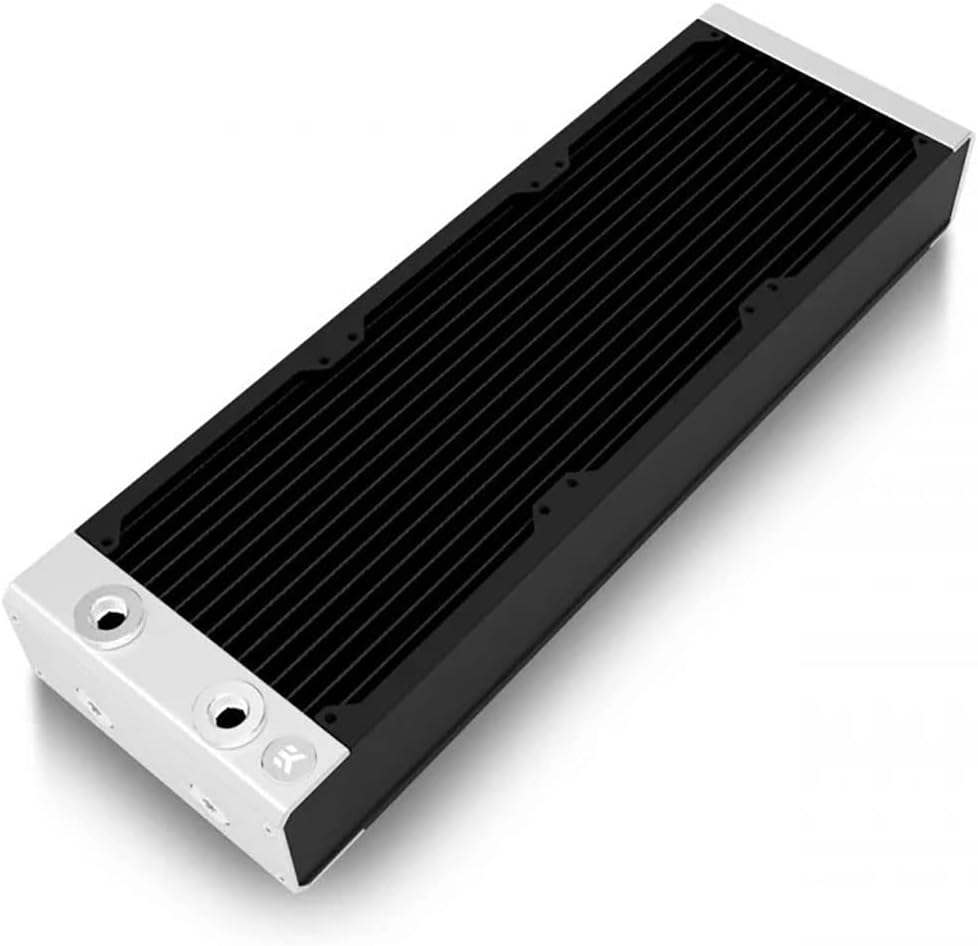
The EK-Quantum Surface X360M Schwarz is a thick radiator designed to offer substantial cooling power within the EK-Quantum Surface line. With a 4.3 rating, it provides a useful loop-level option for builders who need to pair a dedicated Nvidia waterblock with a radiator capable of supporting medium- or high-speed fans.
We may earn a commission when you buy through this link, at no additional cost to you.
Its 58 millimeter thickness creates room for a more substantial internal fin and tube arrangement. Sixteen 2 millimeter copper tubes run across the radiator, while non-louvered copper fins provide an 18 FPI density. That balance is intended to preserve effective heat transfer without pushing air resistance excessively high. The design can also benefit from a push-pull fan setup.
Its depth is also the primary practical constraint. A radiator this thick requires a compatible case and enough room for fans, tubing, and the GPU installation. The supplied information notes that international products may differ in fit, age ratings, labeling, and language, so regional listings deserve careful review.
Choose the X360M Schwarz when a high-capacity radiator is needed for a powerful custom loop. It is not itself a GPU waterblock and cannot cool a discrete Nvidia card by itself, but it can serve as a key heat-rejection component alongside a compatible Vector3 block. Check case dimensions and regional fitment information before ordering.
The 58 millimeter thickness gives the X360M more material than a conventional thin radiator. This is valuable in a loop paired with demanding graphics hardware, provided the case can accommodate the larger assembly.
Sixteen copper tubes move coolant through the radiator, while 18 FPI non-louvered fins balance thermal transfer against airflow resistance. The design can also make effective use of push-pull fan arrangements.
We may earn a commission when you buy through this link, at no additional cost to you.
The EK-Quantum Vector3 Astral RTX 5080 is a premium GPU waterblock designed exclusively for ASUS ROG Astral GeForce RTX 5080 graphics cards. It features an open split-flow cooling engine, an expanded fin array, enhanced coolant paths, and active cooling across the GPU core, VRAM, and power stages.
We may earn a commission when you buy through this link, at no additional cost to you.
A nickel-plated electrolytic copper coldplate provides the primary heat-transfer surface. The CNC-machined cast acrylic top reveals the coolant, while a black anodized aluminum backplate adds structural integrity and passive cooling. Pre-cut thermal pads support direct contact with the covered components, and a full-coverage L-shaped backplate extends passive cooling to PCB hotspots.
The major qualification is model specificity. This design is not a general RTX 5080 block and should be matched only to the appropriate ROG Astral card. The supplied data also provides no customer rating, so its reputation is better established here through its documented design than through a numerical customer score. That makes careful listing verification especially important.
For an ROG Astral RTX 5080 owner, this is a feature-rich choice that combines extensive active cooling, passive PCB cooling, transparent presentation, and synchronized lighting. Matrix7 compatibility also assists tube routing and vertical or horizontal installation planning, making it a strong centerpiece for an elaborate ASUS-based build.
The block combines copper-coldplate heat transfer with active cooling for the core, memory, and power stages. Its L-shaped backplate then adds passive cooling for additional PCB areas, creating broad coverage across the graphics card.
Following the Matrix7 standard allows the block to integrate more cohesively with other EK-Quantum loop parts. It also simplifies planning for straight tube runs and both vertical and horizontal GPU orientations.
We may earn a commission when you buy through this link, at no additional cost to you.
The EK-Quantum Volume 3 FLT 140 is a flat-shaped reservoir intended to change how custom loops are planned. It has a 3.0 rating, the lowest numerical score among the products listed, but its defining features are practical: nine G1/4-inch ports, a 225 milliliter approximate capacity, and a relatively shallow profile.
We may earn a commission when you buy through this link, at no additional cost to you.
The reservoir measures 146.5 by 143.5 by 44 millimeters and includes digital RGB lighting. Its nine ports give builders more choices in how the coolant circuit is connected and routed. Rather than functioning as a graphics-card coldplate, it acts as a fluid-management and visual centerpiece within a larger liquid-cooling loop.
The lower rating suggests that prospective buyers should examine current customer feedback carefully for details not included in the supplied listing. It may also be less immediately appealing to someone focused on direct GPU cooling. The port count and flat shape are valuable for loop design, but they do not eliminate the need to pair it with a compatible coldplate, radiator, pump, tubing, and fittings.
This reservoir is best suited to builders creating a flat, flexible custom loop around a dedicated Nvidia waterblock. Its low thickness may help with case planning, while the multiple ports offer routing freedom. Confirm the available mounting arrangement and current fitting requirements before committing it to a build.
Nine G1/4-inch ports provide considerable flexibility when connecting the reservoir to a pump, coldplates, and other components. The number can reduce the need to rethink the loop's layout as additional blocks are introduced.
At 44 millimeters thick, the reservoir is designed around a flat form factor. That profile can make it easier to incorporate into a case where a tall cylindrical reservoir would be less convenient.
We may earn a commission when you buy through this link, at no additional cost to you.
The EK-Quantum Vector3 Astral RTX 5090 is a custom GPU waterblock for ASUS ROG Astral GeForce RTX 5090 graphics cards. It is built around comprehensive thermal coverage, actively cooling the GPU core, GDDR7 VRAM, and power stages while an L-shaped backplate passively cools additional PCB hotspots.
We may earn a commission when you buy through this link, at no additional cost to you.
The enhanced cooling engine combines an expanded fin array with optimized coolant paths. Its nickel-plated electrolytic copper coldplate supports heat transfer, and the CNC-machined cast acrylic top creates a clear coolant showcase. A black anodized aluminum backplate provides structural reinforcement and passive cooling, balancing the block's technical and visual design.
EK-Matrix7 compatibility allows the block to integrate with components such as EK-Quantum Reflection² distribution plates. It also supports straightforward tube routing in both vertical and horizontal GPU mounting configurations. The principal limitation remains fitment: the product is custom-designed for the ROG Astral RTX 5090, and the supplied information contains no customer rating.
This is the most aspirational option for a ROG Astral RTX 5090 showcase build, especially when the entire loop uses Matrix7 planning. It delivers broad active and passive coverage, clear acrylic presentation, and fourteen individually addressable RGB LEDs. Confirm the card model, mounting requirements, and loop orientation before purchase.
Active cooling reaches the core, VRAM, and power stages, while the included L-shaped backplate addresses PCB hotspots passively. This broader coverage is well suited to extended gaming, rendering, and overclocking workloads.
Matrix7 planning and the option for vertical or horizontal GPU mounting let the block adapt to different case layouts. Fourteen addressable LEDs along the top and back edges maintain visibility in either arrangement.
We may earn a commission when you buy through this link, at no additional cost to you.
The right EK waterblock depends on whether you need a dedicated graphics-card coldplate, a processor block, or another component for the loop. Compatibility, thermal coverage, mounting, and routing should be considered together.
Nvidia GPU waterblocks are frequently engineered for a specific card model and sometimes only for named board variants. The Vector3 Master block is listed for Gigabyte AORUS RTX 5090 Master 32G and GeForce RTX 5090 Gaming OC 32G models, while the TUF version targets ASUS TUF RTX 5080 cards. The Astral versions are exclusive to ASUS ROG Astral RTX 5080 and RTX 5090 designs. Check the listing against the exact product name, GPU dimensions, PCB layout, and mounting-hole arrangement rather than relying only on the chipset designation.
Choose only a block that explicitly supports your card. Broad RTX 5090 or RTX 5080 labeling is not enough when a design serves one board partner's design.
A useful GPU waterblock should identify which chip areas it actively cools. The Vector3 models in this guide extend active cooling to the GPU core, GDDR7 VRAM, and power stages. That is broader than a basic design aimed at the processor alone. Some blocks also include a full-coverage backplate for passive heat dissipation from PCB components, while the Vector3 Master and TUF designs describe that feature explicitly.
Prioritize blocks that cover the core, memory, and power components. Treat backplate coverage as an additional benefit rather than a replacement for active chip cooling.
Coldplate material is central to heat transfer. The listed Vector3 GPU blocks use nickel-plated electrolytic copper, while the AM5 Velocity 2 White uses 99.99 percent pure electrolytic copper and the multi-platform Velocity 3 uses a nickel-plated copper coldplate. Internal flow matters just as much: open split-flow designs, expanded fin arrays, and optimized coolant paths are intended to move coolant consistently across the covered areas.
Look for copper construction, a defined flow path, and a design intended to manage hydraulic restriction. These details provide a more reliable basis than appearance alone.
A GPU waterblock is only one part of a functioning liquid-cooling system. A complete loop also needs a radiator, pump, reservoir, tubing, fittings, and compatible coolant connections. The Surface X360M offers thick-radiator cooling capacity, while the Volume 3 FLT 140 provides a flat reservoir with nine G1/4-inch ports. The CPU blocks can provide a second coldpoint when the processor is also liquid-cooled.
Plan the complete loop and its flow direction before buying isolated components. Ensure every fitting and connection type matches, and account for routing space around the graphics card.
Block dimensions, radiator thickness, and fan placement must work together within the available case. The Surface X360M is 58 millimeters thick and can benefit from push-pull fans, making it particularly dependent on adequate clearance. The Velocity 3 is comparatively compact at 69 by 69 by 25.1 millimeters, while the Volume 3 FLT 140 is listed at 146.5 by 143.5 by 44 millimeters. GPU blocks also add tubing and fitting space around the card.
Measure the case rather than relying on product dimensions alone. Leave room for connectors, tube bends, and comfortable access to fill ports.
D-RGB lighting can unify a custom build, but compatibility depends on connectors and control software. The listed blocks and reservoir include D-RGB or addressable RGB lighting, with several specifying support for major motherboard synchronization technologies. The Vector3 Master uses thirteen individually addressable LEDs, the TUF RTX 5080 uses twelve, and the Astral designs use fourteen. The Velocity 2 CPU block and Volume 3 reservoir also feature digital RGB lighting.
Verify the header, software ecosystem, and cable length needed to connect the lighting controller. Appearance should complement a compatible thermal plan, not determine it alone.
Installation is easier when thermal pads, mounting screws, paste, and a defined mounting method are included. The Vector3 GPU blocks include pre-cut thermal pads, and the TUF model uses captive backplate screws. The Velocity 2 D-RGB CPU block includes Thermal Grizzly Hydronaut paste, while the Velocity 3 emphasizes precise mounting pressure. The EK Exact Mount system and Matrix7 standard are also relevant to routing and component integration.
Favor solutions with clear installation hardware and an established mounting standard. Fewer improvised parts can make a complex loop easier to service and reduce installation errors.
A clear acrylic top, black anodized aluminum backplate, white finish, and coordinated D-RGB can all contribute to a polished build. The Vector3 GPU blocks emphasize coolant visibility with CNC-machined cast acrylic, while the white Velocity 2 targets pale-themed systems. The Surface S120 and X360M use Schwarz finishes for a more restrained appearance. Function should come first: fitment, thermal coverage, and loop compatibility matter more than color.
After confirming the technical requirements, choose the finish and lighting arrangement that best suit the rest of the system.
Begin by identifying the exact graphics card, processor socket, radiator, reservoir, pump, and fittings that will form the loop. Confirm that the chosen waterblock explicitly supports your hardware and compare every connection type before assembly. Lay out components on a protected surface, read the current instructions, and use the included thermal pads, paste, and mounting hardware where specified.
Prepare the coldplate and component contact areas carefully, secure the block without over-tightening, and connect the tubes with enough space for planned bends. Fill the system gradually, check every fitting for leaks, and run the pump to circulate coolant before placing the GPU under load. Monitor for trapped air, unstable temperatures, and unintended flow restrictions during the initial test.
For ongoing care, keep the GPU and radiator dust-free, inspect fittings and tubing, and verify that the pump and fan configuration remains stable. Flush the loop when component changes are required or if discoloration and sediment develop. Follow the coolant manufacturer's guidance, avoid mixing incompatible liquids, and never operate a custom loop without adequate liquid circulation.
No. The Vector3 products in this guide are model-specific, covering named Gigabyte Master, ASUS TUF, and ASUS ROG Astral variants. Even cards with the same GPU chip can have different PCB layouts, dimensions, and mounting points, so the exact board name and model must match the block's compatibility list.
A CPU waterblock transfers heat from a processor through a socket-specific coldplate. A GPU waterblock fits directly over a compatible graphics card and may actively cool the core, VRAM, and power stages while using a backplate to cool additional PCB areas. They are separate parts of a custom loop.
A reservoir can support fluid management, air management, and visual presentation, but the supplied information does not state that every EK GPU waterblock requires one. Whether it is necessary depends on the complete loop design, pump configuration, available case space, and the builder's preferred routing approach.
Different graphics-card partners use different coolers, PCB shapes, power sections, and mounting arrangements. A waterblock made for an ASUS ROG Astral cannot automatically be assumed to fit a Gigabyte AORUS card, even when both use the same Nvidia GPU. Exact model verification protects against gaps, inaccessible fasteners, and poor contact.
Matrix7 is a product standard used to simplify planning and integration across EK-Quantum components. In the Vector3 GPU blocks, it supports cleaner tube routing and integration with compatible distribution plates and reservoirs. It does not eliminate the need to verify fittings, flow direction, mounting orientation, and case clearance.
Several listed products support synchronization with major motherboard RGB technologies. The TUF RTX 5080 block specifically lists a 3-pin 5V digital LED header, while other designs describe compatible cables and addressable LEDs. Check the live listing and current software requirements before connecting lighting.
Its 58 millimeter thickness, sixteen copper tubes, and 18 FPI fins make it a high-capacity radiator option for a demanding custom loop. It still needs to be matched with the GPU block, pump, coolant, tubing, fittings, and fan arrangement. Adequate case clearance and airflow are essential.
Fill the loop gradually, inspect every fitting, and circulate the coolant before connecting or powering the graphics card under a normal workload. Keep the system monitored during its first run and verify stable temperatures and flow. If leakage or air-related instability appears, shut down and address the issue before continuing.
The top Nvidia-focused choices are the Vector3 Master RTX 5090 for specified Gigabyte cards, the Vector3 TUF RTX 5080 for ASUS TUF models, and the Vector3 Astral RTX 5090 for the ROG Astral platform. Each combines model-specific fitment, copper-coldplate construction, active cooling across major chip areas, a full-coverage backplate, and integrated D-RGB lighting.
Prioritize exact hardware compatibility, active thermal coverage, coldplate material, flow design, and installation hardware before appearance. A wider-looking block is not necessarily better if it does not match the PCB, and a polished lighting system is only worthwhile when the underlying loop is mechanically sound and sized correctly for the case.
Customer ratings can help compare established products, but some of the newest Vector3 models do not yet have numerical ratings in the supplied information. Review the current listing, recent customer feedback, installation documents, and current price before buying. Product availability and pricing can change, so final confirmation at the point of purchase is important.