
IRWIN Tools Clamp-On Vise
4.5Editor score
Attaches to tables up to two inches
Integrated pipe jaws
Built-in anvil shaping horn
A clamp on bench vise gives woodworkers, metalworkers, and DIY users a firm way to secure material without permanently modifying a workbench. The best models combine a secure base, useful jaw capacity, smooth rotation, and enough clamping force for common workshop tasks while remaining practical to install, reposition, and remove.
We compared ten clamp on bench vise options using the specifications and product details supplied for this guide. The list covers compact models for occasional work, heavy-duty cast and forged options, dual-jaw designs, pipe-jaw combinations, and vises that can be mounted permanently with screws or attached temporarily with a clamp.
Each review highlights the most important differences in opening, jaw width, throat depth, rotation, material, installation method, and intended workload. Ratings reflect the supplied customer feedback, while prices and availability can change, so readers should verify current product details before making a purchase.
4.5Editor score
4.8Editor score

4.3Editor score
As an Amazon Associate we earn from qualifying purchases.
The comparison below evaluates all ten vises by their mounting approach, jaw configuration, capacity, swivel capability, and construction, helping shop owners and DIY users identify the model that best matches their bench and typical projects.


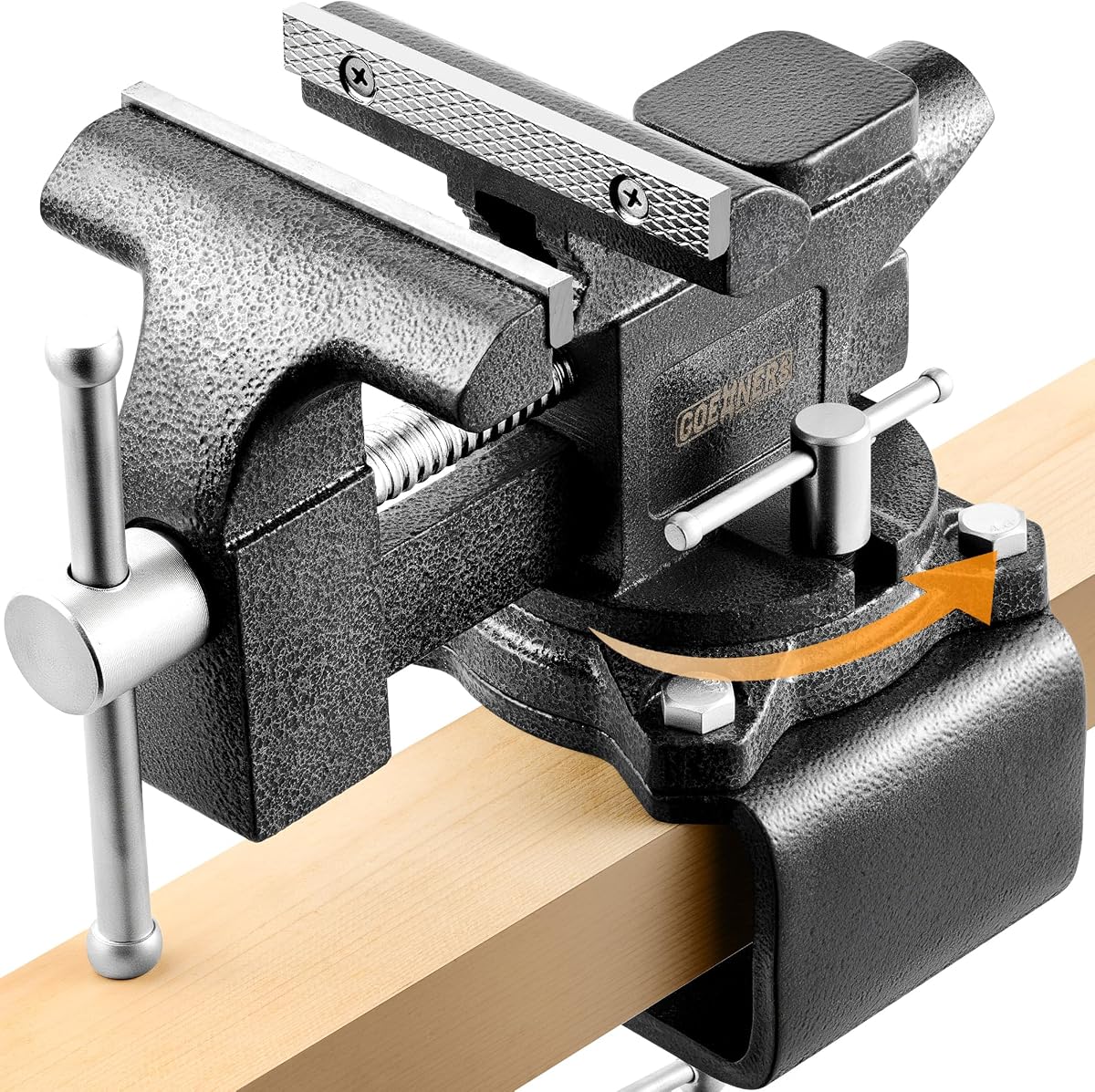
This portable cast-steel vise has a 4.4 rating and stands out for combining a large anvil with a fully rotating clamp-on base. Its 3.2-inch jaw width is useful across woodworking, drilling, gluing, sanding, sawing, metalworking, and conduit-cutting tasks, making it a general-purpose option for home shops.
We may earn a commission when you buy through this link, at no additional cost to you.
The oval swivel base rotates through 360 degrees, while a smooth guide rail helps the screw and handle operate consistently. A base clamping range of up to four inches allows the vise to attach to a broader range of benches than many compact alternatives. Hardened, hammered jaws and a textured gripping surface support controlled material retention.
Its main limitation is scale. The maximum jaw opening is approximately 2.79 inches, and the manufacturer describes it as suitable for general-purpose and light work rather than heavy industrial service. Users needing substantially more jaw travel or a broad anvil for repeated metal forming should choose a larger design.
This is a strong recommendation for a homeowner or hobbyist who wants one portable vise for many mixed tasks. It is particularly useful when bench access is limited, because the 360-degree base changes the working angle without requiring the workpiece to be repositioned constantly.
The rotating base makes this vise useful for holding boards, pipes, conduits, and smaller fabricated pieces at different angles. That flexibility reduces the need to loosen and re-clamp the workpiece when access changes.
The quick-release oval base is designed for straightforward installation and removal. It suits temporary work at different benches without requiring permanent holes in the work surface.
We may earn a commission when you buy through this link, at no additional cost to you.
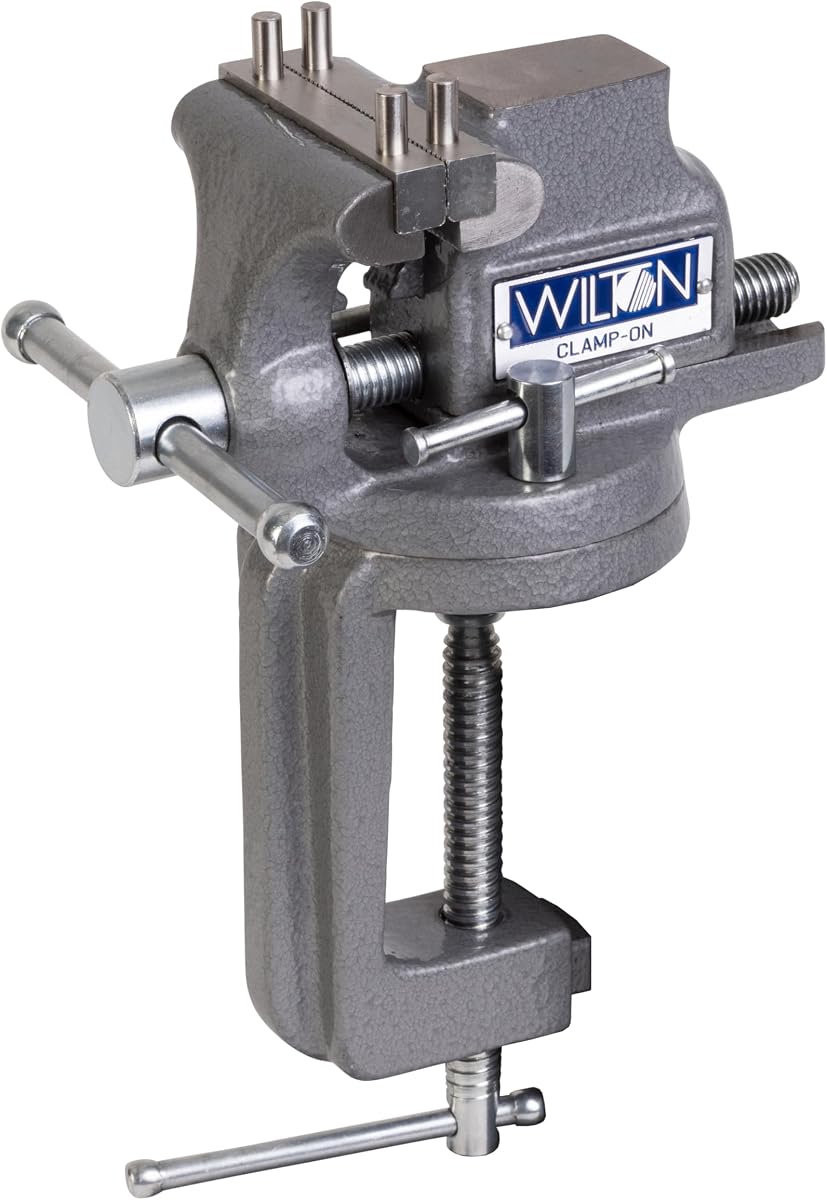
The Wilton 3-inch Clamp-On Apprentice Vise earns a 4.8 rating, the highest customer rating among the ten products. It combines a lightweight format with an advertised clamping force of up to 1,800 pounds, making it appealing for apprentices, homeowners, and workshop users who want meaningful holding power.
We may earn a commission when you buy through this link, at no additional cost to you.
Its quick-release mounting clamp fits work surfaces up to three inches thick. The base swivels 45 degrees and uses dual lockdowns to keep the selected position stable. A two-inch throat depth and a stated pipe capacity of one-half to one inch broaden the applications beyond flat woodworking pieces.
The principal limitation is bench compatibility. A three-inch maximum mounting thickness excludes thicker tables, and the two-inch throat depth is modest compared with several 4.5-inch jaw models. The product data does not specify a replaceable soft jaw, so delicate work may benefit from a separate protective insert.
Despite those limitations, this is the strongest all-around recommendation in the guide. It combines a top customer rating, substantial stated force, fast installation, and stable repositioning in a design aimed at common workshop work.
The stated force capacity is the model's defining advantage. It gives users more confidence when securing dimensional lumber, pipe, tubes, and workshop components than the category's lighter portable designs typically offer.
Quick-release mounting reduces setup time, while dual lockdowns help maintain the chosen angle. This combination is useful for users who regularly move between tasks rather than keeping one fixed clamping position.
We may earn a commission when you buy through this link, at no additional cost to you.
The WORKPRO Dual Jaws Table Vise has a 4.5 rating and differentiates itself with interchangeable-scale jaw options: 2.5-inch serrated jaws and 1.5-inch smooth jaws. This gives users a practical choice between an aggressive textured grip and a smaller, smoother contact surface.
We may earn a commission when you buy through this link, at no additional cost to you.
Its base and head rotate through 360 degrees, allowing the workpiece to remain accessible from different sides. The vise can use either clamp-on or bolt-down installation, although 1/4-20 bolts are not included. At 7.7 pounds and 8.7 by 6.9 by 3.5 inches, it is relatively easy to transport between work areas.
Construction uses ductile iron with carbon steel jaws hardened to 52–58 HRC. The listed clamping force reaches 660 pounds, which is lower than the 1,800-pound figure given for the Wilton Apprentice Vise. The smooth jaw option is nevertheless valuable when the user does not want the pronounced bite of serrations.
Choose this model for mixed DIY, woodworking, tube, and metalworking jobs where jaw versatility matters more than maximum force. It is also a good fit for compact workspaces and users who want both temporary mounting and the option to bolt the vise down later.
Serrated jaws suit projects that benefit from a firm bite, while the smaller smooth jaws can provide gentler contact for selected workpieces. Having both sizes also helps users accommodate narrower stock more efficiently.
The 360-degree movement and relatively low listed weight make the vise easier to reposition around a project. Multiple mounting options provide flexibility for temporary and more permanent workshop arrangements.
We may earn a commission when you buy through this link, at no additional cost to you.
The Wilton Super-Junior has a 4.3 rating and emphasizes thoughtful construction over maximum jaw travel. Its four-inch jaw width provides a broad clamping surface, while replaceable grooved top jaws are a notable long-term advantage for a workshop vise.
We may earn a commission when you buy through this link, at no additional cost to you.
An enclosed design helps keep contaminants out while retaining lubrication for smoother operation. Double lockdowns add stability, and the base rotates 45 degrees to either side so the user can bring the jaws closer when working around the edge of a bench. Wilton also backs the product with an industry-leading lifetime warranty against manufacturing defects.
The 2.25-inch opening and two-inch throat are not unusually large, so this is not the right choice for wide pipe, large cabinet components, or bulky material. Its customer rating is also lower than those of several newer competitors, although ratings alone do not reveal why individual customers were satisfied or dissatisfied.
For a craftsman who values serviceable construction, replaceable jaw components, and manufacturer support, this remains a premium-oriented choice. It is well suited to general-purpose work and light tradesman tasks where a stable, maintainable vise is more important than extreme opening capacity.
Replaceable top jaws extend useful component life, while the enclosed body protects the moving mechanism from debris. These features favor owners who plan to maintain and reuse the vise over many years.
The 45-degree left-and-right swivel helps position the jaws closer to the workpiece near a bench edge. This is particularly useful for general assembly, trimming, and light trade tasks.
We may earn a commission when you buy through this link, at no additional cost to you.
This 4.5-inch bench vise carries a 4.4 rating and offers an unusually flexible installation setup. It can be fixed to a table with the supplied screws or held to the edge with the included base, allowing users to use it temporarily or commit to a permanent workshop position.
We may earn a commission when you buy through this link, at no additional cost to you.
The jaws measure 4.5 inches wide with a listed maximum opening of 3.3 inches. A 270-degree swivel base supports angled work, while multifunctional soft jaws are intended to reduce damage to the workpiece. The product is made from high-strength forged steel, and its coated surface is designed to resist rust.
At 13 pounds, it is heavier than several compact alternatives, which can make repeated bench-to-bench transport less convenient. Its maximum clamp range is 2.3 inches, so users must confirm that their table or bench fits within that limit. The product listing also advertises a three-year replacement policy for malfunction during normal use.
This is a compelling choice for woodworkers, craftspeople, model makers, welders, and electronics hobbyists who want a broad jaw and two installation methods. It gives users freedom to begin with temporary clamping and later convert the vise into a fixed workshop tool.
The two-in-one design addresses a common workshop dilemma. Users can clamp the vise for occasional projects and later use the included screws when consistent positioning becomes more important.
Multifunctional soft jaws help reduce surface damage on workpieces that would be vulnerable to direct metal contact. They also broaden the vise's usefulness for finished parts and detailed hobby projects.
We may earn a commission when you buy through this link, at no additional cost to you.
The 4-1/2 Inch Bench Vise has a 4.8 rating and focuses on a drill-free installation path. It can be secured using four screws or clamped to the edge of a workbench, allowing owners to protect a tabletop that should not be permanently drilled.
We may earn a commission when you buy through this link, at no additional cost to you.
Its combined pipe-and-flat jaws include V-grooves for circular workpieces and flat areas for standard material. A set of soft jaws is included to reduce workpiece damage. The 4.5-inch jaw width, 3.5-inch maximum opening, and 2.2-inch throat depth provide useful capacity for mixed workshop tasks.
The swivel base turns 270 degrees and uses double lock nuts. A polished flat anvil supports light flattening, shaping, or striking tasks. Construction uses high-strength cast iron, hardened jaws, and a listed 14.4-pound weight, which adds stability but makes the vise less convenient for frequent carrying.
This is a strong all-around recommendation for users who refuse to drill their bench but may want a permanent installation later. The combination of a top rating, generous opening, included soft jaws, and dual mounting methods makes it especially attractive to DIYers and home woodworkers.
The clampable base offers a practical solution for renters and homeowners with finished tables. It allows the vise to be removed later without leaving mounting holes in the work surface.
V-grooves support pipes, tubes, and other circular parts, while the flat sections handle boards and sheet material. Soft jaws add another layer of protection for components that need careful handling.
We may earn a commission when you buy through this link, at no additional cost to you.
The MAXMAN Clamp Bench Vise has a 4.4 rating and uses a distinctive 360-degree spherical design. Its head can rotate through a full circle and tilt to 45 degrees, allowing users to orient work in ways that conventional pivoting bench vises may not accommodate.
We may earn a commission when you buy through this link, at no additional cost to you.
The installation kit includes a fully lacquered orange clamp, four support posts, four soft rubber protective covers, two non-slip gaskets, and ten available mounting holes. Rubber pads protect the desktop, while additional soft jaw gaskets help prevent finished pieces from sliding or being scratched.
The maximum opening is 3.2 inches, the jaw width is approximately three inches, and the clamp can reach a height of 12.5 inches. The manufacturer advises against increasing leverage or extending the distance between the sides of the screw, since excessive pressure can destabilize the jaws.
This vise is best for DIYers and woodworkers who value angular positioning and complete protective accessories. Buyers should become familiar with the spherical adjustment and respect the stated leverage guidance, particularly when working with soft materials or smaller components.
The combination of full rotation and side tilt creates more positioning options than a standard horizontal swivel. That flexibility is useful for angled assembly, drilling, and shaping work.
Rubber covers protect both the bench and the clamping posts, while non-slip gaskets cushion the jaws. The supplied hardware makes it possible to adapt the mounting arrangement to different bench profiles.
We may earn a commission when you buy through this link, at no additional cost to you.
The 2-In-1 Table Vise has a 4.5 rating and emphasizes fast positioning in a compact package. Its one-button mechanism brings the jaws together to locate and hold the material, reducing the need to repeatedly adjust the screw by hand.
We may earn a commission when you buy through this link, at no additional cost to you.
A 360-degree swivel base changes the angle of the workpiece, and smooth guide rails support easier tightening. The vise can be screwed to a workbench or attached with the clamp. Its base supports table thicknesses up to four inches, which is one of the broader limits in this roundup.
The jaw width is 3.3 inches with a 2.5-inch maximum opening. Hardened, engraved jaws provide a non-slip texture. The product information does not list a maximum clamping-force figure, so buyers should judge it primarily by construction and intended general-duty applications rather than compare a force claim.
This is a good match for homeowners and small workshops that need a portable vise capable of woodworking, drilling, conduit cutting, gluing, metalworking, sanding, and sawing. The four-inch base range and rapid jaw positioning make it especially useful for varied, short-duration tasks.
The one-button action streamlines initial placement. Users can bring the jaws around the workpiece quickly and then use the screw for controlled tightening.
A clamp range of up to four inches accommodates many common home and hobby benches. The screw-down alternative also supports a more permanent workshop arrangement.
We may earn a commission when you buy through this link, at no additional cost to you.
The Updated 2-In-1 Bench Vise has a 4.4 rating and stands out with a stated clamping force of up to 5,500 pounds. That figure is the highest listed among the products in this guide, while a 4.5-inch jaw width and 110-millimeter maximum opening give it generous capacity.
We may earn a commission when you buy through this link, at no additional cost to you.
Users can screw the vise to a table or use the clamp-on base for temporary placement. A 270-degree swivel changes the clamping angle, and smooth guide rails support convenient operation. Combined pipe-and-flat jaws use hardened, engraved surfaces to grip round tubes and pipes as well as ordinary flat stock.
The product is constructed from high-strength forged steel described as handling 60,000 PSI, and its sprayed surface is intended to improve corrosion resistance. The 270-degree range is not as complete as the full 360-degree movement offered by several competitors, and the large metal construction may take up more bench space.
This is a strong option for users who prioritize force and capacity over compact portability. It is suitable for demanding woodworking, metalworking, and general shop tasks where a substantial holding force is valuable, while the dual mounting system allows it to suit either temporary or permanent placement.
The stated 5,500-pound force provides a useful margin for heavy clamping demands. Users should still clamp appropriately for the workpiece and avoid using force beyond what the material or task requires.
The pipe-and-flat jaw combination handles circular and rectangular materials with the same vise. This reduces the need for separate fixtures during mixed workshop projects.
We may earn a commission when you buy through this link, at no additional cost to you.
The IRWIN Tools Clamp-On Vise has a 4.5 rating and delivers a straightforward combination of portable mounting and general-purpose clamping. Its easy clamp-on feature allows it to attach to common work surfaces without a complex installation process.
We may earn a commission when you buy through this link, at no additional cost to you.
The vise accommodates tables up to two inches thick and offers a two-inch jaw capacity. Integrated pipe jaws help keep round workpieces steady, while the incorporated anvil shaping horn provides a small secondary surface for light shaping and forming tasks.
Its two-inch jaw capacity and two-inch table limit make it more modest than the larger 4.5-inch models in the guide. It is not intended to dominate demanding heavy-duty work, but its simpler design can be an advantage for users who want a compact tool for light assembly, hobby repair, and general holding tasks.
This is the best budget-oriented pick for a user who needs a portable vise without complex angle adjustment or extensive accessories. It is particularly attractive for occasional work at different tables, provided the material and bench dimensions fall within its stated capacity.
Integrated pipe jaws and the shaping horn add functions that would otherwise require separate accessories. The result is a convenient general-purpose vise for lighter bench work.
The clamp-on format supports temporary use across compatible tables. For small projects, that portability can matter more than the larger opening and force available from heavy-duty models.
We may earn a commission when you buy through this link, at no additional cost to you.
The right clamp on bench vise depends on bench thickness, workpiece size, gripping needs, rotation, portability, and the force required for recurring tasks. Comparing these factors before buying prevents a compact vise from being asked to handle oversized material or a heavy model from becoming an unnecessary burden.
Begin by measuring the thickest part of the table or bench where the vise will attach. The listed clamp limits range from two inches for the IRWIN model to four inches for the 3.2-inch and 3.3-inch models. A higher limit allows use on more substantial benches, but the base must still match the table's shape, edge clearance, and underside access.
Choose a model whose stated clamp range comfortably exceeds the actual bench thickness. Avoid assuming that a nominal jaw width determines bench compatibility; those are separate measurements and do not directly correspond.
Jaw width determines the broad face available for gripping, while maximum opening controls the largest workpiece that fits between the jaws. Models in this guide range from roughly three inches wide with smaller openings to 4.5-inch jaws with openings around 3.3 to 4.33 inches. Measure both the stock's width and its available depth from the bench edge.
For wide boards and panels, prioritize jaw width. For pipes and thicker pieces, opening is more important. A two-inch throat depth may also affect clearance when working near the front edge of a bench, so account for that dimension before ordering.
Serrated or engraved jaws improve purchase on round or rough material, while smooth jaws can reduce marking. Several products include soft jaws or non-slip rubber pads, adding protection for finished wood, painted surfaces, and delicate components. The WORKPRO's separate 2.5-inch serrated and 1.5-inch smooth jaws provide a different kind of adaptability.
Match jaw aggressiveness to the workpiece. Soft inserts are valuable for finished pieces, whereas serrated teeth are more appropriate for stock that can tolerate localized indentation. Always inspect the workpiece after clamping to ensure the jaws are not denting or marring it.
Rotation determines how easily a user can reach the workpiece from different sides. Full 360-degree bases are the most flexible, while 270-degree and 45-degree mechanisms cover many common jobs with less movement. The MAXMAN adds a spherical head that can also tilt sideways, improving access to angled assembly and drilling.
Choose the greatest range that genuinely improves your workflow. More movement is useful for three-dimensional work, but users should confirm that the vise's base and locking mechanism hold securely at the selected angle.
Clamping-force claims range from 660 pounds for the WORKPRO to 5,500 pounds for the Updated 2-In-1 model, while the Wilton Apprentice Vise is listed at up to 1,800 pounds. More force is useful for resisting strong tool loads, but excessive pressure can damage delicate material or cause the bench to shift. Stability and base quality matter alongside the headline number.
Choose a force rating that exceeds the normal demand of your projects without encouraging unnecessary tightening. For general woodworking and light fabrication, a moderate-force model may be sufficient; metalworking and demanding DIY tasks may justify a higher-capacity design.
Cast steel, cast iron, ductile iron, and forged steel offer different combinations of weight, strength, and portability. Cast and forged designs often feel substantial and resist deformation, while compact models are easier to move. Replaceable jaws, enclosed mechanisms, chrome-plated spindles, and corrosion-resistant coatings are features worth considering for long-term ownership.
Favor accessible jaws and straightforward cleaning points. A well-maintained vise should have its screw cleaned, moving parts lubricated appropriately, and gripping surfaces checked for embedded debris that could affect accuracy.
Portable clamp-on vises are ideal for occasional work, renters, and users who share a workspace. They are easier to relocate but depend on a sound, clean bench and a correctly tightened base. Permanently mounted vises provide more consistent positioning but require suitable surface preparation and screws.
The best choice depends on how often the bench changes. Frequent relocations favor a light clamp-on model, whereas a stationary shop may justify a heavier 4.5-inch vise with both clamp and bolt-down options.
Prepare the workbench before installing the vise. Clean the tabletop, check the base for warping or damage, and confirm that the clamping range accommodates the bench thickness. Position the vise so the jaws sit near the edge while leaving enough clearance for the handle and for the material to be positioned through the jaw opening.
Place the workpiece against the rear and bottom of the jaws, then tighten the handle gradually. Check that the piece is square and cannot shift under tool pressure. For pipe or round stock, use the appropriate pipe jaw or V-groove, and for delicate surfaces, engage the included soft jaws or an appropriate protective pad before tightening.
After the project, loosen the screw fully, remove debris from the jaws and threads, and wipe the vise dry. Periodically check the base, swivel lock, screw, nuts, and jaw surfaces for looseness or wear. Use appropriate lubrication for the mechanism according to the manufacturer's guidance, and avoid excessive leverage that could destabilize the jaws or damage the bench.
A clamp-on vise attaches temporarily to the edge of a compatible workbench and can usually be relocated without drilling. A permanently mounted vise is secured with screws or bolts, offering a more consistent position but requiring work to install. The 2-in-1 models in this guide support both approaches.
It depends on the specific model. The listed limits range from two inches to four inches, so measure the bench before buying. The vise should fit fully within its rated range, and the underside must provide enough clearance for the clamp screw and handle.
Jaw width matters most when holding broad boards, panels, or flat stock. Jaw opening matters more when clamping pipes, thick blocks, or bulky workpieces. For most mixed workshop use, users should compare both dimensions along with throat depth and bench clearance.
Yes, provided the table thickness falls within the vise's rated range and the base can sit securely on the surface. Non-slip pads or protective covers help reduce scratching. Do not exceed the clamp range or use the vise on a thin, unstable, or uneven table.
Throat depth is the vertical clearance from the jaws to the lower edge of the vise base. It influences how deeply a workpiece can sit below the top of the jaws and how close to the bench edge the vise can operate. Smaller throat depths can require more careful workpiece placement.
Soft jaws are generally preferable for painted, varnished, or easily marked surfaces because they distribute pressure and reduce damage. They are less essential for rough stock where maximum grip is the priority. Several listed models include soft jaws or rubber protective inserts.
General household and hobby tasks rarely need the maximum force advertised by heavy-duty models. Choose a vise that feels stable, has a firm base, and holds the workpiece without shifting. Reserve higher-force designs for demanding work where tool pressure would otherwise overcome a lighter vise.
Remove the workpiece after each use, clear chips from the jaws and threads, and wipe away moisture to discourage corrosion. Periodically inspect the swivel lock, clamp hardware, spindle, and jaw surfaces. Follow the manufacturer's lubrication instructions and avoid excessive handle leverage.
The Wilton 3-inch Clamp-On Apprentice Vise is the strongest all-around choice, combining a 4.8 rating, high stated force, quick-release mounting, and stable swivel positioning. The IRWIN Tools model is a straightforward budget pick, while the Wilton Super-Junior stands out for replaceable jaws, an enclosed mechanism, and long-term warranty support.
For buyers with larger workpieces, the 4.5-inch models offer more useful jaw width and opening. Prioritize bench thickness, workpiece dimensions, jaw texture, and required rotation before considering force. A portable clamp-on design is ideal for occasional work, while a dual-installation model provides more flexibility for a permanent shop setup.
Ratings, product configurations, and prices can change, so check the current listing and all dimensions before ordering. Verify that the base fits your bench, the jaw opening clears the material, and the mounting method suits both your work surface and maintenance preferences.