
GoveeLife Smart Air Quality Monitor H5106
4.3Editor score
Tracks PM2.5 temperature humidity
Supports GoveeHome appliance automation
Stores and exports historical readings
Indoor air can change quickly when people gather, meals cook, windows remain closed, or cleaning products release fumes. A useful indoor air quality monitor turns those invisible changes into readable measurements, helping you identify when ventilation, filtration, or reduced occupancy may deserve closer attention.
We compared ten monitors across the factors that matter most: measured pollutants, sensor coverage, display quality, alerts, app support, data history, automation, power options, and portability. The list includes plug-in models, rechargeable portable devices, Alexa-compatible equipment, and a feature-rich radon monitor for continuous whole-home awareness.
Each review explains who the monitor suits, what stands out, and where its compromises lie. The shortlist and comparison table make the differences easier to scan, while prices and availability can change, so confirm current listing details before choosing a model for your space.
4.3Editor score
4.0Editor score

4.0Editor score
As an Amazon Associate we earn from qualifying purchases.
The table below compares all ten monitors by sensor coverage, connectivity, power source, and standout functions, making it easier to match a device to a room, routine, or monitoring goal.



The Amazon Smart Air Quality Monitor offers a straightforward way to turn invisible indoor conditions into an easy-to-understand score. Its 4.2 rating reflects a generally useful mix of sensing, app support, and automation, with the strongest appeal coming from its connection to Alexa. It measures particulate matter PM2.5, volatile organic compounds, carbon monoxide, humidity, and temperature, covering a practical collection of common concerns without presenting a crowded measurement screen.
We may earn a commission when you buy through this link, at no additional cost to you.
Its standout strength is the way those readings become actionable. A color-coded LED gives you a quick indication of current conditions, while the Alexa app supplies more detailed information and an understandable air-quality score. Phone notifications and Echo announcements can call attention to a decline, and compatible routines can activate air purifiers, dehumidifiers, or fans in response to sensor changes. For an existing Alexa household, that automation is more useful than merely collecting numbers.
The trade-offs center on display and portability. This is a plug-in unit rather than a rechargeable handheld meter, and the provided information does not indicate a local screen with continuously visible readings. The exact set of measurements it can make is also narrower than the broad multi-parameter displays offered by several competitors. It also does not measure carbon dioxide, which makes it a less complete choice for tracking ventilation and occupancy-related changes.
This monitor is best for people who want simple alerts, voice updates, and automatic purifier or fan control without managing a complicated interface. It is particularly suitable as a first indoor air monitor in a room where an air purifier is already compatible with Alexa. Buyers seeking CO2 trends, formaldehyde readings, local screens, or portable operation should look toward one of the more analytical models in this guide.
The most valuable feature is routine support. Once a compatible purifier, fan, or dehumidifier is connected, the monitor can help react to changing air conditions without requiring continuous manual checks. That makes it a practical centerpiece for an automated room.
The color-coded LED, phone notifications, and Echo announcements offer several ways to learn that conditions have worsened. Users who prefer voice updates or alerts may find this approach more convenient than interpreting a dense multi-parameter display.
We may earn a commission when you buy through this link, at no additional cost to you.
This 16-in-1 Indoor Air Quality Monitor combines a strong 4.9 rating with a display-oriented design suited to people who want to see readings immediately. It tracks PM1.0, PM2.5, PM10, TVOC, formaldehyde, temperature, and humidity. Despite the 16-in-1 name, the supplied description explains that its broader label comes from combining several sensing and display functions rather than measuring sixteen distinct airborne substances.
We may earn a commission when you buy through this link, at no additional cost to you.
The large high-definition color screen is the defining feature. Readings are refreshed every 1.5 seconds and presented with color-coded air-level information, reducing the need to open an app or interpret a coded numerical result. One-button operation handles power and Celsius or Fahrenheit switching, while a double tap disables the audio prompt. Those details make the device easy to use in a bedroom, office, vehicle, classroom, or other indoor location.
Its main limitation is power duration. A full charge supports approximately four to five hours of continuous sampling, so the monitor is better for temporary checks than all-day observation unless it remains connected to a suitable power source. The supplied information also does not describe app connectivity, remote alerts, or stored trend history. Most importantly, the manufacturer explicitly states that the device is for reference and is not a smoke alarm or carbon monoxide alarm.
Choose this model when immediate visual feedback and portable testing matter more than cloud history or always-on operation. It is a natural fit for checking a bedroom before sleep, inspecting a car, comparing areas of an office, or watching particulate and VOC changes around activities. For a fixed home installation with remote access, the Amazon or BREATHE options provide a more connected experience.
The color screen is especially helpful when a user does not want to depend on a phone. Quick updates and visual air-level cues make changes easy to notice during cooking, cleaning, sleeping, or routine room checks.
Its compact form and included charging cable allow the monitor to move between a home, vehicle, or workspace. The shorter runtime means it should be charged before an extended check or kept connected when continuous use is required.
We may earn a commission when you buy through this link, at no additional cost to you.
The 16 in 1 Air Quality Monitor Indoor 7-inch model is built for users who want a large, continuously visible dashboard rather than a minimalist status light. Its 4.2 rating reflects a feature-rich device that monitors CO2, PM2.5, PM1.0, PM10, formaldehyde, TVOC, temperature, humidity, and AQI. The name also accounts for seven distinct AQI alert buzzers, providing both visual data and audible notifications.
We may earn a commission when you buy through this link, at no additional cost to you.
A seven-inch LED screen is the central attraction. It presents the measured information at a glance and offers three brightness levels for different lighting conditions. The alert system can respond to the tracked parameters, and a mute button silences the buzzers when they are not wanted. A double press of the power button changes the temperature scale, keeping routine operation uncomplicated despite the broad measurement set.
This is not strictly a portable all-day monitor despite its support for portable placement. The stated maximum continuous runtime is about eight hours, and an included AC adapter and USB-C connection make it practical to keep it operating in a fixed location. The listed accuracy figure of 0.001 units should also be considered in context: the manufacturer warns users not to touch the external sensors or expose them to perfumes and strong odors, which suggests that consistent readings depend partly on careful placement and handling.
The device fits users who want CO2, particles, gases, and environmental readings together on a large screen with audible cues. It is a sensible choice for a bedroom, home office, classroom, or vehicle used for extended periods. People who need remote access, multi-month data history, or a monitor specifically designed for radon should consider other options in this roundup.
Seven alert functions add value for users who may be away from the screen while cooking, working, or sleeping. The mute control provides flexibility when audible warnings would be inconvenient.
Because CO2 appears alongside particulate, gas, temperature, and humidity readings, the display can help connect multiple changes in a room. It remains a reference monitor rather than a certified life-safety alarm.
We may earn a commission when you buy through this link, at no additional cost to you.
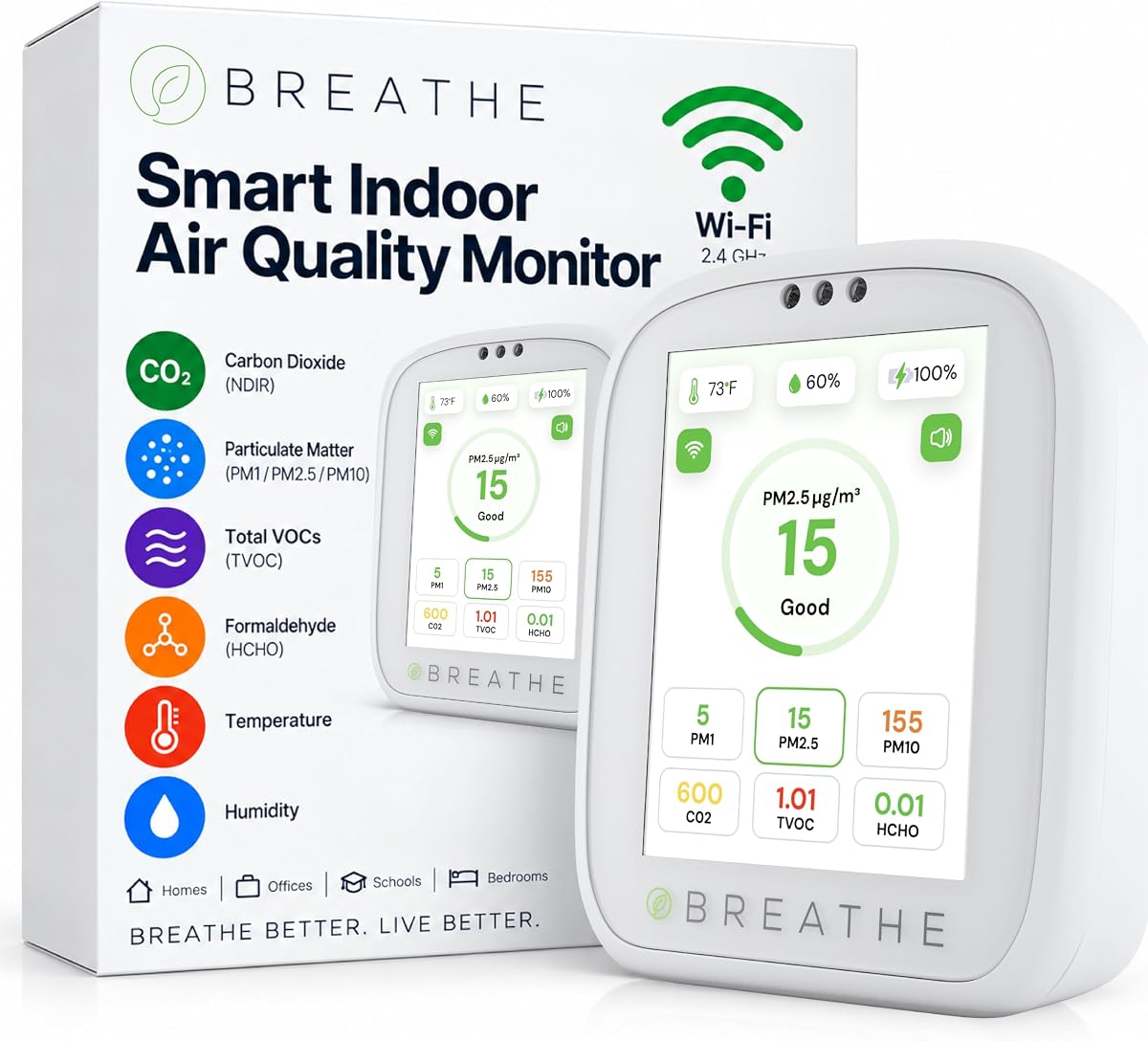
The BREATHE Airmonitor Plus Gen 2 is a balanced indoor air monitor for users who want both immediate readings and meaningful historical context. Its 4.0 rating reflects a versatile device that tracks CO2, PM1, PM2.5, PM10, TVOC, formaldehyde, temperature, and humidity in real time. A color display provides local information, while the free Breathe Tech app extends the monitor into remote monitoring, alerts, graphs, and long-term review.
We may earn a commission when you buy through this link, at no additional cost to you.
The combination of NDIR CO2 measurement, laser particle sensing, dedicated TVOC detection, and formaldehyde sensing gives it a notably complete sensor package. Instead of isolating one pollutant, it lets users examine how cooking, cleaning, occupancy, HVAC operation, and ventilation affect several readings at once. Configurable CO2 and PM2.5 alerts, 90-day app history, and data export make it especially valuable for noticing patterns rather than relying on a single momentary observation.
The main compromises involve power and connectivity. The Gen 2 offers up to six hours of portable use, so a fixed location is usually better for long-term tracking, although it can operate while connected to USB-C power. App pairing requires 2.4 GHz Wi-Fi, and the provided information does not mention Bluetooth as an alternative. Users who want the unit to function only as an offline screen may find some of the app sophistication unnecessary.
This is our Editor's Choice because it offers the strongest overall balance of measurement breadth, usable history, remote access, and data export. It suits households, offices, classrooms, and bedrooms that want to understand trends without buying separate CO2, particle, and VOC instruments. Choose it when historical analysis and actionable alerts are priorities; choose a simpler wired screen instead when only immediate PM2.5 readings are needed.
Ninety days of stored readings can show how air changes across a normal week rather than only during one unusual moment. The export function also allows readings to be examined outside the app for deeper analysis.
Tracking CO2 beside three particle sizes, TVOC, and formaldehyde offers a more complete view of a room. It is particularly useful for comparing ventilation with activities such as cooking, cleaning, and extended occupancy.
We may earn a commission when you buy through this link, at no additional cost to you.
The 10-in-1 Smart Air Quality Tester combines a perfect 5.0 rating with a design focused on portable, continuous monitoring. It detects CO2, formaldehyde, TVOC, benzene, PM2.5, and PM10, giving users a broad view of gases and particles. A high-definition color screen presents current data and can change color when readings exceed a configured threshold, allowing a potentially poor condition to stand out without constant number checking.
We may earn a commission when you buy through this link, at no additional cost to you.
Its major advantage is battery life. The built-in 2000mAh rechargeable battery supports up to 20 hours of continuous intelligent detection, substantially longer than the other portable units in this guide. That makes the monitor suitable for moving around a home, checking a car, observing a plant or pet area, or conducting an extended inspection in a workshop. The included USB charging cable supports straightforward recharging.
Simplicity is another strength. A three-second press turns the device on or off, after which it begins full-range detection automatically. A one-second press switches the temperature unit between Celsius and Fahrenheit, reducing the need to navigate complicated menus. Its sensor package includes dedicated CO2 detection plus electrochemical sensors for formaldehyde and TVOC, with smart calibration intended to maintain stable sensitivity. Nevertheless, the supplied information does not describe app connectivity, remote access, or historical data storage.
This monitor is best for users who prioritize long portable operation and a broad collection of immediate readings. It is a strong alternative for a room, vehicle, or temporary inspection where remote monitoring is unnecessary. People seeking a permanently installed monitor with cloud alerts, or those who need established carbon monoxide sensing, should examine the Amazon or Airthings options before making a final choice.
The twenty-hour runtime allows the monitor to cover a substantial workday or a full trip without constant recharging. It is one of the most practical choices for temporary checks in several rooms or a vehicle.
Automatic color changes make abnormal readings easier to notice at a glance. This is useful in a workshop, bedroom, or kitchen where the display is visible but the user may be occupied with another task.
We may earn a commission when you buy through this link, at no additional cost to you.
The GoveeLife Smart Air Quality Monitor H5106 is a focused, practical choice for anyone who mainly wants PM2.5, temperature, and humidity information with smart-home integration. Its 4.3 rating reflects a device that keeps the measurement set understandable while offering remote viewing, historical graphs, export, and automatic control of compatible GoveeHome appliances. It earns the Best Budget label because it focuses on the features many room monitors actually need rather than adding a crowded list of gas readings.
We may earn a commission when you buy through this link, at no additional cost to you.
The sensor refreshes PM2.5, temperature, and humidity data every two seconds, and a top-button layout switches the display between clock and PM2.5 mode. A long press changes the screen between bright and night modes. Four LED air-quality levels offer a quick visual summary, while Bluetooth or Wi-Fi connectivity allows remote monitoring through the GoveeHome app. Online graphs cover 13 days, and data can be exported for up to two years.
Its limitations are clear. The H5106 is a wired unit with no built-in battery, and it measures only three core environmental factors. It does not detect CO2, carbon monoxide, VOCs, or particulate sizes beyond PM2.5. The clock display through Wi-Fi specifically requires 2.4 GHz, and the automation feature works with listed compatible GoveeLife purifiers, humidifiers, fans, and space heaters rather than every smart-home product. Its value therefore depends on using a Govee ecosystem or wanting only the core measurements.
This is a strong recommendation for a bedroom, living room, or nursery where PM2.5 and comfort are the priorities and a purifier is already in the GoveeLife family. It is also appealing for buyers who want historical information and export without a subscription or a larger display. For carbon dioxide, broad pollutant coverage, or a standalone battery-powered device, move up to the BREATHE or portable 10-in-1 options.
PM2.5, temperature, and humidity provide a practical daily snapshot without a difficult interface. The display remains easy to read, while the app adds detail for users who want trends.
Compatible purifiers, humidifiers, and fans can respond automatically when air quality changes. This is valuable for consistent operation, although compatibility should be checked before buying.
We may earn a commission when you buy through this link, at no additional cost to you.
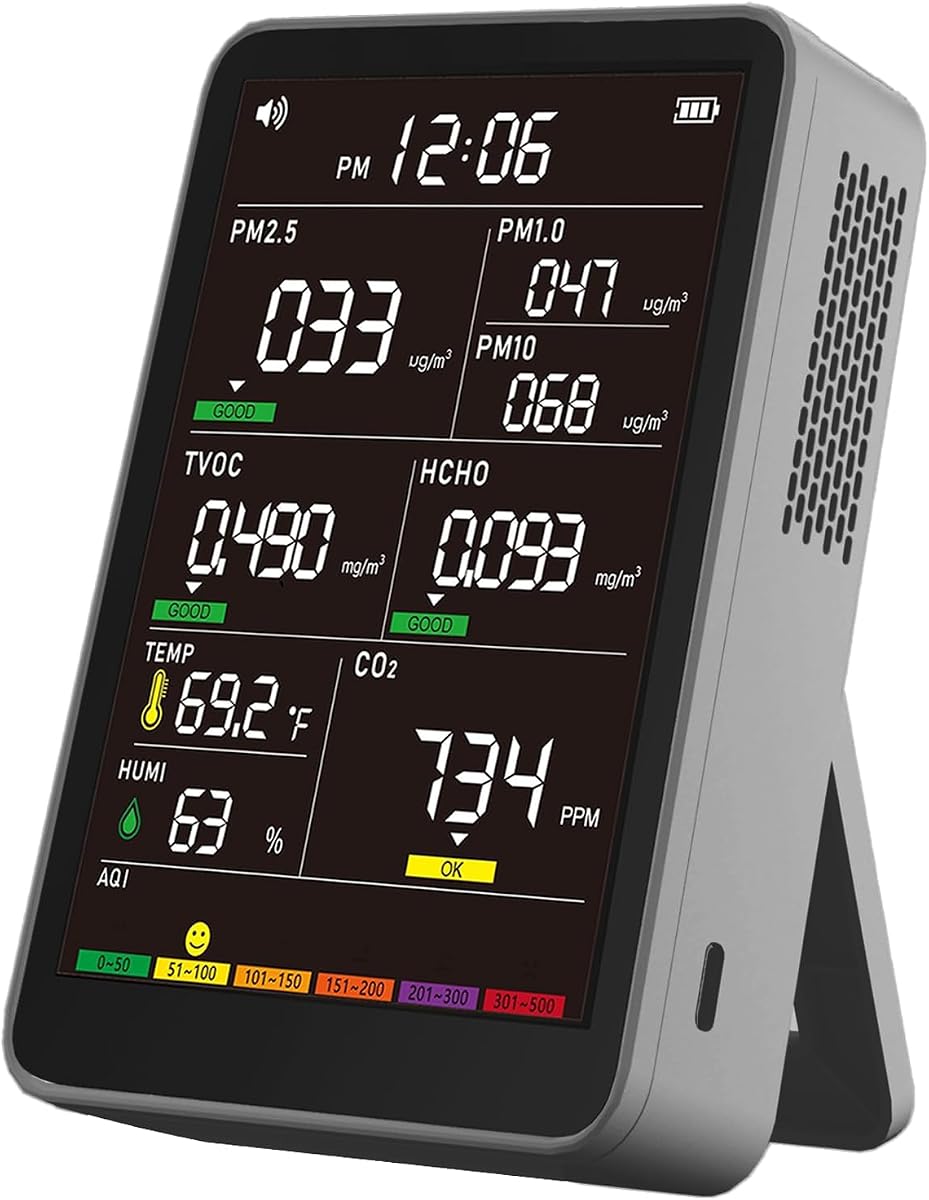
The 16 in 1 Air Quality Monitor Indoor High-Precision CO2 Monitor is a strong all-in-one display with a 4.9 rating. It reports CO2, PM2.5, PM1.0, PM10, formaldehyde, TVOC, temperature, humidity, AQI, and time, while seven alert buzzer functions add audible warnings. The 5.5-inch HD LED display balances visibility with a more manageable size than the seven-inch alternative in this guide.
We may earn a commission when you buy through this link, at no additional cost to you.
Three brightness levels make the screen usable under different lighting conditions, and a double press of the power button changes Celsius and Fahrenheit. The monitor provides up to 10 hours of continuous operation on a full charge, giving it the longest stated portable runtime among the large-screen 16-in-1 models here. A USB-C interface and included AC adapter make it suitable for extended use in a bedroom, office, vehicle, or other indoor space.
As with other external-sensor monitors in this category, placement and handling matter. The supplied guidance says not to touch the sensors or expose them to perfumes and strong odors, which helps preserve measurement consistency. The product information does not describe an app, cloud history, or remote notifications, so its strengths are centered on immediate readings, visual clarity, and local alarms rather than remote analysis. It is a monitoring reference and should not be treated as a certified life-safety alarm.
Choose this model for users who want many readings visible at once, audible warnings, and a longer portable runtime than smaller alternatives. It is particularly effective when a screen must be readable across a room or desk. Those wanting trends, remote access, and long-term exports should favor the BREATHE Airmonitor Plus, while a permanent smart-home installation may suit the Amazon monitor better.
The extended runtime provides more freedom than many screen-equipped portable monitors. It can remain useful through a workday, travel in a vehicle, or cover several rooms during a temporary inspection.
Nine parameters on a 5.5-inch display create a useful room dashboard. Adjustable brightness helps the screen remain readable without making it unnecessarily prominent at night.
We may earn a commission when you buy through this link, at no additional cost to you.
The Amazon Smart Air Quality Monitor 2-Pack is a practical choice when different rooms need separate monitoring points. Its 4.2 rating matches the single-unit version and reflects a device designed around accessible air-quality scores, phone notifications, and Echo announcements. Because the package contains two units, users can place monitors in locations such as a bedroom and living room without choosing one room over another.
We may earn a commission when you buy through this link, at no additional cost to you.
Each unit measures PM2.5, VOCs, carbon monoxide, humidity, and temperature. A color-coded LED communicates the current indoor air-quality indication, while the Alexa app supplies more detail and an easy-to-understand score. When conditions decline, the system can notify a phone or make an announcement through Echo devices. Compatible air purifiers, dehumidifiers, and fans can also be tied to routines that react to the sensor readings.
The limitations are shared with the single Amazon monitor. There is no local numerical screen, no built-in battery, and no CO2, formaldehyde, or multiple particle-size measurements in the supplied specifications. Each unit also needs a power outlet, so placement is guided by available sockets and extension-cord safety. A two-unit setup is only as useful as the ability to distinguish trends between locations, so the app and notifications become particularly important.
This bundle is best for Alexa users who want to watch more than one area, particularly rooms with different occupancy or ventilation conditions. It works well when each room also has a compatible purifier, fan, or dehumidifier that can be automated. For rich local displays, broader chemical sensing, or portable use, the BREATHE and large-screen monitors offer more direct measurement options.
Two units make it easier to see where conditions differ, such as between a frequently occupied family room and a quieter bedroom. Each location receives its own sensor readings and status indication.
Compatible appliances can respond automatically when a monitor detects a change. This makes the bundle useful for maintaining a consistent response across multiple rooms, especially within the Alexa ecosystem.
We may earn a commission when you buy through this link, at no additional cost to you.
This second 16-in-1 Indoor Air Quality Monitor is another highly rated, display-focused option. It earned a 4.9 rating and covers PM1.0, PM2.5, PM10, TVOC, formaldehyde, temperature, and humidity. The device automatically samples and processes air data every 1.5 seconds, creating a continuously changing view that is useful when users want to watch how a room reacts to cooking, cleaning, occupancy, or open windows.
We may earn a commission when you buy through this link, at no additional cost to you.
Its high-definition color screen gives readings a clear visual hierarchy and uses color-coded air levels to make conditions easier to interpret. One button handles power and the Celsius or Fahrenheit setting, while a double tap disables the audio prompt for quieter use. The compact, lightweight body expands its potential locations to include bedrooms, offices, vehicles, campsites, homes, and classrooms. A matching Type-C cable and AC adapter are included in the package.
Portability is constrained by the stated four-to-five-hour runtime. For extended monitoring, the unit would need to remain connected to power, making the rechargeable feature less consequential in a permanently installed location. There is no mention of app connectivity, remote access, alert thresholds, or historical storage. The product is also not a smoke alarm or carbon monoxide alarm, so it should remain a reference instrument rather than a substitute for certified safety equipment.
This model is a good match for buyers who prioritize a large, attractive, real-time display and straightforward controls. It works well for short inspections in different rooms, vehicle checks, and periods when users want to observe several pollutant categories without setting up an app. For longer portable sessions, the 10-in-1 Smart Air Quality Tester offers substantially more runtime, while the BREATHE model adds history and remote access.
The 1.5-second refresh interval makes the display feel responsive during changing conditions. This is useful when a quick rise in particles or VOCs follows a cooking or cleaning event.
The adjustable audio prompt allows the monitor to remain visually informative without producing unwanted sound. A single-button layout also reduces the learning curve for older users or anyone wanting minimal controls.
We may earn a commission when you buy through this link, at no additional cost to you.
The Airthings View Plus is the most specialized and comprehensive monitor in this roundup, earning the Best Premium designation for its continuous radon detection and always-on connected design. Its 4.0 rating reflects a device built for users who want long-term awareness of a home's air rather than only a momentary check. It measures radon, PM2.5, carbon dioxide, VOCs, humidity, temperature, and air pressure.
We may earn a commission when you buy through this link, at no additional cost to you.
Radon is the feature that clearly separates it from the other products. A dedicated digital radon detector makes the unit relevant for long-term household monitoring, especially where radon testing, property inspections, or regional risk factors have previously prompted concern. The other measurements provide context, allowing users to compare radon with occupancy-related CO2, particulate pollution, chemical VOCs, and basic comfort conditions in the same application.
Unlike many plug-in indoor monitors, the View Plus is battery-powered and therefore easier to place without following a cable. Its understated e-ink screen suits a permanent location. The Airthings app provides live data, trend analysis, notifications, and local pollen information through Breezometer, while readings are securely stored in the cloud. These capabilities also create dependencies: an account, the app, and internet access are required, and the monitor will not function as intended without them.
Choose the View Plus when radon monitoring is a central concern and you want a single always-on device that also tracks several common air-quality indicators. It is especially appropriate for a basement, first-floor area, or a home where a professional radon assessment has led to ongoing monitoring. For routine PM2.5 tracking or a portable room check, the other picks provide a simpler and generally less involved experience.
A dedicated radon sensor brings a dimension missing from most general-purpose indoor monitors. Continuous readings can support long-term awareness and complement professional testing or property guidance.
The app, cloud history, trend analysis, and notifications allow the monitor to be checked from beyond the room where it sits. This makes long-term data collection more useful than local readings alone.
We may earn a commission when you buy through this link, at no additional cost to you.
Choosing an indoor air quality monitor means balancing the pollutants you need to measure with the way you will use the readings. Sensor coverage, local visibility, remote access, alerts, power, placement, and maintenance all influence whether a device will fit your routine.
No single model in this guide measures every possible contaminant, so begin with the air-quality questions that matter in your home. PM2.5 is useful for tracking fine particles associated with cooking, dust, smoke, and outdoor infiltration. CO2 can indicate how ventilation responds to occupancy, while TVOC and formaldehyde readings may help identify changes linked to cleaning products, furnishings, paints, adhesives, and other chemical sources. Carbon monoxide and radon are distinct hazards that require dedicated sensing when they are your primary concern.
Look for the measurement list rather than relying on a product name such as 10-in-1 or 16-in-1. Some of those names combine display modes, alert types, or time readings with actual sensor outputs. Choose a monitor that measures the pollutants central to your concern and supports your intended response, such as opening a window, running a purifier, or changing an appliance schedule.
A local screen is valuable when you want a glanceable reading in the room. The large-display models show numerous values at once, while the GoveeLife H5106 uses a simpler LED and button arrangement, and the Amazon monitor relies on an LED plus app score. App access adds remote visibility, graphs, notifications, and data export, but it can also require an account, compatible network configuration, and reliable internet access. Decide whether the monitor is primarily a bedside or desktop dashboard or a tool you expect to check away from home.
A local-only device is usually easier to operate without ongoing network setup. A connected model is more valuable when monitoring over days or weeks matters. Match the interface to your habits: abundant real-time data is useful only if you will examine it and have a clear idea of what action to take.
Alerts can be visual, audible, voice-based, or delivered through an app. The multi-parameter portable monitors use buzzers and color changes, the Amazon models provide phone notifications and Echo announcements, the BREATHE model supports configurable CO2 and PM2.5 alerts, and the Airthings View Plus sends air-quality notifications. Each approach serves a different environment. Buzzers work well in a room where a visible screen is not always attended, while app alerts are more useful when you are away.
Check whether alerts can be muted and whether the device supports the parameters you care about. An alert is only valuable if it is noticeable and does not create persistent nuisance noise. For a bedroom, look for adjustable brightness, a quiet prompt, or a mute button; for a kitchen or workshop, audible and visual warnings may be more appropriate.
Plug-in monitors such as the Amazon and GoveeLife H5106 are straightforward for permanent locations, but they require access to an outlet and Type-C power in the latter's case. Rechargeable monitors provide more freedom: the 10-in-1 model is stated to run for up to 20 hours, the 16-in-1 HD model for up to 10 hours, the seven-inch model for up to 8 hours, the BREATHE Gen 2 for up to 6 hours, and the compact multi-parameter models for approximately 4 to 5 hours. The Airthings View Plus uses battery power for cable-free placement.
For permanent monitoring, continuous wired power is usually the least disruptive. For checking multiple rooms or a vehicle, battery duration becomes the deciding factor. Always use the supplied charging guidance and compatible Type-C cables, and avoid assuming a portable unit can remain unattended on battery indefinitely.
Historical data helps turn isolated readings into useful patterns. The BREATHE Airmonitor Plus stores up to 90 days of app data and supports export, the GoveeLife H5106 provides 13-day graphs and export for data over the past two years, and the Airthings View Plus uses cloud storage for ongoing analysis. The Amazon monitor emphasizes current scores, alerts, and routines rather than a long local history. Screen-only portable units generally prioritize current readings instead of retained trends.
Choose history when you want to see how cooking, cleaning, sleep, weather, or occupancy affects the air over time. Export adds value for detailed review or comparison across devices. If you only need to know whether conditions are acceptable right now, a simpler model may be sufficient and easier to maintain.
Compatibility is a major differentiator. The Amazon Smart Air Quality Monitor works with Alexa and can connect its readings to compatible purifiers, dehumidifiers, and fans through routines. The GoveeLife H5106 can automate listed GoveeLife purifiers, humidifiers, fans, and space heaters. The BREATHE model uses the Breathe Tech app over 2.4 GHz Wi-Fi, while the GoveeLife device uses Bluetooth or Wi-Fi and requires 2.4 GHz for its time display. Other portable models are primarily local-display devices.
Verify the exact ecosystem, device models, and network requirements before purchasing. Automation can be valuable, but it should not replace ventilation or sensible habits. Check compatibility first, then decide whether remote control, voice updates, or simple local readings best fit your household.
The products use different wording for precision, including stated accuracy ranges, error margins, or decimal-level units. These claims are not directly interchangeable because the products measure different variables and may present readings at different levels of resolution. The physical placement and condition of a sensor also matter. Some external-sensor models explicitly warn against touching sensors or exposing them to perfume and strong odors.
Use the most credible value to guide your response rather than treating every decimal place as laboratory-level certainty. Look for consistent behavior, suitable placement, and readings that respond logically to ventilation or an indoor source. A monitor is primarily a practical awareness tool, and none of these products should replace a certified alarm where one is required.
Place the monitor where it can sample representative air without being blocked, and keep the sensor area clear. Avoid direct contact with strong odors or interference, particularly on units with external sensors. The GoveeLife H5106 should remain unobstructed to preserve detection accuracy, and the Amazon monitor needs an outlet. Portable units benefit from being moved to the area being checked rather than left closed away in a storage space.
Cleaning and charging are also part of ownership. Follow the included instructions, use the specified Type-C cable where applicable, and avoid placing the device where moisture, heat, or direct sunlight could interfere with operation. A monitor that is always powered in a suitable location will usually provide more consistent trends than one that is charged only occasionally.
Begin by deciding what the monitor should help you learn and where it will live. Install connected products, complete account setup, select the correct temperature unit, and verify that readings appear on the display or in the app. Position the device in the breathing zone of the room, away from direct sunlight, obvious dust, cooking vapor at the source, and objects that block airflow. If using a multi-sensor model with external probes, follow the guidance to avoid touching the sensing area.
Establish a baseline before judging a reading. Watch the device through normal conditions, including doors and windows being opened or closed, appliances running, and different times of day. A sudden increase in PM2.5 after cooking or TVOC after cleaning can reveal a source, while a gradual CO2 increase in an occupied room may point to a ventilation pattern. Avoid reacting to every isolated fluctuation; look for repeated patterns and use the readings to guide ventilation, filtration, or activity changes.
For ongoing care, keep the sensor unobstructed and dust-free, use only the recommended charging cable, and follow the manufacturer's calibration or cleaning instructions. Portable devices should be recharged before planned extended checks, while plug-in models should be positioned on stable surfaces with secure connections. Review app trends regularly, export data when you want to compare periods, and update connected appliance routines only after understanding how your monitor behaves in the room.
It depends on the problem you want to investigate. PM2.5 is broadly useful for fine-particle exposure, CO2 is helpful for examining ventilation and occupancy, and TVOC or formaldehyde can reveal chemical changes from products or furnishings. Choose a monitor around your main concern instead of assuming the largest number of readings is automatically the most useful.
No. General-purpose indoor air quality monitors are not substitutes for certified life-safety devices. Several products in this guide explicitly state that they are reference monitors and are not smoke alarms or carbon monoxide alarms. A dedicated alarm and appropriate ventilation, maintenance, and safety practices remain necessary.
People exhale carbon dioxide, so CO2 can accumulate when a room is occupied and fresh outdoor air is limited. A rising trend may indicate that additional ventilation would be useful, although the monitor should be considered alongside other indicators. Opening a window, improving mechanical ventilation, or reducing prolonged occupancy can help address the pattern.
A plug-in model is usually more convenient for permanent monitoring because it can operate continuously without planning around a charge. A battery-powered model is better for checking several rooms, vehicles, or temporary locations. The stated runtimes range from roughly 4 to 5 hours on some compact models to as much as 20 hours on the longest-running portable option.
One unit can monitor the area where it is placed, but air conditions often differ by room. A two-pack can cover separate spaces, while a portable model can be moved during scheduled checks. If you want comparisons by room, note the location of each reading and avoid placing monitors near open windows, direct pollution sources, or obstructed airflow.
It depends on your home, location, testing history, and property guidance. Radon is a distinct gas that the more general-purpose monitors in this guide do not measure. The Airthings View Plus includes dedicated continuous radon detection, while professional testing can provide an independent assessment of local conditions.
First consider nearby activities such as cooking, cleaning, candles, dust movement, or a window opening. A brief increase may be tied to that source and can settle after the activity or with ventilation. Repeated or persistent changes are a reason to examine the room, filtration, and building conditions rather than relying on a single reading.
A large display is convenient for immediate, glanceable readings, while app history is better for identifying trends over days or weeks. The Amazon and GoveeLife models emphasize simple connected status, the BREATHE model emphasizes 90-day history and export, and the portable multi-parameter monitors focus on local readings. Choose based on how you normally check and act on air conditions.
The GoveeLife Smart Air Quality Monitor H5106 stands out as the best value for focused PM2.5, temperature, and humidity monitoring, particularly when GoveeHome automation is useful. The BREATHE Airmonitor Plus Gen 2 is the Editor's Choice because it combines broad sensor coverage, 90-day history, remote alerts, and export in a balanced connected package. For comprehensive, always-on monitoring with a specific radon focus, the Airthings View Plus is the premium selection.
Prioritize the pollutant coverage and interface that match your actual routine. A portable screen works well for quick checks, a connected model suits long-term trend analysis, and a large display is useful when several values should remain visible. Before finalizing, verify ecosystem compatibility, power needs, placement guidance, and whether you need dedicated radon or carbon monoxide detection rather than a general indoor air monitor.
Ratings, features, and availability can change, and current prices are worth checking before purchase. Compare the product listing with your room, ventilation setup, household routines, and app preferences. The right indoor air quality monitor is not necessarily the model with the longest feature list, but the one that helps you consistently notice meaningful changes and take a useful next step.