
WF-8930/50NPB RV Distribution Panel
5.0Editor score
30 and 50 amp compatibility
120 and 240 VAC support
Compact integrated wiring design
Our RV Electrical Panel with Breaker guide compares ten options for outdoor power, circuit protection, receptacle layouts, weather resistance, and easier
An RV electrical panel with breaker combines a protected power inlet, branch-circuit control, and weather-resistant housing into one system for shore power, generators, temporary hookups, or RV service upgrades. The best choice depends on supported amperage, voltage, receptacle configuration, available space, and the degree of installation work you are prepared to handle.
This guide compares the complete ten-product list using the supplied specifications, ratings, construction details, installation features, and intended applications. It covers temporary outdoor power boxes as well as fuller RV power distribution centers, distinguishing between compact hookup panels and panels designed to organize numerous AC and DC loads.
Each review explains the strongest features, practical limitations, and likely buyer profile. Ratings and specifications reflect the information available for the November 2026 roundup, while retail listings, product details, and availability may change, so confirm compatibility before buying or beginning installation.
5.0Editor score

4.4Editor score
4.7Editor score
The comparison covers temporary hookup boxes, outdoor receptacle panels, integrated RV distribution centers, and a general outdoor load center, with each product presented according to its documented amperage, installation approach, and available feature information.
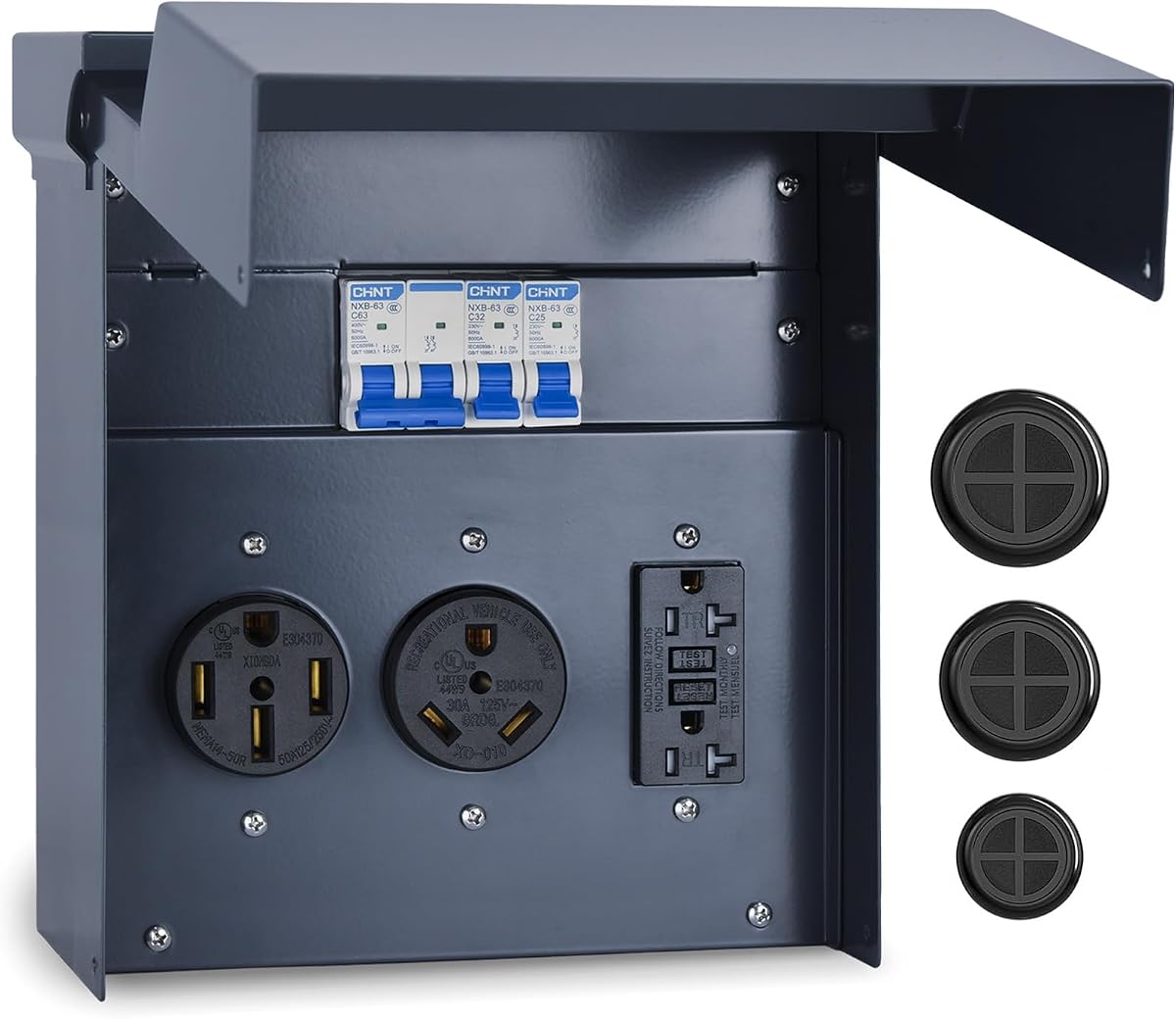


The Umaoqus RV Electrical Panel with Breaker earns the Editor's Choice position because it combines broad receptacle support, a thoughtfully enlarged closure, and a construction-focused outdoor enclosure. Its 4.4 rating reflects a well-received product with enough documented detail to stand out among temporary RV power boxes. The panel is particularly relevant to owners who need one hookup solution for 20-, 30-, and 50-amp service.
We may earn a commission when you buy through this link, at no additional cost to you.
Its most immediately useful feature is the three-outlet configuration. Instead of carrying separate boxes for different RV power standards, users can select the appropriate receptacle for their equipment. The UL-certified sockets use silver-plated contact surfaces, while internal high-conductivity copper wiring is designed to maintain stable current and reduce heat generation. A matched circuit-breaker arrangement adds a clear layer of overload protection for each service path.
The housing uses high-strength cold-rolled steel with an AkzoNobel electro-galvanized anti-corrosion coating. According to the supplied information, that finish has passed more than 2,000 hours of salt-spray testing under ASTM B117 and is intended to resist fading and cracking at elevated temperatures. The widened panel and three-and-a-half-inch closing depth also create room for bulky plugs, heavy conductors, and larger cable bends, addressing a common source of frustration with compact outlet boxes.
This is a strong choice for temporary hookups, RV parks, construction sites, and outdoor travel. The breakers and receptacles arrive pre-wired, so installation centers on connecting ground, neutral, and live conductors to the correct terminal positions. The trade-offs are that the listing does not spell out every voltage detail, and no basic electrical panel can safely substitute for sound wiring practices and code-compliant installation. For buyers wanting flexible amperage in a rugged temporary enclosure, it remains the most balanced pick.
Its most immediately useful feature is the three-outlet configuration. Instead of carrying separate boxes for different RV power standards, users can select the appropriate receptacle for their equipment. The UL-certified sockets use silver-plated contact surfaces, while internal high-conductivity copper wiring is designed to maintain stable current and reduce heat generation. A matched circuit-breaker arrangement adds a clear layer of overload protection for each service path.
Offering 20-, 30-, and 50-amp receptacles in one enclosure reduces the need for multiple temporary power boxes. This makes the panel useful for RV owners, contractors, and outdoor users who work with different equipment and connection standards.
The steel construction, anti-corrosion coating, and expanded closure space are especially relevant outside the vehicle. The larger interior accommodates demanding cable and plug arrangements while the protective coating supports long-term resistance to moisture, dirt, and environmental wear.
We may earn a commission when you buy through this link, at no additional cost to you.
The Blue 50/30/20 Amp RV Box is a well-equipped temporary power panel for users who value organized cable entry and straightforward mounting. Its 4.3 rating places it among the stronger products in the roundup, while the supplied details show a strong focus on weather protection, independent breaker control, and reduced installation friction. The enclosure is intended for RVs, campers, construction sites, mobile homes, and other outdoor power needs.
We may earn a commission when you buy through this link, at no additional cost to you.
Each of the three receptacles has an independent circuit breaker matched to its current rating. The receptacles are UL listed, which provides an important distinction from an unprotected outlet or a generic socket assembly. The panel's widened design includes three inches of additional closure depth so the weatherproof cover can close around large handles and thick cables. That practical improvement helps prevent a partially open door from undermining the enclosure's weather-resistant design.
Installation details are thoughtfully arranged. Three pre-cut power-entry openings come with double-sided rubber plugs measuring 1.18, 1.45, and 1.18 inches, allowing installers to select a suitable opening while helping block insects and moisture. A 90-degree self-latching hinge keeps the cover open during wiring without requiring the installer to hold it, and pre-installed hook slots support wall or pole mounting. All breakers and outlets arrive pre-wired.
The main caution is straightforward: the supplied instructions advise checking every wire connection before use because shipping can affect terminal tightness. That is a sensible inspection step for any electrical installation. The panel is also more specialized than a basic single-receptacle box because it provides three service sizes and sealed entry provisions. For an RV owner seeking a clearly organized outdoor hookup panel, it offers a particularly thoughtful balance of protection and convenience.
Installation details are thoughtfully arranged. Three pre-cut power-entry openings come with double-sided rubber plugs measuring 1.18, 1.45, and 1.18 inches, allowing installers to select a suitable opening while helping block insects and moisture. A 90-degree self-latching hinge keeps the cover open during wiring without requiring the installer to hold it, and pre-installed hook slots support wall or pole mounting. All breakers and outlets arrive pre-wired.
Pre-cut openings with removable rubber plugs make it easier to route a power cable while limiting gaps around the entry point. This arrangement is useful where insects, rain, or blowing debris could otherwise reach the enclosure interior.
The self-latching hinge, pre-wired components, and mounting slots reduce common obstacles during setup. They do not replace electrical verification, but they make wiring and physical placement more manageable.
We may earn a commission when you buy through this link, at no additional cost to you.
The WF-8930/50NPB is the most advanced power-distribution option in this roundup, earning a 5.0 supplied rating and the Best Premium designation. Unlike a simple temporary outlet box, it is presented as a full RV breaker and distribution center capable of supporting both 30-amp and 50-amp AC service, numerous branch circuits, and DC loads. It is best suited to serious RV electrical builds, replacements, or OEM-style installations.
We may earn a commission when you buy through this link, at no additional cost to you.
Dual 30-amp and 50-amp compatibility lets the panel adapt to different RV access scenarios instead of requiring separate panel replacements. It supports 120 VAC and 240 VAC input frequencies and is compatible with mainstream shore power and portable generator supply standards. Internally, the distribution system provides 15 independent DC branch circuits and capacity for up to 12 dedicated AC branch circuits, allowing onboard equipment to be divided into clearly controlled groups.
The enclosure measures 13.75 by 9.5 by 4 inches and weighs 3.75 pounds. Those dimensions are meaningful in travel trailers and motorhomes, where cabinet space is limited and bulky components can interfere with storage or equipment layout. The panel also uses integrated internal wiring, electromagnetic shielding, and damping structures intended to support quiet operation without introducing current ripple or frequency interference into televisions, refrigerators, lighting, or Bluetooth audio.
This is not a drop-in outlet for an inexperienced user. Advanced AC and DC distribution requires careful conductor sizing, correct grounding, neutral and hot arrangements, code-compliant branch protection, and thorough testing before energizing. The inverter is also not included. Even so, the feature set is compelling for builders who want a single compact center for multiple service standards and onboard loads, making it the strongest premium option when the installation is professionally planned.
Dual 30-amp and 50-amp compatibility lets the panel adapt to different RV access scenarios instead of requiring separate panel replacements. It supports 120 VAC and 240 VAC input frequencies and is compatible with mainstream shore power and portable generator supply standards. Internally, the distribution system provides 15 independent DC branch circuits and capacity for up to 12 dedicated AC branch circuits, allowing onboard equipment to be divided into clearly controlled groups.
The combination of up to 12 AC branches and 15 DC branches makes this panel useful for complex RV systems. It can organize lighting, pumps, fans, appliances, and other loads within one cabinet-friendly housing instead of separate improvised distribution points.
Shielded circuits and damping-oriented construction are intended to reduce electrical interference and operating noise. Its compact proportions also preserve more cabinet and storage space than a larger, less integrated panel arrangement.
We may earn a commission when you buy through this link, at no additional cost to you.
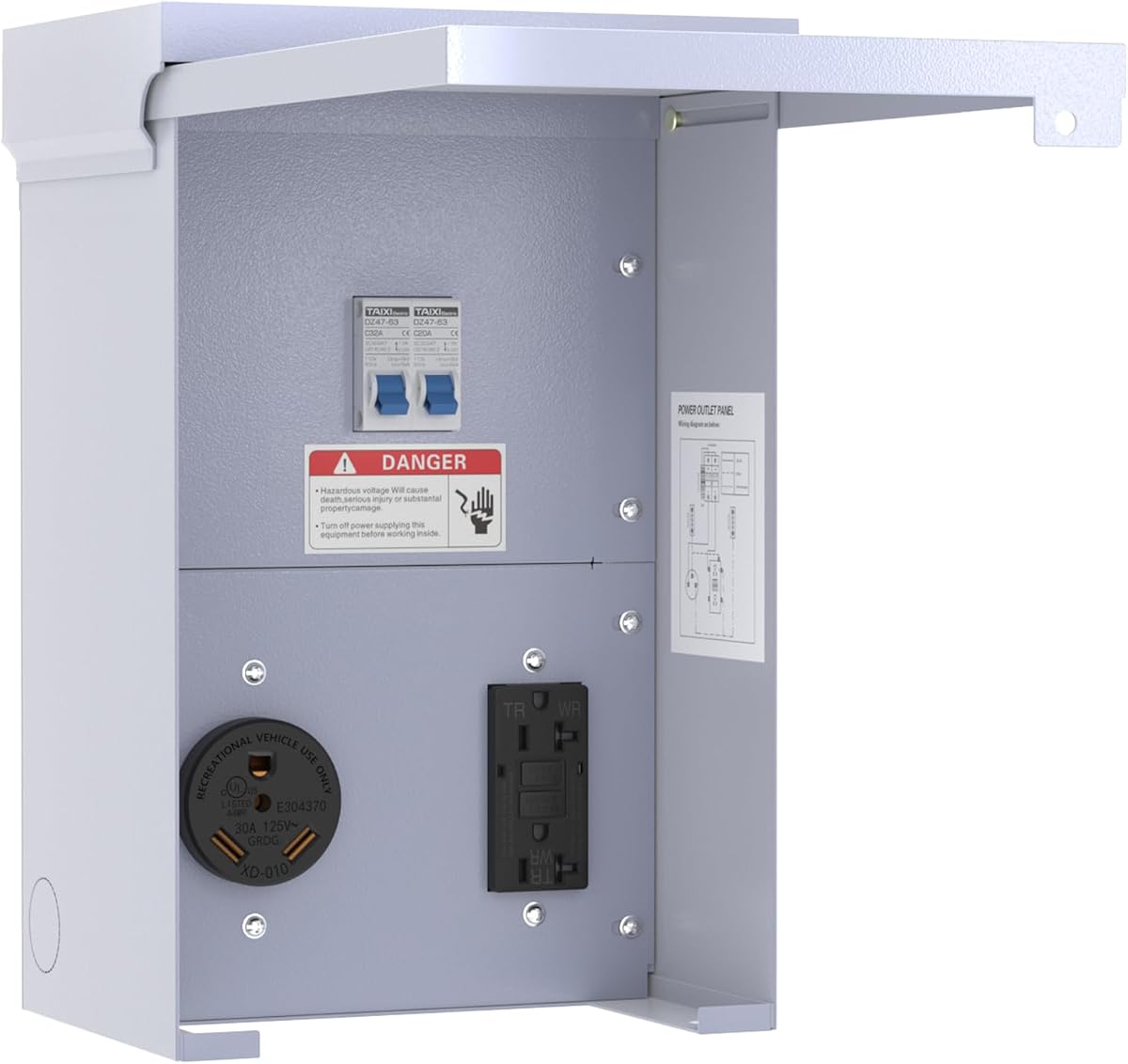
The 20/30 Amp Temporary Power Box delivers the core features many RV buyers need without expanding into a full distribution center. Its 4.7 rating is among the strongest in the list, and the product includes two separately protected receptacles, a steel weather-resistant enclosure, and a pre-wired assembly. It is a practical option for 20-amp accessories, 30-amp RV hookups, construction sites, and RV parks.
We may earn a commission when you buy through this link, at no additional cost to you.
The box is made from heavy-duty cold-rolled steel and uses a whole-body spraying process to resist corrosion, splashing water, rain, dust, snow, oil, and ultraviolet exposure. Each 20-amp and 30-amp outlet is paired with a matched circuit breaker designed to interrupt power during an overload. The receptacles and breakers are UL certified, adding a meaningful layer of component-level assurance.
Installation is one of the panel's strongest selling points. The receptacles and breakers arrive prewired and assembled, while ample rear screw holes make it easier to hang the enclosure on a suitable surface. Three knockouts at different positions allow installers to choose the most convenient location for the incoming power cord. The enclosure measures 12.6 inches high, 8.5 inches wide, and 6.1 inches deep, so users should confirm the mounting area before ordering.
The limitation is its narrower scope compared with the 50-amp options. There is no 50-amp receptacle, and a full distribution center would offer more branch-circuit capacity and DC organization. Nevertheless, for a user whose equipment is compatible with 20- or 30-amp service, this panel delivers a clear, straightforward package with a high supplied rating and fewer unnecessary components.
Installation is one of the panel's strongest selling points. The receptacles and breakers arrive prewired and assembled, while ample rear screw holes make it easier to hang the enclosure on a suitable surface. Three knockouts at different positions allow installers to choose the most convenient location for the incoming power cord. The enclosure measures 12.6 inches high, 8.5 inches wide, and 6.1 inches deep, so users should confirm the mounting area before ordering.
Independent matched breakers help protect each outlet against overload conditions. This focused design is sufficient for many temporary hookup needs without the added bulk of a broader multi-circuit distribution system.
Pre-wired components, several mounting holes, and three selectable knockouts simplify placement and conductor routing. These details make the box especially appealing for straightforward RV park or jobsite power arrangements.
We may earn a commission when you buy through this link, at no additional cost to you.
This fifth listing appears within the RV electrical panel category, but the supplied product record contains no title, description, rating, image, or technical information. As a result, it is impossible to verify its amperage, voltage, receptacle arrangement, breaker inclusion, enclosure rating, mounting method, or suitability for either temporary hookups or permanent RV distribution.
We may earn a commission when you buy through this link, at no additional cost to you.
That absence of information is itself an important buying consideration. An RV electrical panel with breaker must match the amperage and voltage of the incoming supply, the connector used by the RV or appliance, the required conductor sizes, and the applicable installation rules. Without those details, compatibility cannot be established safely from the available listing data.
There is also no way to evaluate whether the enclosure is suitable for outdoor exposure or whether its receptacles and breakers carry appropriate certification. A panel that merely includes a breaker is not automatically appropriate for RV service, particularly when weather resistance, grounding, branch protection, and conductor access are essential.
This listing is therefore included to preserve the complete ten-product comparison, but it should not be selected without opening the live listing and confirming its full specifications, approvals, dimensions, and warranty. If those details cannot be verified, choosing one of the documented products with a clearly identified receptacle, breaker, and construction package is the more defensible decision.
That absence of information is itself an important buying consideration. An RV electrical panel with breaker must match the amperage and voltage of the incoming supply, the connector used by the RV or appliance, the required conductor sizes, and the applicable installation rules. Without those details, compatibility cannot be established safely from the available listing data.
Open the listing and confirm input rating, output receptacles, breaker configuration, enclosure suitability, dimensions, and certification. Do not rely on category placement alone when making an electrical purchase.
Do not assume that an unspecified panel includes a correctly sized breaker or weather-resistant enclosure. Those details must be documented by the seller and matched to the intended installation.
We may earn a commission when you buy through this link, at no additional cost to you.
The WF8930/50 RV Power Distribution Center is a 5.0-rated option designed to organize an RV's AC and DC electrical systems in a single panel. It supports 30-amp or 50-amp service configurations and accepts 120/240-volt input, making it relevant to campers that need flexibility across different utility or generator arrangements. Its defining benefit is comprehensive branch organization rather than a small number of temporary hookup sockets.
We may earn a commission when you buy through this link, at no additional cost to you.
The right side contains a DC fuse board with as many as 15 positions for 12-volt loads such as lights, fans, and pumps. On the left, the AC section accepts compatible residential-style breakers. Dedicated neutral and ground bars help separate the AC wiring paths and support a more professional, serviceable layout. This arrangement is particularly helpful when an RV contains multiple systems that need clearly grouped circuits.
Status indicator lights and a door assembly with a viewing window improve visibility into the panel's condition. The supplied installation reminder is appropriately methodical: disconnect all power, mount the panel securely, connect the battery leads, land the DC circuits, complete AC breaker, neutral, and ground wiring, and inspect every terminal before energizing. The panel is not positioned as a simple consumer plug-in product.
Its primary tradeoff is installation complexity compared with a temporary outdoor outlet box. Correct AC and DC distribution demands sound electrical knowledge, appropriate wire sizing, reliable terminations, and verification under load. For an RV builder, replacement project, or generator-equipped camper, though, the 12 AC positions, 15 DC positions, and visual monitoring features provide a more complete foundation than a basic receptacle panel.
The right side contains a DC fuse board with as many as 15 positions for 12-volt loads such as lights, fans, and pumps. On the left, the AC section accepts compatible residential-style breakers. Dedicated neutral and ground bars help separate the AC wiring paths and support a more professional, serviceable layout. This arrangement is particularly helpful when an RV contains multiple systems that need clearly grouped circuits.
Placing DC fuse positions beside the AC breaker section makes the two electrical systems easier to identify and service. Dedicated neutral and ground bars also support cleaner conductor routing and reduce wiring ambiguity.
The viewing window and status indicator lights make the panel easier to inspect without opening the enclosure immediately. This visibility is useful for routine checks and for troubleshooting whether a branch or source has been interrupted.
We may earn a commission when you buy through this link, at no additional cost to you.
The supplied record for this seventh product provides only an Amazon address and no accompanying product details. The product name, rating, image, and description are all unavailable, so its connection to a particular RV electrical panel configuration cannot be verified. It may have relevant features, but none can be responsibly summarized from the available information.
We may earn a commission when you buy through this link, at no additional cost to you.
Electrical compatibility depends on details that cannot safely be guessed. A buyer would need to know the incoming voltage and amperage, the required connector type, the number and rating of branch breakers, the grounding and neutral arrangement, and whether the enclosure is suitable for outdoor use. Each of those factors affects whether the panel can be used safely in an RV.
The panel's physical dimensions and mounting method would also need verification. Space around a distribution panel must allow the cover to open, cables to enter without sharp bends, and service access to remain possible. A listing that omits these details should be treated as incomplete rather than assumed to be interchangeable with another model.
This product remains in the list because the request calls for one review per supplied product, but it is not a defensible recommendation. A prospective buyer should open the live listing, compare its documentation with the RV's electrical system, and seek technical support if any rating is unclear. If the seller cannot establish compatibility and installation requirements, choose a fully documented option instead.
Electrical compatibility depends on details that cannot safely be guessed. A buyer would need to know the incoming voltage and amperage, the required connector type, the number and rating of branch breakers, the grounding and neutral arrangement, and whether the enclosure is suitable for outdoor use. Each of those factors affects whether the panel can be used safely in an RV.
Look for a wiring diagram, dimensional drawing, input and output ratings, certification information, and environmental enclosure details. These documents should come from the seller rather than from a generic category page.
A panel is only suitable when the supply, connector, conductors, breakers, and RV equipment all agree. Review the complete system instead of comparing one visible receptacle rating in isolation.
We may earn a commission when you buy through this link, at no additional cost to you.
This eighth record is also incomplete in the supplied data. No product title, descriptive information, image, rating, or dimensions are available, leaving its amperage, outlet configuration, breaker design, and installation method unknown. The category relationship alone is not enough to establish that it is an RV-specific temporary power panel or a permanent RV distribution center.
We may earn a commission when you buy through this link, at no additional cost to you.
Before purchasing such a listing, determine whether the product is actually a panel with breakers, a transfer switch, a surge protector, a standalone receptacle, or another electrical accessory. Those devices can appear near RV power products in online marketplaces, but they perform different jobs. Treating a transfer switch as a distribution panel or assuming that a surge protector provides branch overload protection would be an unsafe substitution.
The listing should also disclose the required conductor size, input configuration, grounding provisions, cover type, and environmental limitations. For an RV installation, those details must be reconciled with the vehicle's service rating and the local electrical code. If the page does not provide this information, professional advice is essential before purchasing or connecting anything.
Because of the missing data, there is no defensible way to compare this product's value or suitability against the documented models. The live listing should be examined for updated information, but the safer choice for most buyers is one of the products whose outlet sizes, breaker arrangement, construction, and mounting features are clearly documented.
Before purchasing such a listing, determine whether the product is actually a panel with breakers, a transfer switch, a surge protector, a standalone receptacle, or another electrical accessory. Those devices can appear near RV power products in online marketplaces, but they perform different jobs. Treating a transfer switch as a distribution panel or assuming that a surge protector provides branch overload protection would be an unsafe substitution.
Confirm that the item includes the required outlets and overload protection rather than only switching, monitoring, or surge functions. Product labels and diagrams are more reliable than assumptions based on marketplace placement.
Compare the documentation with the RV's existing service entrance, generator output, shore connection, and planned loads. Every stage of the power path must be compatible from source to appliance.
We may earn a commission when you buy through this link, at no additional cost to you.
The supplied data for this ninth listing contains only its product address, with no descriptive details, rating, image, or technical attributes. It is therefore impossible to establish whether this is a 20-, 30-, or 50-amp hookup box, a complete RV distribution panel, or a related accessory that appears in the same category without offering the required breaker functionality.
We may earn a commission when you buy through this link, at no additional cost to you.
This uncertainty is especially significant because a panel's category name does not establish its suitability. A prospective buyer must examine its internal breaker layout, receptacle ratings, conductor terminals, neutral and ground bars, and outdoor enclosure construction. It is also important to determine whether the unit is designed for temporary external mounting or for installation inside the RV.
A well-documented listing should make the intended power flow clear. It should identify the source connection, the protected outputs, the number of available circuits, and any limitations on simultaneous loads. It should also state what installation supplies are not included. Without those points, a buyer could purchase a functional electrical box that still cannot serve the planned RV configuration.
Although this listing must remain in the full ten-product comparison, it is not one of the recommended selections. Open the live page and obtain the missing specifications before making any commitment. If the information remains absent, favor a model with documented protection, clearly identified receptacles, physical dimensions, and an understandable installation path.
This uncertainty is especially significant because a panel's category name does not establish its suitability. A prospective buyer must examine its internal breaker layout, receptacle ratings, conductor terminals, neutral and ground bars, and outdoor enclosure construction. It is also important to determine whether the unit is designed for temporary external mounting or for installation inside the RV.
Trace the intended connection from source to protected outlets and then to the RV loads. This reveals missing components and prevents a category-level product from being selected for a role it was not designed to perform.
Look for clear circuit protection, grounding arrangements, and manufacturer instructions. If a seller cannot explain the panel's function or limits, proceeding without clarification would add unnecessary risk.
We may earn a commission when you buy through this link, at no additional cost to you.
The Siemens W0816ML1125CU is a 125-amp, eight-space outdoor load center with capacity for 16 circuits, earning a 4.7 supplied rating. It differs from the RV-specific products in the roundup because it is presented as a general outdoor center-load enclosure rather than as a temporary RV hookup box. That makes it most relevant to a buyer who needs a conventional distribution enclosure and understands how to adapt it to RV wiring.
We may earn a commission when you buy through this link, at no additional cost to you.
The core specifications are clear: 125-amp capacity, eight spaces, and 16-circuit capacity in a gray outdoor enclosure. The item weighs 13 pounds and measures 15.5 inches long by 13 inches wide by 5.3 inches high. Those dimensions should be checked against the intended mounting surface, and adequate working space must remain around the cover for inspection and service.
Unlike several temporary power boxes, the supplied information does not identify the receptacle style, individual breaker configuration, included accessories, or RV-specific mounting provisions. It also does not explicitly describe the enclosure's exact environmental rating. Buyers should therefore review the live manufacturer or retailer documentation before assuming it satisfies a particular campsite, RV park, or RV installation standard.
The main strength is its straightforward high-capacity general distribution design. Its limitation is that it is less tailored to RV hookups than the 20/30/50-amp boxes and the WF-8930/50 panels, which explicitly include RV receptacles and branch layouts. For a DIY builder comfortable designing the panel around the vehicle's system, it may provide a useful enclosure; for a plug-and-play temporary hookup, one of the RV-specific options would be easier to justify.
The core specifications are clear: 125-amp capacity, eight spaces, and 16-circuit capacity in a gray outdoor enclosure. The item weighs 13 pounds and measures 15.5 inches long by 13 inches wide by 5.3 inches high. Those dimensions should be checked against the intended mounting surface, and adequate working space must remain around the cover for inspection and service.
A 125-amp enclosure with 16-circuit capacity can serve a range of properly planned outdoor branch arrangements. Its value is in flexibility, although the actual usable layout depends on the breaker and accessory configuration selected by the installer.
Because the listing does not specify RV receptacles or a temporary hookup configuration, check manufacturer documentation for environmental suitability, access, and mounting. Confirm all required components before choosing it for an RV project.
We may earn a commission when you buy through this link, at no additional cost to you.
Choosing an RV electrical panel with breaker begins with the RV's power requirements and installation environment. The right panel must align with the source voltage and amperage, the equipment connector, branch loads, grounding requirements, available space, and the user's installation experience.
Start by identifying the amperage and voltage of every power source and load that will use the panel. A temporary box may provide 20-, 30-, and 50-amp receptacles, while a full distribution center may support 30- or 50-amp service and 120/240 VAC. The selected outlet must match the RV inlet and the intended circuit rather than merely appearing close in shape or capacity. Higher-amperage service also affects conductor sizing, breaker selection, and installation requirements.
Choose a panel whose documented input and output ratings cover the complete power path. If the manufacturer does not state the voltage or service type, do not infer it from the receptacle shape.
Decide whether the panel will provide a temporary external connection or organize the RV's internal electrical system. Temporary hookup boxes emphasize weather-resistant enclosures, accessible receptacles, pre-wired components, and simple mounting. Full distribution centers add branch breakers, DC fuse positions, neutral and ground bars, and more elaborate wiring requirements. Choosing the wrong category can add unnecessary complexity or leave the RV without the number of protected circuits it needs.
Match the product to its actual role. For campsite or jobsite power, favor a focused outlet box; for an RV rebuild or generator system, consider a comprehensive power center.
A panel with breaker should place appropriately rated protection on each intended branch. Check whether breakers are independent, what amperages they serve, and whether the number of positions matches the planned circuits. The 20/30-amp temporary box, for example, offers two separately protected outlets, while the WF-8930/50 options provide much greater branch capacity. A receptacle alone is not equivalent to a protected branch circuit.
Count the required loads, then add room for future expansion. Confirm that the panel can accommodate the intended breaker style and conductor size without crowding.
RV hookup panels are commonly exposed to rain, dust, insects, snow, ultraviolet exposure, dirt, and physical impact. Look for a metal enclosure, corrosion-resistant coating, gasketed or otherwise protected cover, and secure cable entries. The blue 50/30/20-amp box uses pre-cut openings with rubber plugs, while the Umaoqus panel emphasizes its anti-corrosion finish and expanded closure depth. A weather-resistant label should also be verified for general-purpose products.
Favor complete enclosure features over a bare outlet mounted on an open plate. Check that the door can close around the actual plug and cable used in service.
Power cables must enter without sharp bends, pinched insulation, or interference with the closing cover. Large RV cords often have bulky handles, so closure depth and interior space are more important than exterior dimensions alone. Panels with pre-cut entry openings, knockouts in several positions, wire guides, or a wide enclosure give the installer more routing options. Confirm the diameter and bend radius of the conductor before drilling or removing a knockout.
Choose the opening that fits the cable snugly and use the provided sealing provision. Avoid improvised gaps around the conductor.
Pre-wired temporary boxes can shorten the installation process, but connecting hot, neutral, and ground conductors still requires care. Full RV distribution panels add substantially more complexity, including AC branch wiring, DC circuits, battery connections, proper load calculation, and terminal inspection. The WF8930/50 model even provides a step-by-step power-up reminder. Buyers without appropriate electrical knowledge should obtain professional assistance rather than relying on a product description alone.
Evaluate the task honestly. Pre-wiring reduces repetitive work but does not remove the need to verify conductor size, polarity, grounding, protection, and code compliance.
RV cabinets, exterior compartments, posts, walls, and storage bays all impose different space constraints. Record the available width, height, and depth, including room for the cover to open and for service access. The WF-8930/50NPB is explicitly designed around a compact 13.75-by-9.5-by-4-inch format, while the Siemens load center measures 15.5 by 13 by 5.3 inches. Temporary boxes also need secure support and appropriate orientation.
Measure the installation area and photograph nearby obstructions. Check that the enclosure will not interfere with vents, storage, generator access, or other equipment.
Clear documentation is especially important when a product is sold for outdoor electrical use. Look for UL or other relevant certification information, a wiring diagram, terminal labels, input and output ratings, environmental claims, and manufacturer support. Some supplied listings have incomplete product data, making compatibility impossible to assess. A documented product with a complete installation guide is generally more useful than an unidentified item with a broad category title.
Download or save the relevant instructions before installation. If specifications are missing or contradictory, ask the seller or a qualified RV electrical professional before proceeding.
Before installation, disconnect all sources of power, including shore power, generators, inverters, and battery feeds as appropriate to the panel's design. Mount the enclosure securely in a dry, accessible location, then identify every terminal before connecting conductors. Follow the supplied wiring diagram, observe the marked hot, neutral, and ground locations, and use conductors appropriate for the load and installation environment.
After wiring, check each terminal for tightness, verify polarity and grounding, confirm that breaker ratings correspond to the connected circuits, and remove any stray metal or packaging from the enclosure. Restore power only after the inspection is complete. For temporary setups, select the proper receptacle, attach the cable without excessive strain, close the cover fully, and use weather-rated entry seals to prevent moisture or insects from entering.
Perform periodic visual inspections and recheck connections if the panel has been moved, exposed to impact, or operated at unusually high loads. Look for corrosion, moisture, heat discoloration, loose covers, damaged cables, and signs of dust intrusion. Keep unused knockouts properly sealed, retain the cover closed during weather, and contact a qualified technician if a breaker repeatedly trips, a connection feels hot, or the enclosure shows damage.
A temporary outlet box mainly supplies protected exterior receptacles for hookups at RV parks, campsites, or work sites. A full power distribution center organizes multiple AC and DC branches inside the RV, often including space for numerous breakers, fuse positions, neutral bars, and ground bars. The former emphasizes quick external access, while the latter supports a more complex onboard electrical architecture.
Some temporary panels include receptacles for all three amperages, including the Umaoqus and blue 50/30/20-amp models. The correct outlet still must match the equipment and the RV's service configuration. A 50-amp receptacle does not automatically mean every connected load can safely operate at 50 amps.
An inverter converts battery power to usable AC power and is a separate device from a breaker and distribution panel. The supplied information for the WF-8930/50NPB explicitly states that an inverter is not included. Choose the panel for power distribution and protection, and add an inverter only if the electrical design and connected loads require one.
Pre-wiring reduces repetitive assembly work, but it does not make incorrect installation safe. Users must still identify hot, neutral, and ground conductors, match wire size to load, tighten terminals, follow the wiring diagram, and comply with applicable electrical requirements. A full AC and DC distribution panel is best installed or checked by someone with appropriate RV electrical experience.
Choose a panel with a weather-resistant metal enclosure, protected cover, and secure cable entry, then keep the door fully closed during use. Use the provided rubber plugs or properly fitted seals around the selected knockout, avoid leaving unused openings exposed, and mount the box where it will not be struck by vehicles or exposed to standing water. Periodic inspections can reveal damaged seals, moisture, or corrosion.
Repeated tripping can indicate an overload, a short circuit, a poor connection, or equipment drawing more current than the branch permits. Disconnect loads one at a time and review their ratings before reconnecting them. Do not repeatedly reset a breaker that trips immediately or appears hot, damaged, or scorched; have the circuit and panel inspected by a qualified technician.
Leave enough room to open the cover, read labels, inspect terminals, and service connected conductors without removing nearby storage or equipment. Also allow space for cable bends and entry fittings. Measure both the enclosure and the available opening, then check the product dimensions and any manufacturer-specific service-clearance requirements before installation.
It may be possible when the load center has the required rating, breakers, receptacles, environmental protection, and space, but the adaptation must be planned carefully. Some general load centers do not include RV-style receptacles, and their supplied information may not describe every required feature. Confirm compatibility and obtain electrical guidance before using one in place of a purpose-built RV panel.
The Umaoqus 20/30/50-amp outlet box is the strongest all-around temporary hookup choice because it combines three common receptacle sizes, a weather-resistant steel enclosure, pre-wired components, and useful closure clearance. The WF-8930/50NPB is the most capable premium option for a full RV installation, while the 20/30-amp temporary box delivers a focused and highly rated solution for simpler hookups.
Prioritize the power path above all else. Match the panel's input, outputs, breakers, conductors, grounding, voltage, and mounting arrangement to the RV and every planned load. Temporary users should prioritize a weather-resistant enclosure and correctly sized receptacles, while RV builders should examine branch capacity, DC organization, neutral and ground bars, and the quality of the installation instructions.
Retail listings and product details can change, so confirm the current specifications, certification information, dimensions, included components, and warranty before ordering. If a listing does not disclose the information needed to establish safe compatibility, pause and obtain clarification rather than relying on assumptions.