
Liquid Solder Flux Dropper
4.6Editor score
RMA rosin flux formula
Precision dropper container
Lead-free and non-corrosive
This liquid flux for soldering guide compares ten options for electronics, jewelry, stained glass, HVAC, and hard-to-solder metals.
Liquid flux for soldering helps remove oxidation, improves solder wetting, and supports cleaner joints on electronics, jewelry, stained glass, and metalwork. A useful formula must suit the base metal, application method, and acceptable residue level rather than simply offering the strongest possible cleaning action.
This guide compares ten liquid fluxes using the supplied product information, including chemistry, container format, intended materials, residue claims, ease of application, and customer ratings. It covers rosin, no-clean, zinc, water-soluble, precious-metal, and acid-based options for hobbyists and professionals.
Each selection highlights the most relevant use case, practical advantages, and trade-offs. The top three represent a budget choice, an editor's choice, and a premium option, while the full reviews explain who should consider each product. Availability and pricing change, so confirm current details before buying.
4.6Editor score

4.8Editor score

4.6Editor score
The comparison below places all ten products by their stated chemistry, intended use, package format, and key operating consideration. It is designed to make it easier to distinguish precision electronics formulas from jewelry, stained-glass, industrial, and general-purpose fluxes.




This 30 ml RMA liquid flux combines a rosin-based formula with a precision dropper and a stated 4.6 customer rating. Its selling point is flexibility: the product data identifies applications ranging from ordinary electrical soldering to desoldering, rework, and reflow, making it a practical first choice for a compact electronics bench.
We may earn a commission when you buy through this link, at no additional cost to you.
The formula is described as high purity, organic, lead-free, zinc chloride-free, and ammonium chloride-free. It reportedly removes oxides from tin-lead, lead-free, gold, silver, and copper alloys while improving immersion and wettability. A neutral pH and non-conductive dried rosin are particularly relevant when the work involves circuit boards or electrically sensitive components.
The main limitation is its 30 ml capacity. Although a dropper allows economical, controlled application, a repairer who repeatedly solders large connectors, chassis, or multiple boards may eventually want a larger bottle. The term no-clean also does not mean residue-free; it means the residue is intended to be low and non-corrosive, so sensitive or high-voltage work may still call for inspection and cleaning.
This is a strong selection for beginners, electronics hobbyists, and technicians who want one general-purpose rosin flux without committing to a specialist chemistry. Choose it for fine electronics work, lead-free projects, rework, and applications where a precise dropper is more useful than a large-volume brush or squeeze bottle.
A dropper is especially helpful around small pads, leads, connectors, and crowded assemblies because it places flux only where needed. That control can reduce excess material while keeping the working area easy to inspect during heating.
The listed alloy range and support for soldering, desoldering, rework, and reflow make this more broadly applicable than a flux formulated only for a single craft or metal. It remains important to verify compatibility with the specific solder, board materials, and cleaning process.
We may earn a commission when you buy through this link, at no additional cost to you.
Aquiflux is tailored to jewelry soldering rather than general circuit-board work. Its transparent liquid formula allows a jeweler to see the seam while flux and solder move across gold, silver, platinum, and related precious-metal assemblies. The 4.6 rating and 8 fl oz size make it a notable option for bench work, fabrication, resizing, and professional repair.
We may earn a commission when you buy through this link, at no additional cost to you.
Its principal benefits are visibility and flow into detailed areas. Seams, settings, and small jewelry components can be difficult to inspect if the flux obscures the joint. The low-residue positioning also supports cleaner-looking finished work, which matters when appearance is one of the main goals of the fabrication process.
The trade-off is specialization. The supplied information does not identify this product for PCB assembly, SMD rework, or general electrical work, so it should not be treated as a universal rosin flux substitute. Its bottle format also lacks the narrow applicator tips found on precision electronics products, making controlled placement less precise than with a dropper bottle.
Jewelers, metalsmiths, repair-shop technicians, and serious hobbyists should consider this when clean precious-metal joints and visibility are priorities. It is less relevant for a home electronics bench where a fine tip, strong component compatibility, or no-clean electrical residue is more important than a larger jewelry-work container.
A clear formula reduces the visual obstruction created by an opaque treatment, helping the user judge whether solder has entered the seam and whether the joint is moving as intended.
The explicit support for gold, silver, platinum, fabrication, repair, and resizing gives the product a clearer role than a general electronics flux. That focus makes it easier to select for professional jewelry environments.
We may earn a commission when you buy through this link, at no additional cost to you.
Novacan Old Masters Flux is an all-purpose zinc flux with a 4.7 customer rating, the highest among the general-purpose entries in this roundup. Its 8 oz container and water-cleanup instruction make it appealing to users who solder larger metal assemblies and prefer a straightforward post-work cleaning process.
We may earn a commission when you buy through this link, at no additional cost to you.
The primary advantage is simplicity. Zinc chemistry is straightforward to identify, and the stated ability to clean up with water removes the need to rely on a separate solvent immediately after soldering. The larger capacity also supports recurring hobby or shop use better than a 30 ml dropper product.
Water cleanup is not universally appropriate. It may be unsuitable for boards, components, connectors, or surfaces that cannot tolerate moisture. The supplied data also does not emphasize low residue, precise dispensing, or a no-clean electronics formula, so users should evaluate whether a washable zinc treatment fits their workpiece and cleaning area.
This flux is a sensible candidate for general metalworking, larger hobby projects, and benches where water cleanup is convenient. It is less compelling for fine electronics work where a narrow applicator, non-corrosive residue, or a no-clean RMA formula would be more useful.
A flux that cleans up with water can reduce solvent use and make post-solder housekeeping more approachable. Workpieces must still be washed promptly and should be checked for water sensitivity.
The 8 oz package provides a useful balance for recurring projects while remaining less bulky than a one-pint industrial container. That makes it accessible for a permanent hobby bench or small shop.
We may earn a commission when you buy through this link, at no additional cost to you.
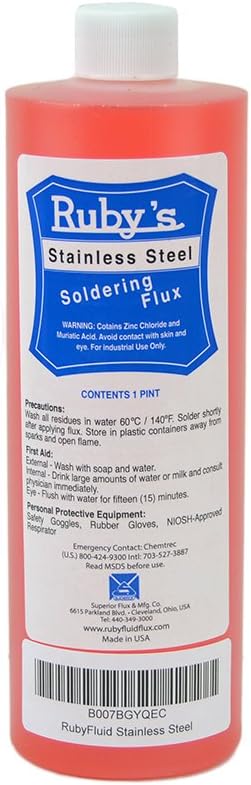
This industrial-grade acid flux is designed for stainless steel, nickel, brass, and other surfaces that can defeat general-purpose rosin flux. Its 4.6 rating, fast-wetting claim, and one-pint resealable bottle make it a purposeful choice for fabrication, HVAC work, metal repair, and professional shop environments.
We may earn a commission when you buy through this link, at no additional cost to you.
Where standard electronics flux is optimized for controlled board assembly, this product emphasizes stronger oxide removal and durable joints on tough metals. The stated ability to support rapid wetting and uniform flow is particularly relevant when soldering stainless steel or nickel, materials known for tenacious surface oxides.
Acid flux requires more deliberate handling than a no-clean RMA treatment. It should not be assumed to be non-corrosive, electrically benign, or compatible with every board, component, alloy, or cleanup method. Users should protect the work area, follow the product instructions, and remove residue according to the manufacturer's guidance before the repaired item returns to service.
Buy this product when conventional flux is failing on stainless steel, nickel, brass, or another hard-to-solder metal and the job requires a professional acid formula. It is not the natural choice for routine PCB work, fine jewelry, or users who specifically want low-residue, no-clean electronics chemistry.
Stainless steel and nickel form persistent barriers that can prevent solder from wetting evenly. A specialized acid flux attacks that barrier, giving the torch or iron a better chance to form a continuous joint.
The resealable one-pint bottle suits a workstation that sees repeated fabrication or repair work. Its larger size reduces the inconvenience of replenishing a small applicator during heavy jobs.
We may earn a commission when you buy through this link, at no additional cost to you.
TOWOT offers a compact no-clean RMA rosin flux in a 30 ml precision-dropper bottle. Its 4.2 rating is the lowest listed among these ten products, but the product remains purpose-built for electronics, PCB repair, circuit boards, and DIY soldering, which gives it a clear audience despite less feedback than the leading options.
We may earn a commission when you buy through this link, at no additional cost to you.
The described formula promotes fast wetting and smooth solder flow while leaving minimal, non-conductive, non-corrosive residue. Those qualities are important for routine board work because they can reduce visible contamination and shorten the cleaning stage, although users with sensitive or inspection-critical assemblies should still verify their own cleaning requirements.
Its advantages are straightforward but somewhat narrowly documented. A precision dropper is useful for small joints, while the no-clean positioning is convenient for common electronics maintenance. On the other hand, the supplied information gives fewer details about alloy compatibility, storage behavior, applicator design, and specific residue testing than some competing listings.
This is a practical option for DIY electronics, board repair, and lead-free projects that need an RMA treatment in a small controlled bottle. Buyers who want a broader material list, stronger evidence of environmental or halogen-free formulation, or a larger repair bundle may prefer a more fully specified alternative.
The no-clean claim centers on minimal residue that should not interfere with ordinary electrical use. It simplifies routine work, although residue should still be considered in high-impedance, high-voltage, cosmetic, or rework-sensitive applications.
The 30 ml dropper is appropriate for occasional repairs where controlled placement matters more than high throughput. It also lowers the commitment for someone assembling a first electronics soldering kit.
We may earn a commission when you buy through this link, at no additional cost to you.
This 30 ml squeeze bottle is a feature-rich no-clean RMA option with a 4.6 rating. It combines high-purity rosin with two tapered tips and a sealing cap, providing more application control than a conventional brush bottle while remaining more approachable than a full repair bundle.
We may earn a commission when you buy through this link, at no additional cost to you.
The product data states compatibility with tin, lead, copper, silver, and nickel alloys, plus soldering, desoldering, rework, wave soldering, reflow, audio connectors, PCBs, and SMD work. A neutral pH, non-corrosive formula, nonflammability, high flash point, and nonconductive dried residue all favor routine electronics use when handled as described.
The main practical caution is that squeeze bottles can release more liquid than intended, especially when the applicator is close to a heated joint. A user should dispense a small amount onto the workpiece or iron rather than flooding the area. The two tips help reach different spaces, but they do not turn the bottle into a formal dispensing system.
This product fits hobbyists and technicians seeking a versatile, well-documented RMA flux with precise tips and broad process support. It is a good alternative to the simpler dropper model when access to tight spaces, multiple metal types, and wave or reflow work is important.
The supplied tapered tips can address larger openings and narrower recesses, reducing the need to transfer liquid to a separate applicator. This is useful for connectors, leaded components, and compact assemblies.
A sealing cap helps limit contamination between uses, while the stated low volatility, mild odor, high flash point, and nonflammability make the formula comparatively practical for a prolonged electronics work session.
We may earn a commission when you buy through this link, at no additional cost to you.
IMPRESA is purpose-built for stained glass, copper foil, zinc foil, and lead foil rather than electronic assemblies. Its 4.6 rating, included brush, and 8 oz bottle give it a clear identity as a craft flux for both beginners and experienced stained-glass workers.
We may earn a commission when you buy through this link, at no additional cost to you.
The water-soluble formula is the defining feature. It is designed for cleanup within six to eight hours, which can help protect the appearance of finished work while avoiding the need for aggressive solvent cleanup. The included precision brush allows controlled application across foil lines and joints, helping users keep the flux where the seam is being formed.
A water-soluble product is not automatically a no-clean product. The need to wash within a stated window means the workflow includes aftercare, and finished stained glass should be checked for suitable cleaning conditions. The product is also not positioned for delicate PCB repair, where moisture or corrosion would be unwelcome.
Choose IMPRESA for stained-glass hobby work, repair kits, and craft benches that use copper, zinc, or lead foil. Its specialized chemistry and included brush make it more coherent for that application than a general-purpose electronics rosin flux.
The included precision brush makes it easier to lay a controlled line of flux along foil seams. That focus matches the repetitive, line-based workflow of stained-glass construction.
The formula's water solubility offers a straightforward cleanup path, although the stated six-to-eight-hour window encourages timely washing. Users should follow the complete product instructions and avoid assuming all finished pieces can be washed immediately.
We may earn a commission when you buy through this link, at no additional cost to you.
This repair bundle combines 30 ml of no-clean RMA liquid flux with two five-foot rolls of 2.5 mm copper desoldering braid. Its 4.8 customer rating is the highest in the roundup, and the pairing addresses two recurring needs: preparing a joint for soldering and removing unwanted solder from a pad.
We may earn a commission when you buy through this link, at no additional cost to you.
The flux is described as halogen-free, chlorine-free, non-toxic, environmentally friendly, low-residue, and non-corrosive. Applicator tips and a sealing cap support controlled use, while the listed ability to spread into tight spaces makes the formula relevant to fine-pitch components, leads, pads, game-console boards, computers, smartphones, and audio cables.
The copper braid is a flat design intended to transfer heat quickly and absorb excess solder. According to the product information, it can remove solder bridges, clear through-hole pads, and prepare pads for component replacement. The trade-off is that wick is not a self-contained removal tool: it requires heat from a soldering iron, so technique and temperature control remain the user's responsibility.
This is the most complete repair-oriented choice in the list and is well suited to hobbyists who already own a soldering iron but want both flux and desoldering aid in one purchase. It is less necessary for users who do not rework boards, but for bridge removal and component replacement it offers greater utility than a standalone dropper.
Flux and wick are complementary rather than redundant: one improves wetting and joint formation, while the other removes solder that must be cleared. Buying them together simplifies the parts inventory for a repair kit.
The narrow applicator tips help place small amounts of flux around leads and pads, and the 2.5 mm braid suits relatively compact work areas. Users should still match temperature, dwell time, and wick placement to the component and board.
We may earn a commission when you buy through this link, at no additional cost to you.
Kester 186 is a rosin-based organic liquid flux specifically designed for conventional and surface-mount circuit-board rework. Its 4.6 rating and detailed emphasis on low residue make it the premium-focused selection in this guide, particularly for technicians whose work involves correcting existing assemblies.
We may earn a commission when you buy through this link, at no additional cost to you.
The low-solids content and activator system are described as leaving residue that will not interfere with electrical testing. That claim matters in rework because adding another variable to a board that has already been assembled can make inspection and diagnosis more difficult. The formula also reportedly improves soldering performance to minimize bridges during rework operations.
The two-ounce bottle is compact compared with the craft and industrial containers in this list. That is a drawback for heavy production work, but it is sensible for a dedicated repair bench where controlled inventory and repeatable procedures matter more than dispensing a large quantity at once.
Kester 186 is best suited to experienced electronics users, repair technicians, and controlled rework environments. Its documented objective is unusually specific, so it is more compelling for professional board-level work than for a user who only needs a small amount of flux for occasional household wiring.
The product's low-solids and activator design is aimed at reducing material that could interfere with testing. That makes the formula attractive where board condition and electrical verification are central parts of the workflow.
Instead of relying only on a general cleaning claim, Kester 186 is expressly configured for conventional and surface-mount rework. Its stated bridge-reduction performance addresses a common failure point during replacement and correction work.
We may earn a commission when you buy through this link, at no additional cost to you.
Oatey No. 11 is a 4 oz liquid soldering flux built around a strong cleaning agent. It is intended to support fast soldering, remove the need to manually clean oxidized copper, and serve HVAC applications, giving it a broad mechanical and installation role rather than a narrow electronics focus.
We may earn a commission when you buy through this link, at no additional cost to you.
Its main attraction is effective preparation of oxidized metal. A strong cleaning treatment can be useful when copper or another compatible surface has developed an oxide layer that interferes with solder flow. The 4 oz container is large enough for regular shop use but still compact enough for a standard tool kit.
The aggressive cleaning emphasis requires care. The supplied information does not describe the formula as no-clean, non-corrosive, or electrically safe for every board, and a strong flux may leave residue that calls for neutralization or removal. It should not automatically be selected for delicate electronics without checking the full label instructions.
Oatey No. 11 is most appropriate for HVAC installation, general copper soldering, and metalwork where a strong cleaning agent is wanted. Users assembling a compact electronics kit should favor a no-clean RMA product, while experienced shop workers may appreciate this option for suitably compatible mechanical applications.
The strong cleaning agent targets oxidation before solder touches the workpiece, which can reduce the need for separate mechanical cleaning of oxidized copper. The exact application method should follow the label directions.
The container balances portability and recurring use. It is more substantial than a dropper bottle but smaller than the one-pint industrial option, making it suitable for maintenance kits and general shops.
We may earn a commission when you buy through this link, at no additional cost to you.
The right liquid flux depends less on a universal strength rating than on the metals, soldering temperature, workpiece, acceptable residue, and cleanup process involved. Match the chemistry and delivery format to the job rather than assuming the strongest cleaner is always the safest or most effective option.
RMA rosin flux is a common choice for electronics because it is engineered around controlled wetting and manageable residue. Zinc and acid-based formulas can address tougher metals or higher oxidation, while water-soluble formulas suit certain craft and metalworking workflows. A product marketed for jewelry, stained glass, HVAC, or stainless steel should not be assumed to be interchangeable with an electronics no-clean flux.
Good solder flow depends on the joint surfaces as well as the solder. General rosin options commonly address tin, lead, copper, silver, gold, and nickel alloys, while the stainless-steel product specifically targets steel, nickel, and brass. Precious-metal work calls for a clear, low-residue formula designed to remain visible in detailed seams, and stained glass requires compatibility with the foil and solder being used.
No-clean means the residue is designed to be non-corrosive and electrically acceptable, not that the joint is completely residue-free. Some applications still benefit from cleaning, especially after chemical or acid flux. Zinc and water-soluble options may need prompt washing, while strong cleaning agents can require residue removal or neutralization. Consider the cost and availability of compatible cleanup materials before choosing.
A dropper or tapered tip gives better control around small pads, leads, and detailed joints. Squeeze bottles can be efficient but may dispense too much when heated. Brush bottles suit broad, line-based work such as stained glass, and larger jugs or shop containers support fabrication. The amount of flux actually required can be surprisingly small, so a small precision bottle may be better than an oversized container for occasional repair work.
Low volatility, mild odor, nonflammability, and a high flash point can make prolonged work more comfortable, while a sealing cap helps prevent contamination. These are useful handling attributes but should not replace the manufacturer's safety data sheet and directions. Strong acid flux and cleaning agents require more careful storage, ventilation, protection, and cleanup than a mild no-clean rosin formula.
If the work includes removing components, clearing bridges, or preparing pads, flux alone may not be enough. A copper desoldering wick works with heat to absorb unwanted solder, while suitable solder wick, a solder sucker, and other tools can serve different removal needs. A bundle can offer better value and convenience than separate purchases when both flux and wick are already on the required parts list.
A no-clean formula can still leave a visible film, and residue behavior may differ with solder, temperature, dwell time, and board surface. High-impedance, high-voltage, cosmetic, coating, or rework-sensitive work may demand stricter cleanliness. Low-residue claims are more meaningful when paired with a specific purpose, such as electrical testing, fine-pitch work, or minimizing post-solder cleaning.
Large quantities are useful for production benches and repeated metalwork, but they are not automatically better. A 2 oz bottle may be appropriate for controlled rework, a 4 oz bottle may serve general installation work, and an 8 oz or 8 fl oz package may suit jewelry or stained-glass craft work. Select for realistic consumption, storage space, and how often the container will be opened.
Begin with a clean, dry workpiece and a compatible solder. Follow the flux manufacturer's instructions for whether to apply the liquid directly to the joint, warm the tip, or use an iron. A dropper or narrow tip helps limit the amount; do not flood a small pad or delicate joint. The appropriate temperature still depends on the solder, base metal, and thermal mass of the assembly.
Heat the joint while keeping the work area within the flux's recommended conditions. As solder melts, it should flow into the cleaned seam rather than be pushed across a surface. Remove excess liquid or residue according to the formula's instructions. A no-clean product may not need immediate removal, while water-soluble, zinc, acid, and strong-cleaning treatments can require specific washing, neutralization, or disposal steps.
After use, close the container and store it as directed in a cool, dry area away from incompatible materials. Clean the applicator tips or brush so dried flux does not block flow. Keep containers upright, clearly labeled, and separated from food or drink. Dispose of residue and cleanup materials according to local rules and the product's safety information, especially for acid-based or chemically active formulas.
A no-clean flux is formulated to leave residue that is generally non-corrosive and electrically non-conductive under intended conditions. It does not mean that the board is completely free of contamination. High-impedance, high-voltage, cosmetic, coating, or rework-sensitive applications may still require cleaning according to the manufacturer's instructions and the project's quality standard.
Some general rosin fluxes may work across both applications, but specialized products are better matched to the task. Jewelry flux may be selected for visibility and precious-metal joint appearance, while electronics flux is usually optimized for controlled wetting, board compatibility, and acceptable electrical residue. Follow the stated uses and avoid assuming that a strong metalworking flux is suitable for delicate components.
Rosin and RMA products use rosin-based chemistry, with RMA adding mild activation for improved wetting. Zinc flux is a separate category commonly associated with water cleanup and broader metalworking. Acid flux is more aggressive and is often selected for difficult metals. Each category has different residue, handling, and corrosion considerations, so the choice should follow the workpiece and process.
Usually, no-clean flux is formulated so routine cleaning is unnecessary, but the answer depends on the product and project. Some users clean it for appearance, coating compatibility, high-impedance circuits, or rework. Acid, zinc, and water-soluble products have different cleanup needs, so always read the specific label rather than relying only on the general product name.
Use enough to promote wetting without flooding the area. For small electronics joints, a small drop or the end of an applicator tip is often enough. Excess flux can spread beyond the joint, slow heating, create residue, or make cleaning harder. If more liquid is needed, add it in stages while monitoring the solder's flow and the iron temperature.
Flux can remove or disrupt many oxide films and improve wetting, but it is not a substitute for adequate mechanical cleaning. Heavy corrosion, contamination, plating damage, or a badly oxidized surface may require abrasion, cleaning, or another treatment before soldering. Persistent failure to wet may also indicate the wrong temperature, solder, or flux for the job.
Look for a no-clean RMA formula, a narrow dropper or tapered tip, a sealing cap, and compatibility with the alloys and processes you use. Pay particular attention to residue claims for rework or electrical testing. Product volume is secondary to precise placement, stable storage, and suitability for the specific board or component.
Wick is primarily used to remove solder with heat, while flux assists wetting and removal of oxidation. It can be used with many compatible rosin or no-clean fluxes, but a chemical treatment that leaves harmful residue should not be introduced into the process without checking the instructions. The wick also needs appropriate temperature and iron contact for effective transfer.
The leading choices serve different needs. The Liquid Solder Flux Dropper offers a versatile and budget-friendly 30 ml RMA option for electronics, the RMA Flux and Desoldering Wick bundle provides the most complete repair package, and Kester 186 serves as a premium, low-residue choice focused on circuit-board rework.
Prioritize material compatibility, acceptable residue, application control, and cleanup requirements before considering container size. A precision dropper is valuable for small joints, a brush benefits line-based stained-glass work, a clear liquid assists jewelry visibility, and a strong acid or zinc treatment may be necessary for demanding metal surfaces.
Ratings and product details provide a useful starting point, but the correct flux still depends on the exact joint and your standards for cleanliness. Confirm the current label, safety instructions, availability, and pricing before purchasing, and select the smallest formula that delivers the wetting and joint quality the project requires.