
galphi 4K Dash Cam Front
4.4Editor score
4K UHD front recording
5GHz WiFi connectivity
32GB card included
Our Go Kart Dash CAM guide compares 10 compact, front, rear, and multi-camera models for clarity, night vision, parking protection, and easier setup decisions.
A dash cam for a go kart or recreational vehicle should capture the track, nearby traffic, and every turn without interfering with the driver. The best model balances a compact profile, readable video, reliable power, and simple controls, with front-only, front-and-rear, and weather-resistant options available for different riding environments.
We compared all 10 products by examining their resolution, lens coverage, night performance, storage support, parking features, connectivity, installation requirements, and overall suitability for compact vehicles. The list covers screen-free car dash cams, dual-camera systems, a motorcycle-oriented model, and a four-channel setup for comprehensive coverage.
Each review explains the product's strongest benefits, practical limitations, and ideal buyer. Ratings and product details reflect the supplied listings, while current prices, promotions, and availability can change, so readers should verify the latest listing before making a purchase.
4.4Editor score

4.5Editor score

4.6Editor score
This side-by-side comparison highlights each dash cam's resolution, camera coverage, connectivity, storage arrangement, and most important practical feature for use in a go kart or other compact vehicle.




The ROVE R2-4K Dual is a feature-rich front-and-rear dash cam that combines detailed daytime recording, a sensitive STARVIS 2 sensor, built-in GPS, and fast wireless transfers. It stands out as the most complete option here for riders who want useful evidence from both directions without relying on a separate rear camera.
We may earn a commission when you buy through this link, at no additional cost to you.
Its front camera records at 2.5K and upscales the result to 4K, while the rear camera records at Full HD 1080P. The Sony STARVIS 2 IMX675 sensor, wide F1.5 front aperture, HDR, and enhanced night vision make the front view particularly useful at dusk, during tunnel transitions, and on poorly illuminated roads.
Dual-band 5GHz and 2.4GHz WiFi allows the ROVE app to handle live viewing, settings, firmware updates, and downloads at speeds advertised up to 20 MB/s. The included 128GB microSD card is immediately usable, and built-in GPS adds speed, compass, route, and location data to the video. A hardwire kit is required for parking mode but is not included.
This is a strong recommendation for a road-going go kart, compact performance car, or small vehicle where front-and-rear evidence matters. The package is comprehensive, the sensor performs well in low light, and the app removes much of the card-handling inconvenience. Buyers should simply understand that the front 4K mode is enhanced through upscaling rather than native 4K capture.
Recording ahead and behind at the same time gives a much clearer account of a junction, following vehicle, or parking incident. The rear 1080P camera is a practical companion to the higher-detail front view and is especially valuable when evidence must show what happened after a vehicle passes the camera.
The high-speed dual-band wireless connection is useful when a rider needs to preserve a clip without removing the memory card. GPS overlays, route information, speed stamps, and compass direction can then be reviewed with the ROVE GPS Player on a compatible computer.
We may earn a commission when you buy through this link, at no additional cost to you.
The galphi 4K Front is a straightforward, compact dash cam aimed at drivers who want high-resolution evidence and convenient phone access without a large display. Its listing combines 4K UHD recording, a wide 160-degree lens, 5GHz WiFi, night-vision features, and an included memory card.
We may earn a commission when you buy through this link, at no additional cost to you.
The screen-free design is particularly appropriate for a go kart or small vehicle because it reduces visual distraction and keeps the mounting footprint small. The supplied app can be used to manage footage, while the 5GHz connection is advertised at up to 8 MB/s for faster transfers than a 2.4GHz connection.
An F1.6 aperture and wide dynamic range help balance low-light and high-contrast scenes, while seamless loop recording handles limited storage and the G-sensor locks clips following sudden movement or a collision. The preinstalled 32GB card makes the camera ready to use, and larger Class 10, U3, and V30 cards are supported for extended capacity.
The galphi model makes sense for straightforward front-facing evidence, daily drives, and riders who value a simple screen-free design. It does not include a rear camera, and its parking mode needs a separately purchased Type-C hardwire kit. Even so, it delivers an unusually complete basic package at a budget-focused level.
The slim body and absence of a display help preserve windshield visibility in a compact go kart. Its uncomplicated form also means fewer physical distractions for riders who prefer a camera that works quietly in the background.
Loop recording continuously manages limited storage, while event locking gives important clips protection from automatic deletion. The G-sensor and optional time-lapse parking mode broaden the camera's usefulness beyond ordinary road recording.
We may earn a commission when you buy through this link, at no additional cost to you.
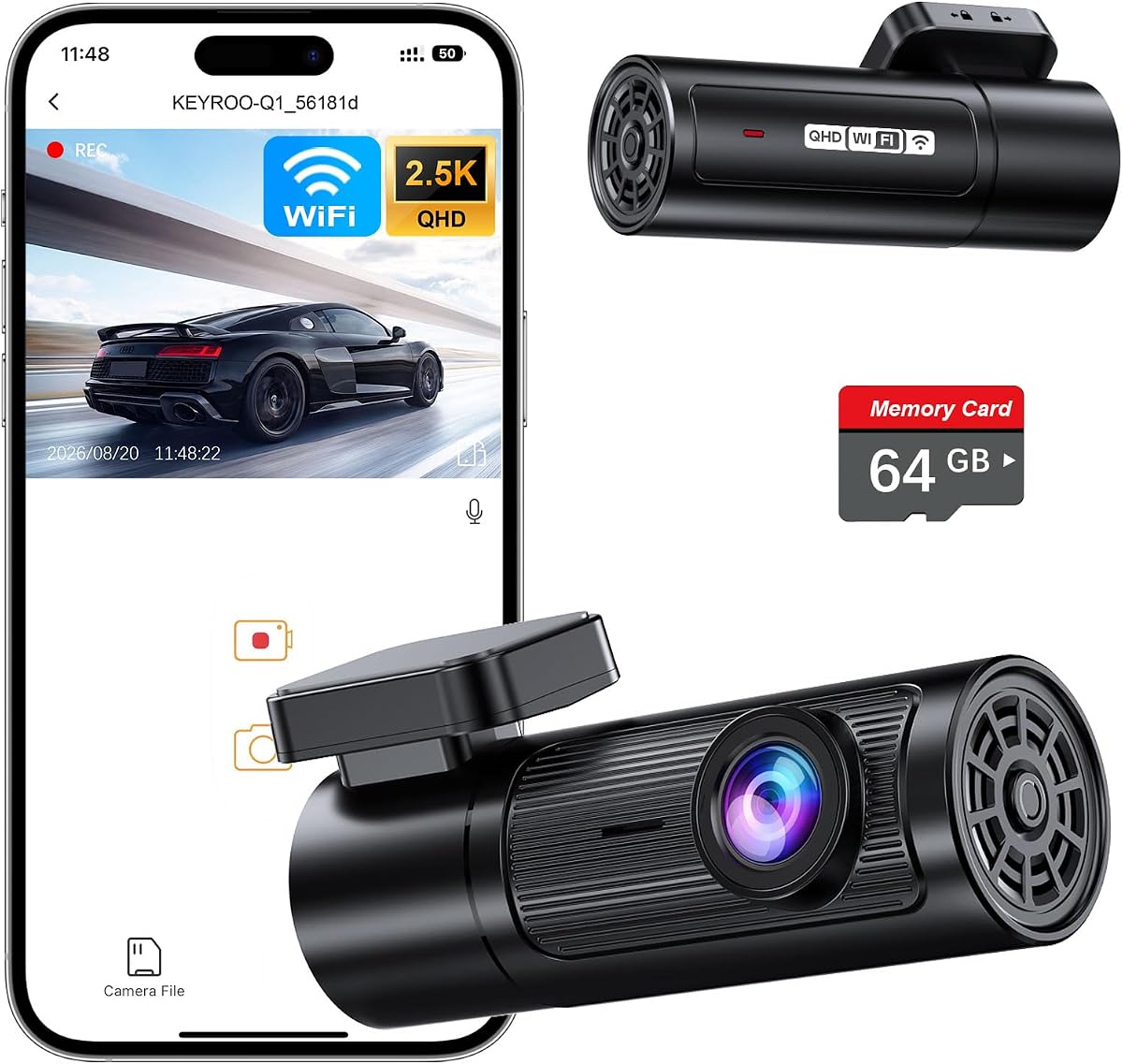
The KEYROO Q1 2.5K combines a mini footprint, a 160-degree lens, and a generous included memory card. Its 2.5K QHD front recording offers more detail than a conventional 1080p camera, while the screen-free construction suits vehicles where windshield space is limited.
We may earn a commission when you buy through this link, at no additional cost to you.
The camera records at 2560 by 1440 at 30 frames per second and uses a six-layer lens to support its claimed night performance. Built-in WiFi works with iOS and Android apps for previewing, downloading, replaying, and sharing clips. The preinstalled 64GB high-endurance card provides a generous starting point for loop recording.
A G-sensor locks footage following impacts, and the parking mode can use time-lapse recording when a suitable hardwire kit is installed. The 360-degree rotatable lens makes it possible to aim the camera through the windshield or toward the cabin, which may be useful for rideshare-style work or unusually open go kart layouts.
This is an attractive option for riders who prioritize a clean, compact installation and useful storage capacity. The absence of a rear camera means it cannot document traffic directly behind the vehicle, and 24-hour parking requires extra hardware. Even so, the included card, flexible mounting, and simple app workflow make it particularly approachable for first-time owners.
The preinstalled 64GB card eliminates the most common setup step of choosing and formatting a compatible card. Seamless loop recording then maintains continuous operation, while the G-sensor protects event footage from being overwritten.
The 360-degree lens rotation and detachable bracket make this model more adaptable than a fixed-forward design. That flexibility is helpful when the camera needs to face slightly sideways, into the cabin, or around a different windshield angle.
We may earn a commission when you buy through this link, at no additional cost to you.
The CAMECHO Dual is designed primarily for motorcycles and other exposed vehicles, making it one of the most relevant options for an outdoor go kart used in dusty or wet conditions. It pairs a 1080P front camera with a 720P rear camera and provides a split-screen preview on a two-inch display.
We may earn a commission when you buy through this link, at no additional cost to you.
IP65 protection for the main unit and IP67 protection for the cameras support use in rain, snow, and dusty environments. Front and rear cameras cover 120-degree and 90-degree fields of view respectively, and HDR helps balance bright and dark areas as the vehicle changes direction.
A wired controller placed within reach provides an LED recording indicator plus physical controls for locking footage, taking photos, starting or stopping recording, and resetting the camera. Seamless loop recording automatically replaces older clips, and the G-sensor can emergency-lock recordings after a collision or bump.
This is the pick for riders who need weather resistance and handlebar installation more than high-resolution 4K capture. The included memory card is not part of the package, and the rear image is lower resolution than the front. Even so, the physical controller, dual cameras, and sealed construction are especially practical for exposed recreational vehicles.
The stated IP65 and IP67 protection makes this system more suitable for rain, snow, and dusty tracks than standard enclosed automotive cameras. Sealed cameras and accessories help maintain operation when the vehicle is exposed to changing outdoor conditions.
The wired controller lets the rider check recording status and save important clips without navigating a phone. Its lock button is particularly useful when a driver wants to preserve a moment immediately after an incident.
We may earn a commission when you buy through this link, at no additional cost to you.
The Garmin Dash Cam Mini 3 is a compact front camera with a 140-degree field of view, 1080p recording, and a built-in polarising lens. Its small enclosure and low-profile installation make it easy to overlook, which can be helpful in a small go kart or low-profile vehicle.
We may earn a commission when you buy through this link, at no additional cost to you.
Garmin Clarity is designed to reduce windshield glare and preserve important visual detail. The camera can also record in bright and low light, automatically save detected incidents, and respond to voice commands for saving video and controlling audio recording. These features reduce the need to handle the device while driving.
With a compatible smartphone, the Garmin Drive app supports remote access to real-time footage when the vehicle is parked. Parking Guard can notify the user of a detected event, although remote viewing and related Vault functionality require a paid plan, active WiFi, continuous power, and the appropriate app.
The Mini 3 is a good fit for a driver who values a trusted compact design, glare control, and hands-free operation. It is less suited to buyers seeking a bundled rear camera, included memory card, or free comprehensive parking service. Its strongest advantage is a polished, unobtrusive basic setup.
The built-in polarising lens helps reduce reflections that can obscure signs, vehicles, or other road details. This is especially useful during bright daylight when the windshield reflects surrounding scenery into the camera's view.
The key-sized body sits close to the windshield, while voice control handles common actions such as saving a clip or starting audio. This keeps physical interaction to a minimum during a drive.
We may earn a commission when you buy through this link, at no additional cost to you.
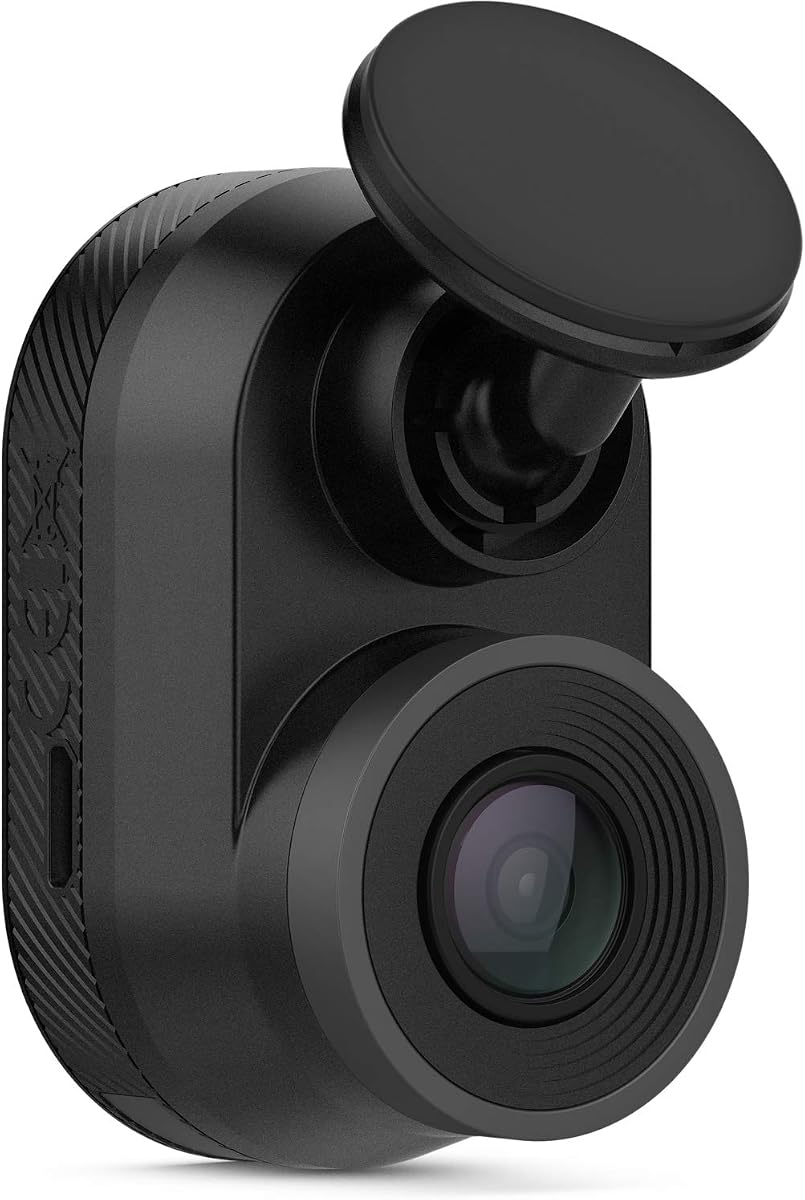
The Garmin Dash Cam Mini is a car key-sized 1080p camera built around straightforward incident recording. Its 140-degree lens captures a broad view of the road, and the tiny body can sit almost unnoticed on a windshield, making it suitable for compact vehicles with limited mounting space.
We may earn a commission when you buy through this link, at no additional cost to you.
Automatic incident detection records and saves important events without requiring continuous manual operation. Built-in WiFi connects with the Garmin Drive app, and Dash Cam Auto Sync can control and play back footage from up to four cameras, offering an easy path to multi-camera coverage if additional units are purchased.
The package includes a low-profile adhesive mount, vehicle power cable, long and short USB cables, and documentation. A Class 10 or faster microSD card of at least 8GB is required, but it is not included, so buyers must add compatible storage before use.
This older Mini listing remains a practical option for anyone who wants a tiny, uncomplicated front camera. It lacks many of the advanced wireless and parking features found in newer models, and its 1080p resolution is below several alternatives. Its strongest appeal is a refined, compact form and a mature multi-camera app workflow.
The small body and low-profile adhesive mount preserve windshield space and reduce visual distraction. This is helpful in a go kart where the driver may already have a crowded instrument area and limited visibility.
Although sold here as a single front camera, Auto Sync can bring up to four cameras into one compatible app workflow. That makes it convenient for owners who eventually want additional viewpoints around a vehicle.
We may earn a commission when you buy through this link, at no additional cost to you.
The Garmin Mini 3 Ultracompact combines a discreet key-sized camera, 1080p HD recording, and a 140-degree field of view. It is designed to capture useful road detail while taking up very little space, making it well suited to a compact go kart cockpit.
We may earn a commission when you buy through this link, at no additional cost to you.
Its Garmin Clarity polariser reduces windshield glare, while automatic event detection records important footage with date and time information. Voice commands are available in several languages and can save clips or control audio recording without requiring the driver to pick up the device.
The Garmin Drive app supports saved-clip viewing and synchronized playback from as many as four dash cams. A paid Vault subscription adds online storage, live remote viewing, and related parking features. Those remote functions also require an active WiFi connection, constant power, and a compatible smartphone.
This listing is best for a buyer who prioritizes compact design, a clear image, and Garmin's connected ecosystem. The need for a subscription for the most advanced remote functions makes it less attractive to someone wanting every feature included. As a basic front recorder, however, it remains compact, capable, and easy to integrate with other Garmin cameras.
When the required subscription and power conditions are met, compatible phones can display live footage from a parked vehicle. Parking notifications add another layer of awareness when the driver is away from the go kart or car.
Synchronized viewing from up to four separately sold cameras improves awareness around a vehicle. Riders can consider additional units later without replacing their preferred dashboard workflow.
We may earn a commission when you buy through this link, at no additional cost to you.
The IIWEY N5 is the most comprehensive camera system in this group, with four channels covering the front, rear, sides, and interior. It can record 1080p on all four channels or switch to a 2.5K front mode with 1080p on the remaining cameras.
We may earn a commission when you buy through this link, at no additional cost to you.
A three-inch IPS screen provides status information and split viewing, while the front and rear cameras use 170-degree lenses and the side cameras use 150-degree lenses. The system has broad spatial coverage, making it useful when a rider wants to understand activity beside the vehicle as well as ahead of and behind it.
The included 128GB card supports up to 256GB, and seamless loop recording manages storage while the G-sensor protects collision clips. A supercapacitor avoids the use of a conventional internal battery and is specified to tolerate a wide temperature range. The rear camera must be wired to the main unit, and parking mode requires a separate hardwire kit.
The N5 suits owners who prioritize coverage over installation simplicity. It has no GPS, no Bluetooth, and requires the original cigarette-lighter charger or an appropriate hardwire kit. For a small go kart, the wiring may also be demanding, but no other model here offers as many simultaneous viewpoints.
Front, rear, side, and cabin channels can record together, reducing blind spots around the vehicle. This arrangement is valuable when an incident involves a passing vehicle, a passenger area interaction, or activity alongside the go kart.
The supercapacitor is designed to offer better heat resistance and longer service life than a traditional lithium battery. The system still requires continuous power, so a proper power connection is essential for dependable recording.
We may earn a commission when you buy through this link, at no additional cost to you.
The GKU D600 Pro Max combines native 4K front recording, a 1080p rear camera, a STARVIS 2 sensor, built-in GPS, and WiFi 6. It is a premium dual-camera option for riders who want detailed imagery, useful location data, and fast access to clips from a phone.
We may earn a commission when you buy through this link, at no additional cost to you.
The front and rear lenses provide 170-degree and 150-degree fields of view, while WDR, Super Night Vision, and an upgraded lens system help manage glare, headlights, and mixed lighting. In front-only mode, the camera also supports HDR. The result is a flexible system capable of changing its recording configuration when the rear camera is disconnected.
Dual-band 5.8GHz WiFi 6 and 2.4GHz WiFi are advertised at download speeds up to 20 MB/s. Built-in GPS records routes, speed, and location for later review through the free GKU GPS Player. A 64GB card is preinstalled, and the G-sensor locks event footage against automatic deletion.
The D600 Pro Max is an excellent premium recommendation for a go kart used on public roads or for a small performance vehicle. Voice control, three parking modes, and both suction and adhesive mounts add flexibility. A hardwire kit is needed for parking mode, and the included USB cable is absent, but the core recording package is well equipped.
Unlike enhanced 4K output, the listed 4K front mode captures at that resolution, while the rear supplies 1080p coverage. This combination creates a useful balance between close detail, broad field of view, and manageable file sizes.
Built-in GPS records route, speed, and location alongside the image, adding context that a basic camera may not capture. WiFi 6 provides a faster route for previewing and retrieving clips through the GKU GO app.
We may earn a commission when you buy through this link, at no additional cost to you.
The Veement V300 is a compact front dash cam that records at 1296p, offering more resolution than a standard 1080p model without moving into a large multi-camera package. Its 170-degree lens captures multiple lanes and a broad section of the road around a go kart or compact car.
We may earn a commission when you buy through this link, at no additional cost to you.
An F1.7 aperture and six-layer glass lens support visibility at night and in other low-light situations. The built-in WiFi connects to the VeeCar app for live preview, playback, downloads, edits, and sharing. The connection is local, so it is intended for direct device management rather than general internet access.
The camera uses an RTC circuit and omits a traditional lithium battery, reducing the overheating concerns associated with small internal batteries. It requires continuous USB-C power while in use. TS streaming, seamless loop recording, and support for cards up to 256GB make it suitable for regular evidence capture.
The V300 is a sensible entry-level choice for buyers who want a wide lens, a better resolution than 1080p, and phone control. A memory card must be purchased separately, and the lack of a rear camera limits coverage. Within those boundaries, it offers a simple, compact design with useful safety-oriented engineering.
The 2304 by 1296 recording mode provides extra spatial detail while remaining straightforward to operate. Combined with the 170-degree lens, it gives a useful view of adjacent lanes and roadside activity.
Eliminating the conventional lithium battery reduces one common source of heat-related concern. Continuous USB-C power keeps the camera active, while the RTC circuit supports accurate time-based organization of recordings.
We may earn a commission when you buy through this link, at no additional cost to you.
The best choice depends on the vehicle, riding environment, available power, and how much surrounding coverage you need. Resolution, storage, low-light performance, installation burden, and parking features should be weighed together rather than treated as isolated specifications.
Resolution determines how much usable detail remains when a clip is enlarged, but it does not tell the entire story. A 4K model can preserve more distant detail, while 2.5K QHD is often a practical balance for a compact vehicle. The ROVE's front 4K is upscaled from 2.5K, whereas the GKU lists native 4K front recording, so buyers should distinguish the two.
Choose a camera with at least 2.5K front resolution when readable signs, plates, and vehicle details are important. A 1080p camera can still work well for general evidence, especially when the image is clean and lens coverage is wide.
A wide lens can capture more of the track, intersection, or parking area, but excessively wide views may make objects near the edges appear smaller or distorted. Models in this guide range from 90-degree rear coverage to 170-degree front and side lenses. Multi-camera systems offer the broadest spatial awareness.
Match the angle to the vehicle. A wide front camera is useful for road evidence, while dual-camera setups help document what happens behind the vehicle. Four-channel systems are worth the added wiring when side and interior coverage are priorities.
Low-light quality depends on the sensor, aperture, HDR or WDR processing, and the quality of the lens. The ROVE and GKU use STARVIS 2 sensors, while other models rely on apertures such as F1.6, F1.7, and F1.8. Night capture is especially relevant for go karts used after sunset or on dimly lit courses.
Prioritize models with a large aperture, wide dynamic range, and clear night-vision processing. Also check whether a camera can retain detail around headlights without making the rest of the scene excessively dark.
Dash cams rely on microSD cards, and the difference between a bundled card and no card can affect both convenience and total capacity. The ROVE includes 128GB, the IIWEY includes 128GB, the GKU includes 64GB, the KEYROO includes 64GB, and the galphi includes 32GB. The CAMECHO, Garmin Mini, and Veement V300 require separate storage.
Check the maximum supported card size and recommended speed class before expanding storage. A high-endurance card is sensible for continuous recording, while loop recording and event locking help manage the limited space available.
Most go karts have a simpler electrical system than a road car, and some parking-mode features require a hardwire installation. The ROVE, galphi, KEYROO, IIWEY, and GKU all support parking functions, but their required hardwire kits are sold separately. The Veement supports parking mode but also needs an appropriate continuous power arrangement.
Choose a hardwire-compatible camera if the vehicle can be safely connected to constant power. Riders without a reliable hardwire point should favor a standard 12-volt or USB power method and avoid assuming that parking mode is immediately available.
WiFi removes the need to remove the memory card for every transfer, and newer dual-band systems can transfer clips much faster than basic 2.4GHz models. The ROVE and GKU advertise speeds up to 20 MB/s, while the galphi lists up to 8 MB/s. The IIWEY also provides 5GHz connectivity.
Check app compatibility and whether advanced services are free. Garmin's remote viewing and Vault features require a paid plan, while the GKU, ROVE, galphi, KEYROO, and IIWEY offer their core app functions without that specific requirement.
Exposed go karts face vibration, dust, rain, and rapid temperature changes. The CAMECHO stands out with IP65 and IP67 protection and a motorcycle-oriented mounting approach. Other automotive models emphasize compact adhesive mounts, while the GKU includes both suction and adhesive options.
Consider vibration, cable routing, and whether the camera can be positioned without blocking visibility. A detachable or adjustable bracket is useful when the vehicle does not have a conventional windshield.
Compact cameras such as the Garmin Mini 3, KEYROO Q1, galphi, and Veement V300 are easier to accommodate in a small cockpit. Screen-free designs avoid adding a bright display to the driver's sightline, while the ROVE and IIWEY include screens for status checks and camera previews.
Choose the smallest body that still meets your coverage needs. A large camera may be easier to operate but can distract the driver or interfere with visibility in an open or tightly framed go kart.
Begin by reading the product's installation instructions and checking the supplied power cable, mount, and memory card for damage. Mount the camera securely without blocking the driver's view, then aim it to show the road rather than the dashboard. For rear or multi-camera systems, route every cable away from pedals, steering components, hot surfaces, and moving parts.
Format a compatible memory card in the dash cam when required, confirm the recording status, and make a short test clip before relying on the camera. Connect it to the app, verify the date and time, adjust exposure or resolution as needed, and test the lock and download functions. The unit should remain connected to the specified power source throughout use.
Check footage periodically and keep the lens clean with a soft cloth. Review the mount for looseness, inspect cables for pinching or heat damage, and confirm that the card remains seated. Owners using constant-power parking mode should test the trigger and check the vehicle's electrical draw, while drivers should regularly back up important clips.
A regular car dash cam can work in many go karts if the vehicle provides a suitable power connection and the mount remains secure. The most important checks are electrical compatibility, cable routing, vibration resistance, and whether the camera blocks the driver's view. Motorcycle-oriented or weather-resistant models may be preferable for exposed tracks.
A front-only camera is usually sufficient when the main concern is recording the road ahead. A rear camera adds evidence of vehicles or incidents occurring behind the go kart, which can be valuable on public roads. Four-channel systems are better suited to riders who also want side or cabin coverage.
At least 1080p is a practical baseline, while 2.5K or 4K provides more detail for distant vehicles, signs, and license plates. Resolution alone does not determine clarity, so aperture, sensor quality, lens performance, lighting, and stable mounting also matter.
Only if it meets the camera's capacity and speed requirements and has been formatted appropriately. High-endurance Class 10 cards with U3 or V30 ratings are sensible for extended recording. A card that frequently reports errors should be replaced rather than trusted with important evidence.
Most local WiFi functions, including live preview and clip downloads, do not require a cellular connection. Garmin's Vault storage, remote viewing, and certain parking features do require an appropriate service and compatible phone. The Veement V300's WiFi is specifically local and does not provide internet access.
Parking mode is useful if the go kart is left in a location where another vehicle or person could approach it. It generally requires a constant-power hardwire connection, and the necessary kit is not included with several models here. Verify the electrical system and installation guidance before using it.
Use a rigid surface near the windshield, keeping the camera clear of the driver's sightline and away from controls. Route cables so they cannot interfere with steering, pedals, or hot engine components. Take a test recording to confirm the angle and check the mount periodically because vibration can loosen attachments.
Use the manual lock function or rely on the G-sensor to protect incident clips, and copy important files to a phone or computer before the loop recorder overwrites them. Avoid removing the card during active recording. Keeping the storage card in good condition also reduces the risk of unreadable files.
The ROVE R2-4K Dual is the strongest all-around choice for drivers who want front-and-rear coverage, strong night performance, GPS, and fast app transfers. The galphi 4K Front stands out as the best budget option, while the GKU D600 Pro Max offers the most premium combination of native 4K detail, rear recording, WiFi 6, and GPS.
Prioritize the features that match your actual use. A compact screen-free camera is ideal for a small cockpit, a weather-resistant dual system suits exposed tracks, and a four-channel arrangement is appropriate when comprehensive spatial coverage matters more than simple installation. Storage, continuous power, and hardwire requirements deserve equal attention with image quality.
Finally, check the current listing before ordering because prices, bundles, and availability can change. Confirm the memory-card status, included power accessories, app requirements, and local rules concerning dash cam use, then choose the model that provides the most useful evidence for your go kart and driving habits.