
MOES Water Flow Meter
4.6Editor score
Four measurement modes
Brass inlet and thread
Gallon and liter units
Our Hose Flow Meter guide compares accuracy, displays, fittings, waterproofing, flow modes, and battery features to help you choose the right model for
A hose flow meter adds useful visibility to an otherwise ordinary garden hose. It displays real-time flow, tracks individual watering sessions, and can reveal how much water a sprinkler, nozzle, or RV connection actually consumes. The best models combine dependable sensors, readable displays, rugged fittings, and enough protection for regular outdoor use.
The products in this guide were compared using the supplied specifications, including stated accuracy, measurement modes, connector materials, waterproof ratings, display orientation, battery behavior, operating limits, and intended applications. The list covers plastic-bodied digital meters for everyday watering, heavy-duty brass-connection models, and metal units for users who prioritize precision and rugged construction.
Each review explains where that product fits best and where its compromises may matter. The top selections highlight different priorities: one offers flexible installation and total tracking, another balances outdoor durability with a broad feature set, and a third emphasizes metal construction and tighter accuracy. Product availability and prices can change, so check the current listing before purchasing.
4.6Editor score

4.5Editor score

4.4Editor score
This side-by-side comparison highlights the differences in accuracy, construction, measurement modes, waterproofing, display flexibility, and connector design across the ten available hose flow meters.


The RESTMO Water Flow Meter is a versatile outdoor meter with a 4.5 rating, combining a one-button interface, a clear LCD, and four distinct tracking modes. It is designed for garden hoses, faucets, sprinklers, and nozzle sprayers, giving users both immediate flow information and cumulative records. The stated hall sensor and IC chipset support a measurement tolerance of less than five percent.
We may earn a commission when you buy through this link, at no additional cost to you.
Its real strength is the range of information it can present. Flow mode shows the current rate, consumption mode retains the previous session, average mode calculates a daily average across a week, and total mode provides accumulated use. A long press in flow mode changes gallons to liters, while long presses in the other modes reset the relevant data. That makes the meter useful for checking a faucet, comparing watering sessions, and tracking longer-term consumption.
Construction is designed for regular outdoor use. The inlet and outlet metal threads use brass, while the main body uses heavy-duty ABS with an IPX6 waterproof rating. The supplied information also states that the housing is designed to resist ultraviolet exposure, sunshine, and rain. Its automatic sleep function turns off the screen after one minute without operation or water flow, reducing needless battery drain.
This is a sensible choice for a homeowner who wants more tracking options than a basic single-session counter. The weekly average and total modes make it more versatile than a minimal display model, while the simple single-button layout keeps operation approachable. Its main cautions are practical: keep your hands dry when opening the battery tray, observe battery polarity, and close the compartment properly. For general hose monitoring, it offers one of the strongest combinations of data, durability, and ease of use in the group.
The four modes cover both immediate and long-term questions. You can check the current rate while a hose is running, review the last watering session, compare a daily average over a week, or monitor accumulated use. That range makes the meter useful beyond merely confirming that water is moving.
Brass threads, an ABS body, and an IPX6 rating make the unit well suited to outdoor watering. A single control button handles mode changes, unit selection, and resets, while the display sleeps when no water is flowing or no button is pressed.
We may earn a commission when you buy through this link, at no additional cost to you.
The Rainpoint Water Flow Meter with Brass Inlet stands out with a 4.7 rating, bidirectional installation, and a display that flips 180 degrees. It is designed for RV water tanks, sprinklers, garden hoses, and nozzle sprayers. Its combination of flexible placement, two total counters, and leak-resistant construction makes it especially useful where hose direction or mounting position is uncertain.
We may earn a commission when you buy through this link, at no additional cost to you.
Four measurement modes divide the information into real-time flow rate, last-session usage, and two independently useful totals. Total 1 and Total 2 can represent different time periods, allowing a user to compare current consumption with an earlier period without erasing the first record. The LCD can rotate 180 degrees, making readings easier when the meter sits upside down or sideways. Bidirectional flow detection also allows water to enter through either connection.
The brass inlet and a double leak-protection design distinguish this model from many basic plastic-bodied meters. Waterproof rubber rings protect the screen and battery cover, while the high-definition display is easy to consult during watering. Its hall sensor and wind-wheel structure are stated to produce a measurement error below five percent. The screen enters sleep mode after one minute of inactivity or no flow and wakes when water starts moving again.
This is the strongest all-around pick for users who need flexibility more than specialized construction. It accommodates RV hookups, garden irrigation, and ordinary hose use without requiring a strict upstream-to-downstream orientation. Users should still check the indicated flow direction, especially if readings seem inconsistent. Even so, its strong rating, useful dual totals, readable adjustable display, and leak-conscious design make it a well-rounded recommendation for both routine watering and more active water monitoring.
Bidirectional detection removes much of the guesswork from installation. The meter can be placed where access, faucet position, or hose routing is most convenient instead of forcing a fixed connection arrangement. This is particularly helpful around RV tanks, compact spigots, and tightly arranged sprinkler connections.
Two total modes let users retain separate measurements for different intervals. The 180-degree screen rotation improves visibility from above, below, or the side, while waterproof rings around the display and battery cover help protect the electronic sections from moisture.
We may earn a commission when you buy through this link, at no additional cost to you.
The RESTMO Brass Thread Meter has a 4.5 rating and a clearly documented operating range of 0.3 to 12 gallons per minute, equivalent to 1 to 45.5 liters per minute. That range suits typical garden watering, RV tank filling, sprinklers, and nozzle sprayers. It also includes flow, last-consumption, weekly average, and total modes for both immediate and accumulated information.
We may earn a commission when you buy through this link, at no additional cost to you.
The brass inlet and metal threads are intended to withstand repeated installation and removal without the wear associated with all-plastic connections. A hall-type sensor and IC chipset support the stated less-than-five-percent measurement tolerance. The LCD is controlled with a one-touch button: a short press changes modes, a long press in flow mode switches between gallons and liters, and a long press in other modes resets the associated data.
Outdoor protection comes from the heavy-duty ABS body and IPX6 waterproof rating. The product information states that the enclosure is designed to resist ultraviolet light, sunshine, and rain. The display sleeps after one minute without operation, which helps preserve battery life between watering sessions. One important operating detail is that the manufacturer recommends a moderate faucet setting rather than the maximum, which is consistent with the stated upper flow limit.
This RESTMO model is a good match for someone who wants documented flow limits and a long-term average mode without moving to a premium metal design. It gives gardeners, RV users, and anyone trying to control watering waste the essential data in a straightforward package. Buyers who routinely run a hose at its absolute maximum should choose a meter with a broader range, but for ordinary outdoor applications, the combination of brass threading, clear modes, and useful accuracy figures is convincing.
The stated 0.3 to 12 GPM range provides a practical basis for matching the meter to normal hose use. It also explains the recommendation to use a moderate faucet setting, since pushing beyond the stated range can reduce the usefulness of the displayed measurements.
The weekly average is valuable for identifying whether a watering routine is becoming more or less efficient. Total mode adds a broader cumulative record, and the previous-session figure provides a quick reference for comparing one watering event with another.
We may earn a commission when you buy through this link, at no additional cost to you.
The RAINPOINT Flippable Screen Meter carries a 4.6 rating and emphasizes visibility, flexible placement, and durable connections. It uses brass for both the inlet and outlet metal threads, allowing it to serve garden watering, RV filling, sprinklers, pools, patios, and other outdoor arrangements. Its one-button 180-degree display flip is especially useful when the available mounting position leaves the regular screen orientation inconvenient.
We may earn a commission when you buy through this link, at no additional cost to you.
The meter provides real-time flow rate, a last-session reading, and two total modes. The separate totals can be used for intervals such as today and the current month, or for comparisons among multiple previous watering periods. This gives the device more flexibility than a basic meter that only retains the latest session. The design also states that installation does not need to follow a fixed water-flow direction, giving users more freedom around a faucet or hose.
Moisture protection is addressed through waterproof rubber rings on the display and battery cover. The one-touch screen-flip mechanism is described as reducing the need to rotate the screen itself, helping limit opportunities for water ingress. A quick connector is included to work with common garden hoses, faucets, and sprinklers. The product information does not publish a specific accuracy figure, so buyers should evaluate the screen and counter features without assuming a stated tolerance.
This is a compelling option for a user who often mounts a meter in an awkward position. The readable display, separate totals, and brass ends cover the most common needs, while the installation flexibility reduces the chance of needing to rearrange a hose or faucet. The important caveat is to check the a-b flow-direction marking on the meter and ensure it corresponds to the selected setting. Consistent orientation protects measurement accuracy and keeps the feature set working as intended.
The 180-degree flip can restore normal reading orientation without physically rotating the entire unit. This is useful above a spigot, below a raised tank connection, or wherever a straight hose run leaves limited access to the screen.
Two total modes support comparisons across days, weeks, or individual watering sessions. The last-session mode remains available for a quick check, while the brass inlet and outlet provide stronger connection durability than an all-plastic fitting.
We may earn a commission when you buy through this link, at no additional cost to you.
The RAINPOINT Five-Year Coverage Meter combines a 4.5 rating with a stated measurement accuracy of plus or minus five percent, solid brass inlet and outlet fittings, and a five-year manufacturer warranty. It is positioned for outdoor garden hoses, lawn sprinklers, RV fresh-water tank filling, black-tank flushing, pool refills, and well-water usage records.
We may earn a commission when you buy through this link, at no additional cost to you.
Its four measurement modes and dual total counters make it useful for both immediate flow checks and longer-term accounting. A real-time rate helps indicate how hard a faucet is running, while separate totals allow different usage periods to remain available. The stated RV applications are particularly notable because measured filling can help users avoid tank overfill, while the totals preserve separate records for other consumption.
The 180-degree flip-screen supports upside-down or sideways mounting, and bidirectional flow detection reduces installation restrictions. An automatic sleep function is intended to conserve battery life across watering seasons. The brass fittings are described as rust resistant and intended to resist cross-threading leaks, and spare rubber washers are included. The product information also includes realistic care guidance rather than claiming identical accuracy in every condition.
This model earns an Editor's Choice position because it combines useful data, flexible installation, strong connection materials, and unusually long stated coverage. The manufacturer advises removing the unit from a faucet in freezing winter and limiting all-day direct sun to reduce screen fogging. It also notes that readings can be unstable at very low flow and that the a-b direction setting should match actual movement. Those caveats are reasonable for an outdoor electronic meter, and the overall feature set makes this a strong choice for serious watering and RV monitoring.
Live flow information makes it easier to stop a tank fill before overflow. Dual totals can preserve separate usage records, which is useful when comparing a current fill with earlier RV water consumption rather than repeatedly clearing the counter.
The brass inlet and outlet are intended to withstand repeated connection changes while limiting corrosion and cross-thread leaks. A five-year warranty provides added reassurance, although the unit should still be protected from freezing weather and prolonged direct sun.
We may earn a commission when you buy through this link, at no additional cost to you.
The RESTMO Dual Zone Display Meter is built around a large LCD that presents real-time information in two areas, reducing the need to repeatedly switch among screens. It has a 4.5 rating and a stated measurement tolerance of plus or minus four percent under normal flow conditions. The hall-effect sensor and IC chipset support the tighter tolerance claimed in the product data.
We may earn a commission when you buy through this link, at no additional cost to you.
Four types of information are presented: single-session volume, average daily use over the previous seven days, cumulative total since a reset, and real-time flow rate. Gallons and liters can be selected with a long press, while the controls are divided between a SET button for display modes and a CLR button for resetting records. The two-button arrangement gives direct access to the most common actions without relying on complicated menu sequences.
Durability comes from pure brass connectors, an anti-clog metal filter at the inlet, a robust ABS body, and an IPX5 waterproof rating. The stated working-pressure range is zero to 116 PSI, or zero to eight bar. A universal three-quarter-inch NH metal inlet is designed to connect with most standard garden hoses, while the brass construction is intended to resist wear, corrosion, and pressure-related damage.
This is the most visually organized meter in the group and a strong option for users who want key readings available at a glance. The four-percent tolerance and inlet filter are attractive features for anyone concerned with measurement consistency and debris. The IPX5 rating means it should be treated as splash-resistant rather than equivalent to the higher-sealed IPX8 and IP68 models. Even so, the large dual-zone display, clear controls, and stated pressure tolerance make it particularly suitable for garden irrigation, RV filling, and pool maintenance.
Showing information in separate areas can make the meter easier to use during a watering session. A user can monitor current usage and flow together rather than repeatedly moving through screens to recover two related values.
The stated plus-or-minus-four-percent tolerance is tighter than the five-percent figures associated with several other digital options. A metal filter at the inlet adds another layer of protection against debris, although the housing carries an IPX5 rather than deeper waterproof rating.
We may earn a commission when you buy through this link, at no additional cost to you.
The IPX8 Metal Water Flow Meter is the premium construction choice in this guide, with a 4.4 rating, aluminum alloy housing, and stated accuracy of up to plus or minus one percent. Its sealed IPX8 body is designed for irrigation, spraying, RV connections, and other outdoor applications where resistance to moisture and impact matters.
We may earn a commission when you buy through this link, at no additional cost to you.
The metal housing offers greater impact resistance than plastic and is intended to reduce the chance of cracking during installation. A rotatable round LCD can be fixed at any angle, providing a broad viewing range when the connection position is not ideal. The auto-off function waits ten minutes before turning off the display, and the stated standby life extends beyond one year. A low-battery alert prompts replacement, which can be completed without removing the meter from the hose.
Unlike most garden-focused digital meters in the group, this model supports hot and cold water. Its stated working temperature range extends from minus 10 to 80 degrees Celsius, or 14 to 176 degrees Fahrenheit. That broadens its potential use around residential hose lines and other water connections, while the one-percent accuracy figure makes it attractive for users who want tighter monitoring than a standard five-percent-tolerance meter.
Choose this model when outdoor durability, sealing, temperature compatibility, and tighter measurement accuracy justify moving above the basic plastic designs. Its round adjustable display and metal body feel purpose-built for demanding outdoor connections. The trade-off is a heavier, more premium-style design and a ten-minute display timeout rather than a one-minute sleep. For users who regularly move, store, or expose a meter to knocks, those characteristics can outweigh the simplicity of a smaller ABS-bodied model.
The aluminum alloy body provides a sturdier shell than a typical ABS housing and is intended to tolerate impacts during installation or storage. Combined with the IPX8 rating, it is a persuasive option for users who expect rain, splashes, and frequent handling.
Hot and cold water support broadens the product beyond typical garden-hose use. The stated operating range covers 14 to 176 degrees Fahrenheit, making the meter potentially useful in residential applications where a standard cold-water meter would not be specified.
We may earn a commission when you buy through this link, at no additional cost to you.
The IP68 Metal Flow Meter has a 4.4 rating and a particularly strong stated ingress-protection rating of IP68. It is intended for garden hoses, RV connections, lawn sprinklers, pools, and other outdoor settings. The aluminum alloy housing is designed to provide better impact resistance than plastic, while the seal is specified to withstand rain, splashes, and wet operating conditions.
We may earn a commission when you buy through this link, at no additional cost to you.
The stated accuracy reaches up to plus or minus one percent, making this a strong candidate for users who want tighter readings than typical five-percent-tolerance meters. It can track batch volume, total water usage, and real-time flow rate. Its round LCD panel rotates and can be fixed at any angle, so the screen remains readable from different installation positions. The adjustment is particularly helpful for RV and sprinkler connections that may not place the display at a comfortable height.
Power management is designed around long outdoor intervals. The display switches off after ten minutes, with a stated standby duration of more than one year. A low-battery warning identifies when service is needed, and batteries can be replaced without removing the flow meter from the hose. This avoids having to disturb a sealed connection just to service the electronics.
This model is best for buyers who prioritize environmental sealing and a metal body over smaller, lighter ABS designs. Its IP68 specification is the deepest in the guide, making it well suited to wet locations and frequent outdoor exposure. Unlike the IPX8 Metal Water Flow Meter, its supplied information does not explicitly state hot-water compatibility or a working temperature range, so buyers with a non-garden hot-water requirement should confirm suitability before ordering.
The IP68 rating is intended to protect against rain, splashes, and demanding wet conditions. It is a logical option for sprinklers, pool work, and RV filling where splashing around the connection is expected throughout use.
Battery replacement does not require removing the meter from the hose, which saves time and reduces the need to reconnect fittings. Batch volume, total usage, and live flow rate are supported, while the stated one-percent accuracy is among the strongest figures in the comparison.
We may earn a commission when you buy through this link, at no additional cost to you.
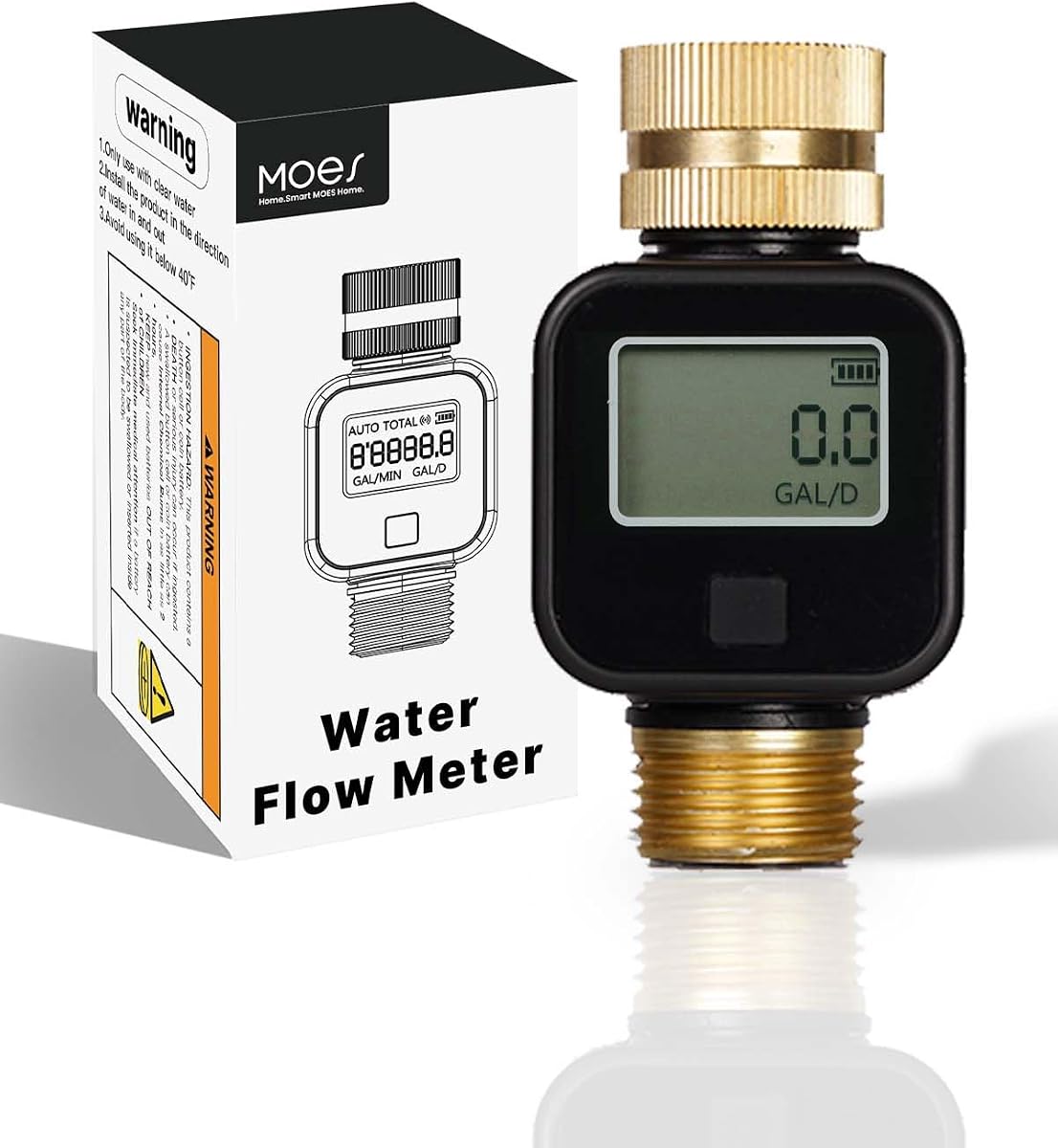
The MOES Water Flow Meter combines a 4.6 rating with a straightforward set of four measurement modes and a pure brass inlet. It is designed for sprinklers and standard three-quarter-inch faucet hoses, offering real-time flow, last-session consumption, average daily flow, and total flow. Gallon and liter displays make it useful for both familiar and metric-based watering routines.
We may earn a commission when you buy through this link, at no additional cost to you.
Its hall-type sensor and IC chipset support a stated measurement tolerance of plus or minus five percent. Maximum consumption reaches 99,999 liters or gallons, while the flow range runs from one to 45 liters per minute, or up to 12 gallons per minute. The working-pressure range is stated as 0.5 to 10 bar, and the supported water-temperature range is 37.4 to 149 degrees Fahrenheit.
The ABS construction and IPX6 rating are designed for outdoor watering, while the brass inlet and metal thread are intended to withstand repeated removal and installation. A high-definition LCD and one-touch button make the menus straightforward. The meter also has an unusual upside-down design: if the values appear inverted, the supplied instructions say to enter auto mode and long-press the button to reverse the orientation.
This is an appealing value-oriented option for a homeowner who wants four modes and durable inlet hardware without moving to a premium metal model. It handles real-time rate, previous-session volume, average use, and cumulative totals, with a large measurement capacity for sustained tracking. The main limitation is its stated five-percent tolerance, which is less precise than the one-percent metal models. For routine garden and hose applications, however, the feature set and 4.6 rating make this a convincing budget-friendly choice.
The four modes cover nearly every common monitoring need: live flow, the last session, average daily use, and a cumulative total. This makes the meter more useful than a simple session timer without requiring a complicated interface.
The stated 45-liter-per-minute maximum and 99,999-unit consumption capacity cover demanding watering tasks. A 0.5-to-10-bar working range and broad temperature specification add useful operating information for buyers beyond basic garden use.
We may earn a commission when you buy through this link, at no additional cost to you.
The MOES Brass Outlet Meter has a 4.7 rating, tying for the highest customer rating among the listed products. It uses a pure brass inlet and outlet with metal threads, an approach intended to improve durability during repeated installation and removal. Like the other MOES model, it provides four measurement modes and a high-definition LCD controlled by one button.
We may earn a commission when you buy through this link, at no additional cost to you.
The display can show real-time flow rate, last-session consumption, average daily use, and accumulated total. The hall-type sensor and IC chipset support a stated tolerance of plus or minus five percent. Maximum consumption is listed as 99,999 liters or gallons, and the supported flow rate extends from one to 45 liters per minute, or up to 12 gallons per minute.
The stated working-pressure range is 0.5 to 10 bar. Water-temperature support is given as 37.4 to 149 degrees Fahrenheit, while the IPX6 waterproof rating and ABS body position the product for regular outdoor use. Suitable applications include sprinklers and standard three-quarter-inch faucet hoses. The upside-down display behavior is also documented, with instructions to use auto mode and long-press the button if the orientation needs reversing.
This model is an attractive alternative to the other MOES option because brass fittings are specified at both the inlet and outlet, while the 4.7 rating gives it an especially strong customer reception. It provides the same broad measurement and flow specifications without claiming the tighter tolerance of the metal premium models. Buyers who change hose fittings frequently, monitor an RV, or want both gallon and liter records should find that combination practical. Its primary limitation is the five-percent accuracy figure and lack of a stated adjustable display.
Using brass for the inlet and outlet improves the physical durability of the two points most exposed to thread wear. This is particularly relevant for users who repeatedly connect and disconnect the meter from different hoses, faucets, or RV connections.
Real-time, last-session, daily-average, and total modes cover both immediate and cumulative needs. The meter can display gallons or liters, and its high consumption capacity supports extended monitoring without frequent counter resets.
We may earn a commission when you buy through this link, at no additional cost to you.
The most useful hose flow meter is the one that fits the connection, measures the intended range accurately, and remains easy to read in the place where it will be installed. Comparing construction, accuracy, flow capacity, display controls, and sealing helps narrow the field before checkout.
Accuracy determines how confidently you can use the display to control irrigation or prevent an RV tank from overflowing. Most digital hose meters in this comparison state a tolerance of less than five percent or plus or minus five percent, while the two metal models claim up to plus or minus one percent. A tighter tolerance can be worthwhile when small differences matter, but it should be considered alongside flow stability because extremely low movement may produce less consistent readings even in a precise meter.
Choose a stated accuracy near five percent for routine garden watering, and consider a tighter figure for critical volume records. In short, match precision to the consequence of an error.
The connection is where a meter experiences repeated handling, cross-threading, hose pressure, and outdoor weathering. Many options use a brass inlet with metal threads, while the newest MOES model adds a brass outlet. Premium metal meters use aluminum alloy for the main housing. These materials are described as more durable than plastic, although the overall product still includes electronic components that should be protected from freezing conditions and extreme direct sun.
Look for brass or another robust metal at points that will be disconnected regularly. If a meter will remain connected, connector material is less important than display readability and sealing.
A real-time flow rate is only one part of useful water management. Most models add last-session volume, cumulative totals, and either a daily average or a second total counter. Dual total modes are particularly useful when comparing today with this month or preserving one interval while starting another. A weekly average helps identify changes in a watering routine, while a total can support longer-term conservation goals.
Choose modes that match the records you actually intend to keep. More data is helpful, but simple categories are easier to use consistently than a complicated menu.
A large LCD is valuable when checking a meter in bright sunlight or working quickly around a faucet. Flippable 180-degree screens, rotatable panels, and dual-zone layouts can make readings easier when the hose connection forces an unusual orientation. A meter installed upside down may also display correctly if its design accommodates that position, but this differs by model and should be confirmed in the instructions.
Prioritize a readable screen and a control layout that you can understand quickly. The best display is not necessarily the largest if its orientation cannot be adjusted.
Waterproof ratings range from IPX5 to IPX8 and IP68 in this group. IPX5 indicates protection from splashes and water ingress under specified conditions, while IPX8 and IP68 denote deeper sealing designed for immersion or highly exposed environments. Rubber rings around screens and battery covers add another layer of protection. Outdoor durability also includes resistance to ultraviolet exposure, rain, impact, and corrosion.
For a hose exposed only to splashes, IPX5 or IPX6 can be sufficient. Choose a deeper-sealed metal model for frequent rain, pool work, RV filling, or locations where the unit may be knocked around.
A meter should cover the flow produced by the faucet or hose without exceeding its stated maximum. Several models support up to 12 gallons per minute or 45 liters per minute, while one RESTMO model identifies a 0.3-to-12-GPM range and recommends a moderate faucet setting. High-capacity meters are practical for filling tasks and broad irrigation, whereas a narrower range may produce better readings around a controlled trickle.
Compare the faucet's typical output with the meter's documented range. Use a moderate setting if the product advises doing so, and do not assume every reading remains equally stable at extremely low flow.
Most products are intended for standard three-quarter-inch garden hoses, faucets, and sprinklers, but compatibility should still be checked before installation. Bidirectional models allow water to flow through either side, which provides useful flexibility around RV tanks and compact spigots. Other meters may require a particular direction. Some include labels such as a and b to identify the selected flow direction.
Confirm the hose thread size, available connection space, and required direction before ordering. Correct orientation is essential for accurate readings, especially on meters that do not support reverse flow.
Most digital meters use replaceable batteries, but sleep behavior varies. Several models enter sleep after one minute without flow or operation, while the two metal products specify a ten-minute auto-off. The latter approach may be convenient during a long watering job, whereas shorter timeouts can conserve energy between sessions. Some meters also provide a low-battery alert and permit battery replacement without removing the entire unit from the hose.
Look for a clear battery alert and accessible compartment, and install batteries with the correct polarity. Keep the tray dry during a replacement and close it fully to preserve the intended seal.
Begin by confirming that the hose, faucet, and meter use compatible connections. Turn off the water, inspect the threads and rubber washers, and attach the meter without forcing it. If the model has a marked flow direction, align that marking with the intended direction before operating it. This is especially important for units that do not support bidirectional flow.
Install the batteries with the correct polarity while keeping your hands dry around the compartment. Lock or close the cover securely, then run the faucet briefly to confirm that the display activates and that the flow arrow or a-b setting matches the direction of movement. Choose the measurement mode that matches your task, and use a long press when the instructions specify it for changing units, reversing the display, or resetting data.
For care, remove or protect the meter from freezing weather and avoid leaving it in prolonged direct sun. Rinse away dirt after outdoor use, especially around a sprinkler connection, and check that washers remain seated. If the reading becomes unstable at very low flow, increase the faucet to a moderate setting and compare the result. Periodically inspect the threads, battery cover, rubber seals, and display for leakage or damage.
A hose flow meter measures the rate and volume of water moving through a connected hose. It can track a single watering session, compare consumption across periods, show real-time flow, and help identify excessive water use. It is also useful for filling RV tanks without overflowing and for checking how much water a sprinkler or nozzle uses.
Brass fittings are generally better suited to repeated tightening, removal, and exposure to outdoor moisture than lightweight plastic threads. Several products in this guide use a brass inlet and metal thread, while the MOES Brass Outlet Meter also specifies a brass outlet. The electronic housing still requires protection from impacts, direct sun, and freezing conditions.
A tighter stated tolerance can be advantageous when precise volume control is important, but the practical difference may be small during ordinary watering. Accuracy can also vary under very low flow. Consider usable display resolution, installation direction, flow range, and outdoor sealing alongside the quoted percentage rather than relying on tolerance alone.
Yes, several products in the guide specifically list RV water tanks or RV filling among their intended applications. A real-time display can help you stop before overfilling, while total modes preserve water-use records. Check the connector size and ensure that the flow direction matches the meter's setting before connecting it to the tank.
These ratings describe different levels of protection against water ingress under their respective test conditions. IPX6 models are built for substantial splash exposure, while IPX8 and IP68 indicate deeper sealing for demanding wet environments. A higher rating does not eliminate the need to close the battery cover properly or protect electronics from freezing and damaging direct sunlight.
Very low flow can produce less stable measurements, a partly closed faucet can reduce the signal, and an incorrect a-b direction setting may also affect the result. Confirm that the meter's flow setting matches the direction of water movement and use a moderate faucet setting when recommended. Cleaning the inlet and checking the hose connection can also help rule out physical restrictions.
The listed models use electronic displays that require power, and many include automatic sleep or auto-off functions to conserve energy. Replace the batteries when readings become unreliable or a low-battery warning appears. Keep the battery compartment dry, observe the correct polarity, and lock or close the cover to maintain the intended water resistance.
Some models are explicitly weather-resistant or have higher waterproof ratings, but electronics still benefit from reasonable protection. The RAINPOINT Five-Year Coverage Meter advises removing the unit from a faucet in freezing winter and avoiding all-day direct sun to prevent screen fogging. Storing it indoors during severe cold or extreme heat can help preserve the display and battery.
The RAINPOINT Five-Year Coverage Meter is the most well-rounded selection, offering four modes, two totals, bidirectional flow detection, brass fittings, an adjustable screen, and a stated five-year warranty. The MOES Water Flow Meter stands out as the budget pick with a 4.6 rating, four modes, a brass inlet, and generous consumption limits. For premium construction and tighter measurement, the IPX8 Metal Water Flow Meter provides an aluminum body, up to one-percent accuracy, and hot-water compatibility.
Your priorities should determine the winner. Choose a plastic ABS model with IPX6 protection for routine watering and simpler budget needs. Select brass fittings and dual totals when changing hoses or tracking separate periods. Opt for a metal, IPX8 or IP68 housing when the meter will face frequent moisture, rough handling, low-flow monitoring, or a broader temperature range. Always verify the connector size, required flow direction, and stated operating range before installation.
Product specifications, ratings, availability, and prices can change, so review the current listing before making a final decision. Comparing the meter's present features with the watering task at hand will help avoid paying for unnecessary capabilities while still obtaining the flow visibility you need.