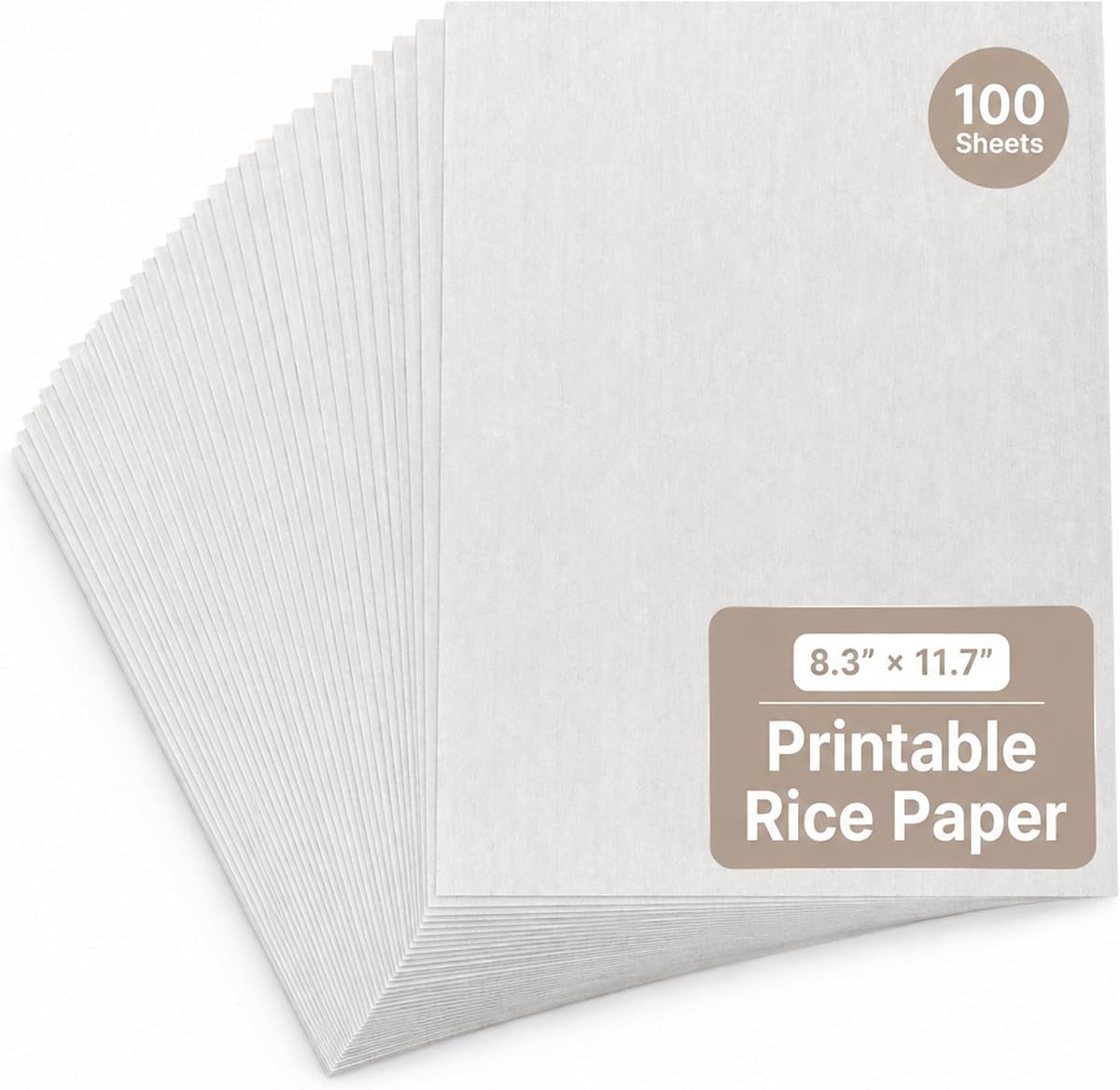
Bryxium Handmade A4 Paper
5.0Editor score
Handmade 35 GSM sheets
One hundred-sheet supply
Smooth printable surface
Printable rice paper combines a delicate, natural-looking surface with enough structure for common inkjet and laser printers. It is especially useful for decoupage, collage, scrapbooking, art journaling, calligraphy, gift wrapping, and mixed-media projects, where thinness and adaptability matter as much as print clarity.
The products in this guide were compared using the supplied specifications, including sheet count, dimensions, weight, material, printer compatibility, surface texture, and recommended feeding method. The list covers both printer-ready options and thinner mulberry or bamboo papers that may require backing or manual handling during printing.
Each review explains the product's strongest applications, practical limitations, and ideal audience. Ratings and specifications reflect the available product information, while material composition, sizing, and printer behavior should always be checked against your intended project. Availability and other listing details may change over time.
5.0Editor score
4.5Editor score

4.6Editor score
As an Amazon Associate we earn from qualifying purchases.
This side-by-side comparison evaluates sheet quantity, dimensions, weight, material, printer suitability, and practical craft applications, revealing how each option differs for decoupage and general paper crafts.


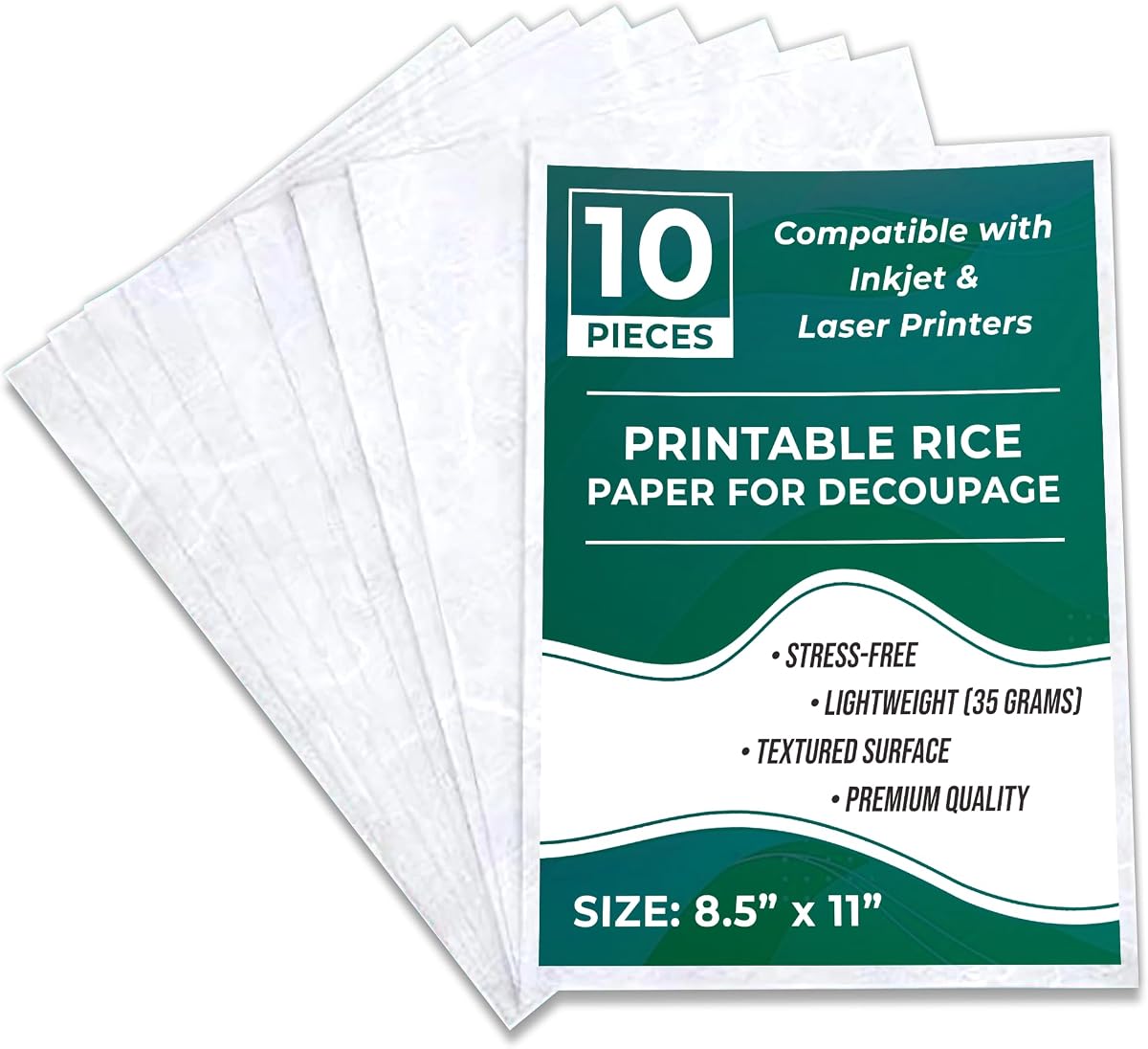
This ten-sheet set combines letter-size dimensions with a lightweight 30–35 GSM construction and compatibility with both inkjet and laser printers. Its 4.5 rating reflects a practical balance of smooth printing, manageable thickness, and versatility. The format is especially well suited to decoupage, where printed images need to adhere cleanly to furniture, wood, or other decorative surfaces.
We may earn a commission when you buy through this link, at no additional cost to you.
The principal strength is its smooth surface, which is designed to support clear text, intricate patterns, and detailed images. At 8.5 by 11 inches, the sheets can accommodate common document layouts without requiring A4 scaling. Its light weight also makes it easier to conform to curved or irregular objects than heavier conventional paper.
Thin rice paper can be awkward for some printers, so the recommended method of taping it to ordinary copy paper or securing it with Easy Tack spray is important. That extra preparation may not suit someone wanting completely hands-off printing, and only ten sheets are included, but it remains a sensible feature for focused decoupage projects rather than bulk crafting.
This is the strongest all-around option for crafters who regularly print images for furniture makeovers, scrapbooks, journals, and mixed decorative projects. Choose it when image clarity, letter-size convenience, and easy application to craft surfaces matter more than having a large supply on hand.
The smooth face is intended to preserve fine details without the texture interfering with small text or illustrated elements. That makes the sheets useful for both full-color decoupage panels and smaller embellishments.
Because the 30–35 GSM material is thin and light, it can be cut, layered, and molded around decorated objects with less stiffness than standard printer paper.
We may earn a commission when you buy through this link, at no additional cost to you.
This Maitys pack contains 100 A4-size sheets at a lightweight 30–35 GSM weight. Its supplied rating is 3.8, placing it below the leading selections, but the generous quantity makes it practical for classroom activities, workshops, repeated decoupage pieces, and crafters who want to reduce replenishment.
We may earn a commission when you buy through this link, at no additional cost to you.
The paper is described as soft, tear-resistant, and naturally conformable to wood, glass, furniture, and other surfaces. It supports both inkjet and laser printing, and its smooth face is intended to produce crisp images. A plain sheet placed underneath helps stabilize the material and reduces the likelihood of feeding problems.
The primary drawback is that its 3.8 rating is lower than those of several alternatives, suggesting less consistently favorable customer feedback. Printer compatibility also depends on following the backing-sheet method, because very thin paper can wrinkle or misalign if fed directly. Despite these issues, the material combines flexibility with useful tear resistance.
This pack is best for teachers, workshop leaders, and prolific hobbyists who need many similar sheets. It is less attractive for someone wanting only a few full-size decoupage prints, but its quantity and broad surface compatibility make it a functional workshop choice.
One hundred identical sheets are easier to distribute among participants or reserve for a sequence of coordinated projects than a small decorative assortment.
The construction is intended to conform naturally to wood, glass, and furniture, giving crafters more freedom than a rigid conventional sheet.
We may earn a commission when you buy through this link, at no additional cost to you.
This 200-sheet Maitys set offers the largest stated quantity among the printer-compatible choices. It uses the same lightweight 30–35 GSM construction and A4 title dimensions as the 100-sheet version, making it aimed at sustained projects, classroom use, and professional craft sessions where frequent replacement would be inconvenient.
We may earn a commission when you buy through this link, at no additional cost to you.
Its tear-resistant fibers and soft texture are designed to balance flexibility with useful strength. The smooth printable surface supports detailed images and text in inkjet and laser printers, while the natural sheet dimensions suit international paper layouts and many craft templates.
Its 3.8 rating is the main caution. It also shares the feeding caveat common to thin printable papers: placing a plain sheet beneath it improves stability and helps produce a flatter result. Buyers with limited storage space may find the bulk unnecessary, while users who consume large quantities can put it to better use.
Choose this option when repeated decoupage, collage, painting, gift wrapping, or workshop output is expected. It is better suited to organized, high-volume making than small personal projects, but it offers the most substantial paper supply in the guide.
A large reserve lets crafters work through coordinated batches without constantly dividing a smaller pack into separate supplies.
The flexible surface is useful beneath or over painted areas, allowing the material to sit more closely on uneven decorative objects.
We may earn a commission when you buy through this link, at no additional cost to you.
This VEOOK set combines a strong 4.6 rating with 100 letter-size sheets made from natural goji bark and sandalwood bark fibers. Although marketed as mulberry paper and often categorized with rice paper, it is best evaluated as a natural-fiber decorative paper rather than assumed to have identical performance to traditional rice paper.
We may earn a commission when you buy through this link, at no additional cost to you.
Its uniform fiber distribution is described as providing flexibility, good tension, and permeability without unpleasant odors. It is compatible with inkjet and laser printers and offers useful dimensions for calligraphy, painting, DIY crafts, decoration, and gift wrapping. That combination makes it an accessible, broadly applicable choice.
The main consideration is terminology. Traditional rice paper and mulberry paper can differ in composition, absorbency, and surface response, so the paper may not be ideal when an exact material match is essential. Natural fibers and texture can also influence ink appearance, making a small test print advisable before a larger project.
This is a strong selection for teachers, beginners, calligraphy enthusiasts, and gift-wrap projects that need letter-size natural paper. It is especially compelling for buyers who prioritize recognizable ratings, useful sheet quantity, and a wider range of decorative applications over a tightly specialized decoupage format.
Even fiber distribution supports consistent handling, helping the sheet fold, layer, and adhere without behaving as unpredictably as loosely structured paper.
The material suits writing, painting, decorative wrapping, interior accents, window coverings, and classroom activities in addition to printed projects.
We may earn a commission when you buy through this link, at no additional cost to you.
This 50-sheet pack uses a 60 GSM off-white paper designed more heavily for art projects than conventional office printing. Its supplied rating of 3.4 is the lowest in the guide, but the material offers a distinctive combination of one smooth side, one rough side, and more substance than typical lightweight rice paper.
We may earn a commission when you buy through this link, at no additional cost to you.
The greater weight is intended to reduce printer jams and make the paper more practical for decoupage. It can run in laser and inkjet printers when the A4 setting is selected, although the description explicitly warns that not every printer will accept these non-U.S.-standard dimensions. Some mild ink bleeding is also expected.
Hand-trimmed sheets can vary by up to 0.4 inches, and soft material may arrive with creases. The two-sided texture also means the rough face is better reserved for backgrounds or one-sided work. Those limitations are meaningful for precision printing, but they are understandable for a handmade-style art paper.
This option suits mixed-media artists who value texture, slight ink bleed, and a more substantial sheet. It is less attractive for commercial-style printing or projects requiring exact dimensional consistency, making a trial print and printer compatibility check important before committing to a large job.
The smooth face offers a more controlled printing area, while the rough side adds visual texture suited to painting, collage, and pressed-flower backgrounds.
At 60 GSM, the paper is described as thicker than common 35 GSM rice paper, which can make printer handling more dependable.
We may earn a commission when you buy through this link, at no additional cost to you.
This plain white 35 GSM set provides 20 letter-size sheets for crafters who create their own printable designs. Its 4.5 rating is strong, and the straightforward format is appealing for decoupage projects that rely on personal photographs, custom typography, illustrations, or repeated patterns.
We may earn a commission when you buy through this link, at no additional cost to you.
The paper is compatible with inkjet and laser printers, giving users flexibility in choosing their printing setup. At 8.5 by 11 inches, it fits common letter-size templates, while the 35 GSM weight keeps it thin enough for decorating furniture and other curved surfaces.
The package contains fewer sheets than most multipacks in the guide, and the plain white surface offers none of the visual variety found in decorative assortments. Users designing large jobs may therefore need to purchase more than one pack. Thin sheets may also benefit from a carrier sheet during printing.
This product is a good fit for users who already have the artwork and want a consistent blank surface. It is less suitable for buyers seeking pre-themed designs, decorative textures, or a large classroom supply, but it offers focused utility for personalized decoupage work.
The undecorated surface gives digital artwork the full visual focus, making it easier to reproduce exact colors and personal designs.
The 35 GSM construction is thin enough to conform around furniture edges and other shaped surfaces during decorative application.
We may earn a commission when you buy through this link, at no additional cost to you.
Bryxium's 100 handmade sheets earn the highest supplied rating in the guide at 5.0. Each A4-size sheet weighs 35 GSM and is designed for inkjet and laser printing, providing a smooth surface for text, patterns, and images while retaining the thin, adaptable character expected from rice paper.
We may earn a commission when you buy through this link, at no additional cost to you.
Its standout feature is the combination of handmade construction and a generous quantity. The sheets can be used for decoupage, collage, scrapbooking, art journals, painting, calligraphy, card making, gift wrapping, and DIY decorations. They may also be cut, torn, layered, or combined with other craft materials.
Like other thin printable sheets, it is most reliable when attached to standard copy paper before printing. That backing step helps stabilize the page and encourages smoother passage through compatible printers. The A4 dimensions may also require a different layout than letter-sized designs, and handmade sheets can be less uniform than factory-standard paper.
This is the pick for crafters who want an expansive supply of fine-feeling printable paper with the guide's strongest supplied rating. It is especially attractive for dedicated decoupage artists, workshop leaders, and mixed-media makers who value smooth printing and easy layering.
The printable face is designed to keep text and detailed graphics clear while the handmade paper retains a more tactile decorative quality.
Easy cutting, tearing, and layering make the paper useful as a surface for collage, journals, cards, and layered decoupage compositions.
We may earn a commission when you buy through this link, at no additional cost to you.
This letter-size mulberry paper provides 100 sheets made from goji bark and sandalwood bark fibers. Its 4.6 rating places it among the strongest products here, while the flexible construction and natural fiber distribution make it useful beyond printer projects.
We may earn a commission when you buy through this link, at no additional cost to you.
The paper is suitable for inkjet and laser printers and offers good permeability, tension, and flexibility without unpleasant odors. Users can apply it to decoration, gift wrapping, interior design, window coverings, painting, calligraphy, and general DIY work. Letter dimensions also make it convenient for common North American layouts.
As with the other natural mulberry selection, material terminology deserves attention. It is not necessarily interchangeable with conventional rice paper, and its organic fibers may create subtle differences in ink absorption, color density, and texture. Decorative tasks will often embrace those variations, while precision projects benefit from testing first.
This set is an excellent option for gift wrapping, classroom use, calligraphy, painting, and natural-looking decorations. Choose it when a letter-size surface, high supplied rating, and flexible plant-based stock are the priorities, rather than when an exact rice-paper composition is mandatory.
Plant-derived fibers give the sheet a distinctive organic appearance that can enhance wrapping, journaling, and nature-themed decoration.
Good tension and permeability help the paper remain manageable during writing, painting, folding, and decorative application.
We may earn a commission when you buy through this link, at no additional cost to you.
FIVEIZERO's package includes 50 creamy-white A4 sheets made from goji bark and sandalwood bark fibers. With a 4.6 rating, it performs well as a natural-fiber option for card making, gift wrapping, calligraphy, painting, and decorative crafts.
We may earn a commission when you buy through this link, at no additional cost to you.
Even fiber distribution, strong flexibility, good tension, and permeability are central advantages. The textured surface is blank and printable, and the sheets are described as easy to fold and relatively resistant to tearing. Those traits make them especially useful for origami-inspired work, handmade cards, and wrapped gifts.
The texture may not be ideal for extremely fine photographic reproduction or graphics that demand a completely uniform surface. The pack contains 50 sheets, which is fewer than several letter-size natural-paper competitors. Since the product is sold as a 50/100-sheet listing title, buyers should also verify the stated package quantity before ordering.
This paper is best for creators who value foldability, organic texture, and decorative versatility. It is well suited to student and beginner projects as well as established crafters making cards and wrapped gifts, particularly when those applications benefit more from texture than perfectly smooth printing.
Strong flexibility and tear resistance allow the sheets to be shaped for cards, envelopes, origami details, and layered decorative elements.
The visible fiber character adds depth to wrapping and painted backgrounds, helping finished pieces feel less industrial than standard paper.
We may earn a commission when you buy through this link, at no additional cost to you.
This bamboo pulp tissue paper is the only option in the guide explicitly identified as unsuitable for printers. That limitation makes it a specialized choice rather than a direct substitute for the other products, but its 4.4 rating and wet-strength construction are compelling for gel plate printing, wet collage, tracing, and mixed media.
We may earn a commission when you buy through this link, at no additional cost to you.
Made from long-fiber bamboo pulp, the paper is described as ultra-thin, translucent, and sturdy when used with wet media. Its smooth and rough sides provide different working surfaces, while translucency allows images to show through without heavy bleeding. It also supports watercolors, acrylics, pencil pigments, stamp printing, and layered scrapbook effects.
Because it does not work in printers, this sheet cannot fulfill the central function of printable rice paper. It may be difficult to cut and package because of its soft texture, and creases can occur during transit. Those surface imperfections can often be smoothed with water or an iron, but delicate users may prefer a more rigid option.
Choose it for wet-media printing, tracing intricate patterns, veiling photographs, restoration-inspired work, lampshades, screens, and small wrapped gifts. For straightforward desktop printing, choose one of the explicitly printer-compatible options instead.
Wet-strength construction helps the sheet remain intact when exposed to water-based media, making it more dependable than ordinary tissue paper.
Semi-transparency creates veil-like effects over photographs and allows underlying details to remain subtly visible in layered artwork.
We may earn a commission when you buy through this link, at no additional cost to you.
The right printable rice paper depends on printer type, sheet dimensions, material weight, surface behavior, and the volume of work you expect to complete.
Begin by confirming that the manufacturer explicitly lists your printer type. Most of the rice paper choices in this guide support both inkjet and laser printing, while the 60 GSM art paper warns that some printers may not accept its dimensions. The bamboo pulp option is specifically unsuitable for printers. Compatibility should also include a suitable paper size and, for thin sheets, a way to support the material while it passes through the feed mechanism.
Choose only products explicitly described as printable for your printer, and check the required paper size before designing a layout.
Letter-size sheets measure 8.5 by 11 inches, while A4-style sheets measure approximately 8.3 by 11.7 inches. Letter size aligns with many North American templates, while A4 is common in international settings and may require different margins in design software. Some titles and descriptive specifications can even refer to slightly different dimensions, so buyers should inspect the package details carefully.
Match the sheet dimensions to your printer settings and existing design templates before ordering.
Weight influences printer handling, cutting, layering, and how naturally the sheet conforms to a decorated surface. The 30–35 GSM papers are very light and commonly need a backing sheet. The 60 GSM option is described as heavier and less prone to jams, although it comes with its own texture and ink-bleeding considerations. Material terms such as mulberry paper may affect behavior independently of the stated weight.
Prefer a lighter sheet for curved decoupage and a heavier sheet when stiffness or more reliable feeding is the priority.
A smooth surface generally favors text, crisp patterns, and detailed images. Dual-textured papers can be more visually engaging for art, but one face may be better suited to single-sided printing. The 60 GSM product may produce mild ink bleed, whereas smooth printable sheets are described as supporting vibrant, precise results. Natural fibers can also influence absorption and color density.
Test a small area with your chosen ink and artwork whenever texture, bleed, or fiber variation is important.
Sheet count should reflect both project volume and storage needs. Ten- and twenty-sheet packs suit focused decoupage work, while 50-, 100-, and 200-sheet packs benefit classrooms, workshops, and frequent makers. A larger quantity can be convenient, but it also requires enough dry storage and may encourage purchasing more material than a one-time project needs.
Estimate print failures, test sheets, and decorative trimming before deciding how many sheets to keep on hand.
Traditional rice paper, mulberry paper, and bamboo pulp tissue are related but distinct choices. Some listings describe plant fibers such as goji bark, sandalwood bark, or bamboo pulp, while others use generic rice-paper terminology. Composition can influence transparency, texture, flexibility, absorbency, and the final appearance of a craft. If the appearance of a specific natural material matters, read the material description rather than relying only on the product name.
Choose bamboo pulp for wet media and translucency, mulberry-style paper for natural texture, or rice paper for a traditional lightweight decoupage feel.
The best sheet for one application may be unsuitable for another. Decoupage values thinness, print clarity, adhesion, and the ability to conform to furniture or shaped objects. Calligraphy and painting may favor texture and absorbency. Gift wrapping and card making benefit from foldability, while wet collage demands enough strength to withstand moisture. Tracing and gel plate printing benefit from translucency and wet-strength characteristics.
Prioritize the properties required by your main project rather than selecting solely by sheet count or appearance.
Thin rice paper is sensitive to moisture, bending, and handling. Store the sheets flat in a dry location, and avoid crushing the package if it is likely to create creases. The 60 GSM and bamboo options specifically mention possible transit creases, while soft paper may require smoothing. Because different papers react differently to water, test any proposed conditioning method on a spare sheet first.
Keep unused sheets dry, flat, and lightly protected to preserve print quality and minimize creasing.
Prepare the artwork at the exact dimensions of the sheets and select the corresponding paper size in the printer or editing software. Use high-resolution source images, keep margins practical, and avoid placing essential details too close to the edge. A test page can reveal whether the paper's texture, absorbency, or ink behavior changes the appearance of text or illustrations.
Attach the rice paper to a plain sheet of ordinary copy paper using a few strips of low-tack tape or a suitable repositionable adhesive, as recommended by the manufacturers. Feed the backing sheet into the printer, then remove the delicate paper after the print is complete. Print one sheet at a time, keep the printer feed path clean, and avoid forcing the paper if it does not align naturally.
Allow the image to dry fully before trimming or adhering the sheet. Cut with a sharp craft knife or clean scissors, working from the back when possible to protect the printed surface. For decoupage, apply the paper with a suitable craft adhesive, smooth it from the center outward, and let it conform gradually to the object. Store unused sheets flat and dry.
Printable rice paper is mainly used for decoupage, collage, scrapbooking, art journaling, card making, calligraphy, gift wrapping, and mixed-media work. Its thin construction allows printed artwork to conform to wood, glass, furniture, and shaped objects. It is also useful for adding delicate images or patterns to journals and layered crafts.
No, although most products in this guide specifically list inkjet compatibility, the bamboo pulp tissue paper is explicitly unsuitable for printers. Some thin sheets also require a plain backing sheet for reliable feeding. Always check the product description and run a small test before printing a complete project.
A plain backing sheet gives the lightweight rice paper stability inside the printer. It helps maintain alignment and reduces the likelihood of wrinkles, catching, or feeding problems. After printing, the rice paper can be separated from the carrier and used for the intended craft.
Not necessarily. Several products in this guide use natural fibers from goji bark, sandalwood bark, or bamboo pulp and market them as mulberry paper, rice paper, or natural-fiber tissue. Differences in fiber, texture, thickness, and absorbency can affect printing and craft performance, so material descriptions should be checked carefully.
Bleeding depends on the paper and the ink. Smooth sheets are designed to support crisp results, while the 60 GSM art paper may produce mild bleed and is not suitable for every kind of ink. Test the exact ink, printer setting, and paper combination on an unused sheet before completing a large project.
Some printers may accept A4 sheets even when their default paper setting is letter size, but this depends on the model. Other printers may not support the dimensions. The A4 products should be checked against the printer's supported paper sizes, and software settings should be adjusted to A4 where appropriate.
Light creases may be flattened by placing the paper beneath a clean, dry cloth and pressing gently with an iron on a low setting. The bamboo pulp product specifically recommends smoothing with water or ironing, but water can affect printed ink. Always test an unprinted corner first and avoid excessive heat.
The bamboo pulp option is the most specialized for wet applications because it is described as wet-strength tissue suitable for gel plate printing, wet collage, watercolor, and acrylic. Most other products in the guide focus on printer compatibility and decoupage, so a wet-media paper should be chosen when moisture resistance is the main requirement.
The Printable Rice Paper Sheets stand out as the most balanced choice for letter-size decoupage because they support two printer types, offer a smooth surface, and provide clear feeding guidance. Bryxium's handmade A4 paper earns the top supplied rating and excels for large, smooth printed craft projects, while VEOOK's natural mulberry paper is a strong all-purpose option with a high rating.
Prioritize printer compatibility first, then match the sheet dimensions, weight, texture, and material to the finished project. Lightweight sheets suit delicate decoupage, thicker art paper offers more stability, natural mulberry-style paper adds organic character, and wet-strength bamboo tissue serves a different role in mixed media.
Before purchasing, review the current package details, sheet quantity, material description, and printer instructions. Product information and listing availability can change, so checking the latest product page helps ensure the chosen paper matches the planned project.