
WG-026 10-Piece Test Lead Set
4.7Editor score
Ten color-coded test leads
Twenty nickel-plated steel clips
Twenty-two AWG copper wire
This guide compares Electrical Alligator Clips with Wires, examining wire gauge, length, insulation, clip size, ratings, and uses to help you choose.
Electrical alligator clips with wires provide a practical way to make temporary connections during testing, troubleshooting, prototyping, and everyday electronics work. A quality set should offer secure jaw pressure, dependable electrical contact, suitable insulation, manageable cable length, and a wire gauge appropriate for the intended current.
This guide compares ten options based on their documented wire materials, insulation, clip construction, dimensions, electrical limits, included quantities, color coding, and customer ratings. The selections cover lightweight bench-testing leads, insulated dual-ended jumper wires, and heavier silicone leads intended for more demanding diagnostic applications.
Each review identifies the most useful balance of specifications for a particular type of buyer. The top picks show why a versatile ten-lead kit, a color-coded set of five heavy-duty leads, and a longer silicone pair stand out. Product availability and pricing can change, so verify current listing details before purchasing.
4.7Editor score
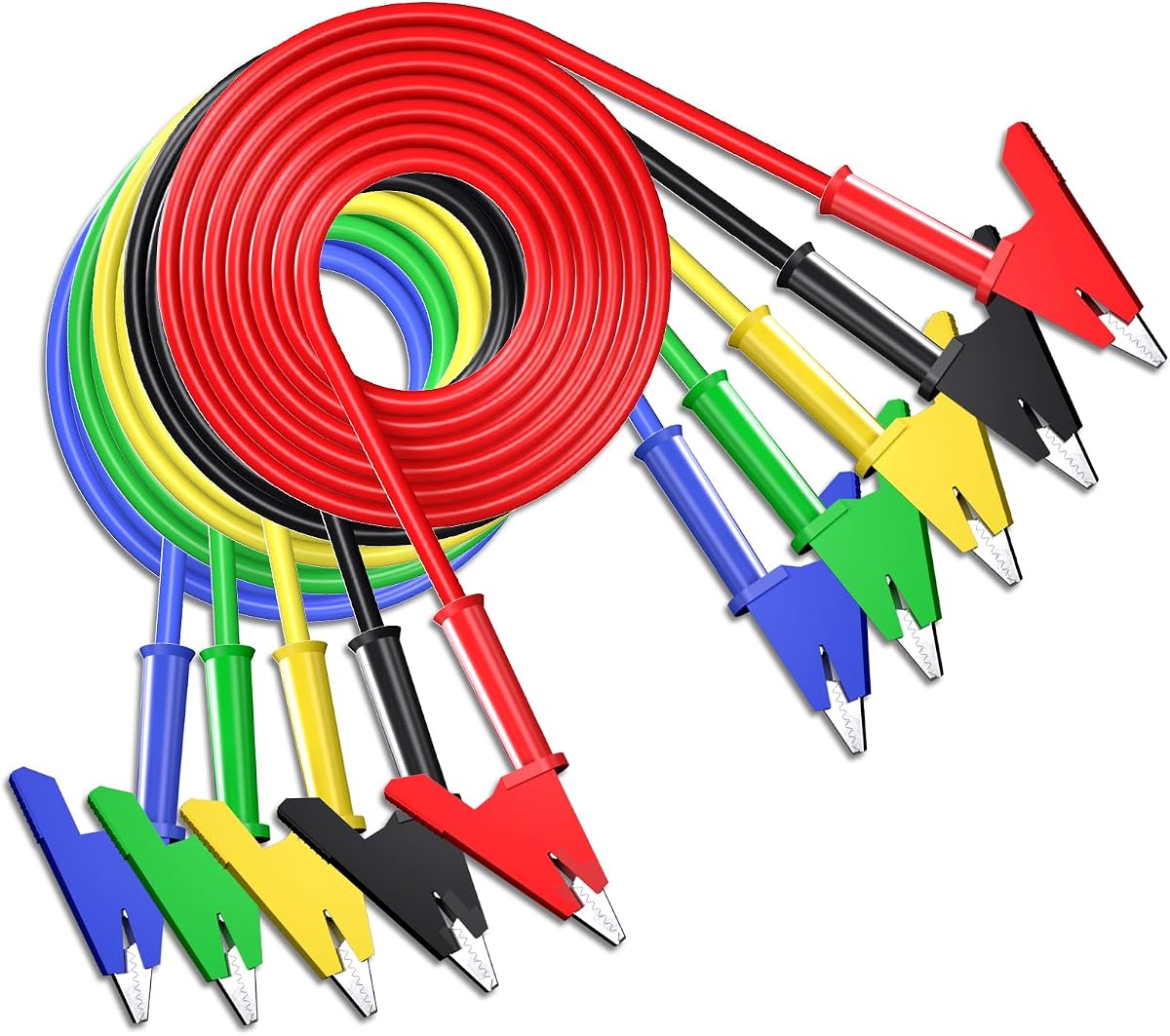
4.8Editor score

4.6Editor score
The table below compares all ten sets by lead count, cable length, wire construction, and documented electrical limits, making it easier to identify the option that matches your testing environment.


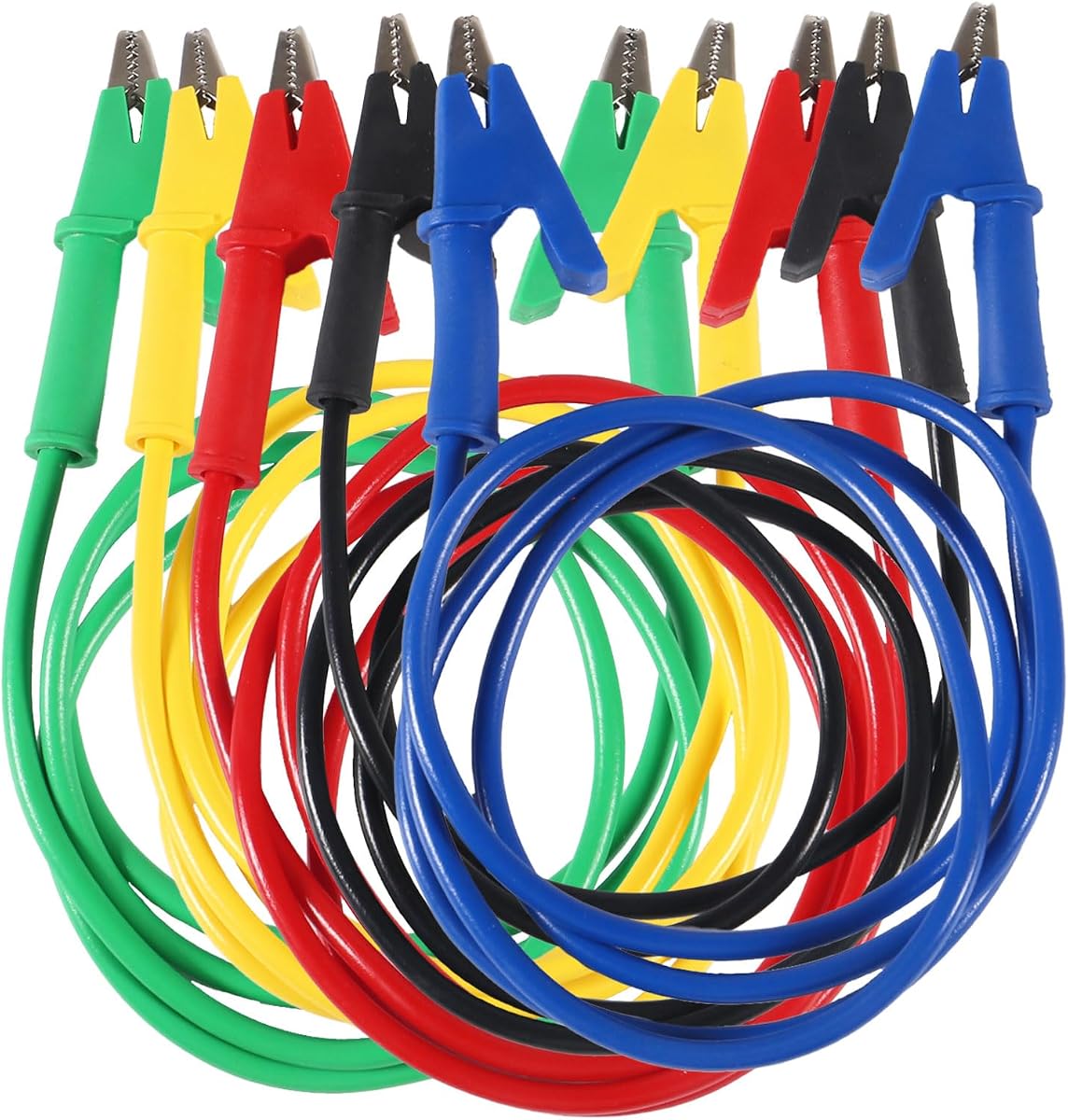
The WG-026 set combines ten color-coded leads with twenty nickel-plated steel alligator clips, creating one of the most practical general-purpose kits in this guide. Its 4.7 customer rating reflects a favorable balance of useful quantity, manageable size, and clean organization. Each 22 AWG copper lead is insulated with PVC and measures 20.5 inches end to end.
We may earn a commission when you buy through this link, at no additional cost to you.
Two leads in each of five colors make it easier to keep separate circuits, voltage paths, and test points visually distinct. The clips have strong springs and a corrosion-resistant nickel-plated steel construction, while their soldered and stamped wire attachments are intended to support reliable conductivity. These attributes make the set particularly useful for breadboards, prototypes, classroom experiments, and general troubleshooting.
The primary limitation is the relatively light 22 AWG wire. It is well suited to low-current electronics and signal testing, but it is not the appropriate choice for automotive starting circuits, high-current loads, or other demanding power work. Buyers who need greater current capacity should move toward a 14 AWG or 18 AWG option. Within lightweight test-lead sets, however, the clip quantity and color selection are unusually useful.
This is the most practical recommendation for students, electronics hobbyists, and bench technicians who want a ready assortment without a large collection of single-purpose leads. It is also a good first kit for temporary connections around a workbench. Choose it when flexible routing, clear identification, and a broad range of clip colors matter more than heavy-current capability.
Five colors make it easier to distinguish separate test paths without repeatedly checking the wiring diagram. The two leads provided in each color also allow you to build matched temporary circuits quickly.
At 20.5 inches, the leads are long enough for common bench arrangements without creating excess cable clutter. Their 1.6-inch clips are sized for small components, pins, and moderately sized terminals.
We may earn a commission when you buy through this link, at no additional cost to you.
SWANLAKE provides two 3.5-foot dual-ended leads built for extended reach and hands-free electrical testing. The 4.7 rating indicates strong user reception, particularly from buyers who need flexible cables capable of entering confined areas. Each lead has copper alligator clips at both ends and insulated cabling rated for up to 1000V and 15A.
We may earn a commission when you buy through this link, at no additional cost to you.
The principal advantage is reach. A 3.5-foot cable can bridge the distance between a meter, circuit board, battery, or enclosure without forcing the operator to hold a probe in place. The insulated cable and durable clip design are intended to reduce accidental contact while the spring jaws grip selected test points. Compatibility with multimeters, electrical probes, and banana-terminal testers makes this a flexible addition to a diagnostic kit.
Two leads are less convenient than a large assortment when several temporary connections must be made simultaneously. Color differentiation is also limited because no multi-color organization is described. The stated 15A rating should be treated as a product limit rather than an invitation to run near the maximum continuously, and users must still verify that their circuit falls within the documented electrical and environmental conditions.
This set is best for electricians, technicians, and advanced hobbyists who frequently work on circuits spread across a vehicle, appliance, control panel, or crowded workbench. It is also useful as a small pair of extended test leads rather than a complete jumper-wire collection. Choose it when reach and secure hands-free contact are the main requirements.
The 3.5-foot length gives the meter operator room to reposition the instrument while the clips remain attached. This is particularly helpful when test points are separated by cabinet walls, component housings, or vehicle components.
The protected cable and insulated clip areas help reduce accidental contact while a connection is being established. As with any lead set, power should be handled according to appropriate electrical safety practices.
We may earn a commission when you buy through this link, at no additional cost to you.
The EDGELEC 12-piece set is designed for organized prototyping with six colors, 18 AWG tinned copper conductors, and clips that can open as wide as 0.67 inches. Its 4.5 rating reflects a solid general-purpose option for electronics experimentation, troubleshooting, and temporary circuit connections. The listing describes a total lead-and-clip length of 23.5 inches.
We may earn a commission when you buy through this link, at no additional cost to you.
The use of UL1015 wire and tinned copper gives the set a more substantial construction than a very light signal lead. Nickel-plated steel clips are covered with non-slip rubber sleeves, improving control during placement and helping reduce slipping from a test point. The soldering and stamping used to secure the clips to the wires is also presented as a durability measure.
Its 18 AWG wire is still intended primarily for prototyping and general electrical testing rather than heavy loads. The maximum 0.67-inch opening also means that unusually large battery posts, bus bars, or thick terminals may not fit comfortably. Buyers should not treat the clip opening as equivalent to unrestricted cable current capacity, and each lead should be used within its stated rating.
This is a strong choice for students, educators, and electronics builders who regularly work with breadboards and need a broad palette of wire colors. Twelve leads provide enough inventory for several circuits without taking up the space of a much larger kit. It is especially helpful when visual separation is central to diagnosing a complex prototype.
A broader color palette helps separate power, ground, signals, and individual test paths. That visual clarity can reduce wiring mistakes during breadboard construction and troubleshooting.
The non-slip coverings provide a better grip during placement and removal. They are particularly useful when working with small component leads or terminals that require precise alignment.
We may earn a commission when you buy through this link, at no additional cost to you.
This 20-piece crocodile clip kit offers the largest assortment in the guide, with four leads in each of five colors. The 4.3 customer rating reflects its usefulness for temporary circuit connections and power-testing probes, although it sits below the stronger-rated alternatives. Each lead is approximately 21.7 inches long and terminates in a 35-millimeter metal clip.
We may earn a commission when you buy through this link, at no additional cost to you.
The extended clip size creates a useful distinction from smaller breadboard-style clips. Its stated purpose includes connections to motor testing points, electronic appliances, digital products, and temporary power arrangements. A detachable-style arrangement and simple two-terminal connection make the kit convenient for rapidly changing a circuit during a diagnostic session.
The most important caution is the absence of a documented voltage or current rating in the supplied product information. The metal clip terminal is exposed, and the listing explicitly warns against exceeding a rated voltage. Buyers who need established electrical limits should choose a set with clear voltage and current specifications instead of assuming comparable performance from the clip size.
This kit makes the most sense for hobbyists, repair technicians, and educators who need numerous temporary connections and prefer the visual organization of five colors. Its quantity is particularly helpful for classrooms, prototyping stations, or a workbench where several leads may be needed at once. For regulated or higher-current diagnostics, select a specification-heavy option instead.
The generous count allows users to create several connections without sharing clips or moving a single lead between multiple test points. That convenience can materially reduce the time spent reconnecting a prototype.
The 35-millimeter tips are suited to modest-size component leads and terminals. Buyers should compare the opening dimensions with their actual targets because a longer clip does not automatically accept every large connection.
We may earn a commission when you buy through this link, at no additional cost to you.
The EDGELEC 14-gauge pair is the strongest heavy-duty option in the guide, with UL3135 tinned copper wire, silicone insulation, and documented limits of 1500V and 15A. Its 4.6 rating reflects a favorable response among users seeking more substantial test leads. The red and black configuration also follows a familiar convention for positive and negative connections.
We may earn a commission when you buy through this link, at no additional cost to you.
The two-inch nickel-plated copper clips open to 10 millimeters and carry rubber sleeves for added grip. Their soldered and stamped wire attachments are intended to preserve a dependable connection. Silicone insulation remains flexible and is easier to route around hot, cramped, or irregularly shaped components than a stiff conventional jacket. The supplied cable ties help keep the pair from tangling during storage.
This is still a focused two-lead kit rather than a broad assortment. The heavier 14 AWG cable and larger clips may feel excessive for small breadboard work, where lighter 22 AWG leads are more convenient. Users must still observe the rated limits and use suitable protection when working around high-energy circuits, especially in automotive applications.
Choose this pair for technicians who inspect motorcycles, automotive electrical systems, or larger bench projects and need flexible silicone construction. It is also appropriate for labs and workshops that favor red-and-black color conventions. For those who need only one substantial red and black pair, it delivers a more specialized purpose than the multi-color kits.
Silicone cable is easy to bend and route around components without immediately trying to form a sharp permanent crease. That flexibility is valuable when connecting to awkward or moving test points.
The heavier conductor provides a meaningful capacity advantage over lightweight electronics leads. Its stated fifteen-amp limit makes it better suited to diagnostic applications than standard breadboard jumper sets.
We may earn a commission when you buy through this link, at no additional cost to you.
This four-group set organizes dual-ended jumper wires in red and black, making it useful for circuit experiments that benefit from immediate polarity identification. Its 4.4 rating points to a dependable but less universally favored set. Each group connects multiple clip ends, and the one-meter cable length provides useful distance between a source and its destination.
We may earn a commission when you buy through this link, at no additional cost to you.
The clips use nickel-plated steel with strong springs to support stable contact. Insulated sleeves can slide along the clip to adjust how much of the metal is exposed, which offers useful control depending on the terminal being contacted. The grouping and color scheme make it easier to keep related connections together instead of mixing them with unrelated leads.
No numerical voltage or current limit appears in the available specifications, so the set should not be treated as equivalent to the explicitly rated options. The adjustable insulation can also require care to position correctly before energizing a circuit. Buyers working with substantial loads should use a lead with documented electrical ratings and suitable wire construction.
This product is appropriate for laboratory demonstrations, classroom exercises, and general prototyping where a one-meter dual-ended lead is the preferred format. It is less compelling for technicians who need a broad collection of cable lengths or clearly documented high-current performance. Its advantage is the organized group arrangement rather than a single standout specification.
Separating the leads into groups makes matching and storage more convenient. This is especially useful in shared workspaces where loose test cables otherwise become difficult to sort.
The sliding insulated clip coverings can be repositioned for different terminal sizes. Correct placement helps balance physical protection with the need to establish a reliable electrical connection.
We may earn a commission when you buy through this link, at no additional cost to you.
The Goupchn five-piece set earns the highest customer rating in this comparison at 4.8. It combines five dual-ended, color-coded leads with pure copper alligator clip contacts, a 3.3-foot length, and documented limits of 1000V and 15A. The result is a balanced option for technicians who want both identification and stated performance.
We may earn a commission when you buy through this link, at no additional cost to you.
The clips open to 10 millimeters and use a rubber insulation layer to help them remain steady during use. Strong springs are designed to resist deformation over repeated cycles. Copper contacts support efficient conductivity, while five colors help separate circuits or identify different test paths. The set is particularly appropriate for automotive accessories, motorcycles, vintage vehicles, and general circuit testing.
Five leads provide less flexibility than the ten-, twelve-, and twenty-piece assortments, so users working on complex multi-point prototypes may need additional leads. Copper can develop surface oxidation over time, making periodic inspection and cleaning sensible. The stated limits should also be treated as boundaries rather than continuous operating targets.
This is the most balanced recommendation in the guide for automotive and electronics technicians who want documented ratings, useful color coding, and a moderate number of full-length leads. It is also a strong fit for advanced hobbyists restoring or troubleshooting older vehicles. Choose it when clear specifications and orderly setup matter as much as having a large assortment.
Distinct colors let an operator identify individual test paths without relying solely on labels. This speeds temporary circuit setup and makes troubleshooting easier to follow.
The documented 1000V and 15A limits provide more concrete guidance than an unrated jumper set. Those specifications make this option easier to evaluate against the circuits it will serve.
We may earn a commission when you buy through this link, at no additional cost to you.
EBOOT supplies four dual-ended alligator clip leads in two color groups, giving users a straightforward set for low-voltage circuit connection and laboratory experiments. Its 4.4 rating suggests a generally positive reception. Each cable is approximately one meter long and includes clips at both ends.
We may earn a commission when you buy through this link, at no additional cost to you.
The construction combines copper wire, PVC insulation, and vinyl-covered clips with strong springs. Red and black color coding helps users avoid crossing polarity during basic tests, while dual-ended clips make it fast to create temporary links between two points. The design supports common tasks such as joining components to wires and checking low-voltage circuits.
The product information does not state a numerical voltage or current rating, which limits its appeal for users who need to verify a lead against a defined circuit load. Four leads may also be insufficient for projects involving numerous simultaneous connections. As with other exposed metal clips, the vinyl covering helps organize and protect the lead but should not be treated as complete touch protection under every condition.
Choose EBOOT for students, teachers, and electronics hobbyists who want a straightforward four-lead introduction to temporary wiring. It is a sensible option for demonstrations and simple experiments where dual-ended leads are more convenient than single-ended probes. For regulated diagnostics, compare it with a set that lists explicit electrical limits.
Having a clip at both ends removes the need for separate adapter pieces. That makes the leads convenient for linking two components, powering a small circuit, or holding a temporary connection during a test.
Red and black are familiar identifiers for positive and negative paths. The pairing reduces confusion and keeps simple classroom or bench circuits visually understandable.
We may earn a commission when you buy through this link, at no additional cost to you.
DROK combines heavy-gauge construction with a compact 50-centimeter length in this two-lead set. Its 4.6 rating reflects solid performance among users seeking more current capacity than a standard breadboard lead. The conductors are reinforced 14 AWG copper, while the clips use copper-nickel plating for corrosion resistance.
We may earn a commission when you buy through this link, at no additional cost to you.
PVC insulation supports everyday durability, and the product is listed for up to 19 amps. These characteristics make the pair relevant to automotive diagnostics, laboratory experiments, and general DIY work where a short, sturdy temporary connection is needed. The relatively compact cable is easier to carry and less likely to become tangled than a meter-length lead.
The listing does not provide a specific maximum voltage, so it is not possible to compare its insulation limit directly with the products that list 1000V or 1500V. The short 50-centimeter span also limits reach into deep enclosures or between widely separated points. Users should verify both circuit voltage and available space before choosing it.
This is a good match for technicians who already own longer meter probes and want two sturdy alligator-clip attachments for close-range work. It is also useful for compact experiment setups where excess cable is undesirable. Choose it for current-focused, short-distance diagnostics rather than extended reach or large multi-lead projects.
A 50-centimeter lead is convenient for compact work areas and close-range probing. It can also serve as a supplementary clip lead when a longer standard test probe cannot conveniently hold a terminal.
The copper-nickel clip finish is intended to withstand repeated use and resist corrosion. Periodic cleaning and inspection remain important when a dependable connection is essential.
We may earn a commission when you buy through this link, at no additional cost to you.
This five-piece set delivers dual-ended alligator leads with pure copper contacts, a 3.3-foot length, and documented limits of 1000V and 15A. Its 4.7 rating places it among the strongest-reviewed products here. The clips open to 10 millimeters, and their rubber insulation layer is designed to help maintain a firm grip.
We may earn a commission when you buy through this link, at no additional cost to you.
The key differentiator is the smooth, kink-free silicone cable. It remains flexible, coils neatly for storage, and is described as retaining flexibility in cold weather. That makes the leads convenient for field diagnostics, lab work, automotive inspection, and any task where a rigid PVC cable would be awkward to route.
Five leads may not be enough for a circuit requiring several independent temporary connections at once. The available description does not emphasize multiple colors, so users needing strong visual identification should look for a color-coded alternative. The voltage and current ratings provide useful guidance, but continuous operation near the limits should be avoided without considering the entire circuit and environment.
Choose this set for technicians and advanced hobbyists who value flexible silicone wiring, clear ratings, and dual-ended convenience. It works particularly well in cold or cramped environments where cable maneuverability matters. For larger prototyping systems, the five-piece WG-026 or EDGELEC assortment may offer more leads and better color separation.
The smooth cable bends around equipment without developing pronounced kinks, making it easier to reach recessed terminals. Its flexibility also allows the leads to be coiled neatly after use.
The cable is described as remaining flexible in cold weather, which can be advantageous for outdoor or unheated workspaces. This does not eliminate the need to follow the product's electrical ratings.
We may earn a commission when you buy through this link, at no additional cost to you.
The right alligator clip leads depend on the circuit, current level, working environment, and how many connections you need to maintain at once. Compare these factors before choosing a set.
Wire gauge determines how much current a lead can carry without excessive heating. Light 22 AWG leads are appropriate for low-current electronics, signals, breadboards, and small prototypes. An 18 AWG option offers more capacity, while 14 AWG is better suited to heavier diagnostic work and automotive or appliance testing. Always compare the wire gauge with the lead's documented current rating rather than assuming that a larger clip automatically means a higher safe current.
Choose lighter wire for signal work and heavier wire for power-oriented testing.
Insulation protects the cable and user from contact with conductive surfaces, but only within its specified limits. Sets in this guide list limits ranging from no numerical voltage specification to 1000V or 1500V. Silicone and PVC provide different handling characteristics, with silicone generally remaining flexible in cold conditions. Confirm the voltage rating before using a lead on mains, automotive, industrial, or other energetic circuits.
Treat the published rating as a firm limit, not a target.
Short leads are convenient for compact breadboards, nearby component testing, and portable tool kits. Twenty- to twenty-four-inch leads suit common bench layouts, while one-meter and 3.3-foot leads provide better reach into enclosures and across work areas. The longest cable is not automatically the most useful; excessive length can add clutter and make fine connections harder to control.
Match cable length to the physical distance between test points.
Clip dimensions determine which terminals can be contacted reliably. Small leads may suit component pins and breadboard contacts, while larger clips can grasp battery posts, thicker terminals, or wider conductors. Compare the documented maximum opening with the target terminal rather than relying on overall clip length. A well-sized jaw improves both contact consistency and operator control.
Measure the terminal and check the documented jaw opening.
A larger assortment allows several circuits to remain connected simultaneously and reduces the need to move one clip between unrelated points. Four- or five-piece sets are easier to organize and carry. Color coding adds another layer of clarity: red and black are familiar for polarity, while six or more colors help identify independent signal and power paths in elaborate prototypes.
Choose enough leads and colors for the connections you maintain.
A dependable lead requires a secure mechanical attachment between the conductor and clip. Products that describe soldered and stamped connections suggest attention to reducing looseness. Strong springs, non-slip sleeves, and corrosion-resistant clip plating also contribute to dependable contact. Inspect the jaw and wire joint regularly, especially after cables have been pulled, bent sharply, or stored under pressure.
Look for secure attachments and corrosion-resistant clips.
Different workspaces impose different demands. Electronics labs favor flexible, color-coded leads, while automotive work often benefits from heavy wire, long reach, and insulated red-and-black pairs. Field repairs benefit from silicone cables that remain flexible and coil without forming sharp bends. Shared classrooms or busy benches benefit from grouped leads and storage ties because they remain easier to sort and retrieve.
Choose construction suited to the workspace, not just the circuit.
Confirm that the connector style works with the intended meter, probe, battery, or breadboard accessory. Dual-ended leads are broadly useful for temporary links, while some meters require banana plugs or additional adapters. Before energizing a circuit, check insulation, exposed metal, polarity, and the manufacturer's limits. Disconnect power before attaching or rearranging clips whenever the circuit permits.
Verify compatibility and de-energize before connection.
Begin by identifying the circuit, its polarity, and the maximum voltage and current expected. Match those conditions to the lead's documented ratings, then inspect each cable and clip for damaged insulation, exposed conductors, corrosion, or a weakened spring. If the circuit can be safely de-energized, disconnect power before making connections.
Attach each clip squarely to the intended terminal. Firm, metal-to-metal contact is necessary for consistent readings, but the clip should not be forced onto a terminal that exceeds its opening width. Keep red, black, and other colored leads associated with the correct paths, and avoid crossing conductors unintentionally. Route the cable so it does not carry weight or become pinched between moving parts.
After testing, switch off and disconnect the circuit before removing clips. Store the leads loosely coiled rather than tightly wrapped around the jaws. Keep the connectors clean and dry, inspect the wire periodically for cracking or flexibility changes, and replace a lead whose insulation is compromised or whose clip no longer grips securely.
The main difference is conductor thickness and the amount of current each lead can carry without excessive heating. Fourteen AWG is the heaviest of the three and suits automotive, appliance, and higher-current diagnostic work. Eighteen AWG is a middle option for prototyping and general testing, while 22 AWG works well for breadboards, low-voltage circuits, and signal testing. Clip size alone should not be used to judge current capacity.
They can be useful for multimeters that accept compatible banana-style adapters or test accessories. The clips allow a meter to remain connected while the operator works with both hands, making them especially helpful for battery, circuit-board, and remote diagnostic tests. Confirm the meter's connector type, voltage category, and current rating before attaching third-party leads.
PVC is a versatile, economical choice that works well in ordinary indoor environments. Silicone is usually more flexible, resists kinking, and retains easier handling in cold conditions, making it attractive for automotive, field, and crowded bench use. The more important consideration is that the insulation must remain intact and the complete lead must stay within its documented electrical rating.
A simple point-to-point test may need only two leads, while a breadboard prototype often benefits from six to twelve. Larger circuits, class demonstrations, or simultaneous diagnostic comparisons can justify a larger assortment. Color coding becomes more valuable as the number of connections increases because it helps preserve polarity and separate different test paths.
Only when their voltage, current, temperature, and construction ratings suit the application. Fourteen AWG silicone leads or a documented 1000V and 15A set may be appropriate for many vehicle diagnostic tasks, while lightweight breadboard leads may not be. Disconnect the battery when the vehicle procedure requires it and prevent clips from contacting unintended metal surfaces.
A weak spring, surface corrosion, a narrow terminal, or a poorly aligned jaw can all reduce contact. Check that the clip fully closes around the target and clean corrosion from accessible contact surfaces with an appropriate method. Replace the lead if the spring has weakened, the hinge has become loose, or the insulation no longer protects the wire.
Not necessarily. Current capacity is primarily limited by the conductor gauge, insulation, contact condition, and thermal environment. A large clip may accept a thick terminal but can still be paired with wire that is too light for the intended load. Evaluate the entire lead specification rather than judging capacity from jaw size alone.
They should be stored loosely, preferably in a large loop or gently coiled without tight bends around the clip jaws. Tight winding can stress the cable near the soldered connection and encourage the silicone or PVC jacket to take a permanent set. Cable ties or a pouch can keep them organized without applying unnecessary strain.
The WG-026 10-piece set is the most versatile starting point for electronics, breadboards, and organized low-current testing. The Goupchn five-lead set stands out for its strong customer rating, clear 1000V and 15A specifications, and color coding, while the EDGELEC 14-gauge silicone pair offers the most substantial construction for heavier diagnostic work.
Prioritize the factors that match your actual application: conductor gauge for current, insulation rating for voltage, jaw opening for the terminal, and lead length for routing. A large set is useful for complex circuits, but a smaller group of properly rated leads can be more convenient for routine work. Match red and black leads to polarity and use additional colors when signal paths need separation.
Finally, review the current listing specifications before ordering, especially the included quantity, cable length, clip dimensions, and electrical limits. Ratings and product configurations can change, and availability may vary. Choose the set whose documented construction aligns with the circuits and environment in which you will actually work.