
3D Printer Glue 50g
4.6Editor score
Brush or dropper application
Thirty-second initial set
Fifty-gram container
Discover the best 3D printer super glue options for PLA, ABS, PETG, TPU, and resin, comparing application control, cure speed, capacity, and repair versatility.
Super glue can transform a promising 3D print into a functional assembly, but not every cyanoacrylate formula handles printed surfaces equally well. A useful 3D printer super glue should wet into layer lines, cure quickly, resist brittleness, and apply without flooding delicate details or creating an unwanted ridge around the joint.
This guide compares ten options based on the supplied material compatibility, viscosity, applicator design, container size, curing information, and stated repair features. It covers thin, medium, and gel formulas for joining printed parts, filling small gaps, reinforcing seams, and repairing models across PLA, ABS, PETG, TPU, ASA, nylon, and resin.
Each review explains the strongest application for that product, along with the trade-offs visible in its specifications. The top three identify the strongest overall, budget, and premium options, while the guide also explains how viscosity, tip design, material compatibility, and curing expectations should shape your final choice. Product availability and pricing can change.
4.6Editor score

4.7Editor score

4.7Editor score
This side-by-side comparison organizes the ten products by their most important practical traits, including formula behavior, supported printing materials, applicator options, curing time, and container size.




The 3D Printing Super Glue Gel 1.75 oz is the strongest all-around choice in this guide, earning a 4.7 rating among the listed options. It is explicitly formulated for PLA, ABS, PETG, TPU, ASA, and nylon, making it unusually broad for a product aimed at 3D-printing repairs. Its thick, no-drip gel is especially useful when a joint is vertical, uneven, or surrounded by details that should not be flooded.
We may earn a commission when you buy through this link, at no additional cost to you.
The controlled formula is the product's defining advantage. Rather than racing through a narrow seam, the gel is designed to remain around the contact area, making it useful for layer repairs, support-related joints, mechanical fits, and functional printed parts. The precision needle and anti-clog design support deliberate placement, while the stated ability to withstand temperatures up to 110°C and humidity gives it relevance for RC components, mechanical assemblies, and outdoor-printed pieces.
There are reasonable compromises. A thick gel is less likely than a thin cyanoacrylate to penetrate the smallest layer-line irregularities, and a 1.76-ounce tube may be excessive for someone assembling only a miniature. The product is also described as offering up to five times more glue than standard bottles, so buyers should consider their actual project volume before committing. Even so, its combination of control, compatibility, and environmental resistance is difficult to match in this category.
This is the recommendation for makers who want one dependable bottle for common filaments, repeated repairs, and assemblies where appearance and placement matter. Choose it for vertical seams, layer splits, detailed models, functional parts, and projects that may encounter moderate heat or moisture. For a small, highly visible repair, a smaller container may be more convenient, but for an active workbench or print farm, this gel provides an especially versatile balance.
The no-drip gel is most valuable where ordinary thin glue could travel beyond the joint. It stays close to vertical seams, corners, support interfaces, and uneven mating surfaces, giving the maker more time to align each printed component before the adhesive carries into unwanted areas.
Compatibility with six common filament types, combined with stated heat and moisture resistance, makes this a practical choice for more than display models. It is a sensible option for RC parts, mechanical fits, and outdoor-printed components that need more durability than a cosmetic repair.
We may earn a commission when you buy through this link, at no additional cost to you.
The 3D Print Glue 30g Thin Super Glue combines a 4.5 rating with a particularly clear use case: joining printed parts when layer lines, warping, or rough edges prevent a joint from sitting flush. Although its title says thin, the product information describes a thick, high-viscosity cyanoacrylate that forms a controlled bead rather than immediately wicking across a surface. That distinction makes it more useful for seam repair than a conventional ultra-thin CA.
We may earn a commission when you buy through this link, at no additional cost to you.
Its three precision applicator tips help place small amounts along figure limbs, prop sections, model bases, and hard-to-reach edges. The adhesive supports PLA, ABS, PETG, TPU, and resin, while the clear formula is designed to leave a discreet bond line. That makes it attractive for collectibles, cosplay pieces, architectural models, and presentation samples where a dark or bulky seam would be visually distracting.
The slower setting is the main trade-off. The adhesive positions in approximately 45 seconds but reaches full cure in 24 hours. The product information also cautions against using the cured bond on hinges or repeatedly flexed joints, making it better for rigid assemblies and light-duty repairs than for moving mechanisms. The 30-gram container is modest, which works well for a compact model-making kit but may need regular replacement during intensive assembly work.
Choose this option when the central problem is a small but stubborn gap between two rigid printed pieces. It is particularly well suited to miniatures, props, and multipart models that benefit from fuller surface contact and controlled glue placement. Users who need an immediate full-strength load immediately or a joint that repeatedly flexes should look toward a product explicitly designed for those demands.
Rough layer lines and slightly warped edges are common in functional printed parts. This adhesive's high-viscosity body is designed to remain within the contact area and fill minor irregularities, creating a more substantial repair than a very thin, fast-running adhesive.
The clear formula is a meaningful advantage for display pieces, miniatures, and presentation models. When used sparingly, it forms a discreet bond line instead of leaving a visibly dark seam, although the repair will still be most attractive when the amount is carefully controlled.
We may earn a commission when you buy through this link, at no additional cost to you.
The CAMALEAO 3D Printing Super CA Glue kit is a compact, feature-rich option with a 4.4 rating. Its medium-viscosity formula is described as comparable to syrup, providing more control than a watery CA while remaining capable of flowing into layer lines. The stated 2610 PSI strength and rapid cure window of five to 30 seconds target functional prototypes and quick assembly work.
We may earn a commission when you buy through this link, at no additional cost to you.
The package goes beyond a conventional single bottle. It includes a 1-ounce bottle, an extra 1-gram aluminum tube, an additional anti-clogging cap, and six precision microtips. The steel pin in the cap is intended to help keep the opening clear, while the aluminum tube offers a portable format for on-the-go repairs. The product data also highlights compatibility with plastics, metal, leather, wood, ceramics, and pottery, extending its usefulness beyond printed assemblies.
As a medium-viscosity adhesive, it demands a little more deliberate application than a thin super glue, but that is beneficial when a maker does not want adhesive racing across a model. The information claims near-zero whitening and permeability of 0.008 inches, both useful qualities for visual repairs. Its stated 24-month shelf life assumes storage in a cool, dry, dark environment, so proper storage matters if the kit is kept for long periods.
This kit is a good choice for builders who want rapid curing, several applicator options, and a portable backup tube in the same package. It is well suited to layer-line bonding, functional prototypes, miniatures, and mixed-material hobby repairs. For someone who only needs one tiny assembly, the bundle may be more than necessary, but for a regularly used toolkit, the extra tips and tube improve convenience.
The medium viscosity is a useful middle ground for 3D prints. It is fluid enough to wet printed surfaces and penetrate the stated 0.008-inch gap while remaining thick enough to reduce the runaway application associated with very thin CA formulas.
Six microtips, an extra cap, and a portable aluminum tube reduce the need to search for compatible replacements. That makes this kit especially convenient for model stations, hobby desks, and repair bags where a clogged tip can interrupt an otherwise quick assembly.
We may earn a commission when you buy through this link, at no additional cost to you.
The 3D Printer Glue 50g earns a 4.6 rating and stands out as a budget-conscious option with unusual applicator flexibility. Instead of committing to one delivery method, it includes both a brush for smooth, even coverage on broad joints and a small dropper for seams, cracks, corners, and fine details. That versatility makes it useful for more than one kind of 3D-printing repair.
We may earn a commission when you buy through this link, at no additional cost to you.
It is specifically designed for PLA, ABS, PETG, and TPU, with applications including model assembly, miniatures, prototypes, crack repairs, and functional builds. The formula sets in approximately 30 seconds, allowing makers to align components quickly, while the instructions recommend allowing 24 hours for full cure and maximum bond strength. The built-in steel pin in the cap helps seal the opening and reduce dried glue between uses.
The main limitation is its more focused filament list. Unlike several options in this roundup, it does not explicitly claim compatibility with ASA, nylon, or resin. A brush is highly useful for a larger mating surface, but careless application can still leave excess glue on a highly visible seam. The 50-gram bottle is also larger than a minimal cosmetic-repair package, which is useful for repeat work but less efficient for a single tiny fix.
This is a strong recommendation for makers who want flexible application methods at a budget-friendly level of investment. Choose it when you assemble printed models regularly, alternate between large panel joints and small detail repairs, or want a bottle that can serve general model-making tasks. For display-only work, control the bead carefully; for load-bearing assemblies, allow the full recommended cure before testing the joint.
A thin brushed layer can cover a broad, relatively flat joint more evenly than a narrow bead, while the dropper is better for isolated cracks and tight seams. Having both applicators on hand reduces the temptation to over-apply a precision formula to a large area.
The integrated steel pin addresses one of the most common frustrations with CA glue: a dried, blocked opening. Combined with the 50-gram capacity, it makes this bottle suitable for regular assembly, recurring repairs, and projects that involve more than one type of joint.
We may earn a commission when you buy through this link, at no additional cost to you.
The All-Purpose Super Glue Gel 1.76 oz has a 4.6 rating and offers a useful alternative for makers whose workshop contains more than printed models. Its gel formula is intended for both household repairs and industrial-scale tasks, while the crystal-clear finish is designed to remain inconspicuous on intricate crafts and other visible surfaces.
We may earn a commission when you buy through this link, at no additional cost to you.
The principal advantage is controlled application without an obvious residue line. A gel is particularly helpful on vertical or uneven joints where a thin adhesive could run, stain the print, or create an unwanted buildup. The product reaches maximum handling durability in seconds according to the supplied description, and the airtight precision tip with an anti-clogging safety cap is intended to maintain consistent flow during storage.
Because the product is positioned as all-purpose rather than exclusively for 3D printing, its listing does not provide a detailed compatibility list for PLA, ABS, PETG, TPU, or other filaments. That makes it less informative for a highly material-specific purchase. The large professional-style container is also unnecessary for someone who will make only one small repair, and the gel remains a strong choice only when it behaves as expected on the particular surfaces being joined.
This product is best for a mixed maker bench where 3D prints sit alongside plastic crafts, household items, and general repairs. Its clear finish and gel consistency make it attractive for visible seams where a dark line would be objectionable. If your work is entirely specialized to filament assemblies, one of the explicitly 3D-focused formulas may offer more relevant material guidance, but this gel remains a versatile option with a strong rating.
The crystal-clear finish addresses a common concern with cyanoacrylate repairs: the glue line can be as noticeable as the original break. This gel is intended to remain invisible or inconspicuous on intricate crafts, making it more suitable for a display repair than a visibly dark adhesive.
The general-purpose positioning is useful for a mixed repair kit. It is not limited to the filament-focused applications highlighted elsewhere in this guide, so one bottle can potentially cover several kinds of household and craft bonding tasks.
We may earn a commission when you buy through this link, at no additional cost to you.
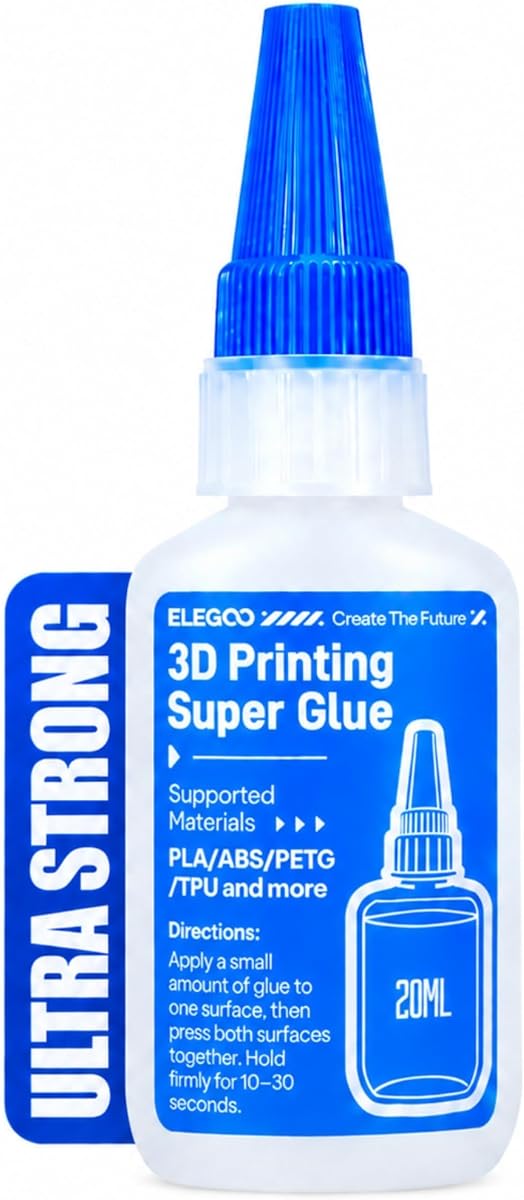
The ELEGOO 3D Printer Super Glue 20 ml carries a 4.5 rating and is the most directly focused on appearance among the leading choices. Its low-bloom formula is designed to minimize visible whitening after curing, making it attractive for display pieces, painted miniatures, detailed assemblies, and repairs where a cloudy adhesive mark would reveal the joint.
We may earn a commission when you buy through this link, at no additional cost to you.
Material compatibility is broad, covering PLA, ABS, PETG, TPU, ASA, resin, and other materials. The formula provides an initial bond in approximately 10 to 30 seconds at room temperature, then develops full strength within 24 hours. A fine-tip applicator supports precise placement on small components and complex assemblies, reducing the need to flood a seam merely to reach it.
The compact 20-milliliter container is the main compromise. It is appropriate for a careful hobbyist or occasional repairer, but intensive assembly or repeated breakages could consume it quickly. Low bloom should not be confused with a completely invisible bond under every condition; surface finish, application amount, and the printed material can all affect appearance. As with other cyanoacrylates, allowing the complete cure period gives more predictable results.
Choose this adhesive when appearance and precise placement are at least as important as fast assembly. It is a strong option for resin miniatures, painted figures, cosplay accessories, and visible prototypes. The broad material list also makes it useful for mixed-filament projects. If you need a larger volume for print-farm repairs, the 50-gram and 1.76-ounce options may be more practical.
Low-bloom performance is particularly valuable on light-colored, painted, or translucent parts. The clear formula is designed to preserve surface detail rather than leave a prominent cloudy halo, so it is worth testing on the exact material and finish before repairing an especially valuable piece.
The fine-tip applicator makes it easier to place a small amount at the intended bond line. That control is valuable around miniature faces, thin limbs, panel details, and fragile features where a broad bead could cause squeeze-out or make later sanding more difficult.
We may earn a commission when you buy through this link, at no additional cost to you.
The 3D Printing Super Glue for PLA, ABS, and PETG has a 4.3 rating and focuses on speed and penetration. Its thin cyanoacrylate formula is designed to flow into tiny seams and micro-gaps between printed layers, which can be useful when a joint has already separated and the mating surfaces no longer align perfectly.
We may earn a commission when you buy through this link, at no additional cost to you.
The adhesive sets in as little as 10 seconds, offering one of the fastest stated initial cures in this guide. It supports PLA, ABS, PETG, and TPU, and the cured bond is described as impact-resistant, heat-resistant to 110°C, and water-resistant. That combination makes the product relevant to RC models, drone parts, electronics, and outdoor components, provided the parts are properly prepared and allowed to cure.
A thin formula also creates the greatest risk of runaway application. It can enter nearby details, stain a finished surface, or bond unintended features, so precision comes from using very small drops. The 4.3 rating is the lowest among the ten products, though that does not negate its specialized strengths. Its 1.23-ounce bottle and four bonus microtips give it a reasonable balance of capacity and control.
This is a good option for quick repairs where a hairline gap must be penetrated and waiting time is minimal. It is less suitable for broad joints, vertical surfaces, or repair areas where a thicker gel would stay in place. Choose it for urgent fixes and tightly controlled drops, but keep the bottle away from fine display features until you are comfortable with how the thin formula behaves on the print.
The thin consistency allows the adhesive to enter small spaces between layers and mismatched edges. This can be advantageous when a joint has opened slightly, since the glue has a better chance of reaching the interior contact area than a thicker gel that remains on the surface.
Stated heat resistance up to 110°C and water resistance make the product more relevant to functional assemblies than a general craft adhesive. Those properties are most useful for rigid parts that will not be continuously flexed and are applied with enough adhesive to create a proper bond.
We may earn a commission when you buy through this link, at no additional cost to you.
The 3D Printer Glue 30g is a balanced gel option with a 4.4 rating. Its clear cyanoacrylate formula is intended to stay where it is applied, reducing movement around seams, corners, and small contact points. Unlike a very thin CA, this controlled gel is less likely to travel across a completed surface, making it a sensible general choice for printed figures, props, prototypes, and small components.
We may earn a commission when you buy through this link, at no additional cost to you.
Its material compatibility is one of its strongest features. The product supports PLA, ABS, PETG, TPU, ASA, and nylon, giving it broad coverage across common printing materials. A precision dropper tip helps control placement on narrow seams, detailed models, RC parts, and miniature accessories, while the anti-clog cap is designed to reduce drying and blockage between uses.
The product data does not provide a specific initial-set or full-cure time, nor does it state a heat-resistance figure. That makes it harder to compare with products that publish explicit curing and environmental specifications. Gel formulas also need careful quantity control, because an oversized bead can leave excess material around the joint. The compact 30-gram size is convenient for a workbench but may not suit a high-volume repair schedule.
This adhesive is a strong general choice when you want clear appearance, controlled gel placement, and compatibility with several filament types without moving to a more specialized formula. It is appropriate for loose joints, broken figures, miniatures, RC components, and prototype assembly. If your decision depends on a specific set time or operating temperature, review the product documentation before committing to it for a demanding application.
The gel body is well suited to joints with limited surface area, including corners, seams, and miniature details. It gives the user more opportunity to position the parts correctly without the immediate movement that can occur with a very thin, rapidly spreading adhesive.
Compatibility extending from PLA and ABS to PETG, TPU, ASA, and nylon makes the bottle convenient for mixed inventory. It is particularly attractive for hobby benches that already contain several materials and need a general-purpose repair adhesive.
We may earn a commission when you buy through this link, at no additional cost to you.
The Plastic Glue 100g is built around rigid plastic repair and assembly, earning a 4.4 rating. Its 100-gram container is the second-largest capacity in this roundup, making it suited to repeated repairs, model cars, miniatures, crafts, and household plastic components. The formula is also relevant to PLA printed pieces, although it is not presented as a universal filament adhesive.
We may earn a commission when you buy through this link, at no additional cost to you.
The stated material list covers PLA, ABS, PVC, and acrylic. It also receives a quick-setting emphasis for broken, split, or separated rigid components, which is useful when a maker wants to restore a part rather than reprint it. Six precision micro-tips support work in tight gaps, corners, and detailed areas, reducing both mess and the likelihood of applying a large amount where only a small bond is needed.
Its most important limitation is that PETG, TPU, ASA, and nylon are not explicitly included. That makes it less appropriate as the only adhesive in a filament-focused workshop. The product information also does not provide a precise cure time, viscosity level, or heat-resistance rating, so buyers should not assume it has the same performance characteristics as the more technically specified CA options. The large capacity is valuable only if the intended plastics are compatible.
This is a good choice for rigid plastic repair, model cars, miniatures, and mixed hobby work involving compatible plastics. It is especially useful for a maker who makes frequent breakages and wants a larger bottle with several precision tips. For a workshop dominated by PETG, TPU, or advanced engineering filaments, select an adhesive that explicitly names those materials instead.
The 100-gram container makes the product practical for users who routinely repair models or household plastic parts. It reduces the need for frequent replacement and gives room to work across multiple joint types without treating every application as a scarce resource.
Six micro-tips are useful around corners, fine cracks, and detailed assemblies where a standard narrow nozzle may still be difficult to position. They also help limit over-application, which is especially relevant on repaired areas that must remain visually clean.
We may earn a commission when you buy through this link, at no additional cost to you.
The Medium Super CA Glue Kit 4.6 oz is the premium pick in this guide, sharing a 4.7 rating with the leading gel and offering the most substantial accessory bundle. It consists of two 2.3-ounce bottles and is backed by detailed specifications: 750 CPS viscosity, 0.008-inch permeability, a stated strength of 2610 PSI, and a cure window of 15 to 30 seconds.
We may earn a commission when you buy through this link, at no additional cost to you.
Its medium consistency is positioned between very thin and thick gel formulas. That balance makes it useful for precision bonding, hobby models, aquascapes, and 3D printing with PLA, ABS, and PETG. It also works with metal, leather, wood, ceramics, and pottery, giving it broader workshop value than a filament-only product. The easy-squeeze bottle, built-in steel pin, and additional caps focus on convenient handling and reliable dispensing.
The package includes 24 precision microtips, a user manual, and four extra anti-clogging caps. This is excellent for a busy bench, but it can be excessive for someone making one miniature repair. The stated 24-month shelf life assumes storage between 35-45°F in a dry place away from light, which means proper storage is essential if the bottles will remain unused for a long period.
This is the recommendation for a serious maker who wants quantity, technical detail, and a broad range of accessories in one purchase. Choose it for frequent prototyping, mixed-material repair, multiple applicator sizes, or a workshop where a single clogged tip should not disrupt work. For occasional cosmetic assembly, a smaller bottle is more convenient, but the kit offers the strongest long-term utility of the general-purpose options here.
Two substantial bottles, 24 microtips, and four replacement caps cover both capacity and maintenance needs. The bundle is particularly useful for users who switch between broad repairs and extremely detailed work, because different tip sizes can be used without replacing the entire bottle.
The listed viscosity, permeability, strength, and cure window provide a clearer technical basis for choosing the formula. Medium viscosity offers enough control for precision placement while maintaining the flow needed to bond printed layer lines and restore separated rigid components.
We may earn a commission when you buy through this link, at no additional cost to you.
The right 3D printer super glue depends on the joint, the printed material, the level of detail, and how often you repair parts. Viscosity, tip design, curing expectations, and container capacity should be evaluated together rather than treating the fastest-setting adhesive as automatically the most suitable option.
Viscosity determines how the adhesive behaves after it leaves the bottle. Thin cyanoacrylate flows readily into micro-gaps and layer-line irregularities, making it useful for separated edges and tight repairs, but it can also spread beyond the intended joint. Gel formulas stay closer to the application point and are generally easier to control on vertical surfaces, broad seams, and detailed models. Medium-viscosity products occupy the middle ground, combining flow with enough body to reduce uncontrolled travel. The best choice depends on whether the printed parts fit closely, whether the seam is uneven, and how visible the repair will be.
A product marketed for plastic repair is not automatically suitable for every filament. Look for explicit support for the materials in your workshop, such as PLA, ABS, PETG, TPU, ASA, nylon, or resin. Flexible TPU has different surface characteristics from rigid PLA and PETG, while ASA and nylon may also have requirements not shared by standard consumer plastics. A broad compatibility statement is useful, but a formula that specifically names your chosen material provides a clearer starting point. If you work with several materials, prioritize a product with a long listed range or keep separate adhesives for specialized surfaces.
The applicator determines how precisely glue can be placed. Fine needles and microtips suit miniatures, facial details, thin limbs, and narrow seams. A dropper provides controlled placement but still requires careful dispensing. A brush is highly practical for broad mating surfaces because it distributes a thin layer over a larger area. Some kits include multiple tips, while others provide one fixed nozzle with an anti-clog pin. Consider the range of joints you expect to repair. A single well-chosen precision tip may be enough for display miniatures, whereas frequent workbench use benefits from a brush, several nozzle sizes, and replacement caps.
An initial set is not the same as full cure. A product may hold parts together in seconds while continuing to strengthen over several hours. The listed products provide initial set information ranging from approximately 10 seconds to 45 seconds, with full cure commonly identified as 24 hours. For a cosmetic model, the initial set may be sufficient before the part is positioned for display. For a load-bearing prototype, mechanical fit, or outdoor component, waiting the full recommended cure is the safer approach. Faster-curing formulas are convenient, but speed should not replace proper joint preparation, controlled quantity, or adequate curing time.
Container size should reflect repair frequency and the risk of premature curing. A 20-milliliter bottle is convenient for occasional, highly visible work, while 30-gram, 50-gram, 1.23-ounce, and 1.76-ounce containers suit more frequent use. The premium 4.6-ounce kit is intended for serious or mixed-material workshop demand. Also follow the storage guidance. Some products specify cool, dry, dark storage and a temperature range, while anti-clog caps reduce the chance of a dried opening. A larger bottle is not automatically more efficient if it will remain open for months and lose usability.
A repaired seam can be nearly invisible or immediately obvious, depending on the formula and application. Clear products are suitable for visible parts, while low-bloom formulas are especially useful for light-colored, painted, or translucent prints. Appearance still depends on how much adhesive is applied and how closely the parts mate. Thick excess can create a raised ridge, and thin overflow can leave a cloudy or dark halo. For a valuable display model, test a small amount on an inconspicuous area and choose a formula with controlled flow. Low bloom should improve the result, but it does not replace careful placement.
A repair's environment changes the adhesive requirements. Some products state heat resistance up to 110°C, water resistance, or durability in moisture, which makes them more relevant to RC components, mechanical fits, and outdoor-printed parts. However, one explicitly advises against hinges or repeatedly flexed joints after cure. A rigid bond that becomes brittle may be less useful on a moving mechanism than a slightly flexible alternative designed for that purpose. Match the product to the actual duty cycle, and distinguish a decorative assembly from a part that will carry repeated force, impact, heat, or weather exposure.
No adhesive can compensate for every printing defect. A failed layer split may contain gaps, contamination, or loose fragments that should be trimmed and cleaned first. Printed surfaces should be clean and dry, and mating edges should be tested for alignment before glue is introduced. For a gap-bridging repair, a higher-viscosity gel may stay within the imperfect contact area, while a thin CA may penetrate farther into the joint. Identify whether the task is simple assembly, filling a small void, reinforcing a seam, or replacing a broken feature. That diagnosis makes it easier to select a formula without relying on fast curing as the only criterion.
Begin with a clean, dry printed surface. Remove loose plastic, dust, oil, and sanding residue from both mating areas, then dry-fit the parts without adhesive to confirm their alignment. If a layer split or warped edge prevents flush contact, trim the obstruction or choose a formula with enough viscosity to bridge the irregularity. Wear suitable eye protection, work in a ventilated area, and keep uncured cyanoacrylate away from skin and eyes.
Apply the smallest practical amount to one mating surface. Use a fine tip for miniature details, a brush for a broad panel, or a dropper when a controlled bead is appropriate. Bring the parts together immediately and hold them in the intended position until the initial set is reached. Avoid forcing misaligned pieces together, since that can create a bond that looks complete but remains mechanically weak. Wipe away any squeeze-out only after confirming the safest method for the printed surface.
Allow the assembly to reach the stated full cure before placing it under load or exposing it to heat, moisture, or repeated movement. After use, recap the bottle and wipe the applicator so residue does not form around the opening. Store the adhesive in a cool, dry, dark location, and replace tips or anti-clog caps as needed. A sealed, properly stored bottle helps preserve the usable working life described by the manufacturer.
No. Cyanoacrylate adhesives work best when the product information explicitly supports the printed material. PLA, ABS, PETG, TPU, ASA, nylon, and resin can behave differently because of surface texture, flexibility, and chemical composition. Check compatibility before use, and test a small area when the print is valuable or highly visible. A compatible adhesive still depends on clean, dry surfaces and proper curing.
Use thin glue when the objective is to penetrate tiny gaps, layer-line irregularities, or slightly separated edges. Use gel when you want the adhesive to remain close to the joint, especially on vertical surfaces, broad seams, or detailed models. Medium viscosity offers a middle ground. The best choice is determined by joint geometry and how difficult excess glue would be to remove, not simply by the word super glue.
Follow the initial-set and full-cure guidance for the selected product. The listed adhesives provide initial set times from approximately 10 to 45 seconds, while several recommend allowing 24 hours for full cure. Initial set is enough for careful positioning, but a load-bearing or frequently handled joint should receive the full cure period. Avoid testing the bond by repeatedly flexing it during that time.
Yes, if the product has a clear or low-bloom finish and the amount is carefully controlled. Clear options in this guide include the ELEGOO adhesive and the 30-gram thick glue, while the no-drip gel is designed to remain close to the joint. Excess adhesive can still create a raised line or visible residue, so apply a small amount and test the finish before repairing an especially valuable model.
Several options in this guide explicitly claim compatibility with TPU. However, a flexible printed part can deform or stretch during alignment, and a rigid CA bond may not tolerate repeated flexing. Use a small quantity, support the joint while it cures, and avoid hinges or repeatedly stressed connections unless the adhesive is explicitly designed for that use. ABS, ASA, and nylon are also included by some formulas but not others.
Use the supplied precision tips carefully and avoid leaving the bottle open. Several products in this guide include anti-clogging caps or built-in steel pins intended to clear the opening and reduce dried residue. Wipe glue from the nozzle and threads before recapping, and store the bottle in a cool, dry, dark environment. Replace microtips and caps when residue can no longer be removed cleanly.
A larger bottle is better when you make frequent repairs or assemble many parts, but it is less efficient for occasional cosmetic work. Cyanoacrylate can cure inside partially used bottles, so capacity should be matched to the number of joints you expect to glue. Products in this guide range from a 20-milliliter bottle to a 4.6-ounce kit with multiple applicators and replacement caps.
It can restore many rigid breaks, loose joints, and small cracks when the pieces still align and the remaining structure is sound. Cleaning away loose fragments, improving the mating surfaces, and adding controlled adhesive often make repair practical. A heavily cracked part, a damaged structural feature, or a joint under constant flexing may be better printed again. For visible collectibles, preserve the original surface by keeping glue away from paint and fine details.
The 3D Printing Super Glue Gel 1.75 oz is the strongest overall recommendation because it combines controlled gel application, broad compatibility with six filament types, an anti-clog precision tip, and stated heat and moisture resistance. The 3D Printer Glue 50g is the budget pick for makers who value both brush and dropper application, while the Medium Super CA Glue Kit is the premium option for a busy, mixed-material workbench that needs capacity and many replacement tips.
Prioritize material compatibility, viscosity, and joint geometry over a universal fast-set claim. Thin CA is useful for micro-gaps, gel stays where placed, and medium viscosity balances flow with control. Fine tips suit small details, brushes cover broad panels, and a stated cure time is more important for a functional assembly than for a display model. Clean, dry surfaces and a careful dry fit remain the foundation of a strong repair.
Finally, check the current product listing, customer rating, availability, applicator contents, and cure guidance before purchasing, because formulations and bundles can change. Product prices also fluctuate, and the right adhesive depends on your filament, the joint you need to repair, and the level of finish you want. Use the options in this guide as a structured shortlist rather than treating one universal glue as suitable for every 3D-printing project.