
Attwood Tsunami MK2 Aerator Pump
4.7Editor score
500 GPH rated flow
Straight and angled outlets
One-handed cartridge release
Tool-free installation design
An aerator pump for a livewell circulates and oxygenates water so bait and caught fish remain healthier during long fishing days. A capable unit should combine adequate flow with a secure marine-grade intake, flexible mounting, protected electrical connections, and a serviceable motor that can be removed without dismantling the entire plumbing system.
This guide compares ten livewell and baitwell aeration options based on published specifications, included components, construction, installation considerations, and customer ratings. The list covers fixed and portable recirculating pumps, complete spray-head kits, and airline-based oxygenation systems, giving readers several ways to create a dependable livewell setup.
The selections show how high-capacity 800 GPH circulation, compact 350 GPH portability, straightforward cartridge service, and dedicated air-bubble aeration differ in practical use. Ratings and product details can change over time, and livewell hardware is frequently updated, so shoppers should verify current specifications, compatibility, and availability before purchasing.
4.7Editor score

4.6Editor score

4.7Editor score
As an Amazon Associate we earn from qualifying purchases.
The comparison below places the ten aeration systems side by side, focusing on the factors that most strongly affect livewell performance: circulation type, rated flow, electrical requirements, serviceability, and included components.



The SEAFLO 05 Series combines 800 GPH circulation with a right-angle housing designed to fit where a traditional straight pump would be awkward. Its 4.6 customer rating reflects a well-regarded approach to livewell aeration, while the detachable motor, corrosion-resistant components, and four-year warranty make it a strong all-around choice for boat owners building or refreshing a baitwell system.
We may earn a commission when you buy through this link, at no additional cost to you.
The angled design is particularly useful around a transom, hull side, or inside a confined livewell. At the same time, the 800 GPH flow rate offers enough capacity for active circulation in a typical fishing boat. Internal anti-airlock fins help maintain steady movement when the pump is mounted at varying angles, and the water-cooled motor is designed to dissipate heat while operating quietly and with limited vibration.
Service access is one of the model's strongest practical advantages. A push-button release allows the motor cartridge to be removed without extensive disassembly, which makes cleaning and replacement more approachable. The trade-offs are that this is a fixed, plumbing-based pump rather than a portable drop-in aeration kit, and it must be connected to a suitable 12-volt supply. It also needs appropriate hose and outlet hardware to complete the installation.
This pump suits anglers who want strong circulation, a compact angled profile, and straightforward cartridge maintenance. It is a particularly sensible choice for a permanent livewell system where space is limited and dependable freshwater or saltwater operation is required. For those needs, the SEAFLO 05 Series is our leading recommendation among the ten options.
The 90-degree housing makes the pump easier to position around a transom or inside a narrow compartment. That geometry can reduce the amount of repositioning needed compared with a straight pump, although the outlet connection and surrounding hose must still be planned carefully.
The push-button cartridge release simplifies routine cleaning and replacement, while the high-impact ABS housing and fiberglass-reinforced nylon components are intended to withstand fresh and salt water. Marine-grade wiring and ignition protection add further suitability for a wet marine environment.
We may earn a commission when you buy through this link, at no additional cost to you.
The SEAFLO 04 Series is a high-flow, straight-intake livewell pump with a 4.6 rating and a listed 800 GPH output. It is suited to anglers who want a traditional fixed-pump configuration, generous lift capability, and a replaceable cartridge motor that can be accessed without replumbing the complete system.
We may earn a commission when you buy through this link, at no additional cost to you.
Its listed 13-foot maximum head gives it more vertical reach than many competing compact pumps, which can be useful when the water source sits below the outlet or livewell level. The three-quarter-inch NPT outlet provides a familiar connection size, and the single one-point-02-inch inlet gives water a direct route into the pump. Corrosion-resistant ABS and fiberglass-reinforced nylon support use in both freshwater and saltwater.
The main limitation is physical clearance. A straight intake can be easier to plumb in some locations, but it generally needs more uninterrupted space than the angled SEAFLO 05 Series. The package also includes sealing hardware and installation accessories, yet buyers may still need the appropriate livewell hose, a strainer arrangement, and additional electrical connection pieces depending on the boat.
Choose the 04 Series when lift performance, a straight water path, and a replaceable motor are priorities. It is a strong permanent-install option for center consoles, skiffs, bass boats, and offshore vessels, particularly when a higher head rating is needed to move water into an elevated livewell.
A 13-foot listed maximum head makes this model useful when the pump must draw from a lower source and deliver water to a raised tank. Actual performance still depends on the complete hose run, fittings, lift height, and restrictions in the intake.
The single inlet offers a straightforward route for water and supports the pump's strong lift capability. In a finished installation, a suitable intake screen or strainer should be used to prevent debris from reaching the impeller.
We may earn a commission when you buy through this link, at no additional cost to you.
The SEAFLO 10 Series is designed for anglers who want portable aeration without building a permanent pump and hose system. Its 4.5 rating, low nominal current draw, suction-cup base, and included adjustable hosepipe make it convenient for temporary livewell setups, bait tanks, and situations where quick repositioning is valuable.
We may earn a commission when you buy through this link, at no additional cost to you.
The stated specifications identify a 350 GPH model with a 12-volt supply, a three-quarter-inch outlet, a 13.8-inch adjustable hosepipe, and a six-point-three-inch aerator tube. A stainless steel motor shaft, impact-resistant housing, moisture-tight seal, and ignition-protected design support marine use. The snap-in strainer base and compact body help simplify installation and maintenance.
One caution is that the supplied information is internally inconsistent: the specification line states 350 GPH, while one descriptive bullet claims 800 GPH. Shoppers should treat the 350 GPH figure as the more specific technical listing and confirm the current package details with the manufacturer or retailer. The lower flow is still meaningful for compact tanks, but it is not equivalent to the output of an 800 GPH fixed pump.
This kit is an attractive option for smaller livewells, temporary bait aeration, and boaters who prefer a removable setup. It is less appropriate for a large tank requiring high-volume circulation. Its portability, low draw, and straightforward mounting make it a useful specialty choice within this roundup.
The suction-cup base allows the pump to be attached to a suitable surface without permanently altering the boat. This is especially useful when the aerator must be moved between compartments or removed for storage, though the mounting surface must remain clean and securely wet.
The product information contains conflicting flow claims, with the technical specifications listing 350 GPH and a separate description stating 800 GPH. Buyers should verify the model and package contents before use, especially when selecting a pump for a tank size or lift requirement.
We may earn a commission when you buy through this link, at no additional cost to you.
The SEAFLO 13F Series combines a submersible 800 GPH recirculating pump with a stainless steel strainer and aerator spray head. Its 4.6 rating and self-contained design make it well suited to owners who want a ready-made system that can circulate and oxygenate livewell water without relying on a through-hull connection while underway.
We may earn a commission when you buy through this link, at no additional cost to you.
The included spray head disperses water within the tank, helping move oxygen through the livewell while also supporting water movement and cooling. The pump operates entirely underwater with low noise and vibration, and its push-button cartridge release allows the motor to be removed for cleaning or replacement. Marine-grade blocked wiring is designed to resist corrosion in wet environments.
As a portable kit, it offers more than a bare pump, although the additional components introduce more connection points that must be secured correctly. A three-point-three-foot marine-grade lead and 2.5-amp current draw mean that a reliable 12-volt connection is still needed. Tank size, hose routing, and whether a fixed recirculation system or a temporary arrangement best fits the boat should guide the decision.
The 13F Series is a strong pick for boaters who want a complete, compact recirculating aeration package and may need to operate while underway. It combines useful flow, straightforward maintenance, and a purpose-built spray head, making it more versatile than a simple fixed pump used without an aeration distribution setup.
Because the kit recirculates tank water rather than depending entirely on a through-hull supply, it can maintain water movement while the boat is moving. This makes it useful when offshore or when external water access is limited or unavailable.
The included stainless steel spray head helps distribute circulated water through the tank, encouraging aeration and temperature exchange. Its position should be adjusted so incoming water does not create excessive splashing or disturb the bait unnecessarily.
We may earn a commission when you buy through this link, at no additional cost to you.
The Attwood Tsunami MK2 is a compact 500 GPH aerator pump with a 4.7 customer rating, making it one of the highest-rated products in this guide. It appeals to boaters who value simple installation, quick servicing, and compatibility with an established family of Tsunami livewell components.
We may earn a commission when you buy through this link, at no additional cost to you.
The package supports flexible routing by including both straight and 90-degree outlet options. A one-handed cartridge release provides fast access in tight compartments, and the stated tool-free, sealant-free installation approach can reduce assembly complexity. Backwards compatibility with earlier Tsunami aerator models is valuable for an owner who already owns matching hardware.
Its 500 GPH output is lower than the leading 800 GPH pumps, so it may require more attention to tank size and the amount of livewell water being circulated. It is also a pump rather than a full hose-and-spray-head kit, meaning owners may need additional plumbing components. The 12-volt requirement remains standard, but the electrical and hose setup must match the boat.
For a compact livewell, an upgrade from an older Tsunami unit, or a straightforward pump without extra kit components, this model is a well-balanced selection. Its high rating, serviceable cartridge, and flexible outlet make it particularly practical. It earns our value-oriented recommendation because it focuses on the essentials without requiring a complete aerator system.
The one-handed cartridge release lets an owner reach the impeller area without removing an entire fixed plumbing assembly. This is especially helpful in a cramped livewell compartment where tools and hands have limited working room.
Backwards compatibility can simplify a replacement because familiar outlets, fittings, or related components may remain usable. Buyers should still confirm the dimensions, thread standards, and electrical requirements of the existing installation before assuming every component is interchangeable.
We may earn a commission when you buy through this link, at no additional cost to you.
The B-15 Marine Metal Aeration System uses an air bubbler rather than circulating water with an impeller pump. Its 4.7 rating reflects a distinctive approach to livewell oxygenation: a quiet 12-volt unit draws only 0.46 amps and feeds air through airline tubing to weighted stones in the tank.
We may earn a commission when you buy through this link, at no additional cost to you.
The supplied information states that the system can provide 99.5 percent saturation of dissolved oxygen and aerate one or two live wells up to 35 gallons. The package includes ten feet of airline tubing, two weighted air stones, and two anti-siphon valves. This makes it a flexible choice for bait buckets, compact livewells, or a paired-tank setup, provided the tanks fall within the stated capacity.
This system does not perform the water-circulation function of the 800 GPH pumps in this roundup. It also depends on secure tubing placement and reliable airflow, so leaks, kinks, or poorly weighted stones could reduce performance. Nevertheless, its low electrical demand is exceptional, making it attractive on boats where battery preservation is important or where continuous aeration is needed alongside a separate water-exchange system.
The B-15 is a premium choice for a specific need: strong, continuous air-bubble oxygenation with minimal electrical draw. It is particularly valuable for bait keepers and smaller paired tanks. Those who also require significant water movement may need a recirculating pump, but for dedicated dissolved-oxygen support, this system offers a focused and practical solution.
A listed draw of just 0.46 amps helps limit the burden on a boat battery compared with many impeller-based circulation pumps. It can be useful during extended periods when bait health is the main concern and constant water exchange is not required.
Two weighted air stones and two anti-siphon valves allow the system to serve more than one container. Each airline should be routed securely, checked for kinks, and positioned so bubbles circulate through the tank without repeatedly pulling water into the air line.
We may earn a commission when you buy through this link, at no additional cost to you.
The Marine Metal Super Saver is a complete 500 GPH livewell and bait system rather than a single-purpose pump. Its 4.6 rating and broad accessory package make it appealing to owners who want circulation, oxygenation, wash-down capability, and a backup arrangement in a single system.
We may earn a commission when you buy through this link, at no additional cost to you.
The supplied information states that the pump produces 99.5 percent saturation of dissolved oxygen by moving water into and out of the live well while also functioning as a bilge and wash-down pump. The package includes suction cups, a ten-foot 16 AWG cord with copper battery clips, two aeration spray pipes, mounting clips, flexible tubing, a fish foam filter, screws, and additional suction cups.
The main advantage is versatility. A complete package reduces the need to source several accessories separately, and the pump can be mounted inside the tank or against the outer hull for water renewal. The drawback is that numerous parts create more opportunities for installation error, and the 500 GPH pump may not provide the same circulation volume as an 800 GPH model in a large tank.
This kit is a good choice for a larger boat needing backup aeration or a multi-purpose livewell arrangement. Its fresh and saltwater suitability, included mounting hardware, and wash-down utility broaden its appeal. Owners should organize the components by function before installation and verify that the hose and electrical connections are correctly sized.
Moving water in and out of a livewell can support aeration while also helping with wash-down or bilge-related needs. This multifunction approach is useful on larger boats where one powered circulation system can serve several routine tasks.
Spray pipes, tubing, filter material, suction cups, clips, screws, and a battery cord cover the major installation pieces. The number of components calls for a deliberate layout, but it also reduces the need to search for compatible accessories separately.
We may earn a commission when you buy through this link, at no additional cost to you.
This 800 GPH livewell pump is a straightforward fixed-pump option with a 4.5 rating. It offers the same broad capacity as the leading SEAFLO models, along with straight and 90-degree outlet configurations, a compact housing, and a removable cartridge intended for cleaning or replacement.
We may earn a commission when you buy through this link, at no additional cost to you.
Internal anti-airlock fins are designed to maintain even water movement, while the water-cooled motor, sealed construction, and ignition protection support dependable submerged operation. A rustproof, corrosion-resistant stainless steel shaft helps address a common concern in livewell environments, and tin-coated 16-gauge wire is specified for the electrical lead. The 90-degree threaded intake is 125 millimeters long, offering added routing flexibility through a transom.
The product information is less complete than that of the established SEAFLO models, so buyers should verify maximum current, head rating, dimensions, outlet sizing, and included parts before installation. The lower customer rating than the category leaders does not automatically indicate poor performance, but it is reasonable to consider manufacturer support and warranty clarity when making a long-term purchase.
This pump is well suited to an owner who wants high output and several outlet routing choices in a permanent system. It is less convenient for a quick temporary setup and may require separate hose, fittings, and aeration hardware. Confirm the electrical load and physical dimensions against the boat before selecting it.
Including straight and 90-degree outlet tails allows the installer to match the pump to the space around the livewell. This can simplify hose alignment and reduce unnecessary bends, although a secure, leak-free connection remains essential.
Anti-airlock fins help sustain flow as the pump position changes, and the water-cooled motor is intended to manage heat during extended operation. Both features are valuable in a permanently powered livewell where consistent circulation is expected over long periods.
We may earn a commission when you buy through this link, at no additional cost to you.
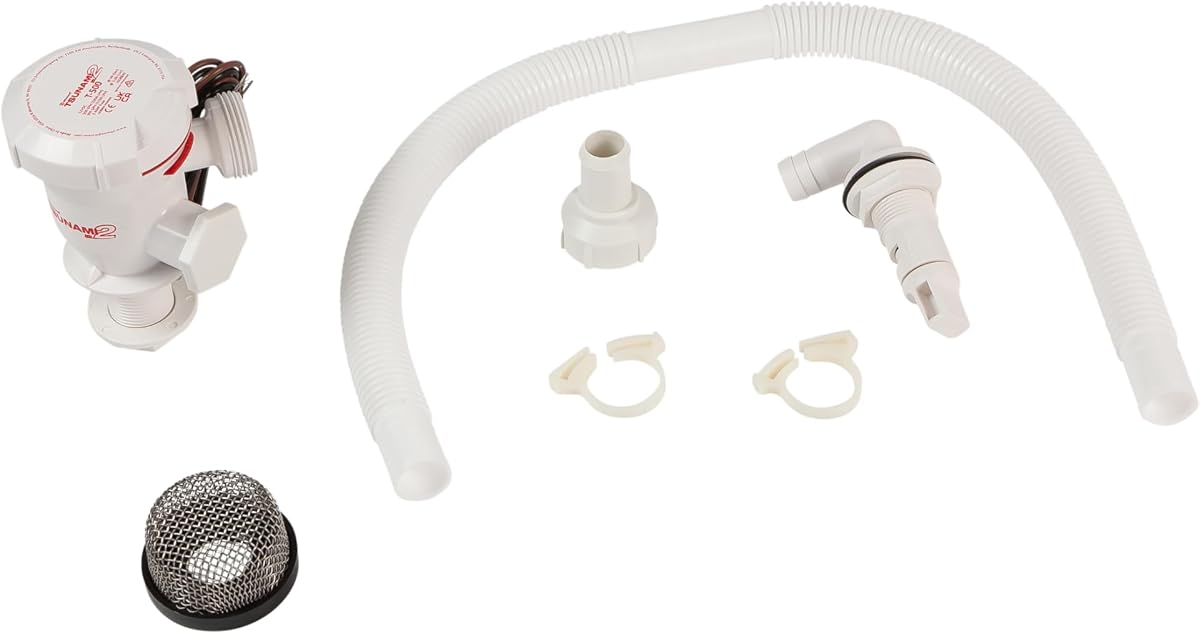
The Attwood 5253-4 Tsunami Mk2 Livewell Kit combines a 500 GPH aerator pump with the hardware needed to distribute water in a tank. Its 4.3 rating is the lowest among these ten products, so it requires careful comparison, but the comprehensive package and recirculating design remain meaningful strengths.
We may earn a commission when you buy through this link, at no additional cost to you.
Included components include plastic hose clamps, a three-quarter-inch by 23-inch length of poly hose, a straight thread-to-barb connector, an aerator spray head, and a stainless steel strainer. Together, these create a more complete installation than a bare pump. The system recirculates livewell water to keep it cooler and richer in oxygen and can operate while the boat is underway without requiring a through-hull connection.
The stated installation approach avoids the need for sealant and tools, and compatibility with earlier Tsunami models may be helpful for owners replacing related equipment. However, 500 GPH is less output than the 800 GPH pumps, and the kit's lower rating may reflect differences in customer satisfaction, packaging, or the particular experience of individual installations.
This kit is best for an owner who wants a recognizable aeration package and values a self-contained recirculating setup. It is less compelling for a very large livewell that requires more circulation. Confirming the tank size, available space, and required fittings before buying will help ensure that the included components suit the installation.
The kit includes the spray head, strainer, hose, connector, and clamps needed to create a basic recirculating arrangement. Matching the included parts can reduce compatibility concerns, though the final mounting arrangement still needs to be designed around the boat.
The self-contained recirculation approach can maintain aeration and cooling while underway. It is especially useful for boats that cannot rely on a continuous through-hull intake, provided the spray head is positioned to distribute water effectively.
We may earn a commission when you buy through this link, at no additional cost to you.
The Amarine Made 800 GPH livewell pump is a high-capacity, angled pump with a 4.4 customer rating. It combines a fully submersible design, an easily removed motor cartridge, and a 90-degree threaded intake, making it relevant for anglers building a permanent high-flow system in a constrained space.
We may earn a commission when you buy through this link, at no additional cost to you.
The listed 4.0-amp current draw provides a clearer electrical reference than many competing descriptions, while the high-impact plastic housing and corrosion-resistant stainless steel shaft are intended for prolonged fresh or salt water exposure. Internal anti-airlock fins support consistent flow, and water-cooled motor construction, ignition protection, moisture-tight seals, and quiet operation strengthen its case as a permanent livewell component.
The straight and 90-degree outlet hose tail configurations provide installation flexibility, while the extra-length 125-millimeter angled intake can help route water through a thicker transom. The product information does not clearly state whether both outlet tails are physically included, nor does it provide a detailed maximum-head value. Those points should be confirmed before purchase to avoid unexpected modifications.
This pump is a good fit for a boat with a compact livewell compartment and a need for 800 GPH circulation. Its 4.4 rating remains respectable within the category, and the cartridge design supports routine service. Buyers should compare the electrical load, head capability, outlet hardware, warranty terms, and dimensional details with the leading options before making a final choice.
The 90-degree threaded intake changes the direction of the water path, which can be advantageous in tight compartments or near a transom. The longer intake section may also help route the pump through a thicker hull, subject to the boat's available space.
Water-cooled motor design, ignition protection, moisture-tight sealing, and a corrosion-resistant shaft all support continuous marine use. Routine cartridge removal allows the internal pump area to be inspected and cleaned without taking apart the entire livewell installation.
We may earn a commission when you buy through this link, at no additional cost to you.
The right aeration pump depends on tank volume, water-source layout, available electrical capacity, and the degree of circulation required. Comparing flow ratings alone is not enough, because hose length, lift height, mounting constraints, and service access can have an equally large effect on real-world performance.
Recirculating water pumps move existing livewell water through a spray head, while airline systems add oxygen directly through bubbles. Recirculating pumps also support cooling and water movement, whereas a dedicated bubbler is primarily concerned with dissolved oxygen. Match the method to the problem: use a recirculating design when bait needs both movement and aeration, and consider airline aeration when low electrical demand and compact tank oxygenation are the main priorities.
An 800 GPH pump offers greater circulation capacity than a 350 or 500 GPH unit, making it better suited to larger livewells, more fish, or demanding warm-weather conditions. Flow is only one part of the equation. Maximum head indicates how effectively the pump can move water vertically, and actual performance will be affected by hose length, bends, fittings, intake restrictions, and the height difference between the source and outlet.
Most livewell pumps in this guide operate on 12-volt DC marine systems, with listed current draws ranging from a very low 0.46 amps for the B-15 bubbler to several amps for high-flow circulation pumps. Compare rated and maximum current with the boat's available circuit and fuse. Continuous aeration increases battery consumption, so a low-draw system can be valuable on long fishing days, while a high-flow pump may require a stronger power source.
A livewell pump repeatedly encounters water, salt, heat, and organic debris. Look for corrosion-resistant shafts, marine-grade wiring, moisture-tight seals, and housing materials intended for both fresh and salt water. A stainless steel strainer is also useful in the intake path because it helps reduce the chance that a small obstruction will damage the impeller. Material claims should be evaluated together because no single component determines overall marine durability.
A removable motor cartridge is one of the most useful maintenance features in this category. It allows the impeller area to be cleaned or the motor replaced without dismantling the entire hose and outlet assembly. Push-button or one-handed release systems improve access further, especially in tight compartments. Check whether the design is genuinely serviceable in the intended installation and consider how often debris, slime, and fishing residue will need to be removed.
Angled pumps can fit around a transom or inside a narrow compartment where a straight model would create awkward hose alignment. Straight-intake pumps may offer simpler routing in other layouts. Portable suction-cup systems are useful for temporary setups, while permanent fixed pumps require stable brackets and secure hose connections. Measure the available space and inspect the pump in both its intended position and the positions it may occupy during maintenance.
The intake must be protected against leaves, bait fragments, and other debris, but excessive restriction reduces flow. A suitable intake screen or strainer balances protection with water movement. Airline systems also need correctly weighted air stones and anti-siphon valves to help prevent water from entering the air line. Inspect these components regularly, especially after rough transport or extended periods of use.
A bare pump gives experienced installers more freedom, while a kit can be more convenient for a new build. Included hoses, spray heads, strainers, connectors, clamps, and mounting hardware can simplify assembly, but every item should be checked for proper sizing. Also confirm outlet thread standards, electrical connector style, intake orientation, and backwards compatibility before assuming the product will work with an existing livewell system.
Begin by planning the complete water and electrical paths before mounting the pump. Position the intake where it can draw clean water without repeatedly collecting weeds or debris, route the outlet toward the intended spray head, and confirm that the pump remains fully submerged. Secure hoses with appropriate clamps and avoid sharp bends that could restrict flow or stress the connections. On the electrical side, use a correctly rated 12-volt circuit, appropriate fuse, and sound marine-grade wiring.
Run the system with the livewell open and observe it for several minutes. Listen for unusual vibration, inspect every connection for leakage, and confirm that water is moving where intended. Adjust the spray head or airline stones so the flow distributes oxygen through the tank without excessive splashing. If using airline aeration, listen for continuous bubbling and check that the anti-siphon valves and weighted stones remain in position. A brief test before departure can reveal a loose fitting or obstructed line while there is still time to fix it.
During use, keep an eye on battery condition and water temperature, especially with larger catches or extended periods of stationary fishing. After the trip, disconnect the electrical supply before opening the plumbing. Remove the motor cartridge or airline components as directed, rinse away debris with fresh water, and inspect the impeller or air stones for blockage. Allow parts to dry before storage, check seals and hoses for wear, and reinstall everything securely before the next outing.
Not always. A higher-rated pump can move more water and may suit a larger livewell, more bait, or a higher outlet, but actual performance also depends on lift height, hose length, fittings, and restrictions. A 500 GPH pump may be sufficient for a small tank, while a dedicated airline system may meet oxygenation needs without circulating the entire volume of water.
Most products in this roundup operate on 12-volt DC, which is standard for many boat electrical systems. Verify the product's nominal and maximum current draw, use a properly sized fuse, and make sure the circuit and wiring can support continuous operation. Never assume every motor, connector, or accessory is interchangeable across different electrical systems.
Yes, if the pump is fully submerged and the plumbing remains secure. A self-contained recirculating kit can move water from the tank back into the spray head without depending on a through-hull intake. This is valuable offshore or when external water access is unavailable, but the spray head should be adjusted to provide good distribution without excessive spray.
Inspect it before and after each trip, with more frequent checks when fishing in weedy, shallow, or debris-filled water. Remove the cartridge according to the manufacturer's directions, rinse away residue, and clear the impeller and strainer. Cleaning after every use is not always necessary, but a blocked intake or impeller can quickly reduce flow and increase electrical draw.
A recirculating pump moves water through the livewell and often through a spray head, supporting aeration, circulation, and cooling at the same time. An airline aerator injects air into the water through tubing and a stone, focusing on dissolved oxygen with very low electrical demand. The better choice depends on whether water movement, cooling, and circulation are as important as oxygenation.
Most of the listed products are specifically described for freshwater and saltwater use, but installation and maintenance still matter. Salt accelerates corrosion and leaves mineral deposits on components, so the pump should be rinsed with fresh water after use. Inspect the shaft, seals, wiring, and fittings regularly, and replace degraded parts promptly.
A properly selected strainer or guarded intake is highly recommended because leaves, small bait, and fishing debris can damage or obstruct the impeller. The screen must be fine enough to protect the pump but open enough to avoid restricting flow. Airline systems do not use the same type of intake screen, but they still need secure, correctly weighted air stones and anti-siphon protection.
Common signs include weaker water movement, reduced bubbling, increased vibration, unusual noise, a rising current draw, or visible leakage. Check the electrical connection, hose restrictions, intake screen, impeller, spray head, and airline tubing before replacing the entire unit. A removable cartridge makes this inspection much easier and is one of the main reasons to favor serviceable designs.
The SEAFLO 05 Series leads the roundup for its 800 GPH output, angled space-saving design, anti-airlock construction, and quick-release motor cartridge. The Attwood Tsunami MK2 offers a more compact and value-oriented route with 500 GPH output, flexible outlet choices, and simple service access, while the B-15 Marine Metal system stands apart as a dedicated, low-draw oxygenation solution for bait buckets and paired compact tanks.
For a permanent, high-volume livewell installation, prioritize adequate flow, vertical lift, corrosion protection, and a removable motor. For a portable or entry-level setup, look for a compact suction-cup arrangement and easy electrical connection. If oxygen is the primary concern rather than broad water movement, an airline system can provide effective support with minimal battery consumption, but it should be viewed as a complement to, rather than a replacement for, a well-designed water-exchange plan.
Before ordering, compare the current product specifications with the boat's tank size, available power, plumbing dimensions, and mounting space. Also check the included fittings, warranty coverage, and return terms because these details can change. Prices and availability also move over time, so confirming the latest listing and total system requirements is the best way to select a livewell aeration setup that fits the boat.