
BEHRINGER C-2
4.6Editor score
Matched cardioid condenser pair
Switchable roll-off and attenuation
Designed for studio and live use
Matched pair microphones guide comparing ten stereo mic sets for drums, choirs, guitars, piano, ensembles, live recording, and field recording.
Matched pair microphones are engineered to capture a source with closely related sensitivity and tonal behavior, making them especially useful for stereo recording. The right pair can give drum overheads, choirs, acoustic guitars, pianos, and ensembles a stable, centered image while reducing the need for correction during mixing.
This guide compares ten matched stereo microphone sets based on the supplied specifications, included accessories, polar patterns, self-noise, maximum SPL, frequency response, and practical applications. It covers everything from a compact budget pair with onboard controls to premium condenser packages supplied with bars, clips, windscreens, cases, and individual response measurements.
Each review explains the most useful features, likely strengths, and practical limitations so the right microphone pair can be selected for a particular room and source. Ratings and product configurations can change over time, so shoppers should confirm the latest listing and included accessories before purchasing.
4.6Editor score
4.9Editor score

4.4Editor score
This side-by-side comparison highlights the included equipment, microphone construction, application focus, and practical controls available across ten matched pair microphone options.




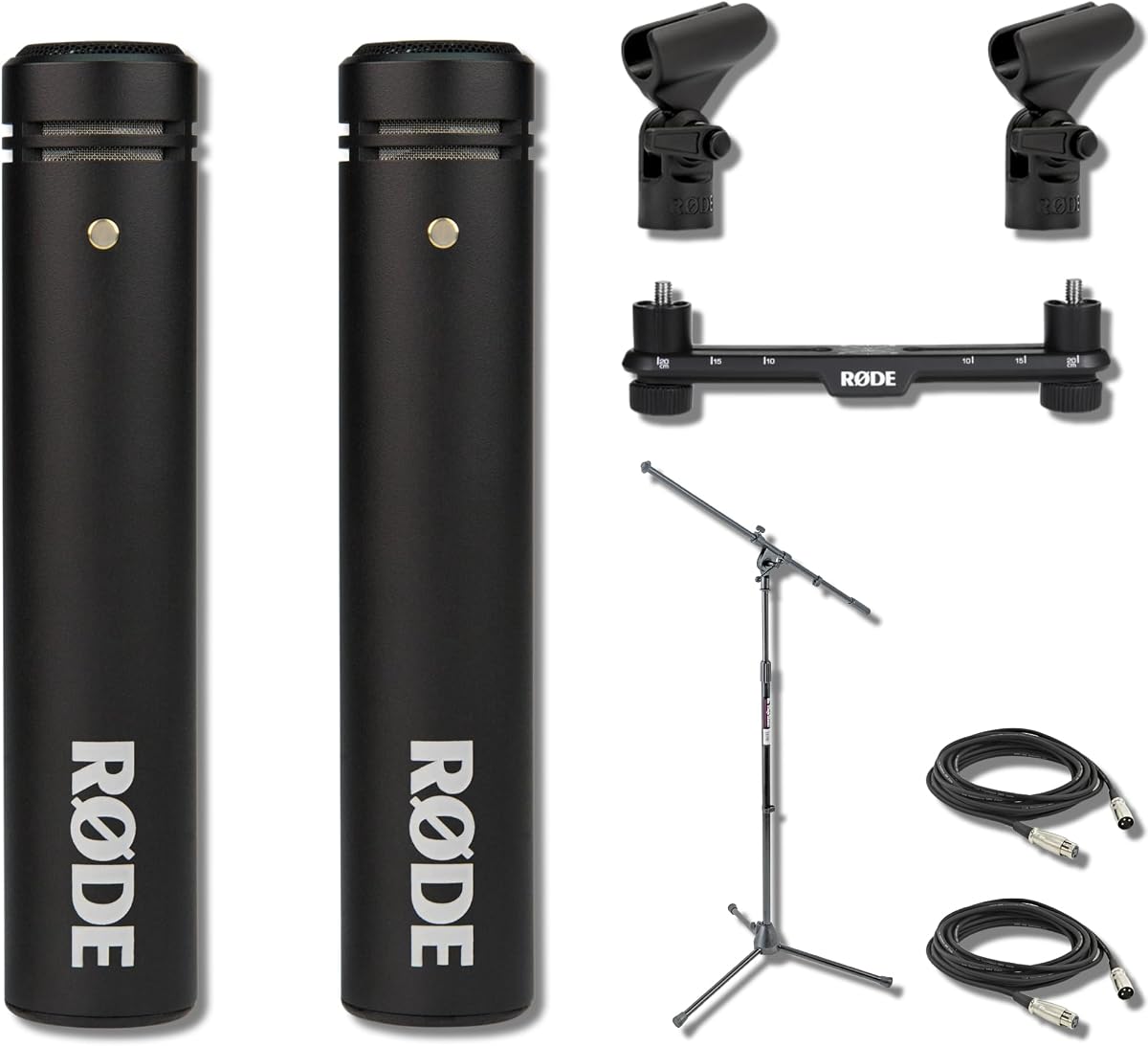
The Rode M5-MP Complete Stereo Recording Bundle combines two factory-matched small-diaphragm condensers with nearly every accessory needed to establish a working stereo setup. Its 4.9 rating reflects a particularly attractive balance of capsule performance, matching accuracy, and included equipment. Two M5 microphones, an SB20 stereo bar, a heavy-duty tripod boom stand, two long XLR cables, windshields, and stand mounts make this a strong choice for a recorder who wants to begin recording with minimal additional shopping.
We may earn a commission when you buy through this link, at no additional cost to you.
Each microphone uses a half-inch true condenser capsule and is factory selected to remain within 1 dB of its partner in sensitivity. The stated 20 Hz to 20 kHz response covers a broad musical range, while 19 dB-A self-noise is appropriate for quiet rooms, detailed acoustic instruments, and distant ensemble capture. The cardioid pattern, consistent phase behavior, and 140 dB SPL capability make the pair versatile enough to move between drum overheads, choirs, orchestra, and acoustic guitar positions.
The main trade-off is the bundle's physical scope. Some users may already own a sturdy stand, XLR cables, shock mounts, and a stereo bar, making the extra accessories less useful to them. The microphones also require standard 48-volt phantom power, so an interface, mixer, or preamp with XLR inputs and appropriate power is necessary. Even so, the complete set offers excellent convenience without sacrificing the central benefits of matched small-diaphragm condensers.
This package is best for home-studio owners, project recording engineers, and live sound teams that need one coordinated purchase for stereo recording. It is especially compelling for drum overheads because the SB20 provides repeatable spacing and mounting. Buyers who need only a bare matched pair may find a less elaborate option better suited to their existing setup, but for value across microphones and accessories, this is the most complete choice in the list.
Matching the two microphones within 1 dB helps the left and right channels behave more like a consistent pair. That control is valuable on XY and ORTF arrays, where small sensitivity differences can shift the apparent center of a sound or make one side appear louder.
The SB20 bar, boom stand, two 20-foot XLR cables, WS5 windshields, and RM5 mounts remove much of the setup friction associated with assembling a matched pair. The result is a practical package for someone building a first stereo recording rig or replacing several accessories at once.
We may earn a commission when you buy through this link, at no additional cost to you.
This Rode M5-MP package is a focused alternative to the more comprehensive bundle, pairing two M5 condensers with the SB20 stereo bar. Its 5.0 rating reflects an exceptionally well-specified option for drum overheads, choir capture, piano, and acoustic guitar. The microphones are factory selected within 1 dB, and the included bar makes repeatable XY or ORTF positioning straightforward.
We may earn a commission when you buy through this link, at no additional cost to you.
The half-inch gold-sputtered diaphragm platform is described as the same platform used in the NT5 family. With a cardioid pattern and 20 Hz to 20 kHz response, the pair can provide a broad view of cymbals, strings, voices, and other acoustic sources. A self-noise figure of 19 dB-A and a 140 dB maximum SPL provide ample headroom for both delicate rooms and louder instruments, although actual results will depend on placement and the rest of the signal chain.
The SB20 is compact but carefully organized. Its top surface identifies ORTF and XY angles, and its dimensions and mounting threads allow it to fit common stands. The drawback is that this package does not include a stand or XLR cables, so users need to account for those items separately. The bar also determines how closely and at what angle the microphones can be mounted, which means the pair is less flexible than a widely spaced setup using separate stands.
This is a strong recommendation for a recorder who already owns suitable stands and cables but wants a matched, precisely mounted stereo array. It is especially useful for a drummer or ensemble requiring repeatable overhead placement. The complete M5-MP bundle is better for someone starting from scratch, while this version concentrates the budget on the microphones and their stereo bar.
The SB20 identifies XY and ORTF positions directly on its surface, helping users mount the two microphones at consistent angles. Repeatable geometry is especially helpful when comparing takes or recreating an established drum-overhead setup.
The stated 19 dB-A self-noise makes the pair suitable for detailed acoustic work and quiet ensemble recordings. It can also handle louder percussive sources, with 140 dB maximum SPL giving the capsules substantial dynamic-range potential.
We may earn a commission when you buy through this link, at no additional cost to you.
The Rode NT5 matched pair is a premium small-diaphragm condenser option built for critical recording work. Its 4.3 rating comes from owners who recognize the established NT5 platform, while the included specifications emphasize a gold-sputtered half-inch capsule, very low self-noise, accurate cardioid behavior, and broad frequency response. This pair is aimed at users who already understand the value of quality matched condensers.
We may earn a commission when you buy through this link, at no additional cost to you.
The microphones share the same fundamental design language as the M5 models featured higher in the list, but the NT5 listing highlights a premium matched-pair proposition and a 10-year warranty. The cardioid pattern gives each microphone a defined front focus, which is useful for room capture, acoustic instruments, percussion, and ensembles. A wide response allows the pair to capture both fundamental body and upper-frequency detail rather than restricting it to one narrow application.
Compared with the more elaborate M5 packages, the NT5 product data does not mention a stereo bar, mounting clips, cables, or a case. Those omissions are not a flaw in the microphones themselves, but they make the total setup less convenient. Users wanting simple overhead placement will need to choose a suitable bar, stands, and cables, while those who already own the equipment may appreciate the focus on the microphone pair.
The NT5 matched pair is best for experienced studio owners, project engineers, and serious musicians who want a renowned premium condenser architecture and long-term warranty coverage. It is a sensible choice when microphone quality is the priority and the recording rig is already in place. For a ready-to-position package, the Rode M5 bundles offer more integrated support.
The NT5 package centers on the matched microphones rather than a broad collection of accessories. That makes it a natural fit for established studios where shared bars, stands, cables, and cases are already available.
The listed cardioid pattern is well suited to directional stereo work, where each microphone faces a defined area of a kit, stage, or ensemble. Its emphasis on accuracy and low noise makes it relevant to critical acoustic and percussion recording.
We may earn a commission when you buy through this link, at no additional cost to you.
The BEHRINGER C-2 is a straightforward matched pair of small condenser microphones for stereo studio recording and live applications. Its 4.6 rating makes it one of the most appealing choices for budget-conscious buyers who still want two microphones, directional pickup, and practical controls. Each microphone can serve as a main or support position, providing flexibility across recording and reinforcement tasks.
We may earn a commission when you buy through this link, at no additional cost to you.
A cardioid pattern is the core design feature, helping the pair focus on sound in front of each microphone and making it more practical in live settings. The low-mass diaphragm is listed for an ultra-wide frequency response and faithful reproduction. Each microphone also offers a switchable low-frequency roll-off and input attenuation, allowing a user to address rumble, proximity buildup, and high-level sources without replacing the pair.
The listing provides less technical depth than some premium products. It does not state a precise self-noise figure, maximum SPL, matching tolerance, or included accessories, and no stereo bar appears in the supplied information. Buyers who need the microphones for spaced-pair techniques can still use separate stands, but the absence of a dedicated bar makes precise side-by-side setup a matter of positioning the two mounts carefully.
The C-2 is a strong recommendation for musicians beginning to build a stereo recording system, rehearsal rooms, podcast or demonstration setups, and live performers who need a matched backup pair. It offers more utility than a single microphone because both units can be deployed at once. Users prioritizing highly detailed specifications and factory-documented matching should move up to the Rode, sE, Lewitt, or beyerdynamic options.
Switchable low-frequency roll-off and input attenuation make the C-2 adaptable to different sources. These controls are particularly handy around drums, close-placed acoustic instruments, and live stages where rumble or high transient levels need attention.
The cardioid pattern helps each microphone prioritize the source in front of it, which supports both focused stereo recording and live use. Two cardioid microphones also offer options for a main-and-support arrangement rather than a single stereo array alone.
We may earn a commission when you buy through this link, at no additional cost to you.
The SE Electronics sE7 factory-matched pair offers a transparent specification-driven alternative in the small-diaphragm condenser category. Its 4.5 rating reflects a well-regarded stereo set with a 20 Hz to 20 kHz response, 19 mV/Pa sensitivity, and an impedance below 200 ohms. The pair is well suited to acoustic guitar, piano, percussion, room capture, and other applications where two consistently behaving microphones are needed.
We may earn a commission when you buy through this link, at no additional cost to you.
The listing states that the sE7 uses 48-volt power, making it compatible with the conventional phantom-powered XLR equipment commonly found in studios and live rigs. Its maximum SPL is listed as 136/156 dB SPL, indicating headroom for louder sources as well as quieter acoustic work. A pair of clips is included, which helps secure the pencil microphones to compatible stands or accessories.
This package offers fewer visible extras than the sE7 bundle ranked sixth. There is no mention of a stereo bar, XLR cables, pop filters, or fastening straps in the supplied product information. A recorder creating an overhead array will therefore need to plan the mounting geometry separately. It is also important for the user to verify exactly which clip arrangement suits the available stand, since the clip's fit cannot be confirmed from the listing alone.
The standard sE7 pair is a good choice for a studio that wants detailed electrical specifications and a factory-matched cardioid condenser pair without a large accessory package. It works particularly well for guitarists, pianists, and percussion recordists who already maintain their own cables and supports. Shoppers seeking the same microphones with a more extensive bundle should examine the sE7 accessory package instead.
Sensitivity and impedance figures help users anticipate how the microphones will behave with their preamps and cables. The 19 mV/Pa sensitivity is a useful reference when evaluating gain requirements in a studio or live console.
The listed 20 Hz to 20 kHz range gives the pair broad coverage for both low-frequency body and detailed high-frequency content. That makes the microphones relevant to acoustic instruments, percussion, ensembles, and room-based capture.
We may earn a commission when you buy through this link, at no additional cost to you.
The sE7 Stereo Recording Bundle combines matched small-diaphragm condensers with a substantial collection of practical accessories. Its 5.0 rating makes it one of the strongest customer-rated options in the guide. The microphones are aimed at overheads, pianos, and other stereo applications, while the package adds two 20-foot XLR cables, two pop filters, and a set of touch fastener straps.
We may earn a commission when you buy through this link, at no additional cost to you.
The technical centerpiece is the matched stereo pair, with a cardioid pattern, transformerless circuitry, a selectable 20 dB pad, and a selectable low-cut filter at 80 Hz. The pad is a useful safeguard when a loud source produces peaks, while the filter can reduce low-frequency rumble or unwanted buildup. Transformerless circuitry makes the package attractive to users who want a modern, streamlined condenser signal path.
The large number of touch fastener straps is a minor practical consideration. They can be useful for organizing or securing cables and accessories, but a buyer who has no need for them may find the quantity excessive. More importantly, the supplied information does not mention a stereo bar. Overhead users will still need a dependable way to maintain spacing and angle, especially if they want a repeatable XY or ORTF geometry.
This bundle is a strong recommendation for home studios and project rooms that need more than a basic microphone pair. The inclusion of cables and pop filters reduces immediate setup work, and the high customer rating supports confidence in the package. It is particularly appealing for guitarists, pianists, and drummers who want a versatile pair with useful source controls, provided they add an appropriate mounting bar or stand arrangement.
The 20 dB pad gives the microphones more room when a loud acoustic source creates strong transients. The 80 Hz low-cut provides a separate method for reducing rumble and excessive low-frequency energy without replacing the pair.
Two 20-foot XLR cables and two pop filters make the bundle more immediately useful in a home studio. The accessories do not provide a complete overhead array by themselves, but they cover two important connection and vocal-protection needs.
We may earn a commission when you buy through this link, at no additional cost to you.
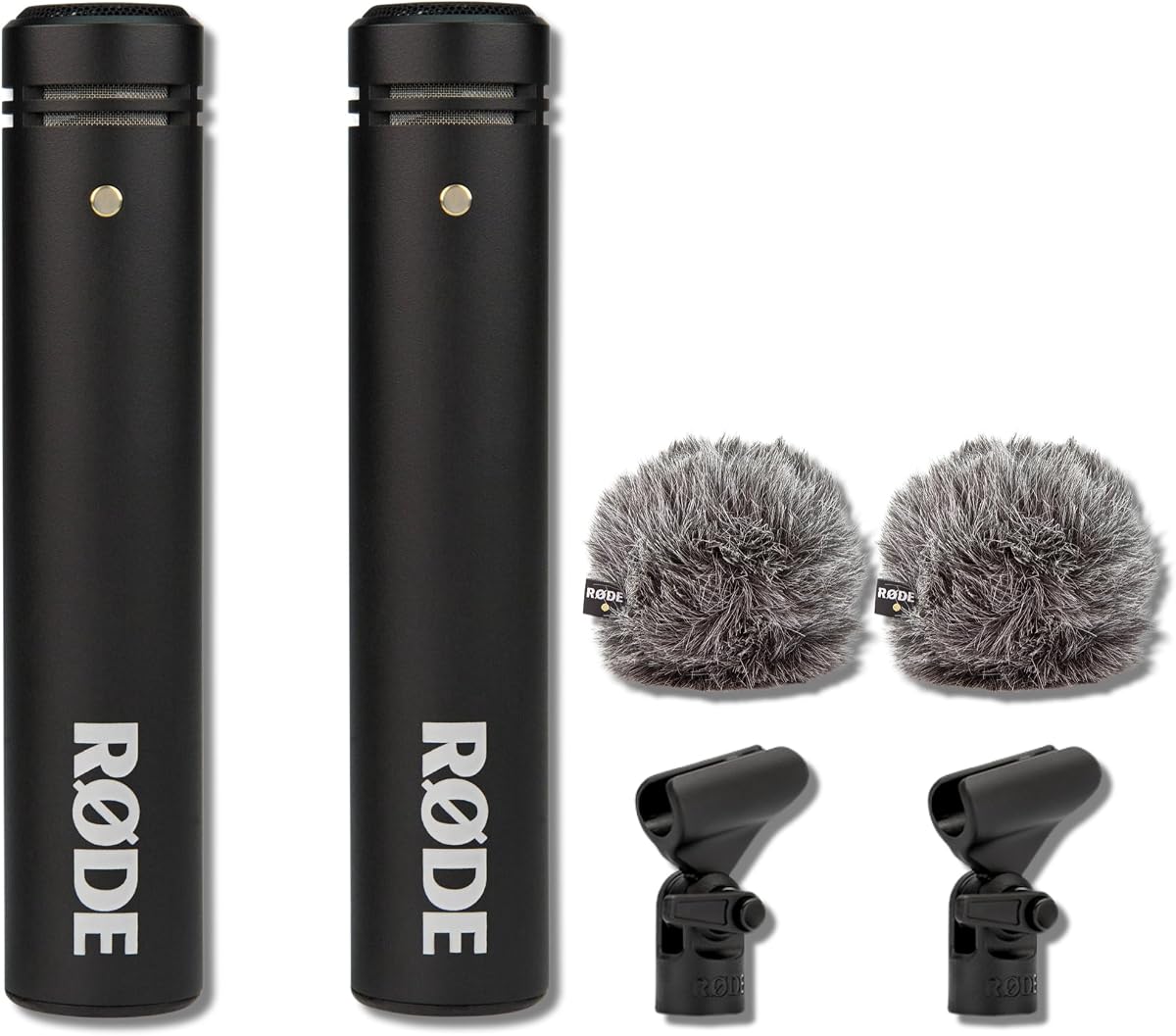
The Rode M5 matched pair with two WS8 windshields is designed for stereo users who may record indoors but also need protection in exposed locations. Its 5.0 rating is among the strongest in this comparison. The set combines two factory-matched half-inch gold-sputtered condenser microphones with 19 dB-A self-noise, 140 dB maximum SPL, and two dual-layer WS8 windshields.
We may earn a commission when you buy through this link, at no additional cost to you.
The factory matching within 1 dB supports a balanced stereo center, which is particularly helpful in XY, ORTF, and spaced configurations. The low self-noise figure suits quieter acoustic work, while the maximum SPL allows the microphones to accommodate loud cymbals, snares, and other percussive events. Together, those characteristics make the pair versatile across drum overheads, choirs, acoustic guitar, orchestral sections, and location recording.
The WS8 is the bundle's defining feature. Each windscreen combines an outer faux-fur layer with open-cell foam and a molded rubber base that seals behind the capsule. This layered construction addresses both turbulent airflow and residual noise more thoroughly than a basic foam cover. At 0.63 ounces each, the shields add little weight to a stereo bar. Nevertheless, the package does not list a bar, stand, or cables, so it is not as ready for immediate mounting as the complete M5-MP bundle.
This set is best for location recordists, mobile ensembles, church teams working in unpredictable environments, and drummers who want robust overhead protection. Its 5.0 rating and precise matching make it an especially attractive M5 configuration. Users already equipped with a good bar and field cables can focus on the microphones and wind protection rather than purchasing a larger accessory system.
The WS8 combines faux fur, open-cell foam, and a sealed rubber base to reduce the chance of wind disturbing the microphones. That design is particularly relevant to outdoor ensembles and location recording in exposed spaces.
A one-decibel sensitivity tolerance helps the left and right channels present a more even stereo image. The benefit becomes more noticeable when the microphones are mounted close together or used in a precisely defined array.
We may earn a commission when you buy through this link, at no additional cost to you.
The SE Electronics sE8 matched pair is a premium small-diaphragm condenser system for critical acoustic, percussion, studio, and live work. Its 4.4 rating is supported by a feature set that includes handcrafted gold-sputtered capsules, ultra-low-noise Class-A circuitry, an all-metal chassis, switchable pads, and low-cut filters. The bundle also provides a mounting bar, windscreens, clips, and a carrying case.
We may earn a commission when you buy through this link, at no additional cost to you.
The three-micron gold-sputtered diaphragm and sophisticated backplate are designed to provide natural, balanced sound and reliable off-axis performance. A matched pair helps ensure that both channels behave consistently, while the capsule and electronics are aimed at preserving detail without distortion. The pair can be used for acoustic instruments, percussion, or detailed ensemble work, where low noise and controlled response are valuable.
The two switchable pads and low-cut filters let users adapt the microphones to different source levels and placement conditions. They are especially useful around drums, where broad high-frequency content and mechanical vibration can challenge a microphone setup. The sE8's interchangeable capsule concept also extends its flexibility, although the optional Omni, Supercardioid, and measurement-style capsules are not included with the base matched pair.
This is the premium recommendation for a serious recording engineer or musician who values capsule construction, low noise, durable housings, and a complete accessory package. The included bar and case improve convenience, while the measured-response approach adds confidence for critical work. A less elaborate solution may suit a home studio, but the sE8 pair is well aligned with professional acoustic and percussion recording priorities.
The ultra-low-noise Class-A electronics are intended to capture subtle detail while limiting unwanted noise. This makes the pair relevant to quiet acoustic instruments, ensembles, and controlled studio sessions where the microphone's own noise floor matters.
The mounting bar, windscreens, clips, and carrying case make the package easier to deploy and protect. It is a meaningful convenience over buying only two premium microphones and arranging the supporting hardware separately.
We may earn a commission when you buy through this link, at no additional cost to you.
The Lewitt LCT-140-AIR is a matched stereo pair distinguished by two switchable sound characteristics: AIR and FLAT. Its 4.6 rating makes it a compelling option for users who want to shape the microphones during a session without choosing between entirely separate microphone models. The set also includes two snap-in clips, a transport bag with separate pockets, and two windscreens.
We may earn a commission when you buy through this link, at no additional cost to you.
Both small-diaphragm condensers are built around excellent transient response and a lightweight CNC-machined aluminum housing. The AIR and FLAT settings provide tonal flexibility across instruments, and the durable body design makes frequent repositioning straightforward. That combination is useful for a drummer comparing overhead textures, an acoustic guitarist evaluating brightness, or a recordist moving the same pair between two different sources.
One limitation is that the supplied information does not state a numerical factory-matching tolerance. The product is clearly sold as a matched stereo pair, but buyers who require a documented sensitivity figure may want to compare that information with the Rode and sE8 alternatives. A dedicated stereo bar is also not mentioned, so precise array positioning must be arranged with separate mounts or another compatible bar.
The LCT-140-AIR is best for a mobile recordist or studio that values compact construction, quick tonal changes, and a useful set of included accessories. The AIR mode can add presence when a source needs lift, while FLAT offers a more neutral starting point. It is a flexible premium-leaning choice for acoustic instruments, percussion, and detailed room capture.
The AIR and FLAT modes give the user a practical way to change the character of the pair during a session. That flexibility can shorten experimentation when one source calls for more presence and another benefits from a neutral starting point.
The CNC-machined aluminum housings are described as both durable and lightweight, while snap-in clips simplify attachment to suitable mounts. The two-pocket transport bag also helps keep the matched microphones and accessories organized between sessions.
We may earn a commission when you buy through this link, at no additional cost to you.
The beyerdynamic MC 930 Stereo Set is a true-condenser, small-diaphragm pair for detailed studio and live recording. No customer rating is supplied for this listing, so it does not carry the same rating-based track record as the other products in the guide. Its strongest qualifications come from the technical description: cardioid capsules, a switchable minus-15 dB pad, a 250 Hz low-cut filter, 30 mV/Pa sensitivity, and individually measured microphones.
We may earn a commission when you buy through this link, at no additional cost to you.
The pair is positioned for guitars, piano, drum overheads, choirs, vocals, and orchestras. Its largely linear frequency response and strong transient performance are intended to preserve fast attacks and subtle detail. High sensitivity can reduce the amount of preamp gain required, potentially improving noise performance and leaving more headroom in the rest of the signal chain.
The switchable pad and low-cut filter provide useful control for loud or close sources. The pad protects against demanding transients, while the filter helps reduce impact noise, proximity buildup, and unwanted low-end energy. The microphones are handmade in Germany using in-house capsule components, and each one is individually measured and supplied with its frequency-response curve, adding a level of documentation that can appeal to critical users.
The MC 930 Stereo Set is a strong option for a professional studio that values precision, documentation, and transparent condenser performance. Its lack of a listed customer rating is the main reason it is not presented as a rating-led recommendation, and buyers should check the current listing for available accessories such as a bar or case. The microphones themselves are clearly aimed at high-resolution acoustic and ensemble work.
Each microphone is individually measured and supplied with its frequency-response curve. That documentation can help engineers establish baselines, compare units, and make more informed decisions in critical recording environments.
The minus-15 dB pad creates additional headroom for high-level transients, while the 250 Hz low-cut helps control rumble and proximity buildup. Together, they make the pair adaptable to demanding close placements and amplified environments.
We may earn a commission when you buy through this link, at no additional cost to you.
The most useful matched pair is one whose response, sensitivity, pattern, controls, and mounting options fit the intended source and recording environment. Reviewing those factors before buying helps prevent an otherwise capable pair from being placed in a position that does not suit its design.
Choose a pair that explicitly addresses your primary source rather than relying on broad marketing language. Drum and ensemble applications may justify a higher maximum SPL, while quiet studio work places more importance on self-noise and low-level detail.
For close XY or ORTF arrays, documented matching is especially useful. For widely spaced microphones, room acoustics and source differences may have a greater effect than the small sensitivity variation between units.
Cardioid is the most common pattern across this list, but placement still determines its real-world effect. Position each microphone carefully, keep its rear aimed away from unwanted sources, and listen for changes caused by nearby reflective surfaces.
Match the microphone's dynamic range to the source. Quiet detail calls for low noise, while loud transients call for sufficient maximum SPL and an appropriate pad setting.
Choose built-in controls when they correspond to common problems in your recording space. They are convenient, but they should complement rather than replace good placement and gain management.
Inventory the hardware already owned before choosing. A bare pair offers more flexibility, while a coordinated bundle is usually more convenient for a new or incomplete setup.
Check the room first. If a microphone can be positioned close to the source in a controlled space, an elaborate outdoor bundle may offer little practical advantage.
Build the signal chain before placing the microphones. Confirm power, cable routing, gain staging, recording format, and available channels so the pair can operate without preventable interruptions.
Begin with the recording environment, not the microphone placement. Reduce unnecessary vibration, turn off noisy equipment when possible, and position the stand so the capsules are not directly exposed to air-conditioning vents. For stereo work, choose an arrangement such as XY, ORTF, or spaced pair based on the desired image, then maintain identical height, angle, and distance for the two microphones wherever the application calls for symmetry.
Connect each microphone to the correct balanced XLR input, apply the required phantom power, and set the preamp gain conservatively before introducing the loudest expected source. Listen in both mono and stereo, because a centered source should remain stable when summed, and a properly matched pair should produce a natural left-right image. Use the pad and low-cut controls only after listening to determine what the source and room actually require.
For care, treat the pencil bodies as precision tools rather than handles. Keep them away from severe impact, moisture, excessive heat, and strong magnetic fields, and avoid leaving them in direct sunlight inside a hot vehicle. Windshields should be kept clean and dry, cables should be coiled without tight kinks, and the microphones should be stored in a padded case. When comparing pairs or changing positions, label each microphone and preserve the left-right orientation so its matched relationship remains clear.
Matched microphones are selected and tested to have closely related sensitivity and response characteristics. That consistency helps a stereo image remain balanced, particularly when the units are mounted close together. Unmatched microphones may still create a usable stereo recording, but their output differences can require more correction or make the center image less stable.
No. A matched pair is most useful when the goal is simultaneous stereo capture or a coordinated main-and-support setup. A single microphone may be better for a focused mono source, a mobile location session where space is limited, or a recording that requires one flexible point of view. The pair's value comes from how its matching, pattern, and accessories fit the application.
The condenser pairs featured in this guide are designed for conventional phantom-powered systems, with the M5 and sE7 information specifically identifying 48-volt requirements. Confirm the manufacturer's requirements before connecting a pair, and make sure the preamp supplies phantom power only to the intended XLR inputs.
The Rode M5-MP packages are especially relevant because they combine matched half-inch condensers with an SB20 stereo bar, while the M5 specification includes 140 dB maximum SPL. The sE7, sE8, Lewitt, and beyerdynamic options also offer useful features for percussion. The best choice still depends on room size, desired image, existing accessories, and how much output headroom the recording chain provides.
In an XY arrangement, the microphone capsules point outward while their bodies are mounted close together, creating a strongly focused stereo image. ORTF places the microphones farther apart and angles them inward, usually producing a more open spatial impression. The Rode SB20 bars in the featured bundles mark both geometries to simplify repeatable setup.
A stereo bar is not strictly required, but it makes close and repeatable placement much easier. Separate stands allow wider spacing and independent movement, while a bar keeps the microphones at a defined distance and angle. Choose the mounting method based on the desired image and the amount of symmetry the recording requires.
Use a properly fitted windscreen, move the microphones away from direct airflow, and place them so their rear sections are not exposed to moving air. The M5 bundle with two WS8 shields is designed for exposed recording because each model combines faux fur, open-cell foam, and a sealed base. Even with protection, placement and shock isolation remain important.
Compare them primarily when recording quiet sources in a controlled environment, since lower self-noise is easier to hear and more useful there. For loud sources, maximum SPL, pad behavior, preamp gain, and room placement may matter more. Specifications also use different measurement conventions, so they are best treated as comparative guidance rather than a complete description of the recorded sound.
The Rode M5-MP Complete Stereo Recording Bundle is the most convenient all-around choice because it combines matched condensers, a stereo bar, a boom stand, cables, mounts, and windshields. The Rode M5-MP with SB20 offers a more focused microphone-and-bar package, while the sE7 bundle serves users who want cables, pop filters, and onboard source controls.
Prioritize the source, room, and recording method before choosing a model. Matched sensitivity is most valuable for precise stereo arrays, low self-noise matters in quiet rooms, maximum SPL matters around loud percussion, and onboard filters and pads help when placement cannot be perfectly controlled. The BEHRINGER C-2 covers the basic matched-condenser role economically, while the sE8 and MC 930 suit users who prioritize refined capsule design, documentation, and professional-level specifications.
Before purchasing, confirm the current listing details, included accessories, power requirements, and available configurations. Retailer inventories and bundles can change, and the supplied information may not include every accessory shown in a listing image. Checking the latest product page helps ensure the selected matched pair includes the stand, bar, cables, clips, wind protection, or case needed for the intended setup.