
Baofeng UV-5R Ham Radio Handheld
4.5Editor score
Dual-band analog operation
128 memory channels
CHIRP programming support
LED flashlight included
This Cheap Ham Radio guide compares 10 affordable options for features, range, programming, emergency tools, battery life, and ease of use.
Affordable amateur radios can provide an impressive range of features, but choosing a cheap ham radio requires balancing capability, reliability, and licensing needs. A useful model should support the frequencies you need, provide clear controls, and include the charging equipment required for regular operation.
This guide compares ten handhelds and one mobile starter kit across transmit bands, display size, memory capacity, programming options, emergency functions, charging methods, and included accessories. It also highlights important distinctions between basic analog radios, expanded-coverage models, and dual-mode digital equipment.
The top three recommendations cover different priorities: a low-cost entry point, a well-equipped two-radio package, and a more advanced tri-band handheld. Ratings and specifications reflect the supplied product information, while prices and availability can change, so confirm current listings and accessories before purchasing.
4.5Editor score

4.8Editor score

4.3Editor score
The table below compares each radio by its core format, frequency support, display or memory capabilities, charging approach, and standout functions. It shows how the inexpensive entry model differs from expanded-coverage handhelds, a digital mobile-capable radio, and a more specialized mobile base-station kit.

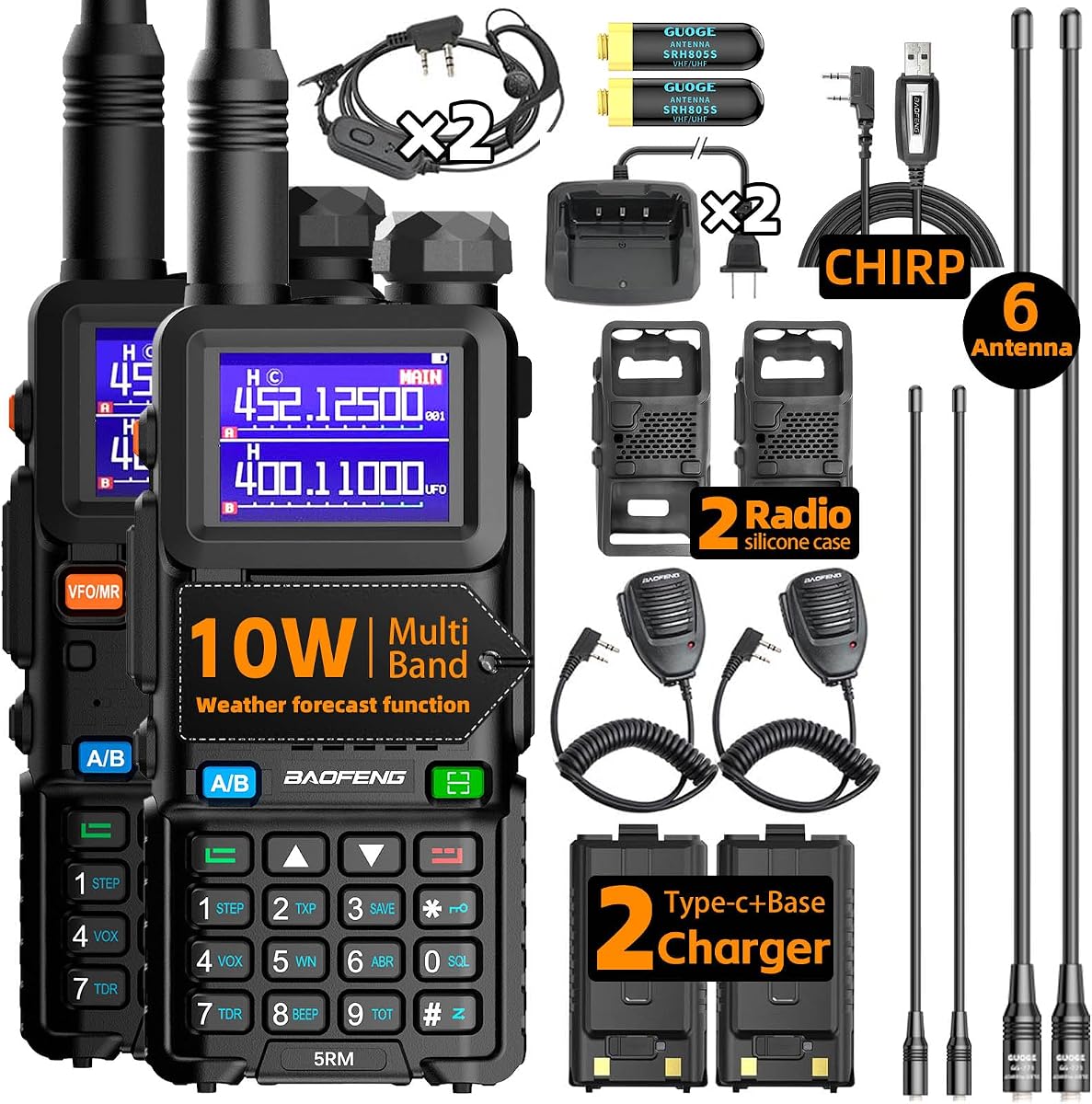


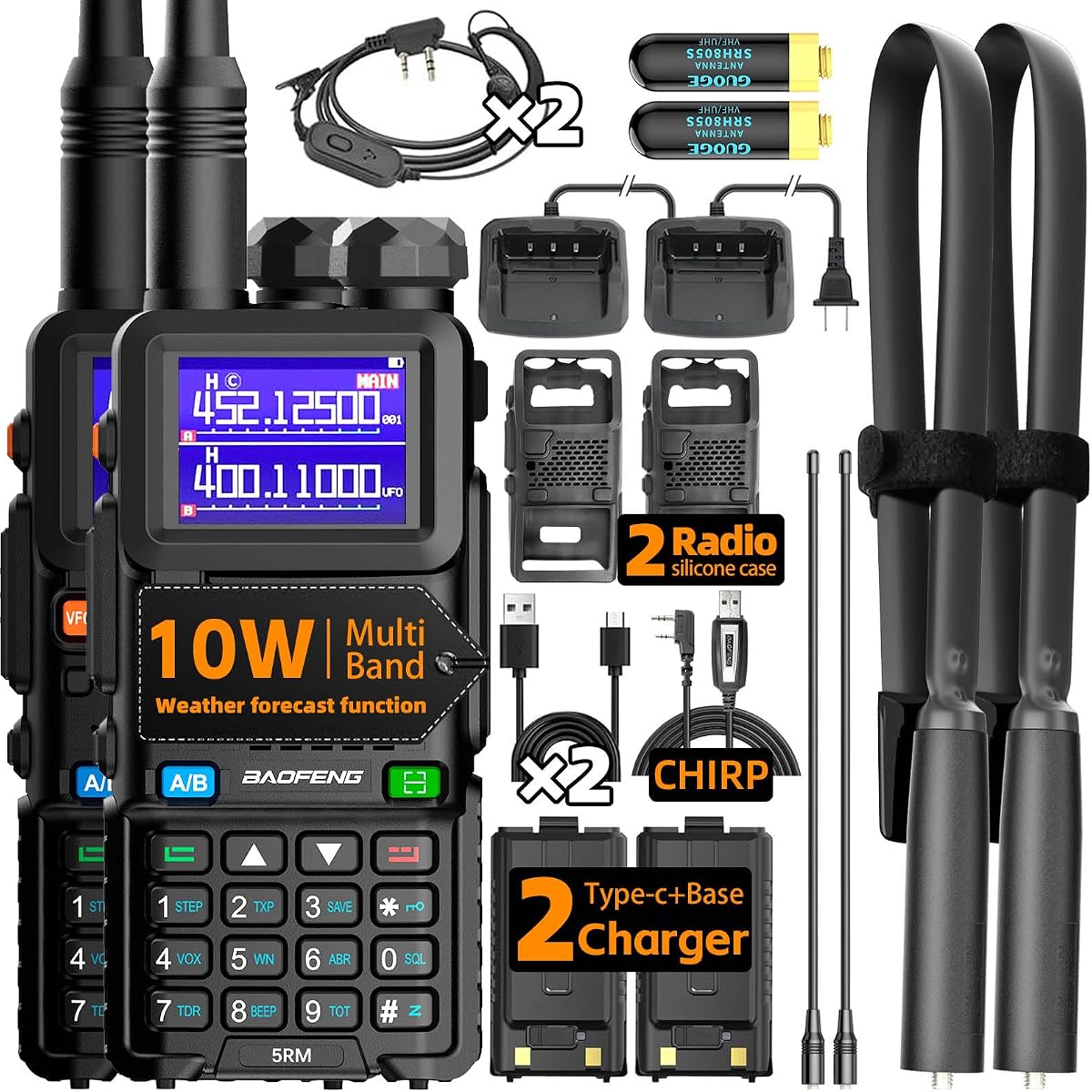
This two-pack AR-5RM handheld combines a large accessory bundle with the expanded feature set associated with the UV-5R family. Its supplied rating is 4.5, and the most notable qualities are the pair of 10-watt radios, 999-channel memory capacity, 1.77-inch color screen, rechargeable batteries, speaker microphones, and programming cable. The package is particularly useful for families, clubs, or teams that want matched radios rather than a single unit.
We may earn a commission when you buy through this link, at no additional cost to you.
The stated receiving coverage extends from 108 through 520MHz across several separated ranges, while transmission is limited to 144-148MHz and 420-450MHz. That distinction matters: broad reception can be valuable for aviation, broadcast, and other listen-only activity, but users must remain within their license privileges when transmitting. CHIRP compatibility and a supplied programming cable simplify loading a channel plan, while the one-touch frequency copy function can duplicate settings between compatible radios without repeatedly entering every parameter.
Charging is one of the package's strongest practical features. Each radio includes a USB-C cable, desktop base charger, and larger 2500mAh rechargeable battery, allowing charging from a wall adapter, power bank, laptop, car, or other USB-powered source. The NOAA weather receiver adds useful emergency awareness, and the color display, flashlight, emergency alert, keypad, and adjustable power options make the radios adaptable to hiking, camping, hunting, travel, and preparedness use.
The trade-offs are the learning curve associated with programming and the fact that expanded reception does not mean expanded legal transmit capability. The full list of supplied components is extensive, but beginners should identify the speaker microphones and earpieces before setup and avoid changing settings without recording original channel data. Overall, this is a strong choice for buyers who prioritize two complete systems, included accessories, flexible charging, and room to build a larger memory list.
The AR-5RM designation matters when programming. Some software databases organize devices by model rather than generic UV-5R labeling, so check that the radio is recognized before importing a codeplug. Once set up correctly, the package's combination of memory, charging options, and included hardware makes it a practical starter system for coordinated communications.
Buying two matching radios eliminates the need to source a second unit separately. Each set includes a battery, charging cable, base charger, speaker microphone, earpiece, belt attachment, and hand strap, making the package easier to distribute among two users or a larger group.
The included programming cable and CHIRP support allow channel plans to be prepared on a computer. The frequency-copy function provides a quicker alternative for compatible radios, although keeping a written or digital backup remains sensible.
We may earn a commission when you buy through this link, at no additional cost to you.
The original-style Baofeng UV-5R is one of the most accessible entries in this roundup, earning the Best Budget designation for buyers who want a straightforward dual-band handheld without a large accessory package. It has a supplied rating of 4.5 and covers the core amateur bands of 144-148MHz and 420-450MHz. Its 128-channel memory, dual-frequency display, dual standby, keypad lock, and large LCD give users the fundamentals needed for local and repeater communications.
We may earn a commission when you buy through this link, at no additional cost to you.
Operating features are unusually generous for an entry radio. Selectable high and low transmit power helps manage battery consumption, while busy-channel lockout reduces accidental interruptions. CTCSS and DCS tone functions, VOX, voice companding, a selectable tri-color backlight, an emergency alert, and a 25kHz or 12.5kHz switchable setting give users control over how the radio behaves in different situations. A built-in LED flashlight is another practical feature for camping, hiking, or nighttime work.
Programming flexibility is one of its strongest long-term advantages. The radio can be programmed manually, through a computer with the appropriate interface, or through CHIRP. This matters because a new handheld is only useful if its memory contains the correct local repeater channels, offset tones, and transmit permissions. A separate programming cable may need to be purchased, which can add a small cost but gives the buyer greater control over channel organization.
The unavoidable trade-off is that this model has fewer memory positions and less expansive reception than several newer alternatives in the list. It also lacks the premium color screen, USB-C convenience, named zones, GPS, or digital voice functions found in higher-end selections. For buyers who only need a reliable analog handheld and can manage a straightforward interface, those omissions are reasonable rather than disqualifying.
This is the best budget choice for a first license, club loaner, practice radio, or simple emergency-communication setup. It supports the frequencies required for conventional amateur use and avoids locking buyers into an advanced digital platform before they understand their local repeater system. Confirm that a suitable programming cable is included with the current listing before ordering, and use only frequencies and power levels permitted by the applicable license.
The display and keypad expose the essential operating controls without adding a complex operating system. Dual-band display, dual standby, power selection, and channel scanning are approachable for someone learning how local repeaters work.
CHIRP support keeps the radio useful beyond its factory channel list. Buyers can organize local channels, name them, and update them as their club, travel plans, or emergency contacts change.
We may earn a commission when you buy through this link, at no additional cost to you.
The BF-F8HP PRO is the most structured and advanced conventional handheld in this guide, earning the Best Premium badge for operators who want organized channel management and a tri-band platform. Its supplied rating is 4.3, while standout features include 1,000 memories, ten named zones, clear English menus, a full keypad, USB-C charging, Airband and NOAA reception, updatable firmware, and a two-channel display that can show names as well as frequencies.
We may earn a commission when you buy through this link, at no additional cost to you.
Its organization tools go well beyond a simple numeric memory list. Operators can create named zones for home, travel, club events, simplex use, and other groups, then decide which zones participate in scanning. A busy channel can be temporarily skipped without rebuilding the saved list. Dual Watch alternates the receiver between two displayed channels, while Single Watch gives one channel a full-screen view, and approximate dBm readings add useful signal context.
The radio supports common changes directly from the keypad, but larger codeplug projects can be handled in BTECH CPS or supported CHIRP-next software with the separately sold PC03. Firmware updates likewise require the appropriate cable, software, and model-specific instructions from BTECH. The radio-to-radio location-sharing function is another distinguishing feature: compatible BF-F8HP PRO units can exchange location information on the same channel, although the feature does not provide APRS maps, repeater pass-through, continuous tracking, or an emergency-location service.
The main limitation is complexity relative to a basic UV-5R. The scanning functions apply to conventional analog channels, not DMR or trunked systems, and the location-sharing function should not be mistaken for a full tracking platform. The PC03 programming accessory is also not included. These are meaningful drawbacks for buyers wanting simple out-of-box operation, but the premium is justified for users who value memory capacity, named organization, and flexible computer programming.
Choose the BF-F8HP PRO if you maintain several channel lists, travel to different areas, or want a radio that can grow without repeatedly replacing memory banks. It transmits on amateur bands, while Airband AM, NOAA weather, and broadcast FM are receive-only, and valid amateur authorization is required for transmissions. For a new operator who only needs one simple repeater list, the UV-5R remains more economical and easier to manage.
Named zones make it easier to separate local, travel, club, and event channels without repeatedly scrolling through a long list. The ability to choose which zones scan together adds control that a basic memory-based handheld cannot provide.
Airband AM, NOAA weather, and broadcast FM broaden what the radio can monitor without expanding legal amateur transmit ranges. Users can keep informed of aviation and weather activity while remaining responsible for transmitting only within their privileges.
We may earn a commission when you buy through this link, at no additional cost to you.
This UV-5RM two-pack is a flexible pairing for outdoor users who want matching radios, expanded reception, and a large memory bank. It carries a supplied rating of 4.6, and its key strengths include dual 10-watt radios, 999 channels, a 1.77-inch color display, frequency cloning, NOAA weather reception, and both USB-C and desktop charging for each unit.
We may earn a commission when you buy through this link, at no additional cost to you.
The receive ranges cover 108-136MHz, 136-174MHz, 220-260MHz, 350-390MHz, and 400-520MHz. Transmitting is confined to 144-148MHz and 420-450MHz, so the broad reception should not be interpreted as authorization to use every listed frequency. The advertised FCC ID is 2AJGM-5RH, and CHIRP compatibility offers a practical way to create and maintain a larger channel plan.
For buyers setting up a pair without advanced radio experience, the one-touch frequency-copy function is useful. It can clone settings between compatible radios and reduce repetitive keypad entry. NOAA reception adds weather and emergency information, while the speaker microphone supports hands-free operation in noisy environments. The two 2500mAh batteries, USB-C cables, and desktop bases provide multiple ways to keep both radios ready, including use with a power bank, laptop, car adapter, or wall outlet.
The primary drawback is that broad receive capability can create an incorrect impression of what the radios can legally transmit. The advertised 10-watt output also applies only to the permitted amateur bands, and actual results depend on antenna condition, terrain, battery state, and other radio factors. A second drawback is the requirement to prepare the channels correctly. Quick cloning is convenient, but it is not a substitute for understanding the frequencies and tones contained in the codeplug.
This two-pack is well suited to hiking, camping, hunting, skiing, construction sites, events, and emergency kits where two people need equivalent equipment. It also gives buyers a straightforward path to add a programming cable. For anyone prioritizing simple inexpensive handhelds, the basic UV-5R costs less and remains adequate; for those who need more memory and broader receive coverage, this package is a strong middle-ground choice.
The frequency-copy function helps put two units on the same channels without entering every setting twice. It is especially helpful for travel groups or family preparedness kits that may be programmed by one knowledgeable member.
USB-C and desktop base options make it easier to recharge at home, in a vehicle, or from a power bank. The 2500mAh batteries also help users balance operating endurance with a packable size.
We may earn a commission when you buy through this link, at no additional cost to you.
The single-radio UV-5RM gives buyers the expanded feature set of the AR-5RM generation without committing to a multipack. Its supplied rating is 4.6, and the combination of 999 memory channels, a 1.77-inch color screen, 10-watt licensed-band output, NOAA reception, and USB-C charging makes it an attractive general-purpose handheld.
We may earn a commission when you buy through this link, at no additional cost to you.
The radio supports conventional analog communication throughout the amateur 2-meter and 70-centimeter bands, with advertised transmission from 144-148MHz and 420-450MHz. Its receive coverage extends across numerous ranges from 108 to 520MHz, allowing monitoring of aviation, broadcast, weather, and other activity where reception is appropriate. CHIRP compatibility helps users build a personalized list rather than relying on a limited factory configuration.
The frequency-copy function is a notable convenience when a user already has a compatible radio with channels programmed. A new user can clone the necessary settings instead of manually navigating menus for every channel, although the result is only useful if the source frequency and tone information is accurate. The color screen helps display names and settings clearly, and the included 2500mAh battery, USB-C cable, and desktop charger make charging straightforward.
NOAA reception strengthens the radio's emergency role by delivering weather information and alerts when ordinary cellular service may be unavailable. The speaker microphone supports hands-free communication, and the stated use cases include camping, hiking, hunting, road trips, and outdoor events. This is still a conventional analog handheld, however, so it cannot decode DMR or trunked systems and should not be selected solely because the word digital appears in an accessory listing.
This option is best for a buyer who needs one well-equipped radio and can obtain a second compatible unit later. It offers a better display and memory capacity than the basic UV-5R, while avoiding the complexity of named zones, firmware management, GPS, or digital voice. Confirm exactly which charging parts and speaker accessories are included with the current listing, as multipack configurations of similar models can otherwise appear similar.
A 999-channel capacity offers more room for local repeaters, travel frequencies, and family or work contacts than a 128-channel model. The extra space matters most to operators who maintain several overlapping channel lists.
The NOAA receiver can provide forecasts and severe-weather alerts during outdoor trips or emergency preparations. It complements cellular service rather than replacing a dedicated weather-alert device.
We may earn a commission when you buy through this link, at no additional cost to you.
The BAOFENG DM32 stands apart from the conventional analog handhelds because it supports both DMR digital voice and traditional analog FM. Its supplied rating is 4.3, and the major attractions are 10-watt maximum output, up to 4,000 channels, a two-inch screen, a full keypad, built-in GPS, APRS, text messaging, call recording, encryption options, and a Type-C connection for charging, programming, and firmware updates.
We may earn a commission when you buy through this link, at no additional cost to you.
Digital and analog dual-mode operation makes the radio useful in mixed environments where one type of system may not be sufficient. Voice coding and anti-interference functions are designed to improve clarity, while high, medium, and low power settings let users balance output against battery use. TDMA dual-time-slot capability can improve channel utilization on compatible digital networks, although actual interoperability depends on the network, talkgroup, color code, and programming requirements.
Location support is the model's clearest specialty. Built-in GPS and APRS allow compatible position reporting, and the radio also includes FM, AM, and NOAA reception. Digital features extend beyond voice with a 128-character text function in Chinese or English, a voice recorder, remote monitoring, and ARC4, AES128, or AES256 encryption options. Users should understand their legal and organizational requirements before using private or encrypted traffic on shared systems.
The main trade-off is that a capable digital handheld is not automatically compatible with every digital network. It also provides no matching second radio in this one-piece package, and its large screen and full keyboard make it bulkier than a basic UV-5R. Programming is more involved, while the Type-C cable, support for up to 4,000 channels, and side-key customization favor operators willing to invest time in configuration.
The DM32 is best for users participating in DMR groups, public-service teams, hiking clubs, or technical hobbyists who specifically need GPS, APRS, text messaging, and a large channel database. A new operator whose local system is analog can still benefit from the FM mode, but should not buy it for digital functions unless compatible infrastructure or other users are already present. For simple local repeater work, a less advanced analog model is easier to manage.
GPS and APRS turn the radio into a more useful field tool for compatible teams. A user can report position through compatible equipment, although users should verify network and equipment compatibility before relying on it for navigation.
The ability to handle DMR and analog voice allows the radio to fit mixed club or event systems. Talkgroups, color codes, and regional network settings still require correct programming and coordination.
We may earn a commission when you buy through this link, at no additional cost to you.
The AR-5RM two-pack stands out as the most complete inexpensive pairing in the roundup, earning the Editor's Choice badge. It has the highest supplied rating at 4.8, along with two radios, 999 channels apiece, a 1.77-inch color display, 10-watt output on the listed amateur bands, NOAA reception, frequency copying, rechargeable 2500mAh batteries, and both USB and desktop charging.
We may earn a commission when you buy through this link, at no additional cost to you.
The upgraded model is designed for users who want more than the original UV-5R's basic receive coverage. It spans 108-136MHz, 136-174MHz, 220-260MHz, 350-390MHz, and 400-520MHz for reception, while transmission is specified for 144-148MHz and 420-450MHz. The listed FCC ID is 2AJGM-5RM. Aviation reception, FM reception, CTCSS and DCS tones, a flashlight, VOX, DTMF, an alarm, and a time-out timer broaden the feature set.
Programming can be handled with CHIRP, and users searching software databases should look for the 5RM model as instructed in the product information. The frequency-copy function offers a fast way to clone compatible settings, which is useful for two matching units. A thorough setup should still include correct local repeater channels, offsets, CTCSS or DCS tones, transmit restrictions, and a verified power level for each use case.
The package supports several charging methods. Each radio has a 2500mAh rechargeable battery and works with USB and base charging, while low USB power requirements allow flexible charging from suitable mobile or field sources. NOAA reception provides forecasts and emergency alerts, and the 1.77-inch color display makes menus and channel labels easier to read. These qualities suit hiking, camping, hunting, travel, security, and preparedness applications.
The important limitation is that its wide reception range can be mistaken for general transmit authority. The radio should transmit only on frequencies allowed by the operator's license, and reception-only bands should not be used for voice transmission. Buyers should also verify the exact package contents in the current listing because several closely related UV-5RM two-packs use similar imagery and descriptions.
This is the best overall pairing for budget-conscious buyers who want two usable handhelds with good displays, large memory, flexible charging, and emergency reception. It offers more than the basic UV-5R without moving into the complexity or feature cost of a digital radio or premium tri-band model. With proper programming and attention to legal frequencies, the package is a particularly strong foundation for family, club, or outdoor communications.
The two-pack gives partners, families, or small groups matched equipment immediately. Each radio has its own display, battery, charging options, controls, and memory, allowing both users to participate on the same programmed channels.
NOAA reception, flashlight, alarm, broad analog coverage, and rechargeable batteries make the kit useful for preparedness and outdoor use. It remains easier to program than a full-featured digital system for many new owners.
We may earn a commission when you buy through this link, at no additional cost to you.
The Retevis RT95 is the only mobile radio in the selection, making it a distinctive option for vehicle communication, a home base station, or portable field use with a suitable power source. Its supplied rating is 4.4, and it offers dual-band amateur operation, 200 stored channels, a 180-degree rotatable TFT color display, a high-gain antenna, dual speakers, RCA output ports, and a base-station installation package.
We may earn a commission when you buy through this link, at no additional cost to you.
The small enclosure measures approximately 1.54 by 4.88 by 6.42 inches and is designed to install in a truck, Jeep, RV, or other vehicle. It can also serve as a base station at home or in the field. The included high-gain antenna is intended to help obtain stronger distant signals, while adjustable microphone gain and dual speakers are designed to improve intelligibility and provide a fuller sound over long-distance communications.
Audio flexibility makes the RT95 useful in vehicles. RCA output ports can connect to a car audio system, creating an immersive listening experience, while the display can rotate to remain readable from different mounting positions. Brightness controls, illuminated front-panel buttons, and illuminated microphone buttons improve visibility in strong light and at night. The built-in cooling fan is designed to support stable operation, and the housing includes shockproof, dustproof, and voltage-protection features.
Programming is flexible through VFO mode and CHIRP compatibility. With 200 channels plus CTCSS, DCS, DTMF, five-tone, and adjustable power functions, the radio is capable of serving as a central station. A 13.8-volt, 10-amp power supply is not included, so buyers must account for a proper fused supply, secure grounding, cable routing, and antenna installation. These requirements make it less convenient than a handheld for spontaneous use.
The RT95 is best for a ham who wants a dedicated mobile or base station alongside one or more handhelds. It is particularly appropriate for travel, emergency communications, community events, and vehicle-based operating. It is not the cheapest or simplest way to begin a hobby, but it offers a more permanent installation, larger controls, and stronger station-style integration than the compact models elsewhere in this guide.
A fixed mobile radio provides a larger control surface, external antenna options, vehicle integration, and easier extended listening. It suits users who regularly travel in a vehicle or operate from a stable base.
RCA outputs allow the radio to feed a compatible vehicle audio system. Installation still requires sound judgment, proper electrical connections, and attention to secure mounting and antenna placement.
We may earn a commission when you buy through this link, at no additional cost to you.
The BF-F8HP, also described in the listing as a third-generation UV-5R, combines an eight-watt maximum output with a 2100mAh battery, high-gain antenna, three power levels, and a full accessory kit. Its supplied rating is 4.5. The radio is designed for users who want more transmit flexibility than a low-power entry model while retaining the familiar dual-band analog platform.
We may earn a commission when you buy through this link, at no additional cost to you.
Output can be set to 8 watts, 4 watts, or 1 watt, allowing operators to balance range against battery life. Broad and narrow bandwidth choices are available, and the listed frequency coverage spans 136-174MHz and 400-520MHz. As with any transceiver, users should understand the rules applying to their jurisdiction and avoid assuming that a wider advertised range automatically grants permission to transmit on every frequency.
The package includes the radio, a 2100mAh battery, V-85 dual-band antenna, CH-5 desktop charger, CH-5 110-volt adapter, earpiece kit, wrist strap, belt clip, and user manual. The V-85 antenna is presented as an improvement over the earlier generation's antenna, while the hardened shell and larger battery target durability and endurance. A detailed guide is included to help buyers who are not already radio experts.
BTECH is also highlighted for United States support and model-specific warranty service, although a PC03 FTDI programming cable is recommended for easier computer programming and is not part of the stated kit. This means buyers who want CHIRP-based setup should plan to source the correct interface separately. Compared with newer models, the BF-F8HP does not provide the large color display, named zones, or USB-C convenience seen in the AR-5RM and BF-F8HP PRO.
The BF-F8HP is a strong choice for a buyer who values straightforward operation, selectable power, a substantial battery, and a well-equipped package. It is especially useful for hiking, travel, and local amateur work where a higher-power setting may help, while the lower power levels conserve energy. New operators should confirm frequency limits and local repeater settings, and experienced users should verify programming-cable requirements before ordering.
The three selectable output levels let users move between maximum reach, a moderate setting, and low-power conservation. This flexibility is useful when regular local communication does not require the radio's highest output.
The included battery, antenna, desktop charger, AC adapter, earpiece, strap, clip, and manual cover the essential accessories. Only a computer programming cable is identified as an additional recommendation.
We may earn a commission when you buy through this link, at no additional cost to you.
This UV-5RM listing provides another single-radio route into the expanded AR-5RM-style feature set. It has a supplied rating of 4.5 and includes a 1.77-inch color display, 999 memory channels, 10-watt output on the listed amateur bands, a 2504mAh rechargeable battery, USB-C and desktop charging, NOAA weather reception, frequency copy, and CHIRP compatibility.
We may earn a commission when you buy through this link, at no additional cost to you.
Its receiving capability covers 108-136MHz, 136-174MHz, 220-260MHz, 350-390MHz, and 400-520MHz. Transmitting is limited to 144-148MHz and 420-450MHz, and the listed FCC ID is 2AJGM-5RH. The wide receive coverage can be useful for aviation, broadcast, and emergency listening, but operators must transmit only where their license and local rules allow it.
The 999-channel memory and color display make this model easier to manage than a simple 128-channel unit. Users can prepare a detailed channel list in CHIRP, while the one-touch frequency-copy function helps synchronize a compatible second radio. That second function is particularly useful for clubs or families that eventually want two matching devices, even though this listing supplies only one handheld.
The 2504mAh battery and USB-C cable offer modern charging convenience, and the desktop base offers an alternative home setup. NOAA reception provides forecasts and severe-weather alerts, while the speaker microphone supports hands-free use in noisy environments. The radio is positioned for camping, hiking, hunting, road trips, outdoor events, and emergency supplies, where a rechargeable radio with broad receive capability can be valuable.
The trade-offs are conventional rather than digital. It cannot operate on DMR or trunked systems, and its one-radio package lacks the immediate convenience of a matched pair. It also does not provide GPS, APRS, or named zones. Buyers who want basic digital functionality should consider the DM32, while those who want advanced channel organization should consider the BF-F8HP PRO.
This radio is best for an individual who wants a feature-rich analog handheld with a large screen and memory but does not need the higher complexity of a tri-band or dual-mode system. It also works well as a first radio for a new operator who expects to add more channels and possibly a second unit later. Confirm current package contents and programming-cable availability, then build a clear local channel plan before relying on it in the field.
The 999-channel capacity and 1.77-inch color display make longer channel lists easier to browse and identify. This is useful for users who travel, coordinate events, or maintain contacts across several geographic areas.
USB-C supports convenient charging, while the frequency-copy function can transfer compatible settings between radios. Together they simplify routine ownership, provided the source configuration is accurate and the user respects transmit restrictions.
We may earn a commission when you buy through this link, at no additional cost to you.
The best inexpensive ham radio is not automatically the model with the longest specification list. Compare legal frequency needs, analog or digital operation, programming methods, memory capacity, charging, accessories, and the environments in which the radio will actually be used.
Begin with the amateur bands you are permitted to use. Most entry models transmit on 144-148MHz and 420-450MHz, while the BF-F8HP PRO adds another amateur band. A radio with wider receive coverage can monitor aviation, broadcast, weather, and other services, but that does not make those frequencies legal for amateur voice transmission. Prospective buyers should confirm the exact transmit bands, their local regulations, and whether they need a license before ordering.
Most inexpensive handhelds in this roundup use conventional analog FM. The DM32 is the exception, offering DMR digital voice alongside analog mode. Digital operation can add efficiency, text messaging, and mixed-system flexibility, but it requires compatible infrastructure, talkgroups, color codes, and other users. A new operator entering a purely analog local repeater system may find a straightforward analog handheld easier and less expensive.
Memory capacity determines how many frequencies can remain loaded, while organization determines how easily they can be used. The basic UV-5R stores 128 channels, several UV-5RM variants offer 999, the DM32 supports up to 4,000, and the BF-F8HP PRO combines 1,000 memories with ten named zones. Frequent travelers, club members, and event coordinators benefit from more capacity and stronger organization than a single operator who only needs a handful of local channels.
A radio is only useful if its channels, offsets, tones, and labels are programmed correctly. CHIRP support appears across several choices, while the BF-F8HP PRO also supports BTECH CPS and CHIRP-next. Some packages include a programming cable, while others recommend a separate PC03-style interface. Buyers should verify the cable requirement, ensure the software recognizes the exact model, and keep a backup copy of the final codeplug.
The basic UV-5R uses a large LCD, while the UV-5RM generation offers a 1.77-inch color screen and the DM32 provides a two-inch display. The BF-F8HP PRO adds clear English menus, named zones, a two-channel view, and approximate dBm context. A more advanced display is valuable for large channel lists, but simpler controls can be better for beginners who mainly need clear power, volume, and channel-selection operation.
The radios in this guide use rechargeable batteries and offer either USB or desktop charging, with some including both. A 2500mAh or 2504mAh battery is supplied with several UV-5RM models, while the BF-F8HP includes a 2100mAh cell. USB-C is convenient for travel and power-bank charging, whereas a desktop base is useful at home. Actual runtime varies with transmit power, display use, audio volume, and battery condition.
NOAA reception, weather alerts, alarms, flashlights, and dual charging can improve preparedness kits. The DM32 goes further with GPS, APRS, text messaging, and emergency signaling. These functions are not equally useful to every buyer. A hiker may value position reporting, while a family emergency kit may prioritize NOAA alerts and accessible charging. Features should support a planned use case rather than merely increase the specification count.
Handhelds are portable, inexpensive, and easy to carry, but they usually use smaller internal antennas and lower-gain setups. The Retevis RT95 is designed for vehicle or home-station installation, with an external high-gain antenna, larger display, RCA audio outputs, and a required 13.8-volt, 10-amp supply. It offers greater potential for extended vehicle use but needs installation expertise and a stable power source.
Begin by confirming your license, identifying the channels and repeater offsets you need, and charging both the radio and spare battery if one is included. Install the antenna securely, attach the belt clip, and learn the power, volume, channel, menu, and scan controls before taking the radio outside. Enter a simple channel list through the keypad or program it with compatible software, using the exact model identifier to avoid incorrect settings.
Program a small group of local channels before attempting a large travel list, and verify each channel by listening before transmitting. Learn the transmit-power setting, tone controls, emergency alert, flashlight, and NOAA functions. When using a repeater, press the programmed transmit control rather than holding it continuously, speak clearly, and release it promptly. Respect station identification rules and avoid transmitting on receive-only frequencies.
For care, keep the radio dry, protect the connector and controls from dirt, and use a compatible charger and approved battery. Avoid leaving the device in a hot vehicle or allowing the battery to remain depleted for long periods. Clean the keypad and casing with a lightly dampened soft cloth, and never use harsh solvents. If reception or battery performance changes, test the antenna, inspect the contacts, and update the software or codeplug only with model-specific instructions.
The Baofeng UV-5R Handheld is the strongest budget starting point in this guide because it provides dual-band analog operation, multiple power levels, 128 channels, and CHIRP support. Its programming cable may need to be purchased separately. A new operator should budget for that accessory and confirm the local repeater channels and tones before regular use.
A capable inexpensive radio can be a useful part of an emergency kit, especially when it has NOAA reception, a flashlight, rechargeable batteries, and flexible charging options. It should supplement, not replace, a charged cellular phone, paper maps, extra food and water, and other preparedness supplies. Test it regularly and keep the programmed channels and accessories accessible.
Purchase and possession rules can vary by country, but operating on amateur frequencies generally requires the appropriate authorization. Some radios can receive broader frequency ranges than they can legally transmit on. Buyers should check local regulations and follow the licensing requirements that apply to their location.
Analog handhelds use conventional FM voice and are widely used on local repeater systems. DMR radios use digital voice and may also provide text messaging, location features, encryption options, and more efficient use of compatible networks. DMR equipment is not automatically compatible with every digital system, so talkgroup, color code, and regional settings must match.
A beginner with only local repeaters may be comfortable with 128 channels, while travelers and active club members may benefit from 999 or more. More memory does not automatically mean better operation, and advanced models with named zones can be easier to navigate than a long unstructured list. Prioritize the channels and organization you will genuinely use.
Many of the listed models support CHIRP, but the radio must be identified by its exact model or FCC ID within the software. A compatible data cable is also required, and it may not be included with every package. Back up the original codeplug before making changes and confirm transmit frequencies, offsets, and tones.
A mobile radio can provide a larger display, external high-gain antenna, better vehicle integration, and easier extended operation from a stable location. It also requires a proper 13.8-volt power source, secure mounting, correct grounding, and more installation planning. A handheld is more convenient, portable, and usually less expensive for occasional use.
A compatible programming cable is the most important addition for many buyers because it enables easier CHIRP setup. A spare rechargeable battery, suitable antenna, belt clip, earpiece, speaker microphone, and protected storage case can also improve convenience. Match accessories to the exact model and avoid assuming that a cable or radio version listed for one variant works with another.
The Baofeng UV-5R Handheld is the best budget pick for a new operator who wants a familiar, affordable analog radio with 128 channels and CHIRP support. The Baofeng UV-5RM Two Radio Kit is the Editor's Choice for buyers seeking two complete matching units, larger displays, 999-channel memory, flexible charging, and NOAA reception. For a more advanced but still conventional premium choice, the BF-F8HP PRO offers tri-band transmission, 1,000 memories, named zones, and a clearer organized interface.
Prioritize authorized transmit bands, correct programming support, and the accessories actually needed for your intended use. Basic local-repeater work does not require GPS, thousands of channels, or a digital platform, while travelers, club coordinators, and technical users may value those features enough to justify a more advanced radio. A mobile installation deserves consideration when vehicle use and a stable external antenna matter more than portability.
Finally, check current listings carefully because closely related models can share similar names while differing in memory capacity, battery type, included charging equipment, and programming accessories. Prices, bundles, and availability also change over time. Verify the exact variant, FCC ID, included cables, and return terms before making a final purchase.