Mylar Emergency Blankets
4.7Editor score
Retains up to 90% body heat
Four reusable thermal blankets
Folds into compact storage
Explore the best emergency preparedness items for 2026, comparing survival kits, radios, water filters, warmth gear, and essential medical supplies today.
Emergency preparedness works best when useful supplies are already organized, easy to reach, and suited to the hazards you may face. A strong kit combines protection, information, water treatment, medical support, lighting, and dependable power rather than relying on a single oversized container.
The products in this guide were compared by examining their stated capabilities, included equipment, portability, power options, water-treatment methods, emergency coverage, and practical roles in a home, vehicle, travel, or outdoor kit. The list covers individual essentials as well as broader survival packages.
Each review explains what makes a product useful, where its trade-offs appear, and which type of preparer it serves best. The picks also show how a well-rounded kit can connect warmth, hydration, alerts, lighting, and first aid, while current prices and availability can change over time.
4.7Editor score

4.8Editor score

4.6Editor score
This side-by-side overview highlights the different roles these emergency preparedness items play, from compact warmth and portable hydration to NOAA alerts, lighting, first aid, and broad survival coverage.



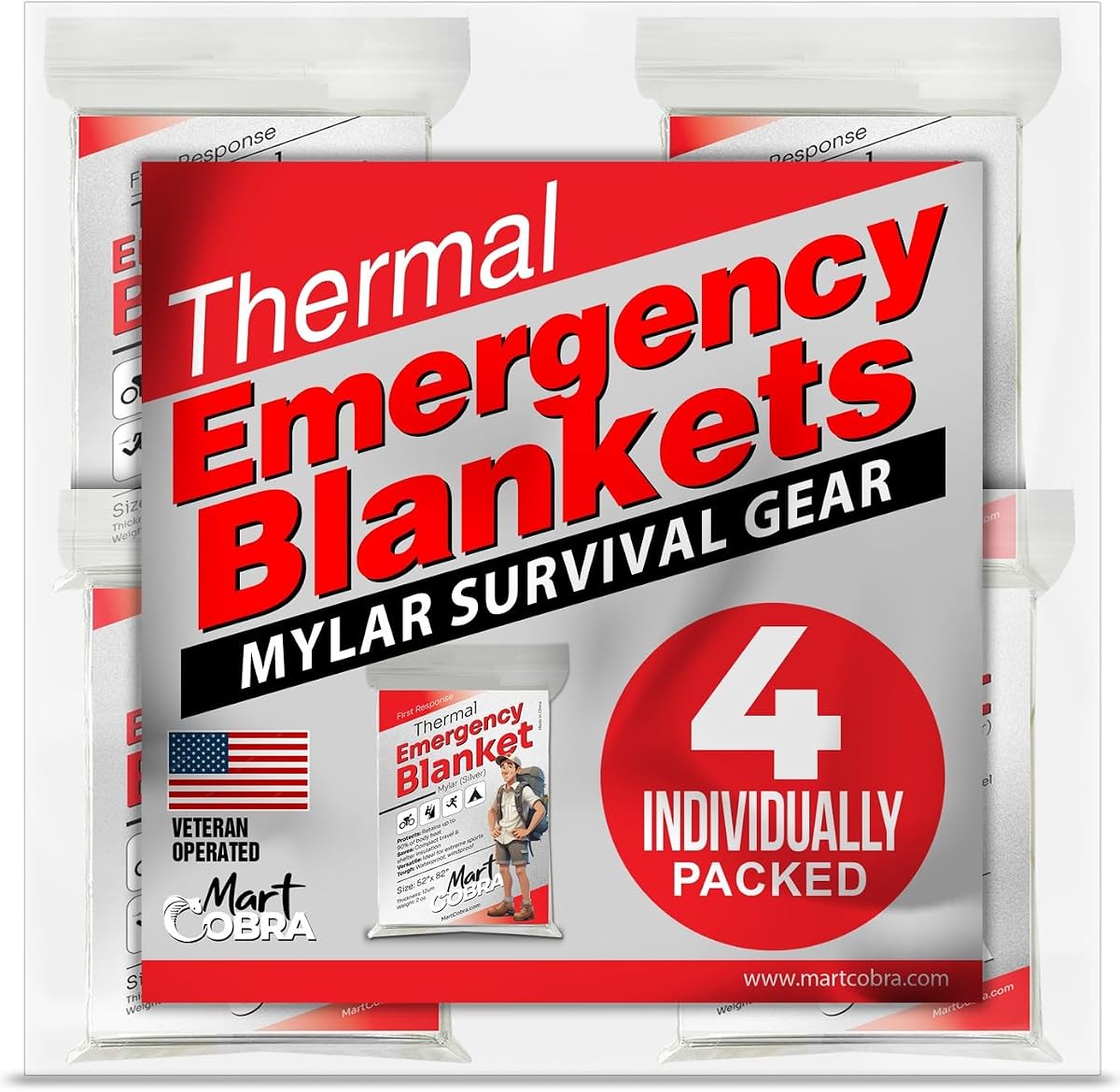
This four-pack of aluminized Mylar emergency blankets combines a strong warmth-to-weight ratio with a format that is easy to distribute across several kits. It carries a 4.7 rating, and its stated ability to retain up to 90% of body heat makes it especially relevant during cold weather, vehicle breakdowns, power outages, and outdoor emergencies.
We may earn a commission when you buy through this link, at no additional cost to you.
Each blanket measures 82 by 52 inches when opened, providing enough surface area for use as a wrap, ground cover, or supplementary shelter component. The material is described as tear-resistant and reusable, so the pack can support repeated preparedness use rather than serving as a single-use-only item. Its low weight and compact fold also make it easy to place in a backpack, car, or general emergency supply box.
The main limitation is that a space blanket is not a complete substitute for an insulated sleeping bag, tent, or properly rated sleeping system. It can also be vulnerable to punctures, and users would benefit from treating it as an emergency layer rather than an everyday comfort item. Those trade-offs are reasonable given the simple role it serves.
This is a strong choice for anyone building a inexpensive foundation of emergency preparedness supplies. It is especially valuable for people who need warmth for multiple family members, drivers concerned about cold roadside conditions, and campers who want a lightweight emergency shelter component. Among the products reviewed, it is the most budget-friendly way to add a dedicated thermal-protection layer.
The blankets offer substantial thermal coverage while taking up little room. That makes them easy to divide among a household, keep in a vehicle, or tuck into a smaller hiking and evacuation pack.
In addition to preventing heat loss, the material can serve as a ground cover or emergency shelter element. That versatility makes it more useful than a product designed for only one narrow task.
We may earn a commission when you buy through this link, at no additional cost to you.
The LifeStraw Personal Water Filter is a compact hydration solution for hikers, travelers, and emergency kits. Its 4.8 rating is the highest among the products in this guide, while its stated microfiltration performance makes it a compelling choice when the available water may contain bacteria, parasites, turbidity, or microplastics.
We may earn a commission when you buy through this link, at no additional cost to you.
The membrane is stated to remove 99.999999% of waterborne bacteria, including E. coli and Salmonella, and 99.999% of parasites, including Giardia and Cryptosporidium. It also removes microplastics down to one micron and reduces turbidity to 0.2 microns. The listed laboratory verification uses protocols associated with the US EPA, NSF, and ASTM, giving the product a more evidence-based foundation than a basic improvised filter.
Its long-life microbiological purification system is rated for 4,000 liters, or 1,000 gallons, making it a reusable investment rather than a consumable. The trade-off is that it is designed for personal use and does not provide the storage capacity of a larger household filter. It also is not intended for desalination, so users should not apply it directly to seawater.
This filter is a particularly good fit for hikers, campers, international travelers, and anyone who wants drinking-water protection without carrying a bulky purifier. It complements, rather than replaces, stored drinking water: filters handle uncertain sources, while sealed pouches or bottles cover immediate access. For a versatile one-person emergency water solution, it is the strongest overall choice in this roundup.
Its strongest benefit is the combination of high stated filtration performance and portable size. It can move from a hiking pack to a desk drawer or vehicle kit without taking up substantial room.
The 4,000-liter rated capacity means it can serve many trips if handled and maintained as directed. This makes it more economical over time than repeatedly replacing a disposable filtration option.
We may earn a commission when you buy through this link, at no additional cost to you.
The FosPower NOAA Emergency Radio brings together weather information, lighting, signaling features, and backup power in one device. Its 4.6 rating reflects a balanced package, and the 7400mWh internal battery gives it more general utility than a basic hand-crank radio focused only on broadcasts.
We may earn a commission when you buy through this link, at no additional cost to you.
The radio can receive NOAA emergency forecasts as well as AM and FM stations. Its power-bank function is intended to provide emergency power to a phone or small tablet, while the radio itself can run through a hand crank, solar panel, or AAA batteries. A 4 LED reading light and a 1-watt flashlight provide illumination for reading instructions, navigating a dark area, or signaling during an evacuation.
The tradeoff is that it is a larger device than the most compact radios in the list and still depends on a rechargeable internal battery for convenient charging. It also does not eliminate the need for a separate water solution, medical supplies, or physical shelter. Its strongest value appears when several of those communication and lighting needs are consolidated.
This radio is well suited to households that want NOAA information and a substantial emergency power bank in one unit, especially during outages, severe weather, camping trips, and roadside emergencies. It is our premium pick because the battery capacity, three-input design, and dual-light arrangement create a more complete emergency communications package than a bare radio.
The internal power bank is the standout feature, allowing the radio to support more than information reception. That capability is valuable when a phone is needed for family communication but charging outlets are unavailable.
Dedicated access to NOAA broadcasts is essential for weather warnings, while the reading light and flashlight prevent the radio from becoming useless when the situation turns dark.
We may earn a commission when you buy through this link, at no additional cost to you.
The Ready America 70280 backpack is a broad emergency package designed for two people over a three-day period. Its 4.7 rating and grab-and-go backpack format make it one of the most approachable options for couples, families, offices, vehicles, and households that want preparedness supplies kept together.
We may earn a commission when you buy through this link, at no additional cost to you.
The stated food supply consists of two emergency bars totaling 4,800 calories, accompanied by 12 sealed drinking-water pouches. Two emergency ponchos and two survival blankets address rain, wind, and cold. The medical and protective section includes a 33-piece first aid kit, dust masks, and nitrile gloves, while two 12-hour lightsticks and a whistle help with visibility and signaling.
The primary limitation is that its prepackaged quantities are specifically framed for two people, so larger households will need to supplement it. It also should not be treated as a complete long-term shelter system, and users may need to adjust the pack for children, medical needs, climate, and dietary requirements. Personal documents, medications, and additional water would remain important additions.
This backpack is a good choice for couples or a small household that wants a ready-to-grab starter kit. It offers a practical balance of food, water, warmth, first aid, and signaling without requiring a separate purchase for every category. For a comprehensive kit with a manageable two-person focus, it is one of the most balanced selections in the guide.
The pack covers the most common short-term needs in one organized place. This convenience makes it easier for households to maintain a ready kit instead of assembling scattered items over time.
Its stated food, water, shelter, and medical quantities are organized for two people, making it easier to identify gaps than a vague collection of unrelated supplies would be.
We may earn a commission when you buy through this link, at no additional cost to you.
This 262-piece survival kit is designed for the critical first 72 hours and includes an unusually broad mixture of emergency, camping, and outdoor equipment. It carries a 4.6 rating, and its red crossbody packaging, organized compartments, detachable strap, MOLLE-compatible straps, and D-rings make the many included pieces easier to manage.
We may earn a commission when you buy through this link, at no additional cost to you.
The listing includes a tent, blanket, compass, rope, wire saw, fire-starting supplies, a flashlight, a camping lamp, glow sticks, a fishing kit, a collapsible water container, a multi-use spoon, and a detachable 17-inch axe and shovel combination. A separate red pouch holds tweezers, scissors, pins, cotton products, adhesive strips, and other first aid materials, plus an emergency information card for recording personal details.
The largest concern is that a high piece count does not automatically guarantee that every item will suit a particular user or hazard. The tent, tools, and numerous accessories may create a bulky load, and some users may need lighter substitutes. Every tool should be checked for damage, blocked operation, or missing pieces, and the water container and fire-starting tools require appropriate storage and regular review.
The kit is best for campers, hikers, hunters, and households that want one broad package rather than sourcing individual pieces. It also functions as a starter kit that can be customized with additional food, water, medications, documents, and local emergency information. For extensive outdoor utility in a single organized bag, it stands out from the more specialized products here.
The tent, rope, saw, blanket, axe, shovel, and fire-starting supplies provide a useful foundation for creating shelter and managing basic outdoor tasks. They are particularly relevant when evacuation destinations cannot be reached.
The crossbody format, separate medical pouch, compartments, D-rings, and compatible straps help prevent the large assortment from becoming an unstructured jumble during a hurried departure.
We may earn a commission when you buy through this link, at no additional cost to you.
The Mylar Emergency Sleeping Bag provides full-body thermal protection in a compact emergency format. Its 4.7 rating, 84-by-36-inch size, and bivy-style construction make it an appealing option for cold-weather travelers and anyone who wants more body coverage than a basic rectangular space blanket.
We may earn a commission when you buy through this link, at no additional cost to you.
The product is positioned for camping, hiking, blizzards, rain, and extreme cold. It can serve as a bivy blanket or sleeping bag and is described as providing warmth even without a separate survival tent. Its stated size accommodates adults and children, although fit and comfort will vary by user. The ultralight construction also makes it practical for a bug-out bag or vehicle emergency kit.
As with other Mylar products, the main tradeoff is comfort and durability over extended use. It is an emergency bivy rather than a padded sleeping bag, so condensation, moisture, and repeated abrasion can become concerns. It should not be expected to replace a proper tent and sleeping system during normal camping trips, although it can serve as a fallback shelter component.
This pick is best for travelers, backpackers, drivers, and households seeking lightweight full-body warmth. It also gives users a more body-conforming option than folding an emergency blanket around themselves. Its straightforward purpose, generous dimensions, and low weight make it a valuable addition to an emergency kit.
The elongated 84-by-36-inch shape covers the body more like a bivy sack. That makes it easier to retain warmth while lying down during an unplanned overnight stay.
Its ability to provide warmth without a tent makes it a useful last-resort shelter layer. It complements a conventional tent rather than replacing one for routine comfort.
We may earn a commission when you buy through this link, at no additional cost to you.
Potable Aqua tablets offer a lightweight chemical backup for treating questionable drinking water. This package includes one bottle of 50 Potable Aqua Water Purification Tablets and one bottle of 50 PA Plus tablets. With a 4.7 rating and a small storage footprint, they are a practical companion to filters and sealed water in an emergency kit.
We may earn a commission when you buy through this link, at no additional cost to you.
The tablets are stated to make questionable water bacteriologically suitable for drinking during emergencies when used as directed. They are effective against bacteria and Giardia lamblia, two important categories to consider when water may have been exposed to flooding, sewage, animal waste, or prolonged outdoor storage. The manufacturer also states that correct use leaves no iodine taste or color.
The important limitation is that treatment requires accurate dosing and the appropriate contact time, making clear instructions essential. These tablets are not a universal answer to every chemical contamination issue, and users should understand the difference between the two included tablet types. Treating water does not replace filtering out sediment or other physical contaminants before use.
This product is an excellent add-on for hikers, travelers, families, and preparedness planners who want water treatment that takes almost no space. It can serve as a backup if a mechanical filter is damaged, missed, or overwhelmed by heavily contaminated water. For compact chemical treatment and a large tablet inventory, it is one of the most useful picks in the guide.
Tablets occupy very little space and need no fuel, water, electricity, or working pump. That makes them easy to carry when filter capacity or mechanical reliability is uncertain.
The stated effectiveness against bacteria and Giardia gives households a second line of defense. The two 50-count bottles also provide enough inventory for multiple treatment events or a group kit.
We may earn a commission when you buy through this link, at no additional cost to you.
The RunningSnail Hand Crank Radio combines weather information, portable charging, and lighting in a unit measuring 5 by 1.8 by 2.4 inches. Its 4.5 rating and stated weight of half a pound make it particularly practical for go-bags, hiking kits, and emergency kits where space is limited.
We may earn a commission when you buy through this link, at no additional cost to you.
The radio receives AM and FM broadcasts and is described in the product data as providing real-time local weather alerts and emergency broadcasts. Its retractable antenna is intended to improve reception in remote or weak-signal locations. A 2,000mAh rechargeable battery supports phone charging, while the hand crank, solar panel, and internal battery create three power-source options. A 1-watt LED flashlight provides basic illumination.
Compared with the FosPower and Leaton options, the internal battery is smaller, so its emergency charging capacity is more limited. Users should also verify the exact reception functions and operating instructions for the current model they purchase, because feature naming can vary. Solar and hand-crank performance depends on conditions and effort, while an internal battery still needs maintenance.
This radio is a good choice for campers, travelers, and small households seeking a lightweight, rechargeable communication device. It balances portability with a flashlight and charging function, covering the core needs of receiving information and maintaining a phone during a shorter disruption. It is less suited to users who require a very large power bank, but it delivers the essential functions in a compact format.
Its stated dimensions and low weight make it easy to fit in a pack without crowding other essentials. That makes it a practical choice for hikers and travelers who must balance utility and bulk.
The combination of hand crank, solar panel, and rechargeable battery provides meaningful redundancy. It is designed to remain useful when household power and conventional charging are unavailable.
We may earn a commission when you buy through this link, at no additional cost to you.
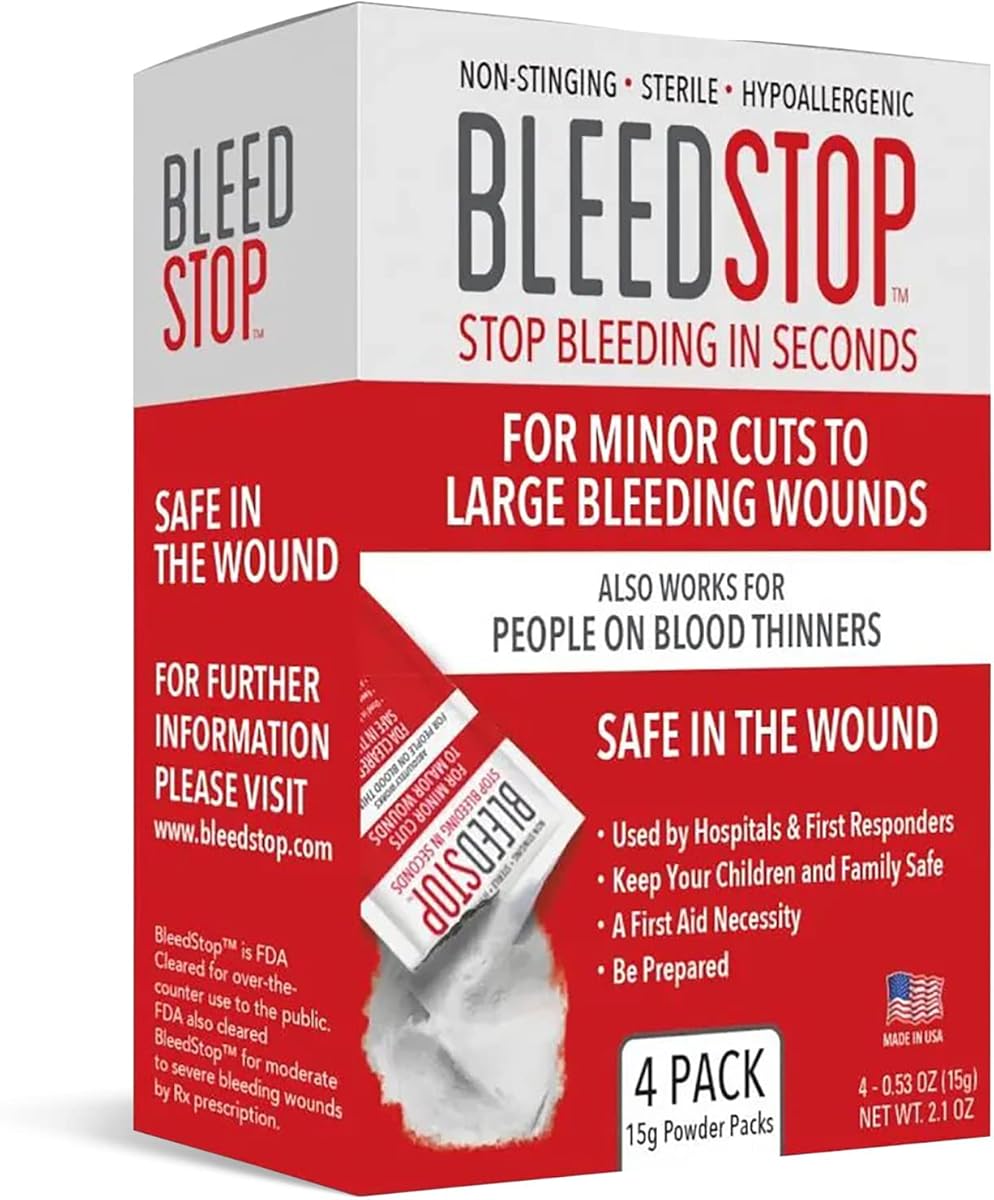
BleedStop First Aid Powder is a focused first-aid product for controlling moderate to severe bleeding from cuts, lacerations, scrapes, and nosebleeds. Its 4.8 rating ties the highest score in this roundup, while the four individually packed 15-gram portions make the product easy to distribute among household, vehicle, and outdoor kits.
We may earn a commission when you buy through this link, at no additional cost to you.
The application method is straightforward: apply a layer that covers the wound surface, then add firm pressure with sterile gauze or a bandage. The powder is described as safe to leave in place, and the formula is stated to be non-stinging and suitable for children. The product data also specifically says it is intended to help people who regularly take blood thinners, a group for whom timely bleeding control can be especially important.
The most important limitation is that this is first aid, not a substitute for emergency medical care. Serious bleeding requires prompt professional treatment, and prolonged bleeding after applying pressure is a clear reason to seek help. Users should also follow the package directions, use clean materials, and receive appropriate training on when and how to control wounds.
BleedStop is a strong addition for campers, cyclists, travelers, caregivers, and households that want a dedicated bleeding-control item alongside gauze and bandages. Its compact pouches, simple procedure, and non-stinging formula make it approachable for family first-aid kits. The rating reflects a product that addresses one serious need clearly and without adding bulk.
The powder is intended to work upon contact and is paired with firm pressure and sterile dressing. This makes it a focused supplement to a conventional first-aid kit rather than a replacement for one.
The stated suitability for people taking blood thinners adds a meaningful layer of preparedness. Households with relevant medical risks should place it where all responsible members can find it quickly.
We may earn a commission when you buy through this link, at no additional cost to you.
The Leaton Hand Crank Emergency Radio is a high-capacity portable power and information device. Its 4.5 rating reflects a broad feature set, and the 10,000mAh internal battery is the largest stated battery capacity among the radios reviewed. It also includes USB output for emergency phone charging, NOAA, AM, and FM reception, multiple lighting modes, and a compass.
We may earn a commission when you buy through this link, at no additional cost to you.
Power can come from the built-in solar panel, hand crank, or USB-C input. The product data estimates that one minute of steady cranking may provide 15 to 20 minutes of listening, though actual output varies. The radio offers a high, low, and SOS flashlight mode, plus a 1.3-watt reading lamp. Its IPX6 rating indicates protection from water spray and splashing, but the manufacturer clearly states that it is not for immersion or heavy rain.
Its most significant functional limitation is that NOAA reception requires manual tuning. It does not support SAME technology, automatic alerts, or location-based warnings, so someone must extend the antenna, select NOAA mode, and locate the clearest local station. It also has no headphone jack and cannot charge multiple devices simultaneously. The 5V/1A output is modest compared with charging speeds people may expect from modern wall chargers.
This radio is a strong option for households, campers, RV travelers, and vehicle kits that value battery capacity and outdoor durability. Its one-year warranty, included cable, and one-year maintenance guidance are useful additions, but owners should fully charge it initially and recharge it every three to six months during storage. For those who understand its manual-alert design, it is a capable multi-purpose emergency radio.
The 10,000mAh internal battery gives the radio greater potential as a backup charger than smaller models. The stated expectation of approximately one to one-and-a-half iPhone 14 charges reflects realistic conversion and efficiency losses.
The IPX6 water-splash rating, compact dimensions, one-pound stated weight, and three charging methods suit camping, hiking, fishing, and vehicle use. It remains an electronic device that should be protected from immersion and severe exposure.
Because the radio does not provide SAME or automatic location-based alerts, users need to learn how to tune NOAA manually. Recording the clearest local station during normal conditions can make this task easier when conditions are poor.
We may earn a commission when you buy through this link, at no additional cost to you.
The best emergency preparedness items should match your hazards, household size, mobility, and ability to maintain them. Consider coverage gaps first, then examine capacity, portability, ease of use, and long-term upkeep before making a purchase.
Local risks should determine the balance of your kit. Areas exposed to severe storms may prioritize a NOAA radio and dependable lighting, while earthquake, wildfire, or flood regions may require more water, protection from debris, and longer-term supplies. Travelers and hikers need portable filtration, warmth, navigation, and communication rather than a large quantity of duplicated household items. A practical method is to list the likely first 72 hours of needs: safe water, food, medical care, warmth, light, information, and a way to signal for assistance. The broader survival kits provide a useful starting framework, but they still require customization. Look for products that address your specific region, household members, mobility limits, and any medical equipment that must remain powered.
A comprehensive kit is convenient, but every added tool adds weight and takes up space. Portable filters, tablet treatments, compact radios, and lightweight bivies are easier to carry during an evacuation than a large collection of full-size camping equipment. At the same time, a compact collection may be inadequate for an extended power outage. Separate the kit into a grab-and-go section and a fixed shelter or supply section so important items remain accessible. For vehicles and homes, weight matters less, but storage space and clear labeling do. Check dimensions, carry options, and whether a bag is organized into compartments. The best setup is the one people will actually maintain, locate quickly, and update.
A water filter, purification tablets, and sealed drinking water solve different parts of the hydration problem. Filters offer repeated use and convenient processing of natural sources, while chemical tablets are exceptionally compact and provide a backup when mechanical equipment fails. Sealed pouches and bottles ensure immediate access but do not treat new water. Evaluate the contaminants you are likely to encounter, the volume required by your household, and the time needed to obtain clean water. Do not assume any filter can remove salt or every chemical. Read treatment directions carefully, and maintain filters as specified. A resilient kit often combines at least one treatment method with a reserve of already-safe water.
A preparedness radio should provide useful information when cellular networks and household electricity fail. Look for NOAA weather reception, AM and FM broadcasts, a rechargeable internal battery, a flashlight, and more than one way to recharge. Understand whether alerts are automatic or require manual tuning. Devices with SAME or location-based alerts may issue warnings more readily, but a manually tuned radio can still provide broadcasts when users know how to find the right station. Check physical controls, antenna design, speaker quality, and battery-care requirements. Large controls can help older adults and families operate the radio under stress. Also consider where the radio will live, because a device in an inaccessible storage bin may be of little value.
First-aid supplies are most useful when family members know how to use them. Broad kits can include adhesive strips, cotton materials, tweezers, scissors, gauze, masks, and gloves, but quantity alone does not guarantee preparedness. Add items for the specific hazards in your area, including bleeding control, allergy treatment, blister care, medications, and sanitation supplies. Anyone using a blood-control product should understand the application process, know that it is not a substitute for professional care, and be prepared to call emergency services. Store medical items in a labeled, reachable pouch and check expiration dates regularly. Training through a recognized first-aid course can make any kit more effective.
Emergency warmth products are compact safeguards, not substitutes for proper cold-weather equipment. Mylar blankets can reduce heat loss, cover the ground, or form part of an improvised shelter, while bivy-style sleeping bags provide more full-body coverage. Consider the stated dimensions, weight, tear resistance, and whether one person can use the product without assistance. Puncture resistance and careful folding matter because damaged foil can lose much of its effectiveness. For camping or extended travel, a proper sleeping bag, insulated pad, and weatherproof tent should remain the primary system. Emergency thermal products are best treated as contingency layers for travelers, drivers, and households facing outages.
Rechargeable emergency devices need a maintenance plan. Follow the stated guidance for initial charging and periodic top-ups; the Leaton radio specifically recommends recharging every three to six months during long-term storage. Test radios, flashlights, and power banks on a regular schedule, and replace aging disposable batteries where the design uses them. Solar panels can be a useful backup but should not be the only charging method, since charging speed depends strongly on light. Hand cranks provide valuable redundancy, yet users should learn how much cranking is required. Keep a written note about device functions, radio stations, and battery care so another household member can operate the equipment if needed.
No single product can prepare a household for every emergency. A radio does not purify water, a survival bag does not monitor weather, and a first-aid powder does not provide light. Build complementary layers: at least one water-treatment approach plus stored water, one radio or information source, multiple lighting methods, dedicated medical supplies, and warmth options. Keep critical items in more than one location, such as home, vehicle, and workplace, without creating so many duplicates that maintenance becomes difficult. Update quantities as household members or medical needs change. Redundancy is most valuable when each layer performs a genuinely different function and remains in working condition.
Begin by separating products into clearly labeled groups for water, communications, medical care, warmth, lighting, food, and shelter. Inventory each item, record expiration dates where applicable, and place frequently needed gear in a backpack or handled tote that can be reached without searching multiple rooms. Keep the most critical supplies together in a grab-and-go container rather than distributing every item across the home.
Learn the functions before an emergency. Practice filling a filter from a safe source, following tablet directions, tuning the radio, activating its lights, charging a phone, and applying pressure with bleeding-control supplies. Run a realistic family drill that includes locating the kit, checking weather information, and assigning responsibilities. Ensure children and older adults know which tasks they can safely perform without delaying emergency calls.
Inspect and maintain the kit on a schedule. Recharge radios and power banks, replace batteries, check sealed food and water, examine filters, verify tent and tool components, and update first-aid materials before their expiration dates. After using any item, replace it immediately rather than waiting for the next inspection. Store consumables in cool, dry conditions and protect electronics from moisture and extreme temperatures.
The most useful foundation includes safe drinking water, multiple water-treatment options, a working radio, lighting, first-aid supplies, warmth items, and food suitable for the expected duration. A ready-to-grab bag should also contain basic tools and a copy of important documents. The exact mix should reflect local hazards and the needs of each household member.
A complete kit provides a convenient starting point and can prevent important gaps, but it should still be customized. Individual purchases are useful for replacing weak components, addressing specialized medical needs, and reducing bulk. Many households benefit from using a broad kit as the core while adding tailored water, food, radio, and clothing supplies.
Authorities commonly recommend at least one gallon of water per person per day for several days, though the correct amount depends on climate, activity, medical needs, and available purification equipment. The Ready America backpack includes sealed pouches for a limited group and period, while filters and tablets can expand available water from suitable sources. Stored water should be replaced on the manufacturer’s recommended schedule.
Neither is universally better. Filters are convenient for repeated use and can process larger volumes, but their effectiveness depends on the model and maintenance. Tablets take extremely little space and are easy to carry, though they require correct dosing and waiting time. Keeping both methods plus a reserve of sealed water provides stronger redundancy.
That depends on the radio. Some models support SAME or location-based automatic alerts, while others require users to tune manually to a NOAA channel. The Leaton radio listed here does not support automatic alerts and must be tuned manually. Buyers should verify the alert method and test reception in their area before an emergency.
Several radios can provide limited USB charging from an internal battery. Charging speed and capacity vary with the radio and phone, and some models support only one device at a time. A radio’s charging function should be treated as an emergency backup rather than a replacement for a dedicated power bank.
Review the entire kit at least every few months and follow expiration dates on food, water, medicine, filters, and other consumables. Recharge electronic devices on their specified schedule and inspect tools, tents, bags, and batteries for damage. Update the kit after family membership, vehicle, medical needs, or local hazards change.
A vehicle kit is useful because it can be accessed while traveling, but it should not be the only place supplies are stored. Extreme temperatures can degrade food, medications, batteries, and some water containers. Keep a properly sized portion at home as well, and avoid leaving children or animals in a parked vehicle during a heat emergency.
The leading choices cover different core needs rather than competing in one category. Mylar emergency blankets provide inexpensive, lightweight warmth; the LifeStraw delivers highly portable personal water filtration; and the FosPower radio combines NOAA information, lighting, and a substantial power bank. The Ready America and 262-piece kits then provide organized starting points for broader household or outdoor coverage.
Prioritize gaps rather than buying only because a kit looks impressive. A family should first ensure that it can obtain water, receive warnings, see in a blackout, treat a minor injury, stay warm, and leave quickly. Add redundancy for the most likely hazards, place supplies where they can be reached, and learn how each device and medical item works before it is needed.
Finally, review current prices, availability, ratings, and product details before purchasing because features and costs can change. Check the manufacturer’s instructions, verify included accessories, and inspect the shipment on arrival. A well-maintained emergency kit is more valuable than a larger collection that is poorly organized or left unprepared for use.