
XFX Swift Radeon RX 9060 XT OC 16GB
4.8Editor score
16GB GDDR6 graphics memory
Dual-fan Swift cooling
Up to 3320MHz boost clock
HDMI and dual DisplayPort
Our GPU for Elden Ring guide compares 10 capable graphics cards for 1080p, 1440p, and 4K play, covering performance, VRAM, cooling, features, and fit.
Elden Ring can look beautiful on a capable graphics card, but you do not need a flagship GPU to enjoy its open world, combat, and atmospheric environments. The most important factors are consistent frame rates, sufficient graphics memory, effective cooling, and compatibility with your monitor and PC case.
This guide compares 10 AMD Radeon and NVIDIA GeForce graphics cards across memory capacity, processor architecture, boost clocks, cooling designs, power requirements, physical dimensions, and gaming-oriented features. It includes mainstream, higher-resolution, value-focused, and premium options without claiming any card was personally tested.
The top selections represent distinct buying priorities: the ASRock RX 9070 Challenger is the strongest all-around recommendation, the XFX RX 9060 XT is the value-focused choice, and the GIGABYTE RTX 5080 represents a premium upgrade. Product availability and prices change frequently, so confirm current listings and system requirements before purchasing.
4.8Editor score

4.8Editor score

4.6Editor score
The table below compares all 10 graphics cards by architecture, memory, cooling, and the most relevant physical or gaming specifications. It is a quick way to identify the right balance of capability, case compatibility, and upgrade level before reading the detailed reviews.




The GIGABYTE Radeon RX 9070 XT Gaming OC is a well-balanced option for players who want strong image quality and dependable headroom for Elden Ring at 1440p or 4K. It carries a 4.7 rating and combines 16GB of GDDR6 memory with a PCIe 5.0 interface, giving it a modern foundation for high-resolution play and current gaming features.
We may earn a commission when you buy through this link, at no additional cost to you.
Its standout feature is the combination of ample graphics memory and the WINDFORCE Cooling System. The listed thermal gel is intended to improve heat transfer, while the Hawk fan design supports airflow through a card that is likely to run warm during extended exploration and repeated boss encounters. RGB lighting also makes it a visually suitable choice for a showcase build.
The main trade-off is that the RX 9070 XT is a substantial upgrade rather than an entry-level purchase. Buyers should measure their chassis, check the required power connections, and consider whether their processor can avoid creating a bottleneck at lower resolutions. The listed specifications do not provide every physical dimension, so checking the official product page and retail measurements is essential.
This is a strong recommendation for an enthusiast who wants high-resolution texture quality, ray-tracing capability, and a generous memory buffer without moving to the premium RTX 5080 class. It is especially compelling for a new PC build intended to handle Elden Ring and other demanding modern games for several years.
The 16GB memory capacity provides useful headroom for high-resolution textures, shadows, and other high-detail settings. It also makes the card more versatile when Elden Ring is played alongside other graphically demanding titles in the same library.
WINDFORCE cooling and server-grade thermal conductive gel are designed to manage sustained heat. These features are valuable because open-world games often run for long periods, making thermal behavior and acoustic consistency more important than a brief benchmark result.
We may earn a commission when you buy through this link, at no additional cost to you.
The ASUS Dual Radeon RX 9060 XT is a strong fit for 1080p and 1440p gaming, particularly for builders who value memory capacity, a relatively restrained design, and flexible operating modes. Its 4.7 rating reflects a well-regarded product, while 16GB of GDDR6 avoids the tighter memory limitations associated with many lower-cost alternatives.
We may earn a commission when you buy through this link, at no additional cost to you.
The card's 2.5-slot design improves compatibility without abandoning cooling performance. Axial-tech fans use smaller hubs and longer blades to increase downward air pressure, while 0dB technology keeps the fans from spinning during lighter workloads. A dual BIOS switch also lets users select between Quiet and Performance profiles without reinstalling software.
Clock speeds reach up to 3250MHz in OC mode and 3230MHz in default boost mode, providing factory-tuned performance. However, the RX 9060 XT is positioned below the RX 9070 models, so buyers seeking maximum 4K headroom may prefer a larger-tier card. Exact dimensions and power requirements are not included in the supplied specifications and should be verified.
This GPU is a compelling recommendation for a new Elden Ring system at 1080p or 1440p, particularly if 16GB of memory, useful cooling features, and a less bulky format are priorities. It also suits users who want the flexibility of Quiet and Performance modes for different games or daily computing tasks.
Sixteen gigabytes is a meaningful advantage for texture-heavy settings and future games. In Elden Ring, the practical benefit appears most clearly when combining high-resolution visual options with demanding background scenery rather than using only basic settings.
The ability to switch between Quiet and Performance BIOS profiles makes it easy to favor quiet operation while exploring menus or playing lighter games, then select the higher-performance profile for more demanding sessions.
We may earn a commission when you buy through this link, at no additional cost to you.
The ASUS Dual GeForce RTX 5060 Ti 16GB OC Edition combines modern NVIDIA architecture with enough memory for high-quality 1080p and 1440p gaming. Its 4.7 rating, 16GB of GDDR7, and DLSS 4 support make it a particularly relevant choice for players who value current NVIDIA features and a compact 2.5-slot format.
We may earn a commission when you buy through this link, at no additional cost to you.
DLSS 4 is the defining feature, while the card's 767 AI TOPS specification highlights the emphasis on AI-assisted graphics functions. Axial-tech fans improve airflow, 0dB technology allows silent light gaming, and a dual BIOS setup provides Quiet and Performance modes. The factory OC mode reaches 2632MHz, with a 2602MHz default mode.
Compared with the RX 9060 XT, this card sits in a similar broad performance class but offers a different ecosystem and feature set. NVIDIA-specific technologies may appeal to players who regularly use compatible frame-generation or upscaling features. Conversely, buyers interested primarily in raw value may not need every capability of the Blackwell platform.
Choose the ASUS Dual RTX 5060 Ti if you want current NVIDIA graphics technology, 16GB of GDDR7, and DLSS 4 in a relatively compact package. It is a sensible option for a new 1440p-oriented system, particularly when DLSS support is high on your buying list.
DLSS 4 support gives the RTX 5060 Ti access to NVIDIA's latest graphics feature generation. For compatible titles, that can provide useful flexibility between image quality and frame-rate priorities, although actual settings and gains depend on the game and display.
The 2.5-slot chassis is intended to improve build compatibility while retaining cooling efficiency. Axial-tech fans and 0dB operation make this card suitable for systems where a full-size, aggressively cooled GPU would be inconvenient.
We may earn a commission when you buy through this link, at no additional cost to you.
The GIGABYTE Radeon RX 7600 XT Gaming OC is a familiar midrange option for 1080p and 1440p gaming. Its 4.5 rating, 16GB of GDDR6, and triple-fan WINDFORCE design make it relevant for Elden Ring players who want modern memory capacity and a substantial cooling system.
We may earn a commission when you buy through this link, at no additional cost to you.
The 128-bit memory interface is narrower than those found in higher-tier cards, but the 16GB allocation helps compensate in memory-sensitive situations. The card also supports PCI Express 4.0, offers a metal backplate, and includes RGB Fusion. Its HDMI 2.1a and DisplayPort 2.1 outputs support contemporary high-resolution displays and multi-monitor arrangements.
Compared with the newer RX 9060 XT and RX 9070 options, this card belongs to an older and generally lower performance tier. That may not be a disadvantage for a targeted build, but it offers less obvious headroom for future games, ray tracing, and 4K settings. Users should also consider whether the card's physical size and power requirements suit their system.
The RX 7600 XT is most appropriate for 1080p gaming and 1440p play with carefully selected settings. It is a sensible choice when 16GB of memory, multiple modern video outputs, and a triple-fan cooler matter more than having the newest architecture. For buyers seeking the longest possible upgrade runway, a current-generation alternative may be preferable.
Two HDMI 2.1a and two DisplayPort 2.1 outputs make the card adaptable to high-refresh displays and multi-monitor desks. Check monitor standards and adapter requirements before purchase to ensure every planned display is supported as intended.
The 16GB memory allocation remains attractive for texture quality even though the interface is narrower than on newer models. It is especially useful for users who want more memory than common entry-level cards provide without moving into a flagship price category.
We may earn a commission when you buy through this link, at no additional cost to you.
The ASRock Radeon RX 9070 Challenger stands out as the most complete recommendation in this guide. It combines AMD RDNA 4 architecture, 16GB of GDDR6 across a 256-bit bus, and a factory boost clock of up to 2520MHz. That combination gives it a strong profile for high-quality 1440p gaming and 4K exploration in Elden Ring.
We may earn a commission when you buy through this link, at no additional cost to you.
Its 4.8 rating is the highest among the listed products, alongside the XFX Swift RX 9060 XT. The card includes 56 compute units, 3,588 stream processors, third-generation ray-tracing hardware, and second-generation AI accelerators. A 20 Gbps memory speed supports demanding textures, ray tracing, and other graphics-intensive workloads without a more premium product tier.
The product information is unusually clear about compatibility: it is a 2.5-slot card measuring 290 by 123 by 51mm, uses two 8-pin power connectors, and has a recommended 700W PSU. Those are meaningful constraints, but they also make planning straightforward. The triple-fan design includes 0dB silent operation and an LED indicator.
This is the GPU to choose for a balanced high-end build that prioritizes memory capacity, modern architecture, and strong gaming headroom without moving into the RTX 5080 class. It is best suited to builders with a suitably sized case and robust power supply, but it offers a more coherent all-around package than many alternatives.
The 256-bit bus and 20 Gbps memory provide a strong foundation for high-resolution textures and ray-tracing workloads. Sixteen gigabytes also leaves room for demanding settings and future titles without the constraints of a smaller memory allocation.
Published dimensions and a 700W recommended PSU make it easier to avoid an incompatible build. The two 8-pin connectors also require careful cable routing, so the case should have adequate space behind the card for a tidy installation.
We may earn a commission when you buy through this link, at no additional cost to you.
The ASUS Prime Radeon RX 9070 XT 16GB OC Edition is a high-performance choice for 1440p and 4K gaming, with a listed boost clock reaching 3030MHz in OC mode. Its 4.6 rating, 16GB GDDR6 allocation, and modern Radeon platform make it particularly interesting for players who want strong performance in a relatively restrained 2.5-slot design.
We may earn a commission when you buy through this link, at no additional cost to you.
Cooling is handled by two Axial-tech fans, while a phase-change GPU thermal pad is designed to maintain heat transfer and support long-term reliability. The 0dB feature allows the card to remain quiet during light activity, and the dual BIOS switch separates Quiet and Performance profiles. GPU Tweak III adds performance tuning, thermal control, and monitoring tools.
There is some inconsistency in how the same product family is configured across listings, and the supplied clock figures differ from those of other RX 9070 XT models. That does not make the card unsuitable, but buyers should read the listing carefully and avoid assuming that every RX 9070 XT has identical cooling or factory frequencies. Exact dimensions and connector requirements also need confirmation.
This card is best for a builder who values a slim dual-fan solution, sophisticated thermal features, and a high OC-mode clock. It is a strong alternative to larger triple-fan models, provided the case has enough clearance and the power supply meets the card's requirements.
An OC-mode boost of up to 3030MHz offers a strong starting point for games that benefit from higher graphics clocks. Actual sustained performance depends on cooling, power delivery, workload, and the rest of the PC.
The phase-change thermal pad and GPU Tweak III package provide both hardware and software tools for managing a high-performance card. They are useful for users who want visibility into operating conditions and the ability to adjust the card deliberately.
We may earn a commission when you buy through this link, at no additional cost to you.
The GIGABYTE GeForce RTX 5080 Gaming OC is the premium option for Elden Ring players with a high-resolution display and a desire for substantial future headroom. Built on NVIDIA Blackwell architecture, it includes DLSS 4, 16GB of 256-bit GDDR7 memory, and a PCIe 5.0 interface.
We may earn a commission when you buy through this link, at no additional cost to you.
The card's main advantage is not simply extra gaming performance, although that is valuable. Its modern feature set can improve image presentation and frame-rate flexibility in supported games, while the 16GB GDDR7 configuration provides ample room for high-resolution textures. WINDFORCE cooling is designed to handle the substantial performance level of this class of hardware.
The tradeoff is that an RTX 5080 build requires a more generous budget and a power supply that can support a high-end GPU. Exact dimensions, connector requirements, and recommended PSU specifications were not included in the supplied product data, so those details must be verified on the official listing before purchase. A large, well-ventilated case is also advisable.
Choose this card if you play at 4K, use a high-refresh monitor, want premium ray-tracing and upscaling features, or plan to run demanding games beyond Elden Ring. It is less compelling for a 1080p-only system, where the extra capability may go largely unused.
At 4K, the GPU has more pixels to render and higher texture memory demands. A powerful Blackwell card paired with 16GB of GDDR7 is therefore most useful when visual settings are kept high rather than reduced to preserve an unnecessarily large frame-rate margin.
DLSS 4 support provides access to current NVIDIA graphics features in compatible games. These tools can give players more choices when balancing resolution, image quality, and smoothness, although supported feature sets can change over time.
We may earn a commission when you buy through this link, at no additional cost to you.
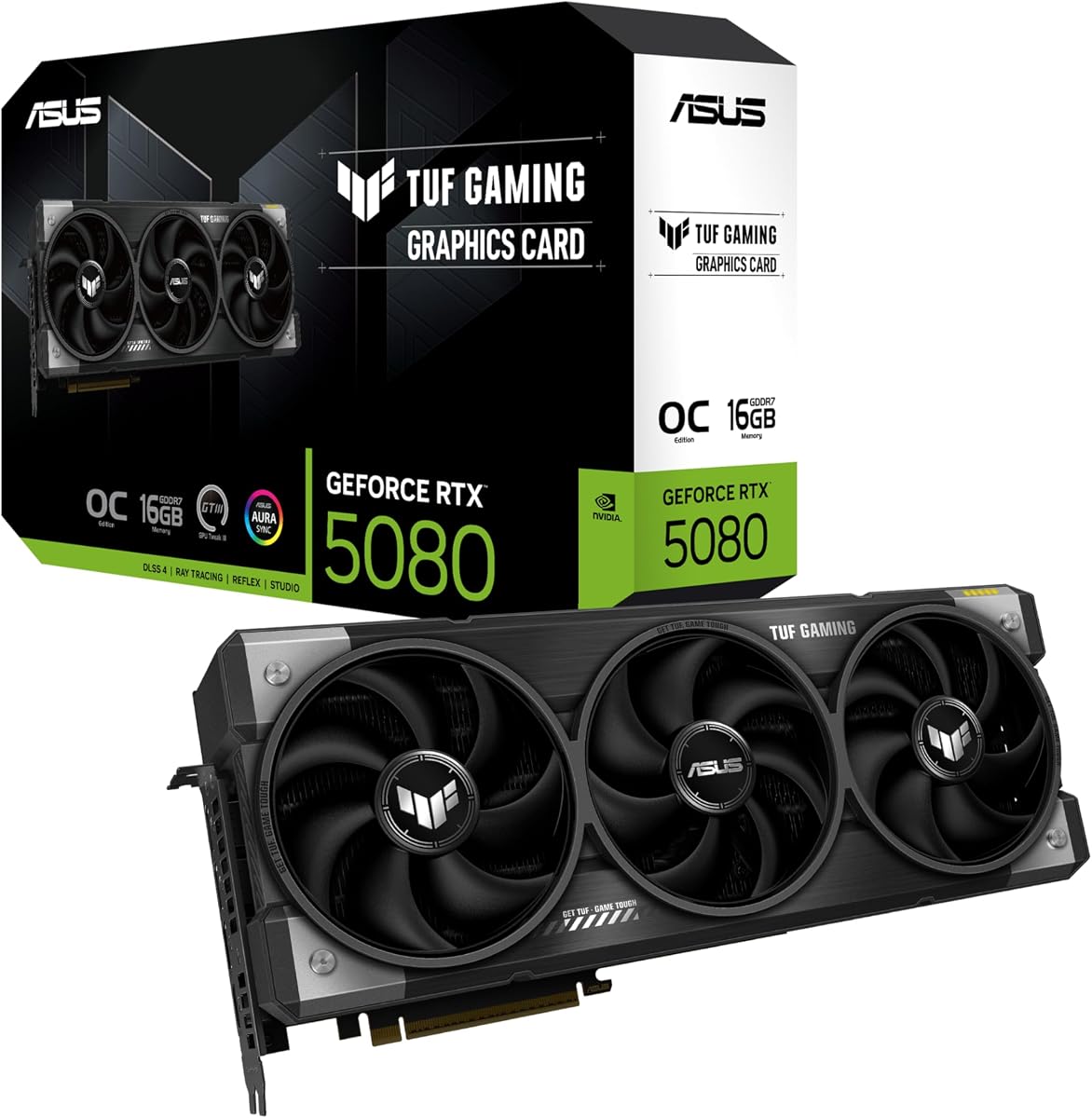
The ASUS TUF Gaming GeForce RTX 5080 is built for buyers who want premium graphics performance with a large, cooling-focused enclosure. Its 4.6 rating, 16GB of GDDR7, and triple Axial-tech fan design make it a high-end option for 4K Elden Ring play and demanding multi-game libraries.
We may earn a commission when you buy through this link, at no additional cost to you.
The thermal specification is extensive. A massive fin array is optimized for airflow, and a phase-change GPU thermal pad is intended to maintain performance over prolonged loads. Military-grade components, a protective PCB coating, and Auto-Extreme manufacturing add durability-focused features that are particularly relevant to an expensive system component.
This card is physically demanding. It measures 348mm long, occupies 3.6 slots, weighs 4.3 pounds, and requires a minimum 850W PSU with a 16-pin 12V-2×6 connector. Users should confirm case clearance, slot spacing, connector availability, and PSU suitability before buying. GPU Tweak III supports monitoring and tuning, with an OC-mode clock of 2730MHz.
The TUF RTX 5080 is ideal for a large enthusiast case where robust cooling, premium construction, and maximum GPU headroom are priorities. It is less appropriate for compact builds or systems with a modest power supply, where a smaller NVIDIA or Radeon card would be a more sensible fit.
The three-fan layout and large fin stack are intended to move substantial amounts of air through a high-power GPU. The phase-change pad also supports stable thermal transfer, which is valuable during long play sessions and demanding graphics workloads.
A 348mm length and 3.6-slot thickness can interfere with large CPU coolers, front fans, and neighboring expansion slots. The included GPU bracket helps with mounting, but chassis planning remains essential.
We may earn a commission when you buy through this link, at no additional cost to you.
The ASUS Dual GeForce RTX 3050 6GB is a budget-oriented upgrade intended for 1080p gaming, including Elden Ring at settings that balance image quality and frame rate. It carries a 4.7 rating and uses NVIDIA Ampere streaming multiprocessors, second-generation RT cores, and third-generation Tensor cores.
We may earn a commission when you buy through this link, at no additional cost to you.
Its 2-slot design is one of the most useful physical attributes in the list. It can fit into compact builds where a 2.5-slot or 3.6-slot card would cause clearance problems. Axial-tech fans promote downward airflow, while IP5X dust resistance is intended to improve long-term durability. The OC mode reaches 1500MHz, compared with 1470MHz in default mode.
The major limitation is 6GB of GDDR6 memory. That capacity is adequate for basic 1080p play, but it leaves less room for high-resolution textures, aggressive settings, and future games than the 16GB options. Users should also avoid expecting flagship-level 4K performance or a complete match for the more advanced cards in this guide.
This is a reasonable choice for an entry-level gaming PC that needs a dedicated GPU, or as a modest upgrade from integrated graphics. It works best when paired with a 1080p display and a system processor that does not create a severe bottleneck.
The two-slot design gives this card an advantage in systems with limited expansion clearance. It is a practical option for builders who value a straightforward upgrade more than maximum settings at high resolutions.
Second-generation RT cores and third-generation Tensor cores support ray tracing and DLSS-related features. These capabilities add flexibility, though the card's 6GB memory and lower overall tier still limit how far high-end settings can be pushed.
We may earn a commission when you buy through this link, at no additional cost to you.
The XFX Swift Radeon RX 9060 XT OC Gaming Edition is the best budget-oriented recommendation because it combines 16GB of GDDR6 with a modern RDNA 4 platform. Its 4.8 rating is among the highest in the list, making it a particularly attractive option for 1080p and 1440p Elden Ring builds.
We may earn a commission when you buy through this link, at no additional cost to you.
The card's listed boost clock reaches up to 3320MHz, while the Swift dual-fan cooling solution manages two key roles: moving heat away from the GPU and keeping noise reasonable during extended play. Its output configuration includes HDMI and two DisplayPort connections, providing flexibility for a single high-refresh monitor or a multi-display setup.
The main limitation is its place below the RX 9070 class in the range. It offers less maximum performance for 4K, ray tracing, and future workloads, and the supplied information does not list exact dimensions or detailed power requirements. Both should be confirmed before ordering, particularly in a compact case or a system with a limited power supply.
This is a strong recommendation for a new gaming PC where 16GB of memory matters but flagship spending is unnecessary. It gives Elden Ring players a modern card with a high clock and ample memory, while remaining more approachable than the premium options in the guide.
The 16GB memory allocation is the card's most important budget-oriented advantage. It provides more room for textures and future games than many similarly positioned entry-level cards, making the Swift easier to recommend for a complete new build.
A boost clock of up to 3320MHz supports strong factory-tuned performance, while HDMI and dual DisplayPort outputs cover common desktop arrangements. Check the exact connector layout and adapter needs for your planned monitors.
We may earn a commission when you buy through this link, at no additional cost to you.
Choosing a GPU for Elden Ring starts with the resolution and settings you intend to use, followed by memory, cooling, power, and physical fit. The most expensive card is not automatically the best choice, so it is important to balance gaming needs with the rest of the system.
In short, match the GPU to the display rather than to a desired upgrade tier. A 1080p system can be excellent with a modest card, while a high-refresh 1440p display benefits from a stronger model.
Choose 16GB when possible, especially for 1440p or 4K play. Treat 6GB as a targeted budget solution rather than a long-term high-settings platform.
Consider the broader graphics ecosystem as well as raw performance. Useful upscaling, ray-tracing, monitoring, and tuning tools can add long-term value.
Prioritize steady thermals, adequate airflow, and a card size your chassis can accommodate. Quiet operation is a major benefit during long exploration sessions.
Check the card's connector and PSU recommendations before buying, then confirm that your processor and other components leave sufficient power headroom.
Measure both length and thickness before ordering. Leave enough room for connectors and airflow, and check that neighboring components will not block the card.
Ensure the processor, memory, and power supply are capable enough to support the GPU. A balanced PC delivers better results than overspending on one component alone.
Prioritize the visual settings you will actually use. Test moderate combinations first and leave enough performance margin for consistent frame rates.
Before installation, read the card's dimensions, power requirements, and included components. Confirm that the case has enough clearance, that the PSU supplies the correct connector, and that the operating system has suitable AMD or NVIDIA drivers. Connect the required power cables before turning on the PC, and route them so they do not obstruct fans or press against sharp edges.
After entering Elden Ring, begin with a moderate graphics preset and adjust resolution, texture quality, shadow effects, and ray tracing one at a time. Use the card's monitoring software to observe temperature, clock speed, fan behavior, and memory use. Allow a stable frame-rate target to guide adjustments, and avoid assuming that a higher numerical setting always produces a better experience.
Keep the card's intake and exhaust paths clear of dust, and ensure the case has enough airflow for the card and CPU. Do not change clocks, fans, or power limits until the default configuration is stable. When using overclocking utilities, make conservative changes, monitor temperatures, and retain the ability to restore default settings if stability or audio behavior becomes an issue.
No. Elden Ring is playable on much more affordable hardware, particularly at 1080p. A card with 6GB or 16GB of memory can provide a good experience when the resolution and graphics settings are matched to the system. A faster GPU becomes more important at 1440p or 4K, or when you want maximum texture detail, ray tracing, and high frame rates.
It is a worthwhile consideration for a new system, especially if the card will also run newer games. More memory allows the GPU to handle detailed textures and complex visual effects with greater flexibility. The RTX 3050's 6GB allocation remains usable for 1080p gaming, but it offers less room for future settings and high-resolution output.
Both brands can run Elden Ring well, and the right choice depends on the complete PC, desired resolution, and preferred features. AMD Radeon models in this guide offer RDNA 4 hardware and ample 16GB configurations on many tiers. NVIDIA GeForce models add features such as DLSS 4, which can be valuable in supported games. Compare performance at your target settings rather than choosing solely by the logo.
The RX 9060 XT is well suited to 1440p gaming with appropriate settings. Its 16GB memory capacity provides useful headroom, and the factory clock is designed for modern gaming workloads. Actual results depend on the processor, game settings, and whether ray tracing or upscaling is enabled, so it is sensible to verify recent independent benchmarks for the exact model.
It depends on the graphics card and the rest of your system. Higher-end cards may require a more powerful PSU or a connector that your current unit does not provide. The ASRock RX 9070 Challenger recommends a 700W PSU, while the ASUS TUF RTX 5080 lists a minimum 850W PSU. Check both requirements and the overall system draw before upgrading.
Allow enough room for the card's thickness, fan clearance, and power cables, and keep the intake and exhaust paths unobstructed. The cards here range from a two-slot design to the ASUS TUF RTX 5080 at 3.6 slots and 348mm long. Measure the case and consider large CPU coolers before buying a model near the size limit.
No. DLSS 4 is an optional feature on supported NVIDIA hardware, not a requirement for playing the game. AMD cards can still deliver excellent results through their own architecture and settings. Upscaling can be helpful for performance, but native image quality, consistent frame rates, and personal preference should determine whether it is worth using.
Yes, every card in this guide can drive a 1080p display, although exact resolution support should be confirmed through the included HDMI or DisplayPort outputs and the desired refresh rate. At 1080p, a budget-oriented card is usually sufficient, while premium models provide additional headroom for higher settings or 1440p and 4K displays.
The ASRock Radeon RX 9070 Challenger is the strongest all-around choice, combining RDNA 4 architecture, 16GB of 256-bit GDDR6, a 2520MHz boost clock, and detailed fit and power information. The XFX Swift Radeon RX 9060 XT is the best budget selection for 1080p and 1440p, while the GIGABYTE GeForce RTX 5080 Gaming OC represents the premium option for high-resolution systems.
For most new builders, prioritize 16GB of memory, sufficient cooling, and a power supply that meets the card's requirements. Match the GPU to the intended monitor resolution, and do not overspend on a flagship card if the system is primarily limited to 1080p. Compact cases also make physical dimensions and slot thickness as important as gaming performance.
Finally, check current product listings, specifications, connector requirements, and prices before ordering because availability and pricing can change. With the right balance of resolution target, memory, cooling, and chassis support, any of these cards can provide a strong foundation for Elden Ring and a broader modern gaming library.
