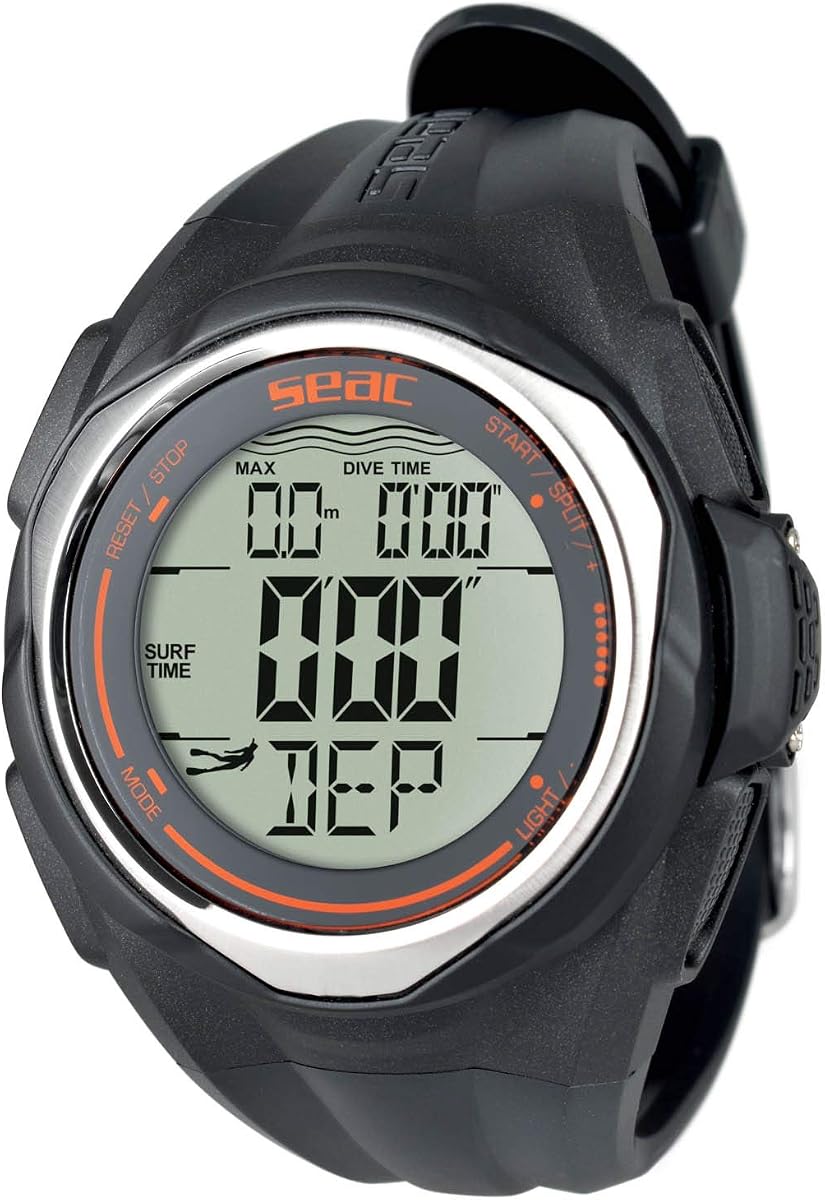
SEAC Partner
4.0Editor score
Up to 99 dive records
100-meter water resistance
Backlit timing display
Our dive watch for freediving guide compares ten wrist computers for depth tracking, timing, displays, safety alerts, navigation, and everyday versatility at
A dive watch for freediving should make underwater information easy to read without distracting from the descent, breath-hold, or ascent. The most useful models combine dependable depth tracking, a clear display, simple controls, relevant alerts, and a comfortable wrist fit, while basic options may focus more narrowly on timing and session records.
This guide compares ten wrist computers using the supplied specifications, including supported dive modes, depth capabilities, display features, navigation functions, connectivity, durability, and battery information. The list covers dedicated freediving watches, general dive computers with apnea modes, and rugged multisport models, so readers can choose according to their experience and priorities.
Each review explains what distinguishes the product, where it may fit into a freediving routine, and which compromises or additional features to consider. Ratings and product details reflect the supplied listings, while prices can change at any time, so readers should confirm the current listing, included accessories, and specifications before purchasing.
4.0Editor score

4.6Editor score

4.6Editor score
The comparison below places each watch according to its stated depth capability, display, freediving support, and broader navigation or connectivity functions. It is intended to make the differences among dedicated freediving computers, scuba-oriented models, and multisport dive watches easier to understand before making a purchase.


The SEAC Partner is a purpose-built wrist computer for freediving, with a 4.0 rating among the supplied listings. Its defining qualities are focused rather than expansive: it combines a stopwatch, countdown function, a backlit display, and storage for as many as 99 dives. That combination makes it a practical option for sessions centered on repeatable breath-hold timing.
We may earn a commission when you buy through this link, at no additional cost to you.
The supplied information gives the watch a 100-meter water-resistance rating and standard CR2032 battery compatibility. Its straightforward timing tools can help structure preparation, descent, breath-hold, and recovery periods, while the log provides a way to retain basic session history. A backlit display also improves the chance of checking information in darker conditions.
The trade-off is that the listed capabilities do not extend into sophisticated navigation, wireless tank pressure, smartphone synchronization, or a full multisport platform. Buyers seeking a compact freediving tool may find that simplicity beneficial, but those who want detailed data analysis or daily-watch functions may need a more advanced model.
The SEAC Partner is best for freedivers who want a dedicated timing and recording device without paying for a broad collection of unrelated features. It is especially relevant to training and routine pool or open-water sessions where consistent timing matters more than navigation or advanced health metrics. For those priorities, it is a focused and approachable choice.
The stopwatch and countdown functions support the central rhythm of freediving practice. This makes the watch a natural fit for organizing repeated breath-hold efforts and reviewing how individual dives progress across a session.
With storage for up to 99 dives, the computer keeps a practical history within reach. That is useful for tracking consistency without requiring a connected device or a more complex data platform.
We may earn a commission when you buy through this link, at no additional cost to you.
The SALVIMAR One Plus carries a 4.2 rating and is positioned as a versatile wrist computer for freediving, spearfishing, snorkeling, and underwater training. Unlike a basic interval timer, it provides depth tracking, dive time, surface interval, and water temperature, giving the diver a broader view of each session.
We may earn a commission when you buy through this link, at no additional cost to you.
Its EL backlit screen is designed for readability in low-light and deeper conditions. The listed feature set also includes a depth gauge, dive timer, surface recovery tracking, and temperature monitoring. Five programmable alarms add a way to structure preparation or recovery, while world time and a long-term calendar make the watch useful away from the water.
The main consideration is complexity relative to a dedicated minimalist freediving watch. A device with this many functions may take more time to learn, and the supplied specifications do not mention wireless tank-pressure monitoring or app-based analysis. Its 100-meter depth tracking and water-resistance figure are clearly stated, but buyers should still verify their actual needs and the manufacturer's instructions.
The SALVIMAR One Plus suits a freediver who wants more than stopwatch timing but does not need a full technical dive-computer system. It is particularly attractive for spearfishing, snorkeling, and training sessions where depth, temperature, recovery, and alarms all have practical value.
The EL backlight helps important depth and timing information remain visible in low-light conditions. That makes the display more useful during early dives, shaded entries, or any session where ambient light is limited.
World time, calendar functions, and programmable alarms extend the device beyond underwater use. The result is more versatile than a dedicated session timer and potentially more convenient for travel and everyday wear.
We may earn a commission when you buy through this link, at no additional cost to you.
The Suunto D5 is a general dive computer with a 4.0 rating, offering a 100-meter waterproof design, color display, digital compass, wireless tank-pressure capability, vibration alarms, and wireless mobile connection. It is aimed at divers who want a versatile wrist computer rather than a watch marketed only for breath-hold training.
We may earn a commission when you buy through this link, at no additional cost to you.
Its color screen is one of the most immediately distinctive listed features, offering a different reading experience from monochrome or small segment displays. The digital compass adds surface and underwater orientation, while wireless mobile connection can support broader device integration. Vibration alarms offer a way to receive important prompts without relying on sound alone.
The supplied details do not specifically identify a dedicated freediving mode, so a buyer focused entirely on apnea timing should confirm that function in the current product documentation. Wireless tank pressure also implies a compatible transmitter for that particular capability, potentially adding an accessory that is not included in every use case.
The D5 makes the most sense for a diver who alternates freediving with scuba or snorkeling and values a colorful display, compass, and connected features. It may be less focused than the SEAC Partner for interval work, but it offers more general-purpose equipment for a broader dive program.
The color display differentiates the D5 from many basic dive watches. It can make menus and changing data easier to distinguish, particularly when the diver wants a single device for several underwater activities.
A built-in digital compass and wireless mobile connection support orientation and integration. These features extend the watch beyond freediving sessions and make it attractive to divers who maintain one computer for many environments.
We may earn a commission when you buy through this link, at no additional cost to you.
The Cressi Nepto is a compact freediving watch computer with a 4.1 rating. Designed specifically for breath-hold diving, it combines a 48-millimeter case, a high-contrast 35-millimeter display, customizable settings, a logbook, and algorithms intended to protect against Taravana risk and pulmonary edema.
We may earn a commission when you buy through this link, at no additional cost to you.
Its size is a major selling point for freedivers who prefer a smaller instrument than a large multisport watch. The high-contrast display is designed to remain readable during critical moments, while the specialized algorithms make the device more purpose-built than a conventional scuba computer that merely includes a freediving mode.
Construction details include mineral glass, a heavy-duty case, steel buttons, a rubber strap, and a stainless-steel buckle. The stated resistance to water pressure is 120 meters. Conversely, the supplied specifications do not mention wireless synchronization, tank-pressure support, or a broad range of everyday smartwatch functions.
The Nepto is a strong recommendation for freedivers who value compactness, a dedicated interface, and safety-oriented algorithms over connectivity. It is less suitable for buyers seeking extensive multisport tracking, but it directly addresses the needs of a specialist breath-hold computer.
The listed Taravana and pulmonary-edema protection functions set the Nepto apart from ordinary stopwatches. These specialized algorithms are intended to support safer freediving decisions rather than merely record elapsed time.
A 48-millimeter case and 35-millimeter high-contrast display favor portability and quick reading. The compact profile may also feel less obtrusive during long sessions than a large smartwatch-style computer.
We may earn a commission when you buy through this link, at no additional cost to you.
The Cressi Leonardo 2.0 is a scuba dive computer with a 4.2 rating, supporting Air, Nitrox, and Gauge modes. Its single-button interface simplifies navigation, while visual and audible alarms help surface important dive information. It also offers integration with iOS and Android devices through wireless connectivity.
We may earn a commission when you buy through this link, at no additional cost to you.
This product is better viewed as a capable general dive computer than a dedicated freediving watch. The supplied feature set concentrates on scuba setups, decompression-related use, critical alerts, and data management. USB and infrared transfer options provide additional ways to move and review dive logs.
For a buyer whose priority is breath-hold timing and freediving-specific safety behavior, the device's scuba emphasis can feel excessive. The supplied listing does not explicitly detail a dedicated freediving mode, timer layout, or other apnea-specific functions, so those details should be checked before purchase.
The Leonardo 2.0 is a sensible option for divers who split their time between scuba and freediving and want phone integration, simple controls, and critical alerts. It offers less of a focused freediving identity than the Nepto, but it may be more useful when one device must handle several types of dive.
The single-button interface reduces control complexity underwater. That can be valuable when a diver needs to change settings quickly or understand alerts without navigating through a crowded keypad.
Compatibility with iOS and Android, combined with USB and infrared transfer, supports more flexible log review. Divers can maintain a history beyond the watch itself and connect the device to a broader digital routine.
We may earn a commission when you buy through this link, at no additional cost to you.
The Garmin Descent G1 earns a 4.6 rating and combines a rugged watch-style enclosure with support for recreational, advanced, technical, freediving, and spearfishing. Its sapphire lens, silicone bands, and monochrome display are designed for a durable, readable instrument that can serve both underwater and everyday use.
We may earn a commission when you buy through this link, at no additional cost to you.
One standout feature is the ability to mark surface entry and exit points using GPS, GLONASS, and Galileo support. The watch stores up to 200 dives and works with the Garmin Dive app for uploading, sharing, and reviewing sessions. This makes it useful for divers who want a more complete record than a standalone timing watch provides.
Its broader platform includes over 30 sports apps, training features such as VO2 Max, wrist-based heart-rate tracking, Pulse Ox, sleep information, and Body Battery monitoring. The supplied information notes that Pulse Ox is unavailable in every country and that the device estimates activity metrics rather than providing medical measurements.
The G1 stands out as the most balanced choice for an active freediver who also trains, travels, and wants location data. Its smartwatch functionality and health metrics create additional complexity compared with a specialist freediving watch, but the combination of durability, freediving support, navigation, and training data gives it exceptional range.
GPS-based entry and exit markers help divers connect each session to a real-world location. This is particularly useful on unfamiliar beaches, rocky entries, or dive sites where finding the exit point from the water can be difficult.
More than 30 sports apps and training metrics extend the watch into general athletic development. Freedivers can monitor broader workload information alongside depth and dive time instead of maintaining completely separate tools.
We may earn a commission when you buy through this link, at no additional cost to you.
The Garmin Descent Mk3i is a premium, watch-style dive computer with a 4.6 rating. Its 1.4-inch AMOLED display, scratch-resistant sapphire lens, 51-millimeter titanium bezel, and 200-meter dive-rated case place it at the upper end of the featured range for display quality and rugged construction.
We may earn a commission when you buy through this link, at no additional cost to you.
The dive-first design supports multiple modes for recreational through technical scuba diving and freediving. SubWave technology can exchange preset messages with nearby divers, and the optional Descent T2 transceiver supports tank-pressure and depth monitoring for a group. The built-in flashlight offers variable intensity and strobe modes for visibility in dark conditions.
Navigation features include DiveView maps with bathymetric contours, more than 4,000 listed dive sites, multi-band GPS above water, and an underwater compass. A readiness tool estimates how sleep, exercise, stress, and jet lag may affect diving preparedness. These capabilities are sophisticated, but they also require more menu familiarity than a simple freediving timer.
The Mk3i is best suited to a serious diver who values a premium display, durable materials, detailed site information, group communication, and a complete wrist-based ecosystem. Its 51-millimeter size may feel substantial, particularly for dedicated freedivers who prefer a compact instrument, but it offers exceptional versatility for long-term ownership.
The 1.4-inch AMOLED screen provides a large, vivid surface for depth, time, maps, and other information. Sapphire glass adds scratch resistance for a device expected to face rocks, gear, and repeated outdoor use.
DiveView depth contours, site information, multi-band GPS, and an underwater compass support orientation before and during a session. This makes the Mk3i useful for freedivers who repeatedly visit complex or unfamiliar entry points.
We may earn a commission when you buy through this link, at no additional cost to you.
The Cressi Raffaello has a 4.4 rating and supports four operating modes, including apnea and Gauge. That explicit apnea support makes it more relevant to dedicated breath-hold diving than many conventional scuba computers, while its built-in digital compass and mixed-gas planning system broaden its use for technical divers.
We may earn a commission when you buy through this link, at no additional cost to you.
The RGBM-based planning system is designed for preparation involving multiple gas mixes. Bluetooth and USB connectivity provide two options for moving dive history to a smartphone or computer, allowing sessions to be reviewed outside the watch. These capabilities make the Raffaello a strong choice for divers who want detailed planning and organized records.
The expected battery life of four years is a meaningful advantage over frequently charged electronic watches. The battery is user-replaceable, which can reduce long-term maintenance concerns. On the other hand, the supplied details do not state the display type, size, backlight, or exact physical dimensions, so a buyer who prioritizes readability should verify those specifications.
The Raffaello suits an experienced diver who wants a full dive computer with apnea mode, navigation, and planning tools. It is less minimalist than the Nepto, but it offers more breadth and serves divers who move between breath-hold, gauge, and other underwater activities.
Apnea mode gives freedivers a native operating option instead of forcing the activity into a general gauge setup. It is a useful foundation for organizing breath-hold sessions within a wider dive-computer platform.
A user-replaceable battery with an expected four-year life reduces charging and replacement frequency. That can be especially convenient for divers who want a reliable instrument without daily smartwatch charging.
We may earn a commission when you buy through this link, at no additional cost to you.
The Shearwater Research Teric holds the highest supplied rating at 4.8. It combines a wrist-watch form with a dedicated Freediving Mode, Bühlmann ZHL-16c decompression algorithm, configurable Gradient Factors, and support for optional wireless tank-pressure transmitters.
We may earn a commission when you buy through this link, at no additional cost to you.
The algorithm and its adjustable Gradient Factors offer detailed control for experienced divers. Switchable audible and vibration alerts allow important prompts to be presented in different environments, while the Freediving Mode places the watch in a category where breath-hold metrics and procedures can take priority.
The 316 stainless steel bezel and buttons add a durable, substantial feel, and the supplied 22-millimeter strap size includes an extender. The 51-millimeter bezel and buttons add a durable, substantial feel, and the supplied 22-millimeter strap size includes an extender. Some freedivers may find a technical computer more complex than a dedicated apnea watch requires.
The Teric is an excellent choice for an experienced freediver who also scuba dives, performs technical dives, or wants a computer with extensive configuration. Its strong rating and flexible algorithm support reward users who understand the settings, while a simple training watch may be easier for occasional swimmers.
Configurable Gradient Factors allow divers to tune the ZHL-16c algorithm around their own objectives and experience. This is a major advantage for technical users who want more than a fixed automatic setting.
Audible and vibration alerts can be switched according to the situation. Divers can use a discreet tactile prompt in noisy or social settings or rely on an audible warning when it is more noticeable.
We may earn a commission when you buy through this link, at no additional cost to you.
The Shearwater Research Peregrine has a 4.7 rating and focuses on a straightforward dive-computer experience. Its two-button interface, 316 stainless steel buttons, and state-aware menu structure are designed to reduce control complexity, while the rechargeable battery can provide up to about 30 hours at medium brightness.
We may earn a commission when you buy through this link, at no additional cost to you.
The state-aware menu changes according to the current activity, which can make navigation more direct. A USB wireless charging station is included, removing the need to hunt for a proprietary cable when the watch needs power. Its compact case also differentiates it from large smartwatch-style dive computers.
The supplied information is limited compared with the Teric and Garmin models, so buyers should confirm the exact dive modes, depth capabilities, freediving functions, and navigation tools in the current documentation. The listed battery figure is based on medium brightness, and actual use can vary with display settings and features.
The Peregrine is a compelling choice for a diver who values uncomplicated controls, solid construction, and convenient charging. It is particularly attractive to anyone who finds a large multifunction display unnecessary, though buyers should verify its freediving data and safety features against their specific needs.
A two-button layout and state-aware menus make the Peregrine approachable. The interface changes with the current context, which can reduce the number of steps needed to find relevant information.
The included USB wireless charging station provides a simple way to keep the computer ready. Up to about 30 hours of battery life at medium brightness is useful for extended dive travel and multi-session weekends.
We may earn a commission when you buy through this link, at no additional cost to you.
The right dive watch for freediving depends on how you train, what data you use, and whether the same device must also support scuba diving or everyday wear. These factors help narrow the field before comparing display quality, endurance, fit, and safety features.
A dedicated freediving mode should present the information and procedures most relevant to breath-hold diving, such as timing, depth, and session organization. Models such as the Cressi Nepto are built specifically for freediving, while the Seac Partner emphasizes stopwatch and countdown functions. Other options, including the Cressi Raffaello and Shearwater Research Teric, place apnea mode inside broader dive-computer platforms.
Choose a dedicated model for simplicity, or a multifunction computer when freediving is only one part of your underwater program. Verify that the interface, timers, and alerts match how you actually train.
Depth capability should comfortably exceed the depth you expect to reach, while water resistance describes the stated pressure rating of the housing. Featured figures include 100 meters for the Seac Partner, SALVIMAR One Plus, and Suunto D5, 120 meters for the Cressi Nepto, and a 200-meter dive-rated case for the Garmin Descent Mk3i.
Treat the listed rating as a product specification, not a guarantee that every recreational depth is appropriate. Check the manufacturer's guidance, preserve the seals, and never use a watch beyond its documented limits.
The display should present depth and time clearly at a glance, especially during the most demanding parts of a session. The Nepto uses a 35-millimeter high-contrast display, the Descent G1 has an easy-to-read monochrome screen, and the Descent Mk3i uses a 1.4-inch AMOLED panel. Backlighting is also important for low-light conditions.
Choose based on legibility, control simplicity, and screen size. A larger display can show more information, but a compact screen may be easier to consult quickly and less distracting on the wrist.
A compass, dive-site maps, and surface GPS can help a diver navigate unfamiliar water or return to a marked entry point. The Garmin G1 supports marking entry and exit locations, while the Descent Mk3i adds DiveView maps, bathymetric contours, multi-band GPS, and an underwater compass. The Suunto D5 and Cressi Raffaello also include digital compasses.
Surface tracking is not a substitute for a dive plan, sound signals, a buddy system, or knowledge of local conditions. Use navigation features as additional support and verify how the device behaves underwater.
Battery life should match the length and frequency of your sessions. The Descent G1 lists up to 25 hours in dive mode, the Peregrine about 30 hours at medium brightness, and the Cressi Raffaello has a user-replaceable battery with an expected four-year life. The Seac Partner uses a standard CR2032 battery, while the Descent Mk3i and Peregrine use rechargeable systems.
Rechargeable models offer convenience but require charging discipline. Replaceable-battery designs may be easier to maintain over years, particularly for extended travel where charging access is inconsistent.
Consider how you want to review sessions. Local storage is useful in the water, while Bluetooth, mobile apps, and USB or infrared transfer can support longer-term review. The Descent G1 and Mk3i store up to 200 dives and work with the Garmin Dive app, while the Leonardo 2.0 supports iOS and Android, USB, and infrared transfer.
Connectivity is useful but should not dictate the purchase by itself. Make sure the app and device remain supported, and retain your own records in case you later change equipment or want to upgrade.
The watch should remain comfortable and easy to consult during repeated dives. The Cressi Nepto is notably compact at 48 millimeters, while the Garmin Descent Mk3i has a 51-millimeter case. Strap material, buckle or bracelet design, case thickness, and wrist size also influence the fit and may affect how readily a diver checks the display.
If possible, compare dimensions with a watch or diving tool already worn. A smaller instrument may feel less intrusive, while a larger screen can be easier to read. Secure the strap properly and follow the manufacturer's guidance for underwater use.
Water exposure, impacts, corrosion, and daily wear all affect long-term durability. The Nepto uses mineral glass, steel buttons, and a heavy-duty case, while the Descent G1 and Mk3i use sapphire lenses. Alerts are another important category: options include audible warnings, vibration prompts, Taravana protection, and algorithms intended to reduce certain risks.
A safety feature is not a substitute for training, conservative planning, appropriate supervision, and personal judgment. Confirm that every alert is understood before relying on it during a real dive.
Before entering the water, read the complete manual for the specific model, install or verify the battery as directed, and confirm that the date, time, units, and dive mode are correct. Explore the menus in a dry environment, understand every alert, and learn how to start, pause, save, and review a session. If the watch supports wireless devices or an app, complete pairing and synchronization before the trip rather than during the entry area.
Treat the watch as a supporting tool rather than the only source of safety information. Establish a conservative breathing and ascent plan, use a buddy system where appropriate, and make surface recovery decisions based on training and current conditions. Review depth and time at sensible intervals, but avoid repeatedly manipulating the controls when a quick glance is enough. A watch can support awareness; it cannot judge how a diver feels.
After the session, rinse the watch with fresh water as specified by its manufacturer, especially after exposure to salt, sand, chlorine, or contaminants. Pay attention to the crown, buttons, strap, and seals without forcing any component. Dry the unit fully before storage, inspect the strap and case for damage, and recharge or replace the battery according to its instructions. Have pressure-resistance checks performed when required and replace a worn strap or damaged seal before the next outing.
A scuba computer can be suitable if it includes a properly implemented freediving or apnea mode and displays the data needed during breath-hold sessions. Some models provide excellent general depth and timing information, while dedicated freediving computers may offer a more focused interface and specialized safety procedures. Confirm freediving functionality, depth limits, and alerts in the current manual before using any computer for breath-hold diving.
A freediving watch prioritizes breath-hold timing, depth, recovery, and a compact underwater interface. A general dive computer may add scuba modes, decompression algorithms, navigation, tank-pressure support, and extensive logging. A general computer can work well for freedivers, but it may be larger and more complex than necessary, while a specialist watch may offer fewer options for scuba or everyday use.
A compass can be valuable when diving in unfamiliar locations, around reefs, or near complex shorelines. It is an additional aid rather than a replacement for a proper dive plan, buoyancy control, and reliable surface markers. Consider the Nepto if compactness is the priority, the Raffaello or Suunto D5 for a built-in compass, or the Garmin models for more extensive navigation and surface-location features.
The best battery life comfortably covers your longest outing plus a reserve for delays and repeated checks. The listed figures range from about 30 hours for the Peregrine at medium brightness to the Raffaello's expected four years with a user-replaceable battery. Display brightness, alerts, navigation, and activity features can affect actual performance, so verify the manufacturer's test conditions and begin with a fully charged or fresh battery.
Yes, if the model supports both freediving and scuba modes and you understand how to configure it for each activity. The Cressi Raffaello, Shearwater Research Teric, Suunto D5, Cressi Leonardo 2.0, and both featured Garmin Descent models provide broader dive-computer functions. Check the supported modes, required accessories, and whether any gas or transmitter setup is needed before the trip.
A larger display can make depth, time, and menus easier to see, especially in poor conditions. However, size also affects wrist comfort and may make the watch more distracting during training. The 1.4-inch AMOLED on the Descent Mk3i offers maximum information space, while the Nepto's 35-millimeter high-contrast display prioritizes a smaller dedicated profile.
GPS generally does not work underwater because satellite signals cannot penetrate the water effectively. Surface GPS can still mark the entry and exit of a dive, as supported by the Descent G1 and Mk3i, while an underwater compass helps with directional orientation below the surface. These features should complement, not replace, sound signals, landmarks, and a well-planned return route.
Rinse the computer with fresh water after each session and dry it thoroughly before opening any compartment or changing accessories. Keep the case, buttons, strap, and seals free of grit, and avoid exposing the watch to extreme heat or impact. Follow the manufacturer's battery, service, and pressure-testing instructions, and replace damaged straps or seals before the next dive.
The SEAC Partner is the focused choice for simple timing, stored dive records, and affordability-oriented use. The Garmin Descent G1 takes the editorial selection because it combines a rugged sapphire-lens design, freediving support, surface location markers, and a broad training platform. For buyers seeking the most advanced display and navigation experience, the Garmin Descent Mk3i provides a 1.4-inch AMOLED screen, durable premium construction, and extensive dive tools.
Prioritize the functions you will genuinely use. Dedicated freedivers may value the Cressi Nepto's compact case and specialized algorithms, while divers who alternate between activities may prefer the Cressi Raffaello or Shearwater Teric. The Seac Partner and SALVIMAR One Plus suit buyers who want simple or versatile wrist computers without a large multisport display, and the Shearwater Peregrine appeals to those who prioritize straightforward controls and convenient charging.
Before ordering, check the current listing, manual, depth rating, supported modes, included accessories, and any transmitter or connectivity requirements. Prices and product configurations can change, so confirm the current details and compare the watch with your own training demands rather than relying on a feature count alone.