
VIPERA NVIDIA GeForce RTX 4090 Founders Edition
4.6Editor score
16,384 NVIDIA CUDA cores
Up to 8K HDR gaming
NVIDIA DLSS 3 support
HDMI 2.1a connectivity
Our flagship graphics card guide compares 10 high-end models for gaming, ray tracing, AI, cooling, memory, and build fit in October 2026 for buyers.
Flagship graphics cards represent the most capable graphics options available for demanding gaming, high-resolution displays, creative workloads, and increasingly capable AI-assisted applications. A genuinely strong flagship must combine substantial processing power, ample memory, effective cooling, reliable power delivery, and enough physical clearance to fit inside the intended computer.
This guide compares ten high-end GeForce RTX and Radeon RX models using their published specifications, including GPU architecture, memory capacity and interface, boost clocks, cooling design, power requirements, display support, and physical dimensions. The list includes NVIDIA Blackwell and Ada Lovelace cards as well as AMD Radeon RX 9070 XT models, providing coverage for different budgets and preferences.
Each review explains who the card is best suited for, where its design strengths matter, and what compromises buyers should consider. Features such as DLSS 4, dual BIOS profiles, 0dB operation, phase-change thermal pads, and liquid cooling are discussed where applicable. Product prices and availability change frequently, so readers should verify current listings and system requirements before purchasing.
4.6Editor score

4.6Editor score

4.7Editor score
The comparison below highlights the major architectural, memory, cooling, and connectivity differences among all ten flagship graphics cards. Specifications are taken from the supplied product information, and dimensions, power needs, and display capabilities should be checked against the rest of your computer before buying.



The GIGABYTE GeForce RTX 5080 Gaming OC is a modern flagship option built around NVIDIA's Blackwell architecture. It carries a 4.6 rating and combines DLSS 4, a 16GB GDDR7 memory configuration, and a 256-bit interface with a dedicated WINDFORCE cooling system. Those headline specifications place it squarely among the strongest cards in this guide for high-end gaming and graphics-intensive applications.
We may earn a commission when you buy through this link, at no additional cost to you.
The most important strength is the combination of architecture and memory. GDDR7 is designed for high-bandwidth workloads, while the 256-bit interface provides a substantial data path for demanding games, high-resolution textures, and graphics work. DLSS 4 adds an important performance option on supported content, allowing the GPU to use AI-assisted rendering while maintaining high visual output. The WINDFORCE system is specifically intended to manage the heat generated by a high-power flagship GPU.
The main trade-off is platform preparation. A card at this level can demand a robust power supply, a spacious case, and careful attention to connector compatibility. Although the supplied specifications do not give the card's exact length, weight, PSU recommendation, or power connector type, those details should be confirmed before checkout. Buyers should not assume that every power supply and enclosure can support the latest flagship hardware.
This is a strong recommendation for a buyer who wants current top-tier NVIDIA technology without moving beyond the mainstream RTX 5080 class. It is especially relevant for modern gaming, high-refresh displays, and workloads that benefit from upscaling. The GIGABYTE card may also suit builders who recognize the WINDFORCE brand and prefer a conventional air-cooled implementation. Verify case clearance, PSU capacity, and the required power connection, then compare current availability with the other RTX 5080 options.
Blackwell and DLSS 4 make this card relevant to gamers using high-refresh or high-resolution displays, where frame rates are closely connected to image clarity. DLSS 4 support is particularly useful when the native rendering cost of a demanding title becomes difficult to manage, although the exact benefit depends on the game and the user's graphics settings.
The 16GB of GDDR7 memory and 256-bit interface provide a capable foundation for modern games and creative applications. Buyers who regularly handle high-resolution assets should also examine total system memory, storage speed, and application requirements because GPU memory is only one part of a balanced workstation.
We may earn a commission when you buy through this link, at no additional cost to you.
The ASUS TUF Gaming GeForce RTX 5070 Ti OC combines a 4.8 rating with NVIDIA Blackwell architecture and 16GB of GDDR7 memory. It is a compelling high-end option for buyers who value a robust partner card rather than the absolute top model in NVIDIA's stack. Its gaming-oriented specifications also make it a natural choice for high-refresh gaming and visually demanding releases.
We may earn a commission when you buy through this link, at no additional cost to you.
Thermal design is a major selling point. A large fin array works with three Axial-tech fans to move air across the GPU, while a phase-change GPU thermal pad is included to support heat transfer and longevity. The card is also protected by a PCB coating intended to reduce the risk of short circuits caused by moisture, dust, or debris. These features make the TUF model appealing for a system expected to run demanding workloads for extended periods.
Power and fit are the most important caveats. ASUS specifies a minimum 850W PSU with a 16-pin 12V-2×6, also identified as 12VHPWR, connector. The 3.125-slot design also needs more expansion-room consideration than a compact two-slot card. The stated OC and default boost clocks are 2610MHz and 2588MHz respectively, giving users a factory-tuned performance profile and a default profile for different priorities.
The ASUS TUF RTX 5070 Ti is best recommended for gamers and creators who want 16GB of modern memory, a substantial cooling system, and the highest listed customer rating among these picks. It may not be the right choice for a compact computer or for anyone unable to accommodate the PSU and connector requirements. Confirm the connector's routing, leave appropriate clearance around the cable, and use the supplied monitoring and tuning tools responsibly.
The three-fan thermal design, large heatsink, and phase-change pad form a comprehensive cooling approach for a high-end GPU. They are particularly relevant to buyers who intend to use the card for long gaming sessions or sustained creative work, provided that the card receives adequate case airflow.
The minimum 850W power-supply recommendation should be treated as a baseline rather than a target. A quality unit with additional headroom, plus a correctly seated 16-pin 12V-2×6 connection, is more important than choosing a PSU solely by its advertised wattage.
We may earn a commission when you buy through this link, at no additional cost to you.
The VIPERA NVIDIA GeForce RTX 4090 Founders Edition is an uncompromising flagship card with 16,384 CUDA cores and a 4.6 rating. Its most compelling capabilities center on high-resolution gaming: support for 4K 120Hz HDR, 8K 60Hz HDR, variable refresh rate, and 8K HDR gaming according to the supplied HDMI 2.1a specifications.
We may earn a commission when you buy through this link, at no additional cost to you.
The underlying hardware combines new flow multiprocessors, fourth-generation Tensor cores, and third-generation RT cores. NVIDIA describes the new multiprocessors as delivering up to twice the performance and power efficiency of the preceding generation, while the Tensor and RT cores focus on AI and ray-tracing workloads. DLSS 3, NVIDIA Reflex, and the NVIDIA Encoder expand the feature set for gaming, responsiveness, and livestreaming.
The central compromise is platform age. Although the RTX 4090 remains a formidable product, it belongs to the Ada Lovelace generation rather than the newer Blackwell architecture represented by several cards in this list. Buyers should compare it with current alternatives based on actual software support, memory needs, power requirements, and the displays they own. A premium GPU also demands careful attention to case dimensions, cooler clearance, and PSU quality.
This card is most appropriate for enthusiasts who want extreme 4K or 8K gaming, high-end creative applications, or a powerful CUDA-oriented development environment. It can be especially attractive when a system is already prepared for a large, power-intensive GPU and when its display setup benefits from HDMI 2.1a. For buyers starting from a modern platform or seeking a newer AI feature set, the Blackwell selections deserve careful consideration.
The card's support for 4K 120Hz HDR and 8K 60Hz HDR makes its display capabilities easy to appreciate on suitably equipped monitors and televisions. Resolution and refresh rate should be matched to the GPU, the game, and the user's settings rather than treated as guarantees of a specific frame rate.
Fourth-generation Tensor cores and the large CUDA count make this model relevant to AI-assisted and GPU-computed workflows. The built-in NVIDIA Encoder also adds value for creators who livestream, while NVIDIA Reflex targets lower-latency gaming.
We may earn a commission when you buy through this link, at no additional cost to you.
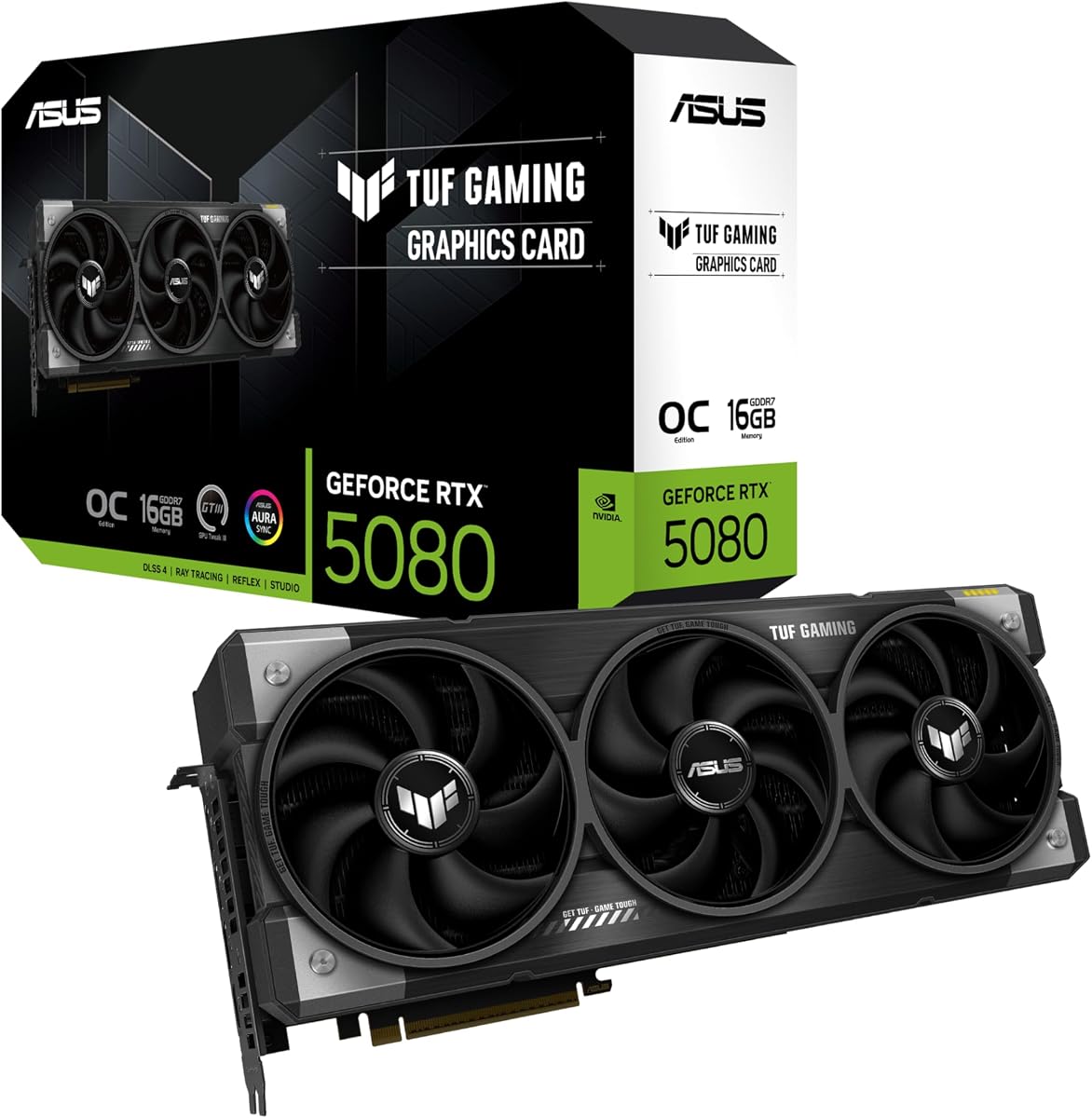
The ASUS TUF Gaming GeForce RTX 5080 16GB GDDR7 OC Edition combines Blackwell architecture with a large thermal system and a 4.6 rating. It is designed for buyers who want a current NVIDIA flagship and can accommodate a substantial three-fan cooler. Its published 3.6-slot size makes case planning unusually important.
We may earn a commission when you buy through this link, at no additional cost to you.
ASUS gives the card a massive fin array, three Axial-tech fans, a protective PCB coating, and a phase-change GPU thermal pad. The OC profile reaches 2730MHz, while the default boost clock is 2700MHz. GPU Tweak III provides performance tuning, thermal controls, and system monitoring, allowing experienced users to inspect behavior and adjust settings with more granularity.
Physical dimensions are clearly stated at 348mm long and 3.6 slots, with a listed weight of 4.3 pounds. A GPU bracket is included, and users must confirm both case clearance and slot spacing. The card also requires a minimum 850W PSU and a 16-pin 12V-2×6 connection. Its size may be excessive for compact cases, while the power requirement can rule out upgrades in systems with modest or aging power supplies.
The ASUS TUF RTX 5080 is a strong recommendation for gamers with a roomy, well-cooled desktop who prefer a robust air-cooled flagship over a liquid-cooled alternative. Its combination of current architecture, 16GB GDDR7, a large cooling system, and detailed monitoring tools should appeal to enthusiasts. Confirm the exact fit and power plan before ordering, and ensure the card's bracket and adjacent slots have the required space.
The large fin array and three Axial-tech fans provide a substantial cooling foundation, assisted by a phase-change GPU thermal pad. This design is well suited to sustained workloads, although the card's 3.6-slot footprint must be reconciled with the rest of the case and nearby components.
The higher OC boost clock gives buyers an immediate performance-oriented profile, while GPU Tweak III adds visibility into temperatures, activity, and settings. Users can start with the default profile and move to the OC profile once system stability has been evaluated.
We may earn a commission when you buy through this link, at no additional cost to you.
The GIGABYTE Radeon RX 9070 XT Gaming OC is a strong flagship alternative with a 4.7 rating, 16GB of GDDR6 memory, and a PCIe 5.0 interface. It gives buyers an AMD route into high-end gaming without requiring a model priced at the extreme upper end of the GPU market. The combination of memory capacity and modern Radeon hardware makes it particularly interesting for 1440p and high-refresh gaming.
We may earn a commission when you buy through this link, at no additional cost to you.
Cooling is handled by GIGABYTE's WINDFORCE system, with a Hawk fan and server-grade thermal conductive gel included in the design. RGB lighting adds visual customization for builds with a visible side panel. These features make the card more than a basic board: it is clearly intended for a complete gaming system where cooling and appearance both matter.
The most significant buyer-side task is verification. The supplied information does not list exact dimensions, slot thickness, power requirements, or connector type, so it should not be installed based on assumptions. GDDR6 rather than GDDR7 also requires an honest comparison with contemporary NVIDIA models, particularly around software support, productivity features, and the user's preferred games and applications.
The GIGABYTE Radeon RX 9070 XT is our budget-focused flagship recommendation because it pairs capable Radeon hardware with 16GB of memory and a high customer rating. It is well suited to gamers who already favor AMD software or want a high-end card without concentrating the entire budget on the absolute most expensive GPU option. Confirm dimensions and power requirements, and compare current pricing against the ASUS Prime Radeon RX 9070 XT.
The 16GB memory pool is a useful feature for modern high-fidelity games and can provide additional flexibility in mixed gaming and creative use. Actual performance still depends on the GPU, game, resolution, and settings, so memory capacity should be considered alongside the underlying architecture.
The WINDFORCE system, Hawk fan, thermal conductive gel, and RGB lighting give the card a complete enthusiast-oriented feature set. Buyers should still ensure that the surrounding case has sufficient airflow and that the card's final dimensions are compatible.
We may earn a commission when you buy through this link, at no additional cost to you.
The ASUS Dual GeForce RTX 5060 Ti 16GB GDDR7 OC Edition combines a 4.7 rating with 16GB of GDDR7 memory and a 2.5-slot design. Although it sits below NVIDIA's highest-tier models, it offers a striking combination of memory capacity, modern architecture, and a relatively restrained physical footprint for buyers building around a high-performance GPU.
We may earn a commission when you buy through this link, at no additional cost to you.
The card uses Blackwell architecture and provides 767 AI TOPS, while the OC mode reaches 2632MHz compared with a 2602MHz default boost clock. A smaller fan hub, longer blades, and a barrier ring support downward airflow. The 2.5-slot format is intended to improve compatibility and cooling efficiency in smaller chassis, which can be a decisive advantage over bulkier cards.
Quiet-use features further distinguish the Dual model. Its 0dB technology allows light gaming in relative silence, and dual BIOS lets users switch between Quiet and Performance profiles. Axial-tech fans use dual-ball bearings that ASUS states can last up to twice as long as sleeve-bearing designs. The supplied data does not provide exact dimensions or a PSU recommendation, so those details need confirmation.
This is a good match for a builder who wants 16GB of GDDR7 and modern NVIDIA features without installing the largest possible flagship. It may be especially useful in a smaller desktop where a 2.5-slot cooler is easier to accommodate. It is not the right choice for buyers who need the maximum raster, ray-tracing, or compute performance available, but it offers a more manageable path to a capable modern system.
The 2.5-slot design creates room for a high-end GPU in builds that cannot accommodate a three- or four-slot cooler. Combined with 16GB of GDDR7, it makes the card appealing to users who consider memory capacity and case compatibility as important as peak performance.
The dual BIOS switch creates a simple way to choose between a quiet profile and a performance profile. This flexibility is useful for a system that alternates between desktop work, light games, and demanding applications without requiring constant software adjustments.
We may earn a commission when you buy through this link, at no additional cost to you.
The ASUS TUF Gaming GeForce RTX 5090 32GB GDDR7 OC Edition is the memory-heavy option in this guide. It includes 32GB of GDDR7, 772 AI TOPS, and Blackwell architecture, giving it an impressive specification sheet for high-end gaming, AI workloads, and professional applications that can benefit from a large GPU memory pool.
We may earn a commission when you buy through this link, at no additional cost to you.
Despite its status as the largest model shown, ASUS describes it as SFF-ready and uses a 2.5-slot design. Two Axial-tech fans use dual-ball bearings, while 0dB technology supports quiet operation during lighter activity. A dual BIOS switch provides Quiet and Performance profiles. The factory clock reaches 2580MHz in OC mode and 2550MHz by default, with GPU Tweak III available for tuning, monitoring, and thermal control.
The 4.4 rating is the lowest among the ten products, which deserves attention even though it remains a positive customer score. It may reflect the extraordinary expectations associated with a top-tier card, but buyers should examine current customer feedback and the exact product listing before deciding. As with the highest-end GPUs, power-supply, case, and connector requirements need careful verification even though the supplied specifications do not state them for this model.
The ASUS TUF RTX 5090 is the logical selection for a buyer who values 32GB of memory above all else or who needs more GPU memory for specialized work. Its relatively restrained 2.5-slot design may also make installation easier than some larger alternatives. For ordinary high-end gaming, the cost and power demands may be difficult to justify, so the decision should be tied to actual workload requirements rather than flagship status alone.
The 32GB memory configuration is the clearest reason to choose this model. It can benefit workloads that exceed the practical limits of a 16GB card, including large datasets, complex 3D scenes, high-resolution media, and AI experimentation, although actual limits vary by software and workflow.
The SFF-ready claim and 2.5-slot cooler make the card more approachable for compact enthusiast builds than its flagship specifications might suggest. The design must still be checked against the case, while the power plan should be prepared before installation.
We may earn a commission when you buy through this link, at no additional cost to you.
The ASUS Prime Radeon RX 9070 XT 16GB GDDR6 OC Edition provides a more restrained high-end Radeon option. Its 4.6 rating, 16GB of memory, and 2.5-slot design make it attractive to builders who want capable gaming hardware without a massive cooler. It is also a natural alternative to the similarly equipped GIGABYTE Radeon model in this guide.
We may earn a commission when you buy through this link, at no additional cost to you.
The cooling system uses Axial-tech fans with smaller hubs, longer blades, and barrier rings designed to increase downward air pressure. A phase-change GPU thermal pad supports heat transfer, while dual-ball fan bearings are stated to last up to twice as long as conventional sleeve-bearing designs. The 0dB feature allows light gaming in relative silence, and dual BIOS profiles make it easy to switch between Quiet and Performance modes.
The card's OC profile reaches a 3030MHz boost clock and a 2480MHz game clock, compared with default-mode values of 3010MHz and 2460MHz. GPU Tweak III supplies performance tweaking, thermal controls, and monitoring. These features are useful for users who want informed control, although the product information does not state exact dimensions, weight, PSU requirements, or connector type, all of which require verification.
The ASUS Prime Radeon RX 9070 XT is best for a high-refresh gaming build where memory capacity, a relatively narrow cooler, and useful software matter more than selecting the largest or most visually elaborate model. It also offers a clean alternative for AMD-focused users. Check the physical specifications against the case, confirm PSU compatibility, and compare its current cost and warranty terms with the GIGABYTE version.
The 0dB feature and Quiet BIOS profile are useful when the system is being used for light games or everyday tasks. Users who want stronger sustained performance can move to the Performance profile while retaining access to thermal and activity monitoring.
A 2.5-slot cooler can be easier to install than a triple- or quad-fan design, yet this model still includes a phase-change thermal pad and upgraded fan bearings. The 3030MHz OC boost clock makes the card attractive for gaming builds where both clock speed and case compatibility are priorities.
We may earn a commission when you buy through this link, at no additional cost to you.
The ASUS TUF Gaming GeForce RTX 5070 12GB GDDR7 OC Edition is a capable mid-to-upper-tier option with Blackwell architecture, DLSS 4, and a 4.7 rating. Its 2640MHz OC boost clock and 2610MHz default boost clock provide a clear performance profile, while the TUF design focuses on cooling and component durability.
We may earn a commission when you buy through this link, at no additional cost to you.
The thermal system consists of a massive fin array and three Axial-tech fans within a 3.125-slot design. ASUS also adds a phase-change GPU thermal pad, military-grade components, and a protective PCB coating intended to protect against short circuits caused by moisture, dust, or debris. GPU Guard and the included bracket are designed to reduce mounting stress and improve stability.
The central compromise is memory capacity. Twelve gigabytes of GDDR7 is less than the 16GB offered by many competing cards in this guide. That difference may matter for future games, high-resolution textures, creative applications, and increasingly demanding workflows. The card is also relatively thick, so builders need to check slot spacing and ensure that the graphics card bracket does not interfere with nearby components.
The ASUS TUF RTX 5070 is a good recommendation for a gamer who values the RTX 5070's performance level, modern upscaling support, and TUF's cooling and construction features without moving up to a 16GB model. It may also suit a build where a 3.125-slot cooler fits comfortably. Before buying, compare memory requirements in the user's target games, check physical clearance, and confirm the card's exact power needs.
Military-grade components, a protective PCB coating, and GPU Guard support long-term reliability and safer installation. These features do not eliminate the need for careful handling, but they show that the card is designed with long-term gaming use in mind.
DLSS 4 support can make high-resolution and high-refresh gaming more manageable on supported titles. The benefit varies by game and settings, so buyers should check current game support and compare image quality preferences before relying on upscaling.
We may earn a commission when you buy through this link, at no additional cost to you.
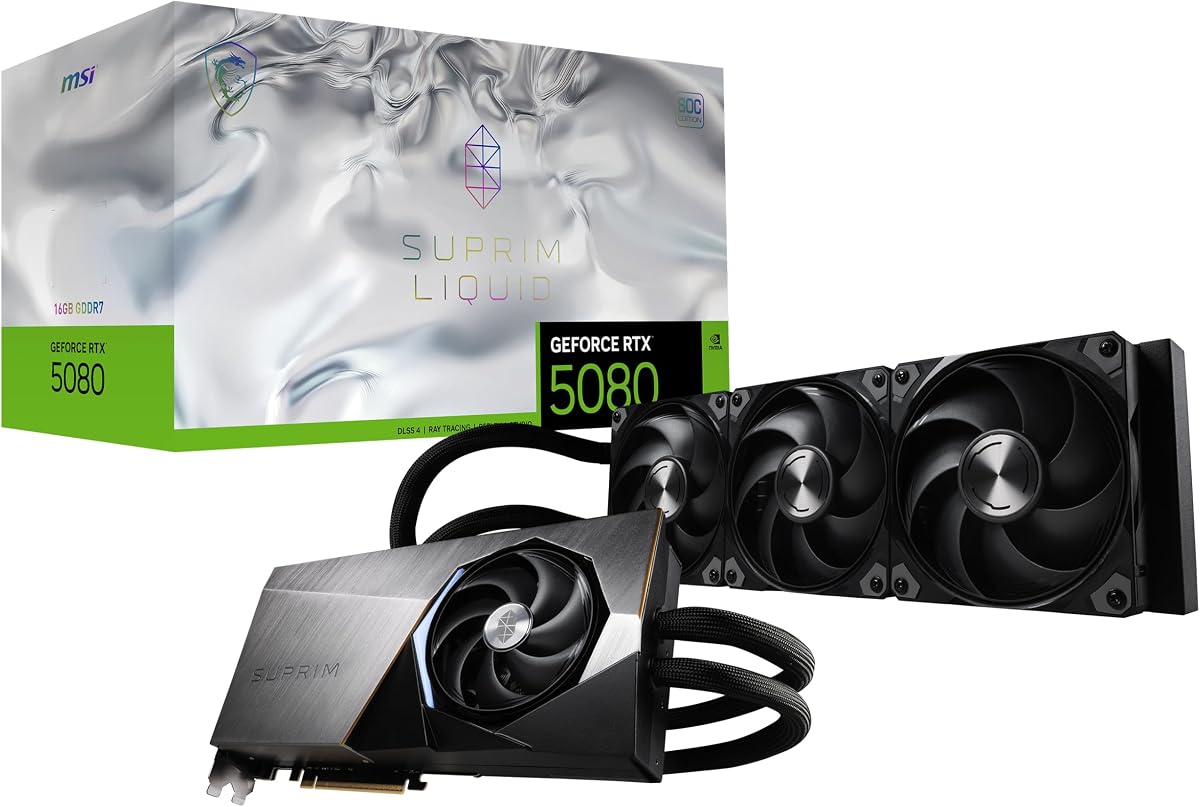
The MSI Gaming RTX 5080 16G SUPRIM Liquid SOC stands apart through its liquid-cooling design and high factory clock. It carries a 4.7 rating, uses the NVIDIA GeForce RTX 5080 chipset with 16GB of GDDR7 across a 256-bit interface, and is specified at an extreme performance clock of 2760MHz.
We may earn a commission when you buy through this link, at no additional cost to you.
Liquid cooling is the defining feature for a builder comfortable with radiator placement and pump connections. It can move heat away from the card more effectively than a conventional air cooler, potentially helping the GPU sustain its performance profile. The tradeoff is installation complexity, additional case planning, and the need to ensure the supplied cooling components fit the selected chassis.
Connectivity is excellent for a high-end multi-monitor or high-resolution setup. The card offers three DisplayPort 2.1a outputs and one HDMI 2.1b output, with a maximum digital resolution of 7680 by 4320. The supplied specifications do not provide PSU wattage, connector type, exact card length, or radiator dimensions, so compatibility should be verified rather than inferred.
The MSI SUPRIM Liquid is a strong choice for enthusiasts who want flagship RTX 5080 performance and are prepared to manage a liquid-cooling installation. It is less convenient than an air-cooled card for a quick upgrade, but the additional planning may be worthwhile in a carefully designed high-performance system. Review the full radiator and tubing dimensions, check GPU clearance, and confirm all power requirements before ordering.
A liquid-cooling solution can help transfer heat away from the GPU, making it especially interesting for sustained gaming and overclocking-minded builders. The radiator must have sufficient case clearance and airflow, and the pump and tubing arrangement should be installed according to the manufacturer's instructions.
Three DisplayPort 2.1a connectors and one HDMI 2.1b output provide flexibility for high-refresh monitors, an ultrawide display, or a multi-screen workstation. The listed maximum digital resolution of 7680 by 4320 also makes the card relevant to 8K displays and compatible media workflows.
We may earn a commission when you buy through this link, at no additional cost to you.
A flagship graphics card should be selected as part of a complete system rather than by looking at one benchmark or a single advertised feature. GPU class, memory, cooling, power, physical dimensions, software support, and display needs all influence whether a purchase will feel worthwhile.
The cards in this guide span NVIDIA's RTX 5060 Ti, RTX 5070, RTX 5070 Ti, RTX 5080, RTX 5090, and RTX 4090, along with AMD's Radeon RX 9070 XT. These are not interchangeable performance tiers. The RTX 5090 and RTX 4090 target the absolute high end, the RTX 5080 and RTX 5070 Ti sit among the most capable modern options, and the RTX 5060 Ti, RTX 5070, and Radeon RX 9070 XT can deliver strong gaming results in different cost categories. Buyers should consider the games, resolutions, refresh rates, and applications they actually plan to use rather than assuming every flagship card offers the same level of performance.
Memory capacity determines how much data the GPU can hold without falling back to slower system memory. Most cards in this guide offer 16GB, which is increasingly useful for modern games and mixed creative work, while the ASUS TUF RTX 5090 stands apart with 32GB. The ASUS TUF RTX 5070 has 12GB, making it a less future-proof choice for workloads that exceed that pool. Memory type also matters: GDDR7 appears throughout the newer NVIDIA cards, while the Radeon RX 9070 XT models use GDDR6. High memory capacity is useful, but it does not automatically make a slower GPU faster than a more capable model with less memory.
Flagship GPUs generate enough heat to make the cooler a major part of the buying decision. GIGABYTE's WINDFORCE models emphasize a dedicated multi-fan cooling system, while ASUS TUF cards use large fin arrays, three Axial-tech fans, and phase-change GPU thermal pads on several models. The ASUS Prime and Dual designs use 2.5-slot layouts to improve case compatibility, and MSI's SUPRIM Liquid uses liquid cooling. Whichever approach you choose, the case needs adequate airflow and room for the cooler. A strong card paired with a cramped, poorly ventilated enclosure can suffer from heat and noise, so cooler design and enclosure capacity should be considered together.
Power delivery is one of the most consequential compatibility issues. The ASUS TUF RTX 5070 Ti and TUF RTX 5080 explicitly require a minimum 850W PSU with a 16-pin 12V-2×6, also called 12VHPWR, connector. Other listings in this guide do not provide equivalent PSU specifications, so their requirements must be checked on the current product page or manufacturer documentation. Use a reputable power supply with sensible headroom, avoid mixing incompatible modular cables, and route the 16-pin connector exactly as directed. Proper seating is essential because an inadequately connected high-current plug can become a safety and reliability concern.
A graphics card's length, height, and slot thickness determine whether it can be installed. The ASUS TUF RTX 5080 is explicitly listed at 348mm long and 3.6 slots, and the ASUS TUF RTX 5070 Ti and RTX 5070 use 3.125-slot designs. Those cards need more room than the 2.5-slot ASUS Dual, ASUS Prime, and TUF RTX 5090. Also check CPU cooler clearance, the positions of drive cages and power supplies, and the space needed to bend or route power cables. The included GPU bracket may be useful if the original bracket conflicts with the case, but it does not resolve insufficient card length or neighboring slot conflicts.
Modern flagship performance is not determined by rasterization alone. NVIDIA cards in this guide support DLSS 3 or DLSS 4, depending on the model, while the RTX 4090 includes dedicated RT and Tensor cores. AMD buyers should consider Radeon features and game support relevant to their library. Upscaling can improve frame rates on supported content, but image quality, latency, and implementation can vary. The ASUS models also provide GPU Tweak III for tuning, thermal controls, and monitoring. Software is only as useful as the user's willingness to update it and understand the available options, so the ecosystem should be evaluated alongside the hardware.
The best GPU is only useful if it can drive the displays you own. The MSI RTX 5080 SUPRIM Liquid provides three DisplayPort 2.1a outputs and one HDMI 2.1b output, supporting a maximum digital resolution of 7680 by 4320. The VIPERA RTX 4090 Founders Edition supports HDMI 2.1a, including 4K 120Hz HDR, 8K 60Hz HDR, and variable refresh rate as specified. For multi-monitor systems, count the required outputs, confirm connector types, inspect the displays' supported refresh rates, and make sure the graphics card can run at the intended resolution and refresh rate.
Flagship cards can be loud under heavy load, but several models provide ways to reduce unnecessary noise. ASUS's 0dB technology supports quiet light gaming on the Dual RTX 5060 Ti, Prime RX 9070 XT, and TUF RTX 5090. Dual BIOS switches on those cards let users move between Quiet and Performance profiles. The TUF RTX 5070 Ti and TUF RTX 5080 use a phase-change thermal pad and larger cooling arrays for sustained loads. Sound levels are difficult to predict from specifications alone because case design, fan curves, workload, and neighboring components all matter, so a controllable fan profile is valuable.
Before installation, create a fresh recovery point, save important work, and shut down the computer. Confirm that the power supply meets the card's requirements, that the required power connector is available, and that the case can accommodate the card's length and slot width. Follow the card and system manuals, install the appropriate graphics drivers, and connect the display outputs to the intended monitors.
After the system boots, install the manufacturer's recommended software and update to a current driver appropriate for the card. Use monitoring tools to inspect clocks, temperatures, fan activity, power behavior, and memory usage. Start with conservative settings, run the intended games or applications, and use the provided tuning software carefully if adjusting the factory OC profile. A higher clock is not automatically more efficient, so compare stability, temperatures, acoustics, and frame consistency.
Keep the card's intake unobstructed, clean nearby dust carefully, and maintain reasonable airflow around the case. Never disconnect or alter power connectors while the system is running, and avoid repeatedly changing BIOS profiles during an active workload. For liquid-cooled models, inspect pump operation, tubing routing, radiator clearance, and possible coolant leakage periodically. If temperatures climb unexpectedly, contact the manufacturer or a qualified repair service rather than continuing to operate an unstable system.
The strongest overall choice depends on how performance and platform age are weighted. The ASUS TUF RTX 5090 offers the largest memory pool at 32GB, while the MSI RTX 5080 SUPRIM Liquid and ASUS TUF RTX 5080 provide current Blackwell architecture. The VIPERA RTX 4090 Founders Edition remains exceptionally powerful, but buyers should account for its older generation and substantial power requirements.
No. A minimum 850W PSU with a 16-pin 12V-2×6 connector is explicitly specified for the ASUS TUF RTX 5070 Ti and ASUS TUF RTX 5080. Other cards may have different requirements, and the supplied data does not list them consistently. Always check the current manufacturer specifications and leave appropriate power-supply headroom.
For many modern games at 1440p or 4K, 16GB is a strong and practical capacity. The advantage becomes more important as texture packs, high-resolution rendering, creative applications, and future titles become more demanding. The 12GB ASUS TUF RTX 5070 may be adequate for its performance class, while the 32GB RTX 5090 provides the greatest headroom in this guide.
Liquid cooling can be attractive for sustained high-performance workloads and elaborate enthusiast builds. It also requires careful radiator placement, correct pump operation, secure tubing, and attention to leakage. An air-cooled card is generally simpler to install, so the MSI RTX 5080 SUPRIM Liquid is best for builders who are comfortable managing a liquid-cooling installation.
Check the card's exact length, slot width, weight, bracket, and power requirements against the case and PSU. Adjacent motherboard slots, CPU coolers, drive cages, and power cables can all restrict installation. For the ASUS TUF RTX 5080, the published dimensions alone are 348mm long and 3.6 slots, making clearance a central consideration.
There is no universally correct answer. RTX 5080 models use newer NVIDIA Blackwell architecture and provide features such as DLSS 4, while Radeon RX 9070 XT cards offer 16GB of memory through a different hardware and software ecosystem. Game preference, current cost, display needs, and desired productivity features should guide the comparison.
No. The default mode is a convenient starting point because it is selected to provide a stable balance of performance, temperature, and noise. OC modes can offer additional performance, but users should test stability and monitor behavior, especially in demanding games or sustained compute applications. ASUS GPU Tweak III makes the available controls and system information easy to inspect.
Update when a new driver improves the games or applications you use, resolves a relevant issue, or is specifically recommended by the manufacturer. Stable drivers do not need to be replaced simply because a newer version exists. Before updating, save your work, create a recovery point, and download the correct driver directly from a trusted source.
The GIGABYTE GeForce RTX 5080 Gaming OC stands out as a balanced Editor's Choice, combining Blackwell architecture, 16GB of GDDR7, a 256-bit interface, and WINDFORCE cooling. The VIPERA RTX 4090 Founders Edition is the premium option for buyers seeking exceptional 4K and 8K capabilities, while the GIGABYTE Radeon RX 9070 XT Gaming OC provides the most budget-conscious path into the high-end Radeon class.
Before committing, prioritize the GPU tier that matches your games, enough memory for future workloads, and a cooler your case can physically accommodate. Pay close attention to PSU requirements and the 16-pin connector on applicable ASUS cards. Display outputs, ray-tracing support, upscaling features, quiet modes, and monitoring software can then refine the decision according to your particular system.
Finally, remember that graphics-card prices, bundles, warranty terms, and availability can change. Review the current listing, compare the product with the alternatives in this guide, and verify the latest manufacturer requirements before checkout. A well-matched card should complement the processor, power supply, case, cooling, display, and workloads rather than simply carry the most ambitious specification sheet.