
Wireless Doorbell Kit 63 Chimes
4.4Editor score
Self-powered wireless transmitter
600-foot open-area range
RGB visual alert mode
IP68 weather protection
This guide compares the best battery free wireless doorbell options, comparing range, chimes, waterproofing, visual alerts, installation, and features for
A battery free wireless doorbell removes charging and replacement batteries from the equation, making it an appealing choice for renters, busy households, and anyone tired of maintaining a traditional button. The strongest models combine self-powered transmitters, plug-in receivers, generous wireless range, attractive chimes, and visual alerts for quieter or noisier environments.
This guide compares ten listings based on the information supplied for each product, focusing on power design, range, weather resistance, sound options, installation, receiver placement, and accessibility features. Because two of the ten listings are not actually battery free, the reviews clearly distinguish true self-powered systems from conventional battery-operated alternatives rather than treating every wireless doorbell as a direct match.
The picks show how much variety exists within the category: the first options balance range, sound libraries, waterproofing, and simple setup, while others emphasize two receivers, RGB visual notifications, emergency-pager use, or extended coverage. Product prices and availability can change, so readers should confirm the current listing details and review recent customer feedback before purchasing.
4.4Editor score
4.7Editor score

4.6Editor score
The following comparison highlights the power method, range, alert system, and outdoor durability of every listed doorbell. It also makes clear that ranks five and ten use batteries and therefore do not fulfill the central battery-free requirement.


This self-powered wireless doorbell earns a 4.4 rating and stands out for a straightforward approach to visitor alerts. A press generates electricity through Faraday electromagnetic induction, allowing the transmitter to operate without a battery, while the plug-in receiver provides a conventional chime in the home. Its strongest appeal is the combination of zero routine battery maintenance, factory pairing, and a broad selection of 60 sounds.
We may earn a commission when you buy through this link, at no additional cost to you.
The receiver supports five volume levels spanning 0 to 100 decibels, including silent operation paired with an LED flash. That makes the system useful in homes where a conventional doorbell could be disruptive, including nurseries, offices, and rooms occupied by sleeping family members. A stated range of up to 600 feet also gives it enough reach for many houses, apartments, garages, and other common property layouts.
The main limitation is that the supplied information does not identify an outdoor IP waterproof rating. Buyers should therefore consider the button's placement carefully, especially in areas directly exposed to rain or severe weather. The model also describes no app, camera, or smart-home integration, which is not necessarily a disadvantage for buyers who simply want a dependable mechanical-style chime without subscriptions or network setup.
This is a strong general recommendation for anyone who values simple setup and dependable battery-free operation over sophisticated connected features. It should appeal particularly to households wanting a chime, visual alert option, and broad sound selection without navigating apps or changing batteries.
The transmitter produces its own power each time the button is pressed, eliminating both disposable batteries and regular charging. That makes the system convenient for entrances where running a cable would be inconvenient.
Sixty chimes and five volume levels allow the household to balance a sharp daytime alert with quiet nighttime operation. Silent mode preserves the visual signal through the receiver's LED indication.
We may earn a commission when you buy through this link, at no additional cost to you.
This 4.6-rated model combines a battery-free micro-power transmitter with an IP68-rated outdoor button, making it one of the more weather-conscious choices in the roundup. Press motion is converted into electricity, which then powers the transmission of the visitor signal. The receiver offers 38 melodies and adjustable volume for personalization without requiring an app.
We may earn a commission when you buy through this link, at no additional cost to you.
Its stated range reaches 600 feet in open areas, enough to cover a sizable property or to communicate between a button and receiver separated by some interior walls. Installation is intentionally accessible: adhesive tape can create a screw-free mount, while screws are included for a more permanent attachment. This flexibility lets renters test placement without immediately modifying a doorframe.
The stated open-area qualification is worth considering because walls and other obstacles can reduce effective range. IP68 protection is a meaningful strength for exposed entrances, although the actual ingress rating should always be matched to the manufacturer's installation guidance. No dedicated visual-alert mode is described, so the product is more dependent on audible notification than several higher-ranked kits.
The product is a good fit for buyers who need genuine battery-free operation, strong outdoor resistance, and a flexible installation process. It is especially appealing for a side entrance, garage, garden office, apartment, classroom, or any space where a wired unit would be inconvenient.
The IP68 rating provides a stronger weather-protection specification than many competing models. It is particularly relevant to outdoor buttons that face rain, dust, cold, and heat throughout the year.
Included adhesive allows a quick, reversible installation, while the supplied screws support a more permanent mounting. That choice makes the same kit practical for both temporary and long-term placement.
We may earn a commission when you buy through this link, at no additional cost to you.
With a 4.7 rating, this model is one of the strongest performers in the guide and offers a well-rounded balance of features. Its self-powered button converts kinetic energy from a press into electricity, then sends a wireless signal that activates the receiver. A large sound library of 38 chord tunes, four volume levels, and a mute function make it flexible for everyday household use.
We may earn a commission when you buy through this link, at no additional cost to you.
The supplied details highlight a maximum open-area range of 150 meters, equivalent to about 490 feet, and describe signal penetration through three or four walls. The product can also function as an emergency pager for an elderly person, infant, or pregnant family member who may need to call for help. That dual-purpose design gives it more utility than a basic visitor chime.
Its IP68 rating supports dependable outdoor use across rain, cold, and heat. The absence of a stated RGB visual alert means it is less suited to households relying exclusively on visual notification, although the mute function still offers some flexibility. As with the similarly named 600-foot model, real-world range can be affected by walls, building materials, and the receiver's location.
The recommendation is strongest for buyers who want a highly rated, genuinely battery-free kit with meaningful range and a secondary emergency-alert use. It is a particularly balanced option for larger homes where the button may sit far from the receiver or where audible variety is important.
The button can serve as an accessible call for help in addition to announcing a visitor. This expands its value for caregivers and households wanting a simple way to summon assistance.
The listed ability to penetrate three or four walls is valuable in multi-level homes. Positioning the receiver centrally can improve consistency when the transmitter is near an exterior door.
We may earn a commission when you buy through this link, at no additional cost to you.
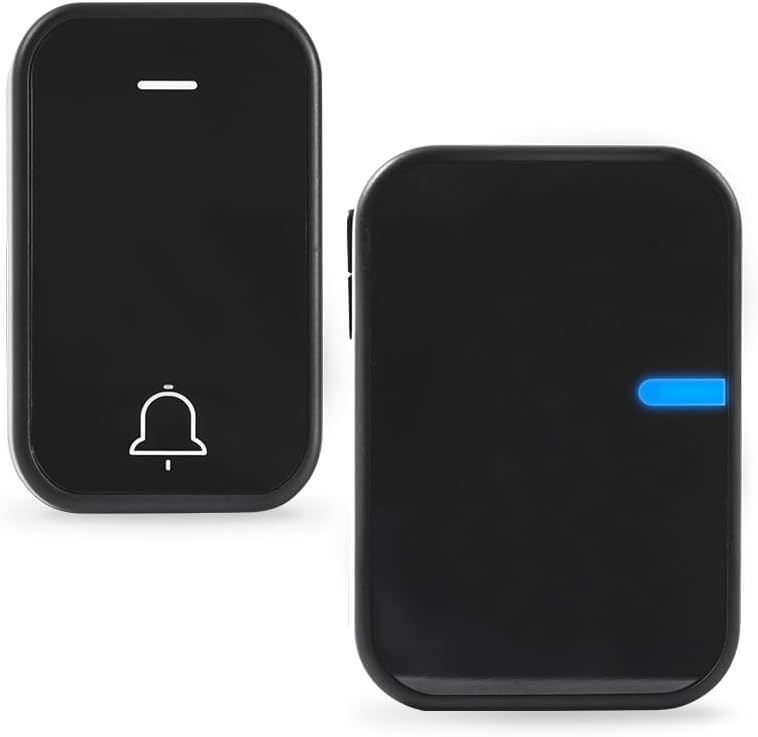
This 4.4-rated kit earns the budget recommendation because it packs several useful features into a battery-free design. The button generates its own power with every press, while the plug-in receiver offers 63 chimes, four adjustable volume levels, and a bright RGB flashing light. It therefore accommodates both audible preferences and households that benefit from visual notification.
We may earn a commission when you buy through this link, at no additional cost to you.
The listed 600-foot open-air range is generous, and the product is promoted for homes, apartments, classrooms, villas, hotels, factories, hospitals, and other spaces. Its IP68 dust- and waterproof rating also stands out. The temperature range is listed as -4 to 140 degrees Fahrenheit, supporting use through cold winters, strong sun, rain, snow, and dusty conditions.
A possible trade-off is that the four volume levels extend from silent to 115 decibels, which is a broad range but fewer steps than some alternatives. The system is not described as app-connected, so its sound library and visual behavior are likely controlled through physical receiver settings. It also does not claim the two-way communication or video functions associated with smart video doorbells.
This is a compelling choice for people who want many sounds, strong visual alerts, and dependable outdoor construction without a rechargeable battery. It is especially suitable for homes with hearing-impaired residents, shared rooms where noise is undesirable, and institutions that want a scalable visual paging setup.
The RGB light gives visitors a way to announce themselves without producing sound. Mute mode can therefore remain useful during sleeping hours, meetings, study periods, or any other noise-sensitive setting.
A broad sound library makes it easier to find an alert that is distinct from common household electronics. It also allows different users or rooms to recognize the doorbell by sound rather than by visual cue alone.
We may earn a commission when you buy through this link, at no additional cost to you.
This SECRUI kit carries a 4.7 rating and is a strong conventional wireless doorbell, but it does not meet the core battery-free requirement of this guide. The transmitter uses a battery with a stated lifespan of three years. It remains worth comparing because its listed 1000-foot obstacle-free range, colorful LED, and flexible unit combinations can appeal to buyers who prioritize long reach.
We may earn a commission when you buy through this link, at no additional cost to you.
The receiver and transmitter arrive paired, and the receiver plugs directly into an outlet, eliminating wiring and complicated setup. Fifty-eight songs and five volume levels provide a broad sound selection, while a one-to-one pairing scheme helps reduce incorrect signal connections between neighboring homes. The kit is described as IP55 protected and rated for temperatures from -4 to 140 degrees Fahrenheit.
Its biggest disadvantage in this comparison is the obvious one: button batteries still need replacement, and the product does not generate its own energy. The receiver is also plugged in, so the system is only partially free of conventional power connections. Compared with true self-powered entries, that introduces maintenance and recurring waste despite the strong range and favorable rating.
This kit is recommended only for buyers willing to relax the battery-free condition, particularly those with unusually large properties or a need for multiple buttons and receivers. For the exact keyword, the self-powered options earlier in the list are more appropriate.
A listed range of up to 1000 feet in an obstacle-free environment can be useful for expansive homes, warehouses, or outbuildings. Indoor obstructions may shorten that distance, so placement testing remains important.
The supplied information describes configurations including one button with two receivers and two buttons with three receivers. This flexibility allows the system to cover several doors or rooms.
We may earn a commission when you buy through this link, at no additional cost to you.
This model has the highest customer rating in the roundup at 4.8, and its core design directly addresses the battery-free request. A micro-power generator converts the motion of each press into electricity, allowing the transmitter to send a signal immediately. The kit includes a self-powered push button and a plug-in receiver for straightforward household use.
We may earn a commission when you buy through this link, at no additional cost to you.
Its stated 600-foot range provides ample potential coverage for ordinary homes, apartments, classrooms, children's rooms, and offices. The button carries an IP65 waterproof rating, offering meaningful protection for an outdoor installation. The white finish also gives the system a restrained appearance that may blend more easily with a light-colored doorframe than a visually heavier unit.
The available product data is comparatively sparse. It does not specify the number of chimes, volume levels, visual-alert behavior, mounting hardware, or exact open-area range conditions. As a result, the 4.8 rating is encouraging, but a buyer cannot compare every performance feature with the more extensively documented systems in the guide.
This is a good choice for someone seeking a uncomplicated, highly rated, self-powered wireless doorbell. It may be especially attractive when the priority is the absence of button batteries and uncomplicated receiver installation rather than an extensive menu of tones or advanced visual paging features.
The micro-power mechanism generates electricity as the button is pressed, so the transmitter operates without disposable cells. This reduces both maintenance and the need to plan battery replacement.
A plug-in receiver can be moved to different outlets as household priorities change. Keeping it near a frequently occupied area can make the chime easier to hear.
We may earn a commission when you buy through this link, at no additional cost to you.
The AURTEC kit earns the premium recommendation because it combines a genuine self-powered transmitter with two plug-in LED flash receivers. It has a 4.6 rating, 51 selectable chimes, four volume levels, and a 500-foot signal range. The extra receiver is the key distinction, allowing alerts to be heard or seen in two separate parts of a home.
We may earn a commission when you buy through this link, at no additional cost to you.
Installation is refreshingly simple. The button attaches to a doorframe using included adhesive tape, and the two receivers plug into standard outlets. The transmitter converts finger-press energy into power, eliminating battery replacement. Its LED indicator automatically lights in darkness, adding a visual cue without requiring buyers to manage a separate mute or brightness setting.
The transmitter's IP44 rating is lower than the IP65, IP67, and IP68 ratings found elsewhere in the list, so it should not be treated as equivalent to fully submersion-resistant outdoor equipment. The listed operating range is -4 to 149 degrees Fahrenheit, and the claimed 20-year operational lifespan reflects the intended long-term design. No app or connected-home features are claimed.
This is the most suitable option for buyers who want to cover a large home with more than one receiver. It is particularly compelling for upper and lower floors, apartments with separate work areas, offices, hotels, and anyone who appreciates simultaneous visual and audible notification.
Two receivers can be placed in separate living zones, reducing the chance that a visitor is announced only in an unoccupied part of the home. The same benefit applies to offices, clinics, and multi-level properties.
The receiver's LED activates in darkness, providing a visual cue alongside the chime. Because brightness is not adjustable, users should test nighttime visibility in their intended location.
We may earn a commission when you buy through this link, at no additional cost to you.
This battery-free kit has a 4.4 rating and focuses on an accessible combination of loud audio and bright visual notification. The button generates its own power whenever pressed, while the plug-in receiver provides 63 ringtones, four volume levels, and an RGB flashing light. It is a practical option for homes where audible alerts alone may not be sufficient.
We may earn a commission when you buy through this link, at no additional cost to you.
The receiver can produce up to 120 decibels according to the supplied information and can operate silently while continuing to flash the RGB indicator. This gives users more control than a basic sound-only chime, especially in bedrooms, hospitals, classrooms, and other environments where sudden noise may be unwelcome. The stated 600-foot range applies in open spaces.
Outdoor protection is another strength. The IP68 rating covers water and dust resistance, and the product is described as operating from -4 to 140 degrees Fahrenheit in sunny, rainy, and snowy conditions. It does not mention a companion app, camera, or connected features, keeping the design focused on reliable local alerts. The very high maximum volume may be unnecessary in many homes, though the adjustment range provides room to lower it.
The product is best suited to hearing-impaired users, shared spaces, and anyone who wants a strong visual fallback. It is also a capable general doorbell for large homes, provided the receiver is positioned where its light and sound can be noticed.
The RGB flash remains active in silent mode, making it possible to identify a visitor without generating a loud chime. This expands accessibility while supporting quiet periods.
IP68 protection and a wide listed temperature range suit exterior doors exposed to precipitation, dust, snow, and heat. Proper placement according to the manufacturer's instructions remains important.
We may earn a commission when you buy through this link, at no additional cost to you.
This Anyfree kit has a 4.4 rating and stands apart by including two self-powered transmitters with one plug-in receiver. That configuration is useful for homes with a front and back entrance, a home office and main door, or a property where visitors may approach from more than one direction. Both buttons use Faraday electromagnetic induction to generate power with each press.
We may earn a commission when you buy through this link, at no additional cost to you.
The receiver provides 60 chimes, four volume levels from 0 to 100 decibels, and a silent LED flash option. Components arrive factory-paired, so installation should not require pairing through an app or complex programming. A stated lab-tested range of up to 600 feet gives the system broad potential coverage, including bedrooms, offices, garages, and backyards.
The included outdoor waterproofing is not accompanied by a stated IP rating, and the kit supplies only one receiver. Buyers seeking visual alerts in two widely separated areas may need to consider a two-receiver model such as the AURTEC kit instead. No smart-home connectivity or camera is described, so this remains a local alerting product rather than a video doorbell.
The product is well suited to buyers who specifically want two battery-free buttons. It is less compelling for a single-entrance home where the additional transmitter will not be used, but the broader configuration provides useful coverage for multi-entry properties.
The two transmitters make it possible to announce visitors from separate doors while retaining a single chime location. This is efficient for properties where both entrances should ultimately notify the same person.
Faraday electromagnetic induction generates the necessary electrical energy at the moment of each press. No disposable battery is required in either included transmitter.
We may earn a commission when you buy through this link, at no additional cost to you.
The TECKNET model has a 4.6 rating and offers the longest stated range in the guide at 1312 feet in open areas. However, it is a battery-powered wireless doorbell rather than a battery-free self-powered system. It is included for comparison because its range, portable receiver, weather resistance, and sound controls may be useful to buyers who can accept battery maintenance.
We may earn a commission when you buy through this link, at no additional cost to you.
The receiver does not need to remain in one fixed outlet, so it can be moved to a desk, garden, garage, or other convenient location. The transmitter has an IP67 rating for protection against dust and powerful water jets, while the receiver offers 60 melodies, five volume levels, a maximum listed output of 110 decibels, and a silent LED mode.
The primary trade-off is its stated battery life of up to 4.5 years under normal use. Although that is longer than many conventional wireless buttons, it does not satisfy the no-battery premise. The 1312-foot range is also an open-area figure, so walls and obstacles may reduce performance. Buyers should not interpret the specification as a guaranteed distance through every building configuration.
This is an attractive conventional choice for very large properties, temporary portable alerts, and users who want minimal battery attention. For a purchase made specifically around the battery-free requirement, however, one of the self-powered models is the more relevant selection.
Because the receiver can be moved between outlets, the alert can follow the user around the property. This is useful in gardens, garages, workshops, and temporary event areas.
An IP67 rating provides strong protection against dust and water jets for exterior placement. It remains below the IP68 ratings offered by several battery-free options in the guide.
We may earn a commission when you buy through this link, at no additional cost to you.
Choosing a battery free wireless doorbell requires balancing true self-powered operation, range, sound, visual accessibility, weather protection, and installation needs. The following factors help separate complete matches from conventional wireless models that still depend on batteries.
In short, look for a press generator or induction mechanism, not merely wireless transmission.
In short, prioritize usable in-home reach over a dramatic maximum measured in open air.
In short, choose the highest practical IP rating for an exposed entrance and check temperature limits.
In short, prioritize a useful sound library, granular volume control, and a visual fallback.
In short, visual alerts add accessibility and quiet-hours flexibility, especially in multi-receiver setups.
In short, count doors, receivers, outlets, and mounting points before choosing the bundle.
In short, choose a local chime for simplicity and dependable alerts or a video system for remote monitoring.
Begin by selecting the receiver location. Plug it into an outlet within easy hearing distance and, when possible, near a central or frequently occupied part of the property. Test the button before fixing it permanently: press the transmitter several times while checking that the receiver responds, then move the button to its intended position and test again. If the supplied instructions call for pairing, follow them before mounting rather than attempting to pair through an app that the model does not have.
Mount the transmitter where visitors can reach it comfortably and where runoff is unlikely to collect around the button. Use screws for a durable permanent installation or the included adhesive for a quick setup, following the product instructions. Clean and dry the mounting surface before applying adhesive. After positioning the button, adjust the receiver's chime and volume settings, including mute mode if the household needs quiet nighttime operation. For kits with multiple buttons or receivers, label each unit and confirm that every alert reaches the correct receiver.
Battery-free does not mean maintenance-free. Periodically press the button to confirm that the self-power mechanism and receiver still communicate, and clean away dust, salt, grime, or debris that may collect around the transmitter. Keep the receiver accessible so it can be unplugged for cleaning without accidentally changing its settings. Avoid directing water or harsh cleaning agents at the button or receiver, and follow the manufacturer's instructions for exposed outdoor installations. If a unit begins responding inconsistently, test the chime, volume, and placement before suspecting a failed component.
The transmitter generates a small amount of electrical energy when someone presses the button, using micro-power generation or electromagnetic induction. That energy powers the radio signal sent to the plug-in receiver. The receiver then plays the selected chime, flashes an indicator, or provides both forms of alert without a battery in the button.
No. Wireless describes how the button communicates with the receiver, not how the transmitter receives power. Some wireless models use disposable or rechargeable batteries, including the SECRUI and TECKNET products in this guide. Buyers seeking the keyword's central benefit should look specifically for self-powered operation, press-generated electricity, or electromagnetic induction.
It can, although actual performance depends on the system and building construction. One of the reviewed models specifically states that its signal can penetrate three or four walls, while most advertise open-area distances. Metal doors, concrete, appliances, and dense walls can reduce range, so testing the intended button and receiver positions is the most reliable approach.
Install the receiver first in an outlet near the area where the alert needs to be heard, then press and test the transmitter before mounting it permanently. Choose a doorframe location that is easy to reach and protected from excessive water exposure. Use the included screws for long-term placement or adhesive for a quicker installation, following the manufacturer's guidance.
Yes, subject to building rules and the radio environment around the unit. The plug-in receiver makes relocation easy, and a lower-volume setting may be more appropriate in shared spaces. A visual-only mode can also reduce disturbance, although neighboring wireless signals should be tested through the pairing and setup process before final placement.
Many of the reviewed kits provide visual alerts, including bright RGB flashing and a mute mode that leaves the light active. Some receivers also offer high maximum volume for additional audible coverage. The button should still be placed where the visual signal can be seen, and users should test nighttime visibility from the locations where they spend time.
The products in this guide are described as local chime systems and do not claim camera footage, two-way audio, cloud recording, or mobile app alerts. Their advantages are straightforward installation, local sound, and visual notification. Buyers who need remote viewing or phone-based alerts should consider a separate connected video doorbell category.
Start by moving the receiver closer to the center of the home and keeping the button away from dense metal or electrical equipment. For a larger property, a kit with two receivers can cover separate floors or distant rooms more effectively. Avoid adding unverified repeaters, and check whether building materials are limiting the radio signal before changing equipment.
The strongest overall choice in this guide is the 4.7-rated Wireless Doorbell 38 Chimes because it combines genuine self-powered operation, IP68 protection, useful wall penetration, several volume levels, and a secondary emergency-pager function. The 63 Chime RGB Doorbell is the leading budget-oriented option, offering a large sound library, strong visual alerts, and a broad listed operating range.
The AURTEC Two-Receiver Kit takes the premium position for people who want simultaneous alerts in separate parts of a home. Before buying any model, prioritize verified self-power generation, realistic in-home signal coverage, and an outdoor protection rating appropriate to the installation. Also consider visual alerts, mounting options, and the number of receivers needed rather than focusing only on the largest headline range.
Product details and prices can change, and customer feedback may evolve over time. Before ordering, confirm the current listing, included components, range conditions, weather rating, and return information. Those checks will help ensure that the chosen battery free wireless doorbell fits the entrance and the household's real alert requirements.