
AlkiVision Solar Security Cameras Wireless Outdoor
4.6Editor score
2K full-color night vision
5000mAh integrated battery
Spotlight and siren deterrence
Solar Wireless IP Cameras are compared for solar power, video quality, night vision, storage, coverage, connectivity, and ease of installation in this expert
Solar Wireless IP Cameras combine flexible placement, battery-powered operation, and remote monitoring without a connection to household power. A capable system should provide dependable daytime detail, useful night footage, responsive alerts, and storage options that suit the homeowner. Solar charging, wireless range, outdoor durability, and privacy are equally important when selecting one.
This guide compares ten solar-powered outdoor camera systems across resolution, night vision, detection features, pan-and-tilt coverage, Wi-Fi compatibility, local storage, subscriptions, installation requirements, and multi-camera support. The products range from single-camera options to complete four-, six-, and multi-camera kits, giving readers useful context for both modest and larger properties.
Each review highlights the capabilities that distinguish that particular system while noting practical limitations and ideal placement. The leading choices cover different priorities, including extensive local recording, flexible solar positioning, and sophisticated multi-camera monitoring. Product specifications and availability can change, so readers should verify current details and compare current prices before purchasing.
4.6Editor score

4.9Editor score
4.3Editor score
This side-by-side overview highlights the most important differences among the ten systems, including camera count, video resolution, storage strategy, wireless compatibility, solar design, and outdoor protection. It provides a quick way to narrow the field before reading the detailed reviews.



This No Monthly Fee Solar Security Cameras system combines an outdoor wireless camera with an NVR, an included 500GB hard drive, and support for as many as ten cameras. Its 4.9 rating reflects an especially strong combination of local recording, image quality, and whole-property flexibility. Unlike cloud-dependent alternatives, the package provides a substantial amount of storage without requiring a subscription.
We may earn a commission when you buy through this link, at no additional cost to you.
The camera uses dual-band 2.4GHz and 5GHz Wi-Fi, which gives the installer a useful choice between longer range and faster throughput. Its 355-degree horizontal rotation and 90-degree vertical tilt reduce the need for multiple cameras around a single installation point. Full-color night vision reaches up to 65 feet, while PIR sensing and AI detection focus alerts on human activity. Two-way audio provides a direct way to speak with family members or visitors.
Solar operation is handled by a four-watt panel and an 8000mAh battery. The stated charging target is two hours of sunshine for one day of recording, with up to 800 to 1000 PIR triggers from a full charge without a power cord. That makes it more appropriate for consistently sunny placement than for shaded locations. The included six LED lights, audible alarm, and white-light deterrence can also be useful at night.
This is the strongest choice for someone who prioritizes local video retention and plans to monitor several vulnerable points. It may be more involved than a single-camera model, and the hub-based setup requires thoughtful placement and network configuration. Even so, the combination of 500GB storage, no mandatory subscription, expandable capacity, and 4MP night recording makes it the most complete general-purpose system in this guide.
The included 500GB hard drive gives the system immediate local recording capacity, while a TF card slot accepts cards up to 128GB. Keeping footage in the supplied system can simplify long-term monitoring without making cloud service a requirement.
Wide pan-and-tilt movement, human-focused AI detection, two-way communication, spotlights, and audible alarms give the camera several ways to observe and respond. It is particularly useful for driveways, yards, gates, and other broad outdoor areas.
We may earn a commission when you buy through this link, at no additional cost to you.
The ARCCTV Solar Security Cameras Wireless Outdoor two-pack offers a balanced way to monitor two outdoor areas without running power cables. Its 4.1 rating reflects a solid mix of 4MP recording, detachable solar panels, dual-band Wi-Fi, and flexible local or cloud storage. The system is designed for simple placement around areas such as driveways, backyards, and garages.
We may earn a commission when you buy through this link, at no additional cost to you.
Each camera records at 2560 by 1440 pixels and offers 355-degree horizontal pan plus 90-degree tilt. Those controls are available manually through the ARCCTV app, allowing the user to change the field of view as needed. The camera automatically selects a suitable Wi-Fi connection during operation, while setup guidance recommends placing it near the router initially to simplify pairing.
The detachable panel is a meaningful design advantage because the camera can be mounted where coverage is needed while the panel is positioned in a sunnier location. MicroSD storage up to 128GB is supported for local recording without a monthly fee. Cloud storage remains available for users who want remote backup and advanced event tagging, but it requires a subscription.
The ARCCTV set is well suited to a homeowner who wants two camera positions and values a detachable solar panel more than automated tracking. The lack of automatic tracking means the user must reposition the view through the app when the monitored area changes. That limitation is acceptable when the two cameras are placed to cover fixed, important zones.
A detachable panel can be exposed to stronger sunlight even when the camera itself needs to sit in a less exposed position. This flexibility makes the two-pack easier to adapt to porches, side yards, gates, and other uneven outdoor sites.
Local microSD recording provides a practical subscription-free route for everyday event capture. Cloud backup can be added when remote storage, event tagging, or other enhanced functions become more important to the household.
We may earn a commission when you buy through this link, at no additional cost to you.
The AlkiVision Solar Security Cameras Wireless Outdoor system is a capable single-camera option with a 4.6 rating. It combines 2K recording, full-color night vision, a 5000mAh battery, a detachable solar panel, and active deterrence features. For buyers who want a well-rounded camera without committing to a large multi-camera hub, it offers an appealing balance of capability and simplicity.
We may earn a commission when you buy through this link, at no additional cost to you.
The modular panel can be positioned to capture useful sunlight while charging the integrated battery. The stated requirement is two hours of direct sunlight per day, and the product information claims a single charge can support up to six months of use. AI-assisted recognition can distinguish people, vehicles, pets, and packages, although those advanced recognition features require a subscription. Local microSD recording is supported up to 128GB.
The 2304 by 1296 sensor provides more detail than 1080p, while the built-in spotlights enable color footage after dark. A 360-degree panoramic view is achieved through the camera's adjustable housing. When relevant motion occurs, the system can record a short event clip, activate the siren and spotlight, send a phone notification, and provide two-way communication.
This camera is a good fit for an entryway, side yard, driveway, or other single high-priority location. Its 2.4GHz-only connection may require more care in a crowded wireless environment, and cloud-oriented AI features are not entirely free. For a buyer prioritizing resolution, solar endurance, night color, and active deterrence in one compact unit, it is the strongest budget-focused recommendation.
The combination of color night vision, a spotlight, a siren, push notifications, and two-way talk means the camera can both record an event and respond to it. Those features are particularly valuable at entrances and isolated outdoor areas.
A modular panel and 5000mAh battery reduce the need for routine manual charging. The panel can be moved toward sunlight while the camera is positioned for a useful view, although actual results depend on weather, season, and settings.
We may earn a commission when you buy through this link, at no additional cost to you.
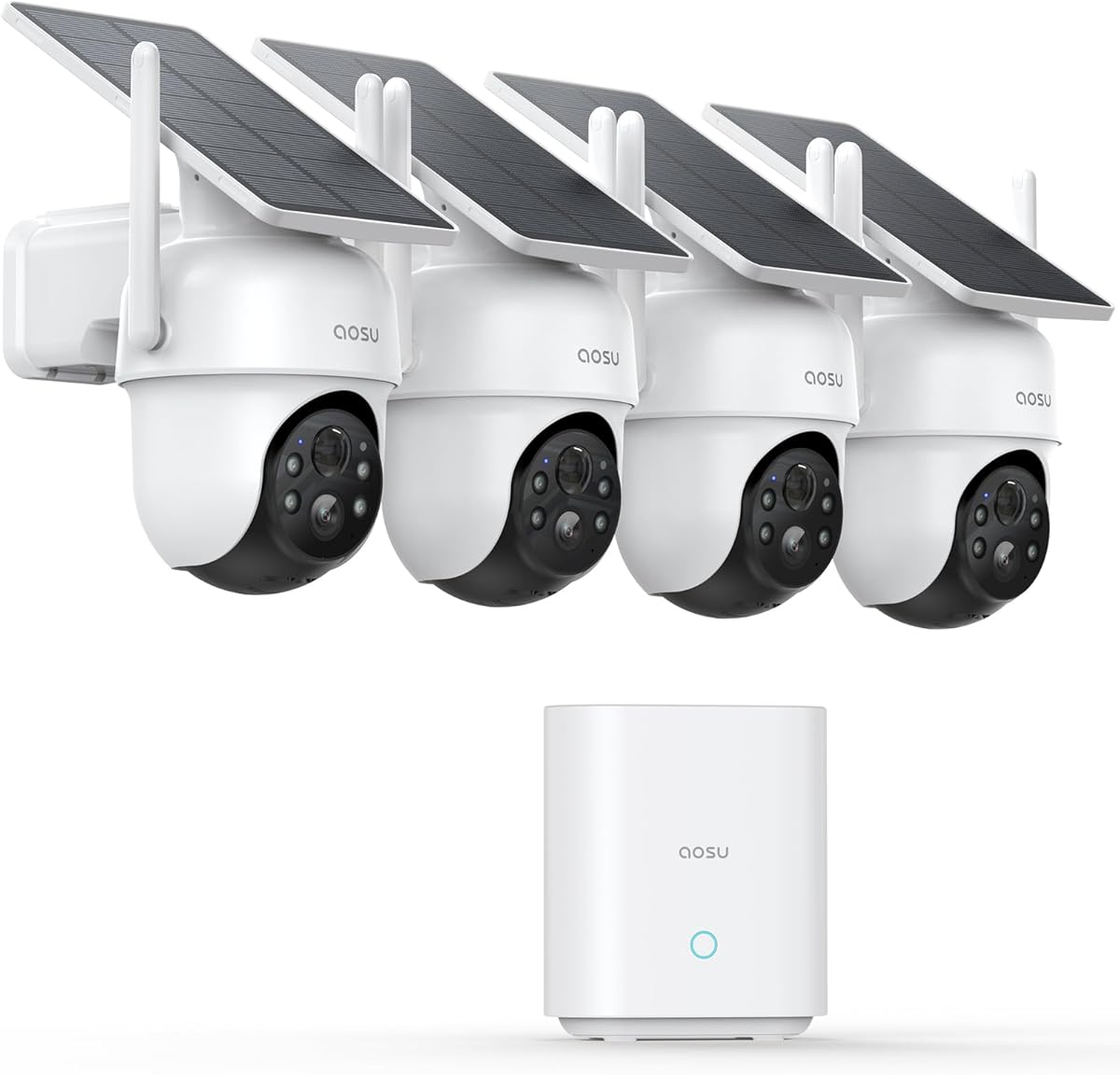
The aosu D1 Classic 4-Cam Kit is a complete four-camera system with a 4.3 rating. It focuses on smooth whole-property monitoring through automatic cross-camera tracking, four simultaneous live views, local encrypted storage, and pan-and-tilt cameras. The included aosuBase provides 32GB of storage and is designed to support up to four months of loop recording without a subscription.
We may earn a commission when you buy through this link, at no additional cost to you.
Each camera offers 360-degree coverage and automatically tracks activity inside the designated target area. Four LED lights provide improved illumination for color night vision, while the stated recording resolution is 3MP. A central advantage is the ability to see four areas at once and relate recordings of the same event, which can make it easier to understand movement across a property.
The built-in solar panel and battery are designed to maintain operation with three hours of sunlight each day. Installation involves drilling three holes and is stated to take about five minutes. That makes the kit approachable for homeowners who want several cameras without hiring installers or running network cables between them.
This system is best for properties where a visitor could cross from one camera zone into another and where reviewing a continuous event matters. It is less attractive for buyers who require dual-band Wi-Fi or a clearly specified large expandable storage capacity. Even so, the combination of no-subscription recording, automatic tracking, and four-camera management is highly practical.
Watching four areas simultaneously reduces the need to switch between separate camera pages. This is useful during busy periods or when monitoring widely separated points around a home.
Cross-camera event correlation can make an activity easier to follow. The feature is most valuable when camera positions overlap or cover a continuous route through the property.
We may earn a commission when you buy through this link, at no additional cost to you.
The GALAYOU R6 is a single-camera solar system with a 4.1 rating and a strong emphasis on automatic movement tracking. It combines 2K video, color night vision, human detection, a siren, and two-way audio. The camera can be used for yards, garages, barns, farms, deliveries, children, or pets, making it versatile despite being a one-camera package.
We may earn a commission when you buy through this link, at no additional cost to you.
PIR detection identifies movement, and human detection helps filter irrelevant alerts. Once motion is recognized, the camera engages its 344-degree horizontal pan and 85-degree vertical tilt. A remotely triggered siren provides an immediate response, while the built-in microphone, speaker, and noise cancellation support real-time conversations. Multi-user app sharing lets more than one household member access the feed.
The primary power method is the integrated or detachable solar panel, with a USB-C port serving as backup during extended cloudy periods. The IP65 rating supports outdoor use, and 2.4GHz Wi-Fi keeps the setup uncomplicated. Out of the box, the Total Recall ecosystem provides two days of access to ten-second alert videos and five days of snapshot history.
Longer local recording becomes possible by inserting a TF card up to 128GB, while cloud backup requires a paid plan. The included alert-video history may feel limited compared with systems offering larger built-in drives, but the automatic tracking and active deterrence compensate for that. This is a strong fit for a single important viewpoint where motion following matters more than extensive local retention.
Automatic pan and tilt helps keep a moving person, vehicle, or pet within the frame. It is a meaningful improvement over cameras that only record a fixed direction after detecting motion.
The USB-C connection provides a practical fallback when the solar panel cannot keep pace with usage. A compatible power source can help maintain operation during extended low-sunlight weather.
We may earn a commission when you buy through this link, at no additional cost to you.
The SEHMUA Solar Security Cameras Wireless Outdoor camera has a 4.2 rating and emphasizes wide mechanical coverage. It records at 2K resolution, supports 355-degree horizontal rotation and a 100-degree vertical tilt, and uses a solar-powered design that removes the need for outdoor power cables. It is a straightforward option for a single outdoor monitoring point.
We may earn a commission when you buy through this link, at no additional cost to you.
Its full-color night vision is supported by a spotlight, although the product information specifies that the spotlight must be manually activated to view the image in color. A sensitive PIR sensor supports real-time alerts and is designed to improve human-like recognition, reducing alerts caused by irrelevant motion. Two-way audio allows the owner to communicate with a visitor from the app.
The camera uses 2.4GHz Wi-Fi, which can be the more practical band for range but does not support 5GHz networks. Its IP65 rating and stated operating range from -4°F to 121°F make it suitable for varied outdoor conditions. Event recordings can be handled through two storage methods, allowing the user to choose an approach that suits the installation.
SEHMUA is most appropriate for buyers who value a broad field of view, clean wire-free installation, and two-way communication. Manual spotlight activation is the main compromise for someone expecting automatic full-color night footage. Otherwise, it offers a useful combination of 2K clarity, responsive movement, and flexible positioning at a single-camera scale.
The 100-degree vertical tilt adds useful vertical coverage compared with many outdoor pan-and-tilt cameras. It can be helpful for monitoring both ground-level approaches and elevated portions of a yard or entryway.
The spotlight can reveal more detail in dark conditions, but users should account for the need to switch it on when color night vision is desired. Automations and detection priorities may affect how often that control is needed in practice.
We may earn a commission when you buy through this link, at no additional cost to you.
This four-pack has a 4.3 rating and provides a balanced combination of 2K imaging, dual-band Wi-Fi, and wireless solar installation. It is designed for homeowners who need several outdoor viewpoints but do not want a large hub-based package. Remote pan, tilt, and zoom, color night vision, human-focused detection, and two-way talk make each camera useful on its own.
We may earn a commission when you buy through this link, at no additional cost to you.
The detachable solar panel can be positioned in a favorable area while the camera remains where it offers a better view. The stated charging target is two hours of sunlight daily, with a built-in battery providing backup during cloudier weather. Its IP65 construction is intended to withstand rain, snow, dust, and temperature changes throughout the year.
Network setup offers a notable advantage over 2.4GHz-only products. The 2.4GHz band can provide better reach through walls, while 5GHz can deliver faster streaming when the signal has a clear path. Users can store footage on a microSD card or use optional cloud storage without being forced into a subscription. Alexa compatibility provides another way to view live feeds or play back recordings.
This set suits medium-sized properties needing coverage of several approaches without a dedicated base station. The storage card is sold separately, and relying on Alexa creates some dependence on a third-party ecosystem. Even so, the four-camera count, flexible network support, and optional local recording make it a versatile middle-ground system.
Dual-band support gives installers more freedom than a single-band camera. Remote locations may benefit from 2.4GHz, while cameras close to a strong router can use 5GHz for smoother live viewing.
A supported microSD card can handle routine local recording without cloud fees. Users who want off-device backup or broader remote access can add cloud service separately.
We may earn a commission when you buy through this link, at no additional cost to you.
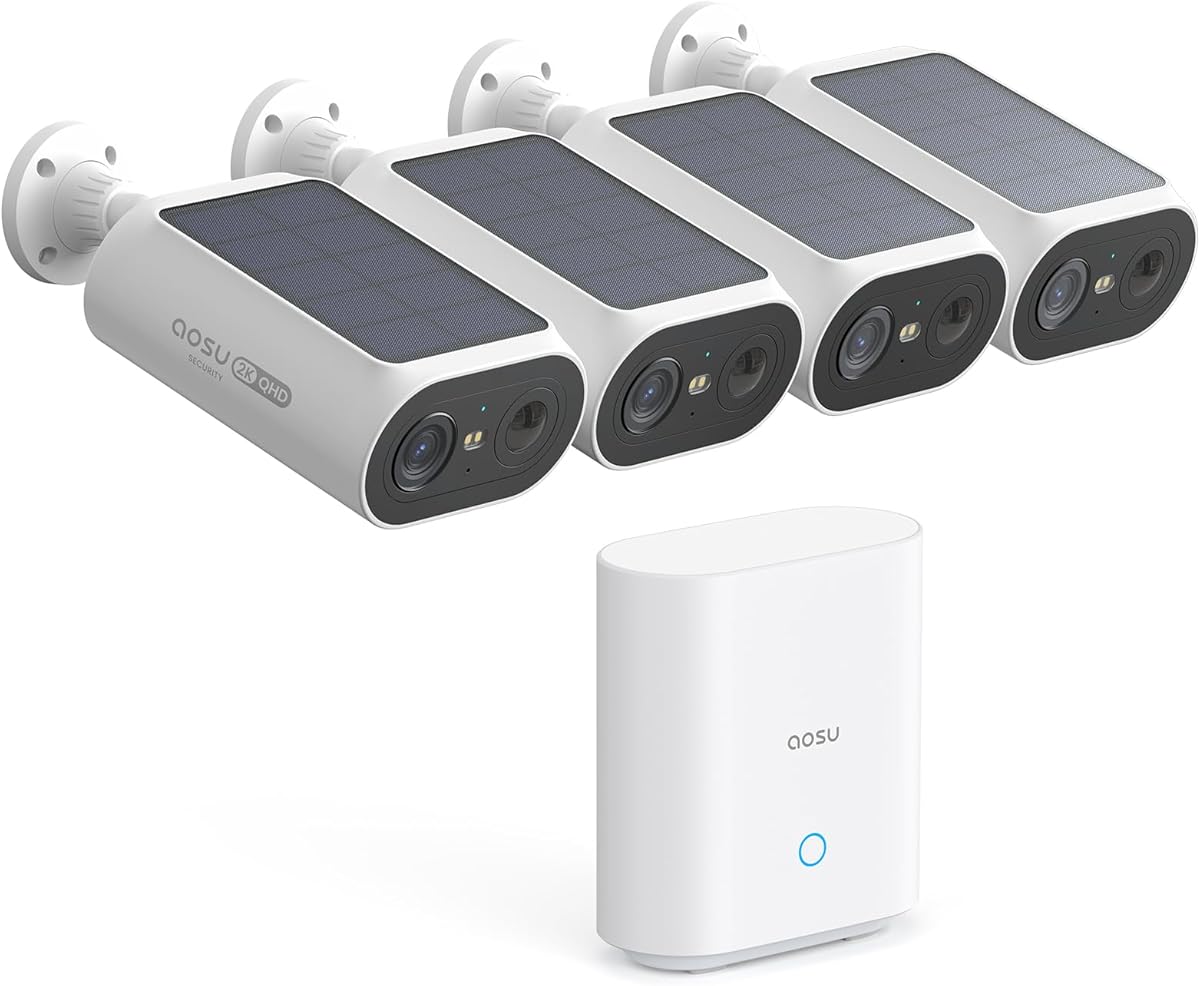
The aosu 2K QHD Solar Security Cameras four-camera system stands out for coordinated monitoring, encrypted local storage, and a polished multi-camera experience. Its 4.3 rating is supported by a system design that can show all four feeds simultaneously and connect activity across cameras into a time-aligned playback. It is a strong premium pick for buyers who value coherent property-wide evidence.
We may earn a commission when you buy through this link, at no additional cost to you.
The aosuBase includes 32GB of encrypted local storage with free playback and secure downloads for up to 60 days. Cam-to-Cam tracking syncs intruder movements across cameras, allowing a user to reconstruct a path without manually switching among feeds. The fixed 130-degree bullet cameras focus on driveways, gates, garages, and fences rather than providing motorized pan-and-tilt movement.
Each camera records in 2K and uses a spotlight for color night vision with detail available up to 30 feet. Its integrated solar panel is engineered for a 30% energy conversion rate, and two hours of direct sunlight are stated to be sufficient for daily operation. A 5500mAh battery serves as backup during low-light conditions. The system also provides siren, spotlight, and app-notification alert modes.
This kit is ideal for a homeowner who wants a permanent multi-camera layout and values synchronized evidence over remote movement. Its fixed viewing angles require thoughtful placement during installation, and the base remains necessary for the full feature set. For a property with several defined danger points, however, the encrypted storage, long local retention, and cross-camera tracking offer excellent overall control.
Seeing all camera feeds together makes it easier to follow an event across the grounds. The time-aligned tracking can reduce repeated viewing and provide a clearer sequence of activity.
Encrypted recordings stored on aosuBase offer a practical alternative to mandatory cloud plans. The stated playback and download window provides useful flexibility for reviewing recent events.
We may earn a commission when you buy through this link, at no additional cost to you.
The aosu 2K Solar Security Cameras six-camera kit is designed for larger properties and expansive outdoor coverage. Its 4.1 rating reflects a useful six-camera package, flexible split solar panels, local storage, and event-oriented monitoring through aosuBase. The system can also grow as security needs expand, making it a flexible choice for buyers planning ahead.
We may earn a commission when you buy through this link, at no additional cost to you.
The separate solar-panel design allows the camera and panel to occupy different positions. This is especially useful where the ideal viewing point is shaded but a nearby surface receives stronger sunlight. The system supports local microSD expansion up to 1TB and does not require a subscription for its basic local-storage approach.
Users can view up to four cameras at once in the app, while Camera-to-Camera Tracking groups appearances of the same person across the system. PIR and AI human detection are designed to reduce irrelevant notifications, although actual detection performance varies with distance, lighting, placement, and settings. Full-color night vision, light, sound, and app alerts provide multiple ways to deter unwanted activity.
This kit makes sense for a large home, rural property, or other setting with numerous monitoring zones. Its six cameras provide more coverage than smaller packs, but the app's four-screen limit means reviewing all feeds simultaneously is not possible. Buyers should also allow time to position each panel effectively. For comprehensive coverage without a recurring storage requirement, it remains one of the strongest options in the guide.
Separating the panel from the camera allows each solar panel to be placed where sunlight is strongest. That flexibility can improve charging opportunities around buildings, fences, and shaded landscaping.
The included six cameras cover more ground, while local storage can expand as recording needs grow. This makes the kit suitable for buyers who want to begin with broad coverage and retain control over future capacity.
We may earn a commission when you buy through this link, at no additional cost to you.
The Hiseeu Solar Camera Security Outdoor four-pack has a 4.2 rating and offers 4MP recording in a fully wireless format. Each camera includes a 5200mAh battery, solar charging, a spotlight, full-color night vision, PIR sensing, AI human detection, a siren, and two-way audio. It is a capable four-camera package for users who want higher resolution than many 2K alternatives.
We may earn a commission when you buy through this link, at no additional cost to you.
The stated battery capacity can support as many as 5000 triggers or approximately one to five months of use, depending on operating conditions. Two hours of direct sunlight per day are described as sufficient for daily operation. The compact cameras have an IP66 waterproof rating and can connect through 2.4GHz home Wi-Fi, a wireless connection, or a hotspot.
At 2560 by 1440 pixels, the 4MP sensor is designed to preserve finer detail in both daylight and darkness. Adjustable human-detection sensitivity helps reduce false alarms. The dual LED options and siren can warn away intruders, while the microphone and speaker allow direct conversations with family or visitors. Cloud storage is optional, and local SD-card and local-storage options are available.
Hiseeu is a practical fit for buyers who want four cameras, 4MP detail, and active deterrence without wiring. Cloud access and extended remote backup introduce a separate cost, and 5GHz networks are not offered. For fixed locations where 2.4GHz provides sufficient signal, it delivers a strong combination of resolution, solar endurance, and accessible installation.
The 4MP sensor provides a useful resolution increase over standard 1080p and many 2K cameras. It can make small details easier to examine when reviewing visitors, vehicles, gates, or other activity.
Home Wi-Fi, direct wireless connectivity, and hotspot support provide more ways to establish a connection. This can be helpful in remote areas or temporary installations where access to a fixed router is limited.
We may earn a commission when you buy through this link, at no additional cost to you.
The right solar wireless camera depends on the property, recording strategy, network environment, and degree of active deterrence required. Comparing these factors before buying can prevent an installation that depends too heavily on one optional feature or leaves important outdoor areas uncovered.
A credible solar camera needs both a suitably sized panel and enough battery capacity to carry it through cloudy periods, busy days, and seasonal variation. Systems in this guide use solar charging with stated daily sunlight targets ranging from about two to three hours, but actual results depend on panel orientation, shade, weather, recording activity, and camera settings. Detachable or split-panel designs offer an advantage when the best security viewpoint does not receive direct sunlight.
Resolution is only one part of usable image quality. This selection includes 2K, 3MP, and 4MP cameras, with full-color night functionality supported by spotlights or LED illumination. Buyers should consider how much detail must be visible at night, how far the camera is mounted from the relevant area, and whether color helps distinguish clothing, vehicles, or other subjects. Spotlight placement and activation behavior can also influence the final result.
Local storage is valuable for privacy, predictable long-term recording, and avoiding recurring cloud expenses. Options in the guide include an included 500GB hard drive, 32GB base storage, microSD cards, and expandable local capacity. Cloud services can add remote backup, event tagging, and AI recognition, but several advanced features are subscription-based. Buyers should separate the essential recording function from optional cloud conveniences before deciding.
Fixed bullet cameras can cover a clearly defined entrance, while pan-and-tilt models can sweep a wider area and sometimes follow detected movement. Manual pan-and-tilt offers broad adjustment but requires user input, whereas automatic tracking can keep a subject in view. Multi-camera systems add value when a property has several separate vulnerable points, provided their viewing angles are planned to avoid large blind zones.
A 2.4GHz-only camera is compatible with many routers and may travel farther, while dual-band systems can use 5GHz for faster performance and reduced congestion. Remote cameras still require a viable signal at the installation point, and walls, masonry, metal, and distance can all weaken reception. A detachable antenna, strategic router placement, or an intermediate access point may be needed on large or obstructed properties.
PIR sensing reduces recording to relevant movement, while AI human detection can further reduce irrelevant alerts from animals, vegetation, or vehicles. Two-way audio is useful for speaking with visitors, and a siren, spotlight, or white light can deter activity after it is detected. Recognition categories, alert areas, sensitivity, and event tagging vary by model, with some advanced AI features reserved for paid cloud plans.
Look for a stated IP rating, particularly when a camera will face rain, snow, dust, or direct sunlight. The products here include IP65, IP66, and IP67 ratings, as well as systems that describe specific operating temperature ranges. A weather rating does not eliminate the need for sensible placement, but it helps indicate that the camera is designed for exposed outdoor installations.
Most systems are designed for DIY installation with a bracket, screws, and app-based pairing. Integrated panels are compact, while detachable panels require an extra mounting step but offer better solar alignment. Battery and panel maintenance should be checked periodically, and camera lenses should be kept clean. Users should also confirm app permissions, account security, and recording settings after the initial setup.
Begin by mapping the areas that need coverage, then test each proposed mounting point for Wi-Fi reception before drilling. Connect each camera to the app, update its firmware, confirm the date and time, and adjust the recording schedule, detection zones, sensitivity, and alert preferences. For local-storage systems, install and format the specified card or drive, then verify that new events appear in playback.
Place the solar panel where it receives direct light without being shaded by the camera housing, roof overhang, foliage, or walls. Mount the camera securely at a height that provides the required view while limiting tampering. Test daytime and nighttime footage from the app, confirm that two-way audio is clear, and exercise the siren or spotlight if those features are included. Multi-camera installations also benefit from naming each device after its monitored location.
Care for the system by cleaning the lens and solar panel, checking the mount for looseness, and inspecting the battery for reduced endurance. Trim nearby foliage if it begins to cast shade. Review storage capacity regularly, export important evidence, and update app and camera software when prompted. After a major weather event, verify that the panel is still exposed, the connections are secure, and every camera is reporting normally.
Yes. The systems in this guide use rechargeable batteries and solar panels to operate without a continuous power cable. Solar performance depends on direct sunlight, panel placement, season, and camera activity, so a location that receives strong sun is important. A backup charging option is useful in some models, but it should not be treated as a replacement for a well-positioned panel.
Many can record locally without a subscription, using an included hard drive, base-station storage, or a microSD card. Cloud storage and some advanced AI recognition features may require a paid plan, depending on the brand and model. Buyers should check which features disappear if they choose local-only recording rather than assuming every advertised function is free.
The 2.4GHz band usually provides better range and is less affected by congestion, while 5GHz can offer faster performance when the signal path is clear. Dual-band cameras are more flexible because the system can use either network. For a remote camera, signal strength at the mounting location matters more than the advertised maximum speed of the router.
2K provides a useful balance of detail and storage efficiency for many residential applications, while 3MP and 4MP offer additional detail for faces, license plates, and wider scenes. Resolution alone does not guarantee clear night footage. Low-light performance, spotlight placement, viewing distance, and the camera's compression and lens quality also influence how useful the recorded image appears.
The correct number depends on the layout and the areas that matter most. A single camera may cover one entryway, while four or six cameras may be appropriate for driveways, gates, side yards, garages, and other separated zones. Fixed cameras work well for defined locations, and pan-and-tilt models can cover broader areas, so camera count should be based on actual sight lines rather than an arbitrary number.
The listed models include outdoor weather-resistance ratings such as IP65, IP66, and IP67, and some specify operating temperature ranges. Those ratings indicate suitability for outdoor conditions, but prolonged cloud cover can reduce solar charging and very low temperatures may temporarily affect battery performance. Regular panel cleaning and occasional battery checks are sensible precautions in demanding climates.
Most products in this guide are designed for ordinary home Wi-Fi and remote app access, so an internet connection is normally needed for live viewing, notifications, and firmware updates. A few multi-camera kits use a local base with cameras communicating through their own network, but the base itself still generally needs a connection for full remote functionality. Local recording can continue during an internet interruption in supported systems.
Clean dirt, dust, leaves, and water from both the lens and solar panel, then verify that the panel still receives direct sunlight. Check the mount, cable-free connections, app status, and storage capacity every few months. If the battery no longer lasts as long as expected, review the panel angle, sunlight exposure, and recording activity before considering a battery replacement.
The No Monthly Fee Solar Security Cameras system is the most complete all-around choice because it combines 4MP recording, full-color night vision, an included 500GB drive, dual-band Wi-Fi, two-way audio, and expansion for up to ten cameras. The AlkiVision model stands out as a capable budget pick with 2K color night footage, a 5000mAh battery, and active deterrence, while the aosu 2K QHD four-camera kit is the premium selection for synchronized tracking and encrypted local storage.
The most important decision is to match the system to the property rather than focus on one headline specification. Consider where the panel can receive sunlight, whether the network reaches each mounting point, how many local recording days are required, and whether fixed views or automatic tracking serve the monitored area best. A smaller camera with an appropriate storage plan may be more useful than a larger kit installed in poor positions.
Before ordering, verify the latest specifications, app requirements, storage details, and current price with the retailer. Solar output and feature access can vary with placement, weather, firmware, and subscription status, so careful planning and current product information remain essential. Buyers who align those conditions with their security needs are most likely to select a solar wireless IP camera system they will continue using effectively.