
Marshall Acton III
4.7Editor score
Wide room-filling soundstage
Bluetooth 5.2 connectivity
Iconic home-speaker design
Bluetooth speakers for jazz music need to do more than produce loud sound. They should reveal the delicate brushes on a snare, the warmth of an upright bass, the airy nuances of a saxophone, and the spacious ambience that makes an intimate recording feel larger. The right speaker balances detail, bass, stereo imaging, and room-filling capability without turning polished recordings harsh.
This guide compares ten Bluetooth speakers across portability, audio performance, wireless connectivity, battery life, physical design, and practical extras such as app control, wired inputs, multi-speaker pairing, and charging functions. It includes compact travel models, rugged outdoor speakers, traditional home systems, powered bookshelf speakers, and premium living-room options, giving readers a useful range of choices.
Each pick below highlights the qualities that matter most for jazz listening, from imaging and tonal balance to portability and room use. Ratings and specifications reflect the supplied product information, while availability and pricing can change. Always compare the current listing and technical details before making a final purchase, especially if you have a preferred Bluetooth version or input in mind.
4.7Editor score

4.6Editor score

4.5Editor score
As an Amazon Associate we earn from qualifying purchases.
This side-by-side comparison highlights the most important differences in sound, connectivity, portability, power, and listening flexibility. It includes every speaker in the guide and is designed to help jazz listeners identify the model that best matches their room, mobile lifestyle, and recording preferences.


The Harman Kardon Onyx Studio 9 is a versatile Bluetooth home speaker with a 4.6 rating, self-tuning technology, and a portable design. For jazz listeners, its most appealing feature is the way it calibrates itself to the environment when powered on. That makes it easier to enjoy the same speaker in a living room, bedroom, studio, patio, or other changing space without manually revisiting the EQ every time.
We may earn a commission when you buy through this link, at no additional cost to you.
Its appeal also lies in practical musical flexibility. The speaker can stream from up to two mobile devices at the same time, allowing two listeners to take turns selecting tracks from their own libraries. The Harman Kardon One app adds customizable EQ and centralized control of compatible speakers, which is useful for adjusting tonal balance according to whether you are listening to a smoky vocal jazz album, a big-band arrangement, or an intimate piano recording.
The built-in battery provides up to eight hours of playback, making the Onyx Studio 9 more flexible than a speaker tied to a wall. It can be moved from one room to another or taken outdoors, although its runtime is shorter than the 24-hour or greater figures offered by several travel-oriented picks. The USB charging port also allows the speaker to recharge a connected mobile device, turning it into a practical power source when the music keeps going.
This is a strong all-around recommendation for jazz fans who want detailed, dynamic playback with fewer placement headaches. It falls short of the longest battery life and the most expansive home-audio features in the list, but its self-tuning, multi-device support, app controls, and ability to pair two units create an unusually balanced package. It works particularly well for listeners who want one speaker to handle both focused home listening and casual jazz sessions away from an outlet.
The automatic calibration calibrates the Onyx Studio 9 to its surroundings when it is switched on. For jazz, that means the speaker can adapt as it moves between a reflective shelf, a side table, or an open area, helping preserve its intended sound without repeated manual adjustments.
Two-device Bluetooth connection makes shared playlists easy, while the USB port can replenish a phone. The built-in battery further allows the speaker to move from room to room for up to eight hours of playback.
We may earn a commission when you buy through this link, at no additional cost to you.
The Marshall Acton III carries a 4.7 rating, the highest among the ten products in this guide, and is positioned as a premium home speaker for listeners who want jazz to fill a room rather than sit as a background stream. Its wide soundstage and room-filling approach suit both small ensembles and more expansive big-band recordings, while its traditional cabinet styling gives it the appearance of a dedicated music system.
We may earn a commission when you buy through this link, at no additional cost to you.
Bluetooth 5.2 makes connection straightforward, and the 3.5mm input gives owners a wired option for a turntable, computer, or other source. Marshall emphasizes simple setup rather than a complicated control process, which is useful for anyone who wants to move quickly from selecting a record to filling a room. The focused acoustic presentation is particularly appropriate for jazz because it is designed as a home speaker rather than a novelty or outdoor-only device.
There are trade-offs. The supplied information does not list a built-in battery, so this is not the choice for readers who need a portable jazz speaker for a patio, park, or weekend trip. It also offers a smaller set of explicit smart features than app-heavy or network-capable systems. Its sustainable build, including a PVC-free construction with 70% recycled plastic and vegan materials, may appeal to environmentally conscious buyers, but that does not change its core role as a mains-powered home speaker.
Marshall Acton III is the pick for jazz enthusiasts who prioritize soundstage, visual character, and straightforward operation in a living room or listening area. It is especially attractive for a home setup centered on albums, although current Bluetooth capabilities should be checked on the listing because the brand describes the platform as ready for future features.
The Acton III delivers an even wider soundstage than its predecessor, according to the supplied information. That room-oriented presentation gives saxophones, piano, upright bass, and drums more space to occupy when a jazz trio or larger ensemble is playing.
Bluetooth 5.2 keeps wireless playback direct, while the 3.5mm input provides a familiar wired connection for compatible sources. The result is a flexible home speaker that can serve both streaming and traditional audio setups.
We may earn a commission when you buy through this link, at no additional cost to you.
The Anker soundcore 2 is a straightforward portable Bluetooth speaker with a 4.5 rating, 12 watts of output, and up to 24 hours of playback. It offers a compelling mix of portability, endurance, and physical power, making it a sensible choice for jazz listeners who want to take their playlists outdoors without moving to a premium home system.
We may earn a commission when you buy through this link, at no additional cost to you.
The supplied information emphasizes dual neodymium drivers, an advanced digital signal processor, and BassUp technology. Those features make the speaker particularly suited to rhythmically driven jazz, funk, fusion, and other recordings where the bass guitar and drums carry substantial energy. Wireless stereo pairing also allows listeners to connect two speakers for a broader left-right presentation, which is a meaningful upgrade for instrumental recordings and large ensemble arrangements.
IPX7 waterproof protection makes the soundcore 2 more dependable around splashes, waves, and water vapor. That protection broadens its use beyond a bedroom or living room to include camping trips, beach visits, and other outdoor situations. The tradeoff is that the speaker's feature set centers on simple controls rather than extensive app-based sound adjustment, so buyers seeking deep EQ control should look elsewhere in this guide.
This is the best-value recommendation for readers who want one portable speaker for both jazz and everyday audio. It does not provide a built-in battery level display or the sophisticated room calibration found on higher-end models, but its 24-hour runtime, rugged protection, 12-watt output, and stereo-pairing support create an excellent foundation for a jazz listening habit.
BassUp technology and a spiral bass port emphasize the low end, while the digital signal processor helps control distortion as volume rises. These traits work well for walking bass lines, punchy drum patterns, and jazz-fusion recordings.
IPX7 protection handles splashes and water vapor, while the battery is rated for up to 24 hours of play. Its portable form and straightforward controls suit trips, patios, picnics, and casual gatherings.
We may earn a commission when you buy through this link, at no additional cost to you.
The Klipsch Detroit is a portable speaker built around four visible drivers: dual one-inch tweeters and dual three-inch woofers. Its 4.3 rating places it below the leaders in overall customer feedback, but the supplied specifications suggest a speaker with enough driver variety and tuning options to create a lively, full-range presentation for jazz away from home.
We may earn a commission when you buy through this link, at no additional cost to you.
The Klipsch Connect app provides separate control over bass, mid-range, and treble, which is particularly useful for jazz because different recordings demand different balances. A trumpet-heavy big-band track may benefit from different adjustments than a close-miked piano trio. The app also supplies firmware updates and support access, while Bluetooth 5.3 supports a stated connection distance of up to 40 feet.
Its portability is impressive, with a removable carrying strap, a built-in microphone for calls, and an IP67 dust and waterproof rating. The product information describes submersion protection up to one meter for 30 minutes, while the battery can run for as long as 24 hours under the stated conditions. It also supports 18W USB-C charging and 10W reverse charging, allowing it to recharge a phone when needed.
The main limitation is that broadcast mode distributes mono audio to additional Klipsch speakers, which is less desirable when listeners want true stereo separation between jazz channels. Even so, the Detroit is a strong pick for mobile listeners who want app-based tonal control, a durable enclosure, and a more complex driver layout than a basic compact speaker. It is particularly suitable for outdoor jazz sessions and listeners who alternate between music and calls.
Separate bass, mid-range, and treble controls make it easier to account for the tonal character of different jazz styles. The app also supports saved preferences and firmware updates, adding flexibility beyond a fixed one-button sound profile.
The IP67 rating protects against dust and water, and the removable strap makes the speaker easier to carry. Reverse USB-C charging adds emergency utility when a phone needs power during a long outing.
We may earn a commission when you buy through this link, at no additional cost to you.
The Klipsch The Three Plus is a premium 2.1 stereo system designed to fill larger spaces, and its 4.2 rating is the lowest in this comparison. That figure should be considered alongside its extensive feature set: dual 2.25-inch full-range drivers, a dedicated 5.25-inch high-excursion woofer, bi-amplification, and tuning by Klipsch acousticians.
We may earn a commission when you buy through this link, at no additional cost to you.
For jazz, the separate woofer can provide a more robust foundation for upright bass, piano chords, and drums than a compact all-in-one speaker. The full-range drivers handle the midrange and treble, where saxophone, trumpet, vocal character, cymbal detail, and brushwork live. The system's ability to fill larger spaces makes it a better match for a dedicated listening room, home office, studio, or open-plan living area than a small desktop speaker.
Its strongest non-wireless feature is turntable readiness. Included Phono/RCA inputs allow a compatible turntable to connect directly, giving jazz collectors a practical way to enjoy records. USB-C playback, reverse charging, Bluetooth 5.3, a 3.5mm-style familiar home aesthetic, tactile switches, and knobs reinforce its role as a traditional source component adapted for modern listening. The Klipsch Connect app adds customizable EQ, saved presets, and firmware updates.
The Three Plus is not the most portable option, and the supplied data does not mention a built-in battery. It is instead a home-oriented system for readers who prioritize larger-room scale, vinyl integration, and dedicated low-frequency output. For serious jazz listening in a permanent setup, that specialized architecture can outweigh the lower customer rating and the bulkier footprint.
Dual full-range drivers work with a dedicated 5.25-inch high-excursion woofer, giving the system more separation between low and high duties than a standard compact Bluetooth speaker. That can benefit piano, bass, drums, and horn-led arrangements.
The included Phono/RCA inputs make a turntable connection straightforward, while Bluetooth 5.3 handles wireless streaming. This makes the system attractive to jazz listeners who move between recorded albums and digital playlists.
We may earn a commission when you buy through this link, at no additional cost to you.
The Sonos Era 100 SL combines a compact form with dual angled tweeters and a powerful midwoofer, earning a 4.5 rating. Its rich, balanced stereo presentation and deep bass make it a natural fit for jazz, particularly when listeners want to move between streaming services, a turntable, and a broader home-audio ecosystem.
We may earn a commission when you buy through this link, at no additional cost to you.
Bluetooth is only part of the story. The speaker can stream over Wi-Fi, and its line-in support opens the door to a turntable or other source. Trueplay fine-tunes the output for the room, helping the system adapt to placement and acoustics. Quick setup through the Sonos app also reduces the friction involved in adding the speaker to an existing connected home setup.
The microphone-free design is a meaningful distinction. It avoids built-in microphone functionality and creates a cleaner proposition for listeners who prefer a dedicated speaker without voice-assistant features. The angled tweeters help produce a broad stereo field, while the midwoofer supplies low-end weight. That combination is well suited to intimate trios, vocal standards, and modern jazz ensembles that need both placement and tonal balance.
Sonos Era 100 SL is a strong recommendation for readers who want a compact speaker that can participate in a connected home system rather than operate only over Bluetooth. Its trade-offs are that it is not a portable battery-powered model, and the lack of a microphone means it does not serve those who want voice interaction. For jazz listeners, however, the combination of stereo imaging, deep bass, room tuning, and flexible source options is especially appealing.
Dual angled tweeters and a powered midwoofer create a rich, balanced stereo presentation. The design gives high-frequency detail room to spread while preserving the bass weight needed for upright bass, piano, and drum kit.
Wi-Fi streaming, Bluetooth, and line-in support provide several ways to play jazz. Trueplay adjusts the output to the room, and the microphone-free design keeps the focus on music playback.
We may earn a commission when you buy through this link, at no additional cost to you.
The Edifier MR3 is a powered studio monitor with a 4.5 rating, Hi-Res Audio certification, and a specified flat response from 52Hz to 40kHz. For jazz listeners who want to hear recordings with more precision, that accuracy-focused positioning distinguishes it from speakers designed primarily to sound exciting at a party.
We may earn a commission when you buy through this link, at no additional cost to you.
Each speaker delivers 18 watts RMS, supported by 3.5-inch mid-low drivers and one-inch tweeters. The stated peak SPL of 92.5dB provides useful headroom for moderate-volume listening. An MDF cabinet is included to reduce distortion, and the product can be used for music creation, video editing, guitar playing, or ordinary listening.
The EDIFIER ConneX app allows detailed adjustment and personalized EQ, while dedicated Music, Monitor, and Custom modes let listeners choose a starting point. Bluetooth supports multi-point connection, and balanced TRS, RCA, and AUX inputs create broad compatibility with computers, instruments, interfaces, and other audio equipment. A headphone output is another useful detail for private practice sessions.
The MR3 is best suited to jazz fans with a desk, studio, or compact listening space who value tonal accuracy and control. It is not a battery-powered travel speaker, and some listeners may prefer a more relaxed, room-oriented sound signature from a traditional home speaker. Still, its accurate response, flexible inputs, app controls, and moderate output make it a compelling choice for attentive listening and critical playback.
Hi-Res Audio certification and a flat response from 52Hz to 40kHz support precise playback. That makes the MR3 useful for hearing the balance of upright bass, piano, brushes, and horns rather than simply using background audio.
Balanced TRS, RCA, AUX, Bluetooth, and headphone connections cover a wide range of equipment. Multi-point Bluetooth and several sound modes make the speaker adaptable to both music and production workflows.
We may earn a commission when you buy through this link, at no additional cost to you.
The JBL Charge 6 pairs a 4.6 rating with rugged construction, real-time sound processing, and one of the longest battery figures in the guide. It is a particularly confident choice for jazz listeners who want portable playback with enough low-end impact for contemporary ensembles, fusion, and groove-oriented recordings.
We may earn a commission when you buy through this link, at no additional cost to you.
AI Sound Boost analyzes music in real time and adjusts the output to deliver larger bass, crisper highs, and greater acoustic performance with reduced distortion. This processing should appeal to listeners who want a lively presentation rather than strictly neutral studio monitoring. The long battery also reduces interruption risk: the supplied information states 24 hours of regular play, plus up to four additional hours through JBL Playtime Boost.
Durability is another major strength. The IP68 design protects against dust and water, while the product information states that the speaker survives one-meter drops and submersion up to 1.5 meters under lab conditions. Fast charging supplies up to 150 minutes of playback from ten minutes plugged in, and the built-in power bank can charge a phone while music continues.
Auracast allows two Charge 6 speakers to be stereo-paired or multiple compatible JBL speakers to be linked for broader coverage. That is useful for outdoor gatherings, although readers should confirm that all speakers in a multi-unit setup share compatible Auracast support. The JBL is not a neutral desktop monitor, and no 3.5mm input is listed. Even so, it is one of the strongest portable choices for bass-conscious jazz fans who value endurance and physical resilience.
AI Sound Boost examines the music during playback to increase bass impact, sharpen high frequencies, and reduce perceived distortion. The result is a livelier presentation for modern jazz and groove-heavy recordings.
The battery provides up to 24 hours of play and as many as four more with Playtime Boost. Fast charging and the integrated power bank help keep both the speaker and a connected phone ready for extended listening.
We may earn a commission when you buy through this link, at no additional cost to you.
This 20W Portable Bluetooth Speaker is a budget-oriented option designed for parties, outdoor gatherings, and everyday music playback. Its 4.5 rating, two-driver configuration, and 20-watt output make it appealing to jazz listeners who prioritize volume and portability over refined room placement or extensive monitoring features.
We may earn a commission when you buy through this link, at no additional cost to you.
The speaker's advanced processing is described as producing a well-balanced sound with minimal distortion, while TWS pairing lets users connect two units for a more immersive stereo image. That is especially useful for a pair of separate vocal and instrumental channels, assuming the chosen units support the required pairing operation. Bluetooth 5.3 and a stated range of up to 100 feet provide convenient wireless reach in larger spaces.
Up to 24 hours of playback is available at 50% volume with the lights off, although actual runtime varies with volume, content, and use. The multicolor lighting can be disabled with a button press, which is important for jazz listeners who may prefer the visual atmosphere of a quiet café or listening room rather than a party display. A built-in microphone supports hands-free calls, and an AUX jack offers an additional wired option.
The IPX5 rating protects against splashes and spills, making the speaker suitable for the pool, beach, camping, and similar settings, but it is not presented as a fully submersible model. The best audience is a listener seeking inexpensive, portable jazz playback with visual effects and stereo pairing. It is less compelling as a nearfield studio speaker or a refined turntable companion.
Twenty watts of output and TWS pairing make it possible to create a broader left-right presentation with two speakers. The adjustable lighting can add atmosphere, although it can also be switched off during quieter listening.
Bluetooth 5.3 supports a stated range of up to 100 feet, and the battery can last up to 24 hours under specified conditions. AUX input and a built-in microphone add practical versatility beyond music streaming.
We may earn a commission when you buy through this link, at no additional cost to you.
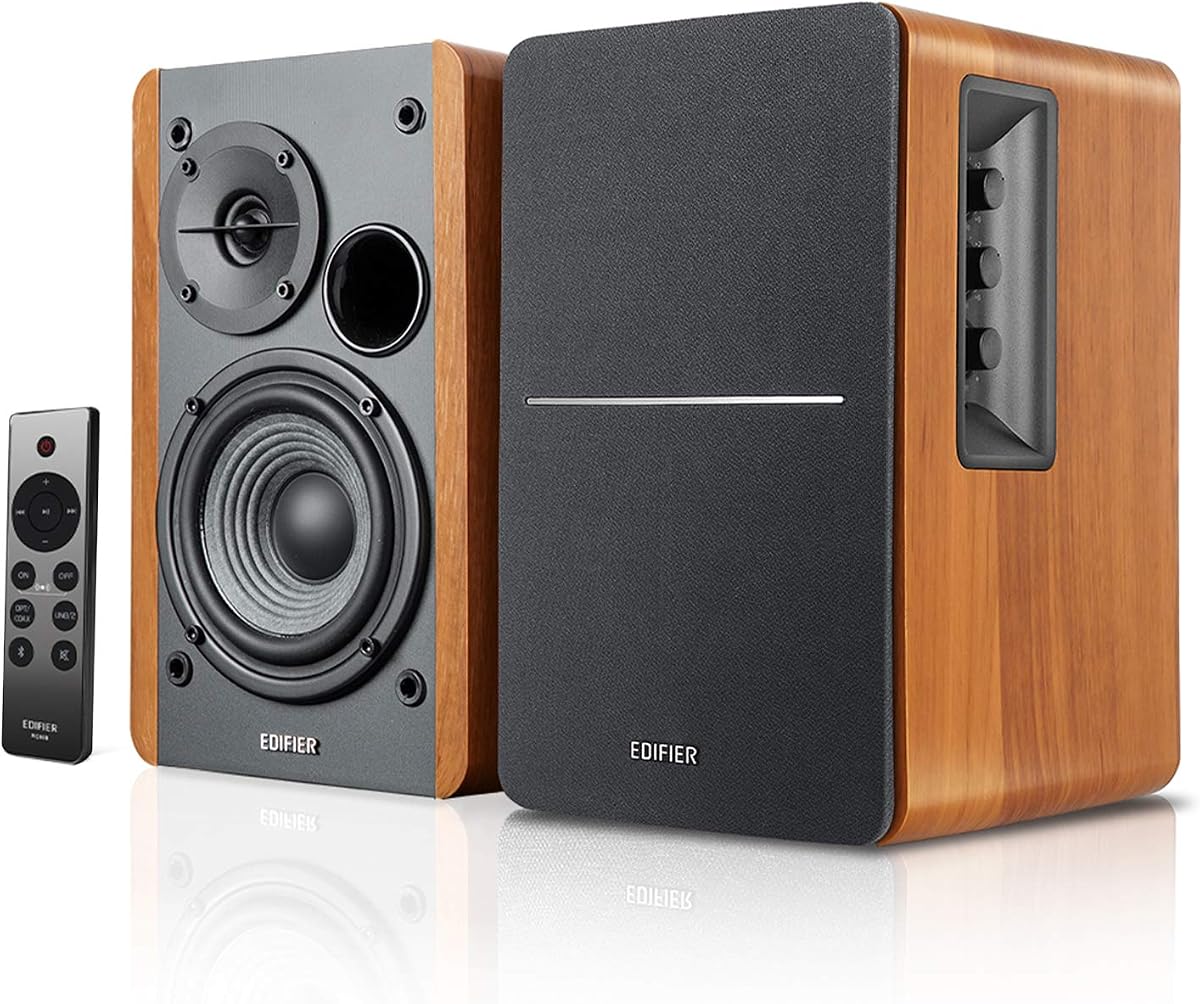
The Edifier R1280DBs is an active 2.0 bookshelf system with a 4.6 rating and 42 watts of continuous undistorted power. Rather than competing as a single compact unit, it targets listeners who want two speakers placed around a room, making it a natural choice for a jazz-focused home listening setup.
We may earn a commission when you buy through this link, at no additional cost to you.
The system combines 13mm silk-dome tweeters with four-inch subwoofer units, and Soundfield Spatializer is included to enhance the listening experience. Its separate stereo cabinet arrangement can create a wider soundstage than a single speaker, allowing the piano, saxophone, upright bass, and drums to occupy distinct areas. The wood-grain finish also gives it a furniture-friendly appearance suited to shelves, stands, and media units.
Connectivity is a major strength. Bluetooth 5.0 works with smartphones, tablets, Macs, and laptops, while optical and coaxial inputs support lossless connections from compatible TVs and computers. The subwoofer output uses automatic detection and a built-in crossover, making it possible to expand the low-frequency performance with a compatible subwoofer. This is particularly attractive for readers who enjoy the weight of acoustic bass and larger jazz ensembles.
The main compromises are physical rather than electronic. The system needs two powered speakers, so it requires more shelf space than a single model, and it is not designed for battery-powered portability. A wireless remote handles volume, mute, and input selection, while side-panel controls provide direct bass, treble, and volume adjustment. The R1280DBs is an excellent final recommendation for a dedicated home jazz system with broad source support.
Using separate left and right speakers allows jazz recordings to occupy a wider soundstage. The four-inch subwoofer units provide a fuller foundation than most compact Bluetooth speakers, especially for upright bass and piano.
Bluetooth, optical, coaxial, and subwoofer connections cover streaming, computers, televisions, and low-frequency expansion. Automatic subwoofer detection and crossover simplify the process of building a fuller system.
We may earn a commission when you buy through this link, at no additional cost to you.
The best Bluetooth speaker for jazz balances detail, bass, stereo separation, and practical convenience. Start with where you will listen, the kind of recordings you enjoy, and the source equipment you already own; then use the factors below to narrow the field without paying for features you will never use.
Jazz is a broad genre, so tonal balance matters more than any single technical specification. A small combo playing near a microphone may need clean mids and restrained treble, while a large ensemble recorded with more ambience benefits from a wide, energetic presentation. Listeners should look for a full-range sound that can reveal brushwork, saxophone breath, piano articulation, cymbals, upright bass definition, and the texture of a brushed snare. The supplied specifications distinguish between dedicated full-range driver arrangements, powered studio monitors, and speakers using digital sound enhancement. None of those approaches guarantees subjective preference, but each gives a clear indication of the intended presentation. A flat or accurate design is best for critical listening, whereas boosted bass and intelligent processing are likely to feel more energetic at a party or outdoors.
Many classic jazz recordings rely on stereo placement. The piano may occupy the left side while the saxophone enters on the right, and a saxophonist may move across the stereo field during a solo. A single compact speaker can reproduce these elements, but two independent speakers or a stereo-paired portable unit usually offers better channel separation. The Marshall Acton III is designed as a dedicated room-filling home speaker, while the Edifier R1280DBs uses separate active cabinets. The Anker soundcore 2, 20W Portable Bluetooth Speaker, and JBL Charge 6 all support wireless pairing, although buyers should confirm the exact pairing process and compatibility in current listings. Wider imaging can make small-group recordings sound more immediate and large ensembles easier to follow.
A speaker that sounds convincing on a desk may not have enough output or bass extension for a large living room, while a room-filling home model can overwhelm a bedside table. The Klipsch The Three Plus is explicitly designed for larger spaces with a 2.1 architecture and dedicated woofer. The Marshall Acton III focuses on an immersive, room-filling presentation, while the Edifier MR3 and R1280DBs are better aligned with nearfield or dedicated two-speaker listening. Self-tuning and room-correction features can reduce placement sensitivity. Harman Kardon Onyx Studio 9 calibrates itself to its environment, and Sonos Era 100 SL uses Trueplay to fine-tune output for the room. Always consider where the speaker will stand, how far away listeners will sit, and whether nearby walls or furniture will influence bass and clarity.
Portability is about more than weight and dimensions. A useful travel speaker needs a protected enclosure, intuitive controls, stable Bluetooth, and enough battery life for the intended outing. The Anker soundcore 2 provides up to 24 hours of playback with IPX7 protection, while the JBL Charge 6 offers up to 28 hours with a more rugged IP68 design. The Klipsch Detroit adds a removable strap, dust and waterproof protection, and up to 24 hours of stated playback. The Onyx Studio 9 provides eight hours and a USB charging port, making it a useful room-to-room option. Speakers intended for permanent home use, such as the Acton III, The Three Plus, and the Edifier bookshelf system, do not list integrated batteries. Consider not only runtime but also charging speed, whether the speaker can recharge a phone, and how the battery is affected by volume and lighting.
Bluetooth versions and supported codecs influence pairing ease, range, and potential future compatibility, but the supplied information does not provide codec details for every model. The list includes Bluetooth 5.0, 5.2, and 5.3 across different products, as well as multi-device or multi-point options in selected cases. Wired inputs can be equally important for jazz collectors. The Klipsch The Three Plus includes Phono/RCA inputs for turntable use, the Edifier R1280DBs supports optical and coaxial digital sources, and the Edifier MR3 offers balanced TRS, RCA, and AUX connections. The Sonos Era 100 SL adds line-in support and Wi-Fi streaming. If your jazz library is stored on vinyl, a computer, television, network player, or turntable, make sure the speaker can accept that source without requiring additional equipment.
The amount of control available varies significantly. The Harman Kardon One app provides customizable EQ and compatible-speaker control, while the Klipsch Connect app adjusts bass, mid-range, treble, saved presets, and firmware. The EDIFIER ConneX app offers detailed EQ, and the Edifier R1280DBs puts bass, treble, and volume controls directly on the speaker. Some simple party speakers emphasize physical buttons and synchronized lights instead. Jazz listeners who enjoy multiple genres may appreciate presets or separate bass and treble controls, while those who want a consistent sound may prefer a simple interface. An app can make a system more flexible, but it is only valuable if the listener is comfortable using it and if the phone remains available when adjustments are needed.
If you plan to grow a jazz system, check which expansion paths each brand supports. Harman Kardon Onyx Studio 9 can pair two units through the multi-speaker connection described as Auracast. JBL Charge 6 also supports Auracast stereo pairing and links with multiple compatible JBL speakers. Klipsch The Three Plus includes broadcast mode for more than ten compatible units, although the supplied details state that these additional speakers receive mono signals. That distinction matters for stereo jazz. The Edifier R1280DBs can connect to a subwoofer through its line output and built-in crossover, offering another route to deeper bass. Expansion is most valuable when it improves the music without adding unnecessary complexity, so buyers should favor ecosystems they already use or understand.
Durability ratings show how safely a portable speaker can handle the environment. IPX5 protects against splashes, IPX7 against water exposure, and IP67 combines dust protection with water immersion protection. JBL Charge 6 adds a stated one-meter drop tolerance, and Klipsch Detroit includes a carrying strap. Extra features may include built-in microphones for calls, reverse charging, fast charging, lighting, and auxiliary inputs. These extras can be useful, but they should not obscure the core priorities of tonal quality, adequate output, and reliable connectivity. A speaker designed for a quiet room, a turntable, a patio, and a camping trip may require compromises in one area or another. The best choice is the model whose strengths match the environment where you will actually listen.
Begin by placing the speaker on a stable surface at roughly ear height when practical, with a little space behind it if the design is intended to project into a room. For a single speaker, a position near the listening area often produces a more even image than placing it beside the audio source. A pair should be separated and angled toward the main seating position. Before changing the EQ, listen to a familiar jazz track at a moderate level, then make small adjustments rather than trying to correct every frequency at once. The app-based models also benefit from completing setup and firmware updates before judging their sound.
Manage power according to the environment. Charge portable speakers fully before trips or long gatherings, and use their protective cases or stable surfaces when moving them. Water-resistant ratings are useful but should not be treated as permission to submerge a speaker unless the manufacturer explicitly states that it is safe. Keep charging ports clean and dry, avoid leaving a speaker in extreme heat, and follow the guidance for its specific battery and power-bank functions. If the speaker can charge a phone, conserve that feature for genuine needs so the music is not interrupted by a depleted internal battery.
For the best results, use high-quality source files and avoid leaving Bluetooth audio competing with heavy network traffic or other wireless activity on the same device. When using wired inputs, match the source level appropriately and let the speaker run for a short period at the intended volume before making tonal changes. Clean fabric or grilles gently according to the manufacturer's instructions, and do not push a cabinet, driver, or control beyond its intended operation. For vinyl users, confirm the correct turntable output or phono setting before connecting a system such as The Three Plus, because the required line or phono level must match the speaker's input.
The right choice depends on room size and source preferences. The Marshall Acton III is a strong single-speaker option for a dedicated home setup, while the Edifier R1280DBs provides two separate channels for listeners who want wider stereo placement. The Sonos Era 100 SL suits a connected home system, and the Klipsch The Three Plus offers greater scale and turntable connectivity. Consider output, bass, room placement, and available inputs before deciding.
No, because many excellent Bluetooth speakers are designed to create a convincing stereo image from one enclosure. A pair can improve channel separation, especially for recordings in which instruments are positioned across the stereo field. It also gives some systems more total output and a wider soundstage. Single speakers remain more convenient, so the value of pairing depends on the room, the recordings, and the speaker's supported pairing functions.
A rating of 20 to 24 hours is useful for day trips, camping, and long gatherings, while shorter runtimes may be sufficient for moving between rooms. The Anker soundcore 2 and Klipsch Detroit are described as offering up to 24 hours, and JBL Charge 6 can reach 28 hours with Playtime Boost. Actual runtime depends on volume, audio content, lighting, and other features, so the published maximum should be treated as a best-case figure.
Only if the speaker has a compatible wired input, because most turntables do not transmit audio over Bluetooth. The Klipsch The Three Plus includes Phono/RCA inputs specifically for turntable use, while the Edifier R1280DBs accepts optical and coaxial digital sources and the Sonos Era 100 SL includes line-in. Check whether your turntable outputs phono-level or line-level audio and configure the connection correctly before playing.
Yes, and rugged models can be particularly convenient if you move between rooms, patios, and other locations. The JBL Charge 6, Klipsch Detroit, and Anker soundcore 2 all have substantial water-protection ratings, while the 20W Portable Bluetooth Speaker uses IPX5 splash protection. A rugged enclosure does not automatically guarantee the most refined sound, so consider tonal features, output, stereo imaging, and app controls as well as durability.
A studio monitor can be excellent when detail, tonal accuracy, and close listening matter most. The Edifier MR3 is explicitly designed around accurate monitoring, with a flat Hi-Res Audio response and multiple modes for music and production. For a relaxed home listening experience or a larger room, a dedicated home speaker such as the Marshall Acton III or Klipsch The Three Plus may be more appropriate. The best choice depends on how critical versus immersive you want the presentation to be.
No. Some products support true left-and-right stereo pairing, while broadcast or multi-speaker modes may distribute the same mono signal to additional units. The Anker soundcore 2, JBL Charge 6, and 20W Portable Bluetooth Speaker advertise wireless stereo pairing, while the Klipsch broadcast functions described in the supplied information send mono signals. Check the pairing instructions carefully before assembling a multi-speaker jazz system.
An app is not necessary, but it can make a speaker more adaptable to different jazz styles and rooms. Harman Kardon, Klipsch, Edifier, and Sonos provide varying degrees of EQ, preset, firmware, or room-tuning control. If you want a straightforward setup with physical buttons, simpler speakers may be more satisfying. If you regularly switch among vocal, piano, fusion, and big-band recordings, deeper control can be worthwhile.
The Harman Kardon Onyx Studio 9 stands out as the most adaptable all-around choice because it combines self-tuning, app-based EQ, multi-device Bluetooth, a rechargeable battery, and wireless stereo pairing. The Marshall Acton III is ideal for a dedicated home room where room-filling sound and distinctive design matter most, while the Anker soundcore 2 delivers the most accessible combination of portability, battery life, water protection, and strong bass for the money.
For jazz specifically, prioritize the type of listening you actually do. Choose accurate monitors and separate stereo channels for close, critical playback; a powerful home system with a dedicated woofer for larger rooms and records; or a rugged paired speaker for outdoor sessions. App control, turntable inputs, digital inputs, reverse charging, and multi-speaker expansion are valuable extras, but they should support rather than replace the core priorities of detail, tonal balance, bass control, and stereo imaging.
Before buying, check the current product listing, package contents, input availability, charging details, and multi-speaker compatibility. Specifications and availability can change, and retailer promotions may also alter the final cost. With those checks completed, the right Bluetooth speaker can make jazz more engaging at home, on a patio, at a gathering, or anywhere a good recording deserves room to breathe.