
Anker Laptop Docking Station 8-in-1
4.5Editor score
Dual HDMI display support
Up to 85W pass-through charging
Eight-in-one port layout
Our expert guide compares the best docking station for Dell laptop options, covering power delivery, display support, port selection, compatibility, charging
A docking station can transform a compatible Dell laptop into a cleaner, more capable workstation by connecting displays, charging, networking, and everyday accessories through one upstream cable. The right model depends on your Dell series, USB-C capabilities, monitor arrangement, power requirements, and the speed of the peripherals you regularly use.
We compared these ten docks using the supplied specifications, including supported displays, charging capacity, port mix, data speeds, compatibility details, and practical limitations. The list includes Dell-designed models and third-party USB-C docks, covering compact setups, multi-monitor workstations, high-speed data transfer, and broader portability needs.
Each pick highlights the features most relevant to a Dell user, while the comparison chart makes port layouts and display capabilities easier to scan. Product details and availability can change, and prices fluctuate over time, so confirm your specific Dell model, operating system, power adapter, and monitor requirements before purchasing.
4.5Editor score

4.5Editor score

4.3Editor score
The comparison below organizes all ten options by their most important characteristics: display flexibility, charging capacity, port selection, and the key compatibility considerations that matter when connecting a Dell laptop.




The Dell Pro Dock WD25 is the most broadly compelling option in this guide, earning a 4.5 rating from customers. It is designed for modern Dell AI PC users while also supporting compatible non-Dell PCs, making it a logical first choice for offices that want a standardized commercial docking solution without closing the door to other hardware.
We may earn a commission when you buy through this link, at no additional cost to you.
Its standout feature is native support for up to four high-resolution displays. That makes the WD25 appropriate for analysts, developers, designers, and administrators who routinely move between several panels. It can also deliver up to 100W to a compatible laptop, reducing the need for a separate charging connection when a suitable power supply and upstream cable are in use.
The practical design deserves attention as well. Dell's ambidextrous USB-C cable can be routed to the left or right, which helps avoid awkward cable strain and makes the dock easier to position. Its emphasis on manageable commercial deployment, newer connector construction, faster USB and network speeds, and reduced standby power consumption strengthens its case for professional workspaces.
This is the dock to choose when your Dell laptop is part of a managed business fleet, your desk uses multiple high-resolution monitors, or you want a native Dell solution with generous charging headroom. It is less compelling for a highly budget-conscious home setup, but its feature set makes it the strongest all-around recommendation for a compatible Dell laptop.
Support for up to four high-resolution displays gives the WD25 considerable flexibility for trading floors, engineering workflows, editing suites, and command centers. Confirm the resolution and refresh-rate combinations supported by your exact monitors and Dell graphics configuration before installation.
The side-flexible upstream cable and commercial management features distinguish this model from a basic USB-C hub. These qualities matter in shared offices and managed deployments where consistent connections, easy maintenance, and tidy installation are priorities.
We may earn a commission when you buy through this link, at no additional cost to you.
The Anker 8-in-1 USB-C dock is the value-focused pick in this roundup, combining a 4.5 rating with a practical collection of everyday ports. It gives a compatible Dell laptop dual-display support, wired networking, card reading, USB-A connectivity, and pass-through charging without attempting to be an oversized desk accessory.
We may earn a commission when you buy through this link, at no additional cost to you.
Its two HDMI outputs can drive one display at up to 4K60Hz or two displays at up to 4K30Hz. That is a useful configuration for many offices where one panel serves as the main workspace and another provides reference information. USB-C Power Delivery can provide up to 85W, although a compatible 100W wall charger and USB-C-to-USB-C cable are required.
The main compromise is that this is a more focused hub than the larger docks in the list. It provides two USB-A data ports rather than a broad collection of USB-A and USB-C connections, and no USB-C data port is listed. Linux is also outside the stated compatibility range, while macOS users receive identical content on both external displays.
Choose this model for a two-monitor home office, study setup, or straightforward business desk where dual HDMI, Ethernet, charging, and basic peripherals are the priorities. It combines a high customer rating with a manageable port layout, making it a sensible starting point for compatible Dell laptops that need more than a simple adapter.
Two HDMI ports make the dock easy to deploy with common office displays. One screen can run at up to 4K60Hz, while two screens can run at up to 4K30Hz, giving users a clear choice between smoothness and resolution.
The combination of USB-A data connections, Gigabit Ethernet, an SD/microSD reader, and audio-free practical connectivity covers common desk accessories. The upstream USB-C port handles data and charging, reducing the number of cables attached to the laptop.
We may earn a commission when you buy through this link, at no additional cost to you.
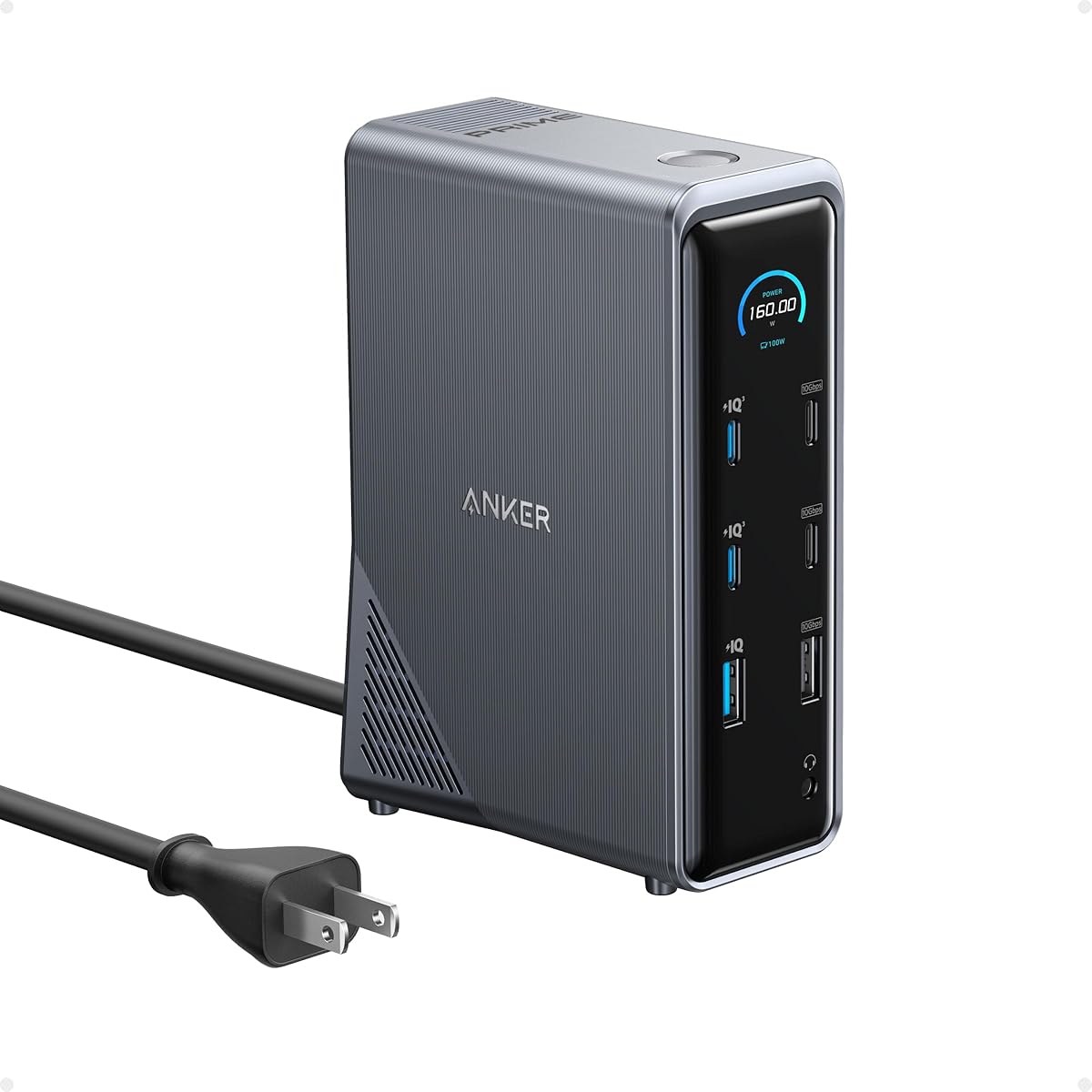
The Anker Prime 14-in-1 is the premium power-and-connectivity pick, with a 4.3 customer rating and the strongest charging headline in the group. Its 160W total output can charge up to four devices simultaneously through three USB-C ports rated up to 100W each and one USB-A port rated up to 12W.
We may earn a commission when you buy through this link, at no additional cost to you.
It also offers a generous 14-port arrangement, data speeds up to 10Gbps, and dual display support. The two HDMI outputs can provide up to 2K60Hz with a DP 1.4 laptop or 1080p60Hz with a DP 1.2 laptop. This makes it particularly attractive for users who need to power several peripherals but may not require four high-resolution screens.
Its limitations deserve attention. The dock does not support a 5120-by-1440 monitor, macOS mirrors the content on both external displays, and Linux is not supported. Those restrictions mean it is better suited to Windows-centric Dell workstations with straightforward dual-screen layouts than to specialized mixed-platform or ultrawide setups.
This is the ideal choice for a power-heavy Windows Dell setup that also needs fast data transfer and several charging connections. The included 100W, 10Gbps upstream cable and substantial port selection make it a polished all-in-one station, provided the display resolution and operating-system requirements match your workflow.
With 160W of total output, the Prime can serve a Dell laptop, phone, tablet, and another USB device at the same time. This eliminates the need for several wall outlets or separate desk chargers when every connected device requires power.
The 10Gbps data options are valuable for fast storage, transfers, and other demanding peripherals. A bundled 10Gbps upstream cable helps preserve those capabilities and reduces the need to purchase an additional certified cable.
We may earn a commission when you buy through this link, at no additional cost to you.
The HoDo 8-in-1 dock is a video-output-focused option with a 4.3 rating. Its four display interfaces—two HDMI, one DisplayPort, and one VGA—offer unusual flexibility for a relatively compact hub, particularly for users who still need to support legacy screens or projectors.
We may earn a commission when you buy through this link, at no additional cost to you.
A single HDMI or DisplayPort output can reach 4K60Hz, while the second HDMI output reaches 4K30Hz. Two connected displays can operate at 4K30Hz and 1080p60Hz with DP 1.4, while a three-display arrangement is also listed as possible. The 100W input and 87W safe laptop output can keep a compatible Dell charged over one connection.
The compatibility section is the most important consideration. The manufacturer explicitly excludes some Dell Latitude 3440 and 3340 configurations, ThinkPad X1 Carbon Gen 7 and Gen 8 models, Dell gaming laptops, and other devices whose USB-C ports lack DisplayPort Alternate Mode. Additionally, connecting VGA affects the resolution of all displays, limiting the arrangement to 1080p.
Pick this dock only after confirming that your exact Dell model has a full-featured USB-C video port and that you understand the resolution trade-offs. For older equipment with DisplayPort and VGA needs, it can be versatile. For a modern XPS or compatible Latitude, the lack of USB-C data ports and extensive exclusions make one of the more specialized picks.
Having two HDMI ports alongside DisplayPort and VGA is useful for mixed monitor environments. It can connect modern high-resolution panels and older office displays without requiring a separate legacy adapter.
Using the VGA connection reduces the maximum resolution of all attached displays to 1080p. Leave it disconnected when working with 4K screens to preserve the higher output capabilities of the digital video ports.
We may earn a commission when you buy through this link, at no additional cost to you.
The Anker Nano 13-in-1 stands apart with a detachable six-in-one portable hub, giving it unusual value for people who alternate between a permanent desk and mobile work. The main dock handles displays and full-size peripherals, while the smaller detachable section provides a more travel-friendly connection for accessories.
We may earn a commission when you buy through this link, at no additional cost to you.
The main unit supports up to three displays through two HDMI ports and one DisplayPort. It can drive a single 4K60Hz display, two 2K60Hz displays, or three 1080p60Hz screens. It also offers 100W Power Delivery, Gigabit Ethernet, SD and TF card slots, 3.5mm audio, multiple USB-A connections, and USB-C data ports with 5Gbps and 10Gbps options.
MacOS users receive mirrored rather than independent content on multiple external displays. The included 140W power adapter is intended to maintain stable performance under a full load, and the dock cannot operate until a laptop is connected through its upstream port. Although the supplied information identifies compatibility with Dell XPS and many Windows laptops, exact model verification remains essential.
This is a compelling recommendation for a Dell user who wants one solution for both home and travel rather than a fixed desktop dock and separate travel adapter. It works especially well for data analysts, traders, and content creators who benefit from extra screen space and need to pack their accessories efficiently between locations.
The detachable hub lets you leave much of the desktop equipment behind while retaining essential USB-C connectivity. This makes the product more adaptable than a conventional fixed dock without requiring two entirely separate accessory bundles.
The dock can scale from one 4K60Hz display to two 2K60Hz displays or three 1080p60Hz displays. Matching the dock to the intended screen count ensures that you receive the intended resolution and refresh-rate combination.
We may earn a commission when you buy through this link, at no additional cost to you.
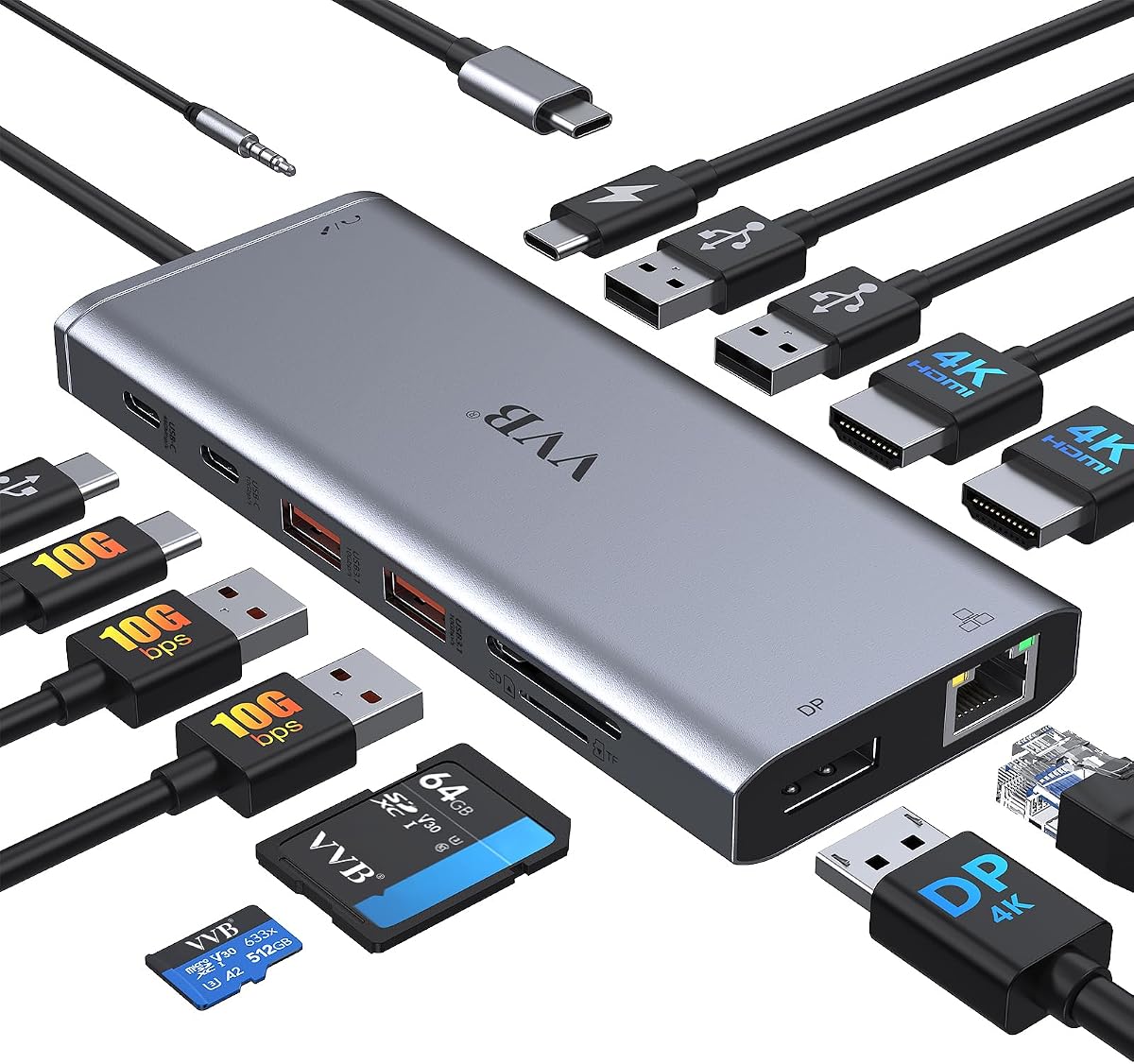
This 14-in-1 USB-C dock offers one of the broadest port combinations in the guide and carries a 4.3 rating. It includes two HDMI ports, DisplayPort, 100W USB-C Power Delivery, Gigabit Ethernet, multiple USB-A and USB-C data connections, an SD/microSD reader, and a 3.5mm microphone and audio jack.
We may earn a commission when you buy through this link, at no additional cost to you.
Its display capability is flexible on Windows. A single HDMI or DisplayPort connection can reach 4K60Hz, the second HDMI supports 4K30Hz, and a dual-screen setup can use 4K30Hz and 1080p60Hz with DP 1.4. Windows systems can also use three displays at 1080p. MacBook users are limited to the same image on every external monitor.
Charging is less convenient out of the box because the charging cable and power adapter are not included. The dock accepts up to 100W input but provides up to 87W to the laptop, and the connected Dell must support USB-C Power Delivery. The compatibility list includes several Dell Latitude, Inspiron, Vostro, and XPS models.
This is a strong option for a compatible Windows Dell laptop that needs multiple display formats, high-speed storage, wired networking, card access, and audio in one unit. It is less convenient for travelers or macOS users, but for a flexible Windows workstation, the combination of ports and 10Gbps connections is difficult to overlook.
The dock combines modern 10Gbps USB connections with legacy USB 2.0 ports, which can be useful when connecting older peripherals. SD and microSD readers also streamline photo and media workflows without requiring a separate card adapter.
Windows systems can use dual or triple displays at different resolutions, while macOS limits all external screens to the same image. This distinction is essential if you alternate between a Dell Windows laptop and a MacBook.
We may earn a commission when you buy through this link, at no additional cost to you.
The Dell WD19S 180W is a native Dell option for users who prioritize a familiar commercial dock and substantial power capacity. Its 3.8 customer rating is the lowest among the ten products here, but the core configuration remains relevant for compatible Dell laptops used in demanding office environments.
We may earn a commission when you buy through this link, at no additional cost to you.
The included 180W power adapter and 130W Power Delivery output provide more charging headroom than many general-purpose USB-C hubs. The dock's USB-C interface, HDMI connection, and dual DisplayPort outputs are especially suitable for business Dell systems that support DisplayPort or compatible USB-C docking.
The supplied information is concise, so buyers should verify the full port list, supported display resolutions, and system compatibility before ordering. Its customer rating may reflect differences in setup, firmware, or individual system configurations that cannot be evaluated from the specifications alone. For a compatible business laptop, a Dell-first support path can still be valuable.
This model is best considered when you already know that your Dell laptop is designed for the WD19 family and need robust power delivery. It is less suitable for buyers who want a detailed, broadly compatible USB-C hub with fast data ports and a clearly specified display matrix. Confirm the exact model and current Dell support information before purchase.
A 130W laptop delivery rating and 180W adapter provide ample power for compatible systems and attached peripherals. That makes this dock useful in professional offices where laptops may run at sustained high workloads.
Using a Dell-designed dock can simplify integration within a managed business environment. It is especially attractive to organizations already standardize their peripherals around Dell equipment.
We may earn a commission when you buy through this link, at no additional cost to you.
The Anker 13-in-1 dock combines a 4.0 rating with a compact vertical form and broad workstation functionality. It turns a compatible Dell laptop into a desktop setup through one upstream cable while offering 13 connections across displays, data, charging, networking, and audio.
We may earn a commission when you buy through this link, at no additional cost to you.
Up to three external monitors can run at 1080p60Hz on Windows 10, Windows 11, and ChromeOS systems with MST. A single HDMI or DisplayPort display can run at 4K60Hz. The laptop receives up to 85W charging, and a separate USB-C port can deliver 18W to a phone at the same time.
Its data features include 10Gbps USB-C, 5Gbps USB-A, and an SD reader with transfer speeds up to 104 MB/s. The vertical enclosure measures 4.9 by 3.5 by 1.6 inches and weighs 13.1 ounces, so it occupies substantially less desk area than many full-size docks. macOS supports charging and data, but external monitors are limited to mirrored content.
Choose this dock for a compact Windows workstation with two or three standard-resolution monitors. It also works well when you want one high-resolution display plus several accessories. The 85W host charging level is adequate for many mainstream Dell laptops, but power-hungry systems should verify their requirements first.
Triple-display support is useful for monitoring communication tools, documents, and applications side by side. For mixed-resolution setups, check whether one 4K panel and additional 1080p panels are supported by the laptop's graphics configuration.
The vertical enclosure keeps the dock narrow and helps conserve desk space. That makes it suitable for compact home offices where a sprawling multi-monitor setup must coexist with limited room for other equipment.
We may earn a commission when you buy through this link, at no additional cost to you.
The Dell WD19 130W is a well-established native Dell docking option with a 4.0 customer rating. It is particularly relevant to users with a compatible Dell laptop designed around the WD19 platform and a need for dependable wired connectivity at a professional desk.
We may earn a commission when you buy through this link, at no additional cost to you.
Its port selection is clearly specified: one USB-C 3.1 Gen 2, three USB-A 3.1 Gen 1 connections, a combined headset port, a separate audio output, two DisplayPort 1.4 interfaces, one HDMI 2.0B port, a USB-C multifunction DisplayPort connection, and Gigabit Ethernet. The included 130W AC adapter supplies up to 90W of laptop power delivery.
The dock's USB-C upstream connection simplifies the physical desk setup, while dual DisplayPort outputs and HDMI provide flexibility for common business monitor arrangements. Its dimensions of 8.1 by 3.5 by 1.1 inches and weight of 20.63 ounces produce a more substantial footprint than some compact third-party alternatives.
This is a sensible option for a compatible Dell business laptop, especially one already associated with the WD19 ecosystem. Before ordering, read Dell's compatibility information and confirm the required host connection and display configuration. It may not suit newer buyers seeking triple-display flexibility or the very fastest USB data rates.
The mix of USB-A, USB-C, Ethernet, audio, HDMI, and dual DisplayPort covers many conventional office accessories. This makes the dock straightforward to integrate into a laptop-based professional workstation.
The WD19 platform is particularly relevant to compatible Dell business notebooks. For organizations with an existing mixed fleet, model-level support documentation is an important reason to consider this over a generic dock.
We may earn a commission when you buy through this link, at no additional cost to you.
The renewed WD19 offers a native Dell dock experience with a 4.1 customer rating. It combines an 180W power adapter, USB-C and Thunderbolt support, dual-display capability, and a broad selection of compatible Dell Inspiron, Venue, Precision, XPS, and Latitude systems.
We may earn a commission when you buy through this link, at no additional cost to you.
Its listed connections include one USB-C 3.1 Gen 2 port, three USB-A 3.1 Gen 1 ports with one supporting PowerShare, a combined headset connection, and a separate audio output. It measures 8.1 by 3.5 by 1.1 inches and weighs 20.63 ounces, matching the form of the established Dell WD19 family.
The renewed status is the defining detail. It may represent an opportunity to obtain a known commercial dock with a capable adapter at a lower acquisition cost, but buyers should review the seller's condition description, included accessories, return terms, and warranty carefully. Firmware updating is also mentioned as a troubleshooting step when compatibility issues arise.
This dock is best for a compatible Dell laptop where a native design and generous adapter capacity outweigh the desire for brand-new condition. Verify USB-C DisplayPort or Thunderbolt support, check your exact model in Dell's compatibility resources, and ensure the renewed listing includes the necessary power and USB-C cables for your setup.
The included 180W adapter offers substantial capacity for a compatible Dell notebook and attached desk equipment. It provides a conventional workstation foundation without requiring a separate high-wattage charger.
A renewed dock can provide the same core port layout as a standard Dell model, but cosmetic and functional details may differ. Review the listing photographs, condition notes, included accessories, and warranty before making a final decision.
We may earn a commission when you buy through this link, at no additional cost to you.
Choosing a docking station for a Dell laptop begins with the laptop's physical USB-C capabilities, not merely its port shape. Display mode, Power Delivery, charging power, monitor count, operating system, and peripheral requirements should all guide your decision.
Summary: Verify video mode and charging support before ordering.
Summary: Match outputs to your exact screens and operating system.
Summary: Check adapter wattage, cable rating, and laptop delivery.
Summary: Match USB speed to storage and accessory demands.
Summary: Count the everyday ports you will actually use.
Summary: Choose a layout that fits your desk and connectors.
Summary: Verify display behavior for every connected operating system.
Summary: Confirm exact model compatibility and firmware support.
Begin by identifying the correct upstream USB-C port on your Dell laptop. It should support DisplayPort Alternate Mode for monitor output and Power Delivery for charging. Connect the dock to the laptop with a suitable USB-C cable, then attach displays and powered accessories. If the computer does not recognize the dock immediately, reconnect the upstream cable and confirm that the port supports the required functions.
Install the power adapter when the dock provides laptop charging or a high total power budget. Use the specified or appropriately rated adapter and cable, especially when the dock or laptop expects 65W or more for stable operation. A lower-wattage adapter can trigger warnings or prevent dependable charging. Connect monitors one at a time when troubleshooting, then use the Windows display settings to select the desired arrangement.
For daily care, keep the dock on a stable, ventilated surface and avoid placing it under papers or other objects that trap heat. Route the upstream cable without creating a tight bend, and do not force connectors into ports. Clean the exterior with a dry or lightly damp cloth, keep liquids away from the enclosure, and update firmware when Dell or the manufacturer recommends it. For shared offices, document the dock, adapter, and display arrangement to simplify future setup and maintenance.
No. The Dell laptop's USB-C port must support DisplayPort Alternate Mode for video output and usually USB-C Power Delivery for charging. Some Dell models have ports that support only data or charging, so check the specifications for your exact notebook before purchasing. USB4 and Thunderbolt ports are generally more capable, but they still need to support the required display modes.
It depends on the dock, the laptop, and the operating system. Options in this guide range from dual-monitor support to as many as four high-resolution displays on the Dell Pro WD25. Some docks support three displays only at 1080p, and macOS may mirror the same content across every external screen. Verify the maximum resolution and refresh rate for each intended display arrangement.
Many models do through USB-C Power Delivery, provided the Dell laptop and upstream port support charging. The available laptop power varies by dock, from lower-capacity desktop-style options to as much as 100W on the WD25 and Anker Nano. Some products also require a separate compatible power adapter that is not included, so check both the input and output ratings.
The required wattage depends on the dock and the laptop you intend to charge. Some basic hubs expect a 65W charger or greater, while larger docks include higher-capacity adapters. Do not assume that a dock advertising 100W input delivers 100W to the computer; some models cap safe laptop output at 87W. Use a compatible adapter and an appropriately rated upstream USB-C cable.
A native Dell dock can provide tighter integration, familiar support resources, and a known 130W or 180W adapter approach. Third-party docks may offer more ports, faster USB data, a detachable travel design, or a lower acquisition cost. The better choice depends on your Dell model, monitor arrangement, power needs, and how important native management is to your organization.
Often yes, provided the exact laptop has a full-featured USB-C port with DisplayPort Alternate Mode and, if needed, Power Delivery. The Anker Nano explicitly mentions Dell XPS compatibility, and several other docks list Latitude, Inspiron, Vostro, and XPS systems. However, some Dell Latitude and gaming configurations are excluded by certain products, so model-level confirmation is essential.
The most likely causes are an operating-system limitation or a macOS display mode that mirrors screens. Several docks state that macOS presents identical content on multiple external monitors even if the hardware has multiple video outputs. On Windows, use the operating system's display settings to select Extend rather than duplicate, and update the laptop and dock firmware if the option is missing.
It depends on your monitor connectors and the dock's outputs. The Dell WD19 and WD19S include HDMI and DisplayPort, while the Anker 8-in-1 uses two HDMI ports. Other docks add VGA or mixed display interfaces. Check the physical inputs on each monitor, select the correct cable, and confirm that your Dell model supports the dock's required display mode.
The Dell Pro WD25 is the strongest overall choice because it combines a 4.5 customer rating, up to 100W charging, support for as many as four high-resolution displays, and a thoughtful native Dell design. The Anker 8-in-1 is the best budget-focused option, while the Anker Prime 14-in-1 takes the premium position with 160W of total charging output, 10Gbps data, and an extensive port selection.
For most buyers, compatibility should take priority over port count. Confirm DisplayPort Alternate Mode, Power Delivery, the required charging level, and the intended display arrangement before choosing a model. Native Dell docks may integrate more smoothly with supported business systems, whereas third-party options often provide greater flexibility for travel, high-speed storage, mixed peripherals, and multi-screen workflows.
Finally, remember that product details, availability, and prices can change. Review the seller's current listing, included accessories, warranty terms, and compatibility information before purchasing, especially for renewed hardware or lesser-known third-party models. For a renewed WD19, pay particular attention to condition and return coverage; for any dock, verify your exact Dell model rather than relying on a broad product family.