
MEYULMOL 12V 300Ah LiFePO4
4.4Editor score
3840Wh nominal energy capacity
200A intelligent BMS protection
APP monitoring for key data
4S4P expansion capability
Our 12V 300Ah LiFePO4 Battery guide compares capacity, cycle life, BMS protection, monitoring, expansion, and key applications.
A 12V 300Ah LiFePO4 battery is a substantial deep-cycle energy-storage option for RVs, boats, solar systems, off-grid buildings, and home backup power. The right model should combine usable capacity, dependable cycle life, effective battery management, and installation features that suit your equipment and environment.
We compared the ten available models by examining rated capacity, energy density, BMS protection, low-temperature handling, cycle claims, monitoring functions, expansion limits, physical characteristics, and intended applications. This guide covers batteries for both energy storage and, where the manufacturer supports it, high-current starting or surge use.
Each review explains the battery's strongest features, practical limitations, and ideal buyer, helping you narrow the field before checking current prices. Specifications and product configurations can change, so confirm dimensions, charging requirements, and system compatibility with the manufacturer before purchasing.
4.4Editor score

4.8Editor score

4.9Editor score
The comparison below highlights the principal differences among all ten batteries, including usable energy claims, battery-management hardware, monitoring options, expansion limits, and special-purpose capabilities.




The MEYULMOL 12V 300Ah LiFePO4 battery combines a 3,840Wh capacity rating with app-based monitoring and a 200A intelligent BMS, making it a well-rounded option for large mobile and stationary energy systems. Its 4.4 rating reflects a capable package, although buyers should interpret the headline 15,000-plus-cycle claim as condition-dependent rather than a guaranteed result under every workload.
We may earn a commission when you buy through this link, at no additional cost to you.
Automotive-grade A-class cells form the core of the battery, while the integrated BMS provides overcharge, over-discharge, overcurrent, and short-circuit protection. The monitoring module reports capacity, voltage, current, and operating temperature through Android and iOS apps without requiring a separate communications device. That makes the battery particularly useful when you want visibility into a remote RV, solar installation, or off-grid cabin.
The flexible 4S4P arrangement is one of its strongest practical features. A single unit operates at 12V, while compatible banks can reach 48V and 1,200Ah, providing up to 57.6kWh theoretically based on the stated nominal figures. A low-temperature cutoff at 0°C protects cells from charging in freezing conditions, although the cutoff means cold-weather charging must wait for a safer temperature. The main trade-off is that buyers must respect the manufacturer's configuration and charging instructions rather than treating the expansion capability as universally interchangeable.
This is a strong selection for RV, marine, solar, camping, and home-backup users who want meaningful capacity, remote monitoring, and expansion without focusing exclusively on starting power. It is especially attractive for installers who want one battery platform to scale over time. Before ordering, confirm its physical dimensions, terminal arrangement, charger settings, and communication compatibility with the rest of the planned system.
The built-in communication module provides voltage, current, capacity, and temperature readings through a mobile app. That visibility can help identify abnormal consumption, charging problems, or changing battery condition without adding a separate monitor to the installation.
Supporting up to 4S4P configurations gives owners a practical path from one 12V battery to a larger 48V storage bank. Use identical compatible units and follow the documented wiring and balancing procedures for the intended configuration.
We may earn a commission when you buy through this link, at no additional cost to you.
This 12V 300Ah lithium LiFePO4 battery is the most versatile model in the group because its intelligent BMS supports both deep-cycle energy storage and high-current starting operation. The 4.9 rating is the highest among these picks, and the headline 1,500A instantaneous-current capability distinguishes it from batteries designed strictly for storage.
We may earn a commission when you buy through this link, at no additional cost to you.
Normal mode treats the unit as a 300Ah deep-cycle battery suited to backup power and repeated discharge cycles, while Power Mode unlocks the cell bank's high-rate discharge capability for starting surges. The two functions address a real RV and marine problem: separating a starter battery from a large house-power bank usually requires extra space, wiring, and maintenance. App monitoring adds voltage, current, power, state of charge, and cycle-count data for day-to-day oversight.
The system can expand from 3.84kWh to as much as 61.44kWh using 16 units in a 4P4S arrangement, with stated power output ranging from 2.56kW to 40.96kW. Temperature protections include charging and discharging cutoffs above 75°C and low-temperature operation down to the manufacturer's stated -20°C to 60°C range. As with any high-current design, the short-duration surge rating should not be confused with continuous power, and the manual should be read before operating either mode.
This battery suits buyers who want one product to serve both starting and storage roles, particularly in RVs, boats, and off-grid systems where space is limited. It is the premium choice in this guide for a reason, but exact suitability depends on the starter's current demand, cable sizing, alternator or charger compatibility, and ventilation around the enclosure. Confirm all electrical requirements before making it part of a working system.
The dual-mode BMS separates sustained storage duties from high-current startup events. This can simplify installations where a conventional starter battery and house bank would otherwise occupy separate compartments.
A maximum 4P4S configuration supports much larger energy systems than a single 12V unit. The stated 61.44kWh ceiling makes the platform relevant to substantial solar, backup, and off-grid installations when correctly balanced and commissioned.
We may earn a commission when you buy through this link, at no additional cost to you.
SUPER EMPOWER's 12V 300Ah LiFePO4 battery delivers a stated 3,840Wh of energy in a package measuring 15.35 by 7.59 by 9.84 inches and weighing 58.4 pounds. Its 4.7 rating and straightforward deep-cycle focus make it a strong candidate for RV, camper, boat, solar, and backup-power users who prioritize capacity over remote communications.
We may earn a commission when you buy through this link, at no additional cost to you.
The battery uses Grade A LiFePO4 cells and a 200A BMS that monitors voltage, current, and temperature while protecting against overcharge, over-discharge, overcurrent, short circuits, and temperature-related conditions. Its cold-weather logic is particularly useful: charging pauses below 0°C, discharge stops at -20°C, and operation resumes once the pack rises above 5°C. Those safeguards reduce the risk of charging lithium cells in unsuitable conditions.
The trade-off is that the listed feature set does not include app or Bluetooth monitoring. That is not a flaw for users who prefer a simpler installation, but it removes remote state-of-charge visibility offered by several competitors. The dimensions also deserve careful attention because a high-capacity battery that is physically too large for an existing compartment can create installation problems regardless of its electrical capabilities.
This model is a good fit for mobile users and installers who want a large, clearly specified battery with temperature protection and a five-year warranty. Verify the battery box, terminal clearance, hold-down method, and charger profile before purchase. It is also a sensible option for projects where a remote monitoring app is not required and dependable deep-cycle performance is the priority.
Separate charging and discharging temperature limits help prevent operation under damaging conditions. The automatic resume thresholds also make the protection easier to understand when temperatures change.
At 58.4 pounds, the battery offers substantial storage in a less demanding footprint than a comparable lead-acid bank. Measuring the available space and confirming a secure mounting method remain essential.
We may earn a commission when you buy through this link, at no additional cost to you.
The PUPVWMHB 12V 300Ah LiFePO4 battery combines a 200A BMS, real-time app monitoring, and a maximum 51.2V configuration in one expandable platform. Its 4.5 rating reflects a capable feature set, with monitoring data covering current, voltage, temperature, and cycle information through the manufacturer's app.
We may earn a commission when you buy through this link, at no additional cost to you.
The manufacturer states that cell capacity remains above 80% after 2,000 cycles, providing a useful benchmark for expected degradation. Series and parallel expansion can reach 51.2V and 1,200Ah, with a maximum energy figure of 61.44kWh and maximum load power of 40.96kW. A low-temperature cutoff is also included, making the battery more appropriate for RV, marine, camping, and solar use than an unprotected basic pack.
The battery's safety claims emphasize the stable chemistry of LiFePO4 and UL testing for the cells. Those benefits depend on correct charging, wiring, fusing, and ventilation, so they should not be interpreted as permission to bypass the BMS or disregard the manual. One modest limitation is that the stated 51.2V and 1,200Ah maximum is below the configuration ceiling offered by a few products in this comparison.
PUPVWMHB is most appropriate for owners who want visibility into battery operation and plan to build a larger solar or backup system over time. It also suits RV and marine users who appreciate the five-year warranty and broad installation positioning. Confirm the app's device compatibility, terminal layout, physical clearance, and required communication area before finalizing the installation.
Voltage, current, temperature, and cycle information help owners understand consumption and charging behavior. App monitoring is especially valuable when the battery bank is installed in an inaccessible compartment.
The stated 51.2V and 61.44kWh maximum configuration provides room for substantial home solar or backup systems. Expansion should use matching batteries and the manufacturer's prescribed balancing and wiring plan.
We may earn a commission when you buy through this link, at no additional cost to you.
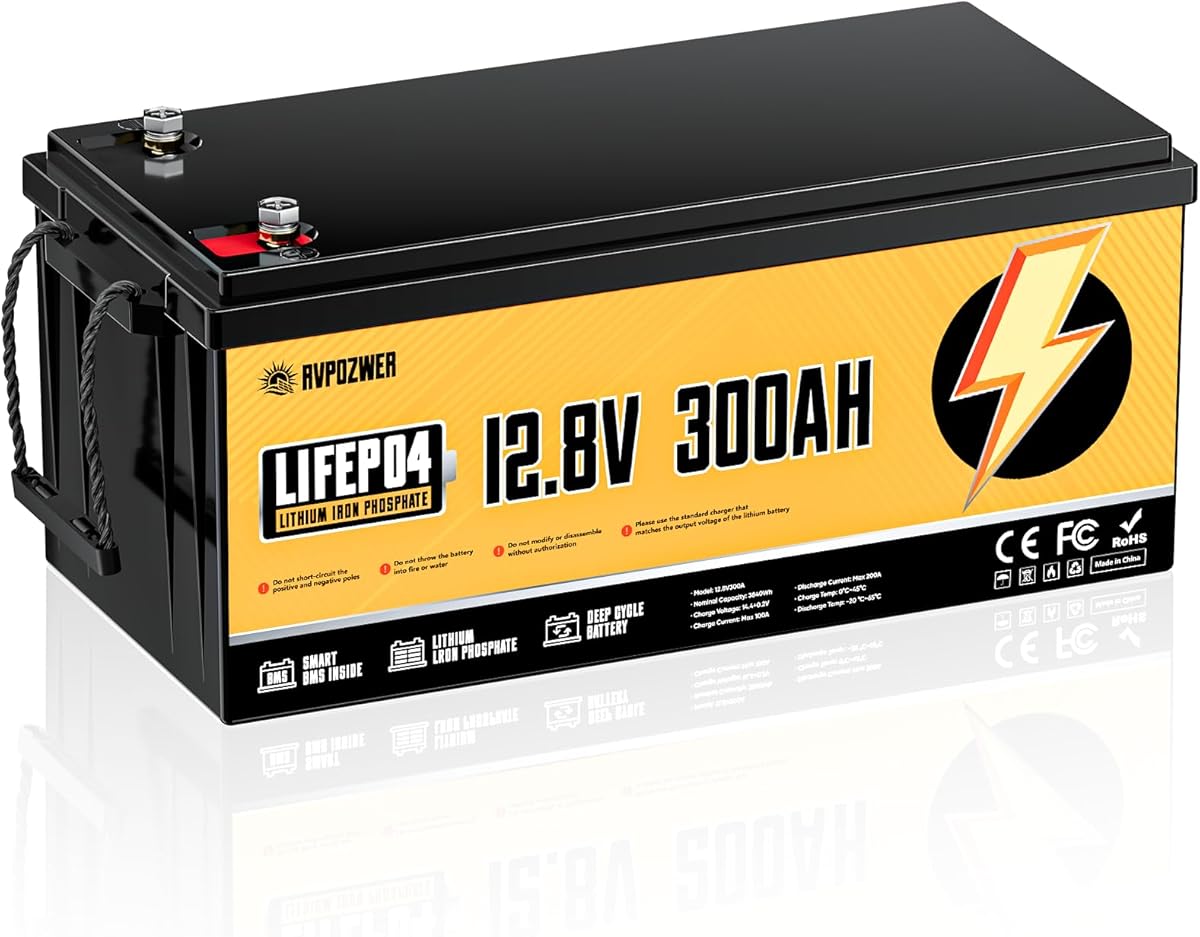
The Rvpozwer 12.8V 300Ah LiFePO4 battery offers a 200A smart BMS, a stated 3,840Wh capacity, and flexible expansion for up to four series or a 1,200Ah parallel arrangement. Its 4.0 rating is the lowest in the group, so buyers should pay particular attention to warranty terms, system compatibility, and the manufacturer's exact operating guidance.
We may earn a commission when you buy through this link, at no additional cost to you.
A notable strength is the transparent cycle breakdown: 4,000 cycles at 100% depth of discharge, 6,000 at 80%, and up to 15,000 at 60%. These figures explain why operating discipline matters. Although advertised cycle totals can be impressive, actual longevity depends on temperature, charge method, load depth, age, and maintenance practices. The battery also includes protections for overcharge, over-discharge, overcurrent, overvoltage, and short circuits.
Rvpozwer describes the unit as meeting Group 31 dimensions and provides a nylon carry handle for easier handling. Its stated operating range extends from -20°C to 65°C, covering many RV, trolling-motor, solar, marine, and off-grid environments. As with other large lithium batteries, the low-temperature rating should be checked against the charging cutoff, since discharge capability and safe charging are separate concerns.
This model is best suited to owners who understand deep-cycle operation and want a single battery platform that can scale with their energy demand. It may be particularly appealing for Group 31-compatible installations and projects where carrying weight matters. Before purchasing, compare the physical fit, terminal orientation, charger compatibility, warranty coverage, and the manufacturer's support terms against the other options.
Publishing separate cycle figures for 60%, 80%, and 100% depth of discharge makes this product's longevity claims more informative than a single headline number. Matching the operating profile to the rating is essential.
The stated Group 31 standard can simplify comparison with existing battery boxes and mounting solutions. Physical dimensions and terminal positions should still be confirmed rather than assumed.
We may earn a commission when you buy through this link, at no additional cost to you.
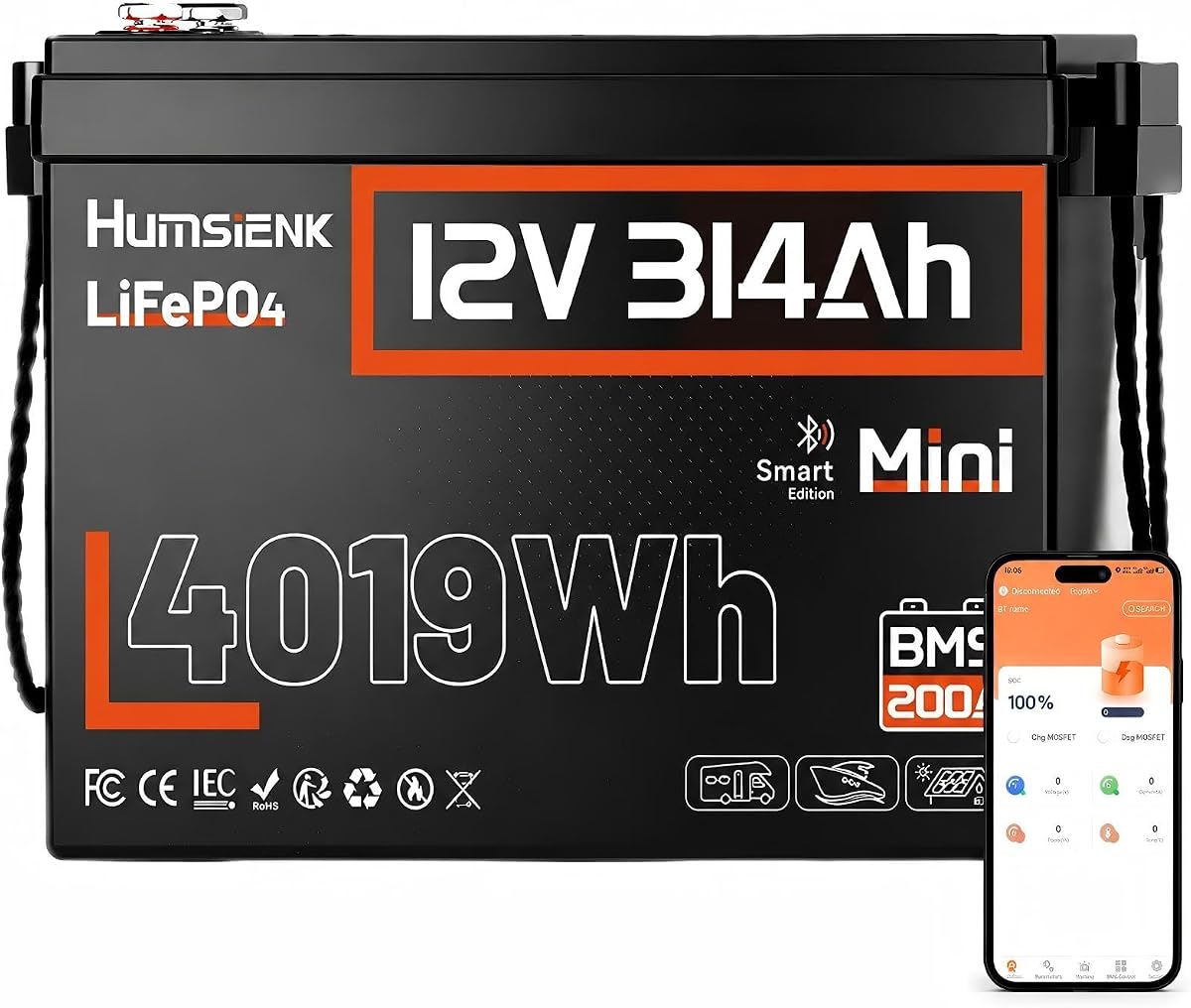
HumsiENK's 12V 300Ah, marketed as 314Ah, combines a 4.01kWh energy rating with a compact 15.1 by 9.7 by 7.6-inch format. The 4.4-rated battery is aimed at RV, marine, solar, and home-storage users who want a high energy density without the footprint of several smaller batteries.
We may earn a commission when you buy through this link, at no additional cost to you.
The 200A BMS handles overcharge, over-discharge, overcurrent, short-circuit, and temperature protection, while a low-temperature charging cutoff helps prevent charging below freezing. The product has passed UL62133 safety tests and uses an aluminum internal frame for structural support. App monitoring provides voltage, current, capacity, and temperature readings through a short-range Bluetooth connection compatible with iOS and Android.
The headline figures require close attention because the product description alternates between 4.01kWh and 4.19kWh, while also identifying the battery as 300Ah or 314Ah. Those distinctions may reflect nominal versus calculated capacity, but buyers should use the label and manual for design calculations. Bluetooth's stated 15-meter range is suitable for nearby setup but is not a substitute for remote cellular monitoring.
This model is a good fit for space-conscious RV, boat, and tight installation environments where a full-aluminum internal structure and relatively low weight are valuable. It is also appealing for solar and UPS users who can sit near the battery to check readings. Confirm the enclosure dimensions, terminal clearance, charger profile, and app requirements before ordering.
The 15.1 by 9.7 by 7.6-inch dimensions are appealing for mobile and marine installations where every inch matters. A 59.5-pound weight also makes the battery more manageable than a multi-battery lead-acid replacement.
An aluminum internal frame, ABS enclosure, UL62133 testing, and a 200A BMS provide multiple layers of protection. Correct mounting, fusing, and charging remain necessary to realize those benefits.
We may earn a commission when you buy through this link, at no additional cost to you.
Vatrer Power's 12V 300Ah LiFePO4 battery combines deep-cycle storage with a starting-battery function, giving it unusual flexibility for RV, boat, and off-grid systems. The 4.6 rating reflects a well-liked product, while its 200A BMS protects against overcharge, over-discharge, overcurrent, and short circuits.
We may earn a commission when you buy through this link, at no additional cost to you.
Automotive-grade cells, a low self-discharge rate, and a stated 5,000-plus cycle cycle-life target position it as a long-service energy-storage option. Low-temperature cutoff protection limits damage in cold conditions, while the high-temperature cutoff prevents charging above 167°F. Up to four batteries can be connected in series and four in parallel, allowing the platform to grow with larger solar or household-storage demands.
The all-in-one energy-storage and starting design can reduce the amount of space occupied by two separate battery types, which is valuable in an RV or marine compartment. It does not mean every starter is an ideal match, however. Cable gauge, starter current, alternator behavior, and the battery's exact starting mode all need to be considered. No app monitoring is listed, so users who prioritize remote state-of-charge information will find other options more suitable.
This is a practical choice for mobile users who want one large battery to support both stored energy and starting events, as well as for solar installations needing expandable deep-cycle capacity. Read the operation manual, use properly rated wiring and fusing, and confirm the battery's position and ventilation. Its versatility is the defining benefit, while the lack of connected monitoring limits convenience for some buyers.
Integrating energy storage and starting functions can simplify RV and marine layouts. It can also reduce the number of separate battery boxes that need routine inspection and maintenance.
Four-series and four-parallel support gives owners room to increase voltage and capacity without changing battery chemistry. Matching units and following the manufacturer's balancing guidance are essential.
We may earn a commission when you buy through this link, at no additional cost to you.
This 12V 314Ah LiFePO4 battery is designed specifically for energy storage and combines a 4.6 rating with an IP65-rated enclosure. That makes it particularly relevant to outdoor solar, marine, fishing, RV, and off-grid systems where moisture and weather exposure need to be considered.
We may earn a commission when you buy through this link, at no additional cost to you.
The enhanced BMS provides overcharge and over-discharge protection, low-temperature charging protection, overcurrent protection, and short-circuit protection. It also initiates automatic balancing when battery voltage exceeds 14.1V, helping connected batteries reach a more consistent state of charge. The stated cycle claim exceeds 6,000 cycles to 80% depth of discharge, and the battery is said to weigh about one-third as much as a lead-acid unit of the same capacity.
Its defining limitation is the explicit prohibition against starting gasoline engines, golf carts, or jacks. The product is storage-only, so buyers attracted by the headline 15,000-plus cycle figure should verify the stated depth-of-discharge assumptions and proper charging regimen. Periodic charging is recommended every six months during prolonged disuse. No connected monitoring is listed.
This battery is a strong option for installers who specifically require an IP65 enclosure and do not need starting capability. It fits outdoor energy-storage roles well, provided the enclosure is mounted as directed and the system uses a compatible LiFePO4 charger. Confirm actual water-exposure limits, cable entry, ventilation, and the manufacturer's storage and recharge guidance before installation.
The IP65 rating is a meaningful advantage for marine and exposed installations. It does not eliminate the need for sensible cable routing, secure mounting, and protection from extreme heat or direct submersion.
By excluding engine-starting duties, the battery focuses on repeated deep-cycle discharge. This makes it easier to select it for a dedicated solar or house-load bank without assuming starter capability.
We may earn a commission when you buy through this link, at no additional cost to you.
The TEMGO 12V 300Ah LiFePO4 battery earns an Editor's Choice for balancing a high 4.8 rating, practical weight, app-based monitoring, and broad expansion options. Its 54.67-pound weight is listed as roughly one-third that of a same-capacity lead-acid battery, easing handling in RV, marine, and off-grid installations.
We may earn a commission when you buy through this link, at no additional cost to you.
Bluetooth connectivity links the battery to the manufacturer's app, giving users access to operating information without a separate monitoring device. The 200A BMS protects against overcharge, over-discharge, overcurrent, overheating, and short circuits. A low-temperature cutoff helps protect trolling-motor and marine applications in cold weather, while the enclosure uses recycled post-consumer ABS material that contains no heavy or rare metals.
The battery supports up to 10 units in parallel and four in series, with 24V, 36V, and 48V configurations available. Manufacturer guidance is explicit that expansion should use the same brand and model because mixed batteries may become imbalanced or trigger BMS protection. That limitation is sensible from an engineering perspective, but it means future expansion may require additional identical units rather than a mixed collection of 12V batteries.
TEMGO is a strong all-around choice for users who want meaningful capacity, low weight, and convenient monitoring without paying for the dual-mode starting architecture of the premium pick. It is well suited to boats, RVs, campers, travel trailers, and off-grid systems. Confirm the physical fit, Bluetooth range and app compatibility, terminal design, and charger settings before making the final installation.
The built-in Bluetooth function provides battery information through the manufacturer's app. It offers a practical middle ground between a completely disconnected battery and a more complex remotely connected platform.
At 54.67 pounds, the battery is among the lighter large-capacity choices shown. Lower handling weight can make installation and service easier, although secure retention remains essential.
We may earn a commission when you buy through this link, at no additional cost to you.
The Paoweric 12V 300Ah, also marketed as 330Ah, offers the broadest series-expansion ceiling in this guide at 6S6P. Its 4.4 rating and stated 10,000-plus cycle capability make it a compelling option for larger solar, RV, marine, emergency-lighting, and home-storage projects that may eventually outgrow a single 12V unit.
We may earn a commission when you buy through this link, at no additional cost to you.
Automotive-grade LiFePO4 cells are paired with a 200A BMS that protects against overcharge, overvoltage, over-discharge, overcurrent, and short circuits. The manufacturer says properly charged and stored batteries can last more than 10 years and describes the unit as roughly one-third the size of a same-capacity lead-acid battery. Up to six series and six parallel connections are supported, with explicit advice against mixing batteries from other brands.
The absence of listed app or Bluetooth monitoring means this is a more hands-on option than several rivals. It can be a benefit for owners who prefer a simpler installation, but anyone requiring remote status data must look elsewhere. Cycle performance also depends on charging discipline and operating conditions, so the headline figure should be treated as a claim governed by the manufacturer's recommended use rather than an unconditional lifespan.
Paoweric is most appropriate for installers planning a large system from the outset or wanting the option to scale in voltage and capacity later. It can support fish finders, small UPS systems, fire-safety systems, RVs, and other deep-cycle loads. Check the physical dimensions, voltage configuration, inverter or charge-controller requirements, and wiring sequence before purchasing or combining batteries.
A six-series maximum allows construction of higher-voltage systems than most competitors listed here. It is a meaningful advantage for larger projects, provided all units and system components are designed for the intended voltage.
The stated 10,000-plus cycle life and more-than-10-year service potential make proper charging and storage important. Avoiding deep discharge and keeping the battery on a suitable maintenance schedule will help preserve performance.
We may earn a commission when you buy through this link, at no additional cost to you.
A 12V 300Ah battery is a major long-term investment, so the best choice depends on electrical demands, available space, operating climate, and the amount of monitoring or expansion you need. Consider the following factors before comparing specifications.
A 300Ah battery at a nominal 12V provides roughly 3,840Wh of stored energy, while a 314Ah version is approximately 4,019Wh. Some listings round these figures differently, so use the battery label and manual for calculations rather than relying on the marketplace title. The usable amount is also limited by inverter draw, state of charge, cutoff behavior, temperature, and the depth to which the battery is regularly discharged.
List inverter and charger requirements first, then calculate expected runtime at your typical load. A large nominal capacity is useful for extended outages or solar charging, but it cannot compensate for an undersized inverter, inadequate wiring, or a charger that does not support the battery chemistry.
A quality 200A BMS is common among these models and normally handles overcharge, over-discharge, overcurrent, and short-circuit protection. Low- and high-temperature cutoffs add important safeguards, particularly when charging in cold conditions or operating in a hot vehicle, boat, or outdoor enclosure. The stated 200A rating describes BMS capability, not a guarantee that every load or cable arrangement is safe.
Look for a BMS that reports voltage, current, and temperature, and confirm that its protection thresholds suit the connected inverter or charger. Proper fusing, cable sizing, terminal security, and ventilation remain the installer's responsibility; no internal BMS can compensate for unsafe external wiring.
Cycle claims across this category range from 5,000-plus cycles to 15,000-plus cycles, but the figures use different assumptions. Some are quoted at 60% depth of discharge, others at 80% or 100%, and temperature and charge method can change results. A higher number under shallower discharge does not mean the battery will deliver the same number of full-depth cycles.
Choose a rating that reflects your real operating pattern and preserve capacity by avoiding unnecessary deep discharges. For long-term value, consider how the battery will be charged, how often it will sit unused, and whether the manufacturer provides a meaningful warranty and technical support.
Large 300Ah-class lithium batteries vary in dimensions and weight, with listed examples ranging from approximately 54.67 to 59.5 pounds. Measure not only the compartment's length, width, and height but also the space required for terminals, cable bends, ventilation, access to monitoring controls, and removal for service.
Check whether the battery is being placed near a heat source, in a confined engine compartment, or where water may collect. Secure mounting is essential, and the manufacturer's stated orientation guidance should take priority over assumptions based on a standard lead-acid box.
APP and Bluetooth monitoring can provide state of charge, voltage, current, temperature, power, or cycle information, helping owners identify problems and optimize charging. It is particularly helpful in an RV battery bay, basement, or off-grid building where the battery is not always visible. Other batteries omit connected monitoring and are more appropriate for users who prefer a simpler installation.
Check app compatibility, communication range, setup procedures, and whether remote or cellular access is genuinely required. A nearby Bluetooth connection is not the same as internet-based remote access, so assess the feature according to how you actually monitor the installation.
Expansion limits range from typical 4S4P arrangements to options such as 4P4S, 6S6P, or a stated ten-unit parallel ceiling. A higher maximum can support larger solar or backup systems, but every battery, cable, breaker, charge controller, and inverter in the bank must be electrically matched. Mixing brands, models, ages, or capacities can create imbalance and BMS trips.
Prefer building with matching units and adding compatible batteries gradually. Confirm the permitted series and parallel limits, communication method, balancing process, and recommended conductor size. Expansion capability is an advantage only when the rest of the system is designed for the resulting voltage and current.
Some 12V 300Ah LiFePO4 batteries can act as both deep-cycle storage and starting batteries, while others are explicitly energy-storage-only. Dual-mode designs may simplify an RV or boat installation, but a high surge rating does not guarantee compatibility with every engine starter. Engine cranking places a very different demand on a battery than sustained household loads.
If starting is required, check the permitted mode, stated surge output, cable recommendations, and charging-system behavior. If the application is strictly storage, choosing a dedicated deep-cycle model can avoid paying for unnecessary starting functionality.
Warranty terms range from a stated one-year service life to five-year coverage on several models, while other products emphasize lifecycle or technical support. The length of the warranty is only one part of the value equation; also consider replacement terms, regional support availability, and whether the manufacturer supplies installation documentation.
Keep the purchase record, serial information, and receipts, and follow the stated charging and storage recommendations. A strong support network can be valuable if readings become abnormal or a battery needs troubleshooting, particularly in an inaccessible or remotely located installation.
Before installation, read the operation manual, verify the battery's rated voltage and capacity, and confirm that the inverter, charge controller, charger, and DC disconnect are compatible with 12V LiFePO4 operation. Use a properly rated LiFePO4 charging profile, secure the battery with an appropriate restraint, and provide cable clearance, ventilation, and protection from water or extreme heat.
Charge with the manufacturer's recommended settings and avoid leaving the battery deeply discharged for long periods. Low-temperature protection may interrupt charging automatically, so do not attempt to bypass a cutoff. Before adding batteries in series or parallel, use matching models, follow the prescribed wiring order, and verify polarity and voltage at every connection.
Monitor state of charge, voltage, current, and temperature, especially during the first few cycles and whenever a new charger or inverter is introduced. Periodically inspect terminals, wiring, and mounting hardware, clean only as directed, and recharge the battery during extended periods of disuse. Follow the manufacturer's storage, recycling, and disposal guidance when the battery reaches the end of its service life.
A nominal 12V 300Ah battery stores about 3,840Wh, or 3.84kWh. A 314Ah model is about 4,019Wh, while listings may round values differently. Usable runtime is normally lower because of conversion losses, battery management limits, temperature, and the depth of discharge reached during use.
It depends on the model. The dual-mode 300Ah battery in this guide explicitly supports a high-current starting function, and Vatrer Power describes an all-in-one storage and starting design. Other products are explicitly storage-only, so check the manual and manufacturer guidance before using a battery for engine cranking.
The limits vary by model, ranging from common 4S4P arrangements to 4P4S, 6S6P, and other stated configurations. Series connections raise voltage, while parallel connections raise amp-hour capacity. Use matching batteries and follow the manufacturer's wiring, balancing, and BMS requirements exactly.
Most models include a low-temperature charging cutoff, often around 0°C or 32°F, because charging lithium cells while frozen can cause damage. Charging normally resumes when the battery reaches the specified recovery temperature. Never bypass this protection merely to complete a charging session faster.
Yes, use a charger designed for the correct lithium-iron-phosphate charging profile and the voltage of the complete battery bank. Generic lead-acid chargers may use inappropriate absorption or equalization stages. A solar charge controller should likewise have a selectable or configurable LiFePO4 profile.
Manufacturers quote cycles at different depths of discharge, temperatures, charge methods, and end-of-life thresholds. A 15,000-cycle claim may require shallow 60% discharge, while a 4,000-cycle figure may refer to full-depth use. Compare like-for-like conditions and expect actual results to vary with operating discipline.
It is not strictly necessary, but it can make system management easier by exposing voltage, current, capacity, temperature, or cycle data. Several picks include Bluetooth or app connectivity, while others omit it. Choose based on whether you need remote or near-installation monitoring and whether the associated app and communication method meet your requirements.
Store it in the condition and at the charge level recommended by the manufacturer, in a cool, dry, secure location, and away from extreme heat or direct sunlight. Recharge it periodically during extended storage. For one product in this guide, the manufacturer recommends charging or discharging the battery once every six months to prevent damage from disuse.
The MEYULMOL battery stands out as a well-rounded value choice with 3,840Wh of capacity, app monitoring, temperature protection, and 4S4P expansion. The dual-mode 300Ah model is the premium selection for buyers who need both energy storage and high-current starting, while TEMGO offers an attractive balance of a 4.8 rating, Bluetooth app monitoring, low weight, and flexible expansion.
For everyone else, prioritize the details that match the installation rather than selecting on cycle claims alone. SUPER EMPOWER is a straightforward deep-cycle choice, PUPVWMHB adds monitoring and larger system headroom, Rvpozwer provides detailed depth-of-discharge cycle information, and HumsiENK emphasizes compact high capacity. Vatrer Power supports combined storage and starting duties, the IP65 model targets outdoor storage, and Paoweric offers the broadest listed series ceiling.
Before ordering, verify dimensions, weight, terminal layout, low-temperature charging behavior, app compatibility, warranty terms, and the complete electrical system. Check current prices and availability at the time of purchase, since promotions and configurations can change, and use the manufacturer's latest manual as the final authority for installation and operation.