
3DMakerpro Fox
3.2Editor score
0.07mm stated accuracy
Markerless AI visual tracking
Integrated JMStudio software
Compact entry-level design
A useful 3D scanner converts real objects into accurate digital geometry, making it valuable for 3D printing, reverse engineering, product design, preservation, inspection, and digital content creation. The best model for you depends on object size, surface material, required resolution, workflow, and tolerance, so advertised resolution alone is far from the whole story.
This guide compares ten handheld, desktop, structured-light, laser, and photogrammetric scanning solutions using their stated accuracy, resolution, frame rate, lighting tolerance, tracking methods, software, export formats, and included accessories. It covers portable models for general creators as well as specialized equipment aimed at industrial measurement and professional scan-to-CAD work.
Each review explains who benefits most from the scanner and where its compromises may affect a project. Creality models emphasize accessible portability, color, and mixed-material scanning, while Revopoint products provide a wider range of professional modes and measurement tools. Product specifications and software requirements can change, so confirm current details before purchasing.
3.2Editor score

5.0Editor score

As an Amazon Associate we earn from qualifying purchases.
The table below compares each scanner's core technology, stated precision, scan speed, and strongest workflow consideration. It is designed to make differences in resolution, portability, object coverage, and professional software support easier to identify before choosing a model.


The Creality Pika combines seven-line blue laser scanning, NIR structured light, and a compact wireless design in one of the most versatile packages in this guide. It carries a 5.0 rating and an advertised accuracy of up to 0.03mm, placing its stated precision alongside more specialized Revopoint models. Its standout appeal is the combination of high frame rate, marker-free operation, color capture, and a 260g body.
We may earn a commission when you buy through this link, at no additional cost to you.
Two scanning technologies give the Pika flexibility. Blue laser mode targets fine details and small components, while NIR structured light supports larger subjects and full-body work with 24-bit true color. The device can capture objects from very small miniatures up to large or life-size subjects, making it useful for collectibles, mechanical parts, prototypes, and digital avatars. Up to 110 frames per second favors smooth acquisition and reduced motion between frames.
AI tools are another differentiator. Body completion can generate a full-body model from a face scan and photographs, AI retexturing maps photographic color onto geometry, and hole filling helps repair incomplete regions. Those functions can shorten cleanup, although they should be treated as workflow aids rather than substitutes for careful capture. The included tripod, turntable, calibration board, and support accessories reduce the need for extra purchases.
The main trade-off is that the touchscreen-centered, app-driven design may feel less immediately suitable for conventional desktop metrology. It is not presented as a dedicated dimensional-inspection system, and some advanced results depend on AI processing and correct operating conditions. Nevertheless, few competitors combine this accuracy claim, object range, frame rate, color, and portability so neatly. The Pika is the strongest all-around choice for makers, educators, designers, and mobile creators who need more than a basic entry-level scanner.
The 0.03mm stated accuracy and 0.1mm stated resolution are especially attractive for figurines, mechanical components, and collectibles. Broad scanning volume prevents users from relying on a single specialized mode for every project.
Wi-Fi 6 PC mode, swappable 3350mAh batteries, and a built-in 3-inch touchscreen support mobile operation. The device can also handle outdoor scanning in lighting up to 110,000 lux, although results still depend on exposure, texture, and stability.
We may earn a commission when you buy through this link, at no additional cost to you.
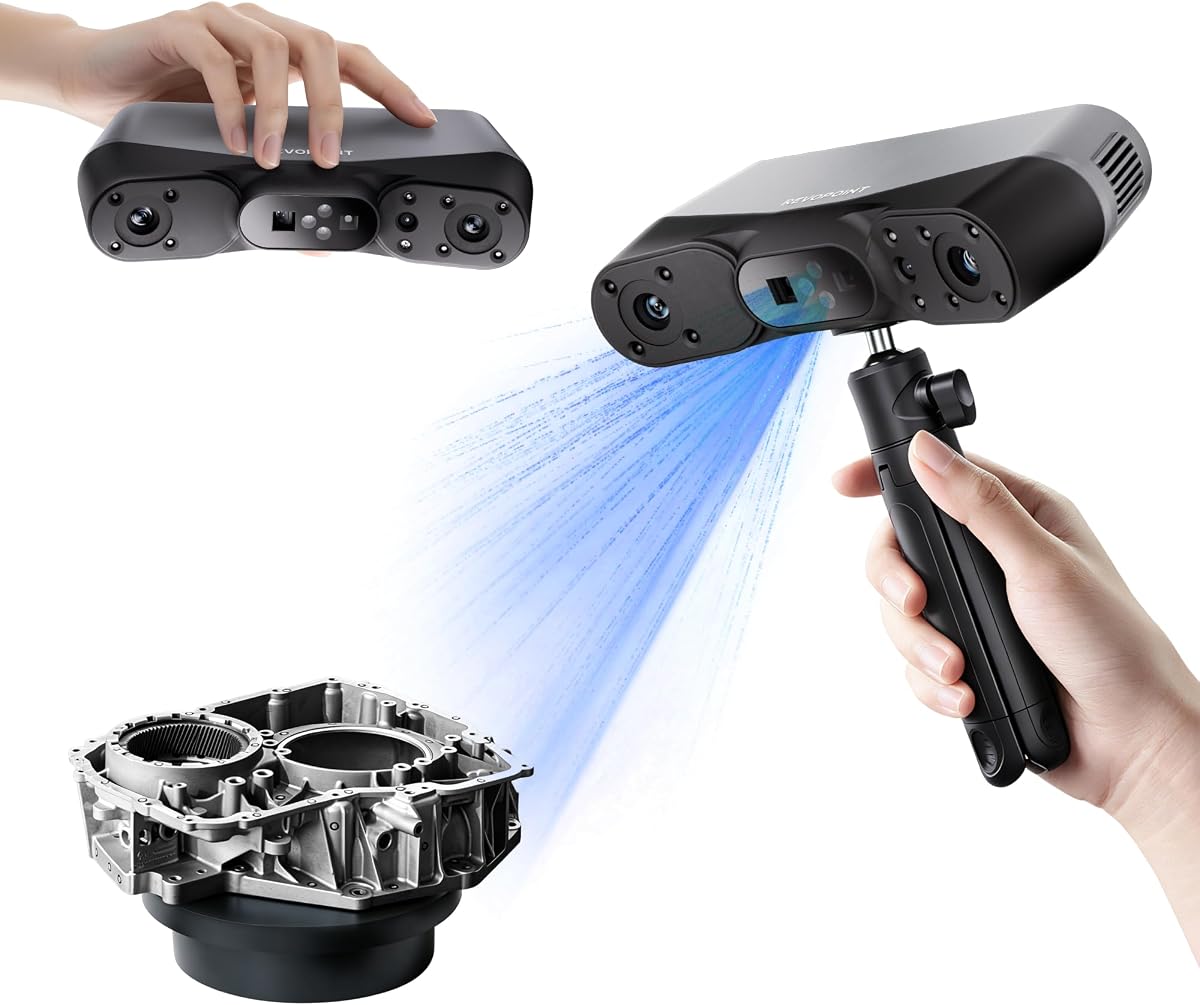
The Revopoint POP 4 is a feature-dense professional scanner aimed at users who need more than a single capture method. Its stated single-frame accuracy reaches 0.03mm, while its five modes cover full-field structured light, hybrid structured light, VCSEL rapid scanning, 30-cross blue laser lines, and single-line deep-hole capture. That variety makes it especially useful for mixed-object collections and demanding surface conditions.
We may earn a commission when you buy through this link, at no additional cost to you.
The scanner supports scan volumes from 10mm cubes to 2-meter cubes, so its applications can span precision parts, decorative objects, large components, and complex scenes. AI object segmentation on Windows separates the subject from its background and tracks it through the scan. A 3D Gaussian Splatting workflow can turn point-cloud and RGB information into a photorealistic representation, while external photographs can be used to add realistic textures.
Outdoor use is a meaningful strength. Multi-line laser operation is stated to work in 50,000-lux conditions, and an outdoor filter extends that to 100,000 lux. VCSEL mode also supports operation in up to 100,000 lux. The included 5500mAh battery grip is rated for as much as four hours of continuous outdoor scanning, and Wi-Fi 6.0 enables live previews and control on a phone or tablet.
Revo Scan 6 provides the core scanning and post-processing environment, while Revo Measure and Revo Design extend the workflow into professional measurement and reverse engineering. Those companion applications are sold separately and support Windows. The POP 4 is therefore a compelling choice for experienced users who value modes, outdoor flexibility, and integrated professional tools enough to manage platform and software costs.
The mode selection directly addresses common scanning obstacles. Cross-laser blue light targets dark and reflective materials, while structured-light and VCSEL options broaden the available field conditions and use cases.
Revo Scan 6 can hand data into Revo Measure and Revo Design for dimensional analysis and CAD creation. Users who only need printable meshes may not need those extras, but metrology and reverse-engineering users gain a more coherent path.
We may earn a commission when you buy through this link, at no additional cost to you.
The Revopoint INSPIRE 2 is a lightweight 190g scanner that brings structured-light and multi-line laser capabilities to a portable form. It advertises up to 0.05mm accuracy and 0.03mm precision, and its calibration board is said to improve point-cloud accuracy by 75%. Those specifications position it as a capable option for 3D printing, reverse engineering, and detailed modeling.
We may earn a commission when you buy through this link, at no additional cost to you.
Eleven infrared laser lines allow it to scan reflective or dark objects without scanning spray, addressing one of the most common frustrations in handheld scanning. An RGB camera captures color and texture, while adjustable 1.5x and 2x optical zoom can improve detail capture across mixed-size objects. Those color and zoom features are particularly useful for heritage preservation, product visualization, and archival models.
Wireless operation through Wi-Fi 6.0 supports mobile capture and real-time streaming from a PC to a phone. Outdoor scanning is specified in lighting up to 20,000 lux, which covers shaded areas and moderately bright conditions but does not match the 100,000-lux claims of the premium Revopoint models. The aerospace-grade aluminum front panel adds durability without undermining the device's portability.
Revo Metro supplies scanning, editing, alignment, and post-processing tools, and a one-click route into Revo Design extends the workflow into CAD. Revo Design is a paid, Windows-only product, which is an important consideration for mobile or mixed-platform users. The INSPIRE 2 is best for creators who want color, portability, and reliable dark-surface performance without moving into a larger industrial scanner.
Built-in RGB mapping and synchronized color data reduce the need for a separate texture pass. Optical zoom adds another way to recover fine surface information from small details.
The included tripod, markers, mini turntable, calibration board, and outdoor filters cover many core setup needs. A complete kit reduces the friction of learning the device on a new project.
We may earn a commission when you buy through this link, at no additional cost to you.
The Revopoint MetroY Ultra is built for users who need high precision and professional scan flexibility. Its 0.01mm single-frame precision and volumetric accuracy of 0.015mm plus 0.04mm multiplied by object length position it for tight-tolerance measurement, reverse engineering, and inspection. Blue laser technology is central to its ability to capture intricate geometry and problematic industrial surfaces.
We may earn a commission when you buy through this link, at no additional cost to you.
Five modes provide meaningful specialization. The scanner offers 34 laser cross-lines for rapid coverage, 15 parallel lines for fine details, a single-line mode for deep holes, full-field blue structured light for marker-free capture, and one-click automatic turntable scanning. The 34-line mode can reach 90fps with NVIDIA GPU acceleration, while CPU operation is stated at up to 60fps. That makes the device suitable for both quick coverage and detail-focused passes.
Dark, glossy, and metallic components can be scanned without spray. Outdoor laser operation extends to 100,000 lux, which is valuable for field inspection, construction environments, and large industrial objects. Wi-Fi 6 connectivity permits monitoring through Revo Mirror on a PC, tablet, or mobile device, while the included 5500mAh battery grip offers around 2.5 hours of operation away from an outlet.
Revo Metro is included and provides point-cloud editing, model processing, alignment, and multi-mode project management. Exports include PLY, OBJ, STL, ASC, 3MF, GLTF, and FBX, supporting printing, visualization, and downstream design tools. The MetroY Ultra is the premium pick for industrial inspection and reverse engineering users who value the strongest stated precision and mode variety in this guide.
The combination of 0.01mm stated single-frame precision and 0.015mm volumetric accuracy is suited to small features and close inspection. Actual results will still depend on calibration, surface condition, and capture technique.
High frame rates improve efficiency on large or moving subjects, while the different scanning modes allow users to balance speed against detail. Full-field structured light also supports marker-free operation.
We may earn a commission when you buy through this link, at no additional cost to you.
The Revopoint MetroX Pro combines strong precision claims with several practical capture strategies. It advertises 0.01mm single-frame precision, 0.02mm single-frame accuracy, and volumetric accuracy of 0.02mm plus 0.04mm multiplied by object length. Those figures make it a credible choice for precision modeling, industrial measurement, inspection, and reverse engineering.
We may earn a commission when you buy through this link, at no additional cost to you.
Its four modes include 30 cross-line lasers, 15 parallel lines, a 62-line full-field blue structured-light mode, and automatic turntable scanning. The full-field mode is stated to capture up to seven million points per second. Cross-line and parallel-line modes can reach two million points per second and handle shiny or dark surfaces without powder or spray. An HD RGB camera adds color in automatic turntable mode.
The dual-axis turntable automates the capture of complex objects, reducing the need to maintain perfect hand movement during a full rotation. Three tracking options—feature, marker, and global marker—provide flexibility across detailed, flat, or geometrically complex subjects. Revo Mirror also streams scans from a PC to a phone or tablet, letting users inspect progress, identify gaps, and reposition the scanner.
Revo Metro handles scanning, editing, and merging, and data can move into Revo Measure, Revo Design, or other 3D software. The measurement and design applications are sold separately and support Windows. The MetroX Pro is a strong fit for professional users who want automated capture, high point density, and a broad range of tracking options in one professional package.
The dual-axis turntable is a meaningful advantage for products with sides, recesses, and geometry that is awkward to present by hand. It also supports consistent color capture through the integrated HD RGB camera.
Feature tracking works well where natural surface detail is abundant, marker tracking helps on flatter surfaces, and global marker mode supports complex shapes. Correct mode selection can improve both usability and data quality.
We may earn a commission when you buy through this link, at no additional cost to you.
The 3DMakerpro Fox is positioned as an approachable entry into handheld 3D scanning. It is described as a medium-format scanner for beginners and hobbyists, with stated accuracy of 0.07mm and resolution of 0.10mm. Those specifications suggest a useful balance for 3D printing, modeling, measurement, and quality-inspection tasks without entering the more specialized industrial category.
We may earn a commission when you buy through this link, at no additional cost to you.
Its most notable feature is markerless AI visual tracking. If the operator moves too quickly, the software can recognize an already-scanned region and relock onto it, allowing work to continue rather than forcing a complete restart. This recovery behavior is particularly helpful for new users who are still learning to move smoothly. The Fox also works with JMStudio, which integrates scanning, editing, and optimization.
The simplified feature set has trade-offs. It does not offer the many optical modes, outdoor lighting claims, wireless ecosystems, or elaborate accessory packages seen on premium Revopoint scanners. Its 0.10mm stated resolution and 0.07mm accuracy are also less ambitious than the 0.01–0.03mm claims of the higher-end models, making it less compelling for very fine metrology.
The Fox is most appropriate for creators who need an affordable way to begin capturing real objects and producing printable or editable geometry. Its AI relocking and integrated JMStudio workflow reduce common sources of frustration, while the relatively compact capability set keeps learning demands manageable. For basic scans, a hobby project, or an upgrade from photographs and manual modeling, it offers a sensible starting point.
Markerless AI recognition can locate a previously captured area and continue the session. This reduces wasted time and makes the scanner more approachable for beginners learning a steady scanning path.
JMStudio combines capture, editing, and optimization, reducing the need to move among separate utilities for basic cleanup. It is a practical advantage for users who want a shorter path from object to export.
We may earn a commission when you buy through this link, at no additional cost to you.
The Creality Otter Lite Basic is a wide-range handheld scanner designed to handle everything from coins to cars. Its 4.8 rating reflects a strong overall proposition, while its stated 0.05mm accuracy and 30fps frame rate suit hobbyists, makers, and general 3D printing workflows. The four-camera arrangement supports a much larger working volume than many compact alternatives.
We may earn a commission when you buy through this link, at no additional cost to you.
Two long-focal lenses are intended for fine detail, and two short-focal lenses provide broad coverage. The stated object range extends from 0.8 inches to 78 inches, with a single-frame capture area of 1460 by 1017mm at a 1200mm distance. That makes it useful for both small components and substantially larger assemblies, reducing the need to change devices for different project scales.
DOE structured light can capture dark, shiny, and metallic surfaces without spray. Outdoor operation is specified up to 30,000 lux. A megapixel RGB camera and two white LED fill lights support 24-bit full-color texture capture, while Class I near-infrared illumination is designed for face and full-body scanning in about one minute. Export options include PLY, OBJ, STL, ASC, 3MF, GLTF, and FBX.
CrealityScan 4 supports Windows, macOS, iOS, and Android and includes AI-powered head-mesh repair. Marker, geometry, and texture alignment offer different ways to manage registration. The optional Scan Bridge handle, sold separately, may be worthwhile for lengthy sessions where handheld stability is important. The Otter Lite Basic is an especially strong all-around scanner for users who need color and a broad size range.
The multi-focal camera system reduces the need to manually change optical approaches as object size changes. Dual short-focal lenses aid coverage, while dual long-focal lenses concentrate detail on small subjects.
The RGB camera and LED illumination produce mapped color without requiring a separate photogrammetry stage in every workflow. That is useful for figurines, artwork, product references, and digital archives.
We may earn a commission when you buy through this link, at no additional cost to you.
The Creality CR-Ferret SE is a desktop-oriented handheld scanner focused on straightforward capture. It advertises up to 0.1mm accuracy, 0.16mm resolution, and a 30fps frame rate. Those figures are sufficient for many visualization, printing, and design tasks, although they sit below the precision claims of the premium models in this roundup.
We may earn a commission when you buy through this link, at no additional cost to you.
One-shot 3D imaging improves tracking efficiency and is intended to maintain tracking through hand movement or quick object shifts. That feature makes the scanner easier to use when the subject or operator cannot remain perfectly still. It supports black and metallic objects without white spray, removing a common preparation step and helping preserve delicate or sensitive surfaces.
A built-in 2MP color camera captures mapped color for more visually complete models. The stated scanning range runs from 150mm to 2000mm, and a single capture can cover up to 560 by 820mm. Those limits make it better suited to medium and large objects than to a miniature captured at extremely close range. Full-color output can enrich figurines, body scans, and product references.
The Ferret SE is designed around Windows PC use through a USB connection, according to the supplied information. Its uncomplicated feature set and anti-shake tracking may appeal to beginners, but users needing tighter tolerances, wireless connectivity, or advanced measurement workflows should consider more specialized hardware. It is best for general makers who value color capture, no-spray scanning, and a reasonably quick desktop workflow over laboratory-level precision.
One-shot imaging helps the scanner maintain its position when the operator or subject moves. The feature is valuable in practical use, where perfectly smooth motion can be difficult to sustain.
The integrated color camera automatically adds color information to captured geometry. This makes the Ferret SE practical for visual projects where a monochrome mesh would not convey the subject fully.
We may earn a commission when you buy through this link, at no additional cost to you.
The CR-Scan Ferret Pro upgrades the Ferret concept with wireless operation through a dedicated Wi-Fi 6 bridge. It retains up to 0.1mm accuracy, 0.16mm resolution, and a 30fps capture rate, so its central improvement is workflow flexibility rather than a major change in the stated precision tier. It has a 3.7 rating and supports full-color scanning.
We may earn a commission when you buy through this link, at no additional cost to you.
The Wi-Fi 6 bridge is claimed to transfer data three times faster than Wi-Fi 5. Wireless capture can be used with compatible Android and iPhone 11 or newer devices, while USB connections support PC and Mac workflows. This makes the Pro attractive for users who want to scan away from a laptop or share the operation between devices.
One-shot 3D imaging and anti-shake tracking are intended to improve tracking success when movement occurs. The scanner operates outdoors in ambient light up to 30,000 lux and exports OBJ, STL, and PLY files. However, the supplied guidance recommends avoiding highly reflective, transparent, or extremely dark surfaces, despite the device's improved optical technology.
System requirements are more demanding than the Ferret SE, particularly for mobile use. Supported configurations include Windows 10 or 11 with an i5 Gen 8 or later processor, more than 8GB RAM, and appropriate software; compatible Mac, Android, and iOS requirements are also listed. The Ferret Pro is best for users who prioritize wireless freedom, full color, and flexible device support while remaining within a practical general-purpose precision level.
The dedicated bridge separates the scanner from the computer during capture, improving mobility around large objects. Live or project transfer can then be handled by a compatible phone, tablet, or PC.
Even upgraded optics can struggle with transparent or highly reflective surfaces. Users should plan lighting, positioning, and surface-preparation strategies around the scanner's stated limitations.
We may earn a commission when you buy through this link, at no additional cost to you.
The Revopoint MIRACO Plus is an all-in-one scanning system with unusually strong photogrammetric metrology support. Its photogrammetric kit includes four carbon-fiber scale bars and two sets of 208 coded targets, while the stated photogrammetric length accuracy is 0.02mm plus 0.05mm multiplied by object length. The updated calibration board improves single-point-cloud accuracy by 20% to 0.04mm.
We may earn a commission when you buy through this link, at no additional cost to you.
A quad depth-camera system covers a wide range of subjects. Near mode is intended for tiny screws and fine details, while Far mode captures large machinery and broad surfaces quickly. Optical infrared zoom at 1.5x and 2x improves detail with less noise. A 48MP RGB camera and flash LEDs provide high-quality color capture, and class 1 infrared technology allows direct face scanning.
The internal configuration is designed for substantial projects. An 8-core 2.4GHz processor, 32GB RAM, a 256GB drive, and capacity for up to 10,000 frames support large datasets. The 6-inch 2K AMOLED screen can flip 180 degrees, making framing and review possible from several positions. Wi-Fi 6 or USB Type-C transfers support Windows and macOS workflows, and projects export to PLY, OBJ, STL, ASC, 3MF, GLTF, and FBX.
At 750g, the MIRACO Plus is portable but heavier than most handheld rivals. Battery life is stated at up to two hours, with 65W fast charging reaching 80% in 35 minutes. Revo Design, based on Quicksurface, is sold separately, and the supplied software requires x86_64 architecture. This scanner is a strong choice for professional metrology, heritage, reverse engineering, and users who want a complete professional kit rather than a basic capture tool.
Scale bars and coded targets extend the scanner into controlled photogrammetric measurement. The aluminum carry case also makes the specialized kit easier to transport between locations.
Near and far modes address objects ranging from tiny fasteners to large machinery. High-resolution RGB capture and optical zoom add visual detail while the depth system records geometry.
We may earn a commission when you buy through this link, at no additional cost to you.
Choosing a 3D scanner means balancing measurement precision, capture speed, material handling, object size, portability, software, and the type of output your project requires. The most useful purchase is the one that can produce dependable data within your specific workflow, not simply the model with the largest headline specification.
Accuracy describes how closely captured geometry corresponds to the real object, while resolution influences the fineness of detail represented in the mesh. Both matter, but neither headline figure tells the entire story. Revopoint MetroY Ultra and MetroX Pro advertise 0.01mm single-frame precision, Creality Pika claims up to 0.03mm accuracy, and models such as the Ferret scanners list 0.1mm accuracy. The figures are not necessarily produced under identical testing conditions, so they should be treated as comparative indications rather than guarantees for every scan. Calibration quality, surface finish, angle, lighting, distance, tracking stability, and post-processing all influence the final model. For reverse engineering and inspection, understand the tolerance required by the project and confirm whether the manufacturer's definition of accuracy aligns with your needs.
Prioritize accuracy for dimensional work and prioritize resolution for fine visual details, but avoid treating the terms as interchangeable. A model that looks detailed can still contain dimensional drift.
Structured light, blue lasers, infrared lasers, VCSEL patterns, and photogrammetric targets approach surface capture differently. Blue and infrared laser modes are commonly chosen for dark, reflective, or low-texture surfaces, while full-field structured light can offer marker-free convenience. Photogrammetry can provide detailed color and scalable measurement when scale bars and coded targets are used. Multi-mode devices give users more ways to approach a difficult object, but they also introduce more settings and workflow decisions. The Pika combines blue laser and NIR structured light, POP 4 offers five modes, and MetroY Ultra and MetroX Pro each provide several specialized options.
Choose a multi-mode scanner when your work includes varied materials. A simpler single-mode unit may be easier to master if your objects are consistent.
Working volume determines whether a scanner can capture an entire object in a practical number of passes. The Otter Lite Basic covers a stated range from 0.8 to 78 inches, while the Pika and POP 4 support very small subjects through large or life-size scans. INSPIRE 2 and the Ferret models also cover medium-to-large work, but their lower capture volumes or minimum distances may be less appropriate for tiny components. Large objects do not always need to fit in a single frame; they can often be captured in overlapping sections and aligned afterward. Very small parts, however, benefit from a close-focusing camera and an appropriate minimum scanning distance.
Match the scanner's minimum distance and single-frame coverage to the smallest and largest subjects in your project. For repeated large-object work, also consider alignment accuracy and export formats.
Dark, black, glossy, transparent, and mirror-like surfaces are difficult because they absorb, reflect, or refract projected light. Several scanners advertise no-spray handling for dark and metallic objects, while others explicitly recommend avoiding highly reflective or transparent surfaces. Outdoor operation adds another variable: stated tolerances range from 20,000 lux on INSPIRE 2 to 100,000 lux on MetroY Ultra, POP 4 with its filter, and other high-end systems. Lighting capacity does not guarantee success, because shadow, glare, and local reflections still require careful positioning. Matte coatings, strategically placed light, and multiple scan angles can sometimes solve problems that additional algorithms cannot.
Test the most difficult material in your collection before committing. No-spray claims are helpful, but they are not substitutes for good scanning technique.
Color scanning is essential when a model must reproduce the appearance of an object rather than only its geometry. Otter Lite Basic captures 24-bit texture with an RGB camera and fill lights, the Ferret SE and Pro include color cameras, INSPIRE 2 synchronizes RGB data with geometry, and MIRACO Plus uses a 48MP RGB camera. POP 4 and Pika offer AI or Gaussian-Splatting-based texture workflows, but those may be more appropriate for visualization and digital content than conventional industrial color metrology. Consider whether a textured mesh is needed for visualization, archiving, printing, or animation, because photogrammetric texture can look convincing while hiding geometric noise.
Choose color resolution according to the final output. Decorative and e-commerce models may need realistic appearance, while reverse engineering may prioritize geometry.
Portable scanners are valuable for heritage sites, construction environments, workshops, and large products that are inconvenient to move. Pika weighs 260g and INSPIRE 2 weighs 190g, while MIRACO Plus is a heavier 750g but offers substantial onboard processing and storage. Wireless operation appears in several models: Pika supports Wi-Fi 6 PC mode, POP 4 supports Wi-Fi 6 and cross-screen interaction, and Ferret Pro uses a dedicated bridge. Wireless convenience can reduce cable management, but it also depends on battery life, device compatibility, and reliable transfer. A desktop workflow may be more appropriate when scans are large, transfers are continuous, or a stable wired connection is available.
Prioritize battery duration and verified platform support if you scan away from a desk. A lighter device is not automatically more practical if it lacks the software or connectivity you need.
The scanner is only one part of the production pipeline. CrealityScan 4 supports Windows, macOS, iOS, and Android, while Revopoint models use Revo Metro, Revo Scan 6, or device-specific software. Some professional applications, including Revo Design and Revo Measure, are sold separately and generally target Windows. Export formats determine where the captured data can go next: STL is central to many printing workflows, OBJ and PLY support broader geometry and color use, and 3MF, ASC, GLTF, FBX, and CAD-oriented outputs expand professional options. Check whether you need raw point clouds, textured meshes, dimensional reports, or a direct CAD conversion path before choosing.
Factor in cleanup, repair, retopology, measurement, and export costs. A capable scanner can still be a poor fit if its software does not support your destination software.
A scanner that produces excellent data only occasionally may be less useful than one that supports a repeatable process. Anti-shake tracking, markerless recognition, automatic turntable operation, and AI relocking can reduce human error. The Pika includes AI hole filling and body completion, the Ferret models use one-shot imaging for tracking, and Fox can relock after interrupted movement. The included accessories also matter: a calibration board, turntable, tripod, scale bars, and coded targets can determine whether a system is ready for use on arrival. Revopoint MIRACO Plus includes 24/7 customer support and a two-year warranty, while several products include calibration boards and other setup tools. Consider return support, warranty terms, documentation, and the availability of replacement accessories alongside the technical specifications.
The best scanner is the one your team can operate consistently. Favor controls, alignment aids, and accessories that support your team's experience level.
Start by reading the scanner's quick-start guide, installing the specified software, and confirming that the computer, phone, or tablet meets the listed processor, memory, operating-system, and connectivity requirements. Charge the scanner fully, update its software, and perform the recommended calibration before capturing an important object. Use the supplied calibration board, turntable, markers, or scale bars exactly as directed because they establish the reference data used for alignment and accuracy.
Prepare the subject and environment before scanning. Remove loose dust, place the object on a stable surface, and choose a position that keeps its relevant surfaces visible. For dark or reflective materials, experiment with the lighting direction and camera angle, and make several overlapping passes if necessary. Move at a controlled pace, maintain a consistent distance, watch the live preview for gaps, and avoid abrupt changes in orientation. Capture a little beyond the object's edges so adjacent sections overlap enough for reliable registration.
After capture, review the mesh from several angles and look for holes, drifting surfaces, blurred textures, or missing regions. Use the software's alignment, fusion, filtering, hole-filling, and retopology tools as appropriate, then export in the format required by the next application. Store scanners and calibration accessories in their supplied cases, keep lenses and optical windows clean with the manufacturer's recommended method, and recharge batteries before long field sessions. Do not clean or modify optical components using unapproved liquids or materials.
The required accuracy depends on the size, material, and purpose of the printed part. General decorative models and prototypes may tolerate looser tolerances, while replacement components, fit checks, and inspection tasks need tighter dimensional control. Compare the manufacturer's stated accuracy and volumetric formula with the tolerance of your project, and validate a test scan before committing to a large job.
Many modern scanners advertise no-spray capture for dark, glossy, and metallic surfaces using laser or optimized structured-light modes. Results still depend on glare, surface roughness, lighting angle, and the scanner's supported material range. Transparent, mirror-like, and extremely dark surfaces remain difficult for many devices, so test a representative sample before planning an entire project.
Accuracy indicates how closely the measured model agrees with the real object's dimensions, while resolution affects how finely visible detail can be represented. A scanner can have a detailed-looking mesh but still show dimensional error. Users doing reverse engineering or inspection should pay closer attention to accuracy, while those recreating small surface details should also consider resolution, point density, and the quality of the final mesh.
No. Some models focus primarily on geometry, while others include an RGB camera, structured-light color mapping, photogrammetric capture, or AI-based texturing. Color capabilities also differ in resolution and accuracy. Consider whether color is necessary for the final output and whether the scanner's texture workflow is designed for visualization, animation, archiving, or conventional printing.
Several models are designed for outdoor use, with stated ambient-light limits ranging from 20,000 lux to 100,000 lux. Strong sunlight is not the only concern: shadows, reflective surfaces, wind, and unstable operating conditions can affect the scan. Outdoor filters, markers, calibration aids, and suitable weather protection should be used according to the manufacturer's instructions.
The listed Revopoint products use different members of the Revopoint software ecosystem, including Revo Metro and Revo Scan 6. Some workflows also integrate with Revo Design and Revo Measure, which are sold separately and are described as Windows-only. Verify the exact software included with the selected model, its operating-system requirements, and any costs associated with the professional add-ons.
A turntable provides repeatable rotation for objects that are difficult to scan from every angle by hand. It can reduce alignment problems, support automated workflows, and make it easier to capture consistent color and geometry. Manual turntables may also rotate while the scanner remains fixed, whereas automated systems coordinate the movement and software. Check whether the supplied turntable supports the scanner, subject weight, and capture mode.
STL is the most widely recognized mesh format for many slicers, while OBJ and PLY can preserve color-related information and 3MF can support richer print workflows. CAD and professional measurement users may need additional formats or a separate conversion process. Always confirm the units, scale, mesh orientation, and whether any repaired or decimated geometry was applied before sending a file to a printer.
The Creality Pika stands out as the strongest all-around selection because it combines 0.03mm stated accuracy, a 110fps frame rate, dual scanning technologies, color, AI tools, wireless operation, and a highly portable body. The 3DMakerpro Fox is the practical entry-level option, while the Revopoint MetroY Ultra is the premium choice for tight-tolerance work, specialized scan modes, and demanding industrial environments.
Your priorities should determine the rest of the list. Choose INSPIRE 2 for a light, color-capable portable workflow; Otter Lite Basic for a wide size range and full-color capture; POP 4 for five modes and professional software integration; MetroX Pro for automated turntable capture; a Ferret model for an accessible Creality workflow; and MIRACO Plus for a complete photogrammetric metrology kit. Look beyond headline precision and consider lighting, object size, tracking, export formats, battery life, and required software.
Before purchasing, verify the current specifications, platform requirements, included accessories, warranty, and availability directly on the product listing. Product details and software requirements can evolve, and the best choice is ultimately the scanner that can deliver the geometry, color, and turnaround your particular projects require.