
Planet Audio AC4000.1D
4.4Editor score
4000 watts maximum at 1 ohm
Variable crossover and bass boost
Six-year parts and labor warranty
Discover the best 4000 watt car amp options, comparing power ratings, channel layouts, controls, protection, and installation features.
A 4000 watt car amp can provide the substantial power needed for a forceful subwoofer setup or a demanding multichannel system, but headline wattage alone does not tell the whole story. Impedance handling, continuous output, thermal protection, crossover controls, and installation requirements all shape the result.
This guide compares ten monoblock, multichannel, and five-channel amplifiers listed for 4000-watt applications. We evaluated the supplied specifications, focusing on real output claims, supported speaker loads, filter and bass controls, protection features, wiring details, and how conveniently each amplifier fits a practical car audio build.
The recommendations show that the strongest choice depends on the system. A subwoofer enthusiast may favor a 1-ohm-stable monoblock, while a full-range driver may need four-channel flexibility and a compact five-channel amp may be more convenient. Product availability and prices change, so confirm current details before buying.
4.4Editor score

4.2Editor score
4.6Editor score
The table below compares all ten amplifiers by channel design, stated power, primary use case, and notable controls or protection, making it easier to identify the model that matches your speakers and installation plan.


The Planet Audio AC4000.1D earns the top recommendation because it combines a 4.4 rating with a versatile set of subwoofer-focused controls. Its stated maximum output is 4000 watts at 1 ohm, with 2000 watts at 2 ohms and 1000 watts at 4 ohms. It also supports strapping, making it a practical foundation for a serious monoblock installation.
We may earn a commission when you buy through this link, at no additional cost to you.
Class D efficiency keeps the amplifier focused and relatively compact for a high-output design. The variable low-pass crossover gives installers meaningful control over which frequencies reach the subwoofer, while the variable subsonic filter helps protect the driver from excessive low-frequency excursion. Variable bass boost adds another layer of tuning flexibility without requiring a separate signal processor.
The most important qualification is that 4000 watts is a maximum rating rather than a continuous RMS figure. Buyers should also notice the 15-by-10-by-2.4-inch dimensions, which may require careful placement in a trunk, under a seat, or in an enclosure. Those considerations do not outweigh the amplifier's useful control set, strong load support, and unusually long six-year parts and labor warranty.
This is the most balanced recommendation for someone building a dedicated subwoofer system and wanting crossover and bass adjustments without a complicated signal chain. Installers who need smaller dimensions, full-range outputs, or explicit RMS power may find a different model more appropriate. Even so, the AC4000.1D offers the strongest combination of usefulness, warranty coverage, and subwoofer-focused features in this group.
The variable low-pass crossover, subsonic filter, and bass boost cover the primary adjustments most subwoofer installers need. This makes the amplifier easier to integrate into a vehicle without relying entirely on the head unit or an external processor.
Strapping capability lets installers combine two matching amplifiers when the electrical system, speakers, and wiring plan support that arrangement. The stated 8000-watt maximum at 2 ohms when strapped shows the intended scale of this feature.
We may earn a commission when you buy through this link, at no additional cost to you.
The Taramps MD 4000.1 is our Editor's Choice for its unusually broad feature set and explicit 4000-watt RMS specification at 1 ohm. It carries a 4.2 rating and is designed as a full-range monoblock, meaning it can serve a subwoofer while also having crossover flexibility for woofer, midbass, and midrange applications.
We may earn a commission when you buy through this link, at no additional cost to you.
Its variable high-pass filter covers 10 Hz to 90 Hz, and the low-pass filter extends from 90 Hz to 10 kHz. That range allows an installer to define a remarkably broad group of speaker applications. A 35 Hz to 55 Hz bass boost with up to 10 dB of gain is included, while thermal, voltage, short-circuit, and low-impedance protection support dependable operation.
The main reason to pause is the distinction between this amplifier's full-range digital design and a traditional subwoofer-only monoblock. Users wanting simple low-pass-only operation may find a dedicated sub amp easier to configure. The supplied data also does not describe physical dimensions or a warranty, so those details deserve confirmation before installation. Even so, the stated RMS output and crossover range distinguish it from headline-driven alternatives.
The MD 4000.1 is best for a builder who wants one powerful and adaptable amplifier rather than a narrowly specialized subwoofer unit. It is especially attractive for projects combining subs with door speakers or separate woofer and midrange drivers. For straightforward high-output subwoofer use, the Planet Audio AC4000.1D may be easier to understand, but this Taramps model offers greater routing flexibility.
The unusually broad HPF and LPF ranges let the amplifier serve more than one speaker role. That makes it valuable in custom builds where a single high-output channel may need to cover a subwoofer, woofer, or midrange driver.
Thermal, voltage, short-circuit, and low-impedance protection address several common installation risks. Smart cooling also complements these safeguards by helping the amplifier manage heat in the confined environment of a vehicle.
We may earn a commission when you buy through this link, at no additional cost to you.
The Planet Audio PL4000.1D is a strong choice for a high-output subwoofer installation, particularly for buyers who value published electrical details. It has a 4.1 rating, 1-ohm stability, and a stated maximum output of 4000 watts at 1 ohm, 2000 watts at 2 ohms, and 1000 watts at 4 ohms.
We may earn a commission when you buy through this link, at no additional cost to you.
Unlike many marketing-led competitors, the supplied specifications include a 0.01 percent THD rating at RMS output, a 100 dB signal-to-noise ratio, a frequency response from 15 Hz to 250 Hz, and three 40-amp ATO blade fuses. At 13.90 by 7 by 2.39 inches and 8.2 pounds, it is also smaller and lighter than the AC4000.1D.
Its Class D architecture reduces power loss and heat while supporting a compact heat sink and circuitry. The variable subsonic filter and variable low-pass crossover provide essential control for matching the amplifier to a subwoofer. As with the AC4000.1D, two units can be strapped for a stated combined maximum of 8000 watts at 2 ohms, and the product includes a six-year parts and labor warranty.
This amplifier suits someone who wants transparent specifications, 1-ohm support, and a subsonic filter without paying for a larger enclosure. Its 1000-watt maximum at 4 ohms may be limiting for certain high-impedance subwoofer configurations, while those seeking explicit RMS power should look elsewhere. For the common 1-ohm or 2-ohm high-power use case, however, the PL4000.1D is technically well documented and installer-friendly.
Published THD, signal-to-noise, frequency-response, impedance, and fuse information makes this model easier to compare on technical grounds. Those details are valuable when coordinating a subwoofer, enclosure, and electrical system.
At 8.2 pounds and a 13.90-inch length, the PL4000.1D is easier to place than the larger AC4000.1D. Its compact Class D design can be advantageous where trunk, seat, or enclosure space is limited.
We may earn a commission when you buy through this link, at no additional cost to you.
The Taramps DS 4000×4 is a four-channel Class D amplifier built for demanding multichannel systems rather than a single subwoofer. It carries a 4.0 rating and states 4000 watts RMS across four channels, with 1000 watts RMS per channel at 2 ohms. It can also be bridged for 2000 watts RMS per pair at 4 ohms.
We may earn a commission when you buy through this link, at no additional cost to you.
A major strength is its range of system applications. The 8 Hz to 20 kHz response allows it to drive front speakers, rear speakers, woofers, or other compatible drivers. RCA and high-level inputs make it useful with both traditional head units and factory-style systems, while the fixed high-pass, low-pass, and full modes simplify integration.
The fixed crossover is the clearest limitation. Installers who want to choose a precise cutoff frequency for each set of speakers will need an external processor or additional equipment. Likewise, the 1000-watt-per-channel maximum at 2 ohms is not comparable to a dedicated 4000-watt subwoofer monoblock. Its strength lies in distributing clean, continuous power across several channels.
Choose the DS 4000×4 when you want to power an entire multichannel vehicle system from one enclosure or need a flexible bridgeable design. It is less appropriate for a single extreme-output subwoofer, but it can serve as a full-range backbone for a balanced build. The 4.0 rating and straightforward control set make it a credible high-power option for informed installers.
Four channels and a full-range response allow the amplifier to cover front and rear speakers or specialized drivers in a custom system. This can simplify wiring and reduce the number of separate amplifiers needed.
Both RCA and high-level inputs support different vehicle electronics. That makes the amplifier practical for an aftermarket head unit, an integrated factory system, or a mixed installation.
We may earn a commission when you buy through this link, at no additional cost to you.
The Rockville dB55 is a five-channel amplifier intended to consolidate a complete car audio system into one unit. Its 4.3 rating reflects a practical design that provides 120 watts by four channels plus 500 watts for a subwoofer at 2 ohms. At 4 ohms, the stated figures are 80 watts by four plus 300 watts for the mono channel.
We may earn a commission when you buy through this link, at no additional cost to you.
Although the product is associated with a 4000-watt peak headline, the more meaningful continuous specification is 980 watts RMS. That distinction matters because the amplifier is designed as a mixed system unit, not as a 4000-watt RMS subwoofer monoblock. Its four smaller channels handle door and rear speakers, while the dedicated mono channel supplies the subwoofer.
Tuning options are a major selling point. A fully adjustable 12 dB-per-octave crossover, subsonic filter, and 12 dB bass equalizer give the installer considerable control. A remote dashboard subwoofer control adds convenience, and RCA line input and output support system expansion. Protection circuitry is listed for overheating, voltage fluctuations, and short circuits.
The dB55 is best for a complete, moderately powerful system where reducing component count is more important than maximum subwoofer output. It is not a substitute for a high-power RMS monoblock when driving a competition-style dual-sub installation. Within its five-channel purpose, however, it offers the best balance of sound control, system integration, and installation convenience in this roundup.
Four amplified channels plus a dedicated mono section can cover front speakers, rear speakers, and a subwoofer. That consolidation can reduce wiring complexity and free installation space.
The included remote control lets the driver change subwoofer level without reaching into the trunk. This is especially useful in a daily-driven vehicle where quick tonal adjustment is valuable.
We may earn a commission when you buy through this link, at no additional cost to you.
The BOSS Audio Systems AR4000D is a recognizable option for drivers who want a straightforward high-output monoblock. It has a 4.1 rating, delivers a stated maximum of 4000 watts at 1 ohm, and provides 2000 watts at 2 ohms. It is also 1-ohm stable and suitable for demanding subwoofer loads.
We may earn a commission when you buy through this link, at no additional cost to you.
The amplifier includes low-level inputs, a variable low-pass crossover, a variable subsonic filter, and variable bass boost. These controls cover the core adjustments needed for a subwoofer installation. Like the leading Planet Audio monoblocks, it is strapping capable, allowing two matched units to be combined for greater output in a properly designed system.
Its Class D construction is designed to reduce power loss, heat generation, and overall size compared with less efficient amplifier formats. The listed dimensions are 14.3 by 6.5 by 2.8 inches, and the weight is 7.96 pounds, placing it between the larger AC4000.1D and the compact PL4000.1D. The published data, however, does not provide a warranty duration or a full RMS power table.
The AR4000D is a good choice for a conventional subwoofer build where easy-to-understand controls and 1-ohm stability matter more than a full-range digital architecture. Someone seeking explicit continuous power, extensive protection details, or a very compact enclosure should compare alternatives. For a conventional high-output monoblock with useful tuning controls, however, it remains a solid and approachable selection.
Low-level input and a variable low-pass filter create a direct route to a subwoofer. The result is a familiar setup that can be tuned without navigating a large menu of digital options.
Class D efficiency supports a relatively compact chassis while reducing energy waste as heat. At nearly eight pounds, it can be easier to mount and secure than a larger traditional monoblock.
We may earn a commission when you buy through this link, at no additional cost to you.
The Pyle PLA2678 is included as a two-channel alternative for shoppers seeking a 4000-watt-branded amplifier in a smaller, multi-purpose format. It carries a 4.0 rating and is described as a dual-channel, bridgeable, high-power MOSFET car amplifier with crossover controls, bass boost, and silver-plated RCA input and output.
We may earn a commission when you buy through this link, at no additional cost to you.
Its appeal lies in the flexibility of a two-channel design. It can power a pair of speakers, operate in bridged mode, or become part of a larger multi-amplifier system. Crossover and bass-boost controls provide basic tuning, while RCA input and output connections support signal routing and additional amplifiers. The supplied data also notes an included amplifier power cable and a user-friendly design.
The challenge is that the available product information does not provide continuous RMS power, minimum load stability, distortion, dimensions, protection features, or crossover ranges. As a result, the 4000-watt headline cannot be compared directly with the explicit RMS figures or maximum ratings used elsewhere in this guide. Buyers should inspect the full manufacturer specifications and manual before committing to a complex high-power installation.
The PLA2678 may suit a simpler project involving two speakers or a compact bridgeable application where physical size and basic controls matter. It is not the strongest choice for a demanding subwoofer system requiring transparent continuous-output data. Its inclusion here highlights an important buying lesson: a large wattage number should be treated as a starting point rather than proof that an amplifier suits a particular load.
A bridgeable two-channel amplifier can serve a stereo pair or operate in a bridged arrangement. That versatility makes it useful for several speaker configurations beyond a dedicated subwoofer.
Before using the PLA2678 for high-power bass, buyers should verify continuous output, supported impedance, and protection specifications. Those details are more informative than a standalone 4000-watt label.
We may earn a commission when you buy through this link, at no additional cost to you.
The Taramps DS 4000X4 is a full-range four-channel amplifier with an explicit 4000-watt RMS total output. It has a 4.3 rating and is rated at 1000 watts per channel into 1 ohm. In bridged mode, it can deliver 2000 watts RMS per pair at 2 ohms, giving installers an additional high-power option.
We may earn a commission when you buy through this link, at no additional cost to you.
Its 8 Hz to 20 kHz frequency response allows it to handle low bass, midrange detail, and high frequencies. Fixed crossover, input and output settings, and a precise level control provide the main system controls. The supplied wiring information is notably specific: 1/0 AWG positive and negative power cable, 11 AWG output cable, 18 AWG remote cable, and a 160-amp circuit breaker or fuse.
That electrical demand is important to consider. A 4000-watt RMS amplifier can place significant load on the vehicle's charging system, especially at sustained high volume. Proper power cable routing, grounding, fusing, and termination become essential. The fixed crossover is another limitation compared with a variable-frequency model, and the one-ohm configuration is intended for serious power rather than ordinary door speakers.
This amplifier is best for a high-output full-range build with four similar channels, a custom competition-style system, or a bridging application. It provides a clearer continuous-power proposition than many products advertised with a single 4000-watt maximum figure. Installers should pair it with a suitably robust electrical system and speakers designed for the intended load. For users seeking only a subwoofer, a dedicated monoblock is usually simpler.
The 4000-watt RMS total provides a more useful basis for comparison than maximum power alone. It helps buyers assess the amplifier against continuous speaker and electrical demands.
Specified cable gauges and a 160-amp protection device give installers a clearer starting point for a safe power installation. These details still require confirmation against the vehicle's electrical system and the manufacturer's full instructions.
We may earn a commission when you buy through this link, at no additional cost to you.
The DS18 SXE-4000.4D/RD is a full-range Class D four-channel amplifier with a 4.3 rating. Its headline figure is 4000 watts, but the more informative channel-level specifications are 275 watts RMS per channel at 4 ohms, 430 watts per channel at 2 ohms, and 750 watts by two channels when bridged at 4 ohms.
We may earn a commission when you buy through this link, at no additional cost to you.
A fully variable crossover is the standout feature. Adjustable gain and input sensitivity add further control, allowing the amplifier to be matched to different source levels and speaker responsibilities. The multichannel layout makes it appropriate for front and rear speakers, component systems, or separate tweeter and midrange channels in a custom installation.
Compared with the Taramps four-channel models, the DS18 offers more explicit per-impedance RMS information and a variable crossover, although its continuous output per channel is lower. The supplied data does not identify a subsonic filter or detailed protection circuitry, so installers should verify those specifications if the amplifier will drive demanding subwoofers or operate in a harsh environment.
This model is best for a balanced full-range vehicle system where precise band routing matters more than extreme low-frequency power. Its compact Class D design is attractive for space-conscious builds, while the 4.3 rating supports its position as a well-regarded specialist option. It is less suitable as a direct substitute for a 4000-watt RMS subwoofer monoblock.
A fully variable crossover allows installers to assign frequency ranges to different drivers. This is especially useful in multi-way systems that use separate tweeters, midrange units, and woofers.
Specifications for 4-ohm, 2-ohm, and bridged operation make it easier to understand the amplifier's real output. Buyers can select a configuration based on their speakers instead of relying on a single maximum-wattage number.
We may earn a commission when you buy through this link, at no additional cost to you.
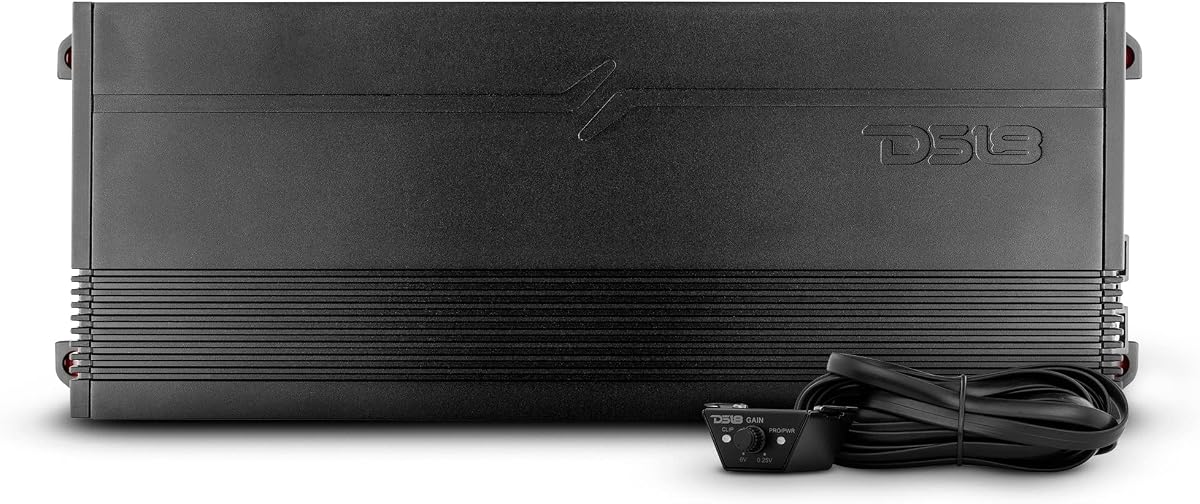
The DS18 G4000.5D GEN-X is the premium pick and the highest-rated product in this guide at 4.6. It combines a five-channel full-range design with a stated 4000-watt maximum output, making it appealing for complete vehicle systems where several speaker types must be powered by a single compact unit.
We may earn a commission when you buy through this link, at no additional cost to you.
The detailed channel output is more useful for system planning: 420 watts by two channels bridged at 4 ohms, 220 watts by four channels at 2 ohms, and 130 watts by four channels at 4 ohms. The amplifier supports one- through four-ohm applications, is bridgeable, and includes high-pass and low-pass filtering. A remote bass knob gives the driver convenient control over low-frequency level.
Its standout physical advantage is the 12.8-by-4.72-by-1.96-inch enclosure. That small footprint is especially useful in custom trunks, under seats, or tightly packed installations where a conventional five-channel amplifier may not fit. As with the DS18 four-channel model, the supplied data does not detail thermal and electrical protection, so buyers should confirm those details before use.
The G4000.5D GEN-X is best for a compact, complete system with front speakers, rear speakers, and a subwoofer, especially when installation space is restricted. Its five-channel format and included remote control can replace several separate components. It is not intended to compete with a 4000-watt RMS monoblock, but as a flexible system amplifier it offers the strongest combination of rating, compactness, and convenience here.
Five channels in a 12.8-inch enclosure reduce the need for separate amplifiers. The compact form can make a complete multi-speaker system more practical in a vehicle with limited installation room.
The included remote bass knob makes it easy to adjust low-end output while driving. That is a useful convenience in daily-driven vehicles where trunk-mounted controls are inconvenient to reach.
We may earn a commission when you buy through this link, at no additional cost to you.
The right 4000-watt car amplifier depends on speaker impedance, channel count, crossover requirements, thermal limits, and vehicle wiring. Review the following factors before choosing a model or planning an installation.
A maximum wattage figure describes the highest output condition and should not be compared directly with a continuous RMS rating. For reliable system planning, prioritize an amplifier's specified RMS output at the exact impedance of the speakers you intend to use. If a listing gives only a large headline number, seek the complete manual or manufacturer specifications before relying on it to match your subwoofer or full-range drivers.
Impedance is measured in ohms and determines how much current an amplifier must supply. A 1-ohm-stable monoblock gives more installation flexibility with low-impedance subwoofers, while a four-channel amplifier may be intended for 2-ohm or 4-ohm loads. Never connect a speaker below the manufacturer's supported impedance, because excessive current can activate protection, damage the amplifier, or create a fire risk.
Monoblocks concentrate power into one high-output channel and suit a dedicated subwoofer. Four-channel amplifiers distribute output among front and rear speakers or other full-range drivers. Five-channel designs add a mono section for a subwoofer, making them convenient for complete systems. Select the channel layout based on the speakers you actually need to power rather than choosing from headline wattage alone.
A low-pass filter is essential for most subwoofer amplifiers because it restricts low frequencies that could damage a subwoofer. High-pass filters protect door speakers from bass they cannot reproduce. Full-range amplifiers benefit from both controls, while a fixed crossover may be enough for a simple predetermined system. RCA and high-level inputs broaden compatibility with aftermarket and factory-style electronics.
Bass boost adds low-frequency energy but can increase distortion, heat, and the risk of damaging a subwoofer. It is best used sparingly and in combination with a proper subsonic filter and crossover setting. Variable low-pass, subsonic, and input-level controls are more valuable for accurate integration than a large boost range. A remote bass knob improves daily usability when the amplifier is mounted out of reach.
Car amplifiers can become very warm, particularly during sustained high-volume use. Class D efficiency reduces heat loss, but proper airflow, secure mounting, and clear space around the heat sink remain necessary. Look for thermal, short-circuit, voltage, and low-impedance protection where specified. Protective circuitry is a safeguard rather than permission to overload speakers or the vehicle's electrical system.
High-output amplifiers place substantial current demands on the battery and alternator. Proper power cable gauge, short positive and ground paths, secure fuse placement, and an appropriate electrical-system upgrade may be needed. Bridgeable outputs and one-ohm operation can increase current draw further. A professional installer can calculate whether the vehicle can support the intended output without creating voltage instability.
The best amplifier is one that fits safely in the intended mounting area. Compare length, height, weight, connector clearance, and the space needed for ventilation. Compact Class D units are useful under seats or in tight trunks, while a larger monoblock may provide more control and output. Also consider whether a remote control, fuse distribution, or additional wiring hardware must pass through vehicle trim.
Before installation, disconnect the vehicle's negative battery cable and read the amplifier's complete manual. Plan the positive power route, fuse location, ground point, speaker cables, remote lead, and signal connections. Use wiring that meets or exceeds the manufacturer's requirements, secure every connection, and confirm that the amplifier's minimum load supports your speaker configuration.
Install the amplifier in a dry, ventilated location and avoid placing papers, fabric, or other heat-trapping materials against its chassis. Set the crossover and subsonic filter before increasing gain, then adjust bass boost conservatively. If the head unit has no RCA output, use an appropriate high-level input or signal converter rather than improvised connections. Confirm the remote turn-on control activates the amplifier as intended.
For initial testing, begin with gain at its lowest setting and use moderate volume. Listen for clicking, humming, distortion, unstable output, or unusual heat. Check the fuse, connections, grounding point, and speaker impedance if a protection circuit activates. Do not bypass a fuse or defeat safety circuitry. After installation, retune the system for the vehicle's acoustics, and inspect connections and airflow periodically.
No. Some products use 4000 watts to describe maximum peak output, while others specify 4000 watts RMS or combine several channels to reach that total. The output at a particular speaker impedance is more meaningful than the headline number. Compare continuous ratings, load stability, and channel configuration before deciding which amplifier fits your system.
It can be enough when the amplifier's continuous output, speaker impedance, and subwoofer design are properly matched. A rated 4000-watt RMS monoblock is intended for demanding low-frequency use, while a five-channel amplifier reaching 4000 watts across multiple channels may deliver much less to its subwoofer section. Match the amplifier to the subwoofer's power range and RMS rating rather than maximizing the number.
Yes, if the amplifier supports bridged operation and the resulting impedance is within its specifications. A four-channel amp can drive a pair of subwoofers or one higher-power subwoofer in a bridged configuration. Check the bridge rating, minimum bridged load, crossover controls, and wiring diagram carefully. Dedicated monoblocks are generally easier to configure for a single subwoofer.
It means the amplifier can safely operate with a speaker circuit whose total impedance is 1 ohm, subject to proper wiring and electrical conditions. Lower impedance allows more current and can produce more power than a 2-ohm connection. It does not mean any speaker can be connected at any time, so verify the amplifier's instructions and avoid loads below its supported impedance.
No. The maximum gain setting is only a reference position, not a target. Increasing gain beyond the point where the system reaches clean output at the desired volume creates distortion and adds stress to speakers and the amplifier. Use gain to match the source voltage, then set the head unit or amplifier level controls for your listening preferences.
Leave enough clearance around the heat sink and keep the amplifier away from moisture and insulating materials. Class D efficiency reduces waste heat, but sustained high output still requires airflow and solid mounting. A compact trunk installation should not be completely sealed or packed against carpets, foam, or other coverings. Follow the manufacturer's ventilation and mounting instructions.
It depends on the amplifier's continuous output, vehicle electrical system, and how long high output is maintained. A high-current installation may benefit from appropriate power and ground cables, a correctly placed fuse, and potentially alternator or battery upgrades. A qualified installer can assess charging capacity and voltage stability instead of relying on the amplifier's maximum power label.
Only when the manufacturer supports the arrangement, the two amplifiers are compatible or matched, and the speakers remain within the combined impedance limit. Strapping requires correct input and output wiring, adequate electrical capacity, and balanced amplification settings. Review the manual carefully because incorrect phase, polarity, or grounding can reduce output or damage equipment.
The Planet Audio AC4000.1D is the most balanced overall choice for a dedicated subwoofer, combining 1-ohm stability, useful crossover and bass controls, strapping capability, and a six-year warranty. The Taramps MD 4000.1 stands out for its explicit 4000-watt RMS rating, wide crossover range, and multi-speaker versatility, while the DS18 G4000.5D GEN-X is the premium five-channel option for compact, complete systems.
The right alternative depends on your layout. A four-channel model is better for distributing full-range power, the Rockville dB55 handles a complete moderate-power system, and the Planet Audio PL4000.1D offers especially transparent technical specifications. Prioritize continuous output at the intended impedance, thermal protection, crossover control, and electrical-system capacity before considering the largest headline wattage.
Finally, confirm current specifications, physical dimensions, warranty terms, and included accessories before purchasing. Product designs and availability can change, and the presence of a 4000-watt number does not guarantee suitability for every speaker. Match the amplifier to the system, install it safely, and tune it carefully for the best result.