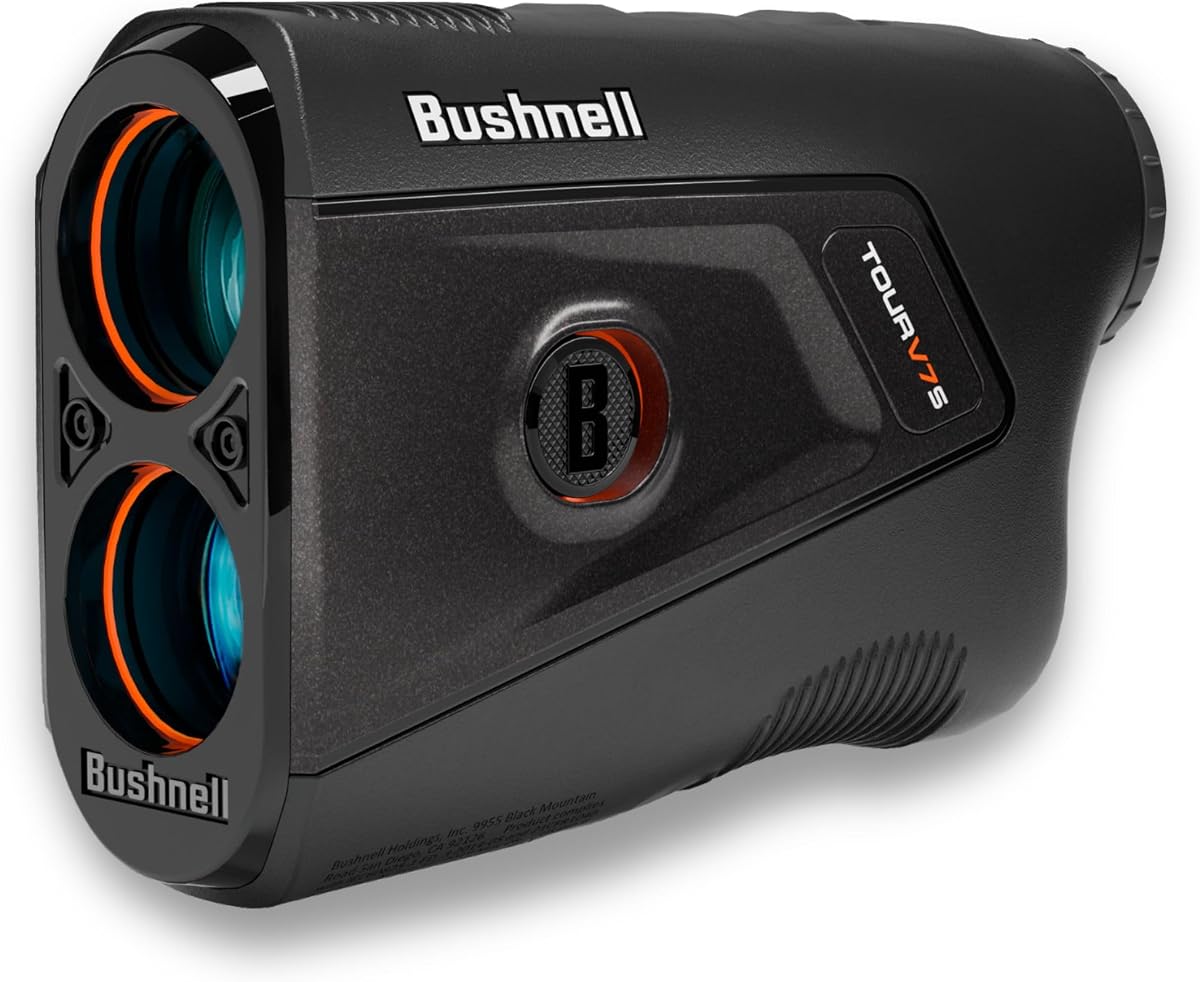
Bushnell Tour V7 Shift
4.6Editor score
Dual-color OLED display
Slope-first distance presentation
Launch-monitor connectivity
Our AI Golf Rangefinder guide compares ten top models for accuracy, slope adjustment, GPS features, magnification, battery life, and smart course strategy.
An AI golf rangefinder combines laser distance measurement with automated slope, weather, GPS, and player-data analysis. The best unit does more than return a number: it helps golfers interpret elevation, wind, temperature, and target position while keeping tournament-legal controls, clear displays, and dependable flag acquisition close at hand.
This guide compares ten rangefinders based on the supplied specifications, including laser range, magnification, slope functions, environmental adjustments, displays, connectivity, shot tracking, durability, and power options. It covers standalone devices, GPS combinations, and broader Arccos systems designed to turn distance readings into personalized club and strategy recommendations.
Each review explains who benefits most from the product and where its compromises may matter. Features that call themselves AI differ considerably across the list, from automatic environmental compensation to swing-informed club suggestions and connected shot analytics. Current prices and availability can change, so confirm the latest listing details before buying.
4.6Editor score

4.7Editor score

4.1Editor score
The table below places all ten rangefinders side by side, emphasizing the capabilities that most directly affect a golfer's pace, target selection, and ability to interpret compensated distance in real time.


The Arccos Smart Laser is an app-connected rangefinder built around the idea that a golfer needs a decision aid rather than a raw distance. It carries a 3.4 rating, while its strongest features include actual and compensated distance, vibration pin lock, a tournament-legal slope toggle, and integration with Arccos course and strategy tools.
We may earn a commission when you buy through this link, at no additional cost to you.
Its central advantage is the distinction between straight-line distance and the advertised plays-like distance. The unit factors in slope and live weather, including wind, rather than adjusting only for elevation. For golfers deciding which target to attack, that extra context can be more valuable than another yard of nominal laser precision.
The software also extends beyond measurement. Arccos AI Strategy can suggest optimal targets, Green Maps can help golfers visualize positions around the putting surface, and the digital yardage book covers more than 40,000 courses. Smart Sensors are not required for the stated course-map function, although a compatible smartphone and active service are still central to the experience.
The main drawback is the ongoing subscription model. The supplied listing notes that active Game Tracking members receive Smart Laser access under an annual promotional arrangement, while other access requires a paid plan. A golfer who dislikes recurring app costs or frequently plays without a compatible phone may prefer a self-contained device. For those ready to use the full platform, however, this is the most strategy-oriented option in the group.
The combination of slope, wind, and actual-distance readouts gives this rangefinder unusual decision value. It is particularly useful when elevation and weather make the direct distance to a pin misleading.
AI Strategy, Green Maps, and detailed hole layouts turn the device into a course-planning tool. Golfers who study targets rather than simply selecting clubs receive substantially more from the subscription.
We may earn a commission when you buy through this link, at no additional cost to you.
The MILESEEY GenePro S1 is built for golfers who want a feature-rich standalone rangefinder with unusually broad AI-assisted environmental compensation. Its 4.4 rating is supported by a 2,000-yard stated range, 7.5x magnification, fast vibration feedback, a slope switch, and SmartSlope technology.
We may earn a commission when you buy through this link, at no additional cost to you.
SmartSlope is described as detecting slope, wind, temperature, humidity, barometric pressure, and elevation before calculating a compensated distance. That breadth of inputs distinguishes it from conventional slope-only units, particularly for players who want one number to represent the effective playing distance in variable conditions.
Target acquisition and visibility are also emphasized. The device can lock onto a pin at distances up to 690 yards, uses filtering for rain, fog, and dust, and offers Ball-to-Pin and PinPoint Green Mode. Its SmartDisplay switches between red and black for changing light, while 7.5x magnification and more than 95% light transmission support target identification.
The IP65 body, adjustable diopter, scratch-resistant construction, and strong magnetic mount make it practical for regular use, although the advanced feature set can take time to learn. Its stated cost is also higher than that of many conventional options. It is best for a technically interested golfer who wants maximal range, strong optics, and environmental data without relying on a separate course ecosystem.
The six environmental inputs listed for SmartSlope offer a richer basis for club selection. The system is most compelling for golfers who routinely analyze changing wind, temperature, and elevation effects.
Seven-and-a-half-times magnification, a seven-degree field of view, and adaptive display colors make the GenePro S1 easier to use when the target is small or the ambient light changes.
We may earn a commission when you buy through this link, at no additional cost to you.
The FlightScope i4 stands apart by connecting rangefinder measurements with the golfer's own launch data. Its 4.7 rating reflects a strong overall package built around AI-powered club recommendations, real-time effective playing distance, and a practical 1,000-yard range with 6x magnification.
We may earn a commission when you buy through this link, at no additional cost to you.
Rather than selecting a club from a generic distance chart, the i4 can use the user's launch data together with current weather and environmental conditions. The result is presented as a personalized recommendation for each shot, which could be especially useful to golfers who want their selection to reflect their actual carry profiles rather than a one-size-fits-all expectation.
The rangefinder also adjusts playing distance for wind, temperature, and altitude. A slope function supplies terrain-adjusted readings and has an easy on-and-off control suitable for tournament play. A built-in magnet, USB-C rechargeable battery, and a measurement range beginning at five yards round out a device designed for convenient course use.
Its main limitation is that the deepest personalization depends on relevant swing information being available. Golfers seeking complete green maps or a broad shot-tracking ecosystem may find the FlightScope less expansive than the Arccos and Blue Tees systems. Even so, it is the clearest choice in this list for individualized club selection supported by environmental adjustment.
Launch-informed recommendations are the i4's defining benefit. They can reduce the gap between a generic playing-distance chart and the clubs that consistently perform for the individual golfer.
The rechargeable battery and integrated cart magnet reduce setup demands. The range and magnification cover conventional approach situations without requiring a large, complicated device.
We may earn a commission when you buy through this link, at no additional cost to you.
The Callaway 300 Pro is a straightforward laser rangefinder for golfers who want slope compensation and clear target confirmation without a large app ecosystem. It holds a 4.6 rating and offers 6x magnification, a five-to-1,000-yard range, plus or minus one yard accuracy, and units in yards or meters.
We may earn a commission when you buy through this link, at no additional cost to you.
Its important usability detail is the external slope on-and-off switch. The control is easy to locate and operate, which helps golfers change between ordinary distance and slope-adjusted readings while also making tournament compliance straightforward. Callaway's Pin Acquisition Technology can lock onto a pin as far away as 300 yards.
A vibrating pulse confirms successful flag acquisition. The integrated Magnahold system provides a strong magnetic attachment point to a cart, while the molded hard case and carabiner make storage and transport more convenient. US units include a battery according to the supplied information.
This is not an environmental AI rangefinder in the same sense as several competitors. It does not advertise live wind, temperature, GPS, or shot-data analysis, and its closest equivalent to intelligent decision support is slope compensation. That limitation may actually be an advantage for golfers who want a predictable, dedicated device, but the omission makes it less suited to those seeking personalized club recommendations.
A physical switch gives users a clear indication of whether compensation is active. That straightforward control is useful for practice, casual play, and competitive rounds.
Pin Acquisition Technology and a short vibration burst reduce uncertainty about whether the unit has measured the flag. This is particularly helpful when multiple reflective surfaces are visible.
We may earn a commission when you buy through this link, at no additional cost to you.
The Blue Tees Golf Captain Air merges laser measurement, course GPS, AI club recommendations, and shot tracking in one relatively approachable package. Its 4.1 rating is the lowest among the ten products, but the breadth of included functions makes it an attractive option for golfers who want more than a basic distance reader.
We may earn a commission when you buy through this link, at no additional cost to you.
True Distance technology accounts for slope, wind, elevation, temperature, and humidity, while the built-in recommendations use shot data and course conditions to suggest clubs. GPS supplies front, center, and back distances, giving golfers a way to understand the entire green rather than relying exclusively on one laser measurement.
The Blue Tees GAME app adds a connected profile, round data, club statistics, tendencies, performance insights, and access to more than 42,000 courses. Bluetooth tracking can help locate the rangefinder if it is left in a bag or cart, and automatic shot tracking supports post-round analysis of strengths and weaknesses.
The physical device offers 6x magnification, a 1,000-yard range, red and black high-contrast display modes, an IP65 rating, and USB-C charging. Its connected functions require compatible Blue Tees gear and a functioning app experience. Even with that caveat, the combination of course data, environmental compensation, and shot analytics makes it a value-oriented choice for a broader connected workflow.
Front, center, and back readings help golfers decide where to aim and how much room remains behind the landing area. The GPS data complements the laser's more precise target measurement.
Shot tracking, club data, tendencies, and performance trends can reveal practical weaknesses. The value grows for golfers willing to review information and use it in future decisions.
We may earn a commission when you buy through this link, at no additional cost to you.
The Blue Tees Golf Captain Pro upgrades the Captain Air concept with a longer stated range, 7x magnification, an OLED screen, and IP67 protection. Its 4.4 rating reflects a capable connected device for golfers who want environmental compensation, GPS course awareness, and club guidance without leaving the optic.
We may earn a commission when you buy through this link, at no additional cost to you.
AI Distance Calibration can toggle slope, wind, elevation, temperature, and humidity. More importantly for speed on the course, club recommendations appear directly in the display, reducing the need to stop and consult a phone before choosing. GPS front, center, and back readings add situational awareness around hazards, layups, and approach shots.
The connected platform records laser shot distances and provides post-round insights, while a personal profile can connect rounds, club data, tendencies, and performance information across compatible Blue Tees equipment. Bluetooth Find My Rangefinder functionality helps recover the device if it is left on the course.
Flag Lock with vibration confirmation improves target confidence, and the OLED display includes adjustable brightness for sunlight and low-light conditions. A magnetic strip provides quick cart access, while IP67 protection supports all-weather durability. Compared with the Captain Air, this model is the better fit for a golfer who prioritizes display quality, stronger weather sealing, and immediate in-view recommendations.
Putting recommendations in the optic makes the system more practical during a round. A golfer can see the suggested club while still focused on the target and surroundings.
The OLED screen and adjustable brightness support clear reading in bright sun and dim conditions. This is a meaningful upgrade for golfers who play at different times of day.
We may earn a commission when you buy through this link, at no additional cost to you.
The Bushnell Tour V6 Shift is a dedicated long-range rangefinder with a 4.8 rating, the highest supplied score in the group. Its 1,300-yard stated range, 6x magnification, slope compensation, tournament-legal switch, and both visual and vibration flag confirmation make it especially appealing for target-focused golfers.
We may earn a commission when you buy through this link, at no additional cost to you.
The device measures the angle of incline or decline to calculate slope-adjusted distance. An external control makes the mode easy to disable, helping users comply with tournament rules. Visual Jolt flashes a red ring, while vibration confirms when the unit has locked onto the flag.
Range and magnification are the most significant physical specifications. A 1,300-yard ceiling gives plenty of margin for long shots and elevated targets, while the optics support fast acquisition. The BITE magnetic system attaches the rangefinder to a cart or another metal surface for one-handed access.
The Patriot Pack includes a premium case, veteran coin, microfiber cloth, quick-start guide, and CR2 battery. Unlike the more software-oriented choices, this unit does not provide personalized club suggestions or GPS course data. Its AI connection is therefore limited, but that simplicity is precisely why it remains attractive for golfers who want fast, dependable distance acquisition.
The 1,300-yard range and 6x optics give the V6 Shift ample reach for long approaches. It is a strong fit for golfers who regularly need to acquire distant flags quickly.
The external slope switch makes a rule-sensitive change immediate. Visual Jolt and vibration provide two forms of feedback that confirm successful flag acquisition.
We may earn a commission when you buy through this link, at no additional cost to you.
The Bushnell Tour V7 Shift is a premium refinement of the familiar Tour formula, pairing a 1,300-yard range with 6x magnification and a 4.6 rating. Its defining feature is a dual-color OLED that shows slope-adjusted plays-like distance in green and actual distance in red.
We may earn a commission when you buy through this link, at no additional cost to you.
That color separation reduces interpretation time. Instead of mentally comparing multiple numbers, the golfer can see the compensated and raw values at a glance. Slope First Technology places adjusted distance prominently, while PinSeeker with Visual JOLT supports fast and confident flag acquisition.
Yardage Range Recall returns the last measured distance with one press, which is useful while practicing or checking a previous target. LINK-enabled technology can pair with Bushnell and Foresight launch monitors to display personalized club suggestions based on the golfer's own yardage data.
The premium positioning is justified primarily by the refined display and connectivity rather than a full course-mapping platform. Compatible equipment is required for LINK club suggestions, and there is no mention of a smartphone app or extensive GPS database. Golfers who value immediate, uncluttered readouts and may already own compatible launch-monitor equipment will get the most from this model.
Green and red display colors separate the adjusted playing distance from actual distance. This visual distinction helps golfers choose a club without performing mental calculations.
LINK compatibility can turn yardage history into personalized club suggestions when paired with a supported launch monitor. It is a focused form of AI support rather than a complete course-management platform.
We may earn a commission when you buy through this link, at no additional cost to you.
The Arccos Air + Smart Laser bundle is the most complete system in the list, pairing a wearable shot tracker with the Arccos Smart Laser. It has a 5.0 supplied rating, the highest score shown, and combines laser measurement with automatic GPS shot capture, AI strategy, Green Maps, and strokes-gained analysis.
We may earn a commission when you buy through this link, at no additional cost to you.
Arccos Air records every shot using GPS motion capture and artificial intelligence. Golfers place the lightweight wearable in a pocket without club sensors, tagging, or a phone in hand, allowing the system to follow the round in the background. The wearable weighs less than 25 grams, measures 2.25 by 1.25 by 0.75 inches, and comes with a wireless case that can power it for up to 12 rounds.
The Smart Laser provides actual and plays-like distances adjusted for slope and live conditions including wind, elevation, temperature, humidity, and altitude. AI Strategy, developed with Edoardo Molinari, can suggest targets and clubs, while the platform compares performance against a target handicap to show where strokes are gained or lost.
The bundle includes a first year of Game Tracking, Rangefinder, AI Strategy, Green Maps, and advanced plays-like distance access, but the membership renews annually afterward. A compatible smartphone is required. Despite that dependency, the bundle offers the deepest connected experience for a golfer who wants automatic shot data, strategic guidance, and course maps in one ecosystem.
GPS motion capture removes the need to tag every shot or carry sensor-equipped clubs. That convenience can make consistent data collection much easier.
AI target advice and strokes-gained comparisons turn individual measurements into a broader performance picture. The system is especially relevant for golfers focused on repeatable improvement.
We may earn a commission when you buy through this link, at no additional cost to you.
The Callaway 300 Pro Elyte is a dedicated laser rangefinder that focuses on slope, target acquisition, and straightforward operation. Its 4.7 rating is among the strongest in the group, and the core specification set includes 6x magnification, a five-to-1,000-yard range, and plus or minus one yard accuracy.
We may earn a commission when you buy through this link, at no additional cost to you.
Callaway's slope measurement calculates an adjusted distance when the target sits above or below the golfer. A physical external on-and-off switch lets the user disable the function for tournament play, reducing the chance that the setting remains active accidentally.
Pin Acquisition Technology locks onto a flag up to 300 yards away, and a short vibrating pulse confirms the result. The Magnahold cart mount keeps the unit accessible, while the ability to display yards or meters adds flexibility for golfers who travel. The device remains conventional in another sense as well: it does not add live weather data, GPS maps, or personalized club analysis.
That makes the Elyte most appropriate for someone who wants a dependable rangefinder with familiar controls rather than a connected coaching system. Its AI label is considerably less expansive than those used for software-heavy competitors, but the core distance-reading experience is clear, compact, and easy to learn.
The external slope switch makes it easy to move between adjusted practice readings and legal tournament operation. Its position is particularly useful for competitive golfers.
Pin locking, vibration confirmation, and the cart magnet cover the essentials without requiring an account or app. The result is a low-friction tool for traditional rangefinder use.
We may earn a commission when you buy through this link, at no additional cost to you.
The best AI golf rangefinder is not automatically the most feature-rich model. Start with how you want to measure, receive guidance, use a phone, and follow tournament rules, then prioritize the technology that improves your decisions without slowing the round.
AI labels cover several very different functions in this category. Some devices calculate compensated distance from environmental conditions, while others connect those readings to launch data, club statistics, GPS, or shot tracking. The Arccos systems emphasize strategy, Green Maps, and strokes gained; FlightScope emphasizes personalized club recommendations; Blue Tees combines GPS, shot data, and club guidance.
Choose AI that supports a specific habit. If your goal is better club selection, look for launch-informed or shot-based recommendations. If the priority is choosing a smarter target, prioritize strategy tools and full-green context. If you simply want an adjusted distance, environmental compensation may be enough.
A 1,000-yard range covers most normal approach shots, while the stated 1,200- and 1,300-yard limits offer extra margin for long shots or elevated targets. The GenePro S1 extends to 2,000 yards, but maximum range is only one part of the equation. Magnification, display clarity, and reliable pin acquisition are often more important during an actual round.
Prioritize a readable optic and dependable flag lock. Six-times magnification is common across the list, while the GenePro S1 offers 7.5x and the Captain Pro offers 7x. Match the magnification to your typical distance and eyesight rather than assuming the largest number is automatically best.
Slope compensation is widely available, but wind, elevation, temperature, humidity, altitude, and barometric pressure are handled by fewer products. The MILESEEY GenePro S1, Blue Tees models, and Arccos systems make broader environmental adjustment a central feature. A slope-only device may be sufficient for fair, still conditions but less informative on exposed or hilly courses.
Check whether the manufacturer describes a realistic playing distance and whether you can see the underlying actual distance. A useful display shows both values, allowing you to understand how much adjustment is being applied instead of accepting an unexplained number.
Most devices include a slope switch, but the implementation matters. An external physical switch is fast and unambiguous, while menu-based controls can require more steps. Tournament rules may restrict which distance information is permitted, so golfers should verify current local regulations and the device's current status before competing.
A dedicated switch is ideal for golfers who practice with compensation and occasionally play in events. Make a habit of checking the setting before the first tee rather than assuming it retained its previous state.
Advanced features often depend on a compatible smartphone, a connected account, or an annual membership. The Arccos products explicitly require compatible smartphones and include subscription access, while Blue Tees connected functions depend on compatible gear and the Blue Tees app. Bushnell LINK features similarly require compatible launch-monitor equipment.
Calculate the long-term ownership cost and consider whether you will consistently use the software. A device that remains useful as a conventional rangefinder can be safer than one whose strongest features disappear without a subscription.
Displays differ in technology and color treatment. The Bushnell Tour V7 Shift uses dual-color OLED to separate slope-adjusted and actual distances, while the Captain Pro uses an adjustable-brightness OLED. Other models offer red and black modes, adaptive display behavior, or conventional high-contrast screens.
Test readability in the conditions where you play most often. A bright screen, distinct colors, and simple font hierarchy can save time at the tee, particularly for golfers who need to process information quickly.
Power options range from replaceable batteries to USB-C rechargeable systems. The MILESEEY GenePro S1, Blue Tees Captain Air, and Blue Tees Captain Pro use USB-C charging, while FlightScope i4 is also rechargeable. The Callaway 300 Pro includes a battery for US units, and the Bushnell Patriot Pack includes a CR2 battery.
A magnetic cart mount is common across the list and should be treated as a standard convenience. Consider charging habits, expected battery endurance, and whether a dead device would be disruptive during a long round.
Weather resistance varies from conventional laser devices to IP65 and IP67 ratings. The GenePro S1, Captain Air, and Captain Pro carry IP65 or IP67 protection, while the Arccos units advertise weather resistance. Rain, dust, cart vibration, and temperature swings all affect electronics over time.
Match protection to your normal playing conditions and maintenance habits. A more sealed device is useful in exposed climates, but careful storage, lens cleaning, and regular charging remain important regardless of the rating.
Begin by learning the unit's basic controls in a safe setting away from the tee. Charge it fully if it uses USB-C, install the appropriate battery, adjust the diopter if one is provided, and set the display brightness and measurement units. Confirm that the slope setting matches your intended practice or competitive format.
Settle into a stable stance and use a clean, unobstructed line toward the target. Aim below the flag when trees, spectators, cart roofs, or other reflective objects may interfere. For a pin reading, use the vibration or visual confirmation before accepting the number, and allow a moment for wind and elevation-aware functions to settle.
After the round, remove dirt without scraping the lens, store the unit in its case or a dry compartment, and recharge it before the next outing. For connected products, keep the app and device software current, review any setup prompts, and confirm that required accounts or memberships remain active. Address erratic readings by cleaning both the laser aperture and receiver window before troubleshooting the device itself.
Accuracy depends on the unit, conditions, and target. Compare stated accuracy, magnification, flag-lock behavior, environmental compensation, and display clarity rather than treating AI as a guarantee. Devices such as the MILESEEY GenePro S1 emphasize precision and broad compensation, while conventional premium units concentrate on dependable slope-adjusted readings. Proper aim and a clear line to the target remain essential.
Many basic distance and slope functions work independently, including on the Callaway, Bushnell, and MILESEEY devices. Connected features such as automatic shot tracking, AI strategy, Green Maps, personal profiles, and anti-loss finding can require a compatible smartphone or app. Check the listed platform requirements before buying if offline operation is important.
Tournament rules generally require golfers to disable nonconforming distance functions, and the products here include slope toggles for that purpose. An external switch is particularly convenient because it makes the active setting easy to verify. Players should still review the current rules of their event and confirm the behavior of the exact model they use.
Actual distance is the direct laser measurement to the target, while plays-like distance adjusts for environmental effects such as slope, wind, elevation, temperature, and humidity. The adjusted figure attempts to represent the distance a shot effectively plays. Devices that display both values help golfers understand how much compensation is being applied.
For most golfers and normal approaches, a 1,000-yard range is already generous, while 1,200 to 1,300 yards provides additional margin. Flag reliability, magnification, and readability often matter more than maximum theoretical range. The GenePro S1's 2,000-yard specification is useful primarily for long-range targeting flexibility.
GPS is valuable for front, center, and back green readings, hazard context, and course awareness. It does not replace precise laser measurement to a specific target. Golfers who already use a course-management app may not need both, while players seeking a self-contained device benefit from a hybrid such as the Blue Tees Captain models.
They can be useful, provided the device has enough data to reflect the golfer's actual performance. Beginners should compare recommendations with known club distances and treat early suggestions as guidance rather than certainty. Over time, consistent shot data can make personalization more relevant.
Keep the lens and receiver window clean, avoid exposing the unit to impacts or extreme moisture beyond its stated rating, and store it in a protective case. Charge rechargeable models regularly and replace disposable batteries when needed. Connected devices also benefit from timely app and firmware updates.
The FlightScope i4 is the leading choice for personalized club recommendations, the Bushnell Tour V7 Shift offers the most refined dual-color distance presentation, and the Blue Tees Golf Captain Air delivers strong connected value with GPS, environmental adjustments, and shot analytics. Each serves a different type of golfer rather than a single universal style of use.
Prioritize the benefit you will actually use. Choose broad environmental compensation for variable conditions, a slope-focused laser for simplicity, GPS and shot tracking for a complete round profile, or AI strategy when your goal is to choose better targets and understand your performance. Also account for app requirements, subscription costs, tournament controls, display readability, and charging needs.
Ratings and specifications provide a strong starting point, but product listings and availability can change. Check the current features, package contents, compatibility requirements, warranty information, and latest price on the linked product page before making a final purchase.