
Segway Navimow i105N
4.1Editor score
RTK plus vision navigation
Assisted automatic mapping
Manages up to 12 zones
Wire-free virtual boundaries
AI robotic lawn mowers combine autonomous navigation, computer vision, obstacle detection, and app-based control to reduce the time and effort required for routine lawn care. The strongest models offer accurate mapping, reliable route planning, clean edge cutting, and sensible management of complex yards without requiring perimeter wires.
This guide compares ten wire-free AI robotic lawn mowers using their stated lawn coverage, navigation technology, obstacle recognition, terrain handling, cutting features, connectivity, and maintenance needs. It covers compact yards, larger properties, wooded areas, slopes, narrow passages, and users who want different levels of automation and control.
Each review highlights the strongest benefits and practical limitations of its mower, followed by purchasing guidance for choosing the right model. Ratings and product details reflect the supplied listings, while availability and pricing change frequently, so readers should confirm current specifications and costs before purchasing.
4.1Editor score

5.0Editor score
4.5Editor score
As an Amazon Associate we earn from qualifying purchases.
The table below compares the ten recommended mowers by navigation system, stated yard capacity, terrain capability, and key control features. It provides a quick way to narrow the field before reviewing the detailed analysis of each model.



The WORX Robot Lawn Mower for 1/4 Acre, Wire-Free with Brushes earns a 4.4 rating and stands out as a balanced choice for homeowners who want sophisticated mapping without installing a boundary wire or RTK antenna. Its combination of RTK Cloud, Vision AI, V-SLAM sensor fusion, and a high-capacity neural processor gives it a versatile approach to autonomous mowing.
We may earn a commission when you buy through this link, at no additional cost to you.
The mower automatically maps lawn shapes and identifies boundary types, while its vision system recognizes common yard objects to reduce interruptions. Reliable navigation in shade is especially valuable because GPS-based systems can struggle beneath dense trees or near structures. RadioLink connectivity extends communication beyond ordinary Wi-Fi coverage, and the app supports unlimited zones, no-go areas, custom paths, map editing, and remote monitoring.
Its edge-cutting system is another major strength. Vision AI lets the mower understand differing boundaries and cross ridable edges, reducing the strips of uncut grass commonly left by conventional robotic mowers. Users can also choose parallel, checkerboard, diamond, or natural patterns, while the included wheel brushes are intended to help maintain traction.
This is a strong recommendation for a medium lawn with trees, unusual borders, or several separately managed areas. The stated one-quarter-acre limit makes it less appropriate for expansive properties, and buyers comfortable with a cloud-centered navigation system may prefer a mower with fully independent LiDAR or local RTK capabilities.
RTK Cloud supplies centimeter-level positioning in open areas, while V-SLAM and Vision AI help preserve navigation in shade or beneath partial cover. This blended approach is useful for yards where one navigation technology alone may not remain consistent.
Unlimited mowing zones, no-go areas, custom paths, and four selectable patterns make the app more flexible than a basic start-and-go robotic mower. It is particularly useful for lawns divided by paths, gardens, pools, or distinct landscaping treatments.
We may earn a commission when you buy through this link, at no additional cost to you.
The Segway Navimow i105N carries a 4.1 rating and offers a practical entry into wire-free robotic mowing. Designed for lawns up to one-eighth acre, it combines RTK positioning with vision enhancement, assisted mapping, and a camera-based obstacle system capable of identifying more than 150 object categories.
We may earn a commission when you buy through this link, at no additional cost to you.
Setup focuses on guiding the mower with a smartphone to establish virtual boundaries. Its AI-assisted mapping feature can identify clear lawn edges and automate navigation of the working area, reducing the need to trace every contour manually. The app supports remote control, mowing schedules, direction changes, progress monitoring, map editing, and as many as 12 zones.
Planned mowing patterns are designed to improve systematic coverage, while a direction change after completing the lawn helps reduce visible tracks. The mower can recharge and continue working, and its 58 dB(A) operating level makes it suitable for homes where early or frequent mowing should remain unobtrusive.
The i105N is best suited to smaller lawns and buyers who value straightforward setup, quiet operation, and app control without paying for the largest available coverage capacity. The optional nature of the 4G anti-theft module and the one-eighth-acre limit are important considerations for larger or security-conscious installations.
Instead of requiring a buried wire, the Navimow uses guided virtual-boundary creation and AI-assisted mapping. The process still requires attention during setup, but it offers a more approachable alternative to manually programming extensive perimeter geometry.
At 58 dB(A), the mower is designed to operate with relatively low acoustic output. That makes it attractive for small suburban lawns where early scheduling, nearby bedrooms, or shared neighborhood space can make noise an important consideration.
We may earn a commission when you buy through this link, at no additional cost to you.
The Neomow X SE holds a 5.0 rating and stands out for its ability to navigate without network or satellite signals. Its 360-degree 3D LiDAR and AI vision system support precise positioning, obstacle avoidance, mapping, and reliable operation in darkness, bad weather, and areas beneath trees.
We may earn a commission when you buy through this link, at no additional cost to you.
The mower handles up to 0.75 acre and can recognize more than 200 obstacle types. Its positioning error is stated at under 0.8 inches, while obstacle detection reaches down to objects only 0.4 inches wide and 5.9 inches high. These specifications are particularly compelling for users concerned about small pets, toys, or garden clutter.
Terrain handling is another major strength. Large front-wheel all-terrain wheels can cross obstacles around 1.6 inches high, while the 11-inch floating deck adapts to uneven ground and includes an anti-clog barrier. Cutting height adjusts from 1.18 to 3.35 inches, and the claimed 95-percent coverage rate helps reduce missed lawn areas.
The Neomow X SE is an excellent choice for larger properties, shaded grounds, or users who do not want to depend on RTK stations or cellular service for positioning. Its relatively substantial body and minimum passage width of 2.53 feet may prevent it from reaching some especially tight areas, so measuring access routes is essential before purchase.
Because the system does not require network, satellite, or RTK positioning, it can continue operating in locations where conventional connected mowers may lose guidance. That independence is valuable in heavily wooded yards and properties with inconsistent wireless coverage.
The floating deck, front-wheel drive, all-terrain wheels, and adjustable cutting height make the mower more adaptable than a compact deck-and-four-small-wheels design. These features are valuable on properties with roots, irregular terrain, or transitions between different grass lengths.
We may earn a commission when you buy through this link, at no additional cost to you.
The ECOVACS GOAT O1000 LiDAR PRO receives a 4.0 rating and appeals to owners of compact or awkwardly shaped yards. It uses a HoloScope 360-degree dual-LiDAR system to map without perimeter wires or an RTK antenna while maintaining a stated two-centimeter positioning accuracy.
We may earn a commission when you buy through this link, at no additional cost to you.
Its integrated TruEdge trimmer is one of the most distinctive features in this group. Rather than relying only on a standard deck for boundary mowing, the mower includes a dedicated edge-cutting mechanism intended to reach along driveways, sidewalks, flower beds, and irregular borders with less string-trimmer work.
AI Vision and 3D time-of-flight LiDAR work together to identify more than 200 obstacle categories, with detection precision down to five centimeters. The super-narrow body can pass through corridors as slim as 0.8 meters, which is useful for side lawns and compact properties divided by narrow paths.
This model is best for users who prioritize compact dimensions and edge finish over large-area capacity. The listing notes that highly complex corners, narrow gaps, and raised edges may still require occasional manual trimming, while initial mapping and fine-tuning can take several adjustments.
The integrated trimmer targets a common weak point of robotic mowing: the narrow strip beside hard boundaries. It can reduce follow-up edging, although unusually intricate corners and elevated edges remain outside the fully automated experience.
An 0.8-meter body can reach passages that larger mowers cannot. That makes the GOAT O1000 particularly useful for properties containing narrow sidewalks, side strips, or separated lawn sections connected by constricted routes.
We may earn a commission when you buy through this link, at no additional cost to you.
The Mammotion LUBA mini 2 AWD 1500H earns a 4.4 rating for combining sophisticated perception with serious all-wheel-drive mobility. It is designed for up to 0.37 acre and uses 360-degree LiDAR plus dual-camera AI vision to recognize objects and adapt its path as the lawn changes.
We may earn a commission when you buy through this link, at no additional cost to you.
Two independently controlled 88-watt motors and an omni wheel support climbing on slopes up to 80 percent. Adaptive suspension helps the mower cross curbs, roots, and thresholds up to 45 millimeters high. Those capabilities make it a compelling candidate for properties with abrupt elevation changes or rough access routes.
Cutting is handled by a main disc and a dedicated edge disc, while automatic cutting-height adjustment allows grass length to be changed through the app. The mower can manage up to 20 independent zones, and DropMow mode offers a quick temporary session without requiring a saved map.
This model is a strong recommendation for buyers who need more off-road ability and detailed cutting control than a conventional compact mower offers. Users who want quick, disposable mowing sessions may appreciate DropMow, while those planning complex recurring layouts will benefit more from permanent mapping and zone scheduling.
Independent motors, active pivoting, and adaptive suspension distinguish this mower from simpler rear-drive or two-wheel-drive units. The design is particularly relevant for steep hills, uneven ground, and routes containing roots or low thresholds.
DropMow mode allows immediate use without building a persistent map, whereas the 20-zone system supports recurring, area-specific routines. Buyers can move between quick spot mowing and detailed whole-yard automation according to the season and lawn condition.
We may earn a commission when you buy through this link, at no additional cost to you.
The Mammotion LUBA 3 AWD 3000H has a 4.3 rating and delivers one of the most technically ambitious navigation systems in the guide. Tri-Fusion positioning integrates 360-degree LiDAR, NetRTK corrections, and dual-camera AI vision, allowing the mower to switch intelligently among navigation methods as conditions change.
We may earn a commission when you buy through this link, at no additional cost to you.
Its LiDAR has a claimed range of up to 230 feet and a 59-degree vertical field of view. The mower can therefore build a detailed point cloud that includes ground-level and elevated features. The upgraded AI processor is stated to recognize more than 300 obstacle categories and calculate safe routes in real time.
Power comes from four independently controlled motors, with 80-percent slope climbing and the ability to cross obstacles up to 80 millimeters high. Two 165-watt cutting motors and six-blade discs work with AI vision to adjust speed and power according to grass density. A battery rated up to 12 ampere-hours supports up to 175 minutes of operation.
This mower is best suited to expansive, challenging properties where obstacle variety, terrain, and multi-zone control matter more than compact storage. The physically substantial design and sophisticated setup may feel excessive for a small lawn, and the cutting-height range starts higher than some competing models.
LiDAR supplies detailed local awareness, AI vision recognizes objects, and NetRTK adds positional correction. The combination creates redundancy that is particularly useful when trees, structures, or uneven terrain interfere with a single navigation method.
The mower offers perimeter-only, zigzag, checkerboard, and adaptive zigzag patterns, together with 30 zones and no-go areas. Its powerful dual-motor cutting system is designed to sustain work in dense grass while intelligent coverage planning reduces missed areas and excessive overlap.
We may earn a commission when you buy through this link, at no additional cost to you.
The Sunseeker S4 earns a 4.4 rating and focuses on precise perception in complex yards. It combines 360-degree 3D LiDAR with a 10 TOPS AllSense processor and Vision AI to create systematic parallel routes across lawns with dense trees, uneven ground, low light, and weak wireless coverage.
We may earn a commission when you buy through this link, at no additional cost to you.
The mower can map up to 0.25 acre, save five maps, and create as many as 100 zones or no-go areas. App-based driving removes the need for perimeter wire or base-station calibration, while interruption recovery allows work to continue after the mower stops.
Rear-wheel drive helps it handle bumps, ruts, passages as narrow as 31.5 inches, and slopes up to 22 degrees or 42 percent. Its six-blade, seven-inch cutting system supports a 1.6-to-3.2-inch height range, floating cut, and a ride-on-edge mode for finishing borders.
The S4 is a strong fit for wooded or visually busy properties where accurate mapping and nighttime consistency matter. Its slope rating is lower than the 80-percent capability of several all-wheel-drive competitors, and its stated 60 dB operation may be less attractive in noise-sensitive locations.
Three-dimensional LiDAR and vision are designed to maintain a detailed map even where trees, shade, eaves, or weak signal complicate ordinary positioning. The result is particularly relevant for yards where satellite visibility and wireless connectivity are inconsistent.
Five saved maps and as many as 100 zones or no-go areas provide unusually detailed organization. This is useful for large numbers of separate lawn sections, seasonal grass treatments, or properties with several visually and operationally distinct areas.
We may earn a commission when you buy through this link, at no additional cost to you.
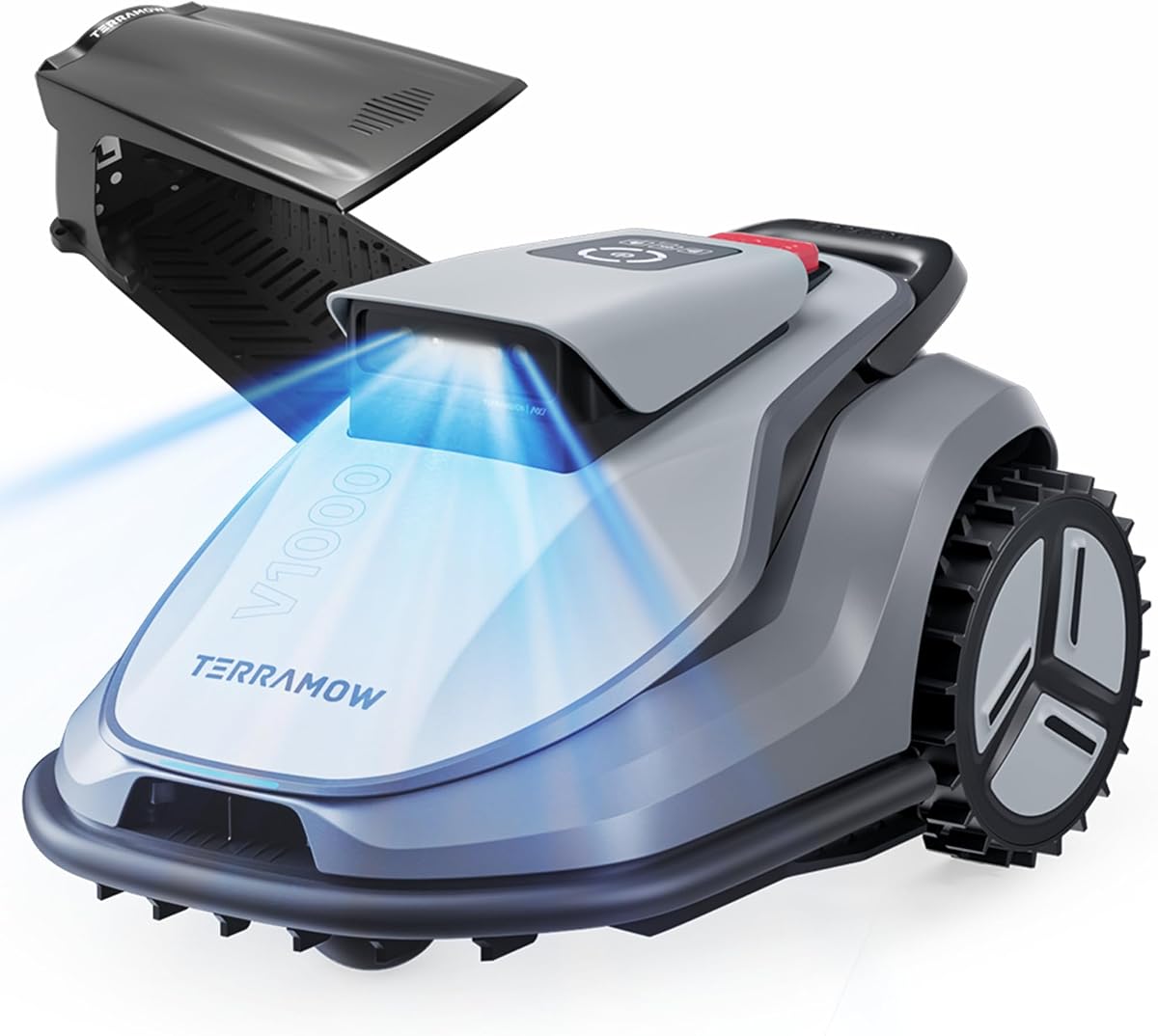
The TerraMow V1000 earns a 4.5 rating and takes a distinctly camera-first approach to autonomous mowing. Its TerraVision 2.0 triple-camera AI vision system creates maps without a boundary wire or RTK installation, allowing setup and automatic mapping to begin quickly.
We may earn a commission when you buy through this link, at no additional cost to you.
The listed obstacle performance is ambitious, with the manufacturer claiming recognition and avoidance of more than 99 percent of obstacles. The system is designed to handle trees, furniture, pools, pets, and small wildlife. Intelligent area detection supports full-lawn coverage, and users can adjust the edge-cutting distance for a closer finish along boundaries.
App features include custom mowing zones, no-go areas, cutting-height and speed controls, path selection, and scheduling. Three independent maps and as many as 20 zones allow separate management of front and back lawns or multiple properties, while automatic resume continues the task after charging.
The V1000 is most appealing to owners who want no antennas or buried wires and value quick configuration. It handles slopes up to 32.5 percent, paths at least 23.6 inches wide, and obstacles up to 1.2 inches high. Buyers should carefully consider whether a camera-based system matches their yard’s tree density, lighting, and obstacle mix.
The camera-led approach removes the need to install a base station or position an RTK antenna. Automatic mapping can therefore be especially convenient for homeowners who want a straightforward path from unboxing to the first scheduled mowing cycle.
Three maps and 20 zones let users preserve distinct layouts for different areas. Custom schedules, paths, speeds, and no-go regions make the mower adaptable to front yards, rear lawns, roadside grass, or multiple properties without duplicating every setting.
We may earn a commission when you buy through this link, at no additional cost to you.
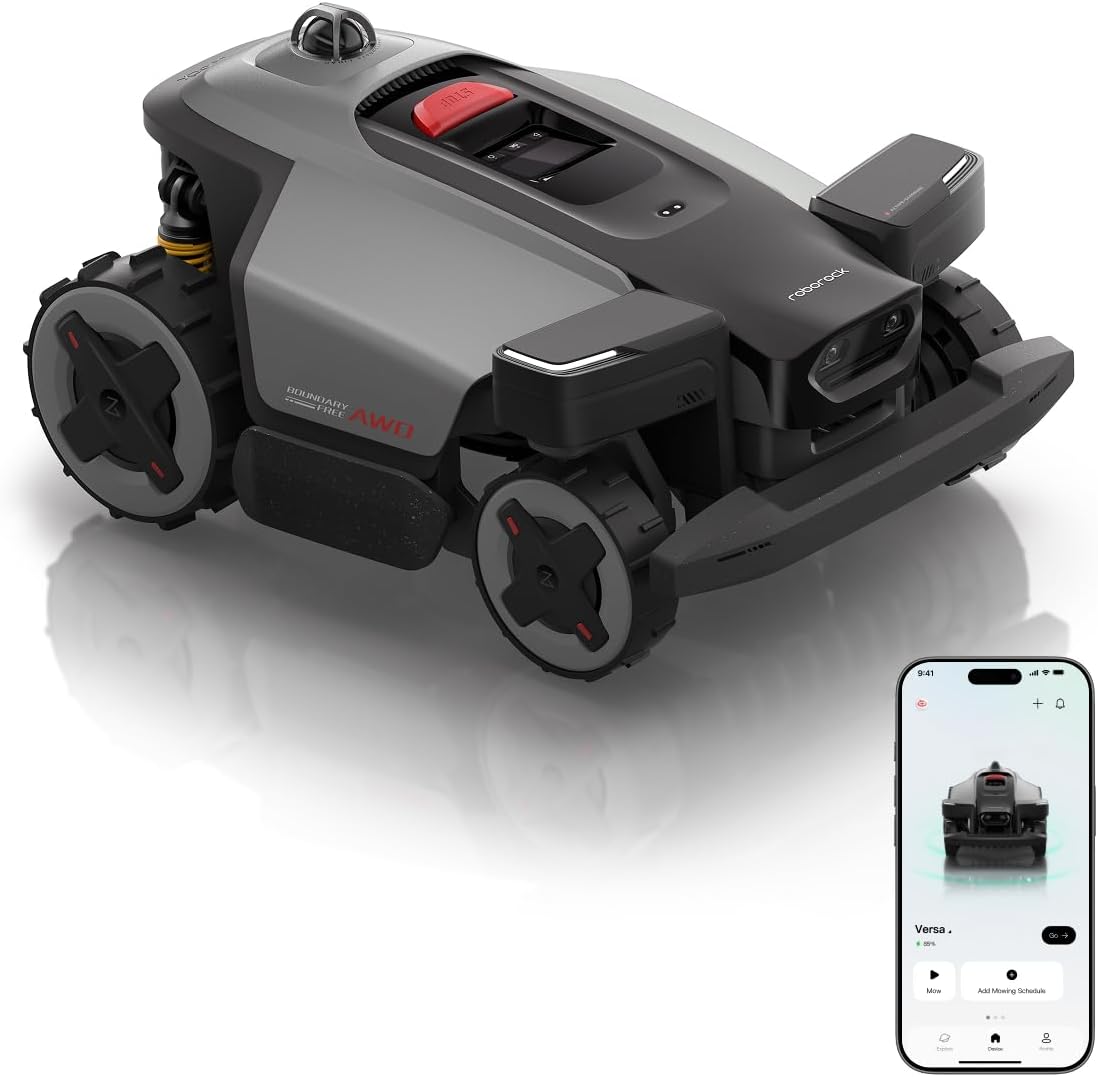
The roborock RockMow X120H earns a 4.5 rating and is the premium choice in this guide. It combines dual 3D LiDAR with AI vision mapping to build a precise yard map without perimeter wires or an RTK base station, while a heavy all-wheel-drive platform targets demanding terrain.
We may earn a commission when you buy through this link, at no additional cost to you.
Its patented active steering system is designed to turn without tearing premium turf. Dynamic suspension and a floating cutting deck help preserve stability on rough ground. The mower claims 80-percent slope capability and the ability to cross obstacles as high as 3.15 inches, exceeding several rivals on both figures.
The 9.49-inch cutting width increases efficiency, while a ride-on approach helps reduce uncut strips along fences, walkways, and driveways. Cutting height adjusts from 1.57 to 3.54 inches. Dual-camera vision works with the LiDAR point cloud to identify toys, furniture, tools, debris, humans, and pets.
Three years of 4G connectivity are included for long-range tracking and control without a stated subscription fee. The RockMow X120H is best for owners of larger, difficult properties who value steering, suspension, edge coverage, and integrated cellular connectivity. Its bulkier design may be less suitable for narrow passages or small storage areas.
Four-wheel drive, active steering, dynamic suspension, and a floating deck work together to maintain traction and stability. The design is aimed at lawns where slope, holes, roots, and irregular ground would challenge lighter or simpler mowers.
The included three-year 4G period supports remote tracking and control without an ongoing subscription according to the listing. Rain sensing, IPX6 waterproofing, and PIN/GPS anti-theft tools add practical protection for unattended outdoor equipment.
We may earn a commission when you buy through this link, at no additional cost to you.
The Mammotion LUBA 2 AWD 3000HX has a 4.2 rating and delivers rugged all-wheel-drive mowing with a broad 0.75-acre stated capacity. Its 165-watt four-wheel motor system is designed to handle steep slopes, potholes, rough terrain, and tall or dense grass.
We may earn a commission when you buy through this link, at no additional cost to you.
UltraSense AI Vision is combined with RTK navigation to support lawn and boundary recognition beneath trees where satellite signals may be limited. A dual-blade disk provides a cutting width of up to 15.8 inches, helping the mower cover ground efficiently while maintaining close edge treatment along paths, beds, and fences.
The app supports up to 30 mowing areas, no-go zones, multiple patterns, and route adjustments. The mower resumes after recharging, chooses avoidance strategies for more than 200 object categories, and includes GPS tracking, a lost feature, and notifications when it leaves designated mowing areas.
This model is well suited to buyers who need serious terrain capability and detailed zone management in a large yard. It may be less convenient for small properties because of its physical size, while the higher 2.2-inch minimum cutting height may not suit every grass type or preferred finish.
Four independently driven wheels and the stated ability to climb 80-percent slopes provide substantial mobility. The system is aimed at lawns where steep grades, holes, uneven soil, or heavy vegetation could cause a lighter mower to struggle.
With up to 30 mowing areas and no-go zones, the mower can coordinate front and back lawns, roadside strips, pools, and flower beds. Pattern choices and algorithmic route adjustments add further control over appearance and coverage.
We may earn a commission when you buy through this link, at no additional cost to you.
Choosing an AI robotic lawn mower involves matching navigation, coverage, terrain capability, and cutting features to the actual conditions of your property. The most important step is to identify problem areas before comparing models, because a mower’s advanced AI cannot compensate for an unsuitable lawn capacity or inaccessible route.
Begin with the usable mowing area rather than the total property size. Exclude pools, gardens, driveways, buildings, and heavily shaded sections that the mower cannot or should not enter. The products in this guide span stated capacities from one-eighth acre to 0.75 acre, and a mower designed for a small lawn may spend more time recharging on a larger property. Conversely, an oversized machine may struggle through narrow passages or be difficult to store.
Choose a mower whose rated capacity comfortably exceeds the area that must be cut. Leave room for the docking station and account for narrow passages, separate lawn sections, and irregular borders that can reduce effective coverage.
Modern robotic mowers use RTK positioning, 3D LiDAR, cameras, or a combination of these systems. RTK can provide precise coordinates but may require an antenna or reliable correction service. LiDAR builds a physical map and can operate independently of satellite signals. Vision-only systems reduce installation requirements but depend heavily on lighting, visible lawn edges, and the quality of their obstacle and boundary models.
For heavily wooded or remote yards, a mower with independent LiDAR or multi-sensor fusion is generally more dependable. For open lawns with clear boundaries and reliable positioning infrastructure, RTK plus vision may be sufficient.
Look beyond the obstacle-category count and consider the smallest detectable object, the distance at which objects are recognized, and whether the mower combines cameras with LiDAR or time-of-flight sensors. Low toys, garden hoses, pets, children, and wildlife can create very different hazards. A wider field of view and earlier detection generally allow the mower to reroute before reaching a blockage.
Also look for physical bumpers, wheel brushes, anti-theft tracking, PIN protection, and notifications when the machine leaves its mowing area. No system is infallible, so children and pets should not be assumed to be safe near an operating mower.
All-wheel-drive mowers are best suited to steep or irregular properties, while rear-wheel and smaller drive systems often handle flat lawns more economically. Compare stated slope percentages, wheel articulation, suspension, deck clearance, and maximum crossing height. A mower that can climb a slope may still struggle with potholes, exposed roots, narrow steps, or soft ground.
Measure the steepest sections and the worst route between charging station and lawn. Confirm that the mower can physically reach all intended areas rather than relying only on its stated acreage or navigation capabilities.
A wider deck reduces the number of passes and can shorten mowing time on larger lawns. However, width must be balanced against maneuverability, especially around obstacles, trees, and curved borders. Cutting height range matters more to some owners than raw deck width, particularly when switching between seasonal grass growth and a shorter finished appearance.
For cleaner borders, consider a dedicated edge blade, ride-on-edge design, or adjustable edge distance. These features reduce manual string-trimmer work, though complex corners, raised edges, and very narrow gaps may still require occasional hand trimming.
Mapping determines how precisely a mower follows your lawn's outline and avoids unwanted areas. Zone management is essential for properties with front and back lawns, pools, flower beds, play areas, or different mowing schedules. AI-assisted mapping can shorten setup, while manual app driving provides more precise control over boundaries and narrow passages.
Check how many maps and zones can be saved, whether no-go areas can be edited remotely, and whether interrupted tasks resume automatically. Owners should also understand whether setup requires a satellite view, manual boundary tracing, a base station, or an RTK antenna.
Wi-Fi is convenient for nearby control, but Bluetooth and extended radio links can help when the mower operates beyond normal router reach. 4G provides remote monitoring and location services away from home, although access plans, included service periods, and regional coverage vary by model. Theft protection should include PIN locking, GPS or cellular tracking, and geofenced alerts.
Choose connectivity based on how often you expect to monitor the mower away from home. A long lawn with weak household Wi-Fi may benefit from a dedicated radio link, while users seeking remote travel access may prioritize included cellular service.
Battery capacity determines how much area can be mowed between charges, while the charging station influences convenience and theft resistance. Features such as adjustable charge limits, off-peak charging, breakpoint resume, and automatic recharging can extend battery life and support efficient routines. Weather resistance is also important because outdoor equipment may encounter rain unexpectedly.
Plan for blade replacement, chassis cleaning, grass-clipping removal, and occasional sensor care. A mower with a rinseable chassis, accessible blades, local support, and a long warranty may require less effort over several mowing seasons.
Begin by installing the charging station on level ground with clear space around it. Charge the mower according to the manual, then use the app to complete the required firmware updates and define the lawn. Depending on the navigation system, setup may involve driving the mower along boundaries, tracing the lawn with a smartphone, allowing assisted mapping, or installing and calibrating an RTK antenna.
Create no-go zones around pools, flower beds, play areas, and other sensitive areas before beginning automatic mowing. Select an appropriate cutting height, establish weekly schedules, and choose a route pattern that matches the desired appearance. Test the first session while the property is clear of people and pets, then inspect the map for missed sections, unwanted travel routes, and edge performance.
Clean the underside and sensors regularly, remove trapped grass, inspect wheels and blades for damage, and keep the charging contacts clean. Replace worn blades in sets when possible to preserve balance. During wet weather, rely on the mower’s rain sensors and waterproofing rating while avoiding operation around standing water. Review app notifications, battery health, firmware updates, boundary changes, and anti-theft status periodically.
Most models featured in this guide operate without buried perimeter wires. They instead create virtual boundaries using RTK positioning, LiDAR maps, cameras, or combinations of these technologies. Some systems may still require an RTK antenna or base station, so buyers should check the installation requirements of the selected model before purchasing.
Yes, but performance depends on the drive system and local conditions. All-wheel-drive models generally handle steeper slopes, roots, and uneven ground better than compact or rear-drive mowers. Compare stated climbing ability, suspension, wheel articulation, and obstacle-crossing height, then inspect the roughest route on your property.
LiDAR-based systems and combinations of LiDAR, vision, and RTK are often better suited to wooded areas because they can maintain local mapping when satellite visibility is reduced. A camera-only mower may still work well if the lawn has clear boundaries, adequate lighting, and reliable AI recognition. Signal-independent models are also useful where cellular or Wi-Fi coverage is poor.
It depends on the model, terrain, grass density, and number of separate lawn areas. The mowers reviewed here cover stated areas ranging from one-eighth acre to 0.75 acre. Choose capacity above the actual mowing area, especially if the property includes narrow passages, steep slopes, or zones that are visited less frequently.
Edge performance varies substantially among models. Dedicated edge blades, ride-on-edge designs, vision-guided boundary recognition, and adjustable edge distance can reduce visible strips along fences, paths, and flower beds. Highly complex corners, narrow gaps, raised borders, and low-hanging obstacles may still require occasional manual trimming.
Modern mowers use cameras, LiDAR, AI obstacle recognition, bumpers, and other safety systems to detect and avoid many hazards, but no automated system is perfect. Keep children and pets away from the operating area, do not rely solely on obstacle detection, and inspect the lawn for toys, hoses, branches, and other objects before each mowing session.
Some can complete basic mowing independently because their mapping and navigation are handled on the mower. The Neomow X SE explicitly operates without network or satellite signals, while other models may use Wi-Fi, Bluetooth, radio links, RTK, or 4G for mapping, remote control, updates, or tracking. Check which functions require connectivity.
Inspect blades, wheels, sensors, and the underside every few weeks during the mowing season, and clean grass clippings regularly. Rinse the chassis only if the model has the appropriate waterproof rating. Replace worn blades promptly, keep charging contacts clean, and review firmware and schedule settings as lawn conditions change.
The Neomow X SE is the standout all-around recommendation because it combines signal-independent 3D LiDAR navigation, large stated coverage, strong obstacle recognition, and adaptable terrain handling. The Segway Navimow i105N offers a more compact and comparatively accessible option for smaller lawns, while the roborock RockMow X120H brings premium drive hardware, active steering, a wide deck, and integrated cellular connectivity.
Prioritize the conditions that cause trouble in your yard rather than selecting solely on the longest feature list. Trees and weak signals favor LiDAR or multi-sensor navigation, steep ground favors all-wheel drive and adaptive suspension, tight passages favor narrow bodies, and extensive borders benefit from dedicated edge-cutting systems. Confirm stated coverage against the usable lawn area and review installation requirements before ordering.
Product specifications, ratings, promotions, and availability can change, and the current cost of each model may differ from earlier listings. Check the live Amazon page for the latest configuration, included accessories, compatibility information, warranty terms, and current price before making a final purchase decision.