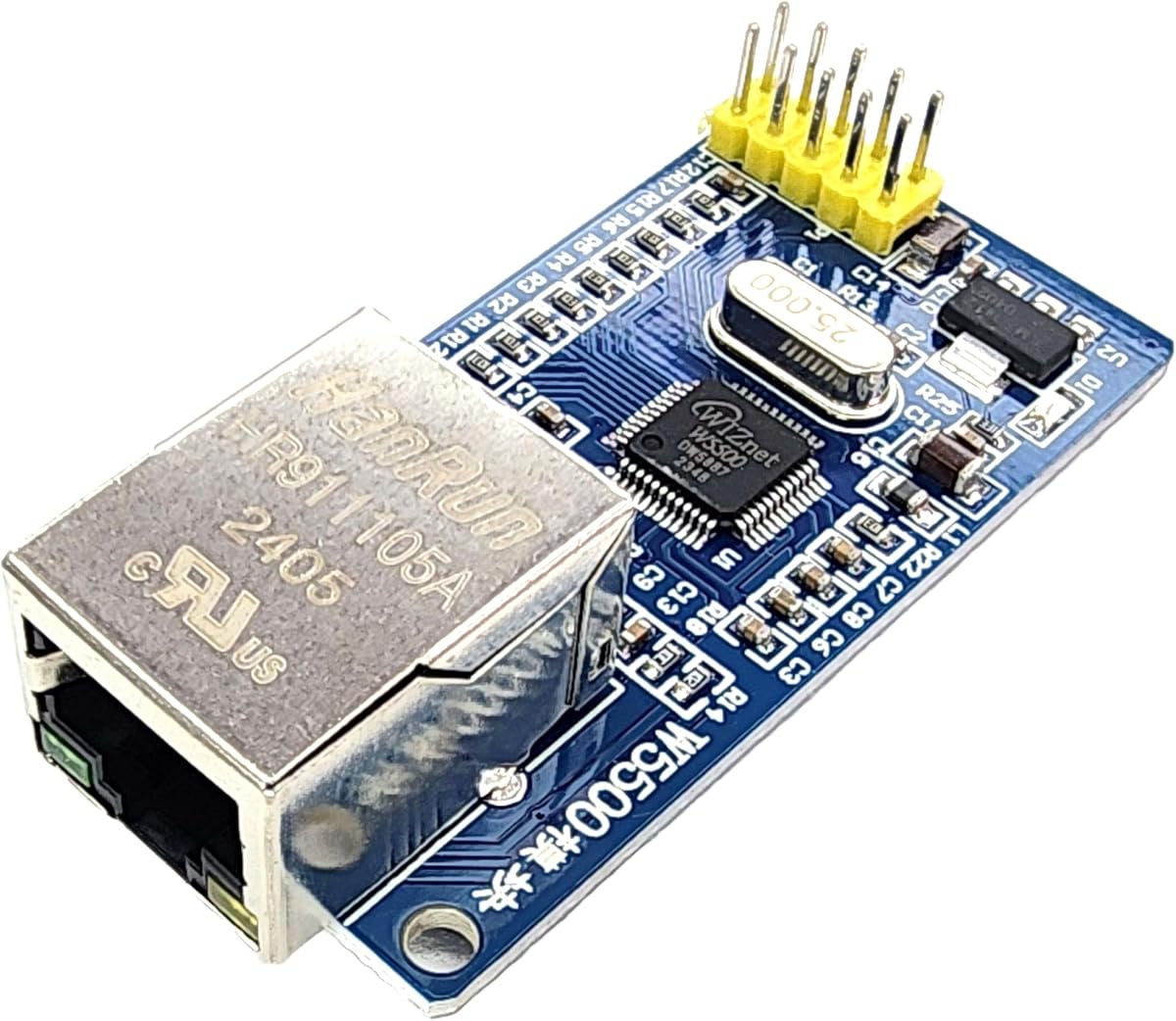
DIYables W5500 Ethernet Module
5.0Editor score
W5500 TCP/IP controller
Full-size RJ45 connector
SPI microcontroller interface
Works with 3.3V or 5V
Supports TCP and UDP
Explore the best Arduino Lan Ethernet Module options, comparing W5500, ENC28J60, W5100, and LAN8720 boards for compatibility, features, and project fit.
An Arduino LAN Ethernet module adds wired network connectivity to projects that need more reliability, throughput, or a physical network connection than a wireless interface typically provides. The right board depends on controller compatibility, supported protocols, available power, connector layout, and whether you need a simple module or an Arduino-shaped network shield.
This guide compares ten modules built around W5500, ENC28J60, W5100, and LAN8720 hardware. The evaluation focuses on documented specifications, interface type, supported microcontroller families, voltage requirements, socket or protocol capabilities, and practical relevance for IoT, robotics, environmental monitoring, and educational builds. No unsupported performance conclusions are used.
The recommendations show how the picks differ: a W5500 module is the most flexible all-rounder, the ENC28J60 is a straightforward SPI option, the W5100 shield integrates directly with common Arduino boards, and the LAN8720 targets lower-level Ethernet designs. Product availability and seller terms can change, so verify current listings and specifications before ordering.
5.0Editor score

4.7Editor score

4.3Editor score
The comparison below places all ten options side by side, highlighting their network controllers, interfaces, supported hardware, voltage arrangements, and standout physical features.




The HiLetgo W5500 2-Pack is a flexible Ethernet option for Arduino and other microcontroller projects that need wired connectivity. Its 4.2 rating reflects a generally useful module with documented support for TCP/IP, UDP-oriented Wake-on-LAN, eight independent sockets, and 32KB of internal transmit and receive buffering. The two-module format also makes it practical for simultaneous or spare builds.
We may earn a commission when you buy through this link, at no additional cost to you.
Its main strength is the combination of a W5500 interface and broad voltage positioning. The listed specifications identify SPI as the communication method and 3.3V or 5V operation, making the board more approachable than a solution tied to one narrow voltage level. Eight sockets are valuable for projects that need several network conversations rather than a single client or server connection, while the internal buffers help the hardware manage network traffic.
There are practical trade-offs. Ethernet modules still require compatible libraries, wiring, and code, and the listing's references to W5100 and TCP/IP51 should be understood as part of the supplied title rather than evidence that the board is a W5100 design. A buyer should confirm the exact pin arrangement and voltage markings for the particular revision. Those considerations are manageable for anyone comfortable with embedded networking.
This pick suits users who want a capable general-purpose W5500 module, need more than one board, or appreciate the option to operate across 3.3V and 5V systems. It is a strong recommendation for classroom controllers, environmental stations, home automation nodes, and multi-device LAN experiments, provided the project includes suitable firmware and a stable Ethernet connection.
Supporting eight independent sockets gives a project room to maintain several network relationships at once. That makes the module more relevant to advanced demonstrations in which one controller acts as a server, exchanges data with several clients, or participates in a small local network.
The stated 3.3V and 5V support broadens the range of boards that may be paired with the module, while the two-pack reduces the need to source additional units for parallel experiments. Always confirm the board's actual markings and logic-level arrangement before wiring.
We may earn a commission when you buy through this link, at no additional cost to you.
The HiLetgo W5500 Module is a compact, single-board option for projects that need a TCP/IP connection through SPI. It carries a 4.3 rating and is listed for Arduino, STM32, and WIZ820io RC5 applications. The straightforward TTL-level 3.3V SPI interface makes it a familiar choice for programmers who want Ethernet without a shield-shaped board.
We may earn a commission when you buy through this link, at no additional cost to you.
The supplied specifications draw attention to power quality. This module uses a 3.3V external supply and should receive more than 200mA of current. That requirement is important because an Ethernet connection can expose the system to surges and current demands that a weak regulator or unsuitable board supply may not comfortably provide. The module's 3.3V control interface also calls for careful logic-level matching.
The main drawback is that it demands more assembly than a native Arduino Ethernet shield. The user must connect power, ground, SPI signals, chip select, and an interrupt line as applicable, then configure the Arduino or STM32 environment with the appropriate W5500 library. For a first timed classroom build, the extra setup may be less convenient, but it creates a compact final design.
Choose this module when you want the W5500's hardware networking capabilities in a compact SPI form factor and are prepared to handle wiring and power requirements. It is especially useful for embedded controllers, custom automation nodes, and projects where the final board layout matters more than shield convenience.
A continuous external supply of 3.3V and more than 200mA is specified for this board. Providing adequate current helps the module handle Ethernet operations without brownouts or unexpected resets, making power planning as important as software configuration.
SPI provides a relatively economical way to connect the Ethernet controller to a microcontroller. The compact module format suits projects where a full-size shield would be too large or where custom wiring gives the installer greater control over the finished enclosure.
We may earn a commission when you buy through this link, at no additional cost to you.
The ACEIRMC W5500 5-Pack is the recommended premium bundle when a project needs multiple networked nodes. It has a 4.3 rating, uses the W5500 SPI architecture, and supports Arduino, STM32, and WIZ820io RC5-oriented applications. Five matching boards are especially useful for mesh demonstrations, coordinated sensors, classroom fleets, and local client-server experiments.
We may earn a commission when you buy through this link, at no additional cost to you.
The module follows a clear hardware arrangement. Its control interface is TTL-level 3.3V SPI, while the power specification calls for a continuous and stable 3.3V supply with at least 200mA available. The listed PCB size of 23 by 25 millimeters keeps the board compact enough for many small enclosures. The multiplier format also allows installers to build parallel systems without sourcing identical modules one at a time.
Its obvious trade-off is unnecessary bulk for a single-node installation. Five boards also mean five sets of wiring, five suitable power arrangements, and five network addresses to manage. Users should not assume the modules can all share a single inadequate supply without checking the total demand and the recommendations for the individual boards.
This bundle is a strong fit for instructors, lab organizers, and makers who want a consistent group of W5500 modules. For one sensor or one classroom demonstration, a single-module option will usually be more practical. For a multi-node LAN project, however, the matched five-pack is the more useful premium choice in this list.
Five modules let a class or laboratory build several independent endpoints with the same controller and interface. That consistency simplifies comparison exercises, distributed logging projects, and demonstrations in which several clients contact a central server.
At a listed 23 by 25 millimeters, the PCB is compact enough for many custom-mounted installations. Its small footprint does not remove the need for stable power or careful wiring, but it makes the board easier to incorporate into tightly planned projects.
We may earn a commission when you buy through this link, at no additional cost to you.
The generic 2-Pack W5500 Ethernet LAN Module presents an ambitious specification sheet, including an integrated TCP/IP stack, eight simultaneous sockets, 32KB transmit and receive buffers, and an embedded 10/100Mbps PHY. Its 1.0 rating is the lowest in this group, so the technical claims should be considered alongside limited customer feedback when making a decision.
We may earn a commission when you buy through this link, at no additional cost to you.
On paper, the board supports TCP, UDP, ICMP, IPv4, and PPPoE, along with Wake-on-LAN over UDP. Its 3.3V core and 5V I/O tolerance are attractive for mixed-voltage projects, while SPI Mode 0 and Mode 3 operation gives developers configuration choices. The auto-negotiation and full or half-duplex capabilities broaden its stated networking flexibility.
The central concern is the combination of generic presentation and a very low rating. Detailed specifications do not substitute for clear documentation, dependable support materials, or confirmed performance. Buyers should inspect the board layout, labeling, documentation, and included accessories carefully, and should be prepared to use a well-supported W5500 library and reference design.
Despite that caution, the module could reward a technically confident buyer who specifically wants two compact W5500 boards and values the documented protocol set. It is less suitable for a plug-and-play beginner project. The low rating makes the more clearly documented, branded W5500 alternatives easier to justify for a first installation.
The listed TCP, UDP, ICMP, IPv4, and PPPoE support moves much protocol work onto the Ethernet controller. This can simplify the microcontroller's role, although applications still require compatible host-side libraries and properly designed network behavior.
A 3.3V core with 5V-tolerant I/O can make the module easier to pair with certain 5V development boards. Signal and supply details should still be confirmed against the board's documentation rather than inferred from the listing alone.
We may earn a commission when you buy through this link, at no additional cost to you.
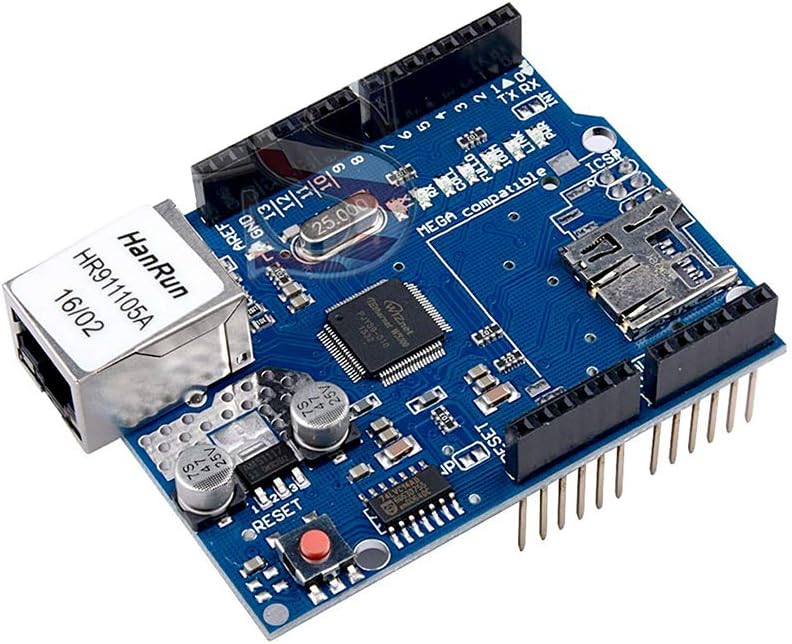
The DEVMO W5100 Ethernet Network Shield is designed for builders who want the familiar direct-plug experience of an Arduino expansion board. Its 3.8 rating places it below the leading module options, but the shield format remains convenient for UNO R3, Mega2560, and other compatible Arduino-style boards. The inclusion of an SD card slot also makes it useful for projects that need local data storage.
We may earn a commission when you buy through this link, at no additional cost to you.
The Wiznet W5100 supplies the hardware network stack and supports TCP and UDP. A standard RJ45 jack connects the board to a wired network, while the shield format reduces the number of separate data and power wires. For a project using an Arduino Uno R3, this can make the first build cleaner than a loose module connected through a breadboard.
Shield compatibility is the main caveat. Dimensions, header spacing, and available pins should be checked against the specific Arduino board, especially if it has a different layout. The SD card slot is not a substitute for Ethernet, and users should confirm whether their particular Arduino model exposes the corresponding SPI and chip-select connections through the expected shield pins.
This is the most convenient pick for conventional Arduino Uno and Mega-style installations, particularly when the goal is to create data logs or combine network access with SD card storage. It is less attractive for compact custom devices because a full shield occupies considerably more space than a bare Ethernet module.
The shield's main convenience is physical. Once pin compatibility is confirmed, the board can be placed directly over the Arduino's expansion headers, reducing loose wiring and making it easier to focus on network configuration and application code.
Supporting TCP and UDP covers common local and internet communication needs, while the SD card slot allows a project to keep records on removable storage. This combination is particularly useful for logging stations that must retain measurements locally as well as send them to a network.
We may earn a commission when you buy through this link, at no additional cost to you.
The HiLetgo ENC28J60 module is a practical starting point for Arduino projects that need a wired LAN connection over SPI. It has a 4.3 rating and a concise hardware specification: an ENC28J60-I/SO main chip, a 25MHz crystal, an HR911105A RJ45 connector with isolation transformer, and a 3.3V power supply.
We may earn a commission when you buy through this link, at no additional cost to you.
Its appeal lies in broad compatibility with the microcontroller families named in the listing, including Arduino, AVR, PIC, LPC, and STM32 boards. The SPI interface allows the module to work with common embedded platforms that lack built-in Ethernet, while the isolation transformer in the RJ45 assembly supports a conventional wired network connection.
The ENC28J60 is an established but comparatively old controller, and the board requires a 3.3V supply. Buyers should not assume it can be powered from a 5V pin merely because it connects to a 5V Arduino. They must also account for the software library and any memory demands of the network stack. These details are the main disadvantages relative to newer W5500 choices.
Choose this module for education, home automation experiments, and projects where a basic single-purpose Ethernet link is enough. It is especially attractive when a supported community library already exists for the chosen controller. Builders prioritizing a broader set of network capabilities or simpler voltage matching may find a W5500 option more suitable.
The ENC28J60 is widely used in microcontroller networking examples, which makes it approachable for learning SPI communication and Ethernet applications. Existing libraries and tutorials can reduce the amount of low-level setup required, provided the chosen board and library versions are compatible.
The HR911105A RJ45 connector includes an isolation transformer, a meaningful hardware feature for a wired interface. The module still needs correct grounding, stable power, and appropriate software before it can communicate reliably on a network.
We may earn a commission when you buy through this link, at no additional cost to you.
The ACEIRMC 5-pack ENC28J60 stands out as the editor's choice because it combines a strong 4.7 rating with a useful set of five matching Ethernet modules. The hardware is built around the ENC28J60-I/SO controller, includes a 25MHz crystal, and uses an HR911105A RJ45 connector with an isolation transformer.
We may earn a commission when you buy through this link, at no additional cost to you.
Five identical boards are particularly valuable for structured projects. An instructor can assign each group a node, build a local client-server arrangement, or test several sensor stations under similar conditions. Because the listing names Arduino, AVR, PIC, LPC, and STM32 compatibility, the format can serve many common embedded teaching platforms as well as personal projects.
The trade-off is straightforward: a single project often needs only one module, and every additional node introduces separate wiring, power, firmware, and network addressing. The board operates at 3.3V, so users should not treat it as a direct 5V plug-in module. Its library support and available memory on the chosen microcontroller also remain important project constraints.
For classrooms, labs, and multi-node home automation demonstrations, this is an excellent way to obtain a matched set at once. It is less rational for a first standalone sensor. Even so, its high rating and clearly identified core components make it the most persuasive ENC28J60 bundle in this comparison.
Using matching modules in a classroom reduces variation between student setups. That makes troubleshooting easier because differences in behavior are less likely to come from inconsistent hardware revisions, and it allows everyone to work from the same platform.
Five nodes make it possible to demonstrate realistic local-network relationships without assembling each board separately. Projects can explore clients, servers, sensor publishing, and distributed control while keeping the hardware platform consistent.
We may earn a commission when you buy through this link, at no additional cost to you.
The DIYables W5500 Ethernet Module is the best budget recommendation in this guide and also carries the highest listed rating at 5.0. It combines a W5500 controller, a standard full-size RJ45 port, and SPI connectivity in a module intended for Arduino, ESP32, ESP8266, and other 3.3V or 5V microcontroller projects.
We may earn a commission when you buy through this link, at no additional cost to you.
This module is well matched to common IoT, robotics, and educational use. TCP/IP and UDP support covers standard network communication methods, while SPI provides a familiar interface to the host controller. The claim that tutorials and sample code are available by searching for DIYables W5500 Ethernet Module also gives beginners a practical starting point without requiring the buyer to design every part of the setup alone.
Users still need to install a suitable library, connect the module correctly, and make the Ethernet, address, and application settings in the sketch. The full-size RJ45 jack is convenient for standard cables but takes up more room than a miniature connector. A single-module package may also be insufficient for a classroom that needs several identical nodes.
Overall, this is the most approachable all-around module for a first Arduino Ethernet build, especially when the developer values abundant community resources. It suits home automation, environmental monitors, connected robots, and local network experiments. Its strong rating and broad platform support make it a particularly confident recommendation for general-purpose users.
Compatibility with Arduino, ESP32, and ESP8266 platforms makes the W5500 useful across more than one project family. The stated 3.3V and 5V support also simplifies board selection, although signal-level details should still be verified before connection.
The availability of online tutorials and sample code can shorten the path from wiring to a functioning network application. Learners should still understand SPI connections, DHCP or static addressing, and the basics of TCP or UDP before adapting a sample to their own hardware.
We may earn a commission when you buy through this link, at no additional cost to you.
The LAN8720 Ethernet Board 2-Pack is a different kind of choice from the complete network modules in this guide. It uses the LAN8720 as a 10/100 Ethernet physical layer transceiver, or PHY, and has a 3.9 rating. The board can suit embedded servers and development boards that already provide the higher-level network controller and software stack.
We may earn a commission when you buy through this link, at no additional cost to you.
Its low-power design can operate from a single 3.3V supply, while an integrated 1.2V regulator supports the internal requirements of the PHY. HP Auto-MDIX allows the board to handle cable orientation automatically, reducing the need to swap straight-through and crossover wiring. These features make the modules relevant to designers who are integrating Ethernet at a lower hardware level.
The essential caveat is that a PHY is not a complete TCP/IP module. The host microcontroller must be able to interface with the LAN8720, and the firmware or board firmware must supply the required network functionality. A beginner who expects to attach this board to any Arduino and immediately gain W5500-like sockets may find that assumption incorrect. The two-pack also includes more hardware than a single basic build may need.
This recommendation is best for technically experienced builders working with a suitable platform or custom Ethernet design. It is less convenient for ordinary Arduino projects. Those who want a complete, well-documented Arduino-to-network path should generally choose a W5500 or ENC28J60 module instead.
Using a dedicated PHY module gives the designer more control over the Ethernet interface and can suit a custom board design. The responsibility for compatible host hardware, firmware, and network functions moves to the project designer rather than the module itself.
HP Auto-MDIX simplifies physical network connections by automatically accommodating cable orientation. It reduces one potential source of setup confusion, though correct power, signal connections, and software support remain necessary for a working link.
We may earn a commission when you buy through this link, at no additional cost to you.
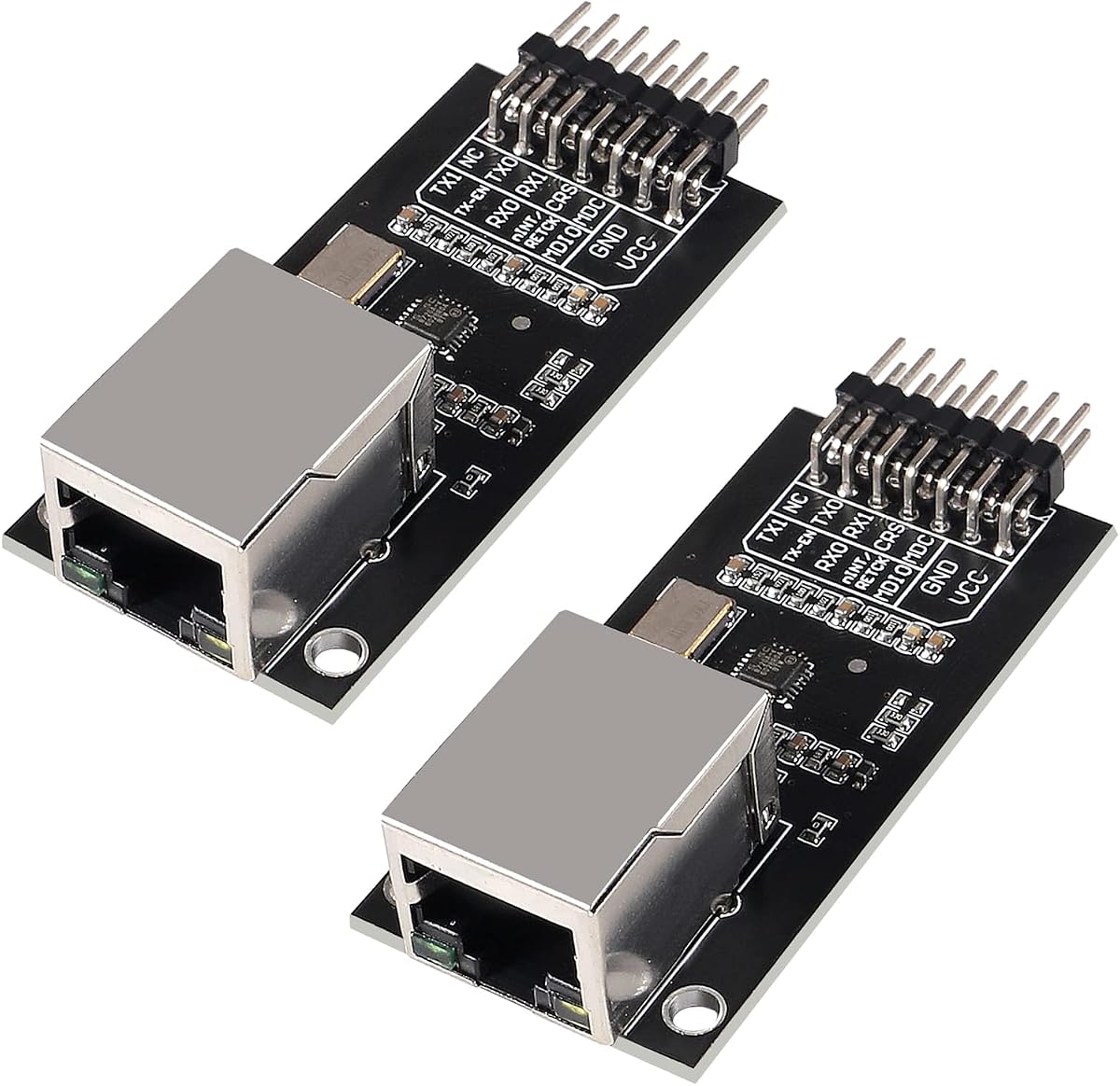
The Hailege ENC28J60 module is a well-rated single-board option for Arduino and embedded networking projects. Its 4.6 rating is the second-highest figure in the group. The listed hardware is easy to identify: a DIP28 ENC28J60-I/SO main chip, a 25MHz board crystal, and an HR911105A RJ45 connector with isolation transformer.
We may earn a commission when you buy through this link, at no additional cost to you.
The SPI interface and stated compatibility with 51, AVR, LPC, and STM32 microcontrollers make the module suitable for many common platforms. It can support projects that need basic Ethernet communication without committing to a larger shield format. For learners already working with an ENC28J60 library, the familiar controller can also make the transition to wired networking more approachable.
The module needs 3.3V power, and the attached controller must be compatible with the voltage arrangement. As with any bare Ethernet board, the project also requires correct SPI wiring, software setup, and network configuration. Its single-module format means that larger classroom or multi-node projects will need additional units, potentially from different sellers or production batches.
This pick is recommended for a single Arduino, AVR, LPC, or STM32 Ethernet node where simplicity and broad platform support are priorities. It is especially compelling for users already familiar with ENC28J60 examples. Buyers seeking the newest controller family or a plug-in shield should compare those alternatives before finalizing.
The ENC28J60 has a substantial history in embedded Ethernet examples, which can be reassuring for builders who already know its library and pin arrangement. Its clear specification also makes it easier to match an established sketch to the correct hardware.
Compatibility with 51, AVR, LPC, and STM32 boards expands the range of projects that can use the module. Always confirm the controller's available memory, SPI hardware, and required library support before committing to a network-heavy design.
We may earn a commission when you buy through this link, at no additional cost to you.
A useful Ethernet-module decision starts with the host board and network software, then moves to electrical details, physical connectors, and the number of project nodes. These factors prevent a visually similar board from becoming an expensive integration mistake.
The controller determines much of the module's networking capability. A W5500 integrates a hardware-assisted TCP/IP stack and is listed with support for multiple sockets, 32KB buffers, UDP, and Wake-on-LAN. The ENC28J60 is also a common SPI Ethernet choice, while the W5100 provides TCP and UDP support through an Arduino-oriented shield. The LAN8720 is only a physical-layer transceiver and therefore needs additional host hardware or firmware to deliver a complete network solution.
Choose the controller according to the software your Arduino library supports and the behavior your application needs. Do not choose only by the chip name, because board revisions, library support, and available documentation can differ.
Check the exact Arduino model before selecting a module. Some boards provide native Ethernet, some expose the expected SPI and chip-select pins, and others differ in operating voltage. The W5500 options are listed for broad Arduino, STM32, ESP32, and ESP8266 use, while the ENC28J60 boards name Arduino, AVR, PIC, LPC, and STM32 families. The DEVMO W5100 shield is specifically shaped for UNO-style boards and includes an SD card slot.
Compatibility is more than a matching family name. Confirm the logic level, available memory, SPI pins, and whether the board can provide enough current. That prevents a physical fit from becoming a communication or power problem later.
Voltage requirements deserve careful attention because 3.3V and 5V Arduino boards are both common. Several W5500 modules are listed as supporting 3.3V and 5V, whereas the ENC28J60 boards and LAN8720 board use a 3.3V supply. The HiLetgo and ACEIRMC W5500 listings additionally call for a stable external 3.3V source with more than 200mA available. A nominal voltage match is not enough if the source cannot maintain the required current during network activity.
Use a supply that matches the module's markings and current requirements, and confirm that the host board's regulator is suitable. When in doubt, provide a dedicated, stable supply and verify the installation with a controlled test.
SPI is the common communication method for the bare modules in this list, so the host must have accessible SPI pins and firmware that knows how to drive the Ethernet controller. The W5500 modules are especially common in Arduino networking examples, while ENC28J60 projects also have a substantial ecosystem. A PHY-only LAN8720 board demands more specialized host support and is a different integration path.
Look for a library that supports the selected controller and the exact Arduino core or board. Read its pin, addressing, and interrupt assumptions before wiring, and avoid changing a library's default pin mapping without understanding how the board is configured.
A simple client sending measurements to one server may need only a basic Ethernet link. More advanced projects can benefit from simultaneous connections. The HiLetgo two-pack and the generic two-pack both list support for eight independent sockets, while the ACEIRMC W5500 uses the same controller family. The ENC28J60 and W5100 options are more naturally evaluated around their specific libraries and target applications.
Think about how many devices will connect, whether the controller must be a server as well as a client, and whether the application needs UDP, TCP, or both. More sockets can add flexibility, but they should be matched to a clear network design rather than treated as a substitute for good protocol planning.
A full-size RJ45 module is convenient for standard Ethernet cables and easy to inspect, but it needs more enclosure space than a compact board. The DEVMO W5100 shield occupies an entire Arduino shield footprint and adds an SD card slot. The ACEIRMC W5500 board is listed at 23 by 25 millimeters, and the other bare modules use a similarly compact format with a standard network connector.
Measure the enclosure and check the direction and height of the connector before ordering. A fixed full-size jack may also be difficult to connect in a deeply enclosed device, so external access or a panel-mount solution could be necessary.
Single-module products are economical for one endpoint, but multi-packs can simplify labs, classrooms, and multi-node installations. The ACEIRMC ENC28J60 and W5500 five-packs, along with the HiLetgo W5500 two-pack and generic W5500 two-pack, provide multiple matching boards. The DIYables W5500 and Hailege ENC28J60 listings each cover a single module.
Count the planned endpoints before choosing a bundle. More hardware is useful only if each node will be deployed, and every additional board still needs a unique network identity, suitable wiring, and dependable power.
Networking projects depend on more than a functioning board. They need a clear pinout, a suitable library, example sketches, and enough guidance to configure addressing, DHCP, sockets, and the physical connection. The DIYables W5500 listing specifically points users toward online tutorials and sample code, while established ENC28J60 and W5500 platforms generally provide numerous community resources.
Choose a module whose controller and documentation you can readily find. Read the seller listing, sample code, and controller reference together, and confirm that they describe the same pin arrangement and operating assumptions. Clear resources are especially important for first-time builders.
Begin by identifying the module's controller, power markings, connector type, and voltage requirements. Check that the board's documentation matches the pins on the Arduino or other microcontroller. Install a library that supports the exact Ethernet controller, wire ground and supply first, and then connect SPI and control signals. Use a compatible network cable and confirm that the Ethernet link is active before adding application code.
For W5500 and ENC28J60 projects, begin with a simple network example that confirms communication before adding sensors, displays, or control outputs. Decide whether the controller will use DHCP or a static address, and be careful to avoid address conflicts when several boards are deployed. A small test sketch that prints network information is useful for checking the connection independently from the project's main function.
Care for the module by keeping the RJ45 connector and board free of dust, moisture, and conductive debris. Avoid flexing the connector or applying force to the PCB, and provide stable power that meets the board's current requirements. When a link becomes unreliable, inspect the cable and connector, verify the supply, reseat the wiring, and review address or firmware changes before replacing the hardware.
Both modules provide a wired Ethernet connection through SPI, but they use different network controllers and software ecosystems. The W5500 offers a hardware TCP/IP stack, multiple socket support, and 32KB buffers, while the ENC28J60 is a more established controller commonly used for basic Arduino networking. The better choice depends on the libraries and network behavior required by the project.
Possibly, but you must verify every power and logic connection rather than relying on the Arduino's voltage alone. A 3.3V module should receive the power it requires, and its SPI signals must be safe for the host board's levels. Some modules explicitly support 3.3V and 5V systems, while others should only be powered according to their markings.
Most Arduino Ethernet projects are simpler with a complete module such as the W5500 or ENC28J60 because the controller and network interface are integrated on one board. A LAN8720 is a physical-layer transceiver intended for a compatible host controller and firmware. It offers lower-level design flexibility but requires more integration knowledge.
An Ethernet shield is designed to plug directly into the headers of a compatible Arduino board, making assembly relatively simple. A bare module is wired through SPI and power connections, which takes more setup but provides greater flexibility and usually a smaller footprint. Shield dimensions and pin compatibility should always be confirmed before purchase.
The number depends on the network design. One module is enough for a single sensor, controller, or client, while a server and several endpoints require one module per networked device. Multi-packs can be convenient for classes because every student receives the same hardware, but each board still requires a unique address and its own correct wiring and power arrangement.
The DIYables W5500 module is explicitly listed for ESP32, ESP8266, and Arduino compatibility, making it a clear option to examine for those platforms. Other W5500 boards may also work, but compatibility should be confirmed from the module's voltage specifications, pinout, and available library. The selected library must support both the network controller and the host development board.
Power instability is one common possibility, particularly when the module shares a weak supply with motors, relays, displays, or other high-demand components. Incorrect grounding, loose RJ45 wiring, voltage incompatibility, and SPI configuration errors can also interrupt communication. Test the Ethernet module alone with a verified cable, then add the other hardware one section at a time to identify the cause.
Yes, provided each controller has its own network identity and the network is configured to permit the intended traffic. Several W5500 options list support for eight independent sockets, and a multi-pack provides multiple matching boards. You still need to assign addresses correctly, handle device discovery or addressing in software, and plan how the devices exchange commands and responses.
The DIYables W5500 module is the strongest general recommendation for a first broad-platform Arduino Ethernet project, with a 5.0 rating, 3.3V and 5V positioning, and a full-size RJ45 connector. The ACEIRMC ENC28J60 five-pack is the leading choice for organized multi-node teaching or experimentation, while the ACEIRMC W5500 five-pack is the best premium bundle for distributed projects.
Prioritize controller and library compatibility, then verify voltage, current, and pin arrangement before focusing on quantity or connector convenience. W5500 boards suit projects needing more capable hardware networking, ENC28J60 modules serve common SPI applications, the DEVMO W5100 shield favors classic Arduino layouts, and the LAN8720 is a specialized lower-level option. The right form factor is the one your controller and enclosure can support reliably.
Before ordering, revisit the current product listing, included components, pin diagram, and seller documentation. Specifications and availability can change, and the same controller may appear on boards with different power arrangements or documentation. Checking the final requirements against the latest listing will help ensure that the selected Arduino LAN Ethernet module integrates cleanly with the rest of the project.