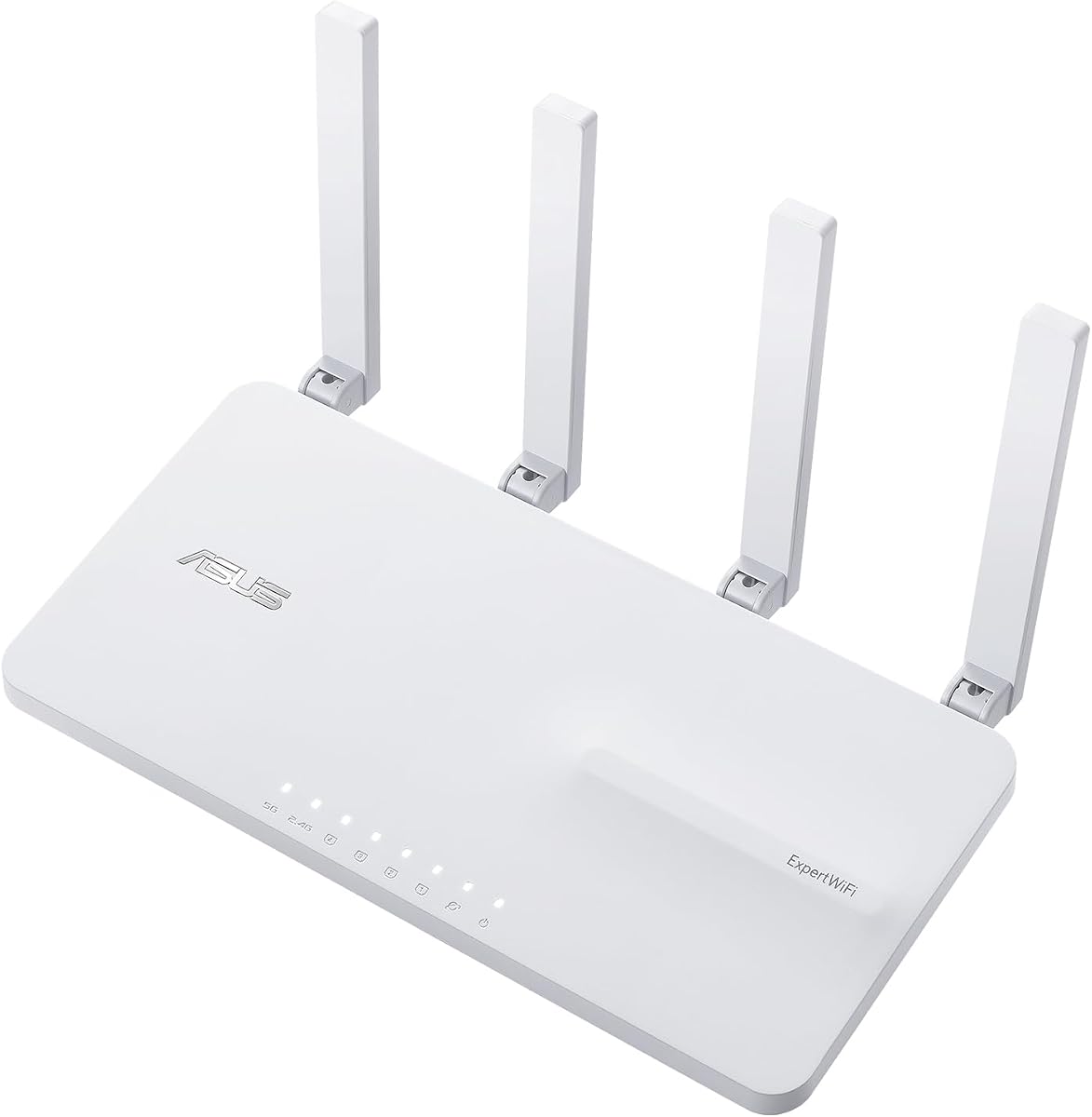
ASUS ExpertWiFi EBR63
4.2Editor score
Up to five separate SSIDs
Customizable guest portal
USB backup WAN option
AiProtection Pro included
Our commercial wireless router guide compares 10 business-class options for coverage, security, management, VPN support, wired speed, and scalability.
Commercial wireless routers are built for more demanding environments than ordinary home networking equipment. They support larger device populations, separate business traffic, remote administration, stronger security controls, and multi-gigabit connections suited to offices, retail spaces, clinics, and hospitality venues. The right model depends heavily on building size, client density, and administrative needs.
This guide compares ten routers and wireless access points using the supplied specifications, customer ratings, management features, wireless standards, port configurations, and security capabilities. It covers everything from self-contained business routers to managed access points that can be grouped into a broader software-defined network, providing a practical range of options for different budgets and deployment models.
Each review identifies the standout features, limitations, and ideal users of the featured product. The list includes affordable business routers, advanced WiFi 7 systems, enterprise access points, and mesh solutions, while noting that product availability and prices change over time. Readers should confirm current specifications and compatibility before purchasing equipment for an active deployment.
4.2Editor score
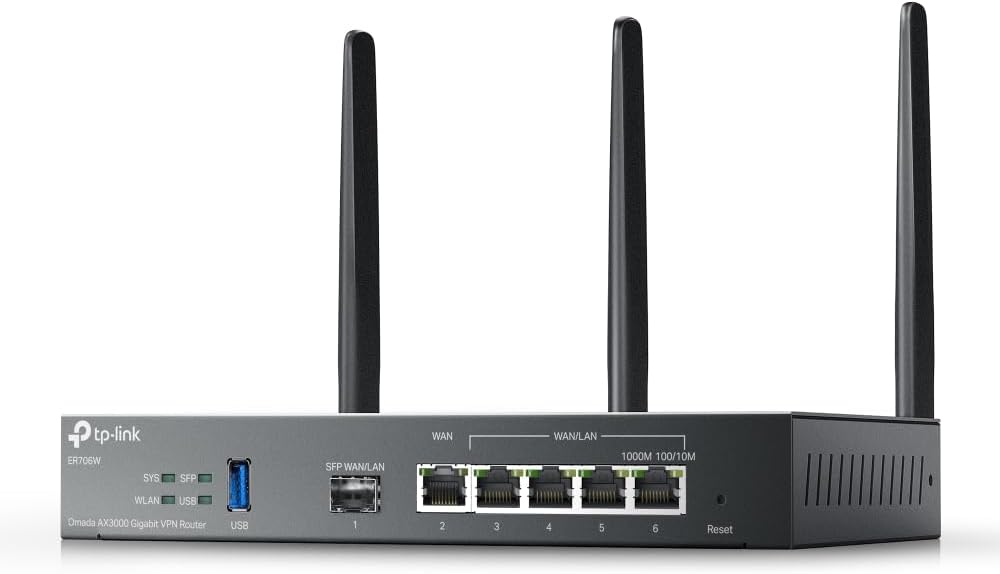
4.1Editor score

The table below compares all ten products by wireless generation, management model, connectivity, and the feature that most clearly distinguishes each option. It includes both integrated routers and standalone access points, so buyers should consider whether their network needs one device or a coordinated collection of managed hardware.




The ASUS ExpertWiFi EBR63 is an AX3000 business router that combines dual-band WiFi 6 with capabilities normally associated with larger commercial installations. It carries a 4.2 customer rating and stands out for its ability to create as many as five separate SSIDs, allowing staff, guests, cameras, and other connected equipment to remain logically isolated. Its most appealing combination is enterprise-minded control without the complexity of a full network controller.
We may earn a commission when you buy through this link, at no additional cost to you.
The customized guest portal is especially useful for offices, salons, clinics, and small hospitality businesses that want visitors to use WiFi without receiving unrestricted access to internal systems. Administrators can adjust the SSID, portal type, branding, and templates. ASUS also includes a free subscription to AiProtection Pro, adding safe-browsing and network-security features that make the package more complete than a basic router.
Connectivity management is more limited than that of the Omada ER706W, which offers five Gigabit RJ45 ports and a Gigabit SFP slot. Nevertheless, the EBR63 supports a USB-connected phone hotspot as a backup WAN, giving an administrator a practical continuity option if the primary connection fails. It also supports VLANs, VPN features, ExpertWiFi remote management, and expansion through ASUS AIMesh.
This is the strongest fit for a small office, retail location, or home-based business that needs multiple networks and professional guest access without operating a large access-point system. It is less appropriate for a high-density venue requiring sophisticated load balancing or a dense collection of wired ports. For those needs, the ER706W is the more flexible commercial choice.
Up to five SSIDs let administrators place employees, guests, surveillance devices, and IoT equipment on different wireless networks. This separation simplifies access rules and reduces the chance that a compromised smart device can freely interact with business systems.
The custom guest portal goes beyond a basic password screen. Businesses can adapt the appearance and portal details to reflect their own operation, which creates a more polished customer experience for offices, clinics, and guest-oriented venues.
We may earn a commission when you buy through this link, at no additional cost to you.
The Omada ER706W is a compact but highly capable Gigabit business router built around AX3000 dual-band WiFi 6. Its 4.1 customer rating reflects a solid overall reception, while the hardware specification distinguishes it from many similarly classified routers. It includes five Gigabit RJ45 ports, a Gigabit SFP slot, multi-WAN load balancing, and an extensive collection of VPN protocols.
We may earn a commission when you buy through this link, at no additional cost to you.
Load balancing across as many as five WAN connections is the model’s signature feature. Businesses can distribute traffic among multiple broadband services, potentially improving utilization and providing a more resilient path than relying on a single ISP connection. The router can also work with Omada access points, allowing administrators to expand coverage without treating every new wireless device as a standalone system.
Security is another strong area. The ER706W supports SSL, IPsec, GRE, WireGuard, PPTP, L2TP, and OpenVPN. This range gives administrators options for site-to-site connectivity, remote access, and different client requirements. While this does not replace a full security architecture, it reduces the need to introduce another device for common tunneling requirements.
The ER706W is the strongest recommendation for a growing small business that needs several WAN options, wired ports, VPN support, and future wireless expansion. It lacks the EBR63’s custom guest portal and may be less attractive for consumer-style home mesh users, but it offers better commercial routing depth. Organizations already invested in Omada SDN will find its ecosystem particularly convenient.
Supporting load balancing on up to five WAN ports makes the ER706W useful for businesses that can access more than one broadband service. Administrators can make better use of available connections and build redundancy into the edge of the network.
Support for SSL, IPsec, GRE, WireGuard, PPTP, L2TP, and OpenVPN gives the router considerable flexibility. Remote workers and branch offices can use protocols appropriate to their operating systems and security requirements.
We may earn a commission when you buy through this link, at no additional cost to you.
The Ruckus WirelessR750 is an indoor WiFi 6 access point explicitly designed for ultra-dense environments. Its 4.3 customer rating and enterprise-oriented design make it relevant to schools, conference venues, stadiums, hotels, and other locations where consistent access matters more than simple standalone convenience. It uses part number 901-R750-US00, which is important to verify when comparing listings.
We may earn a commission when you buy through this link, at no additional cost to you.
Unlike the EBR63, ER706W, and several consumer-style routers in this guide, the R750 is not a complete internet gateway. It is intended to connect to switches, routing equipment, and an appropriate management system. That makes it a specialist choice for organizations that need to deploy multiple access points under a centralized network architecture.
The supplied product information is concise, but it establishes the R750’s primary strength clearly: serving dense client populations in demanding indoor environments. A dense office, school hallway, or public waiting area can create contention that overwhelms a basic router. An access point designed around capacity can distribute that burden across a professionally wired environment.
Buyers should choose the R750 when they already have a network infrastructure or are prepared to add one. It is not a convenient single-box solution for a temporary office or very small home business. Within a larger deployment, however, its specialized density focus makes it a serious contender for organizations prioritizing consistent coverage and enterprise wireless performance.
The R750’s dense-environment focus distinguishes it from general-purpose routers. It is a better fit for locations where phones, laptops, scanners, and operational devices repeatedly share limited wireless capacity.
Because the R750 is an access point, it complements rather than replaces a gateway, switch, and management layer. Organizations adopting several units can build a more structured and scalable wireless topology.
We may earn a commission when you buy through this link, at no additional cost to you.
The Ruckus R670 is a high-end indoor access point built for organizations preparing for WiFi 7, high-capacity client environments, and converged wireless services. It combines six spatial streams across the 2.4, 5, and 6 GHz bands with a stated combined data rate of 9.34 Gbps. The supplied listing has no numerical customer rating, so its evaluation should focus on the documented capability rather than an aggregate user score.
We may earn a commission when you buy through this link, at no additional cost to you.
Ruckus BeamFlex+ adaptive antenna technology is the defining feature. The company describes it as a smart antenna system designed to improve signal coverage, throughput, error resilience, network capacity, MIMO diversity, and spatial multiplexing. These are important considerations in offices, educational buildings, conference venues, and other locations where conventional coverage patterns can leave weak spots.
The R670 also converges WiFi with BLE and Zigbee, supports Matter and Thread, and includes a USB port for future wireless expansion. Its built-in 1, 2.5, or 5 GbE connection removes the bottleneck that can arise when a high-speed access point is forced onto a single-gigabit uplink. Management can be handled through on-premises physical or virtual appliances, with auto-provisioning designed to speed deployment and firmware upgrades.
Security receives enterprise attention through WPA3, enhanced man-in-the-middle protection, and Ruckus DPSK3, which combines WPA3/SAE with dynamic passphrases. This is a premium option for organizations that value antenna performance, multi-gig networking, and centralized access-point management. It is less suitable for buyers seeking an inexpensive all-in-one router, and the lack of a customer rating means ongoing software and compatibility research remains important.
BeamFlex+ is designed to direct capacity more intelligently than a simple fixed antenna pattern. In dense buildings with changing occupancy, that can be valuable for both coverage and usable throughput.
Built-in BLE and Zigbee support with Matter and Thread compatibility lets administrators converge several wireless technologies over a unified network. The USB port also leaves room for future expansion.
We may earn a commission when you buy through this link, at no additional cost to you.
The NETGEAR Orbi 970 Series is a three-piece WiFi 7 mesh system that combines a router with two satellites. It holds a 4.6 customer rating, the highest among the products with a published score, and offers broad whole-home coverage without a complex cabling plan. The system is advertised for up to 10,000 square feet and as many as 200 connected devices.
We may earn a commission when you buy through this link, at no additional cost to you.
Its patented Quad-Band design and Enhanced Dedicated Backhaul reserve a separate lane for traffic between the main unit and satellites. This is an important improvement over systems that share client bands for backhaul, because it helps preserve client performance while users move throughout the property. The system also supports WiFi 6 and WiFi 5 clients, providing a practical transition path for mixed device fleets.
Wired connectivity includes a 10-gigabit internet port plus 10-gigabit and 2.5-gigabit LAN options across the router and satellites. That makes the Orbi 970 useful for demanding home offices, studios, and small creative businesses with high-speed storage or internet services. Guided setup and remote device and guest-network management keep administration approachable.
The main limitation is its consumer-oriented feature set. It lacks the detailed multi-WAN, site-to-site VPN, and granular network segmentation options found in business routers such as the ER706W and EBR63. It is a compelling choice for a large home or very small office needing effortless expansion, while managed enterprises will usually benefit more from coordinated access points and centralized policy tools.
Reserving a wireless lane for satellite traffic helps the mesh maintain performance as clients connect across multiple units. The design is especially helpful in large properties where a single access point would leave gaps.
The mixture of 10-gigabit and 2.5-gigabit ports supports modern high-speed internet and demanding wired devices. It also gives the system useful flexibility for a home office or small studio.
We may earn a commission when you buy through this link, at no additional cost to you.
The Omada EAP650 is a dual-band WiFi 6 access point that brings managed-network flexibility to offices, hotels, classrooms, and cafes. It carries a 4.5 customer rating and supports speeds up to 2976 Mbps through 1024-QAM, HE60, and Long OFDM Symbol technology. Its slim enclosure is designed to blend into modern commercial interiors.
We may earn a commission when you buy through this link, at no additional cost to you.
A major advantage is the choice of management methods. The EAP650 works with free Omada Essentials cloud management, while also integrating into the broader Omada SDN platform through hardware, software, or cloud controllers. Standalone operation is supported, and administrators can centrally manage access points, switches, and gateways. This makes the device useful at multiple stages of a network’s growth.
The wireless feature set is extensive for a business access point. It supports Omada Mesh, seamless roaming, WPA3, band steering, load balancing, airtime fairness, and beamforming. It can be powered through 802.3at PoE+, 48-volt passive PoE, or the included 12-volt DC adapter, giving installers several deployment options when local power availability differs.
The EAP650 is best for a business that wants professional centralized control and intends to add access points over time. Because it is not a complete router, it needs a wired network, internet connection, and suitable gateway. Its five-year warranty and included adapter also make it a straightforward managed deployment option for installers working across offices or customer sites.
Free Omada Essentials cloud management allows administrators to configure and supervise access points without buying a dedicated controller. The same hardware can later join a larger software-defined network.
Band steering, load balancing, airtime fairness, and beamforming work together to distribute client demand more effectively. These features are particularly relevant in offices and educational environments where many users share the same coverage area.
We may earn a commission when you buy through this link, at no additional cost to you.
The Ubiquiti U6+ is a dual-band WiFi 6 access point with a stated 3 Gbps wireless transmission rate. Its 4.6 customer rating places it among the strongest reviewed products, and its wall-mountable form factor is appropriate for offices, retail interiors, and other business spaces where an unobtrusive access point is valuable.
We may earn a commission when you buy through this link, at no additional cost to you.
The device includes a Gigabit Ethernet port and a PoE+ port capable of delivering up to 25.5 watts over one cable. That makes deployment straightforward in locations where a nearby outlet is inconvenient, provided the network switch or PoE injector is compatible. Its support for IEEE 802.11 a/b/g/n/ac/ax also allows it to serve a mixed population of newer and older wireless clients.
Data encryption is included to protect wireless traffic, while the 3 Gbps rate provides a meaningful upgrade for high-use areas. Although its uplink is Gigabit rather than multi-gigabit, the access point can still be a sound choice for typical business networks whose servers, internet connections, and file transfers do not routinely exceed that limit.
The U6+ is best for organizations that already rely on Ubiquiti’s broader ecosystem or want a straightforward managed access point for a business interior. It needs an existing router, switch, and PoE infrastructure, so buyers should include those costs and compatibility requirements in the project plan. For organizations with existing multi-gig infrastructure, the R670 offers more uplink headroom.
PoE+ combines network data and power, allowing the U6+ to be placed where a conventional outlet would be inconvenient. This simplifies aesthetic planning in customer-facing and renovated spaces.
Support for older 802.11 standards through WiFi 6 helps ensure that employees, visitors, and operational devices can connect during a gradual hardware transition.
We may earn a commission when you buy through this link, at no additional cost to you.
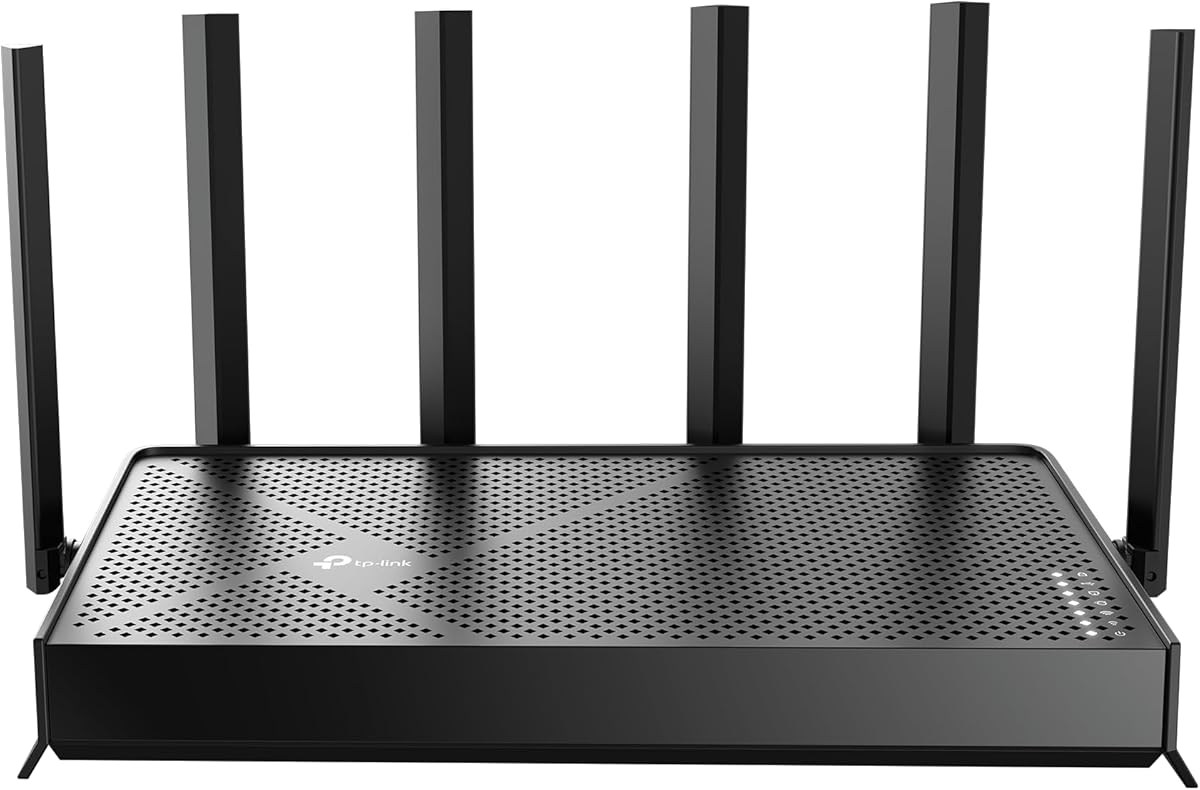
The TP-Link Archer BE400 is a dual-band WiFi 7 router that offers a practical combination of current wireless technology, multi-gigabit wired connections, and straightforward management. Its 4.3 customer rating reflects favorable user reception, while the stated aggregate band rate of 5764 Mbps and six streams position it for demanding home offices, studios, and small businesses.
We may earn a commission when you buy through this link, at no additional cost to you.
WiFi 7 features include Multi-Link Operation, Multi-RUs, and 4K-QAM. Multi-Link Operation is designed to transfer data across frequency bands simultaneously, improving throughput, latency, and reliability. The router also uses six antennas and beamforming to support coverage across as much as 2,400 square feet and up to 90 devices, although actual results depend on the environment and client equipment.
Wired connectivity includes one 2.5-gigabit WAN/LAN port, one additional 2.5-gigabit LAN port, and three Gigabit LAN ports. This is sufficient for a multi-gig internet plan and high-speed local devices without the larger port count found on some premium alternatives. USB tethering support offers an additional way to establish connectivity through a compatible mobile device.
The Tether app simplifies setup, device management, guest access, firmware updates, parental controls, and IoT security. It can also join an EasyMesh-compatible network, although it is not compatible with TP-Link Deco systems. This router is ideal for a small business wanting a modern all-in-one unit without a large controller deployment. More demanding organizations should look toward the ER706W for multi-WAN routing and broader VPN support.
Multi-Link Operation, Multi-RUs, and 4K-QAM provide a modern foundation without requiring separate managed access points. This makes the BE400 approachable for small offices and advanced home offices.
The two 2.5-gigabit ports and three Gigabit LAN ports support fast internet service, network storage, and other demanding wired endpoints. The flexible WAN/LAN designation also simplifies common gateway arrangements.
We may earn a commission when you buy through this link, at no additional cost to you.
The NETGEAR Nighthawk WiFi 7 is a dedicated tri-band router designed to keep high-speed wireless traffic separated from slower clients. It has a 4.3 customer rating, supports aggregate speeds up to 9.3 Gbps, and is advertised for coverage of up to 2,500 square feet with as many as 100 connected devices.
We may earn a commission when you buy through this link, at no additional cost to you.
The third high-speed band gives compatible devices their own wireless lane, reducing the chance that streaming, gaming, and video-call traffic will compete with older WiFi 6 or WiFi 5 clients. The Nighthawk app provides guided installation, speed testing, device pausing, guest-network setup, and remote management. Automatic firmware updates and Advanced Router Protection are enabled out of the box.
Its wired setup is well suited to a business-grade home office. A 2.5-gigabit WAN port accepts a multi-gig internet plan, while two 2.5-gigabit LAN ports and two Gigabit LAN ports support network storage, computers, and smart displays. Compatibility with cable, fiber, DSL, and satellite providers makes the router broadly adaptable, though some gateways may require bridge mode.
The Nighthawk is a good match for power users and small offices that want one powerful router rather than a managed access-point collection. It is less appropriate for large commercial buildings because actual range depends on walls, floors, interference, and placement, and it offers fewer advanced routing features than the ER706W. For a larger property, the Orbi 970 or coordinated access points are more logical choices.
A dedicated tri-band layout helps newer WiFi 7 clients avoid sharing capacity with older wireless devices. This is useful in mixed environments where upgrades occur gradually.
The mobile app centralizes setup, guest access, device control, speed tests, and firmware updates. It gives a small business useful visibility without requiring a dedicated network appliance.
We may earn a commission when you buy through this link, at no additional cost to you.
The ASUS RT-BE88U is a quad-band WiFi 7 router aimed at users who need both fast wireless performance and unusually strong wired connectivity. It has a 4.3 customer rating, supports throughput up to 7200 Mbps, and includes one 10-gigabit SFP+ port alongside a 10-gigabit WAN/LAN port.
We may earn a commission when you buy through this link, at no additional cost to you.
Multi-Link Operation and 4096-QAM form the core of its wireless design. A quad-core 2.6 GHz 64-bit processor provides the processing foundation for demanding applications, while the two high-speed ports allow a network to take advantage of multi-gig broadband, fast local storage, and compatible enterprise switches. The result is more flexibility than a conventional single-gigabit home router.
Connectivity resilience is another strength. AI WAN detection and flexible WAN configuration support different connection arrangements, while the USB port can accept compatible 4G LTE or 5G mobile tethering for an always-on backup connection. The router can establish up to five SSIDs through Guest Network Pro, with separate handling for IoT devices, guest access, and other categories.
Security features include AiProtection Pro powered by Trend Micro, one-tap scanning, comprehensive VPN support, and site-to-site VPN. This makes the RT-BE88U appealing to technically capable small businesses, creative studios, and advanced home offices. It is less convenient for a basic installation because the feature set is extensive, but it provides one of the strongest combinations of 10-gigabit wired access, wireless flexibility, and business-oriented controls in the list.
The SFP+ and 10-gigabit WAN/LAN ports remove a common bottleneck in high-speed wired networks. They provide a direct path to multi-gig services, fast storage, and compatible switching infrastructure.
AiProtection Pro, VPN support, site-to-site VPN, and flexible SSID management give the router a stronger business orientation. The USB tethering option also provides a useful path to continuity when the primary WAN fails.
We may earn a commission when you buy through this link, at no additional cost to you.
A commercial wireless purchase should begin with the operating environment rather than the largest headline speed. Capacity, wired infrastructure, management requirements, security, and future growth usually have a greater effect on daily performance than a difference between two wireless generations.
The first decision is whether the product must perform routing or merely provide wireless access. Integrated routers such as the EBR63, ER706W, Orbi 970, Archer BE400, Nighthawk, and RT-BE88U can serve as the main network device in a small deployment. Access points such as the Ruckus R750, Ruckus R670, Omada EAP650, and Ubiquiti U6+ require an existing gateway, switch, and usually a coordinated management environment. A business that expects several buildings, floors, or dozens of access points should begin with the access-point model, while a small operation with a handful of employees may prefer a self-contained router.
Client density determines whether ordinary WiFi 6 or WiFi 7 equipment is sufficient. The Ruckus R750 is explicitly designed for ultra-dense environments, while the R670 combines WiFi 7 with BeamFlex+ adaptive antennas. More general systems such as the EAP650 and U6+ can cover offices, classrooms, and retail spaces efficiently, but they still need a sensible access-point layout. Compare the stated device limits, spatial streams, antenna behavior, and throughput rather than relying on one aggregate speed figure. Actual results depend on client capabilities, interference, channel planning, building materials, and how users are distributed.
Management requirements can determine the total cost and complexity of the project. ASUS ExpertWiFi provides app-based setup and remote management, while Omada supports cloud, software-controller, and hardware-controller options. Ruckus R670 supports on-premises physical and virtual appliances, and the Orbi 970 uses guided app management. Standalone access-point operation can be convenient for a small site, but centralized cloud management becomes valuable when an administrator needs consistent policies, firmware oversight, and visibility across locations. Make sure the chosen management method matches the team’s technical skill and long-term operating plan.
Wireless performance cannot exceed the network path feeding it. The Omada ER706W provides five Gigabit RJ45 ports and a Gigabit SFP slot, making it highly adaptable. The RT-BE88U raises the ceiling with a 10-gigabit SFP+ port and 10-gigabit WAN/LAN interface, while the Orbi 970 and Nighthawk include multi-gig options. The Ruckus R670 has a built-in 1, 2.5, or 5 GbE port for access-point uplinks. Before purchasing, check the speed of the internet connection, switches, internal servers, and power infrastructure. A faster router cannot compensate for a slow switch or an inadequate uplink.
Commercial networks often need more than a single shared password. WPA3, guest isolation, VLANs, separate SSIDs, VPN support, and centralized policy tools can reduce risk and keep operational devices away from staff systems. The ER706W supports several VPN protocols and multiple WAN balancing, the EBR63 provides VLANs and guest portal customization, and the RT-BE88U includes site-to-site VPN and AiProtection Pro. The R670 adds WPA3 and DPSK3. Security features vary in depth and may require compatible controllers, subscriptions, or endpoint support, so buyers should confirm exactly what is included and how it is configured.
A large area does not automatically require a mesh system; it may require several wired access points. Mesh products such as the Orbi 970 are attractive when cabling is difficult, and the ASUS RT-BE88U and EBR63 can work with AiMesh-compatible equipment. Omada access points can form a mesh or provide seamless roaming with a compatible controller. In offices with concrete walls, dense partitions, or several floors, wired access points usually provide more predictable results than relying on wireless backhaul. Begin with a coverage plan, identify difficult dead zones, and choose an expansion method that matches the building’s wiring and future operating model.
Access points require a reliable way to receive both data and power. The EAP650 supports 802.3at PoE+, passive PoE, and its included DC adapter, providing several installation options. The U6+ uses a PoE+ connection, while the Ruckus models are designed for professional deployment. A ceiling-mounted access point also needs safe mounting, cable routing, and a location away from dense obstructions. Account for the cost of compatible switches, injectors, adapters, and cabling, and verify local building and workplace requirements before installation.
The purchase price is only one part of the operating cost. Management controllers, cloud subscriptions, security subscriptions, PoE equipment, switches, installation, and ongoing support may all matter. ASUS includes AiProtection Pro with the EBR63, while NETGEAR products can involve optional Armor subscriptions. Omada offers free cloud management for the EAP650, and some products also include extended warranties. Check the expected product lifespan, firmware support, replacement availability, and whether existing staff or an installer can maintain the chosen ecosystem before finalizing the purchase.
Start by placing the router or primary access point near the center of the intended service area and away from dense metal, appliances, or enclosed cabinets. For a standalone router, connect the modem or gateway to the appropriate WAN port before powering the unit. For access points, connect Ethernet to a compatible switch and confirm the selected PoE method before mounting. Review the supplied quick-start guide and change all default administrator credentials before inviting employees, guests, or clients onto the network.
Create separate wireless networks for staff, guests, and operational devices where practical. Assign strong unique passwords, enable WPA3 when all required clients support it, and use the guest portal or guest isolation to keep visitors away from internal resources. If the product supports multiple SSIDs, VLANs, load balancing, or VPN functions, configure only those needed for the current deployment. A simple, accurately documented network is easier to maintain than an overengineered configuration that administrators cannot troubleshoot.
After deployment, test coverage in every occupied area, especially meeting rooms, hallways, stockrooms, and exterior entrances. Monitor client counts, channel congestion, firmware status, and WAN performance through the product’s management interface. Keep firmware updated, record the administrative configuration, and periodically review connected devices and access credentials. For access points, inspect cabling and PoE conditions, while for standalone routers, verify that ventilation openings remain unobstructed and that cables are not sharply bent or exposed to damaging conditions.
A commercial wireless router usually includes internet routing, firewall functions, wireless service, and several wired LAN or WAN ports. A business access point focuses on wireless coverage and normally connects to an existing router and switch. Access points are generally better for larger deployments because multiple units can be managed as a coordinated network.
Not always. WiFi 7 can provide better multi-device efficiency and performance for compatible clients, but the internet connection, wired network, and number of users also limit actual results. A well-designed WiFi 6 business system may deliver a satisfactory experience when the budget and client fleet do not justify WiFi 7.
The number depends on area, walls, client density, building materials, and access-point placement. A large open floor may need fewer units, while offices divided into many rooms often require more strategically positioned access points. Coverage should be tested after installation, with overlap used to support roaming and high-density client areas.
A mesh system can work well for a home-based office or small premises with simple requirements. Larger businesses may need more granular SSID control, centralized management, VPN support, multi-WAN resilience, and professional access-point placement. The Orbi 970 is particularly easy to expand, while systems such as Omada or Ruckus are better aligned with structured network management.
PoE is convenient because it carries power and network data over one Ethernet cable, but it is not mandatory for every installation. Some access points support DC adapters, while others are designed specifically for PoE. Confirm the access point’s power requirements and ensure the switch or injector provides the correct standard and wattage.
Separate guest access, strong WPA3 or WPA2 security, and isolation from internal business systems are the core requirements. A custom portal can improve branding and streamline terms acceptance, but it should not replace proper authentication and network segmentation. Businesses should also decide whether guest usage is limited by time, bandwidth, or available hours.
One powerful router is usually simpler for a compact space with moderate client demand. Several access points are more appropriate for larger buildings, dense client populations, or locations where predictable coverage matters. Managed access points also give administrators better control over individual areas and centralized visibility across the site.
Check client density, internet speed, wired port requirements, management capabilities, security policies, power standards, and existing switch compatibility. It is also important to confirm whether the device operates as a router, an access point, or a standalone system. A site survey and a written network plan help prevent equipment mismatches and coverage gaps.
The ASUS ExpertWiFi EBR63 is the most approachable business-focused router for small organizations that need separate SSIDs, a branded guest portal, and solid management without a controller. The Omada ER706W takes the lead for buyers who prioritize multiple WAN connections, VPN protocols, and wired flexibility, while the Ruckus R670 offers the most advanced premium access-point feature set in this group.
For larger or denser environments, the Ruckus R750, Omada EAP650, and Ubiquiti U6+ demonstrate why a managed access-point strategy can be more appropriate than a single router. NETGEAR Orbi 970 is ideal for large properties where convenient expansion matters, while the Archer BE400, Nighthawk, and RT-BE88U suit modern offices with fast clients and multi-gig requirements. Prioritize the management model, wired infrastructure, and client capacity before focusing solely on wireless speed.
Product specifications, availability, ratings, and prices can change, so confirm the current listing and compatibility before ordering. Match the equipment to the building, internet service, switching system, security policy, and number of users. A carefully planned deployment will deliver a more dependable commercial wireless experience than simply choosing the model with the largest headline performance number.