HF End Fed Antenna 4 Band 8 Band
4.5Editor score
1:64 impedance matching
1–30MHz operating range
100W SSB capability
Four and eight-band options
Our end fed antenna for portable HF guide compares 10 options by balun ratio, power handling, band coverage, portability, durability, and setup ease today.
A portable end fed antenna can provide an effective HF solution when space, setup time, and operating convenience matter. A good model should balance a usable impedance-matching network, practical radio power limits, manageable wire requirements, and a housing suited to portable deployment. The right balance depends on whether you operate low-power digital modes, voice, or higher-power transmitters.
This guide compares ten end fed antenna options using the supplied specifications, customer ratings, balun configurations, supported frequencies, power limits, material choices, mounting flexibility, and installation requirements. It covers compact 1:49 and 1:64 designs, dual-ratio units, portable wire antennas, and a higher-capacity 400-watt model for operators with different station and travel needs.
Each review explains the most useful features and the practical compromises visible in the product information. The featured selections highlight a budget four-band option, a versatile performance option, and a high-power premium model, while the remaining reviews help distinguish the choices for POTA, SOTA, emergency communications, listening, and portable amateur radio operation. Prices and availability can change, so verify current listings before buying.
4.5Editor score

4.8Editor score

3.6Editor score
The table below compares the ten antennas by matching network, operating range, stated power capability, portability, and deployment requirements. It also highlights the principal distinction between compact low-power units, portable 150-watt designs, dual-ratio models, and the higher-capacity 400-watt antenna.
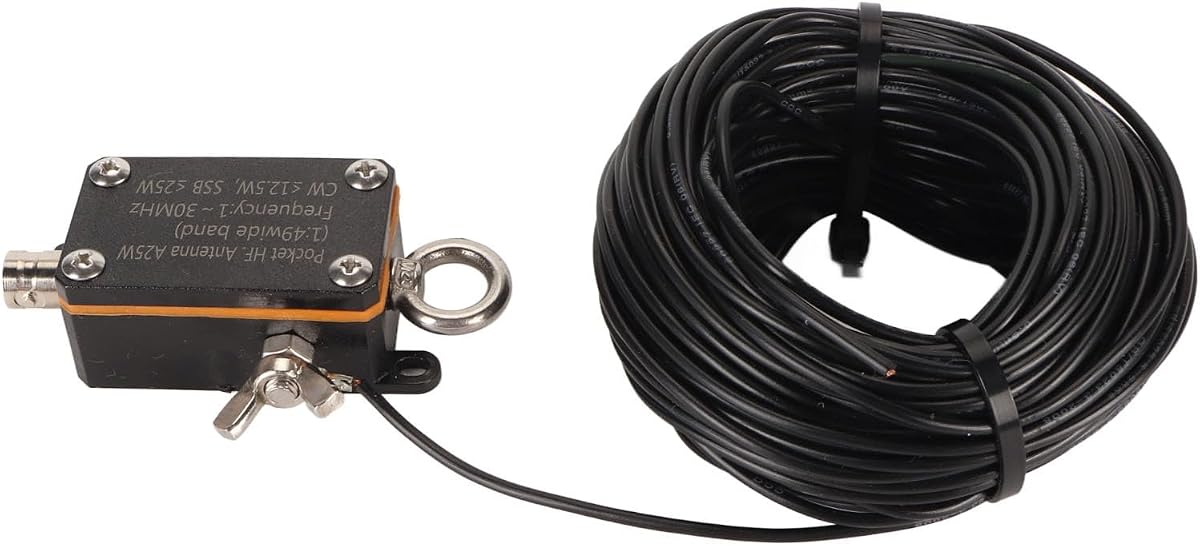
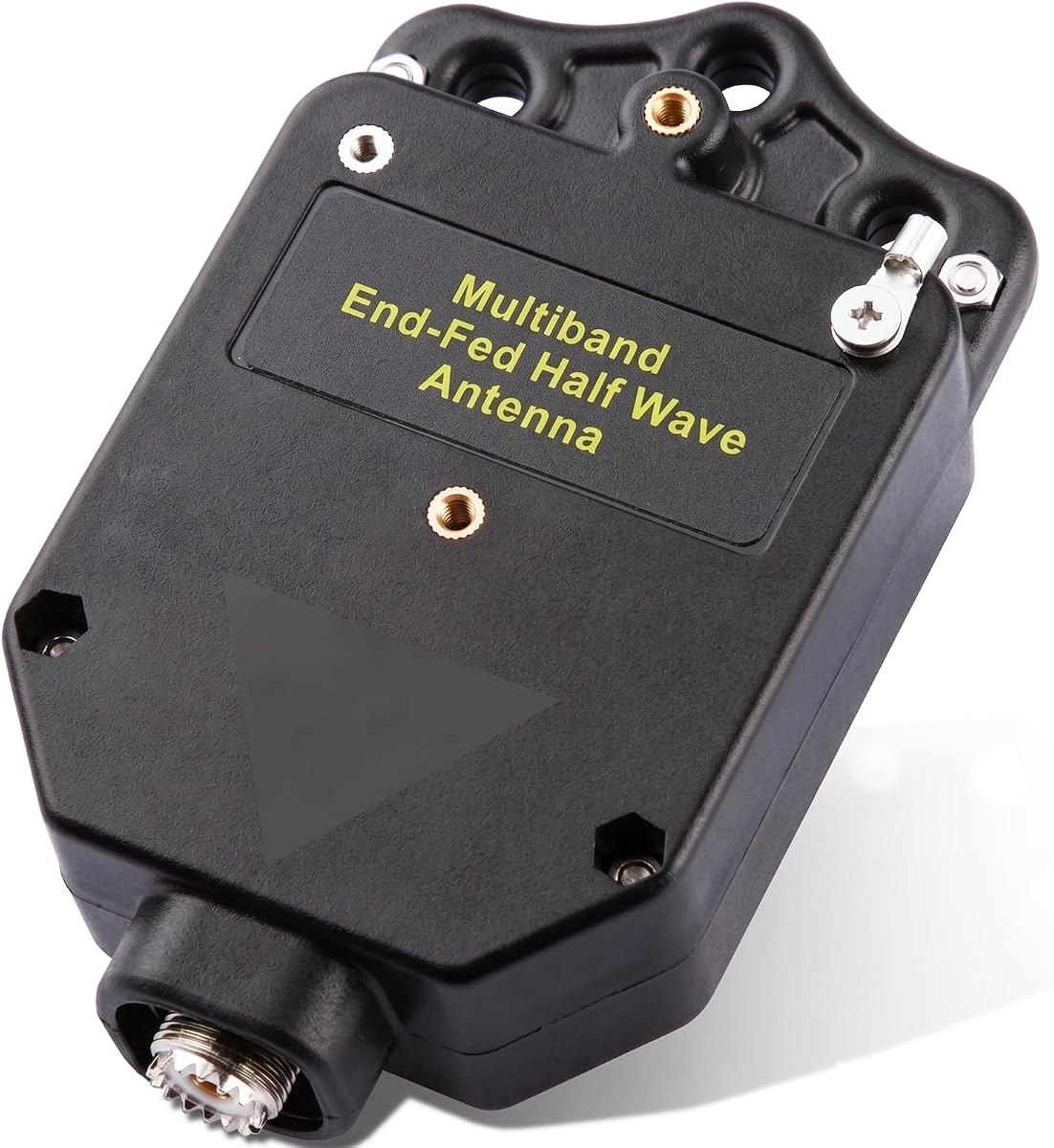



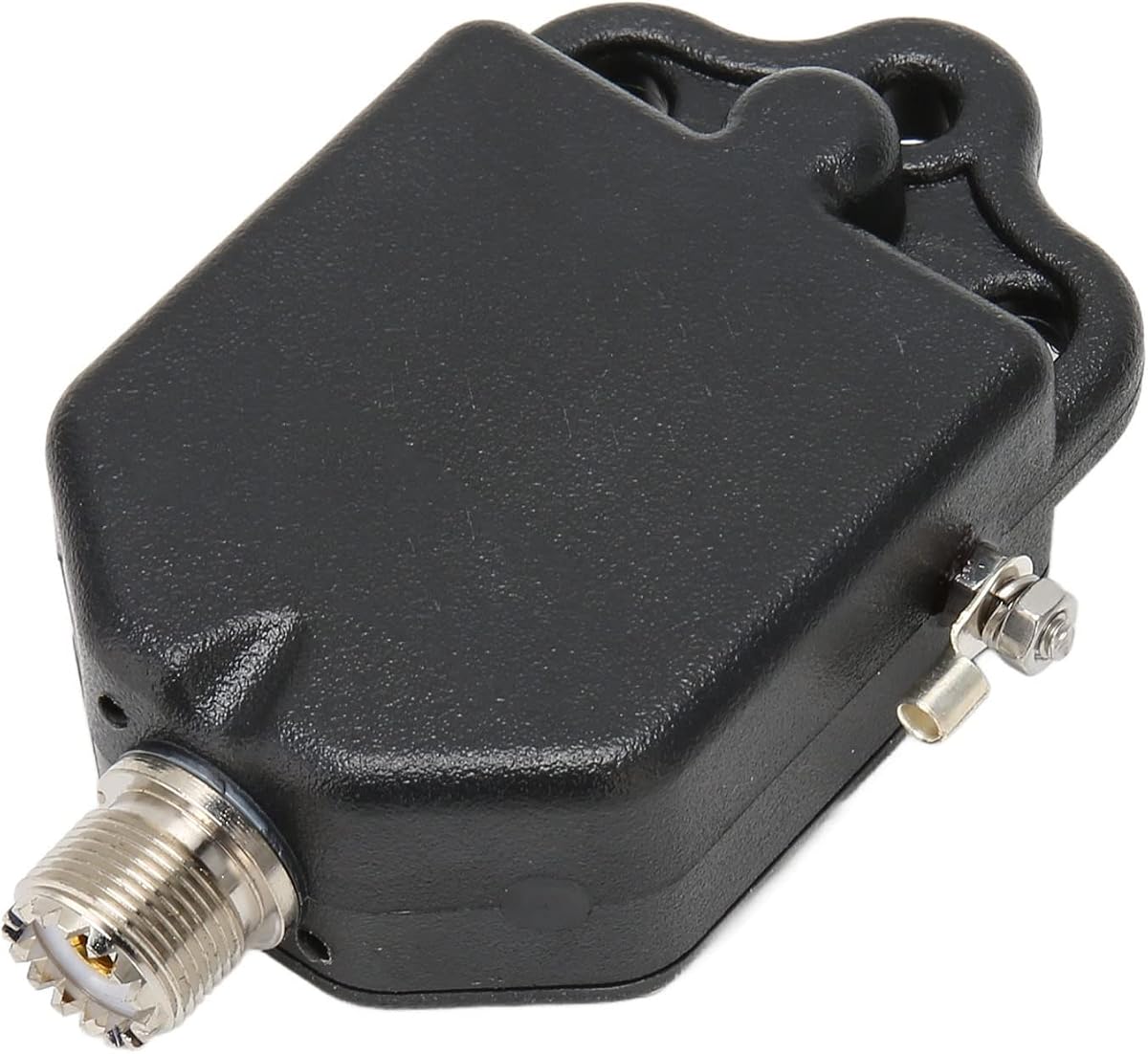
This compact 1:49 end fed antenna is designed for operators who prioritize easy transport and quick deployment over high transmitter output. It covers a stated 1–30MHz range and is listed for SSB below 25W, FE8 below 5W, and CW below 12.5W. Its 4.4 rating reflects a generally positive reception, although the product information does not include hands-on test results.
We may earn a commission when you buy through this link, at no additional cost to you.
The main strength is the combination of a pocket-oriented housing, a standard interface, and broad nominal frequency coverage. The 1:49 balun is intended to make an end-fed wire more compatible with common HF radio connections, while the lightweight PVC body is easy to place in a pack. Installation is described as straightforward, without a complicated setup process.
The meaningful compromise is power. The stated limits make this antenna more appropriate for QRP voice, low-power CW, and especially modest digital operation than for a high-powered contest station. Because end fed antennas are sensitive to surroundings, it also benefits from careful wire placement and testing rather than being treated as a universal solution for every location.
Choose this model when portability, simplicity, and low-power operation are the main priorities. It is particularly relevant for travel, emergency kits, casual listening, and operators who want an inexpensive entry into end-fed deployment. Those needing stronger voice or CW output should compare it with a 1:64 design that expressly supports 100 or 150 watts.
The short housing and lightweight PVC construction make this one of the more practical choices for mobile use. It can be carried without adding the bulk of a larger transformer assembly and can be deployed quickly when a suitable support is available.
The listed limits of 25W SSB, 12.5W CW, and 5W FE8 define the intended operating class. Staying within those figures helps ensure the antenna and transmitter are used in the combination for which they were described.
We may earn a commission when you buy through this link, at no additional cost to you.
This 150-watt end fed antenna matching system is aimed at portable stations, POTA and SOTA activities, emergency deployments, and permanent base installations. It has a 4.6 rating and combines a 1:64 matching network with a stated 1–30MHz range. Its product information identifies 150W SSB, 120W CW, and 60W FT8 or FT4 capability.
We may earn a commission when you buy through this link, at no additional cost to you.
A major advantage is the deployment flexibility. The single-ended design can be mounted horizontally, vertically, or on a slope, and the listed omnidirectional radiation pattern avoids the directional orientation associated with some other antenna forms. The ABS enclosure is described as impact-resistant, while a dedicated ground terminal can accept a 1–2 meter wire for EMI suppression during digital operation.
Users must still account for the antenna wire and installation environment. The recommended four-band wire is approximately 20 meters, while the eight-band arrangement uses about 40.8 meters. The manufacturer recommends keeping the element three meters from ordinary obstacles and five meters from metallic objects, and trimming with an analyzer can improve resonance under changing environmental conditions.
This is a strong choice for an operator who needs more power and configuration flexibility than a compact QRP unit. It is also suitable for users who understand the importance of a good site and are willing to tune the wire. The trade-off is additional wire, setup planning, and a larger footprint than a pocket-style antenna.
The stated omnidirectional pattern and support for horizontal, vertical, and sloped mounting make the system adaptable to varied field sites. That flexibility is valuable when permanent supports or clear directions are unavailable.
The dedicated ground terminal offers a practical way to attach a short grounding wire for EMI suppression. It is intended to reduce interference during digital modes without requiring a buried earth system.
We may earn a commission when you buy through this link, at no additional cost to you.
This 150-watt, 1:64 end fed antenna is the strongest all-around fit in the group for portable HF operation. It carries a 4.8 rating, the highest supplied rating among the ten products, and supports SSB below 150W, CW below 120W, and FM, AM, FT4, and FT8 below 80W. Its stated 1–30MHz range covers 80m, 60m, 40m, 30m, 20m, 16m, 12m, 10m, and 6m.
We may earn a commission when you buy through this link, at no additional cost to you.
The antenna balances useful power handling with a compact, portable enclosure. A standard interface and straightforward installation procedure are appealing for temporary deployments, while the ABS housing is described as hard, wear resistant, and intended for durable use. It can be used for long-term outdoor installation or rapid emergency communication setup.
The principal limitation is that the transformer alone does not eliminate the need for a suitable antenna wire. The listed four-band recommendation is approximately 20 meters, and the eight-band option is about 40.4 meters. Those lengths can be awkward in confined locations, and the wire may need fine-tuning for the selected frequency and environment.
For most portable operators seeking more than QRP capability, this is the easiest recommendation in the list. It handles the major voice, CW, and digital modes at useful stated power levels without moving into the specialized 400-watt category. It remains especially attractive for field stations, travel, and operators who want one matching unit for multiple HF bands.
The 150W SSB and 120W CW ratings provide a substantial operating envelope for portable HF. That range makes the model more versatile than the low-power pocket antennas without requiring the bulkier class of a 400-watt system.
Support for nine listed bands gives operators room to move through common HF allocations. The 1:64 network and standard interface also contribute to the unit's broad appeal as a portable end fed antenna.
We may earn a commission when you buy through this link, at no additional cost to you.
This 1:64 end fed antenna offers a useful combination of power handling, broad frequency coverage, and compactness. It has a 4.5 rating and a stated 1–30MHz range, with support for SSB below 100W and FT8, FM, and FSK below 60W. That specification makes it a practical middle ground for portable voice and digital operation.
We may earn a commission when you buy through this link, at no additional cost to you.
The unit uses a standard interface and is described as quick and convenient to install. Its ABS housing is intended to resist damage and wear, while the compact enclosure supports easy transport. Buyers can select a four-band or eight-band arrangement, although the required wire is not included in the stated package information.
The four-band setup calls for roughly 20 meters of 2.5-square-millimeter wire, while the eight-band version calls for approximately 40.4 meters. In either case, the wire should be trimmed to suit the desired frequency. As with all end fed antennas, nearby structures, metal, and the shape of the installation can change the tuning point.
This antenna is the best budget-oriented choice in the comparison because it combines a 1:64 network with a meaningful 100-watt SSB limit. It is suitable for POTA, portable base operation, and emergency use where 150 watts is unnecessary. Operators seeking the largest power margin may prefer a 150-watt alternative, but this model leaves more room for transmitter output than a compact QRP unit.
A stated 100W SSB ceiling provides meaningful voice capability while remaining compatible with many portable transceivers. The lower 60W limit for FT8, FM, and FSK keeps the intended operating envelope clearly defined.
The ABS matching unit is small enough to support genuinely portable deployment. Its standard connection and straightforward setup are useful when an operator needs to move between parks, campsites, or temporary operating locations.
We may earn a commission when you buy through this link, at no additional cost to you.
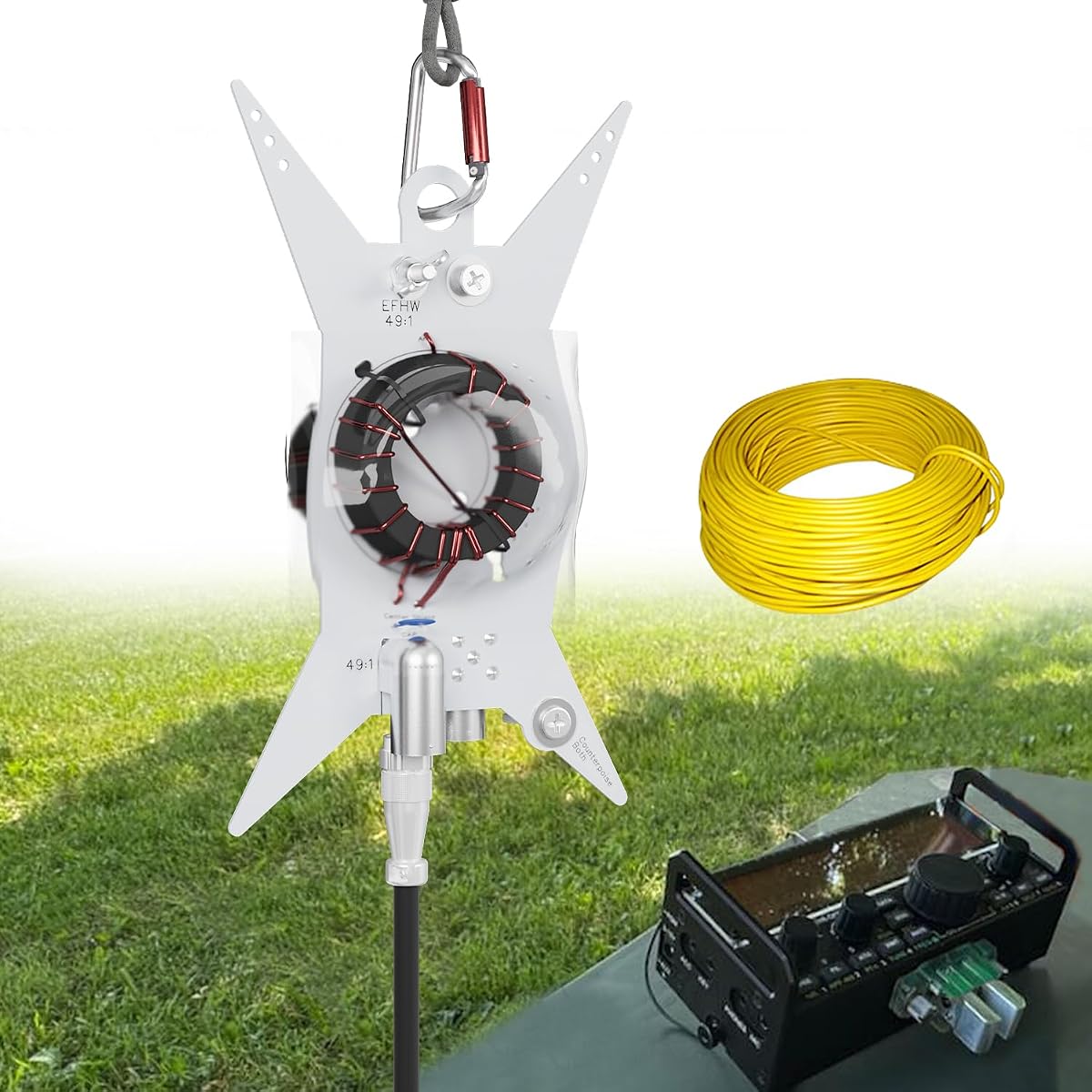
This dual-mode end fed antenna provides both 49:1 and 9:1 impedance-matching options in one enclosure. Its 3.9 rating is the second-lowest in the group, but the product's defining benefit is flexibility: the 49:1 side is intended for resonant end-fed antennas, while the 9:1 side can support random-wire operation over various HF bands when paired with a tuner.
We may earn a commission when you buy through this link, at no additional cost to you.
Supporting wires are included, which removes one preparation step compared with models for which the user must supply a specific wire length. The unit can be hung horizontally, vertically, or diagonally, making it relevant to field operations, POTA, SOTA, camping, and DX work. It is also described as windproof, rainproof, and suitable for harsh-weather conditions.
The key trade-off is that two ratios do not make the antenna automatically resonant on every band. The 9:1 configuration still requires an appropriate tuner and the correct wire, and actual performance will depend on location. The 3.9 rating indicates that some buyers may have found the overall experience less compelling than that of the highly rated 1:64 models.
This is a sensible option for operators who want one compact unit to support both a planned resonant wire and an improvised random wire. It is especially useful where a tuner is already part of the station. Those seeking a straightforward multiband system with more stated power information should examine the 100-watt or 150-watt 1:64 alternatives instead.
The 49:1 side serves a resonant end-fed arrangement, while the 9:1 side is intended for random-wire use. This dual approach gives an operator more options when changing antennas or operating sites.
Included wires and support for horizontal, vertical, or diagonal mounting make the unit convenient for field activities. A compatible tuner remains important when using the random-wire configuration across different bands.
We may earn a commission when you buy through this link, at no additional cost to you.
This upgraded 1:64 model is a well-rounded outdoor end fed antenna with a 4.6 rating. It operates across a stated 1–30MHz range and supports SSB below 150W, CW below 120W, and FM, AM, FT4, and FT8 below 80W. The listed band coverage includes 80m, 60m, 40m, 30m, 20m, 16m, 12m, 10m, and 6m.
We may earn a commission when you buy through this link, at no additional cost to you.
Its ABS shell is described as durable and suitable for indoor or outdoor environments, including poor weather. The small housing and simple installation process suit emergency response communications, long-term outdoor installations, and temporary stations. The optimized 1:64 ratio is intended to reduce signal loss and support stable reception across the supported bands.
This is a matching-network product rather than a self-contained antenna with a fixed wire. The buyer must prepare about 2.5 square millimeters of wire, using approximately 20 meters for four-band operation or 40.4 meters for eight-band operation. The wire should be trimmed for the intended frequency, and the product information specifically recommends an antenna analyzer for fine-tuning.
Choose this model when you want a portable 150-watt system but want a slightly more extensively described feature set than the similarly rated balun option. It is well matched to amateur and shortwave operators who can prepare the proper wire and tune the installation. The main cost of that capability is setup effort rather than portability.
The ABS shell is designed to retain structural strength in changing weather conditions. Its compact form also allows the unit to move between permanent installations and temporary field locations.
Separate SSB, CW, and digital-mode limits clarify how much output the antenna is intended to handle. This makes it easier to select a compatible transmitter without exceeding the stated operating parameters.
We may earn a commission when you buy through this link, at no additional cost to you.
This pocket-design 1:49 antenna combines one of the highest customer ratings in the comparison with a very compact and portable form. It has a 5.0 rating, operates across a stated 1–30MHz range, and is listed for 40m, 20m, 15m, and 10m. Its 1:49 balun and standard interface support straightforward installation.
We may earn a commission when you buy through this link, at no additional cost to you.
The PVC housing is lightweight, relatively hard, and described as resistant to damage and wear. These attributes suit travel, field kits, emergency communications, and operators who need a small matching unit rather than a large base-station system. The antenna can be installed quickly without a complicated setup.
Power is the decisive limitation. The stated maximums are 25W for SSB, 5W for FE8, and 12.5W for CW, so it is best suited to low-power voice, CW, and digital operation. As with any end-fed wire, effective radiation and tuning remain dependent on installation conditions, support geometry, and nearby objects.
The excellent rating and compact dimensions make this a strong choice for portable QRP stations. It also works for shortwave listening and communication tasks within the specified limits. Users planning regular high-power SSB or CW should move to a 1:64 unit with a 100- or 150-watt rating rather than exceed this antenna's stated capacity.
The small, lightweight PVC enclosure is easy to carry and install. That portability makes the model particularly useful for operators who move between locations or maintain a compact emergency radio kit.
The 25W SSB, 12.5W CW, and 5W FE8 figures clearly position the antenna for low-power use. Respecting those limits is essential to getting the most reliable result from the matching system.
We may earn a commission when you buy through this link, at no additional cost to you.
The 4010-400W is the premium high-power option in this guide, with stated support for 400W SSB, 300W CW, and 150W FT8. It operates across the 40m, 20m, 15m, and 10m bands and uses an integrated 1:49 and 1:64 impedance transformer. Its 3.6 rating is the lowest listed, so the impressive specifications should be considered alongside that mixed customer feedback.
We may earn a commission when you buy through this link, at no additional cost to you.
Unlike the smaller matching units, this model is presented as a complete 20-meter antenna system. The housing uses UV-resistant, waterproof ABS, while a waterproof M-J connector and a 63 by 38 by 20 millimeter ferrite core add to the specialized construction. The product information lists a designed service life of three to five years and recommends inspection every six months.
Deployment remains flexible. The antenna can be placed horizontally, vertically, or diagonally, and the balun position can be adjusted for the site. It is intended for POTA, temporary field work, long-term camping, overlanding, backyards, and home stations. For best results, the instructions call for three meters of clearance from objects and five meters from metal surfaces.
Despite the word portable in its intended use, the roughly 20-meter system and high-power hardware make this less convenient than the compact models. Its appeal lies in exceptional power handling and dedicated all-weather construction. Buy it when a fixed or semi-fixed field station needs a robust four-band antenna more than minimal carry weight.
Stated limits of 400W SSB, 300W CW, and 150W FT8 separate this model decisively from the portable units. It is aimed at demanding voice, CW, and digital operations where transmitter output is a central requirement.
The UV-resistant waterproof housing, sealed M-J connector, and ferrite core support long-term outdoor use. The stated three-to-five-year service life and six-month inspection recommendation encourage regular maintenance rather than unattended neglect.
We may earn a commission when you buy through this link, at no additional cost to you.
This portable end fed antenna combines 49:1 and 9:1 matching options in a single unit and carries a 4.6 rating. The 49:1 side is intended for resonant end-fed antennas, while the 9:1 side can be used with a random wire over various HF bands when the station includes a tuner. The included wires simplify the initial setup.
We may earn a commission when you buy through this link, at no additional cost to you.
The antenna is suitable for POTA, SOTA, camping, DX contact, field operations, and outdoor expeditions. It can be mounted horizontally, vertically, or diagonally, giving operators flexibility when the available tree, support, or clearing has an awkward shape. Its compact and lightweight construction also supports transport between operating sites.
Construction is described as solid, windproof, rainproof, and durable. The product information also states broad compatibility with major radio brands and operation across most frequencies, but it does not provide specific SSB, CW, or digital-mode power limits. That omission makes it harder to compare directly with the clearly specified 1:64 models.
The antenna is best for an operator who values two matching paths and a ready-to-hang package. A tuner is still important for dependable random-wire operation, and users must understand that a matching ratio does not remove the need for a proper wire and a good installation. Those wanting explicit power figures may prefer the 150-watt end fed options.
Having both 49:1 and 9:1 in one enclosure lets an operator select a more appropriate feed method for the installation. It reduces the need to carry a separate transformer for each style of wire.
The included supporting wires and simple hanging options make the unit convenient for POTA, SOTA, and camping. The operator can choose horizontal, vertical, or diagonal placement to suit the available support.
We may earn a commission when you buy through this link, at no additional cost to you.
This Zunate portable antenna uses a 1:49 balun and covers a stated 3–30MHz range. It has a 4.5 rating and includes 7, 14, 21, and 28MHz among its highlighted frequencies, corresponding to widely used amateur allocations. The compact PVC body and standard interface make it especially easy to carry, install, or replace.
We may earn a commission when you buy through this link, at no additional cost to you.
Its power figures are suited to modest stations: SSB below 24W, FE8 below 5W, and CW below 12W. That makes it appropriate for low-power communication, shortwave listening, radio broadcasting, and emergency arrangements. The listed applications also encompass radio enthusiasts and general communications use.
Unlike several 1–30MHz alternatives, the lower end begins at 3MHz. That distinction may matter for operators interested in frequencies below the common 40m band. The antenna also cannot provide the transmit headroom of the 100-, 150-, or 400-watt models, so transmitter selection and operating power should be planned carefully.
This is a practical compact choice for travel, listening, and light-weight field communication. It is most attractive to an operator who values minimum size, rapid replacement, and a broad HF reach more than high output. For regular portable SSB or CW, a higher-capacity 1:64 matching network is the more logical choice.
The mini enclosure and low weight are particularly useful for travel and emergency-kit planning. The standard connection supports quick installation or replacement when operating conditions change.
The stated 3–30MHz span includes 7, 14, 21, and 28MHz, giving shortwave listeners and low-power operators a broad selection of frequencies. The lower cutoff is narrower than options that begin at 1MHz.
We may earn a commission when you buy through this link, at no additional cost to you.
The most important buying factors are matching ratio, radio power, required wire length, operating bands, portability, and environmental resilience. Choosing correctly means matching the antenna system to the transmitter, available space, and amount of setup an operator can perform in the field.
A 1:49 or 1:64 balun is designed to help match the high impedance of an end-fed wire to a radio's antenna connection. A 1:49 network is common for a resonant wire, while a 9:1 side can make a random wire more practical to feed. Some products combine both ratios, and that can be useful when a portable station needs to work with planned and improvised wires.
Choose a ratio based on the antenna wire and the way you intend to operate. A resonant configuration generally benefits from careful length adjustment, while a random-wire system may require an external tuner. Do not treat the balun ratio as a substitute for a correctly dimensioned wire or a sound installation.
Power handling is one of the clearest ways to separate portable antenna options. The compact 1:49 models in this guide list limits around 24W or 25W SSB, while the 1:64 options reach 100W or 150W SSB. The premium 4010-400W model goes further, with a stated 400W SSB limit. The appropriate choice depends on your radio output, operating mode, and the antenna wire being used.
Match the radio to the stated limit rather than operating at the maximum under every condition. SSB, CW, FM, AM, FT8, and FT4 can have different stated ceilings even on the same antenna. For a QRP travel station, the lower limits may be ideal; for a high-power field station, the 150-watt or 400-watt options provide much more headroom.
A broad nominal frequency range does not guarantee that an antenna is resonant on every band without adjustment. Several 1:64 products support four-band or eight-band arrangements and list common allocations from 80m through 10m, with one product also including 6m. The dual-ratio products are intended to work over various HF bands, but their random-wire side still needs tuner support.
Check the listed band configuration, the length of wire you are prepared to use, and whether you have an antenna analyzer or another reliable tuning method. Keep the element and support as clear as practical. Environmental changes can shift the tuned point, so an antenna suitable for one location may require trimming in another.
End fed antennas depend heavily on the wire element. Some products require about 20 meters for a four-band arrangement, while eight-band versions can need approximately 40.4 to 40.8 meters. The dual-ratio products list included supporting wires, which is convenient, while several 1:64 models explicitly require the buyer to prepare suitable wire.
Account for wire length before buying. A long element can be excellent in an open field but awkward on a small urban property or at a restricted campground. Verify whether the package includes wire, a connector, or other installation accessories, and plan how the element will be supported without creating sharp bends or conductive contact with metal.
Portable does not necessarily mean small. The pocket antennas use compact PVC housings, the 1:64 units balance larger power capability with portable ABS enclosures, and the 4010-400W option is a roughly 20-meter system. Every product can be mounted horizontally, vertically, or diagonally, but the practical challenge increases with the wire length and total installed footprint.
Think about how you will carry the component and whether it can be redeployed quickly. A small QRP unit is easy to keep in a day pack, while a high-power system may be better suited to a vehicle, camp, or semi-permanent field station. Select based on how often you move rather than on the word portable alone.
Outdoor antenna components must tolerate moisture, temperature variation, and physical handling. The models in this guide use either PVC or ABS housings. The 4010-400W system adds a UV-resistant waterproof housing, a waterproof M-J connector, and a ferrite core, making it the most explicitly engineered for sustained outdoor use among the listed products.
Look for a housing that suits the expected exposure, but also inspect it regularly. Water can enter through poorly seated connectors, and a damaged housing may affect the matching network. The premium model recommends inspection every six months and states a designed service life of three to five years, illustrating the maintenance expected from a permanent outdoor installation.
Digital modes can expose an end fed installation to unwanted electromagnetic interference, particularly when the antenna is close to a noisy station environment. The upgraded 150W 1:64 balun includes a dedicated ground terminal for attaching a 1–2 meter single-strand wire to suppress EMI without a buried earth system. That feature makes it more relevant to operators running FT8 or FT4 in portable locations.
If digital operation is a primary goal, consider both the grounding provision and the placement of the antenna. Keep the element away from metal and other obstacles, follow the product's recommended clearances, and use an analyzer to establish a stable operating point. Grounding is an aid, but it cannot replace a good site and correctly tuned wire.
Most modern HF transceivers use a common SO-239 or similar antenna connection, and many of the listed products use a standard interface. The 4010-400W model specifically identifies compatibility with Yaesu, Icom, Xiegu, Kenwood, and most HF transceivers, while other dual-ratio models state broad compatibility with major radio brands.
Confirm the connector and cable requirements before ordering, especially for a high-power installation. Use suitable coaxial cable for the operating distance and power level, and verify that any additional adapter or connector is appropriate for the station. A matching unit can be portable while the full antenna system still requires planning for cable, wire, support, and strain relief.
Begin by selecting a safe site and a suitable support. The antenna can generally be installed horizontally, vertically, or diagonally, but the best result comes from keeping the wire as far as practical from metal, buildings, vehicles, fences, and dense vegetation. Follow the clearance guidance supplied with the product, and never allow the element to contact conductive objects. Wear appropriate footwear and use another person when climbing or working at height.
Prepare the correct wire for the selected four-band or eight-band configuration, or use the included wire with a dual-ratio model. Attach the element to the balun, connect the radio through compatible coax, and make temporary adjustments before transmitting. Check the standing wave response and trim or adjust the wire as needed. Products that recommend an antenna analyzer provide a more reliable basis for tuning than guessing from a radio's built-in meter alone.
For care, inspect the wire for nicks, broken strands, corrosion, and strain at the connection. Keep the matching housing and connectors dry, particularly after rain, and check the installation after strong wind. If the antenna is used for long-term outdoor deployment, follow the stated maintenance guidance, retune after major environmental changes, and replace visibly damaged components rather than attempting to solve persistent high SWR with excessive transmitter power.
A 1:49 balun is generally intended for a properly dimensioned resonant end-fed wire, while a 1:64 network can provide matching for long multiband arrangements. A 9:1 ratio is useful with a random wire when a tuner is available. The best choice depends on the wire, bands, and operating method rather than on a single universal ratio.
A tuner is most important for random-wire and improvised configurations. Some planned four-band or eight-band systems can be adjusted to their target frequencies by trimming the wire, although the product information for several models recommends an antenna analyzer. Even a nominally resonant antenna can shift when nearby structures or weather-related changes affect its environment.
The compact products in this guide list relatively low limits, generally around 24W or 25W SSB, 12W or 12.5W CW, and 5W for FT8 or FE8. These figures describe the intended operating range. Exceeding them can overstress the matching unit, and operating at the maximum is not recommended when the surrounding installation is poorly tuned.
Several products specify approximately 20 meters of 2.5-square-millimeter wire for a four-band layout and about 40.4 to 40.8 meters for eight-band use. These are starting references, not universal finished lengths. The element should be trimmed for the selected frequencies and the local environment, so users should confirm the manufacturer's details and check the resulting tuning.
Yes. The products in this guide support horizontal, vertical, and diagonal mounting, although the best orientation depends on the available site and local band conditions. Vertical deployment can conserve horizontal space, while other orientations may be easier to support. Clearance from metal, buildings, vehicles, and dense obstacles remains important in every case.
It can be well suited to POTA when the operator has a good site, a compatible wire, and sufficient time to tune. The 1:64 150-watt models offer a practical balance between portability and output, while the 4010-400W system provides greater power but requires a larger deployment footprint. Low-power operators may find a compact 1:49 model easier to carry.
Start by improving antenna placement and keeping the wire away from metal and other nearby structures. One of the 150-watt 1:64 options includes a dedicated ground terminal for attaching a 1–2 meter single-strand wire to suppress EMI. A ground wire can help, but it does not compensate for an unsuitable location, poor wire connection, or incorrect tuning.
Confirm that the matching housing, connector, wire joint, and strain relief are all in good condition before the antenna is exposed to weather. Keep the coax connection secure and inspect it afterward for moisture. The 4010-400W product specifically lists a waterproof M-J connector and waterproof ABS housing, while all installations still benefit from regular visual inspections and secure supports.
The best overall choice is the 150W End Fed Half Wave with its 1:64 network, 1–30MHz stated range, support for major SSB, CW, and digital modes, and a 4.8 rating. The 100W Four Eight-Band Antenna stands out as the budget pick, while the 4010-400W system takes the premium position with exceptional stated power capacity and more specialized outdoor hardware.
Your priorities should determine the rest of the shortlist. Choose a compact 1:49 model for QRP, travel, and easy carrying; a 1:64 unit for a broader balance of power and portability; or a dual-ratio antenna when you want both resonant and random-wire options. Match the radio output to the stated limits, allow space for the required wire, and avoid choosing solely from a frequency label.
Before ordering, verify the current listing, included components, connector details, and manufacturer instructions. Prices, promotions, and availability can change, and the specifications listed in this guide reflect the supplied product information rather than personal test results. A final check of the current product page and the site where the antenna will be used will help prevent surprises.