
UltraPro Portable HD TV Antenna
4.3Editor score
Strong magnetic mounting base
Portable compact monopole design
ATSC 3.0 broadcast compatibility
Explore the best HDMI Antenna for TV options, comparing indoor antennas, range modes, magnetic bases, cable length, and smart TV compatibility for viewers.
An HDMI antenna for TV is essentially an over-the-air television antenna used with a compatible digital or smart television. The best models make it easier to receive local broadcast channels without a conventional cable package, while features such as signal filtering, selectable range modes, magnetic bases, and long coaxial cables can improve installation flexibility.
This guide compares ten indoor TV antennas using the information supplied for each model. The evaluation considers broadcast compatibility, reception features, placement options, included cable length, amplification, support for modern television standards, and practical setup guidance rather than assuming that every antenna will work equally well in every home.
The list includes a range of designs for viewers who want a compact desktop antenna, a flexible magnetic model, or an amplified unit with a longer cable. Each review explains the product's strongest features and limitations, while availability, channel coverage, ratings, and prices can change, so readers should verify current details before purchasing.
An over-the-air TV antenna can provide local channels without a monthly television subscription, but it must be connected to a television with a compatible digital tuner. The keyword “HDMI antenna” is common in shopping searches, although the antenna itself usually connects through a coaxial ANT/IN jack rather than an HDMI port.
4.3Editor score

4.2Editor score
4.2Editor score
The following comparison highlights the principal antenna designs, connection features, placement options, and broadcast capabilities represented in this guide. Specifications reflect the supplied product information, while real-world channel availability remains dependent on tower distance, terrain, buildings, and correct setup.


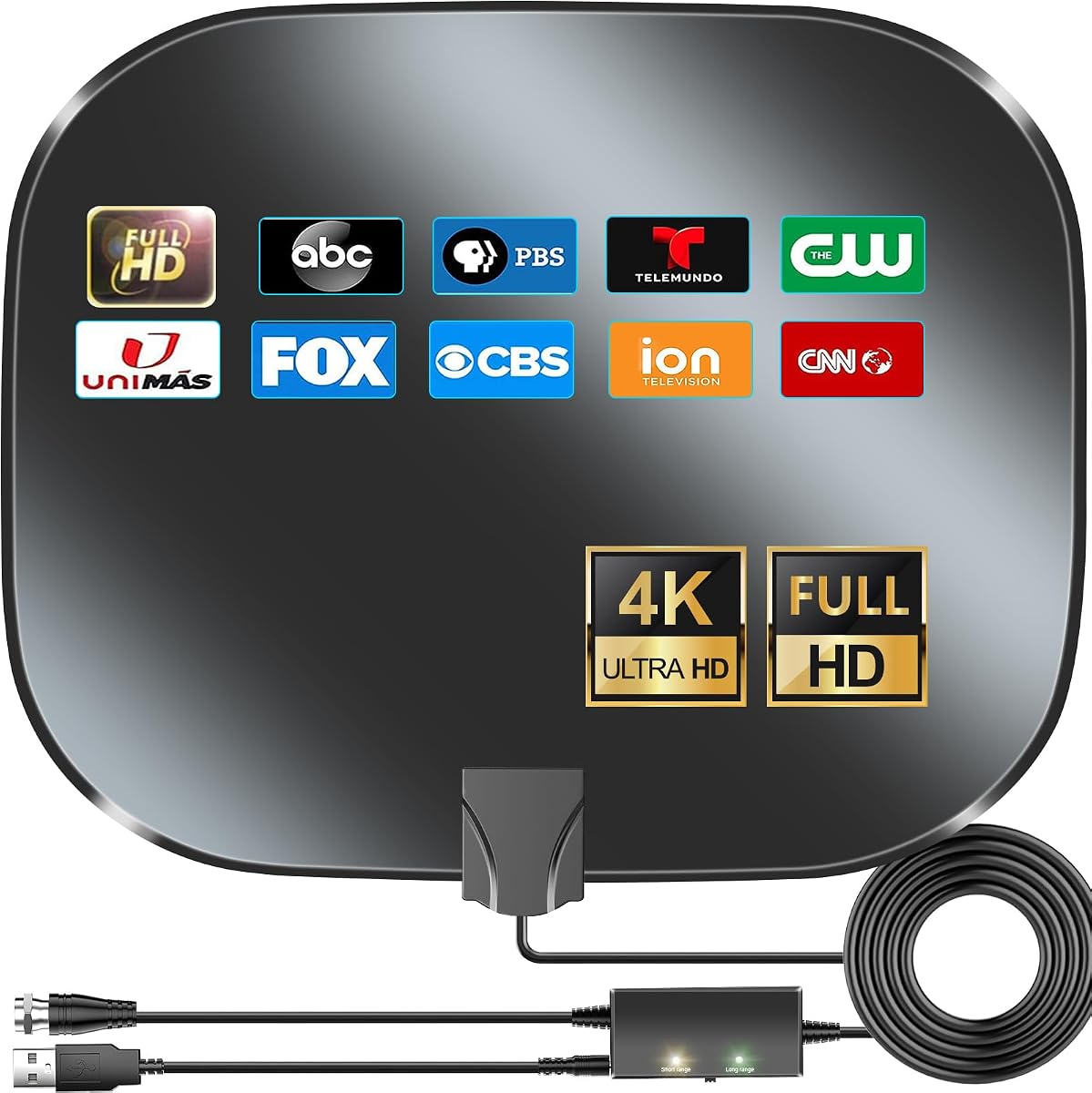
This antenna earns the Editor's Choice position because its selectable range modes make it unusually adaptable for different viewing locations. It has a 4.2 rating and is designed to receive local channels through compatible digital and smart televisions, with support stated for 4K, UHD, and 1080p broadcasts where available.
We may earn a commission when you buy through this link, at no additional cost to you.
Its upgraded smart chip is intended to filter cellular and FM interference while improving gain and frequency performance. More usefully for buyers, the antenna separates short-range operation for locations within 35 miles from a long-range setting for areas between 35 and 250 miles. That control gives users a clear troubleshooting tool instead of leaving placement as the only adjustment.
There are important limits to the performance claims. Actual reception depends on tower distance, terrain, building materials, and interference, and an amplifier may not help where the incoming signal is fundamentally weak. The product supports UHF and high-VHF signals, but some low-VHF channels numbered 2 through 6 may require a separate compatible antenna.
This is a strong choice for viewers who want more installation guidance than a basic indoor antenna provides. The included 16.5-foot cable, high-positioning advice, and re-scan instructions make it especially useful in apartments and multi-level homes. Select the proper range mode, place the antenna high and near a window, and rescan after every adjustment.
Matching the antenna to your approximate distance from broadcast towers is more practical than repeatedly moving a unit with no clear objective. Use short range when you are close and long range when towers are farther away, then rescan after changing the setting.
Even a feature-rich antenna benefits from a high, unobstructed position near a window. Keep it away from metal objects, thick walls, and other electronics, because those obstacles can outweigh the benefit of signal amplification.
We may earn a commission when you buy through this link, at no additional cost to you.
The 2026 Upgraded TV Antenna is our Best Premium selection because it combines an amplified smart chip, a lengthy 18-foot coaxial cable, and flexible indoor or outdoor positioning. Its 4.2 rating reflects a well-rounded feature set for viewers who need more placement freedom than a compact desktop model provides.
We may earn a commission when you buy through this link, at no additional cost to you.
The high-gain amplifier booster is designed to strengthen weak signals and reduce cellular and radio-frequency interference. The long cable allows the antenna to be moved away from obstructions while remaining connected to the television, which is particularly useful when the best signal arrives near a window, on an upper floor, or in an exterior location.
Its headline claims should still be understood in context. Over-the-air reception varies with location, terrain, weather, and the quality of the broadcast signal, so amplification cannot create a reliable signal where none is available. The instruction to read the manual, configure the television correctly, and rescan after movement is therefore important rather than optional.
Choose this model if a long cable and the option to experiment with elevated or outdoor placement matter more than a minimalist design. It is well suited to smart TV owners seeking local channels, particularly those willing to test several positions and use the supplied support service if setup questions arise.
An 18-foot cable lets you search for a clearer signal without moving the television. This is especially helpful when the best reception point is near a window but the television sits against an interior wall.
The smart chip and booster are intended to make marginal signals more usable, but they cannot repair severe obstruction or coverage gaps. Rescan after each placement change and compare results with the unit in different positions.
We may earn a commission when you buy through this link, at no additional cost to you.
The UltraPro Portable HD TV Antenna has a 4.3 rating, the highest among the ten products, and stands out for its magnetic base, compact monopole design, and support for ATSC 3.0 where that broadcast standard is available. It is a practical option for homes, RVs, boats, vehicles, and outdoor viewing areas.
We may earn a commission when you buy through this link, at no additional cost to you.
A strong magnetic base helps the antenna remain stable on compatible metal surfaces, reducing the chance that a minor bump will alter its position. The product supports VHF and UHF reception, works with all television brands according to the supplied information, and is ready for modern 4K and 8K televisions as a receiver for over-the-air channels.
The primary limitation is its more compact form. Unlike antennas supplied with lengthy coaxial cables, this model is designed for direct placement close to the television. Its stated general-purpose reception claims also do not make it a guaranteed solution for viewers far from towers or behind heavy building materials.
It is a compelling choice for cord-cutters, travelers, and anyone seeking a simple antenna that can move between locations. Try mounting it high on or near the television, rotate it to optimize the direction toward local towers, and rescan whenever the orientation changes.
The compact monopole can be stored in a vehicle, RV, boat, drawer, or glove compartment without taking up much space. That makes it one of the most versatile choices for temporary or mobile television setups.
A strong magnetic mount keeps the antenna secure on compatible metal surfaces and makes height adjustment easy. Rotate the element after mounting, then perform a fresh channel scan to determine the best orientation.
We may earn a commission when you buy through this link, at no additional cost to you.
This TV antenna combines a 4.0 rating with an 18-foot reinforced cable, a magnetic base, and a selectable signal booster. Those features make it a flexible option for viewers who may want to move the unit between indoor and outdoor positions or place it on a higher surface for a clearer line of sight.
We may earn a commission when you buy through this link, at no additional cost to you.
The thick coaxial cable is described as supporting more stable 4K signal transmission than ordinary lightweight alternatives, while the magnetic base allows the antenna to sit on a car or other iron-framed surface outdoors. Its booster can be switched on when the viewer is more than 35 miles from a tower, giving the product a useful range adjustment.
Outdoor suitability does not guarantee stronger reception. Wind, rain, terrain, nearby structures, and the direction of the broadcast towers can all affect the result, and the included long cable must be routed without creating a poor connection. Users should also consult local channel maps before buying, since distance alone does not determine the available lineup.
This is a good choice for someone willing to experiment with placement and wants the option of moving the antenna beyond the living room. Begin indoors if possible, use the booster according to the manual, and rescan after every relocation or range-button change.
The 18-foot cable is long enough to move the antenna away from the television and toward a better reception point. Route it carefully along a wall or window area to protect the connection and avoid unnecessary strain.
The magnetic base is useful on compatible metal surfaces, including temporary outdoor arrangements. It can be moved quickly, but the final position should remain stable so that wind or vibration does not alter reception.
We may earn a commission when you buy through this link, at no additional cost to you.
The Digital TV Antenna Indoor has a 4.0 rating and focuses on quick, tool-free installation. Its strong magnetic base can attach to a television stand, the back of a television, a cabinet, a window area, or another suitable metal surface without requiring an internal power source.
We may earn a commission when you buy through this link, at no additional cost to you.
The product uses an upgraded smart chip described as receiving signals from all directions while filtering cellular and FM interference. It supports 4K, UHD, and 1080p HDTV formats, and its cable is described as using stronger copper wiring to reduce signal loss. These features make it appealing for quick setups in relatively favorable reception environments.
Its advertised reception radius is considerably more ambitious than the basic physical dimensions might suggest, so buyers should treat that figure as a best-case claim rather than a guarantee. Building materials, terrain, tower distance, and the position of the television can all reduce performance. The absence of a dedicated range selector also gives users fewer controls than some alternatives.
Choose this model for a simple magnetic installation and broad directional reception, particularly if the television is near a window or has a metal surface that provides a convenient mounting point. Test several rotations and heights, and always perform a new channel scan after repositioning the antenna.
The magnetic base makes setup especially quick: attach the antenna to a suitable metal surface, connect the cable, and scan the television. No tools or internal power connection are needed for the basic installation.
The antenna is described as receiving signals from all directions, but real placement can still determine results. Rotate it gradually, compare channel scans, and keep it in an open area away from large obstructions.
We may earn a commission when you buy through this link, at no additional cost to you.
The UltraPro Hover Digital TV Antenna has a 4.0 rating and offers a distinctive alternative to a conventional indoor antenna. Its hover-style body attaches directly to the top of a television, creating a neat appearance that suits viewers who do not want a separate tabletop unit in the viewing area.
We may earn a commission when you buy through this link, at no additional cost to you.
The antenna swivels horizontally so it can be turned toward a stronger broadcast signal, while a push-on coaxial connector enables quick setup. It can also sit on a flat surface or attach to a wall with the included mounting tape. VHF and UHF reception, an up-to-40-mile stated range, and ATSC 3.0 readiness broaden its potential appeal.
It does not include the extended cable or selectable range modes found in several premium-style competitors, so it is best suited to homes within a practical broadcast range and with a nearby placement point. Mounting tape may not perform well on every textured or delicate surface, so testing placement is advisable.
This is a strong pick for apartment dwellers, bedroom viewers, and home-theater setups where appearance matters. Its 1080p HD capability, modern television support, and straightforward adjustment make it a practical indoor option for viewers close enough to local transmitters.
Mounting above the television reduces visual clutter and leaves the media cabinet open. The low-profile shape can look more integrated than a freestanding antenna placed beside the screen.
The horizontal swivel makes it easy to compare directions without moving the entire television. After each rotation, rescan the available channels and retain the orientation that produces the strongest results.
We may earn a commission when you buy through this link, at no additional cost to you.
The Smart TV Indoor Digital Antenna has a 3.8 rating, making it the lowest-rated product in this comparison, but it remains a straightforward option for viewers seeking a small indoor unit. Its black design can blend into a media setup, and the 9.8-foot cable provides more placement freedom than a permanently attached lead.
We may earn a commission when you buy through this link, at no additional cost to you.
The antenna supports 4K and 1080p digital channels and is described as using filtering technology intended to reduce invalid signals and noise. Setup requires connecting the coaxial cable to the television's ANT/IN port, positioning the antenna near a wall or window, and initiating a channel scan.
Its most important limitation is that it has no integrated amplifier. Some viewers may need to purchase a compatible amplifier separately, adding cost and another installation decision. The shorter cable also makes it more difficult to place the antenna at the best reception point if the television is positioned away from a window.
Choose this model for a simple, compact setup in a favorable reception location, such as a bedroom or living room close to a window. It is best suited to buyers who value a low-profile design and straightforward operation over advanced range controls.
The antenna can be placed behind a television, near a window, or on a wall where signal can reach it. Its understated appearance makes it less conspicuous than a larger tabletop unit.
Because no amplifier is included, a separate compatible unit may be useful in challenging indoor locations. Add amplification only after positioning and rescanning, since an unsuitable setting can sometimes make reception worse.
We may earn a commission when you buy through this link, at no additional cost to you.
This Antenna for Smart TV has a 4.0 rating and a design focused on flexible mounting. Its magnetic base can be hidden behind a television, while the supplied cable and hardware allow it to be positioned on a wall, window area, roof, or other stable surface.
We may earn a commission when you buy through this link, at no additional cost to you.
The product is described as receiving signals from all directions and supporting horizontal or vertical orientation. Copper wiring in the coaxial cable is intended to reduce signal loss, while the magnetic base allows the unit to be moved without tools. Setup is described as a simple process of unwrapping the antenna, connecting it, and scanning for channels.
The product listing also makes broad financial and range claims, but the practical value of any antenna depends on available broadcast coverage. Local stations, terrain, and building construction can prevent a model from delivering every channel promised in generic marketing language. A local channel map should be checked before purchase.
This is a useful option for smart TV owners who want to try several locations and orientations. It is especially appropriate when the television sits near a metal frame or when wall and window mounting would keep the antenna away from the screen.
A magnetic base, wall attachment, and window-area positioning make the antenna adaptable to different rooms. The best position is the one that offers an open view toward the relevant broadcast towers.
The ability to turn the antenna horizontally or vertically allows viewers to compare polarizations. Keep the position consistent during each scan so you can identify which orientation actually improves the result.
We may earn a commission when you buy through this link, at no additional cost to you.
The Vansky Digital Amplified Indoor HDTV Antenna has a 4.0 rating and distinguishes itself with a detachable external signal amplifier. This design gives users the ability to compare configurations rather than leaving amplification permanently active, which can be useful when signal strength changes around the home.
We may earn a commission when you buy through this link, at no additional cost to you.
Its 16.5-foot coaxial cable allows the antenna to be placed near a window or high on a wall while remaining connected to the television. The product supports 720p, 1080i, 1080p, 4K, and ATSC formats, while its indoor construction uses flame-retardant materials intended for safe, stable operation around a home entertainment system.
The detachable amplifier is a useful tool for homes farther from broadcast towers, but it is not a cure for every reception issue. Thick walls, valleys, and high-rise buildings can all reduce the incoming signal, and the product uses a corded electric power source that must be connected during operation.
This model is best for viewers who want both an amplified and a non-amplified option without replacing the antenna. Start with the configuration recommended by the manual, test near a window, and remove the booster if channels fail to lock. Rescan whenever the configuration or position changes.
The external booster can be added for a weak-signal test and removed for a direct comparison. This makes it easier to determine whether amplification is helping or whether a different location would be more effective.
The 16.5-foot cable gives the antenna more freedom to reach a high window position. Avoid pinching the cable during installation and keep the connection stable to prevent intermittent signal loss.
We may earn a commission when you buy through this link, at no additional cost to you.
The DAANT TV Antenna Indoor Long Range has a 4.0 rating and offers a focused set of features for digital television owners. It is intended to receive local broadcast channels through compatible smart TVs and digital TVs, with support stated for HDTV, UHD, 4K, and 1080p formats.
We may earn a commission when you buy through this link, at no additional cost to you.
Its upgraded smart chip is designed to receive broadcasts while reducing unwanted interference, and the included 16-foot coaxial cable uses three aluminum shielding layers within its construction. The listing specifically recommends testing both vertical and horizontal orientations, placing the unit near a window, and rescanning the television for channels.
The product is not suitable for older analog televisions, so compatibility should be confirmed before ordering. It also lacks the explicit range selection seen in some competing models, leaving placement and orientation as the main adjustment tools. The long-range label should be understood as a design description rather than a guarantee for every location.
This is a practical pick for viewers with a digital smart television who want a simple indoor setup and a shielded cable. Check the available channels with a local broadcast map, install near a window, compare both orientations, and rescan until the strongest available lineup is found.
The three aluminum shielding layers are intended to reduce interference and distortion as the signal travels to the television. Keep the cable intact and properly seated at both connectors to preserve that protection.
Connect the antenna to the ANT/IN input, scan the television, and then try different positions and orientations. Because every move changes the conditions, rescan rather than judging the antenna from a single attempt.
We may earn a commission when you buy through this link, at no additional cost to you.
The right indoor television antenna depends on local broadcast coverage, building construction, the television's tuner, and how freely you can reposition the unit. The following factors help separate useful features from marketing claims and focus attention on the conditions that most strongly affect real-world reception.
Before choosing an antenna, identify the local broadcast towers and the channels available at your address using an official coverage map such as the FCC's DTV maps or AntennaWeb. Distance is only one factor: terrain, hills, valleys, tall buildings, and trees can block or weaken signals. A strong indoor model may perform well in one home and poorly in another only a short distance away. Checking expected stations in advance prevents disappointment and helps you determine whether a basic indoor design is realistic or whether a more flexible placement system is worth considering.
Most modern smart and digital televisions include a tuner and a coaxial ANT/IN or RF input for over-the-air channels. Older analog sets may not work with the digital-focused products in this guide. Despite the common search phrase “HDMI antenna,” the antenna generally connects through the coaxial tuner input, while the television's HDMI inputs remain available for streaming devices and other external sources. Check the back of your television and its manual before ordering, particularly if you are buying for an older model or a secondary bedroom set.
Range claims should be treated as best-case figures because the usable distance depends on terrain, broadcast power, antenna design, and installation. A selectable short- and long-range mode can make troubleshooting more systematic, particularly for products such as the Editor's Choice model. Amplification may help a weak but clean signal, but it can also amplify noise or overload the tuner when the signal is already strong. Look for clear instructions about when to use the booster, and always compare results with the antenna in the same position before concluding that amplification helps.
A longer coaxial cable allows the antenna to be placed near a window, high on a wall, or above the television while remaining connected to the set. Products with roughly 16 to 18 feet of cable provide more flexibility than a compact fixed lead. Look for a sturdy, well-shielded cable that can be routed without sharp bends or strain at the connector. Very long runs can also introduce avoidable signal loss, so a long cable is valuable only when it helps you find a materially better position.
A magnetic base makes installation fast and allows the antenna to be moved without tools. It can be useful behind a television, on a metal stand, on a cabinet, or in a temporary outdoor location. However, the surface must be compatible, and the antenna may still need to be rotated to face the strongest broadcast direction. Wall and window mounting can be more stable, while a hover-style top mount can look cleaner in a home theater. Choose the mounting method that matches your room and the positions you realistically expect to test.
Cellular traffic, FM signals, electronics, and other RF sources can interfere with television reception. A smart chip or filter designed to reject unwanted signals may improve stability, but filtering cannot overcome a blocked or very weak broadcast. Compare results in several locations before attributing success to the electronics. Keep the antenna away from routers, power electronics, metal furniture, and other densely packed equipment when possible. Filter features are most valuable in neighborhoods where the desired broadcast signal is present but the environment contains several competing radio signals.
An amplifier boosts the signal entering the antenna, which can help viewers farther from a tower or receiving a partially obstructed transmission. It is not universally beneficial. With a strong local signal, excessive amplification can introduce noise, distortion, or tuner overload, leading to fewer usable channels. This makes detachable or selectable amplification valuable. Test the normal configuration first, add amplification when appropriate, and rescan after every change. If a clean signal cannot be locked, moving the antenna may be more effective than increasing gain.
ATSC 3.0 compatibility, sometimes called NextGen TV, matters if and when the standard is available in your area. It can support improved broadcast audio, color, and other features, but it does not guarantee access to additional channels in every market. Customer support can also be valuable during setup, particularly for products that provide installation instructions or a response commitment. Check what support is offered, but also follow the manufacturer's setup sequence because proper scanning and placement remain more important than the presence of a support line.
Begin by confirming that your television has a digital or smart tuner and identifying its ANT/IN or RF input. Connect the antenna's coaxial plug securely, but do not force it into an HDMI port. Turn on the television, open the antenna, channel scan, or channel search menu, and initiate a full scan. A full scan allows the television to evaluate all compatible broadcast frequencies and create a usable channel list based on the signal present at that moment.
Next, optimize the physical position. Start with the antenna high and near a window if possible, then test both vertical and horizontal orientations for models that support them. If the unit has short- and long-range modes, choose the setting that corresponds to your approximate distance from local towers. Move the antenna only after completing a scan, and always rescan following a change in position, orientation, mode, or amplifier configuration so you can compare results fairly.
For care, handle the antenna by its housing or base rather than pulling on the coaxial cable. Keep connectors clean, dry, and fully seated, and route the cable so it is not pinched, sharply bent, or stretched around furniture. A magnetic antenna should be attached only to a stable compatible surface, while an outdoor installation should be secured against wind. Periodically rescan for newly available stations, and treat any antenna as a supplemental viewing option when cable or streaming service remains more reliable.
Usually not. Despite being marketed with the term “HDMI antenna,” most indoor TV antennas use a coaxial connector that plugs into the television's ANT/IN, RF, or tuner input. The television then sends the received over-the-air signal through its own tuner and displays it. HDMI ports are generally used for devices such as streaming boxes, Blu-ray players, and game consoles.
No. Reception depends on the stations transmitted in your area, tower distance, terrain, building materials, interference, and antenna placement. A coverage map can provide a realistic expectation before purchase. Even a well-designed antenna may perform differently in neighboring homes because walls, floors, and window direction can materially change the available signal.
Yes. A channel scan measures the signals available at the time and location of the antenna. Moving it toward a window, rotating it, changing its orientation, or switching amplification can produce a different set of usable stations. Rescanning after each meaningful adjustment ensures that the television reflects the current reception conditions.
No. An amplifier is most helpful when a reasonably clean broadcast signal is weak or partially obstructed. It can also amplify noise, introduce distortion, or overload the tuner when the local signal is already strong. Test with and without amplification when the antenna allows it, and keep the same position during each comparison.
That depends on the antenna's distribution connections and the television setup. A splitter or network tuner may be needed to send over-the-air signals to more than one television or to combine them with cable service. A simple indoor antenna listed for one ANT/IN connection is not automatically suitable for multiple rooms, and long cable runs can reduce signal quality.
Indoor antennas are generally safer and more convenient because the unit remains protected from rain, wind, and falling debris. Severe weather can still affect the broadcast signal itself, and an indoor model may not be able to reach through the building materials that become more relevant during heavy rain or high winds. An outdoor antenna may offer a clearer path to towers but requires secure, weather-conscious installation.
Yes, when the smart television includes a compatible digital broadcast tuner and a coaxial antenna input. The smart platform does not replace the tuner; it simply allows the television to display local broadcast channels along with streaming apps and connected services. Confirm the presence of an ANT/IN or RF connector before purchasing an antenna.
Try both, because the best orientation depends on the broadcast signal and the antenna's design. Keep the antenna in one orientation during a scan, rotate or flip it, and perform another scan to compare the results. Retain whichever position provides the most stable channels and the fewest dropouts.
The Editor's Choice TV Antenna for Smart TV Indoor stands out for its selectable range modes, interference filtering, and detailed placement guidance. The Best Budget UltraPro Portable HD TV Antenna is ideal for travelers and viewers wanting a compact magnetic unit, while the Best Premium 2026 Upgraded TV Antenna offers extended cable placement and indoor or outdoor flexibility.
For every other option, prioritize the factors that match your environment rather than a headline range number. Check local coverage, confirm that your television has a digital tuner, choose enough cable to reach a clear position, and be prepared to test both orientation and amplification. These steps often matter more than any single advertised specification.
Ratings, product details, channel lineups, and prices can change, so verify the current listing before purchasing. Compare the included accessories and compatibility details as well as the design, then choose the antenna that offers the placement flexibility and controls you will actually use.