
HICTOP Ender 3 Heated Bed
4.5Editor score
Broad Ender compatibility
24V 220W power
110°C maximum rating
Heated bed for 3D printer options compared for compatibility, size, wattage, materials, temperature handling, and first-layer performance.
A heated bed for 3D printer establishes the stable surface needed for strong first-layer adhesion, consistent heat, and dependable results across PLA, ABS, ASA, and other materials. The right replacement must match your printer’s dimensions, mounting pattern, electrical system, and temperature controls rather than simply deliver enough heat.
We compared ten heated beds using the specifications and compatibility information available for each product. The list covers compact Ender 3 assemblies, larger aluminum beds, silicone heating pads, Voron-oriented upgrades, and complete kits, with particular attention to voltage, wattage, dimensions, construction, and included components.
Each review explains the most useful features, practical trade-offs, and the printers most likely to suit each option. Ratings and availability can change over time, and prices also fluctuate, so compare the current listing details with your printer’s requirements before making a final purchase.
4.5Editor score

4.5Editor score

5.0Editor score
The comparison covers ten replacement and upgrade beds across common desktop and large-format systems, highlighting their power, dimensions, construction, protection features, and intended printer compatibility.



The Official Creality Ender 3 V2 Heated Bed is a purpose-built replacement for the popular Ender 3 family, combining an aluminum platform with a 220-watt, 24-volt heater. Its 4.5 rating reflects a generally favorable owner response, while the official branding and clearly defined dimensions make it an appealing choice when exact replacement compatibility matters more than experimentation.
We may earn a commission when you buy through this link, at no additional cost to you.
The bed measures 235 by 235 by 3 millimeters, matching the common Ender 3 platform format. Its assembled cable simplifies replacement compared with a loose heater that requires additional wiring work. The listing also identifies compatibility with the Ender 3, Ender 3 Pro, Ender 3 V2, Ender 3 Neo, and Ender 3 V2 Neo, giving owners of several closely related models a reasonably direct path to a functional replacement.
The principal limitation is that the supplied information does not state a maximum operating temperature. It also does not promise universal support for other Creality models or custom beds. Buyers should still verify their existing bed connector, thermistor arrangement, mounting holes, cable routing, and controller behavior before ordering, even when their printer appears on the compatibility list.
This is the strongest general recommendation for an Ender 3 owner seeking a straightforward replacement. The official construction, 220-watt 24-volt format, preinstalled cable, and 4.5 rating outweigh the absence of a published temperature figure for most mainstream users. It is especially suitable when the original bed has become unreliable or physically damaged.
The assembled cable and official replacement format reduce the uncertainty involved in servicing an Ender 3. A unit that follows the familiar 24-volt platform specification is particularly attractive to users who want to restore their printer without redesigning the heating system.
At 235 by 235 by 3 millimeters, the heater follows the dimensions associated with the listed Ender models. Buyers should compare these figures with their original assembly rather than relying only on the printer family name.
We may earn a commission when you buy through this link, at no additional cost to you.
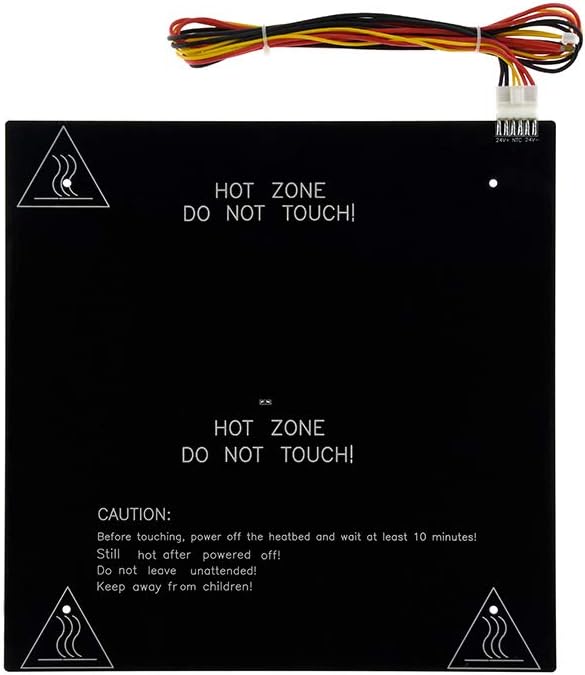
The HICTOP Ender 3 Heated Bed combines a 4.5 rating with a clearly stated 110-degree Celsius maximum and a familiar 220-watt, 24-volt electrical specification. Those practical details make it a compelling budget replacement for the large group of Ender 3 owners who need a conventional aluminum hot bed rather than a specialized high-temperature assembly.
We may earn a commission when you buy through this link, at no additional cost to you.
Its 235 by 235 by 3 millimeter dimensions align with the standard Ender-style heated bed format. The listing extends compatibility beyond a single model to the Ender 3, Ender 3 Neo, Ender 3 Pro, Ender 3 V2, Ender 3 V2 Neo, and Voxelab Aquila X2. That breadth is useful for repair shops, schools, and makers supporting several machines, although each model should still be checked for matching cable and mounting details.
A published 110-degree Celsius maximum provides useful guidance when selecting filament and troubleshooting bed temperature. It is not an extreme-temperature solution, so users who regularly print materials demanding greater heat may need to consider other options. The square platform also does not address oversized or triangular build areas.
For a typical Ender 3 owner, this product offers a strong balance of accessible specifications and broad compatibility. It is a sensible budget choice when the bed has failed or produces uneven heating, provided the replacement’s dimensions and wiring match the machine. The listed rating and explicit temperature ceiling make it easier to qualify than an underspecified assembly.
The stated 110-degree Celsius ceiling helps users select compatible filaments and set realistic slicer profiles. It also makes this option easier to compare with other beds than products that provide power but omit temperature information.
Compatibility across several Ender variants and the Voxelab Aquila X2 makes this bed attractive to owners of more than one machine. Confirm the original connector, thermistor, and screw pattern before ordering.
We may earn a commission when you buy through this link, at no additional cost to you.
The Tosuny 200W 24V Silicone Heated Bed is a compact heating-pad option aimed at Ender 3, CRX, and Ender 3 Pro systems. Its 5.0 rating is the highest numerical rating in this group, and the 235-by-235-millimeter format fits the established square hot-bed footprint used across many entry-level printers.
We may earn a commission when you buy through this link, at no additional cost to you.
The silicone heating element is described as offering rapid heating, uniform heat transfer, low power use, and high thermal efficiency. A three-meter backing rubber is included according to the supplied description, potentially helping with installation. Unlike a complete rigid aluminum assembly, this product may function as a heating element intended to work with an appropriate bed surface, so the installation method deserves careful confirmation.
The product information also warns that the silicone material has a temperature limitation around 200 degrees Celsius and that exceeding the heater’s rating can damage it. The supplied text is difficult to parse in places and does not provide a clean maximum operating temperature, so users should not treat the material limit as a recommended print-bed setting.
This bed makes the most sense for a technically confident Ender user seeking a flexible 24-volt, 200-watt silicone heater rather than a complete replacement frame. Its perfect rating and useful dimensions are attractive, but correct pairing with the existing build plate, thermistor, insulation, and thermal controls is essential for safe operation.
Silicone construction is presented as a way to accelerate warm-up and spread heat across the surface. Uniform heating can help the first layer remain consistent, although actual results depend on the complete bed assembly and printer calibration.
The material warning is meaningful because a heating pad can be damaged by excessive temperature even when the surrounding printer components appear robust. Follow the manufacturer guidance, use a functioning thermistor, and avoid assuming a generic silicone temperature limit is an operating recommendation.
We may earn a commission when you buy through this link, at no additional cost to you.
This 310-by-310-millimeter aluminum heated bed is designed specifically for the Creality CR-10, offering a larger working surface than the compact beds at the top of the list. Its 3.8 rating is lower than the other products with numerical scores, but the detailed dimensions and mounting information make it more useful for a CR-10 repair decision than its relative score alone.
We may earn a commission when you buy through this link, at no additional cost to you.
The assembly is 3 millimeters thick and uses a 24-volt, 220-watt heater. It has a 240-millimeter center-to-center hole distance and approximately 4.2-millimeter mounting-hole diameter. These figures allow owners to compare the replacement directly with the original bed, while the included power wire kit provides useful installation hardware.
A protective film covers the back of the aluminum bed and must be removed before use. Failing to remove it can interfere with heat transfer and the electrical assembly. The narrowly defined CR-10 focus also means this is not a universal large-format bed; its mounting pattern and physical proportions must match the printer.
For a CR-10 owner, the specialized dimensions, power specification, and included wiring are meaningful benefits. The lower rating suggests it may not be the strongest general choice across all builders, but it can be a practical replacement where compatibility is otherwise difficult. Confirm the thermistor arrangement, connector, and mounting layout before installation.
The 310-millimeter square bed creates more usable area than the standard 235-millimeter Ender-style assemblies. That additional room can support larger components or a more flexible arrangement of multiple prints.
Published hole spacing, hole diameter, thickness, and voltage make preliminary compatibility checks much more reliable. The instruction to remove the rear protective film should be added to the installation checklist.
We may earn a commission when you buy through this link, at no additional cost to you.
The YWBL-WH 500mm Heated Bed is aimed at large-format printer builders, offering a 500-by-500-millimeter aluminum alloy platform with a 24-volt, 350-watt heater. Its 2.8 rating is the lowest numerical score in this roundup, so buyers should treat the listing as a specialized component rather than a universally proven drop-in replacement.
We may earn a commission when you buy through this link, at no additional cost to you.
The product description emphasizes a rigid aluminum alloy structure designed to resist deformation and wear during sustained high-temperature operation. An integrated heating plate and aluminum substrate are intended to improve conduction and maintain stable output. The listed 350-watt power rating supports fast heat-up and even distribution across the much larger surface.
Countersunk mounting holes help maintain a flush upper surface, reducing the chance of raised screw heads interfering with the nozzle. The tradeoff is that this benefit only matters if the hole pattern matches the printer’s bed support. No exact center spacing, thermistor details, or explicit maximum operating temperature are provided in the supplied data.
This option is best considered by makers building or upgrading a large 24-volt printer with appropriate structural support and control hardware. Its size, power draw, and mounting requirements make it unsuitable as a casual Ender replacement. The low rating warrants careful review of current customer feedback and a full electrical compatibility check.
A 500-millimeter square surface gives large projects considerably more room than a standard desktop bed. The associated mechanical frame, bed support, leveling system, and thermal expansion must be capable of handling that scale.
Countersunk holes avoid raised fasteners and reduce nozzle-collision risk around mounting points. Users should still inspect the assembled bed for levelness and verify that no hardware projects above the printable surface.
We may earn a commission when you buy through this link, at no additional cost to you.
The FYSETC Silicone Heating Plate for Voron Project is a specialized 300-by-300-millimeter upgrade intended to increase the heated area of selected Voron 2.4 R2 and Trident builds. Its perfect 5.0 rating reflects a strong response, while the inclusion of a 3950 100K thermistor and bimetal thermal fuse gives it a more complete safety-oriented feature set than many replacement pads.
We may earn a commission when you buy through this link, at no additional cost to you.
The silicone mat is approximately 1.8 millimeters thick and is said to cover more than 95 percent of the hot-bed plate. That expanded coverage can reduce unheated regions around the perimeter. It uses an XH2.54 two-pin connector, includes temperature sensing, and has a thermal fuse that disconnects the circuit during overcurrent or excessive temperature conditions.
This is an AC 110-volt, 750-watt product, not a 24-volt bed. It requires a solid-state relay and a printer designed around that electrical arrangement. The maker recommends not exceeding 100 degrees Celsius for service life, despite the pad’s resistance around 120 degrees Celsius, and explicitly warns against trimming or drilling it because that can damage the heater.
For a builder with a compatible Voron 2.4 R2 or Trident configuration, this is the premium pick in the roundup. The combination of broad heating coverage, sensing, over-current protection, and a perfect rating makes it more compelling than an unprotected generic pad. It is not a drop-in option for ordinary Ender 3 systems, and installation should be planned around the required relay and safety guidance.
The pad’s near-full plate coverage is its defining benefit. A larger heated area can make bed temperature more consistent near the edges, where localized cooling commonly contributes to first-layer problems.
A compatible thermistor and bimetal thermal fuse add layers of control and fault protection. These components do not replace sound wiring, relay selection, temperature calibration, or routine inspection of the installed system.
We may earn a commission when you buy through this link, at no additional cost to you.
The 220-by-220-millimeter aluminum hot bed is designed as a 12-volt upgrade for Anet A8 and A6 printers, with additional compatibility claimed for the A2 and other compatible systems. Its 4.5 rating is strong, and the 120-watt rating provides a sensible power level for a compact 12-volt build surface.
We may earn a commission when you buy through this link, at no additional cost to you.
An aluminum substrate and resistance wire form the heating structure, while a 1.2-ohm resistance specification allows owners to compare it with the original heater circuit. The package includes both the hot-bed plate and a hot-bed wire, reducing the need to source a separate cable during the replacement.
The product description does not provide a maximum operating temperature or a complete mounting-hole diagram. Those omissions matter because a similar physical size does not guarantee identical mounting, thermistor, or electrical compatibility. The stated 12-volt requirement also makes this unsuitable for the 24-volt systems featured elsewhere in this guide.
This is a good choice for an Anet A8 or A6 owner seeking a straightforward replacement and a strong customer rating. It is less versatile than the 24-volt Ender options but offers the convenience of an included cable and a conventional aluminum platform. Verify the original bed’s dimensions, resistance, connector, and thermistor position before installation.
A 120-watt heater rated for 12 volts can provide effective bed heating in a compact system without the higher electrical load of a 220-watt, 24-volt replacement. The control system must still support the bed properly.
Including the hot-bed wire makes the package more convenient for basic repairs. Users should still check the connector type and cable length against the original installation.
We may earn a commission when you buy through this link, at no additional cost to you.
This 400-by-400-millimeter aluminum alloy hot bed is a 24-volt, 280-watt kit for larger custom builds and selected Ender 3 Pro or CR-10 configurations. No numerical customer rating is supplied, which means there is no rating-based signal to compare it with the more established options at the top of the list.
We may earn a commission when you buy through this link, at no additional cost to you.
The integrated heating bed and aluminum substrate are intended to provide consistent power output and stable heat conduction. Its countersunk hole design keeps fasteners below the printable surface, helping preserve usable space and reducing the chance that a raised screw will catch the nozzle.
Compatibility language naming the Ender 3 Pro and CR-10 should not be interpreted as proof that the bed fits every version of those printers. The 400-millimeter dimensions differ substantially from the usual Ender platform, and the supplied information does not state the center spacing, hole diameter, thermistor model, connector, or maximum bed temperature.
The option is most appropriate for a maker with a suitably sized frame who wants a broad, rigid aluminum heating surface. The 280-watt rating and integrated construction are attractive for a large bed, but careful mechanical and electrical verification is essential. Current customer feedback should be reviewed closely before committing to a model without a numerical rating.
A 400-millimeter square surface is a substantial step up from compact desktop beds. It allows larger work layouts while retaining a straightforward square format that can be easier to support than a round or triangular bed.
Flush countersunk mounting points help avoid raised obstacles where the nozzle travels near screw locations. Overall flatness still depends on machining, mounting stiffness, and proper bed leveling.
We may earn a commission when you buy through this link, at no additional cost to you.
The 500-by-500-millimeter heated bed combines an aluminum alloy platform with a high-power silicone heating pad for large-format use. No numerical rating is provided, but the headline specifications are extensive: a 24-volt, 350-watt heated bed and a claimed ability to reach 100 degrees Celsius in 90 seconds.
We may earn a commission when you buy through this link, at no additional cost to you.
The product description also refers to a 3,800-watt silicone heating pad. That figure differs from the bed’s 24-volt, 350-watt headline rating, so the exact heater specification should be clarified before installation. It may describe a different pad or a combined arrangement, but it should not be treated as interchangeable with the bed rating without confirmation.
The integrated heating plate and aluminum substrate are designed to improve thermal stability and consistency. Countersunk holes support a flush surface, while the large platform provides ample room for substantial projects. Fast warm-up and broad heat distribution would be useful for demanding materials, assuming the printer’s power supply, MOSFET, wiring, and bed structure are appropriately rated.
This bed is best suited to an experienced large-format builder who can resolve the inconsistent power descriptions and match the mechanical mounting pattern. The 500-millimeter area and claimed rapid heating are compelling, but the lack of a numerical rating and limited dimensional detail warrant more verification than a standard drop-in replacement would require.
A stated 90-second rise to 100 degrees Celsius would reduce waiting time on a large build plate. Because that claim is not independently verified here, it should be treated as a listing feature rather than a guaranteed result.
The headline 350-watt bed rating and 3,800-watt pad reference should be reconciled with the seller’s documentation. A mismatched power supply, relay, or controller could make an otherwise capable bed unsafe or ineffective.
We may earn a commission when you buy through this link, at no additional cost to you.
This silicone heated pad is designed for Voron 2.4 R2 and Trident-style builds, with 300- and 350-millimeter size options. It uses 220-volt AC power and is available in 750-watt and 1,000-watt configurations, making it a high-power upgrade rather than a conventional low-voltage desktop bed.
We may earn a commission when you buy through this link, at no additional cost to you.
The perforated design supports installation while also addressing heat dissipation. The product description emphasizes quick, even heating and stable power delivery intended to limit temperature fluctuations, edge warping, and deformation. These are meaningful benefits for a large bed, provided the heater is installed beneath an appropriate rigid build surface.
Because this is a 220-volt product, it cannot connect to a standard 24-volt Ender controller. It also lacks a numerical customer rating in the supplied information. The compatible Voron models should be treated as a starting point, with the installer responsible for checking exact dimensions, clearances, cable routing, thermal protection, and electrical components.
The pad is a good option for a capable large-format builder who needs substantial AC heating power and a perforated silicone format. Its flexible power choices can accommodate different installation demands, but careful system matching is essential. For most entry-level users, the lower-voltage products earlier in the guide will be easier to integrate safely.
The 750-watt and 1,000-watt variants give builders a choice between two significant heat loads. The correct option depends on the printer’s power supply, switching hardware, thermal mass, and safety provisions.
Even, stable heating can help reduce corner lift and first-layer inconsistencies on large surfaces. Installation quality, insulation, calibration, and ambient conditions still influence the final result.
We may earn a commission when you buy through this link, at no additional cost to you.
A compatible heated bed depends on more than its physical size. Voltage, resistance, connector type, thermistor placement, mounting pattern, temperature needs, and the printer’s power system must all be considered before ordering.
Begin with the exact printer model and revision, not merely the broad product family. Creality’s Ender 3 line includes the Ender 3, Pro, V2, Neo, and V2 Neo, but cable routing, connectors, thermistor positions, and mounting details can differ. Some products in this guide are explicitly aimed at the CR-10, Voron 2.4 R2, Trident, Anet A8, or Aquila X2. Check the seller’s supported list, compare the replacement with the original bed, and look for an exact model-and-revision match whenever possible.
The heater must operate at the voltage supplied by the printer. Most desktop Ender-style beds use 24 volts and 220 watts, while the Anet option uses 12 volts and 120 watts. Large beds such as the YWBL-WH use 24 volts and 350 watts. The Voron-oriented silicone products use AC power at 110 or 220 volts and require suitable mains-rated switching hardware. Wattage also affects warm-up speed and electrical demand, so a high-power bed does not automatically work with a lower-power control system.
Standard Ender-style beds measure 235 by 235 millimeters, while the options for larger systems range from 300 millimeters to 500 millimeters. The Anet bed is a more compact 220 by 220 millimeters. Measure the available area, not only the advertised diagonal, because the printable region can be limited by brackets, supports, and leveling mechanisms. A larger bed also adds weight and may require a stronger frame, more rigid motion system, and stronger bed mounts.
Aluminum remains common because it is rigid, conducts heat well, and is easy to machine or level. Silicone heating pads can conform to a surface and spread heat efficiently, but they usually need a suitable top plate and careful insulation. Some listings combine both concepts. Consider whether the product is a complete heated-bed assembly or merely a heating element. Also examine the flatness of the printable surface and whether countersunk holes eliminate raised screw heads.
Match the bed’s safe operating range to the materials you use. PLA generally needs less heat than ABS or ASA, while advanced polymers can require still more. The HICTOP bed states a 110-degree Celsius maximum, while the FYSETC Voron pad recommends staying below 100 degrees Celsius for service life despite a higher material-resistance figure. Silicone products also carry material-related cautions. Avoid selecting a bed solely by maximum temperature; verify that the sensor, insulation, wiring, and controller are appropriate for the intended heat level.
A reliable thermistor is essential for closed-loop bed control, and a functioning thermal fuse or other cutoff adds protection against runaway heating. The FYSETC Voron plate includes both a 3950 100K thermistor and a bimetal thermal fuse. Other products may rely on the thermistor and thermal protection already installed in the printer. Check connector pinouts carefully because a reversed or incorrectly wired sensor can prevent heating, produce an inaccurate reading, or create a safety concern.
The Official Creality bed and HICTOP bed are described as including cables, while the CR-10 option includes a power wire kit. These additions can simplify a repair, but a complete job may still require mounting hardware, a new thermistor, insulation, a surface sheet, and a correctly sized connector. The Tosuny silicone option mentions backing rubber. Compare what is included with what your existing printer already has, and avoid assuming that a visible cable guarantees every electrical connection is present.
Fast heat-up, even temperature distribution, and low fluctuation improve repeatability, but claims alone cannot reveal long-term durability. Examine whether the bed has a rigid substrate, stable heater attachment, smooth surface, and mounting holes that resist distortion. Larger beds need stronger supports because heat can cause aluminum to expand. Customer ratings can provide useful clues, particularly when a product has an established score, but a low score or absent rating should not be replaced with invented experience. Review current feedback and consider the seller’s support for the specific failure.
Before installation, disconnect the printer from mains power and allow the bed and hot end to cool. Remove the existing bed carefully while noting cable routes, thermistor position, spring tension, and the order of any washers or spacers. Compare the replacement’s dimensions, mounting holes, voltage, resistance, and connector arrangement with the original assembly. Do not install a 110-volt or 220-volt AC heater in a 24-volt system, and never assume identical-looking connectors have the same pinout.
Mount the replacement using the printer’s intended leveling arrangement, then verify that the printable surface is level and that no screw heads, clips, or cable loops rise above the build plane. Connect the heater and thermistor with power still disconnected, inspect the wiring for damaged insulation, and confirm that the sensor responds correctly before allowing the bed to heat. For silicone pads, follow the seller’s instructions regarding the top plate, insulation, thermistor placement, and any requirement for a solid-state relay. Never trim or drill a silicone heater unless the manufacturer explicitly authorizes it.
Run a controlled initial test while monitoring bed temperature, thermistor behavior, and the printer’s thermal cutoff. A rapid temperature rise that does not agree with the sensor indicates a wiring or sensor problem, while no response can indicate a disconnected heater or incompatible control arrangement. Keep the bed clean and free of molten plastic, use an appropriate surface sheet when required, avoid abrupt thermal shocks, and periodically inspect fasteners, cables, insulation, and the surface for warping. Recalibrate leveling and bed adhesion after installing a new assembly.
No. A replacement must match the printer’s physical dimensions, mounting pattern, heater voltage, resistance, connector, thermistor type, and control electronics. Even beds advertised for the same printer family can require different wiring or board revisions. Compare the complete original assembly with the replacement specifications before purchasing.
Generally, no. A 24-volt heater requires a compatible 24-volt supply and control circuit, and forcing it to run on 12 volts may prevent it from reaching temperature. Conversely, placing a 12-volt heater on a 24-volt system can overheat the element and create a safety hazard. Match the manufacturer’s original voltage specification exactly.
Choose a bed that physically fits the printer and supports the dimensions of your intended models. Standard Ender beds are about 235 millimeters square, while larger options range from 300 to 500 millimeters. A larger bed requires a suitably rigid frame, strong mounts, reliable leveling, and enough electrical capacity to heat the added thermal mass.
Most functional heated beds require a thermistor or similar sensor for temperature control. Some products include one, while others expect the printer’s existing sensor to be reused. Never substitute or omit the sensor without confirming that the printer has an alternative control method. Correct wiring and connector pinouts are essential.
Neither type is universally better. Aluminum assemblies are rigid, familiar, and straightforward to level, while silicone pads can provide broad and rapid heat distribution but require careful installation and thermal management. The best choice depends on the printer, the existing plate, insulation, sensor arrangement, and the operating temperature required by your materials.
It is only appropriate if the voltage, wattage, physical dimensions, thermistor, relay, wiring, and control system all match the Ender 3 installation. The Voron-oriented pads in this guide use AC power and are not standard 24-volt drop-in replacements. Attempting an improvised installation can create electrical and fire risks.
Check that the printer is powered, the bed connector is fully seated, and the heater’s voltage and resistance match the original component. Inspect the thermistor resistance at room temperature, confirm the sensor wiring pinout, and verify that the control board or relay is receiving a valid signal. Avoid repeated heating attempts until the fault is identified.
Keep the surface clean, remove spilled filament carefully, and inspect the cable and connectors for wear. Avoid sudden temperature changes and do not drag hard tools across the printable surface. Periodically check mounting hardware, leveling, insulation, and thermistor placement. Recalibrate the bed whenever a new assembly or surface sheet is installed.
The Official Creality Ender 3 V2 Heated Bed is the best overall choice for compatible Ender machines because it combines official positioning, standard 24-volt 220-watt specifications, a preinstalled cable, and a 4.5 rating. The HICTOP option stands out as the best budget pick with broad model support and a clearly stated 110-degree Celsius maximum, while the FYSETC silicone plate is the premium choice for compatible Voron builders seeking expanded coverage, sensing, and thermal-fuse protection.
For most users, correct fit matters more than headline power. Verify the printer revision, physical dimensions, mounting-hole spacing, voltage, resistance, thermistor type, connector pinout, and available clearance. Larger 400- and 500-millimeter beds and high-power AC silicone pads are best reserved for builders with the frame, control hardware, thermal protection, and installation experience they require.
Customer ratings, seller information, availability, and prices can change after this guide was prepared. Review the current listing and recent feedback before purchasing, and compare the final electrical and mechanical specifications rather than relying on a product name alone. This approach helps preserve print quality, simplify installation, and keep the printer operating safely.