
Motion Sensor Alarm with Remote Control
4.2Editor score
Three operating modes
Eleven-language chime support
Tool-free remote setup
Our best indoor motion sensor alarm guide compares detection range, alert volume, remote control, power options, expandability, and installation for 10 models.
An indoor motion sensor alarm can provide an immediate warning when someone enters a hallway, garage, shop, bedroom, or business entrance. The right model balances dependable PIR detection, an alert loud enough to be noticed, simple controls, flexible mounting, and dependable operation without requiring a complicated security network.
We compared the ten products in this guide by examining their stated detection ranges, coverage angles, alert options, transmission distances, receiver systems, power arrangements, installation methods, and expansion potential. The list includes standalone sirens, wireless door chimes, caregiver alerts, and multi-sensor systems suited to different indoor needs.
Each review identifies what makes a particular model distinctive while also noting important limitations from its specifications. Ratings and product details reflect the supplied information, and features can vary by installation environment. Product prices and promotions change frequently, so readers should confirm current listings and availability before purchasing.
4.2Editor score

4.3Editor score

4.5Editor score
The comparison below places each alarm's core detection coverage, alert system, receiver or remote arrangement, and installation requirements side by side, making it easier to identify the model that matches a particular room or monitoring need.




The TECKNET 125dB Loud Indoor Motion Sensor Alarm combines a standalone PIR alarm, a bright visual warning, and a remote control in a package designed for straightforward indoor protection. Its 4.3 rating reflects a versatile balance of loud alert capability, flexible placement, and simple operation. The sensor detects movement from approximately 16 to 26 feet within a 120-degree field of view.
We may earn a commission when you buy through this link, at no additional cost to you.
Its most notable strength is the combination of a 125dB siren with a flashing strobe. That gives users both an audible and a visual indication, which can be valuable in a busy room or when the alarm is positioned somewhere a sound alone may be difficult to notice. The unit offers three stated volume levels—80dB, 100dB, and 125dB—so it can serve as either a gentle visitor chime or a more assertive security alarm.
Power flexibility is another meaningful benefit. Users can operate the detector with AAA batteries for portability or use USB-C for continuous power, making the same unit practical for a hallway, shop, garage, storage room, or vehicle interior. The included remote reaches up to 328 feet in open areas and can arm, disarm, change modes, adjust the operating state, or trigger an SOS alert without walking directly to the sensor.
The honest trade-off is that the usable detection distance depends on installation height, sensing angle, and environmental conditions. Also, USB-C only supplies power; it does not recharge the batteries, so buyers should not interpret the connection as a combined charging and operating solution. Even so, the combination of loud siren, strobe, remote operation, and power options makes this a compelling general-purpose choice for buyers who want meaningful alerts without a hub or app.
It is best suited to households, shops, garages, hallways, entryways, and temporary indoor installations where a loud, flexible standalone alarm is wanted. Buyers who value both audible and visual warnings and do not want to manage a complex security ecosystem should give it particular attention.
The 125dB maximum siren is paired with a flashing strobe, giving the detector two ways to communicate an event. This is particularly useful in locations with background noise or when a visual indicator is easier for household members to notice.
The 328-foot remote lets users change modes, arm or disarm the alarm, and activate the SOS function from another location. That convenience reduces the need to reach a wall-mounted detector or a unit placed in a difficult-to-access corner.
We may earn a commission when you buy through this link, at no additional cost to you.
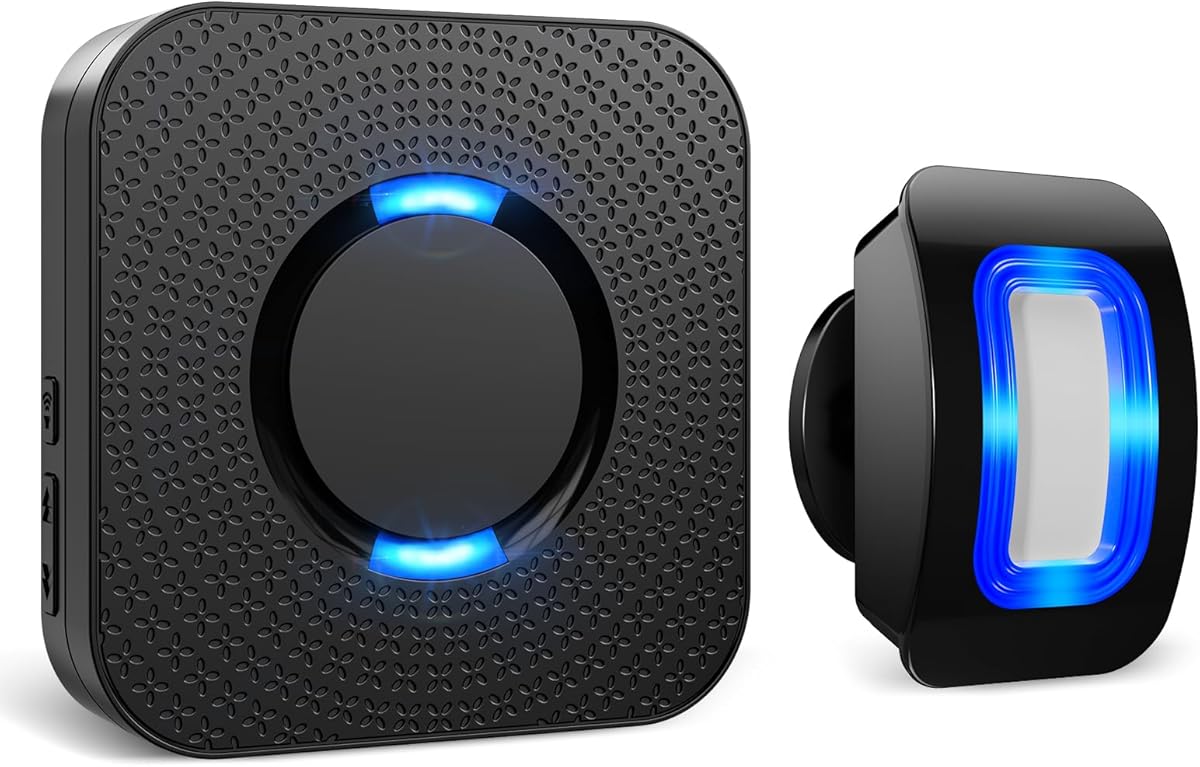
The Wireless Motion Sensor Door Chime is a flexible receiver-and-sensor system designed for entry alerts, business notifications, and indoor monitoring. Its 4.5 rating is among the strongest in this guide. The package includes a plug-in receiver and a battery-powered motion sensor, providing a practical way to place the receiver in one area and the detector near another doorway or room.
We may earn a commission when you buy through this link, at no additional cost to you.
The system supports 32 unique ringtones, including conventional doorbell sounds, alarm sounds, and longer tones. Five adjustable volume levels cover the range from silent operation to a maximum of 110dB. A flashing LED adds a visual indication, which helps when the sound is muted or when someone in the household has difficulty hearing the alert. The receiver can be placed where it is most useful rather than directly beside the sensor.
Transmission distance is a major strength. The stated working range reaches up to 500 feet between the receiver and motion sensor, allowing coverage across a larger home, office, shop, warehouse, garage, or business entrance. Motion detection covers approximately 16 to 26 feet at an angle of up to 110 degrees. The receiver can also be paired with as many as 20 sensors, and additional receivers can be added for broader monitoring.
There are some constraints to consider. The receiver must occupy a standard electrical outlet, so placement is less flexible than that of a portable receiver. The included detector requires two AAA batteries, which are stated to be included, but battery life will eventually require attention. The alert sounds and specifications may also need adjustment to avoid repeated notifications in a high-traffic area.
This is an excellent choice for users who want to monitor several entrances or business customer flow without installing a full security network. Its strong rating, generous receiver-to-sensor distance, visual alerts, and expansion support make it particularly useful for a shop, office, home entrance, garage, or multi-room caregiving setup.
A 500-foot transmission range means the receiver does not need to remain near the detection point. Users can keep one receiver in a central room and place sensors near offices, storefront doors, mailboxes, garage doors, or other monitored areas.
Thirty-two ringtones, five volume settings, and silent operation let users distinguish everyday arrivals from more serious activity. The LED indicator supplies a visual fallback when the receiver is muted or located away from the person who needs assistance.
We may earn a commission when you buy through this link, at no additional cost to you.
The CPVAN 125dB Motion Sensor Alarm is a portable standalone security unit with a stated detection reach of up to 40 feet. It carries a 4.1 rating and is built for indoor locations where a loud, self-contained siren is more important than app-based monitoring. Its features make it relevant to homes, garages, sheds, shops, boats, vans, stairways, kitchens, and storage areas.
We may earn a commission when you buy through this link, at no additional cost to you.
Its broad 40-foot maximum range is the main distinction among the products reviewed, although the stated best performance is usually within 10 to 26 feet. The PIR sensor uses infrared technology to identify human movement, while the unit's 125dB siren is intended to warn occupants and discourage intruders. Two operating modes allow the device to alternate between a loud security alert and a gentler chime for routine movement.
The remote control reaches up to 328 feet in open areas. Users can arm, disarm, or switch modes without approaching the detector. Installation is uncomplicated: the unit can be mounted with an adhesive sticker or screws, placed on a shelf or table, or carried into a vehicle. It operates as a wireless unit without an app, hub, or Wi-Fi connection, and CPVAN supplies an 18-month warranty with lifetime technical support.
The key trade-off is environmental. The alarm is explicitly not waterproof, and PIR sensors cannot detect motion through walls, windows, or glass doors. The advertised maximum detection distance should therefore be understood as a theoretical range that varies with placement. Buyers also receive fewer personalization options than models with numerous ringtones.
CPVAN is best for temporary or portable indoor protection in garages, vans, sheds, storage rooms, shops, and similar spaces. It is a strong choice for buyers who prioritize detection reach, a loud siren, and remote arming over customizable tones or a large receiver network.
The stated reach of up to 40 feet gives this model an advantage in larger rooms, garages, and storage areas. As with every PIR detector, real performance depends on mounting height, angle, obstacles, and environmental interference.
Battery operation and simple remote controls make the alarm convenient for temporary installations. It can be carried to a different room, shop, garage, or vehicle without requiring a hub, router, or account.
We may earn a commission when you buy through this link, at no additional cost to you.
The Wireless Motion Sensor LED Light is a plug-in receiver system with a large library of alert tones and a motion detector designed for indoor entry monitoring. Its 4.3 rating reflects a feature-rich receiver, straightforward installation, and useful visual signaling. It is especially appropriate for buyers who want many sound choices and the ability to connect several sensors to one receiver.
We may earn a commission when you buy through this link, at no additional cost to you.
The receiver offers 58 ringtones and five adjustable volume levels. When a sensor sends a signal, the receiver sounds the selected tone and flashes its LED indicator. The system supports up to 20 motion sensors per receiver, with transmitters and receivers able to be matched according to the user's setup. Its stated receiver-to-sensor operating range reaches 500 feet, making the receiver convenient for placement away from the monitored doorway.
Installation is straightforward. The detector uses two included AAA batteries, while the receiver plugs into a standard outlet. The sensor can be mounted near an entrance with a coverage angle of up to 110 degrees and a detection range of approximately 13 to 16.5 feet. An included 110dB alert supplies the maximum sound level when a stronger warning is preferred.
Trade-offs include the detector's shorter stated sensing distance compared with several other models. The ringtone-changing process also requires a specific button sequence: pressing the volume or down button, holding the volume button, or briefly pressing both buttons until the receiver indicates a setting change. Buyers should follow those instructions carefully rather than assuming the tones change automatically.
This system is a good fit for a home with multiple entrances, a business with several monitored points, or a caregiver who wants different sounds for different rooms. It is less attractive for large open areas requiring greater PIR reach, but its 58 tones, visual alerts, and expansion capability make it a versatile choice for indoor coverage.
The 58-ringtone library is the broadest personalization option in this guide. Different entrances can be associated with distinct alerts, helping users identify where activity occurred without looking at the detector.
The receiver's flashing LED supplements its programmable tones. This makes the system useful in noisy environments, during quiet nighttime hours, or for people who benefit from a visual notification.
We may earn a commission when you buy through this link, at no additional cost to you.
The Motion Sensor Alarm with Remote Control is designed as both a business entrance chime and a home security alarm. It carries a 4.2 rating and stands out for its tool-free setup, three operating modes, and support for eleven languages. The device can welcome customers and visitors, sound a security siren, or use a no-repeat mode intended to avoid repeated alerts.
We may earn a commission when you buy through this link, at no additional cost to you.
Its PIR technology is stated to recognize human movement up to 26 feet while filtering pets and airflow. This makes the alarm relevant to doorways, counters, hallways, offices, retail spaces, and stairways where routine customer movement should not always trigger an aggressive response. Four adjustable volume levels let users move from a quiet office chime to a stronger storefront warning.
Power is flexible. The unit can run on batteries or USB 5V power, and a low-battery voice reminder helps warn users before monitoring is interrupted. Setup is advertised as taking under two minutes without wiring or drilling. Once mounted and paired, the remote can adjust volume, switch among modes, and arm or disarm the alarm from across the room.
The four volume levels are slightly fewer than those offered by many competing receivers, but the wider range of operating modes partly compensates for that. The claim that the sensor ignores pets and airflow should also be understood as a design feature rather than a guarantee; installation height, direction, movement patterns, and the environment can still influence false triggers. Users may need to adjust the sensor angle after testing.
This model is a strong candidate for small businesses, offices, shops, and homes that want a quick indoor setup without tools. It is particularly attractive when the alarm needs to serve both visitor-notification and security roles, or when multilingual announcements are valuable.
The welcome chime, loud alarm siren, and no-repeat mode give the unit more flexibility than a basic single-sound detector. A business can greet arrivals without turning every movement into a full security response.
Tool-free mounting and wireless remote pairing reduce installation time. The result is particularly useful for temporary events, rental spaces, counters, and locations where drilling or permanent wiring is inconvenient.
We may earn a commission when you buy through this link, at no additional cost to you.
The Wireless Caregiver Pager Motion Sensor Alarm is designed for monitoring movement around a home, bedroom, or care environment. Its 4.5 rating indicates strong user reception, and its caregiver-oriented features make it more specialized than a conventional entry chime. It can notify a caregiver when a person rises from bed, leaves a room, or enters another monitored area.
We may earn a commission when you buy through this link, at no additional cost to you.
The supplied sensor detects movement within approximately 16.4 feet across a 110-degree field and sends a wireless signal to connected receivers. The stated open-area transmission range is 260 feet, while walls or doors may reduce that distance to approximately 10 to 40 meters. An adjustable mounting bracket provides some control over the sensing direction, and the system is designed to help reduce the need for continuous close observation.
Receivers provide both sound and light. Buyers can select among 58 unique ringtones and five volume levels, with a maximum stated output of 110dB. The flashing LED gives a visual indication when the receiver is muted, when music or other noise makes the tone harder to hear, or when a hearing-impaired household member is present. Each receiver can be paired with up to 20 transmitters, and each transmitter can be paired with up to 20 receivers.
The principal limitation is that the open-area transmission distance is shorter than the 500-foot systems in this guide. The receiver also needs a plug outlet, while the detector can use batteries or a USB cable. Users should test the range and detection field before permanently fixing the sensor, particularly when walls, doors, furniture, or floor-plan changes may affect performance.
This is a strong option for families monitoring an elderly relative, a person living with dementia, or children in a home where movement around a bed or doorway matters. It can also serve as an ordinary entry alert, but its greatest value comes from the visual paging and broad pairing support.
The receiver can alert a caregiver when someone gets up, leaves a room, or crosses a monitored threshold. That makes the system useful for bedroom-to-kitchen routes, nighttime movement, and other everyday routines that may warrant attention.
The LED indicator provides a clear visual cue when the receiver is muted or difficult to hear. This dual-notification design is especially helpful during sleep, while listening to music, or in multi-person care environments.
We may earn a commission when you buy through this link, at no additional cost to you.
The Electric Doorbells Motion System is a multi-part indoor alert package containing four motion detectors, two receivers, and mounting screws. Its 4.2 rating and bundled quantity make it appealing to buyers who want to cover several points without assembling a large system independently. It can function as a doorbell, garage alert, intruder warning, child or elderly-care alert, or general indoor notification device.
We may earn a commission when you buy through this link, at no additional cost to you.
The detector has an approximately 20-foot infrared sensing distance, while the signal can travel up to 300 feet from a sensor to its receiver. There are two types of notification: a flashing LED and a bell. Buyers can choose among 38 ringtones and three volume levels: medium, high, and low. Silent mode limits the receiver to the LED warning when a sudden sound would be undesirable, such as at night or around sleeping family members.
Because the package contains four sensors and two receivers, it can support more advanced coverage than a single-detector product. The listed uses include front doors, window frames, driveways, walkways, and interior hallways, although the product is not waterproof and should be kept away from rain. Detectors require AAA batteries, which are not included, so users should obtain those before installation.
The main trade-offs are the fewer selectable tones and volume levels compared with the most flexible receivers in the guide. Wind and obstructing objects can activate the detector or block its coverage, so placement matters. The relatively long transmission distance helps when sensors and receivers cannot share the same room, but it does not guarantee the same result through heavy walls or around corners.
This system is a good fit for a home, garage, shop, or care situation requiring several monitored locations immediately. Buyers who prioritize package quantity, flexible placement, and silent visual operation will appreciate it, especially if they plan to install sensors in more than one area.
Four detectors make it possible to monitor several entrances, hallways, garage points, or caregiving routes. Two receivers can then be placed where alerts are most likely to be noticed.
Silent mode leaves the LED warning active without producing a sudden sound. This is useful in bedrooms, nighttime spaces, or any location where a loud chime could be disruptive.
We may earn a commission when you buy through this link, at no additional cost to you.
The Wireless Motion Sensor Alarm Indoor is tailored to business entrances, offices, warehouses, corridors, stores, garages, and rooms. It carries a 4.3 rating and provides a useful combination of customizable tones, adjustable sensing direction, long wireless transmission, and expansion capacity. Its design is particularly relevant to businesses that want a welcome chime in some locations and stronger alerts in others.
We may earn a commission when you buy through this link, at no additional cost to you.
The receiver includes 32 regular tones and three alarm ringtones for a total of 35 choices. Five volume settings cover a range from mute to a maximum stated output of 110dB. A single receiver can coordinate with up to 20 motion sensors, and users can assign unique or shared tones to different entrances. This makes it possible to distinguish a customer at the storefront from movement near an office door or garage.
The sensor offers a 360-degree rotatable base with stated angle settings from 30 to 110 degrees and a distance range of four to eight meters. Its overall detection reach is listed as approximately 13 to 26 feet. Wireless transmission reaches up to 500 feet, allowing the receiver to remain in a central work area while sensors cover distant rooms or entrances.
Installation is flexible. Users can mount the sensor with adhesive on suitable walls or use screws on uneven surfaces. The receiver uses a plug-and-play arrangement, and the product is intended primarily for indoor placement. A limitation is that the stated capacity of 20 sensors does not mean the package includes 20 units; expansion requires additional compatible sensors.
This model is a strong option for retail spaces, offices, warehouses, and larger homes with several activity zones. Its combination of directional adjustment, zone-specific tones, mute control, and long transmission makes it especially useful where knowing which entrance triggered an alert matters.
The rotatable base and adjustable angle let users narrow or widen the monitored area. This is valuable near counters, doorways, corridors, and garage openings where unwanted cross-traffic could otherwise create repeated notifications.
Shared or unique tones allow a receiver to communicate the location or type of activity. Businesses can create a more informative alert system without adding complicated software or network configuration.
We may earn a commission when you buy through this link, at no additional cost to you.
The Luckydeer 125dB Motion Sensor Alarm is a portable standalone detector with a stated 40-foot maximum PIR range and a 125dB siren. It has a 4.2 rating and is marketed for homes, sheds, garages, shops, kitchens, bedrooms, boats, vans, and other indoor spaces. Its remote-controlled operation and included hardware make it easy to deploy without a receiver, hub, app, or Wi-Fi connection.
We may earn a commission when you buy through this link, at no additional cost to you.
The detector uses infrared sensing and intelligent analysis intended to distinguish human movement from interference signals. It can activate a 125dB alarm or operate as a doorbell chime. Two volume levels are provided, which is simpler than the multi-volume receivers elsewhere in this guide. The remote reaches up to 328 feet in an open area and includes an SOS button that triggers the host alarm immediately.
The stated PIR range is 16 to 26 feet, while the product title also identifies a 40-foot detector capability. Buyers should interpret these figures as configuration-dependent and test the actual space before committing to a placement. The package includes the alarm, three AA batteries, double-sided tape, screws, a manual, and the remote. Installation can be completed with the adhesive film in a short time when the mounting surface is suitable.
Its straightforward two-level volume adjustment and less flexible chime selection may disappoint buyers who want numerous tones or fine-grained volume control. The remote also loses some effectiveness around walls, doors, and other obstructions. Another consideration is that indoor monitoring tasks such as child movement or pet access still require thoughtful sensor placement.
Despite those limitations, this is a versatile choice for temporary garage, van, shed, shop, or room monitoring. It is especially appealing when the priority is a loud, self-contained siren, remote arming, and the ability to trigger an emergency alert without accessing a phone.
The integrated SOS button lets a user trigger the alarm from the remote. That adds a useful manual panic option for temporary monitoring, caregiver reassurance, or a secondary way to test the alert.
Included batteries, adhesive, and screws allow the detector to move between a home, garage, shop, shed, or vehicle. Its lack of app and Wi-Fi requirements also makes it convenient for temporary use.
We may earn a commission when you buy through this link, at no additional cost to you.
The METAK 1 PIR Detector is a wireless sensor-and-receiver system built for doorways, hallways, garages, mailboxes, pet areas, homes, and businesses. It carries a 4.5 rating and offers one of the most balanced specifications in the guide: 26-foot detection coverage, 500-foot transmission, 32 ringtones, five volume levels, and support for up to 20 sensors on one receiver.
We may earn a commission when you buy through this link, at no additional cost to you.
The infrared sensor covers a 110-degree field with a stated 26-foot diameter range. Its wireless signal can travel up to 500 feet between detector and receiver, so the receiver can be placed where alerts are likely to be heard or seen while the sensor covers a separate entrance. This separation is particularly useful for a business with a front counter and rear work area or a home with several access points.
The plug-in receiver provides 32 selectable ringtones and five adjustable volume levels, spanning silent operation to a maximum of 110dB. That range allows the same system to produce subtle movement notifications or a stronger security warning. One receiver can support up to 20 motion sensors, making the design suitable for larger spaces that may eventually need more coverage.
The detector uses AAA batteries for flexible placement and also supports Micro USB power for continuous operation. The trade-offs are the receiver's dependence on a standard outlet and the need to keep a suitable power cable available when continuous detector power is preferred. Buyers should also test the stated 500-foot distance in the actual building because walls and doors can reduce the effective range.
METAK is a strong recommendation for buyers who want a polished receiver-based system with extensive tone choices and expansion support. It fits both homes and businesses, especially when a central receiver can monitor several distant sensors and provide reliable audible or muted alerts.
Supporting up to 20 sensors makes the receiver a practical hub for a home, office, shop, garage, or pet-care setup. Additional detectors can be added without changing the basic receiver architecture.
AAA batteries make relocation straightforward, while Micro USB provides an option for continuous use. This dual approach is useful when a temporary installation may later become permanent.
We may earn a commission when you buy through this link, at no additional cost to you.
Choosing an indoor motion sensor alarm means balancing detection geometry, alert method, receiver architecture, power, placement, and expansion needs. The most important rule is to match the product to the monitored space rather than selecting solely by the largest stated number.
PIR detection distance and the width of the coverage field should be considered together. A stated 26-foot range may work well in a straight hallway but be excessive near a busy entrance, while a shorter 13-to-16.5-foot sensor may be better for a compact doorway. Coverage angles in this guide range from 110 to 120 degrees for most models, with one system offering adjustable settings from 30 to 110 degrees and another providing a 360-degree rotatable base.
Choose a model whose field can be aimed away from irrelevant movement. Hallways, staircases, counters, and open rooms may need different orientations, so adjustable detection angles are useful. Never assume maximum range will perform consistently through walls, glass, furniture, or other obstructions.
The appropriate alert depends on the environment. A loud 125dB siren is suited to a garage, shed, shop, or standalone security alert, while a receiver with 32, 35, 38, or 58 ringtones is more useful where the alarm doubles as a customer chime or household notification. Mute and visual LED modes can prevent unwanted disturbance during quiet hours.
Check whether the product offers both alarm and chime modes. Caregiving and business-entry applications usually benefit from softer, distinct alerts, while security-oriented installations may prioritize the highest stated output. A flashing indicator is also valuable for anyone who cannot rely on sound alone.
Standalone alarms place the siren and sensor in one unit and provide simple portability. Remote-controlled models add arming and mode changes over a stated 328-foot range. Receiver systems place the alert in a separate location, which can be especially useful when the detector covers a distant doorway or when several sensors share one central receiver.
Consider where the receiver will be heard, seen, and powered. Plug-in receivers need an outlet, while remote systems depend on clear line-of-sight conditions for their best stated range. Buyers who need information about which entrance triggered an alert should favor systems that support distinct tones per sensor.
Battery operation provides flexibility and makes temporary placement easy, while continuous power is advantageous in fixed installations where frequent battery replacement would be inconvenient. Options in this guide include AAA or AA batteries, USB-C, USB 5V, and Micro USB. Some continuous-power options also preserve the ability to operate on batteries.
Look for a low-battery reminder if the alarm will be responsible for security or caregiving alerts. Also verify which power accessories are included, because some packages include batteries while others require users to supply them. A wired receiver should also have a dependable outlet that is not controlled by a switch likely to be turned off accidentally.
Adhesive mounting is ideal for smooth surfaces, temporary setups, and locations where drilling is undesirable. Screws are more secure for permanent installation and uneven surfaces. A tabletop option or compact portable form can be useful in shops, storage rooms, garages, and vehicles, but it should be placed where it cannot be knocked over or easily disabled.
Look for an adjustable bracket or rotatable base when the sensor must cover a doorway, corridor, or stairway. Test the intended position before drilling, and keep the detection field free of moving objects. Check environmental limits as well, since several products are explicitly not waterproof even when used near a garage or driveway.
Receiver capacity is a major factor when monitoring a large home, office, shop, warehouse, or property with multiple entries. Several systems support 20 sensors per receiver, and one caregiver model also allows each transmitter to pair with up to 20 receivers. Other packages include multiple sensors and receivers from the outset.
Expansion is useful but should not be purchased on assumption. Confirm that additional sensors are compatible with the selected receiver and that the system can assign distinct tones when identifying separate zones matters. Buyers needing only one protected doorway may gain little from paying for broader capacity they will never use.
For a garage, van, shop, shed, or other standalone security setting, a 125dB siren provides a powerful deterrent and clearly announces detected movement. Two relevant products provide 125dB output, while the receiver-based systems commonly peak at 110dB. The difference matters when the detector itself must make the noise rather than a separate receiver.
Remote control adds convenience to these louder standalone units. Depending on the model, users can arm, disarm, change modes, or trigger an SOS function from up to 328 feet away in open areas. If remote reach is important, verify the layout for walls and obstructions rather than relying only on the maximum figure.
Caregivers should look for more than a loud siren. Visual LED indicators, mute controls, adjustable mounting brackets, and distinct ringtones can make a receiver more useful when monitoring an elderly relative, a person living with dementia, or children. The dedicated caregiver pager in this guide supports up to 20 transmitters and receivers, while still providing familiar ringtones and five volume levels.
Test the detection field before fixing the sensor in place. The stated 16.4-foot range should be compared with the actual bedroom or hallway layout, and the receiver should be placed where it can be heard or seen. Usability features matter as much as raw detection distance in a caregiving context.
Before mounting the sensor, identify the protected area and remove nearby obstacles from its likely detection field. Test the unit at the intended height and angle, walk through the space from different directions, and confirm that the receiver or siren is easy to hear or see. If the result includes unwanted alerts, narrow the angle, relocate the sensor, or remove moving objects that may be triggering it.
Install the receiver on a stable wall or countertop and place the sensor where it cannot be knocked, covered, or easily disabled. Follow the supplied instructions for pairing, especially when adding multiple sensors or changing ringtones. Charge or install the specified batteries before testing, and verify that continuous-power options are actually powering the detector rather than serving only as a charging connection.
Test the alarm regularly by using the remote's test or SOS function where available, then trigger the sensor from a safe position. Replace batteries on a schedule, clean the lens gently, and check that adhesive mounts or screws remain secure. Recheck range and sensitivity after moving furniture, changing room layouts, or introducing new airflow, since these factors can alter PIR performance.
A standalone alarm contains the detector and siren together and often includes a remote for arming or mode changes. A receiver-based system separates the sensor from the alarm unit, allowing the receiver to be placed elsewhere and potentially connect to multiple sensors. Standalone models are convenient for temporary protection, while receiver systems are usually better for central monitoring and multi-point coverage.
The products in this guide state detection distances ranging from approximately 13 to 40 feet, depending on the model. Actual performance depends on mounting height, sensing angle, room layout, airflow, and obstacles. PIR sensors generally perform best when people cross the detection field rather than moving directly toward the detector, so testing the intended location is essential.
They can be useful for indoor garage areas and other protected spaces, but most products listed are not waterproof. Direct rain, moisture, and outdoor exposure may damage the unit or reduce reliability. For a driveway or exterior opening, choose a product specifically designed for outdoor use or keep the sensor within a protected, dry enclosure.
Many of the standalone and remote-controlled alarms operate without Wi-Fi, an app, or a central hub. Receiver-based products also generally communicate wirelessly and plug into an outlet, though they create a larger system when multiple sensors are added. This simplicity can be an advantage in locations where network configuration is inconvenient.
Position the sensor away from moving curtains, pets, heaters, ventilation openings, and vehicles that may trigger the detection field. Adjust the angle or distance to match the protected zone, and use a narrower setting if the product supports one. Test the detector after installation and after moving furniture, because changing the room layout can alter its performance.
No. A 125dB siren is valuable for a standalone security alarm in a garage, shed, shop, or van, but it may be excessive for a bedside receiver or customer entrance. Systems with multiple ringtones, volume controls, mute modes, and visual indicators are often more practical when one device must serve both quiet and urgent alerts.
Several systems in this guide support up to 20 motion sensors on a single receiver. The caregiver pager also allows a transmitter to pair with up to 20 receivers, and the four-sensor package includes two receivers for immediate multi-point use. Additional sensors are not necessarily included with every expandable receiver, so buyers should check the package contents.
A caregiving-oriented model should offer a visual indicator, adjustable volume, mute capability, clear ringtones, and a receiver placed where it can be monitored. The dedicated caregiver pager in this guide provides those features and supports broad pairing. Before fixing the sensor, test whether its detection field covers the relevant bedside or doorway route without capturing irrelevant movement.
The TECKNET 125dB model is the strongest all-around standalone choice because it combines a powerful siren, a flashing strobe, three volume levels, flexible power, and a 328-foot remote. The Remote-Control Motion Alarm is a capable budget-oriented option for quick, tool-free installation, while the METAK 1 PIR Detector is the most polished receiver-based system with extensive tone selection and 20-sensor expansion.
Prioritize the features that match the location. Choose a loud standalone siren for a garage, shed, van, or temporary shop protection; choose a receiver system when one alert unit should monitor several entrances; and prioritize visual alerts, mute controls, and mounting flexibility in caregiving or business environments. Always test detection and radio reach in the intended space before final installation.
Current product prices, promotions, availability, and package details can change, so check the latest listing before buying. Confirm the included components, battery requirements, pairing capacity, and exact dimensions or mounting options. Those final checks help ensure that the selected indoor motion sensor alarm fits both the monitored area and the way it will actually be used.


