
Energizer Ultimate Lithium AA Batteries (8 Pack)
4.7Editor score
Eight standard AA lithium cells
Extreme temperature performance
Up to 25-year storage life
Discover the best lithium batteries for trail cameras, with expert comparisons of capacity, compatibility, charging, temperature performance, and field
Trail cameras must operate reliably through cold nights, changing seasons, and long stretches without maintenance, making battery selection a crucial part of the monitoring setup. Lithium batteries can provide strong low-temperature performance, useful shelf life, and consistent output, but the right choice depends on camera compatibility, energy capacity, rechargeability, and the conditions where the camera will operate.
This guide compares ten lithium battery options for trail cameras, including widely compatible AA packs and camera-specific rechargeable cartridges. The analysis considers available ratings, stated capacities, voltage, charging options, supported camera models, temperature ranges, safety features, storage life, and practical differences between disposable and rechargeable designs. It also distinguishes general-purpose batteries from packs designed around particular trail camera systems.
The selections show why the highest-rated option is not automatically the right battery for every installation. Some products prioritize a large reserve of standard cells, while others provide model-specific power packs, visual charge indicators, solar-panel support, or faster charging. Ratings and product details can change over time, and current prices, availability, camera requirements, and accessory compatibility should always be confirmed before purchasing.
4.7Editor score

4.7Editor score

4.3Editor score
This side-by-side comparison covers standard AA lithium cells, high-performance coin cells, and rechargeable camera-specific battery packs. The specifications highlight the differences that matter most: format, capacity, charging method, compatibility, and intended outdoor use.



The Energizer Ultimate Lithium AA Batteries 24 Pack is a strong all-around choice for trail cameras that accept standard AA cells. It carries a 4.7 rating and combines a generous pack quantity with the brand's stated focus on long-lasting lithium performance. The most immediately useful feature is its broad compatibility potential: a 24-cell inventory can cover one camera over several battery changes or support several cameras that use the same cell format.
We may earn a commission when you buy through this link, at no additional cost to you.
Its outdoor credentials are unusually clear. Energizer states that these batteries can operate from minus 40 to 140 degrees Fahrenheit, making them suitable for cold-weather scouting locations and warm-season installations. The company also says the cells can hold their power for up to 25 years in storage. That long storage claim is particularly useful for emergency camera kits because a spare can remain ready without becoming an immediate priority.
The pack also has practical advantages for field maintenance. A 24-cell supply makes it easier to standardize batteries across a property, while the stated leak-resistant construction helps protect equipment during standard use. The product description specifically identifies outdoor surveillance systems among suitable applications, which helps demonstrate that the battery is not being evaluated merely as a general household cell.
The principal trade-off is that these are disposable batteries. They remove the charging and battery-management tasks associated with proprietary packs, but they cannot be topped up between deployments. A user who wants a rechargeable system with visible charge status or solar-panel support may prefer one of the camera-specific alternatives. Even so, the 24-pack provides the broadest combination of quantity, outdoor specifications, and general camera compatibility in this list.
This is the best overall pick for hunters, conservation workers, and property owners who use several AA-powered trail cameras or want a dependable stockpile of standard cells. It is especially compelling for remote installations where battery changes are inconvenient and cold-weather performance matters. Those willing to replace cells as needed should also verify the exact battery count and quantity recommended by their camera manufacturer.
The Energizer 24 Pack ultimately offers the most balanced solution in this guide. It does not need model-specific charging equipment, carries a high rating, and provides an unusually broad stated temperature range. For users seeking a simple, recognizable battery format and a substantial backup supply, it remains an especially practical recommendation.
Twenty-four cells make this a useful maintenance pack for multiple trail cameras or for one camera used across a long hunting and monitoring season. Standard AA format also reduces the need to learn a proprietary battery system, although the camera's manual should still be checked for battery requirements.
The stated minus 40 to 140 degree Fahrenheit range covers demanding outdoor environments. Combined with up to 25 years of storage life, this makes the pack well suited to both active deployments and emergency reserves kept for later use.
We may earn a commission when you buy through this link, at no additional cost to you.
The Energizer Ultimate Lithium AA Batteries 8 Pack is a sensible budget-oriented starting point for one trail camera or a small camera group. It has a 4.7 rating, matching the larger Energizer pack in this roundup. Its main advantage is focused practicality: eight standard cells are enough to begin monitoring without buying a larger reserve, while the familiar AA format keeps battery changes straightforward.
We may earn a commission when you buy through this link, at no additional cost to you.
The product claims a wide operating range of minus 40 to 140 degrees Fahrenheit. That specification makes it relevant for cameras exposed to freezing conditions as well as warm environments. Energizer also describes the batteries as leak proof based on standard use and says their lightweight lithium cells can remain usable in storage for up to 25 years.
Those qualities make the eight-pack useful beyond the initial camera purchase. It can serve as a field-maintenance kit, a backup set kept with other emergency equipment, or a shared supply for compatible cameras. Since the cells offer such a long stated storage life, owners do not need to rotate the entire pack frequently simply because it is being held for a future deployment.
The obvious limitation is quantity. Compared with the 24-cell Energizer option, this pack provides less backup and may need to be replenished sooner. It also lacks a charger and a visible power indicator, as expected from a standard-cell product. Those disadvantages matter less when the goal is a simple first setup or when a user prefers to buy replacement batteries only as needed.
The best buyer for this product is someone operating one or a few AA-compatible trail cameras and seeking an uncomplicated lithium upgrade. It is also a good fit for campers, guides, or hunters who want a compact emergency battery reserve. Confirm that the camera accepts AA lithium cells and follow the camera maker's guidance on cell type and replacement intervals.
As the budget pick, the Energizer eight-pack succeeds by concentrating the same broad temperature capability and long storage claim into a smaller quantity. It does not offer rechargeable convenience, but it remains one of the simplest ways to place dependable lithium power into a compatible trail camera.
The pack provides enough cells to get a compatible camera running and establish a rotation for future changes. Its uncomplicated format is helpful for users who want better cold-weather characteristics without adopting proprietary cartridges.
Up to 25 years of stated storage life means this pack can remain part of a preparedness kit. Its sealed-cell format and broad environmental range are particularly relevant for equipment stored between hunting seasons.
We may earn a commission when you buy through this link, at no additional cost to you.
The Energizer Ultimate Lithium AA Batteries is a straightforward option for trail cameras that accept ordinary AA cells. Its 4.7 rating places it among the well-regarded products in this guide, and its familiar format makes it an uncomplicated choice for users who do not need a proprietary rechargeable pack. The supplied listing identifies Energizer as the manufacturer, offering a clear and trusted brand association.
We may earn a commission when you buy through this link, at no additional cost to you.
The main strength here is versatility. Standard AA lithium batteries can be used in a camera without introducing a special voltage arrangement, dedicated charging cable, or model-specific cartridge. That can make battery logistics easier when the same camera is moved between locations or when several devices share the same power format. It also allows a spare to be added to an existing camera kit without altering the installation.
Compared with the more extensively described Energizer packs in positions one and two, this listing provides much less information. It does not state a cell count, temperature range, storage duration, or construction detail in the supplied product data. Buyers therefore need to inspect the current package information to confirm the exact quantity and features of the package being offered.
That limited description is the principal trade-off. A product with fewer listed specifications naturally gives the shopper less information at the decision point. It may be perfectly suitable, but the purchase should be based on verified compatibility and the current package contents rather than assumptions carried over from another Energizer Ultimate Lithium listing.
This battery is best for a trail camera owner who values a standard AA format, a well-regarded rating, and uncomplicated replacement. It is less compelling when detailed cold-weather claims, a visual power gauge, or a clearly stated pack size is essential. Checking the camera manual and package listing before ordering is especially important.
The Energizer Ultimate Lithium AA earns its place as a practical conventional-cell option. It avoids the learning curve of camera-specific power systems and offers a strong rating, yet its understated listing requires a little more attention from the buyer. Once compatibility is confirmed, it remains a straightforward route to powering a compatible trail camera.
Using a conventional AA lithium cell can make battery changes faster and reduce the amount of specialized equipment carried into the field. The camera maker's compatibility and battery-type instructions remain the deciding factors.
The available listing identifies the manufacturer and rating but does not specify a pack count. Reviewing the live package information prevents surprises over quantity, included accessories, and the exact claims associated with this version.
We may earn a commission when you buy through this link, at no additional cost to you.
The Duracell CR123A 3V Lithium Battery is the highest-rated product in this comparison, carrying a 4.8 rating. It is a specialized option rather than a universal answer for every trail camera. The CR123A format uses a three-volt coin cell, so it should be selected only when the trail camera or an associated sensor specifically calls for that battery.
We may earn a commission when you buy through this link, at no additional cost to you.
Duracell positions the product for high-performance applications, including home security cameras, alarm sensors, professional cameras, and tactical flashlights. That distinction matters because a trail camera may contain a sensor, wireless module, or accessory with its own battery requirement. The description's emphasis on high-energy lithium chemistry suggests a strong fit for compact devices where energy density and dependable output are important.
The pack contains six cells and includes a 10-year storage guarantee. It also claims performance from sub-freezing temperatures to high heat, an important characteristic for outdoor security equipment. Unlike a proprietary rechargeable cartridge, the CR123A can be replaced individually as needed, making it possible to keep a small number of spares close at hand.
The major limitation is format. A CR123A cannot replace an AA battery in a camera designed for AA cells, even though both are lithium technologies. The 3-volt output and physical dimensions are different. A buyer who mistakes chemistry compatibility for physical compatibility could end up with unusable cells, so the camera's battery compartment and manual should be checked before ordering.
This product is best for a trail camera setup with a documented CR123A or three-volt lithium requirement, particularly one that benefits from compact energy density and long-term storage. It is also relevant to compatible security sensors associated with a broader monitoring system. It should not be chosen merely because its rating is higher than that of the AA products.
The Duracell CR123A stands apart through its excellent 4.8 rating, high-energy positioning, long storage guarantee, and wide temperature capability. When the required format is confirmed, it offers a dependable specialized solution. When it is not, the standard AA packs remain the safer choice for most conventional trail cameras.
The CR123A format concentrates three-volt lithium power into a small cell. This makes it appropriate only where the device specifies the same dimensions and chemistry, especially for compatible security and sensor applications.
A six-count pack with a 10-year storage guarantee can sit in an emergency kit without constant rotation. Its broad environmental range also suits sensors and devices stored in outdoor-adjacent environments.
We may earn a commission when you buy through this link, at no additional cost to you.
The BEVIGOR 1.5V Long-Lasting Lithium AA 24 Pack offers a feature-rich standard-cell alternative with a 4.3 rating. It combines a 24-cell inventory, steady 1.5-volt output, and a claimed shelf life of up to 20 years. The product data also gives it a lower weight figure of 15 grams per cell, which may be noticeable when carrying multiple sets for remote camera maintenance.
We may earn a commission when you buy through this link, at no additional cost to you.
One of its most useful claims is the maintenance of full voltage nearly to the end of service, rather than a gradual decline typical of alkaline batteries. For a trail camera, that characteristic can help maintain predictable operation throughout the usable period of each set. The pack also states a self-discharge rate of less than 1% per year, supporting its suitability for backup cells that may remain in storage.
Safety is another point of differentiation. BEVIGOR describes three layers of protection: leak prevention, an explosion-proof valve, and short-circuit protection. These features are relevant in any battery-powered field device, and the stated operating range of minus 40 to 140 degrees Fahrenheit is broad enough for demanding seasonal conditions. Trail cameras are explicitly included among the product's intended applications.
The trade-off is that its 4.3 rating is lower than the 4.7 and 4.8 ratings attached to several competitors. It remains a well-regarded option, but the Energizer packs have a stronger customer-rating profile. As with any disposable battery, users must replace cells rather than recharge them, and there is no built-in gauge showing the state of charge in the camera.
The BEVIGOR pack suits buyers who want a large number of standard cells, detailed voltage and discharge claims, and a lower carrying weight per cell. It is particularly useful for users who appreciate explicit safety protections. Those who prioritize the highest customer rating or the longest stated storage duration may prefer an Energizer Ultimate Lithium offering.
Overall, the BEVIGOR 24 Pack is a credible all-round standard-cell choice. It combines large quantity, low weight, stable voltage, and thoughtful protection features in a format that works with any trail camera explicitly designed for 1.5-volt AA cells. Confirm compatibility and storage conditions before deployment, and keep a tested rotation of spare cells available.
The manufacturer states that the cells maintain full voltage nearly to the end of their service. That steady-output claim makes them appealing for users who prefer more predictable camera operation between battery changes.
Leak-proof construction, an explosion-proof valve, and short-circuit protection address common battery failure concerns. These protections do not remove the need for proper storage, but they make the pack better suited to unattended equipment.
We may earn a commission when you buy through this link, at no additional cost to you.
The Lesaps 2-Pack 6000mAh Rechargeable Reveal Lipo Lithium Batteries Pack is the most fully featured premium option in this roundup. It has a 4.3 rating and is designed specifically for a broad list of Tactacam Reveal models, including the X Ultra 3.0, X Gen 3.0, 2.0, X Pro 3.0, Pro, SK, XB, and X. That explicit compatibility makes model verification essential before purchase.
We may earn a commission when you buy through this link, at no additional cost to you.
Each pack provides 6000mAh of capacity, and two are included. The rechargeable design eliminates repeated purchases of disposable cells, while the LED meter gives users a visual indication of battery status. A flashing light indicates charging and a solid light indicates a full charge, reducing the uncertainty associated with proprietary camera batteries.
Charging flexibility is another major strength. The packs accept USB-C and 12-volt DC power, include a USB-C cable, and can work with Tactacam solar panels. A full charge takes approximately five hours according to the product data. These options suit both base-camp preparation and longer remote deployments where replenishing power from a vehicle or compatible panel is valuable.
The battery also carries a detailed safety system. Its intelligent control chip is described as providing protection against overcharging, over-discharging, overvoltage, overcurrent, overheating, and short circuits. The claimed operating range of minus 20 to 140 degrees Fahrenheit supports year-round use, although users should still store or transport the pack within appropriate conditions.
Its limitations are predictable. This is not a universal AA option, and the compatible camera list must be checked carefully. The batteries require recharging, so a completely hands-off installation still needs an energy source, though compatible solar panels can help address that concern. The 4.3 rating also places it behind the highest-rated standard cells, even though rating alone cannot measure rechargeable system utility.
This is the best premium pick for a user invested in the compatible Reveal ecosystem. It is particularly attractive when several cameras will operate at once, because the two-pack configuration and visible charge indicators simplify rotation. It is also a strong choice for extended outdoor work where USB-C, 12-volt, or solar charging options are available.
The integrated LED meter removes guesswork from monitoring a spare battery. Two packs allow one unit to remain in a camera while the other is being charged, making rotation more convenient during multi-camera deployments.
USB-C offers convenient charging from a standard USB charger, while the 12-volt input supports vehicle and solar-panel options. With an approximate five-hour full charge, the pack can fit into a practical preparation and rotation routine.
We may earn a commission when you buy through this link, at no additional cost to you.
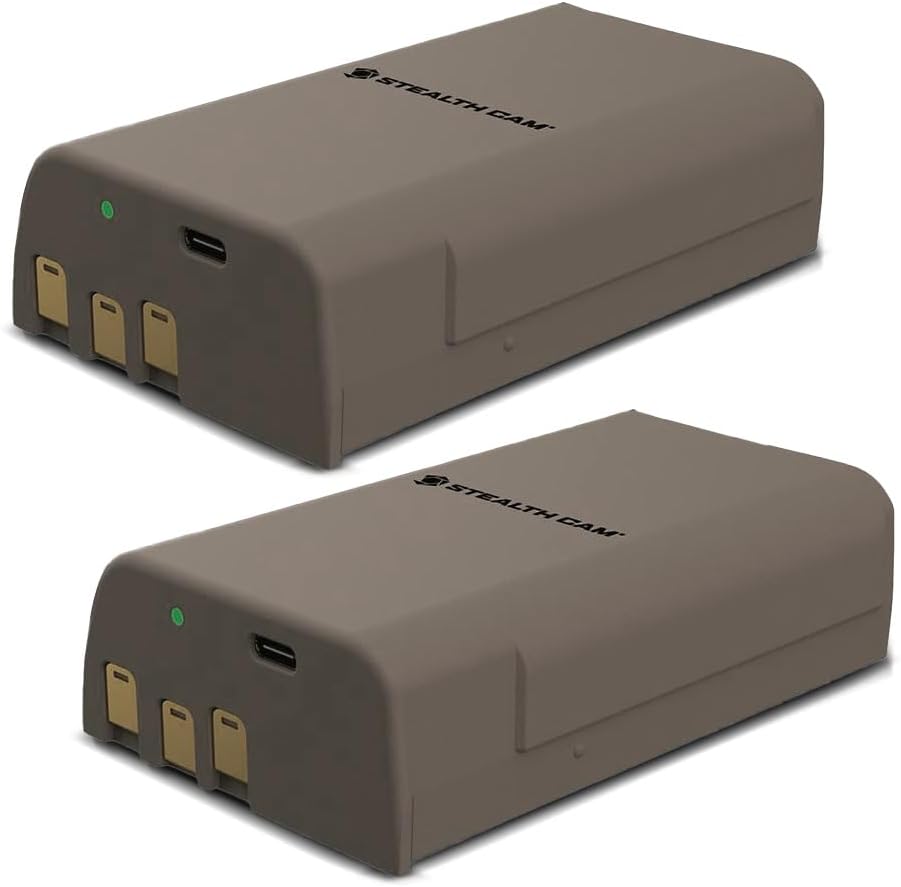
The Stealth CAM FieldMax MAX-PAK is a rechargeable 12-volt, 5000mAh lithium battery cartridge sold as a two-pack. It carries a 4.5 rating and is aimed at users of the Stealth Cam Flashback, Deceptor MAX, Fusion MAX, and Connect MAX models. Its camera-specific design makes it less flexible than an AA battery, but potentially more integrated for owners of the listed systems.
We may earn a commission when you buy through this link, at no additional cost to you.
The principal benefit is the elimination of disposable common power units. Once charged over USB with the included cable, each cartridge can be installed in a compatible trail camera. Rechargeable operation can reduce the recurring chore of keeping large quantities of standard cells on hand and may suit installations that already depend on a dependable camera-specific power architecture.
The MAX-PAK is also designed with wooded and low-light environments in mind. Its stated 5000mAh capacity and rechargeable design are presented as an alternative for locations where sunlight may be insufficient for regular solar charging. The product is described as weather resistant and built to withstand temperature swings, making it more relevant to remote, exposed camera sites than a generic household battery.
The main drawback is the absence of a stated visual power gauge. Users may need to rely on the camera's own reporting or a disciplined testing and rotation process to know when a cartridge needs charging. Compatibility is also limited: the current camera model must be among those specifically named, and the voltage and physical cartridge design are not interchangeable with standard AA cells.
This battery is best for Stealth Cam owners with one or more of the compatible MAX-family cameras, especially those placing units in heavily wooded areas where dependable stored power matters. The two-pack makes camera rotation easier, while the included USB cable simplifies charging. Owners should verify their exact model and establish a routine for inspecting and recharging cartridges.
The FieldMax MAX-PAK is a focused, professional-style power solution rather than a general battery. Its rating, rechargeable design, 5000mAh capacity, and low-light positioning make it compelling within the Stealth Cam ecosystem. Outside that ecosystem, its proprietary format offers little advantage over more universally compatible alternatives.
The proprietary cartridges replace recurring disposable power units with USB-rechargeable packs. The included cable and two-pack quantity support a rotation that keeps compatible cameras supplied with stored energy.
The product is specifically positioned for low-light terrain where solar alternatives may struggle. Its stated weather resistance and temperature tolerance make it a more natural fit for remote, exposed installations than an untested household cell.
We may earn a commission when you buy through this link, at no additional cost to you.
The Lesaps 2-Pack 7000mAh Rechargeable LIT-22 Battery is built for SPYPOINT cellular trail cameras and carries a 4.2 rating. Its headline specification is 7000mAh at 7.7 volts for each pack. The supplied information also states that the battery lasts 30% longer than standard batteries, making capacity and reduced charging frequency its main reasons to consider it.
We may earn a commission when you buy through this link, at no additional cost to you.
Compatibility is notably broad within the SPYPOINT range. The product is described as a direct replacement for the LIT-22 battery and is compatible with Flex-M, Flex G-36, Flex-Plus, Flex-S, and other SPYPOINT trail camera models. This broader camera list is useful for owners of multiple devices, provided the current product listing and camera manual confirm the fit.
Charging is handled through USB-C, with an included Type-C cable and an approximate six-hour charging time. LED indicators use red while charging and green when full. These status lights make it easier to manage a rotating set and avoid deploying an uncharged pack in a remote location.
The battery includes six stated protection layers covering overcharge, overdischarge, voltage, current, heat, and short circuits. Its operating range is minus 20 to 140 degrees Fahrenheit, suitable for cold winters and hot summers. The manufacturer also claims a lifespan three times longer than traditional AA batteries in trail camera applications, though actual runtime depends on the camera, settings, and operating conditions.
The product's limitations are its 4.2 rating, which is the lowest among the rechargeable camera-specific options, and its strict reliance on compatible SPYPOINT hardware. The two-pack configuration is still attractive because it supports rotation, while the 7000mAh specification gives it a substantial capacity advantage over smaller proprietary packs.
This is a strong choice for SPYPOINT users who value capacity over a disposable battery format. It is especially appealing when running multiple cameras, carrying one charged pack, and deploying another. It is less suitable for mixed-brand setups or anyone needing a universal AA replacement. Confirming the exact camera and battery fit before ordering is essential.
At 7000mAh, this pack offers the largest stated capacity among the products reviewed. The claimed 30% longer runtime than standard batteries points to fewer charging interruptions during long monitoring periods.
Red and green LEDs simplify charge-state checks, while six protection layers address common electrical risks. Together, these features make the packs easier to manage as part of a repeatable field kit.
We may earn a commission when you buy through this link, at no additional cost to you.
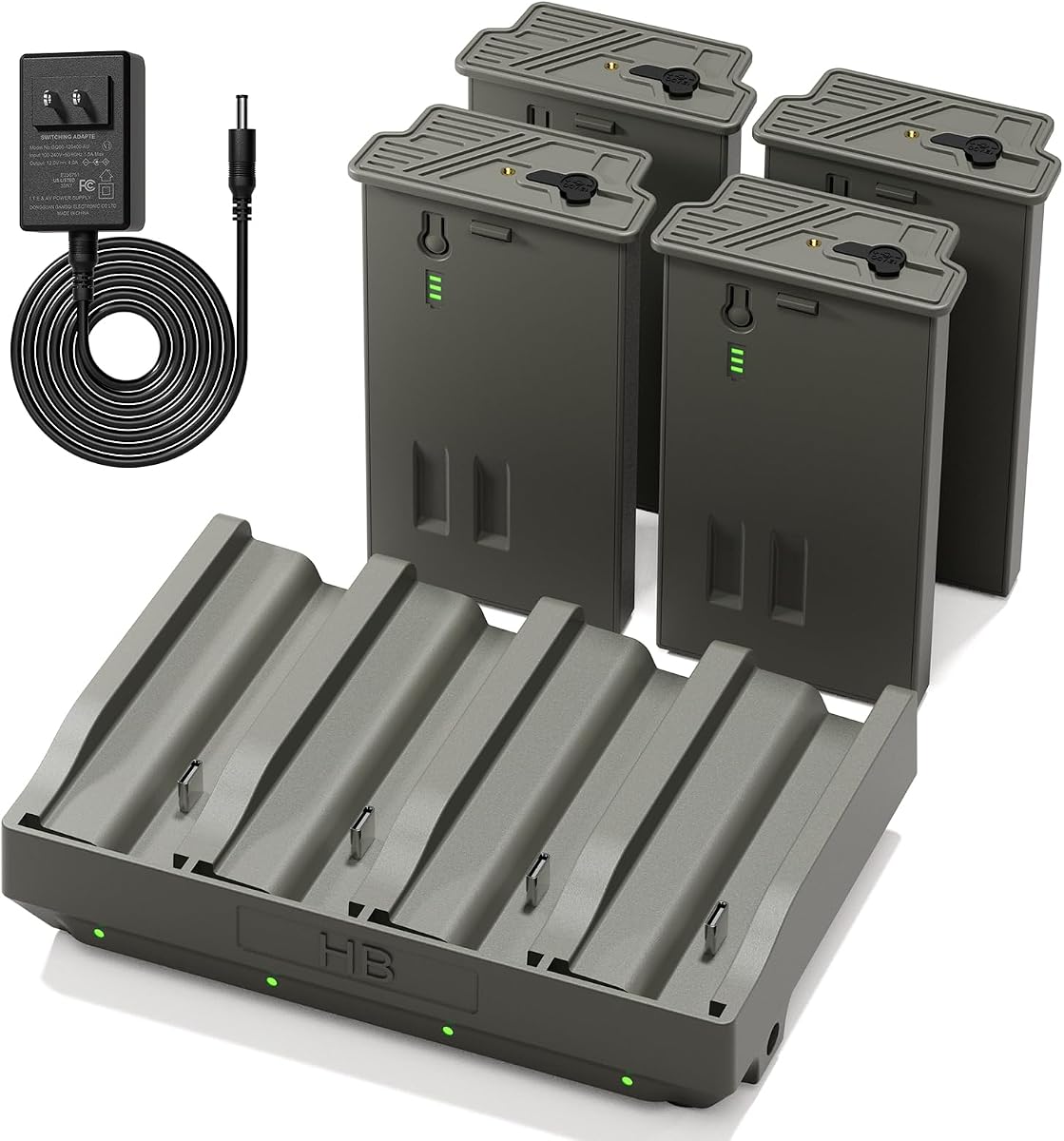
The New Reveal Lithium Battery and Four-Port Battery Charger is a distinctive bundle for users who want charging capability alongside the battery itself. It has a 4.2 rating and includes a 5000mAh rechargeable Reveal battery plus a charger that can handle one to four lithium batteries independently. For a multi-camera operation, that charger design may deliver more day-to-day convenience than several single-battery chargers.
We may earn a commission when you buy through this link, at no additional cost to you.
The battery is engineered for Trail Cameras Ultra, Pro 3.0, X Gen 2.0, 3.0, X Pro, XB, SK, and X series cameras. The extensive model list should make it relevant to a broad Reveal setup, but the precise camera and battery fit should be confirmed in the current listing. Its 5000mAh capacity is designed for dependable outdoor surveillance rather than short-term peak use.
The charger operates each port independently, allowing up to four batteries to be charged simultaneously without separate adapters. Sequential flashing LEDs indicate charging progress, and all four remain lit when the batteries are ready. Type-C charging provides a modern connection, while the included power components reduce the need to source a separate charging system immediately.
The product highlights high-performance Japanese battery cells, built-in protection circuitry, and CE/FCC-certified components. Those points support its positioning as a higher-integrity charging bundle. The integrated LED power indicator also reduces guesswork when checking a battery before installation, and the stated quick, simple installation process suits users changing packs in the field.
The principal trade-off is bundle composition. The product data specifically describes one 5000mAh battery and a four-port charger, but does not clearly establish that four batteries are included. Buyers should therefore confirm the exact number of batteries in the package. The charger may also be more capacity than needed for a single-camera owner.
This bundle is best for Reveal owners running several cameras or expecting to expand a system. The independent four-port charger simplifies battery preparation, and the visible indicators make it easy to see when each pack is ready. It is less essential for someone needing only one battery and a basic USB-C cable, but it remains a well-organized solution for larger deployments.
Independent four-port charging allows a user to prepare a complete set of compatible packs in one location. This is particularly useful for multi-camera sites where staggered deployments would otherwise require extra charging equipment.
The battery's integrated indicator and the charger's sequential flashing lights provide clear status references. Those visual cues help reduce the risk of installing a partially charged pack at a remote camera site.
We may earn a commission when you buy through this link, at no additional cost to you.
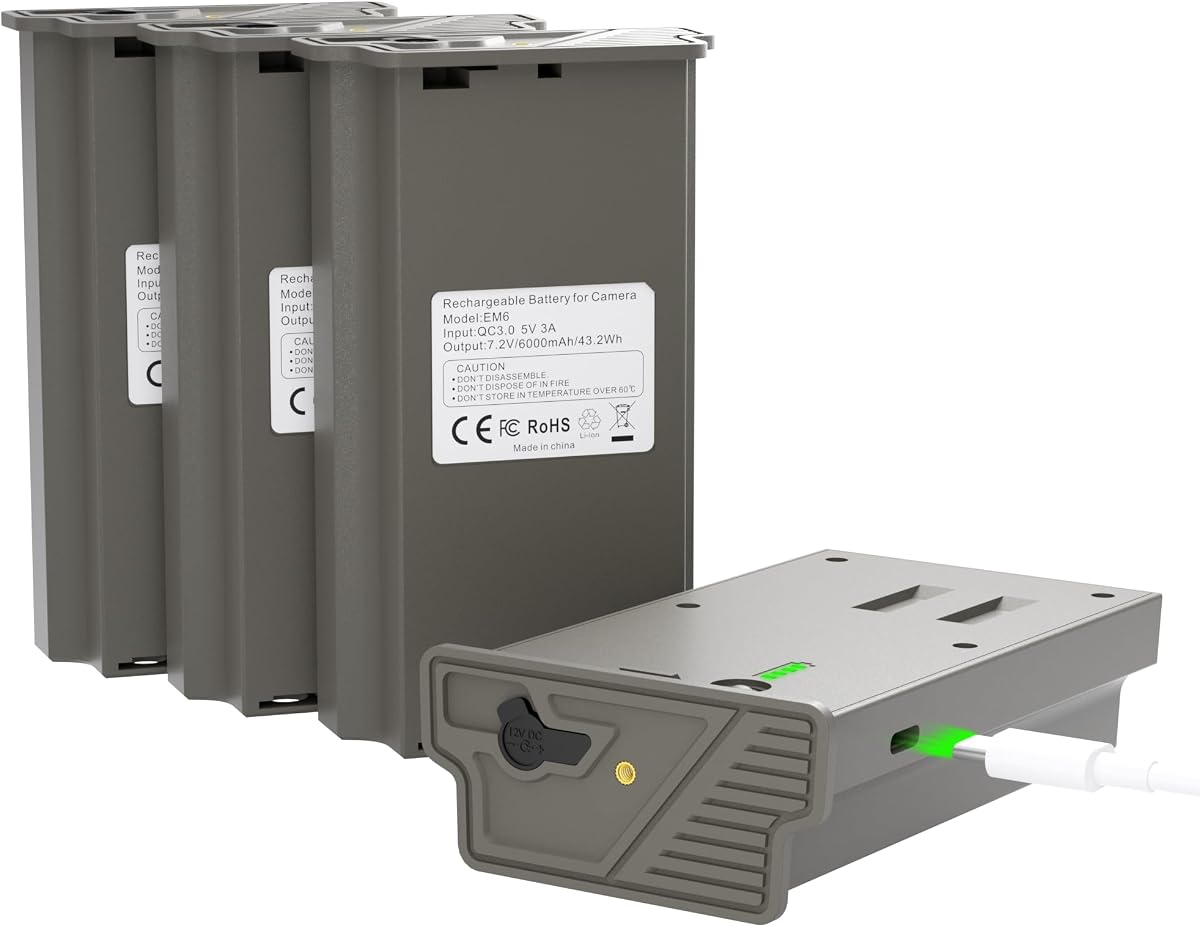
The 4-Pack New Reveal Lithium Battery Pack is a well-rounded multi-camera bundle with a 4.4 rating. It includes four 7.4-volt, 6000mAh rechargeable battery packs, four USB-C cables, and a user manual. The generous pack count makes it especially appealing for owners of several compatible Reveal cameras who want enough batteries to maintain a rotation without relying on disposable cells.
We may earn a commission when you buy through this link, at no additional cost to you.
The stated compatibility list includes the X, XB, SK, X Gen 2.0, X Gen 3.0, X Pro, and X Pro 3.0 trail cameras. The four-pack's capacity is positioned as a way to reduce frequent recharges during continuous outdoor monitoring. It can also connect with matched solar panels, offering a path toward a more sustainable setup for distant installations.
Each battery has a press-button LED power meter, allowing the user to check remaining charge without installing it in a camera. USB-C charging is supported, and the lights flash during charging and remain solid when full. Four separate cables are included, which is convenient for keeping a charging area organized or charging multiple packs in different locations.
Intelligent safety protection is another advantage. The product description lists safeguards against overheating, overcharging, overdischarging, overcurrent, overvoltage, and short circuits. It also states that the packs maintain stable output across changing outdoor temperatures. These characteristics make the batteries more focused on remote monitoring than a general-purpose AA cell.
There are two notable trade-offs. First, the package includes cables but not a four-port charging hub, so the user must supply a way to charge all four at once. Second, the battery format is restricted to the listed Reveal cameras and cannot substitute for standard AA cells. The 4.4 rating is solid, though it does not lead the highest-rated options in the guide.
The best buyer is a Reveal user with multiple cameras, a remote property, or a preference for a complete rotation of four batteries. Solar-panel support adds value for installations away from vehicles or wall outlets. Confirm the camera model, charger requirements, and solar-panel compatibility before ordering, then keep the four included cables with their assigned packs.
Four interchangeable packs make it easier to maintain multiple cameras because one can be charging while another remains ready. The package's four matching cables support a clean, organized charging setup.
Compatibility with matched solar panels offers a practical charging path for cameras placed far from conventional power. The press-button power meter helps determine when a pack needs attention before a field visit.
We may earn a commission when you buy through this link, at no additional cost to you.
The right trail camera battery depends on electrical format, camera model, temperature exposure, runtime needs, and recharge strategy. These factors are more important than a single headline capacity number because a battery cannot deliver useful performance unless it fits, operates safely, and meets the camera's power requirements.
Match the format, dimensions, polarity, and voltage before comparing runtime. Use the camera manual and the current battery listing as the final reference.
Compare actual field runtime when possible, but prioritize a battery that fits your camera and meets its electrical requirements.
For winter hunting areas, choose a battery with documented low-temperature performance and keep spare cells or packs protected until needed.
Choose disposables for simplicity and rechargeable packs for repeated use, rotation, and remote charging flexibility.
Match the charging system to where you will prepare the batteries and how frequently the cameras are visited.
A clear charge indicator is especially valuable when batteries are prepared in bulk and deployed far from a charger.
Look for multiple protection layers and follow the manufacturer's storage, charging, and disposal instructions.
Buy enough batteries to maintain a planned rotation, not merely the minimum number needed for one installation.
Begin by confirming the battery format, voltage, polarity, and permitted chemistry in the trail camera manual. Match every cell or rechargeable pack with the camera's required configuration, and do not combine batteries of different types, voltages, charge states, or brands unless the manufacturer explicitly permits it. For a multi-camera setup, label each battery and its camera so the rotation remains consistent and a depleted pack is not mistakenly returned to service.
Before deployment, test each new AA cell or rechargeable pack in the camera and verify that the camera recognizes it normally. For rechargeable products, charge according to the supplied instructions, watch the stated charging indicators, and allow the pack to reach its indicated full state. Remove packs from cameras before long-term storage, clean contacts with a dry, nonabrasive method, and keep batteries dry and away from extreme heat, moisture, and physical damage.
Plan checks around battery life, weather forecasts, and travel access. A visual indicator helps with compatible rechargeable models, while standard cells require a consistent replacement schedule. Do not leave a depleted or damaged pack in a camera, and avoid mixing partially charged proprietary cartridges with fresh ones. At the end of the season, store unused cells and packs in a dry, moderate-temperature location, and follow local guidance for recycling or disposing of batteries.
Lithium batteries are often better suited to trail cameras because many lithium products maintain more consistent voltage, perform well in cold conditions, and have a longer stated storage life. Alkaline batteries may work in warm conditions but can lose performance as they drain. The best choice still depends on the camera's battery compartment and manufacturer recommendations, and rechargeable lithium-ion packs should not be substituted for AA cells without compatible hardware.
They can be used in cameras designed for standard 1.5-volt AA lithium cells, including many AA-powered trail cameras. They cannot replace coin cells, proprietary cartridges, or other battery formats. Check the camera manual for battery type guidance and pay particular attention to any instructions about mixing battery brands or charge levels. Keeping a consistent set of cells in each camera is a prudent operating practice.
AA lithium batteries are disposable standard cells that are installed one at a time and replaced when depleted. Rechargeable trail camera packs are complete battery systems with a defined voltage, capacity, connector, and charging method. They usually support USB charging, may include LED indicators, and are restricted to compatible camera models. The rechargeable route is convenient for frequent use, while standard cells can be simpler for occasional deployments.
Check batteries more often in cold weather, when cameras record frequently, or when a location receives heavy traffic. The right interval depends on camera settings, temperature, battery capacity, and whether night vision and wireless transmission are active. Rechargeable packs with visible charge indicators can be monitored before deployment, but all systems still benefit from a planned inspection schedule. Always carry a tested spare set when traveling to a remote camera.
Proprietary packs can offer greater usable capacity, an integrated power gauge, and direct compatibility with a specific camera system. They are especially useful for multi-camera deployments because several packs can be charged in rotation. Standard AA lithium cells are more versatile and simpler to carry, but they must be replaced rather than recharged. The better option depends on the camera model, visit frequency, charging access, and preferred maintenance routine.
Some compatible systems support solar charging, including the Lesaps Reveal and four-pack Reveal options when paired with matched panels. A panel's output, connector, and charging controller must match the battery's requirements. Other packs, such as the SPYPOINT LIT-22 and Stealth CAM MAX-PAK, list USB-C or USB charging rather than solar support. Verify the current instructions before connecting any alternative power source.
Store batteries in a dry place with moderate, stable temperatures and away from direct heat, moisture, and physical damage. Keep standard cells in their original packaging and rechargeable packs at a suitable partial or storage charge level if the manufacturer specifies one. Remove packs from cameras for long-term storage, label them, and test them before the next deployment. Follow the battery maker's guidance for damaged, swollen, leaking, or end-of-life products.
No. Different cameras may require different cell counts, and some use proprietary lithium-ion cartridges instead of standard cells. The camera manual or battery compartment will indicate the required quantity and format. Do not assume a 24-pack is sufficient for multiple cameras until you have calculated each camera's requirements and included some extra cells for rotation and unexpected failure.
The Energizer Ultimate Lithium AA 24 Pack stands out as the best overall choice because it combines a high customer rating, 24 standard cells, a broad stated temperature range, and long storage life. The eight-cell Energizer pack is the best budget starting point, while the Lesaps 6000mAh Reveal pack earns the premium recommendation for users who want rechargeable capacity, flexible charging, solar support, and a visible power gauge.
Compatibility should take priority over every other consideration. Standard AA packs are ideal for cameras designed around 1.5-volt cells, the CR123A is appropriate only for matching three-volt applications, and proprietary packs should be selected only after checking the exact camera model. Beyond fit, prioritize cold-weather specifications, credible capacity, charge visibility, safety protections, and enough inventory to support a dependable rotation.
Before ordering, confirm the camera's battery requirements, compare the latest package contents, and check whether the intended charging and solar equipment is included or sold separately. Ratings, product configurations, availability, and prices can change, so current listing information should be reviewed at the time of purchase. With the right format and a sensible maintenance plan, the selected lithium battery can support more dependable trail camera monitoring throughout changing field conditions.