
GPL 205 G0 for Keyboard Switch Lube
5.0Editor score
Covers 300-350 switches
Mixable for sound customization
Includes durable nylon brush
Suitable for stabilizers and springs
Our expert guide compares the best lube for keyboard switches stabilizers, covering grease type, viscosity, packaging, coverage, application ease, and
Lube for keyboard switches stabilizers can transform scratchy, uneven keys into a smoother and more consistent typing experience. The right lubricant reduces friction at contact points, softens hollow rattle, and supports smoother key travel without compromising the behavior of tactile, clicky, or linear switches.
We compared these products by examining lubricant composition, intended applications, container design, included accessories, coverage claims, and suitability for switches, springs, stabilizers, or precision components. The guide includes single-grease formulas, dual-compound kits, syringe applicators, and complete maintenance stations.
Each pick highlights a different practical advantage, from controlled dispensing and broad compatibility to large containers and bundled tools. Ratings and specifications reflect the supplied product information, while current prices and availability can change, so shoppers should verify those details before purchasing.
5.0Editor score

5.0Editor score

4.6Editor score
The table below compares all ten lubricants by formula, container, intended use, and approximate coverage, making it easier to identify the right option for routine switch work or detailed stabilizer maintenance.


HONKID’s 205G0 grease is a straightforward multi-purpose option for mechanical keyboard maintenance. It carries a 4.6 rating and is specifically described for switch and stabilizer lubrication, making it relevant to anyone experiencing spring sound, whispering, scratching, or uneven movement. The 10g container provides a practical balance of capacity and portability.
We may earn a commission when you buy through this link, at no additional cost to you.
The synthetic grease is described as nonvolatile, nonflammable, and stable, which are useful traits for a lubricant that will remain inside a switch or around a stabilizer wire. Its packaging is intended to reduce contamination, while the included small brush offers better access to narrow housing areas. Applied correctly, the company estimates that the jar can cover approximately 300 to 400 switches.
The main drawback is that grease in a jar is less precise than a syringe. Users must avoid applying a heavy layer, since excess lubricant can alter the intended feel or create sluggishness. Only one brush is included, which is adequate for a basic project but less convenient when working with multiple lubricant types or maintaining a frequently used keyboard.
This is a sensible choice for builders who want one dependable grease for both switches and stabilizers without purchasing a full toolkit. It may be particularly attractive for general keyboard maintenance, while users who demand highly controlled droplets may prefer a syringe-based product instead.
Because the same lubricant can be used on switch housings, balance bars, and stabilizer contact points, it reduces the need to keep several separate products on hand. That versatility makes it suitable for general repairs and preventive maintenance.
The narrow brush is designed for controlled placement in confined spaces. It can help users reach plastic and metal contact points without flooding the surrounding switch housing.
We may earn a commission when you buy through this link, at no additional cost to you.
GLORIOUS G-Lube is presented as a universal keyboard lubricant with a 4.6 rating. It is formulated for plastic-on-metal and plastic-on-plastic contact points, making it a natural fit for switches and stabilizers. The defining feature is its broad compatibility with clicky, linear, and tactile switch types.
We may earn a commission when you buy through this link, at no additional cost to you.
Its viscosity is described as neither excessively thick nor thin, which supports a middle-ground application for enthusiasts who do not want to maintain several specialized lubricants. The grease remains stable from -50°C to 130°C, and the manufacturer states that it is suitable for long-term use around stabilizer plastic, metal leaves, and switch stems.
The trade-off is that a standard vial does not offer the same drop-by-drop control as a syringe. Although the product appears uncomplicated and versatile, users will need a suitable brush or similar applicator if one is not supplied with the package. The stated coverage of roughly 500 switches also varies with application thickness and technique.
GLORIOUS G-Lube is a strong fit for builders working across mixed switch collections or wanting a single formula for both switches and stabilizers. It is less compelling for painstakingly precise work, but its versatility and claimed coverage make it a convenient all-in-one option.
Compatibility with clicky, tactile, and linear switches makes this useful for users who rotate among several switch types. It removes the need to choose a different lubricant for every housing design.
The stated temperature range and stable synthetic composition suit keyboards used in varying environments. That focus on durability makes it relevant for both enthusiast builds and routine maintenance.
We may earn a commission when you buy through this link, at no additional cost to you.
This GPL 205g0 keyboard lubricant earns a 4.7 rating and offers a compact package centered on switch, spring, and stabilizer care. It is intended for builders who want one grease to address friction, weak rebound, and occasional jamming rather than a specialized product for each component.
We may earn a commission when you buy through this link, at no additional cost to you.
The package includes a bottle of 205g0 and two lubrication pens, giving users more than one way to apply the material. The grease is also described as suitable for switches, stabilizers, springs, and other parts, which makes the set flexible for a complete keyboard build or repair project.
The key limitation is that the estimated coverage is about 300 switches, which may be modest for someone working on a full-size board or a large collection. The listing also makes clear that pictured switches, springs, and a switch opener are display items rather than included accessories, so buyers should not interpret the image as a complete kit.
This lubricant is best for a focused project requiring 205g0 and two application tools. Users building multiple boards or maintaining a large collection may prefer a larger container, while first-time builders should note that additional tools beyond the two pens may still be useful.
The included pens are useful for reaching different areas of a switch or handling smaller maintenance tasks. They also make the package more convenient than a lone bottle of grease.
Because the product is listed for switches, stabilizers, and springs, it can address several common assembly areas. This broad scope supports a consistent maintenance routine.
We may earn a commission when you buy through this link, at no additional cost to you.
The GPL 205 G0 and GPL 105 combination is the most technically detailed package in this guide. Its 4.6 rating reflects a product aimed at users who want separate formulas for stabilizer and switch work rather than relying on a single grease for every task.
We may earn a commission when you buy through this link, at no additional cost to you.
GPL 205G0 is described as a factory 7:3 mixture of 105 and 205 grease with a perfluorinated base oil. The listing publishes density, viscosity, and a temperature range of -40°C to 350°C. GPL 105 is assigned to springs, while 205G0 is intended for switches and stabilizers, giving the package a clear division of roles.
Mixing the formulas also permits deliberate sound customization: a thicker application reportedly produces a more muffled result, while a thinner application produces a crisper tone. This flexibility is appealing but requires restraint, because too much material can interfere with the intended movement of switches and stabilizers.
This kit is best for experienced builders who want more than a single-bottle solution. New users may find the choices excessive, while anyone seeking dedicated spring and switch lubrication will appreciate the organized two-grease approach and the included nylon brush.
Using GPL 105 for springs and GPL 205G0 for switches and stabilizers creates a more methodical process. It helps users match lubricant properties to the parts that need attention.
The package lists base oil, blend ratio, density, viscosity, and operating temperature. These details give technically inclined users a clearer picture of what they are applying.
We may earn a commission when you buy through this link, at no additional cost to you.
This 3.5ml GPL 205G0 syringe is a precision-oriented choice with a 4.6 rating. Its defining advantage is the narrow applicator, which is especially useful when placing lubricant around stabilizer wires and inside confined mechanical keyboard housings.
We may earn a commission when you buy through this link, at no additional cost to you.
The listed process involves removing the stabilizer keycap and nearby caps, then lifting the stabilizer shaft to create space for the syringe. Its tip is intended to work with Mx-style stabilizers where a metal wire contacts a plastic housing. The product also lists switch lubrication as a secondary use.
The syringe improves dosage control, but precision does not eliminate the need for restraint. The instructions specifically warn that excessive lubricant can result in sluggish stabilizers. Its stated coverage of approximately 280 switches or more is also the lowest among the larger listed quantities, reinforcing that this is a controlled-use product rather than a bulk maintenance option.
This syringe is a strong choice for builders who regularly assemble or tune stabilizers and want repeatable placement. It may be less convenient for covering very large switch inventories, but for detailed work the applicator is arguably more valuable than maximum container size.
A narrow syringe can place lubricant exactly where it is needed around a stabilizer shaft. This reduces the need to flood an assembly and supports a more measured application.
The product instructions explain how to create space for the tip between a stabilizer and its housing. That task-specific guidance makes it practical for detailed keyboard assembly.
We may earn a commission when you buy through this link, at no additional cost to you.
The Krytox 205g0 GPL Lubricant Syringe is one of the two products carrying a 5.0 rating in the supplied information. It combines controlled syringe dispensing with a semi-fluid grade zero consistency and a broad list of compatible applications, making it an especially practical all-around choice.
We may earn a commission when you buy through this link, at no additional cost to you.
The 3ml luer-lock syringe is intended to help users control each drop, which is valuable in switches where too much lubricant can create unwanted drag. The product lubricates stabilizers and switches, with an estimated coverage of approximately 250 switches or more. It is particularly recommended for linear switches and stabilizers, although it can be used on any switch with a light, thin layer.
Its small capacity is the most obvious limitation. A 3ml supply will not cover as many switches as the larger jars, and the supplied information does not list a brush as part of the package. Users working on a full-size board may therefore need another applicator for general switch lubrication.
Despite that limitation, the syringe format, universal switch compatibility, and 5.0 rating make this a top pick for careful builders. It is especially well suited to stabilizer work and users who value measured application over bulk capacity.
The luer-lock syringe makes small applications easier to control. That precision is valuable when reducing friction without introducing a heavy or sluggish feel.
Although especially recommended for linear switches and stabilizers, the product can be used on any switch with a thin application. That makes it a versatile addition to a maintenance setup.
We may earn a commission when you buy through this link, at no additional cost to you.
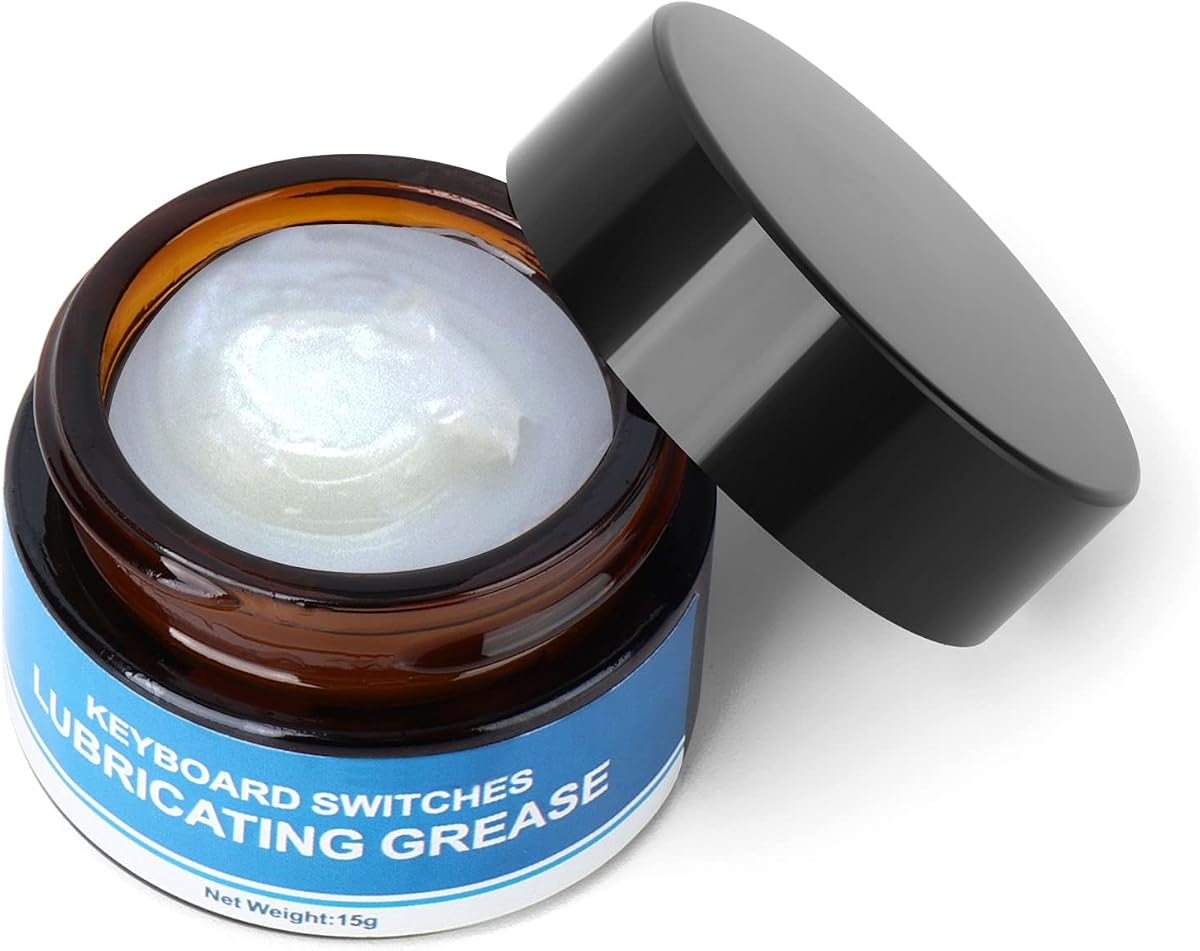
RUNJRX’s 15g GPL 205G0 grease combines a 4.7 rating with enough capacity for substantial maintenance work. The product is intended for keyboard switches and stabilizers, while also being described as suitable for precision instruments and other precision parts.
We may earn a commission when you buy through this link, at no additional cost to you.
Its larger container and claimed coverage of 400 to 450 switches make it a practical option for full-size keyboards, repeated builds, or users who maintain several boards. Two included brushes offer some redundancy and make it easier to dedicate one applicator to switches and another to stabilizers.
The grease is described as resistant to arcing, water, moisture, and volatilization, with high thermal and oxidative stability. Those properties support use in narrow mechanical assemblies, although the company also states that it can improve rebound, jamming, and rattling. As with any jar lubricant, too much application can create excess drag.
This product is best for maintenance-oriented users who value capacity and useful accessories more than syringe-level control. It is particularly well suited to stabilizing multiple keyboards, while precision applicators may be preferable for one especially delicate custom build.
The 15g capacity and 400-450 switch estimate reduce the chance of running short. It is a practical match for full-size boards, multiple builds, and regular upkeep.
Keeping separate brushes for switches and stabilizers can reduce cross-contamination and make it easier to work efficiently. The inclusion of two applicators adds value to the high-capacity package.
We may earn a commission when you buy through this link, at no additional cost to you.
The TIMSEKER Lube Station is the most complete maintenance package in the guide. It combines two 10g lubricants—GPL 205G0 for switches and stabilizers and GPL 105 for springs—with a purpose-built station, switch opener, brushes, tweezers, gripper, and debugging plate.
We may earn a commission when you buy through this link, at no additional cost to you.
The organization-focused design is a major advantage for builders who dislike loose parts spread across a desk. The station offers areas for opening, storing, and organizing switch components, while the tweezers and gripper help handle small parts more cleanly. The lubricant division also gives users a clear workflow for different components.
As a full kit, it will occupy more space than a single jar or syringe and includes accessories that experienced owners may already own. The supplied information does not provide a numerical rating, so direct rating comparisons with the other products are not possible. Users should also judge the value of the station and tools alongside the two grease containers.
This is the strongest option for a new builder who wants a ready-to-use setup, or for an enthusiast who values an organized workstation. If only a small amount of lubricant is needed, one of the single-container options will be simpler and more compact.
The dedicated station keeps opened switches and tiny components in a controlled area. That organization can reduce lost parts and make repeated maintenance sessions more efficient.
GPL 205G0 is assigned to switches and stabilizers, while GPL 105 is intended for springs. This division gives beginners a straightforward starting workflow without removing flexibility from experienced use.
We may earn a commission when you buy through this link, at no additional cost to you.
GPL 205 G0 for Keyboard Switch Lube carries a 5.0 rating and provides a focused 10g package for switch and stabilizer work. Its defining feature is a proprietary 7:3 blend of 105 and 205 greases built around a high-density perfluorinated base oil.
We may earn a commission when you buy through this link, at no additional cost to you.
The product publishes a wide operating range of -40°C to 350°C, along with viscosity values of 522cSt at 20°C and 160cSt at 40°C. It is listed for switches, stabilizer balance rods, and precision components. Users can also mix it with 105 to move between a thicker, more muted sound and a thinner, crisper application.
The jar requires manual brush control rather than drop-precise dispensing, and mixing lubricant to obtain a particular sound can complicate a repeatable process. The stated coverage of 300 to 350 switches is also lower than that of the largest containers, though it is adequate for a typical custom build. The included nylon brush is designed to resist deformation.
This is a strong budget-oriented pick for builders who want a well-documented 205G0 formula without a complete tool station. It offers a high supplied rating, a durable applicator, and useful compatibility, making it especially compelling for switches and stabilizers.
Published blend, base oil, temperature, and viscosity details help users understand the formula. This level of documentation is useful for enthusiasts who value consistency and informed customization.
The option to mix with 105 gives users a way to explore both muted and crisper results. It offers a degree of personalization without requiring an entirely separate range of products.
We may earn a commission when you buy through this link, at no additional cost to you.
This 15g keyboard switch grease is a broad-purpose option with a 4.3 rating. It is intended for keyboard switches and stabilizers, but the manufacturer also lists bearings, instruments, and various precision parts, giving it more uses outside the hobby.
We may earn a commission when you buy through this link, at no additional cost to you.
The sealed glass bottle contains 0.53oz, or 15g, of grease. Its claimed coverage is approximately 450 switches, which is among the stronger figures in the guide. The formula is described as having strong oxidative, mechanical, colloidal, and water stability, qualities that may make it useful in storage or workshop environments.
Its 4.3 rating is the lowest among the rated products, although the supplied information does not identify a specific defect. The package contains only the grease bottle, so buyers will need an appropriate brush or other applicator. A jar also demands careful control because excess material can reduce the intended smoothness of a switch or stabilizer.
This product makes the most sense for users who also maintain precision equipment or want one lubricant with wide utility. Keyboard specialists seeking detailed viscosity information, included accessories, or precision dispensing may find more specialized options elsewhere.
Compatibility with bearings, instruments, and precision parts extends the product beyond a single hobby. That makes it relevant to workshops where one stable grease may serve several small precision mechanisms.
The estimated 450-switch capacity is well suited to full-size boards and multiple maintenance sessions. A proper brush remains an important addition for controlled jar application.
We may earn a commission when you buy through this link, at no additional cost to you.
The best lubricant for a mechanical keyboard depends on the parts being serviced, the precision required, and the tools already in your setup. These factors help narrow the options without overlooking important application details.
Some formulas are intended for general switch and stabilizer use, while others include a separate lubricant for springs or permit mixing for sound customization. A dedicated two-formula setup can make the process more systematic, but a single versatile grease may be more convenient for occasional maintenance. The most important distinction is whether the product is explicitly listed for every component you plan to lubricate.
Choose a broad formula for mixed projects, but prioritize dedicated options when specific spring or switch behavior matters.
The listed products range from semi-fluid grade zero grease to thicker blended formulas. Viscosity influences how the lubricant stays where it is placed and how much drag it can introduce. Products that publish blend ratios, density, and viscosity figures provide more information for users who want a predictable result. Thicker mixtures are often associated with a more muted character, while thinner applications are described as crisper.
Read the consistency details carefully, but always use a thin, even layer regardless of the formula.
Syringes offer the most precise dosage, which is especially useful for stabilizers and switches with tight clearances. Jar grease is easier to brush across larger working areas and often offers greater capacity. A small nylon brush can still provide good control in a housing, although users should avoid loading it with excess lubricant before touching the part.
Use a syringe for delicate or repeated placement; choose a brush for economical, broader coverage.
A useful lubricant should be compatible with the materials found in the keyboard. Most products in this guide are described for plastic-on-plastic or plastic-on-metal contact points, common in switch housings and stabilizer assemblies. Some explicitly recommend linear switches, while others claim compatibility with clicky, tactile, and linear designs.
Verify that the product covers your switch type and the stabilizer standard used by your keyboard.
Coverage figures range from approximately 250 switches to roughly 500, although application thickness heavily influences actual results. Full-size keyboards can contain well over 100 keys, and building with individual switches may require additional lubricant for the assembly process. Larger jars make sense for multiple boards, while a syringe may be sufficient for one focused repair.
Use coverage claims as a planning guide, then account for your own application technique.
Some packages include only the lubricant, while others provide brushes, lubrication pens, switch openers, tweezers, grippers, debugging plates, or a complete station. Accessories can make assembly cleaner and more organized, especially for beginners. They do not necessarily improve the lubricant itself, so experienced users may prefer to buy only the grease they need.
Choose added tools when convenience and organization matter more than minimizing purchases.
Several formulas specify broad operating temperature ranges, along with resistance to oxidation, water, moisture, or volatilization. These properties are relevant to keyboards used in different rooms or maintained for long periods. For most users, normal light application is still the main factor in long-term performance because excess lubricant can collect around contact points.
Favor stable synthetic formulas, but follow the application guidance included with your chosen product.
Even a well-suited grease can create sluggish movement or an unwanted heavy feel if applied too heavily. A thin coating on the relevant contact surfaces is generally more effective than saturating the assembly. Begin with the smallest practical amount, test the key, and add more only if the scratch or rattle remains.
Less lubricant, applied precisely, produces a more predictable keyboard feel.
Prepare the keyboard before applying lubricant. Remove the relevant keycaps, power the keyboard off, and document or photograph the original stabilizer and switch arrangement. For switch work, remove the switch when practical; for stabilizers, the instructions associated with syringe products recommend removing the affected keycap and enough surrounding caps to create working space.
Clean the contact surfaces and remove dust or old lubricant before adding a fresh layer. With a brush, touch a small amount of grease to the intended plastic or metal contact point and distribute it into a thin film. With a syringe, place only one or a few small drops at a time, especially around stabilizer wires, and avoid flooding the housing. Test each modified key for smooth travel, consistent return, and unwanted resistance.
Store the lubricant tightly closed in a clean, dry area, and clean the applicator between different formulas. Do not use the product on people or for unintended purposes. If a key feels sluggish, remove the lubricant and clean the assembly before trying again. Periodic inspection can help identify dried residue, excess grease, or a stabilizer that needs realignment rather than more lubricant.
Yes, every product in this guide is described as suitable for switches and stabilizers or clearly identifies those uses. Some products are especially optimized for stabilizers, while others divide the task between two grease formulas. Always check the listed applications and follow the product-specific instructions, particularly for a syringe designed around Mx-style stabilizer geometry.
No. Excess lubricant can make a switch or stabilizer feel sluggish by increasing drag beyond what the mechanism was designed to have. A very thin layer at the contact points is generally sufficient. Start with a small amount, test the key, and add more only if the unwanted sound or friction remains.
The supplied product information generally assigns GPL 105 to springs and GPL 205G0 to switches and stabilizers. Some listings also describe 205G0 as a 7:3 factory blend of 105 and 205 grease, allowing further customization. If a product lists different instructions, follow those directions and keep each formula properly identified.
Syringes are usually better when precise dosage matters, particularly around stabilizer wires and tight switch housings. Jars are often more practical for larger projects because they offer greater capacity and allow brush application. Neither format is automatically superior; the better choice depends on the precision and scale of the task.
Lubricant can reduce friction where a metal stabilizer wire contacts a plastic housing, but it cannot correct every mechanical problem. A bent wire, misaligned housing, loose fit, or debris may also cause stiffness. If a stabilizer remains slow after cleaning and careful lubrication, inspect its alignment or replace the affected part.
Coverage estimates in this guide range from approximately 250 switches for a 3ml syringe to as many as 500 for a larger vial. Actual use depends on the formula, applicator, and thickness applied. Treat those figures as maximum planning estimates under sensible application rather than a target amount to place on every switch.
It may reduce scratching, spring sound, whispering, and hollow rattle by reducing friction at contact points. Sound also depends on switch type, stabilizer design, keycaps, case materials, and assembly technique. Some products allow sound customization through thickness or mixing, so results will vary between builds.
At minimum, you need a suitable lubricant and a way to remove the keycaps or switches. A small brush is useful for jars, while a syringe provides precise placement. A switch opener, tweezers, gripper, and a lubricant station can make a full disassembly or rebuild cleaner, but the complete TIMSEKER kit is not required for every maintenance job.
The strongest general option is the Krytox 205g0 syringe because it combines a 5.0 supplied rating, measured dispensing, and compatibility with both switches and stabilizers. For a lower-cost, documentation-focused purchase, GPL 205 G0 for Keyboard Switch Lube is compelling, while the GPL 205 G0 and GPL 105 kit offers the most deliberate two-formula approach.
Prioritize the application method that matches your project. Choose a syringe for precise stabilizer work, a small brush for general switch maintenance, and a larger container or full station if you routinely service multiple boards. Regardless of format, a light application on the correct contact points produces better results than saturating a mechanism.
Finally, compare current prices, package contents, ratings, and availability before ordering, since all three can change over time. Check the manufacturer’s listed uses and warnings, and favor a product that provides enough lubricant and the right applicator for the scale of your keyboard project.