
NZXT H5 Flow
4.7Editor score
Compact ATX mid-tower layout
Two quiet airflow fans included
Wide cable-management channels
Our Modular PC Case guide compares 10 mid-towers and compact cases for airflow, expandability, cable management, cooling support, and build flexibility.
A modular PC case should make your system easier to build, cool, upgrade, and personalize. The strongest options combine flexible mounting positions, accessible cable routes, useful front I/O, and enough internal space for modern graphics cards and liquid-cooling hardware without making the enclosure unnecessarily difficult to manage.
This guide compares ten cases using the supplied specifications, with particular attention to motherboard compatibility, radiator capacity, included fans, airflow design, drive support, tempered-glass presentation, and the practical degree of modularity offered by each chassis. The list includes full mid-towers, compact ATX models, a micro-ATX option, and a full-tower alternative.
Each numbered review explains where the case is strongest, where compromises may appear, and which builders are most likely to appreciate its layout. The three highlighted selections represent an overall recommendation, a budget-oriented option, and a premium design choice. Availability and pricing can change, so verify current listings and compatibility before ordering.
4.7Editor score

4.7Editor score
4.7Editor score
The comparison below highlights the major differences among the ten cases, including chassis size, cooling provisions, included hardware, expansion support, and presentation. Use it to identify the layout that best matches your motherboard, graphics card, cooling plan, and preferred building style.

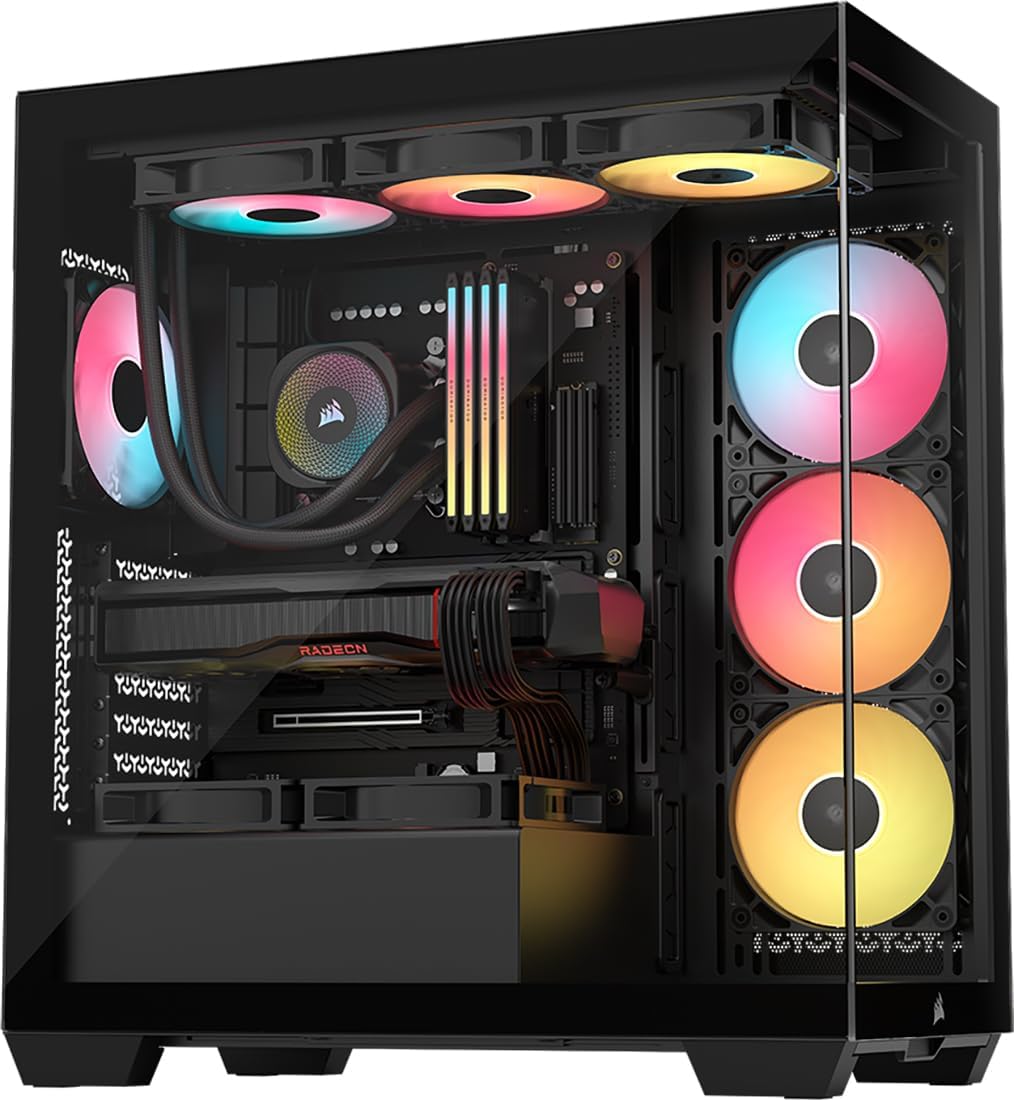


The CORSAIR 4000D RS ARGB stands out as the most explicitly modular case in this group, earning a 4.7 rating for its adaptable FRAME system and flexible approach to case configuration. Instead of presenting a completely fixed interior, it lets builders exchange or reposition key elements as their hardware and preferences change. That makes it particularly attractive for anyone who expects to upgrade a system over time.
We may earn a commission when you buy through this link, at no additional cost to you.
Its airflow foundation is equally convincing. The perforated 3D Y-pattern steel front panel provides a low-obstruction path for incoming air, while three pre-installed CORSAIR RS ARGB PWM fans provide a useful cooling foundation. Those fans support daisy-chained four-pin PWM connections, Zero RPM operation at low loads, and lighting through a motherboard five-volt ARGB header. The InfiniRail mounting system adds further flexibility by allowing fans to slide into different front positions, with a separate roof constraint for 140mm models.
Modularity extends beyond cosmetic front-panel replacement. The internal side panel near the motherboard tray can serve as a cable cover or be removed to support additional side-mounted cooling. This dual-purpose arrangement helps owners adapt the chassis to different cooling strategies and helps maintain a tidy appearance when the extra fans are unnecessary. The tradeoff is that users must understand the FRAME system's arrangement, and an ARGB-capable motherboard or suitable control solution is important for the included lighting.
This is the strongest general recommendation for builders who want genuine configuration freedom without giving up mainstream cooling capability. It is particularly well suited to gamers and enthusiasts who may change components, value clean cable routing, and appreciate a case that can evolve rather than become obsolete after one build. For the most balanced combination of modularity, airflow, included hardware, and upgrade potential, the 4000D RS ARGB is the case to shortlist first.
A case that adapts to the build rather than forcing every component into a predetermined arrangement can make assembly more approachable and future upgrades less disruptive. The 4000D RS ARGB earns that position through practical flexibility, a strong fan package, and a front panel designed around high airflow.
The FRAME system allows the motherboard tray, front I/O panel, and other structural elements to be configured for different needs. That makes the enclosure more than a static shell, particularly for builders who want to replace components as their system evolves.
The steel Y-pattern front panel and low-obstruction cooling path complement the three included PWM fans. Because the fans can use daisy-chain connections and motherboard software, the initial setup remains relatively tidy while preserving meaningful control over speed and lighting.
We may earn a commission when you buy through this link, at no additional cost to you.
The HYXN H1 combines a panoramic dual-chamber design with an unusually substantial cooling package, contributing to its 4.5 rating. Its defining feature is the set of seven pre-installed ARGB PWM fans: three reverse-blade models at the bottom, three on the side, and one forward-blade fan at the rear. That arrangement gives new builders a colorful, active cooling foundation without requiring a separate initial fan purchase.
We may earn a commission when you buy through this link, at no additional cost to you.
The case measures 420 by 285 by 430 millimeters and supports ATX, micro-ATX, and Mini-ITX motherboards. It accepts graphics cards up to 400 millimeters and power supplies up to 200 millimeters, with room for one hard drive and either two or three solid-state drives depending on the configuration. The separated chamber arrangement supports cleaner organization and helps route airflow more deliberately through the lower and side intakes.
Cooling capacity is the H1's major attraction. Although the introductory description emphasizes the ability to fit two 360mm radiators at the top and side simultaneously, the title also identifies support for three 360mm radiators. Buyers should therefore verify the exact mounting arrangement and available positions for their selected liquid-cooling hardware. The seven included fans add further complexity because all must be connected, managed, and balanced to avoid unnecessary noise.
The H1 is best for an enthusiast who wants a dramatic dual-cavity build, abundant fans, and room for substantial cooling hardware. Its footprint and fan density may be excessive for compact desks or builders who value minimalism, but the component compatibility and pre-installed cooling make it an efficient starting point for a visually ambitious gaming system.
This case shows how modular planning can mean dividing hardware and power-supply zones while giving cooling equipment dedicated room. For builders who would rather install several fans than plan every mounting position in advance, the H1's comprehensive package is difficult to overlook.
The lower and side intake arrangement works with a separated internal layout rather than crowding the motherboard area. This can improve organization and gives the large fan and radiator configuration room to function without overlapping every major hardware zone.
Most builders can use the included reverse-blade and forward-blade fans as an immediate cooling foundation. The main responsibility shifts to the owner, who must connect the daisy-chained ARGB PWM leads and tune the lighting and fan curves through the motherboard.
We may earn a commission when you buy through this link, at no additional cost to you.
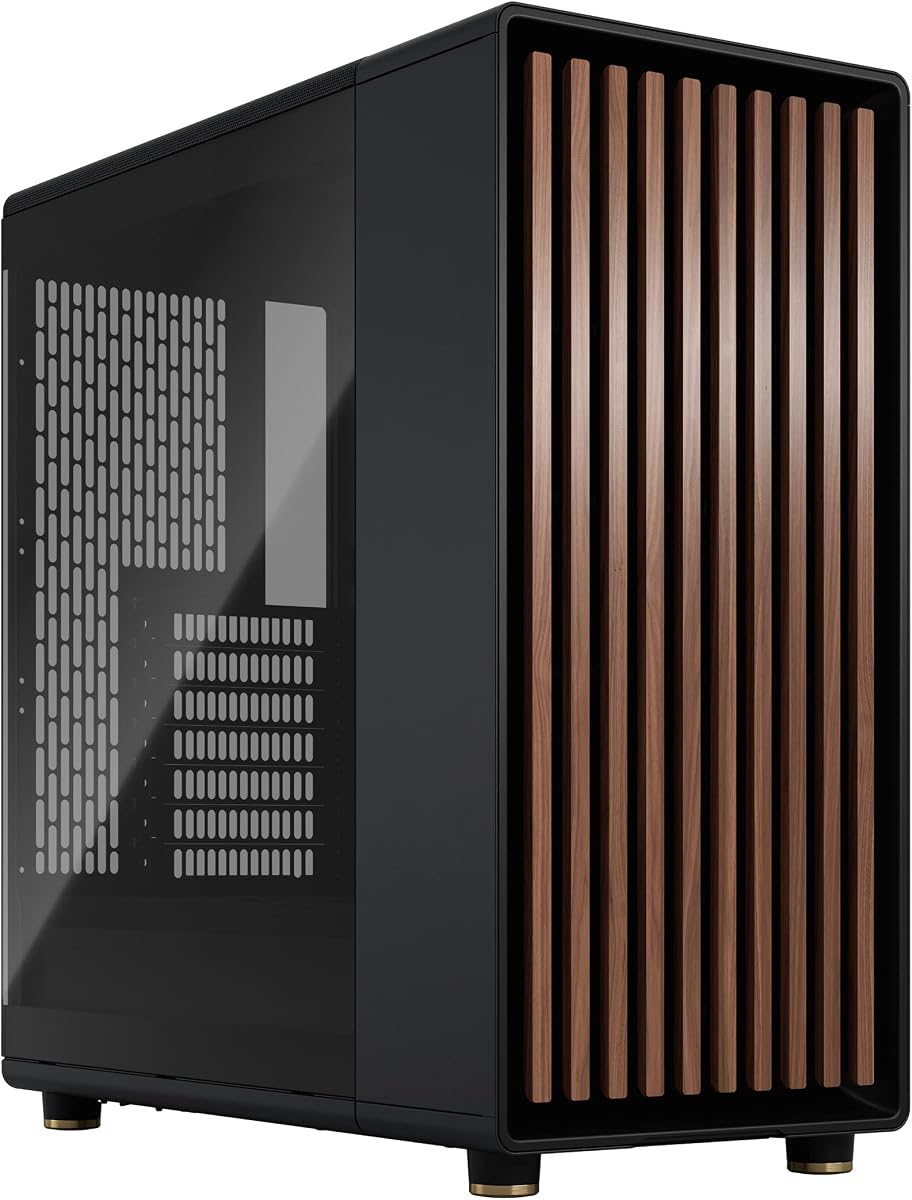
The Fractal Design North is the premium design choice here, pairing a 4.7 rating with a front panel accented by sustainably sourced oak or walnut. It avoids the anonymous appearance common to many ventilated gaming cases and gives a finished system a more natural, furniture-like presence. The clear tempered-glass side panel then preserves a broad view of the components inside.
We may earn a commission when you buy through this link, at no additional cost to you.
Ventilation is built into the concept rather than added as a superficial feature. The open front and integrated mesh provide natural intake while supporting the two included 140mm Aspect PWM fans. The larger fan size can move useful air with fewer high-speed units than a collection of smaller fans, though builders should evaluate noise under sustained load rather than assuming fan size alone determines acoustics.
The North supports ATX, micro-ATX, and Mini-ITX motherboards, along with graphics cards up to 355 millimeters. A 360mm front radiator reduces that stated GPU limit to 300 millimeters, an important clearance relationship for owners planning liquid cooling. It offers seven bridgeless expansion slots, two combined 3.5-inch and 2.5-inch drive mounts, and two dedicated 2.5-inch positions. Type-C connectivity is also listed among the front-facing features.
The case is especially appropriate for builds where appearance matters as much as airflow and expandability. Its genuine wood detail is less suitable for buyers seeking a uniformly metallic or aggressively futuristic enclosure, and the radiator-related GPU constraint requires advance planning. Even so, the integrated tab-based panel removal, tempered-glass presentation, and generous drive arrangement create a compelling premium package.
For a gaming station that should look attractive in an office, living room, or display setting, the North offers a more mature design language than most of its competitors. It is a recommendation for builders who want natural materials, strong airflow, and convenient access rather than a case dominated by RGB hardware.
The walnut or oak front bars are the North's defining visual feature and give the case an unusual connection to furniture-style workshop design. The charcoal metal, glass side, and restrained structural lines allow the natural material to remain the focal point.
Integrated tabs let users remove the side panels, unclip the front, and lift off the top without wrestling with multiple fasteners. This makes routine maintenance and future expansion more approachable than a design that requires tools for every access point.
We may earn a commission when you buy through this link, at no additional cost to you.
The NZXT H5 Flow is a compact ATX mid-tower with a 4.7 rating, offering a clean, restrained approach to modular case design. Its strengths are less about interchangeable decorative parts and more about making the essential building experience orderly: the front and rear fans are already installed, cable routes are clearly defined, and the panels combine visual simplicity with practical airflow.
We may earn a commission when you buy through this link, at no additional cost to you.
Ultra-fine mesh across the top, front, and side panels supports airflow while helping filter dust. The case includes two 120mm Quiet Airflow fans, one at the front and one at the rear, giving a new build a functional baseline without crowding the chassis. For liquid cooling, it supports a 360mm radiator in front and a 240mm radiator at the top, making it possible to plan larger cooling hardware even within a relatively compact enclosure.
Its most valuable modular feature is practical cable management. Wide channels, hooks, and straps allow power leads and front-panel wiring to be concealed rather than bundled loosely behind the motherboard tray. The perforated PSU shroud draws air from two optional 120mm positions on its side and bottom. Although the case does not offer the component-swapping framework of the CORSAIR FRAME system, its fixed layout is coherent, which can make installation more predictable.
The H5 Flow is a strong recommendation for builders who want ATX support without moving to a large full tower and who prioritize a manageable first build. It may not appeal to someone seeking seven decorative fans or extensive physical component interchangeability, and a finished system may benefit from additional lighting or fan hardware. Even with two included fans, however, it delivers the essentials in a focused package.
A good modular case should not demand constant adjustment just to look presentable. The H5 Flow uses a fixed but well-organized design to accomplish that goal, making it a practical selection for everyday gaming builds and compact workspaces.
The enclosure supports full-size ATX boards while offering substantial radiator positions, including a 360mm front mount. That combination is valuable for builders who want current cooling flexibility without dedicating an enormous amount of desk space to the case.
Wide routing channels, hooks, and straps make it easier to secure wiring from the first assembly step. A clean interior is not left to aftermarket accessories, which gives the H5 Flow an advantage for first-time builders and anyone who plans to photograph the completed system.
We may earn a commission when you buy through this link, at no additional cost to you.
The CORSAIR 3500X RS ARGB is a panoramic mid-tower for builders who want the internal layout to remain visible. Its 4.6 rating reflects a strong balance between wraparound tempered-glass presentation, substantial cooling capacity, and compatibility with a wide range of motherboard sizes. The front and side panels are removable, so assembly and later access should remain straightforward.
We may earn a commission when you buy through this link, at no additional cost to you.
Three pre-installed RS120-R ARGB fans support the display-focused design. Their lighting is controlled through a motherboard five-volt ARGB header, and the reverse-oriented appearance is intended to preserve an unobstructed view. Cooling is not limited to those included units: mounting points at the side, roof, and PSU area allow up to ten 120mm fans, giving builders considerable freedom to create a fully populated configuration.
The case supports motherboard formats from Mini-ITX through EATX, which is one of its broadest compatibility claims. It is also validated for ASUS BTF, MSI Project Zero, and Gigabyte Project Stealth motherboards whose connections sit on the rear. Those boards can produce an especially clean result because cables remain behind the motherboard rather than crossing the visible interior.
The main limitation is that the product includes only three fans despite supporting as many as ten. Builders wanting the intended dense visual effect will need to supply additional compatible hardware and confirm mounting orientation. The large glass surfaces also demand more care during installation and cleaning, although removable panels make that maintenance manageable. A premium display case naturally prioritizes appearance over the modest included fan count.
The 3500X RS ARGB is best for a showcase build that combines a panoramic window with room to expand. It works especially well with hidden-connector motherboards and cable-aware components, allowing the glass enclosure to remain visually clean rather than becoming a frame around a tangle of leads.
The wraparound design provides a broad view of the build from multiple angles, while removable front and side panels simplify initial assembly. Owners can inspect connections and clean dust without dismantling the entire enclosure.
Side, roof, and PSU-area mounting points create room for up to ten 120mm fans. The included reverse-blade trio establishes the visual direction, while additional airflow components can be added as the build and its cooling requirements develop.
We may earn a commission when you buy through this link, at no additional cost to you.
The RUIX OV303 prioritizes room for large graphics hardware, offering a 4.7 rating and a stated GPU clearance of up to 420 millimeters. That makes it a practical choice for builders using a long, high-capacity card or planning to leave additional room around a future graphics upgrade. The integrated GPU support bracket adds stability and reduces the chance that a heavy card will place unnecessary strain on the motherboard.
We may earn a commission when you buy through this link, at no additional cost to you.
Its visual construction is equally expansive, using three tempered-glass panels to create depth around the front and side. Four pre-installed 120mm Prism ARGB PWM fans provide a solid lighting and cooling foundation. Additional cooling is possible because the case supports up to ten fans, or seven when a 360mm AIO liquid cooler is installed. Magnetic dust filters at the top and bottom help protect the interior while allowing relatively convenient access.
Front connectivity includes USB 3.0 and Type-C, two standards many builders expect from a contemporary mid-tower. The listed drive capacity consists of two 3.5-inch hard-drive positions and one 2.5-inch position. That may be sufficient for a typical gaming system, but it is less generous than some competing layouts, particularly for users who want multiple SSDs or expect storage to expand over time.
The main practical tradeoff is its extensive glazing. Three tempered-glass panels improve the presentation but require careful handling during assembly and regular cleaning to remain free from fingerprints. Its ARGB fans also need an appropriate five-volt lighting connection and software support, so the case should be considered alongside the chosen motherboard rather than in isolation.
The OV303 is a compelling option for a gaming build centered on a long or powerful graphics card. Its clearance, support bracket, four included fans, and modern front ports create a versatile package, while the glass-heavy design makes it most appropriate for owners who intend to display the finished system.
The stated 420mm graphics-card limit provides more breathing room than many mid-towers. This is particularly helpful for large coolers, triple-fan graphics cards, and future upgrades that may occupy more of the available interior.
A built-in support bracket helps stabilize the graphics card and reduce sag-related strain. It serves both a practical and visual function, making the enclosure more suitable for a powerful modern gaming configuration.
We may earn a commission when you buy through this link, at no additional cost to you.
The FOIFKIN F600 combines a dual-chamber structure with seven pre-installed ARGB PWM fans, giving it a 4.6 rating and an identity suited to visually ambitious gaming systems. Its panoramic glass presents the internal components from a wide angle, while the separated chamber keeps the power supply and drives away from the main hardware area and helps organize the interior.
We may earn a commission when you buy through this link, at no additional cost to you.
The fan package includes six reverse-blade units and one forward-blade model. This arrangement allows the enclosure to create depth with lighting while maintaining a distinction between intake and exhaust positions. The case is also designed to accommodate up to three 360mm radiators simultaneously, although builders should verify exact mounting locations and radiator thickness against their chosen hardware and tubing arrangement.
Compatibility is broad. The F600 supports ATX, micro-ATX, and Mini-ITX motherboards, graphics cards up to 400 millimeters, and power supplies up to 200 millimeters. Storage provisions include one hard-drive position and two solid-state drive positions. Its listed dimensions are 420 by 285 by 430 millimeters, which confirms that the spacious interior comes with a substantial footprint that should be considered on a smaller desk.
The dual chamber is the most meaningful modular feature because it separates power supply and drive placement from the primary chamber. That can improve cable routing and create a cleaner presentation, but the included fan density also transfers more responsibility to the builder. A sensible fan curve is important for balancing cooling, lighting, and acoustic output, especially when seven ARGB units are operating.
The F600 is a strong fit for a colorful dual-chamber build with a serious cooling plan. It may be excessive for compact installations or minimalist systems, but for a roomy gaming enclosure it combines ample fan hardware, broad graphics-card clearance, and flexible radiator support in a visually coherent package.
Separating the power supply and drives from the main hardware area can reduce visual clutter and provide a cleaner path for airflow. The arrangement also gives builders a defined location for components that might otherwise compete for interior space.
Three 360mm radiator positions offer significant cooling potential, while seven included fans provide a ready-made baseline. The important planning step is confirming that the selected radiators, fans, and tubing can occupy the intended positions without interfering with one another.
We may earn a commission when you buy through this link, at no additional cost to you.
The Antec Flux Pro is the full-tower alternative in this guide, combining a 4.7 rating with substantial expansion capacity and six included PWM fans. Its target audience is clear: builders using E-ATX motherboards, multiple radiators, extensive storage, or additional cooling hardware that would overwhelm a conventional mid-tower. The enclosure uses metal, glass, and wood to create a more textured appearance than a purely industrial chassis.
We may earn a commission when you buy through this link, at no additional cost to you.
Six fans are included from the start: three Tranquil 140 PWM fans at the front, two P12R PWM reverse fans on the power-supply shroud, and one Tranquil 140 PWM fan at the rear. Total fan capacity reaches 12 positions, while removable cooling brackets on the top, front, and PSU shroud allow the cooling layout to be reconfigured. The case can hold a 420mm radiator and a 360mm radiator at the same time.
A particularly distinctive feature is the CPU and GPU dual temperature display, which adds an at-a-glance hardware readout to the exterior. The innovative iShift power-supply mounting option changes the orientation of the PSU, adding another degree of layout flexibility. These are useful features for a large enthusiast system, although they also make the design more complex than a straightforward fixed-layout tower.
The major disadvantage is physical scale. A full-tower chassis requires considerably more desk and floor space than the compact and mid-tower alternatives here, and its many configurable brackets may be more than a simple first build needs. Even so, no other case in this list offers the same combination of E-ATX positioning, 12 fan locations, dual large-radiator support, and six included fans.
The Flux Pro is the recommendation for a workstation-style or no-compromise enthusiast build. It is especially attractive when the hardware inventory is extensive or likely to grow, making the extra internal volume more useful than merely decorative.
Twelve fan positions and simultaneous 420mm and 360mm radiator support give the case considerable thermal flexibility. Removable brackets allow cooling hardware to move between areas as the build changes, although radiator thickness and tubing routes should be checked carefully.
The CPU and GPU dual temperature display adds immediate value during tuning. It provides a convenient exterior reference without requiring the system software to be opened, which can be especially convenient when adjusting fan curves.
We may earn a commission when you buy through this link, at no additional cost to you.
The Cooler Master Q300L V1 is the most compact and budget-conscious interpretation of modular design in the list, earning a 4.5 rating. Rather than competing with full ATX mid-towers, it focuses on micro-ATX and Mini-ITX systems. The result is a practical chassis for smaller builds that can still accommodate substantial graphics cards, CPU coolers, and multiple fans.
We may earn a commission when you buy through this link, at no additional cost to you.
Its interior supports CPU coolers up to 159 millimeters, graphics cards up to 360 millimeters, and power supplies up to 160 millimeters long. Cooling plans can include up to five fans or a 240mm liquid cooler, giving small-system builders more options than the enclosure's compact dimensions might initially suggest. Perforated panels on all sides support an open thermal design intended to encourage airflow and heat dissipation.
The clearest modular feature is the adjustable I/O panel. It can be positioned at the front, top, or bottom on either side, allowing builders to align ports with their desk, monitor, or preferred access direction. The edge-to-edge transparent panel provides a view of the completed system, while magnetic dust filters introduce a distinctive finishing detail and help keep the interior cleaner.
This compact format necessarily has limitations. It cannot accept a full-size ATX motherboard, and the selection is less oriented toward elaborate panoramic displays or extensive drive arrangements. A compact case also demands more care with cable routing because every internal dimension matters. Nevertheless, its clearances remain useful for modern graphics hardware, and the open-panel design prioritizes function over enclosure mass.
The Q300L V1 is a sensible choice for a smaller gaming or productivity system built around micro-ATX or Mini-ITX hardware. It offers more flexibility than a barebones enclosure, useful cooling options, and a distinctive adjustable I/O arrangement without occupying the space of a large tower.
The stated 360mm graphics-card clearance and 159mm CPU-cooler allowance leave room for capable components despite the smaller chassis. Checking these dimensions before buying can prevent the frustration of discovering that a favorite part will not fit.
The I/O panel can move among the front, top, and bottom on either side, allowing the finished case to fit a specific workspace. This small decision can materially improve access without changing the internal component layout.
We may earn a commission when you buy through this link, at no additional cost to you.
The Thermaltake Tower 600 is an unconventional mid-tower built around an octagonal shape, three tempered-glass panels, and unusually flexible expansion mounting. Its 4.5 rating reflects a case that prioritizes visual identity and configurability rather than conventional rectangular proportions. The Hydrangea Blue finish also gives it a distinctive look that separates it from the predominantly black alternatives in this guide.
We may earn a commission when you buy through this link, at no additional cost to you.
Tool-free removal makes the front and other glass panels easier to remove during assembly and maintenance. More significantly, the rotational PCIe slots and floating VGA bracket allow the graphics card to be installed in several orientations. This can support unusual motherboard and cooling arrangements, although every connection and clearance must be checked before assembly because changing the card's position may alter the relationship with the rest of the system.
Cooling support is broad. The enclosure accommodates up to nine fans and radiators as large as 420mm. It also supports ASUS BTF, MSI Project Zero, and Gigabyte Project Stealth motherboards with rear-facing connections, allowing a cleaner cable-free appearance. These motherboard options use the case's hidden-connector concept effectively, since the visible interior is a major reason to choose a three-panel glass design.
The tradeoffs come from the unconventional architecture. The octagonal footprint may require more careful placement on a desk than a standard tower, and the rotating expansion system demands more planning than a fixed layout. An optional horizontal display stand can provide another viewing orientation, but it is an added accessory rather than an included standard feature. Buyers should verify the final orientation of every component before committing to the configuration.
The Tower 600 is most suitable for a builder who values unusual industrial design, panoramic visibility, and component-placement flexibility. It is less convenient for someone who wants a straightforward install, but its tool-free access, hidden-connector support, and rotational mounting make it a rewarding enclosure for an experimental showcase build.
Three tempered-glass panels expose the build from several angles and can be removed without tools. The result is an enclosure intended to be viewed, with easier access for assembly and cleaning than fully fixed glass designs.
Rotational PCIe slots and a floating VGA bracket introduce meaningful layout flexibility. This can help builders create a more integrated visual arrangement, though radiator, cooler, motherboard, and cable clearances all need to be considered together.
We may earn a commission when you buy through this link, at no additional cost to you.
A modular PC case should make assembly and future changes easier while preserving adequate airflow, cable access, hardware clearance, and cooling capacity. The most useful features depend on the size of the build, the components already chosen, and how often the system is likely to be upgraded.
Begin with the motherboard format because it determines which cases are physically compatible. ATX and micro-ATX builds can use most mid-towers, Mini-ITX can use nearly every size category, and E-ATX generally requires a spacious mid-tower or full tower. A case may support several formats, but the space remaining for graphics cards, radiators, storage, and cables can vary substantially between them.
Choose a chassis that fits the intended hardware rather than merely accepting the board. Check processor-cooler height, graphics-card length, power-supply depth, and radiator dimensions before buying. The compact Q300L V1 serves micro-ATX and Mini-ITX systems, while the H1, RUIX OV303, and Flux Pro accommodate ATX and larger hardware.
Modern graphics cards can be among the largest and heaviest components inside a case. Clearance specifications should account for the card itself, its cooler or power connector, the front radiator, and any support bracket. The RUIX OV303 lists support up to 420 millimeters, while the H1 and FOIFKIN F600 support up to 400 millimeters and the Fractal Design North lists 355 millimeters, reduced to 300 millimeters with a front 360mm radiator.
Do not choose a case solely by the maximum rating if you expect to use a thick radiator or a card with an outward-facing connector. Leave practical room for tubing and cables. Also consider whether a built-in GPU bracket, included in the RUIX OV303, would improve stability with a heavy card.
A useful airflow layout establishes a clear path from intake to exhaust rather than relying on isolated vent openings. The Fractal Design North uses an open front and integrated mesh, while the HYXN H1 directs air through lower and side intakes toward top and rear exhaust. Cases with removable or magnetic filters, such as the RUIX OV303, are easier to maintain because accumulated dust can be removed before it recirculates through components.
Treat fan counts as only one part of the cooling equation. Fan size, blade direction, obstruction, radiator placement, and the position of internal covers all affect results. Verify that front, top, rear, and side mounting areas are unobstructed and that any included fans are oriented consistently with the intended intake and exhaust plan.
Radiator support determines whether a future liquid-cooling upgrade is realistic. The HYXN H1 and FOIFKIN F600 advertise support for three 360mm radiators, the Antec Flux Pro supports simultaneous 420mm and 360mm radiators, and the Thermaltake Tower 600 accepts radiators up to 420mm. The NZXT H5 Flow provides a front 360mm position and a top 240mm position inside a smaller footprint.
Check the complete cooling package, not just the nominal radiator size. Fans add thickness, tubing needs bend room, and some motherboard headers occupy positions that a radiator might otherwise use. A case with fewer but unobstructed mounting points may also be easier to populate cleanly than one where every advertised position is tightly packed.
The number and type of included fans vary from two in the NZXT H5 Flow to seven in the HYXN H1 and FOIFKIN F600. More pre-installed fans can reduce initial assembly work, but they also increase cable management demands and may require a software-based fan and lighting setup. Reverse-blade fans are commonly used on intakes to present a cleaner surface to viewers, while forward-blade fans are generally used for exhaust.
ARGB lighting needs a compatible five-volt header or controller. Confirm that the chosen motherboard supports the required connection or plan for an alternative controller. For a quieter build, the two 140mm fans included with the Fractal Design North may offer a different balance from multiple 120mm units, while the H5 Flow includes a restrained pair of quiet airflow fans.
Good modular design should make it easy to route, conceal, and reach cables. The NZXT H5 Flow uses wide channels, hooks, and straps, while the CORSAIR 4000D RS ARGB lets its internal side panel function as a cable cover. Cases supporting rear-facing motherboard connections can also reduce visible clutter, but they limit which motherboards are eligible.
Prioritize removable panels and accessible fasteners. The Fractal Design North allows side panels, front, and top to be removed using an integrated tab, while the Thermaltake Tower 600 uses tool-free glass panels. Service access becomes especially important when adding drives, changing fans, cleaning filters, or checking a cable connection after the system is complete.
Drive support should reflect both current needs and likely upgrades. The Fractal Design North includes two combined 3.5-inch and 2.5-inch mounts plus two dedicated 2.5-inch mounts. The RUIX OV303 lists two 3.5-inch and one 2.5-inch positions, while the HYXN H1 and FOIFKIN F600 each list one hard-drive and two solid-state drive mounts. Expansion slots and removable cooling brackets add another layer of flexibility in larger designs.
Check whether the case supports both traditional drives and solid-state modules in the locations you need. Also consider the number of expansion slots for add-in cards. The Fractal Design North provides seven bridgeless slots, while large cases can be better suited to elaborate multi-component configurations.
A case should complement the room and the components inside it. The Fractal Design North uses genuine walnut or oak for a natural appearance, the Thermaltake Tower 600 offers an unusual octagonal silhouette and blue finish, and several alternatives emphasize panoramic tempered glass. More visible panels can showcase a build but require regular cleaning and careful handling during installation.
Consider how the case will be positioned rather than focusing only on the component view. Some designs support alternate display arrangements, including the Tower 600's optional horizontal stand and its rotational graphics-card mounting. For a case under a desk or beside a monitor, the NZXT H5 Flow's smaller proportions and restrained front may blend more easily into a compact workspace.
Before assembly, compare every major component with the case's published clearance figures. Confirm motherboard format, CPU-cooler height, graphics-card length, power-supply depth, radiator size, and storage positions. Lay out screws and removable brackets before working, photograph cable routes as you connect each component, and keep protective films on tempered glass until the build is complete.
Install the power supply and storage first when the layout calls for it, then mount the motherboard and CPU cooling hardware. Connect fans and any ARGB lighting header, organize the cables through the case's channels or behind its shroud, and confirm that reverse-blade and forward-blade fans are oriented consistently. Tighten fasteners evenly and avoid forcing panels or expansion cards into alignment.
After the first startup, check temperatures and listen for unexpected fan noise under load. Fine-tune fan curves in the motherboard software, clean or remove dust filters periodically, and inspect cable areas for obstruction. Use a dry microfiber cloth for glass and a soft brush for mesh surfaces, avoiding aggressive cleaners that could damage coatings or adhesives.
A modular PC case uses removable, repositionable, or interchangeable components to make assembly and upgrades easier. Depending on the design, modularity may involve adjustable I/O panels, configurable fan brackets, separate chambers, replaceable frame elements, or reversible motherboard connections. The strongest modular case also preserves good airflow and hardware clearance rather than focusing only on appearance.
A mid-tower is suitable for most modern gaming systems, including ATX builds with long graphics cards and liquid-cooling radiators. Cases such as the CORSAIR 4000D RS ARGB, HYXN H1, and RUIX OV303 provide generous expansion options. Always check graphics-card length and radiator placement because front-mounted radiators can reduce usable clearance.
Glass panels are ideal when you want to display the components and lighting in the finished system. They require more care during installation and may show fingerprints, dust, and scratches more readily than solid panels. Cases with removable glass and accessible dust filters make this presentation easier to maintain over time.
The right number depends on the hardware, room size, and cooling strategy. A balanced airflow case may need a different intake and exhaust arrangement rather than simply more fans. Cases such as the NZXT H5 Flow start with two fans, while the HYXN H1 and FOIFKIN F600 include seven, so buyers can choose according to their preferred setup and noise tolerance.
Rear-facing or hidden-connector motherboards can produce a cleaner interior because cables remain behind the motherboard tray. The CORSAIR 3500X RS ARGB and Thermaltake Tower 600 support selected ASUS BTF, MSI Project Zero, and Gigabyte Project Stealth boards. This support is optional rather than necessary, but it can improve the appearance of a visible-component build.
An intake fan brings cooler outside air into the case, while an exhaust fan moves warmer air out. Negative-pressure and positive-pressure configurations both have valid uses, but a balanced setup can reduce dust entering through unfiltered openings. Reverse-blade fans are often used at intake positions to present a cleaner face toward the visible side of the enclosure.
Yes, but compatibility depends on the case's listed GPU length and the clearance remaining after fans, radiators, and cables are installed. The Cooler Master Q300L V1 supports graphics cards up to 360 millimeters despite its compact micro-ATX format. Measure the card and compare its dimensions with the manufacturer’s clearance guidance before ordering.
A modular case can be worthwhile when the motherboard tray, I/O panel, fan brackets, or expansion layout may need to change over time. The CORSAIR 4000D RS ARGB makes that philosophy explicit through its FRAME system. Even with a fixed layout, removable panels, adjustable brackets, and generous radiator support can make later upgrades easier.
The CORSAIR 4000D RS ARGB is the strongest all-around choice because it combines a genuine component-changing FRAME system, three ARGB PWM fans, flexible mounting rails, and a high-airflow front panel. The NZXT H5 Flow offers a more compact and budget-oriented route to an organized build, while the Fractal Design North stands out as the premium option for natural materials and refined presentation.
Prioritize compatibility before appearance. Verify the motherboard format, graphics-card length, CPU-cooler height, power-supply depth, radiator size, and front I/O requirements against the chosen model. Buyers wanting more physical configuration freedom may favor interchangeable parts and adjustable brackets, while those with limited desk space may prefer the H5 Flow's focused layout and the Q300L V1's smaller footprint.
Specifications can change between case revisions, and availability and pricing also vary, so confirm the exact model and current listing before purchasing. Once hardware compatibility is settled, choose the case whose fan arrangement, cable access, cooling provisions, and visual character best suit the completed system.