
Klein Tools VDV500-820
4.7Editor score
Five distinct tone cadences
Continuity and polarity testing
Signals travel beyond 1,000 feet
This Network Cable Tracer guide compares 10 leading models for tone detection, wire mapping, fault finding, portability, and network testing.
A network cable tracer helps technicians identify individual cables, follow conductors through walls, test wiring continuity, and isolate faults in Ethernet, telephone, coax, and other low-voltage systems. A useful model combines dependable signal detection with clear diagnostics, durable construction, and controls that remain understandable during demanding installations.
The ten products in this guide were compared using their supplied specifications, focusing on tracing modes, supported cable types, wire-mapping functions, fault detection, port testing, power features, and field usability. The list includes compact digital testers, analog tone-generator kits, and multifunction tools for users handling both network installation and broader cabling work.
Each review explains the product's strongest capabilities, practical limitations, and ideal user, while the comparison table highlights important differences at a glance. Ratings and specifications reflect the available product information, and prices can change over time, so readers should verify current listings and accessories before purchasing.
4.7Editor score
4.8Editor score

4.3Editor score
This side-by-side comparison highlights the products' tracing methods, supported connections, diagnostic functions, and field features, helping readers select a model suited to network maintenance, installation, or general low-voltage wire identification.


The Klein Tools VDV500-820 combines an analog tone generator, tracing probe, continuity testing, and polarity testing in a professional-style kit. Its 4.7 rating reflects a strong balance of useful features and dependable operation, while five distinct tone cadences make it especially valuable when several cables must be identified in the same area.
We may earn a commission when you buy through this link, at no additional cost to you.
Its most impressive capability is tracing signals over more than 1,000 feet, making it a practical choice for larger buildings, structured cabling systems, and installations where the transmitter and probe cannot be positioned close together. Rugged Angled Bed of Nails clips attach securely to wires without requiring a finished connector. RJ11 and RJ12 connections are direct, while RJ45 networks can be addressed through the center pins.
The probe also provides continuity and polarity information through clearly labeled LEDs, allowing it to do more than simply follow a signal. A 3.5 mm headphone jack provides a valuable option in noisy server rooms, mechanical rooms, or occupied buildings where the audible probe tone could otherwise be difficult to hear. The principal limitation is physical rather than electronic: it cannot trace through drywall, solid barriers, or other dense construction materials.
This is the strongest all-around recommendation for technicians who need dependable tone generation, long reach, multiple connection methods, and useful continuity diagnostics in one package. It suits both new installations and maintenance work involving Ethernet, telephone, coax, video, speaker, and data wiring. For users who only need a simple continuity reader, it offers more capability than necessary, but for serious low-voltage tracing, the versatility justifies the investment.
The stated tracing range of more than 1,000 feet is a major advantage on large jobs. Different tone cadences also help distinguish the intended path from unrelated electrical noise or nearby cables.
Continuity and polarity testing turn the kit into more than a signal finder. Clear LED indications make the results easier to interpret while a technician is working with one hand on the probe.
We may earn a commission when you buy through this link, at no additional cost to you.
The Klein Tools VDV500-705 is a straightforward analog tone-generator and probe kit aimed at open-ended, non-active low-voltage wiring. Its 4.4 rating reflects a practical balance of tracing, mapping, and field convenience, and it remains appropriate for technicians who regularly work with Ethernet, telephone, speaker, coax, video, and data cables.
We may earn a commission when you buy through this link, at no additional cost to you.
The kit includes alligator clips for unterminated conductors and an RJ45-to-RJ45 test cable. Together, the toner and probe can perform a pin-to-pin wire map, helping verify that the intended conductor reaches the correct destination. A work light on the probe tip improves visibility behind furniture, inside racks, and in other dim locations, while adjustable volume and a headphone connection let users tune the tone to their surroundings.
Its most important limitation concerns conditions rather than feature count. The product is designed for open-ended, non-active low-voltage wires, and the supplied guidance recommends separating wires when possible and using proper grounding to improve signal detection. Consequently, it may not be the first choice for tracing a live network or for installations surrounded by heavy electromagnetic interference.
The VDV500-705 is best for installers and repair technicians who want simple analog tracing plus a useful wire-mapping function without a large collection of specialized displays. It works particularly well for unterminated cable identification and relatively accessible wiring runs. Buyers prioritizing active-network tracing or automatic fault analysis should examine one of the digital alternatives, while those who value an especially rugged tone system can also consider the Klein VDV500-820.
Pin-to-pin mapping adds a layer of verification that many simple tone probes do not provide. It lets a technician confirm the route after identifying it, which is useful during structured cabling and installation work.
The integrated work light and adjustable audio output address two common jobsite problems: poor visibility and changing ambient noise. Alligator clips make direct connection to unfinished conductors straightforward.
We may earn a commission when you buy through this link, at no additional cost to you.
The Klein Tools VDV500-920 stands out because it can trace cables on an active network as well as isolate individual pairs in analog mode. Its 4.5 rating reflects a versatile combination of digital identification, analog pair tracing, continuity testing, polarity testing, wire mapping, and shield detection.
We may earn a commission when you buy through this link, at no additional cost to you.
Digital mode helps locate the path and destination of cables on an active network, making the kit useful when a technician cannot shut down the equipment. Analog mode supports more precise isolation of voice, data, video, and audio cables. A 60Hz filter improves accuracy in environments where mains-related interference could interfere with detection, while labeled LEDs present continuity and polarity results clearly.
The kit also supports pin-to-pin wire-map verification and shield detection. Rugged ABN clips attach securely to conductors, and an RJ45 port allows testing of RJ45, RJ11, and RJ12 cables. Those features make it well suited to installation and service work where the technician wants both route identification and basic confirmation of wiring integrity.
Compared with the simpler VDV500-705, the VDV500-920 offers greater flexibility and is especially appropriate for environments with active equipment. Compared with dedicated digital cable testers, it retains analog tracing for individual-pair work. The tradeoff is a broader control set that may take more time to learn, and its low-voltage tracing role should not be confused with testing energized electrical circuits.
The ability to trace an active network reduces the need to interrupt service merely to establish a cable path. This makes the VDV500-920 attractive for maintenance teams working around live switches and connected equipment.
A dedicated 60Hz filter helps separate the tracer's useful signal from common electrical noise. Analog mode remains valuable when the technician needs to distinguish an individual pair within a larger bundle.
We may earn a commission when you buy through this link, at no additional cost to you.
The TESMEN TLP-528C is a compact network cable tester designed for CAT5 and CAT6 tracing, line positioning, continuity checks, and cable sorting. Its 4.3 rating reflects a capable budget-oriented tool for home networking, IT setup, structured cabling, and general maintenance where identifying the correct cable is the central task.
We may earn a commission when you buy through this link, at no additional cost to you.
Its non-metallic probe is described as sensitive enough to help locate required cables in bundles, beneath carpets, and behind decorative walls or ceilings. The unit tests line sequence and continuity, while a sequence indicator provides visual confirmation of incorrect connections. A crystal-head crimping inspection feature adds another layer of quality-control information for technicians examining connector workmanship.
The detachable main and remote units are a particularly thoughtful design. They can operate independently or work together at opposite ends of long cables, making the tester practical for wall-mounted ports and extended structured-cabling runs. The plastic shell, non-slip silicone surface, and compact form also favor transport between jobs. The package includes a storage box, user manual, and four AAA batteries.
This is a sensible choice for users who need portable cable identification without the added size and complexity of a professional analog tone-generator kit. It is less appropriate for technicians who require detailed fault localization, PoE measurements, active-network analysis, or extended wire-mapping reports. Within that narrower purpose, however, the TLP-528C offers a clear, approachable way to sort and verify common network and telephone cables.
The compact housing, detachable components, and included storage box make the tester easy to carry between a home, office, or small installation site. Battery power avoids dependence on a workbench during routine troubleshooting.
LED sequence feedback helps a technician see whether wiring is arranged correctly without relying solely on tone volume. The crimp inspection feature also supports basic connector quality checks.
We may earn a commission when you buy through this link, at no additional cost to you.
The FNIRSI LPM-10A is a network cable tester kit that combines cable tracing, active-port identification, continuity and crimp checks, PoE testing, speed verification, length measurement, and non-contact voltage detection. Its 4.2 rating reflects a broad feature set for installation and maintenance work involving CAT5, CAT5e, and CAT6 networks.
We may earn a commission when you buy through this link, at no additional cost to you.
Adjustable tracing sensitivity is useful when a cable must be located in a noisy bundle. The receiver can identify active ports, while the cable tester checks RJ45 continuity and crimp quality, including couplers and patch cords. Diagnostics for opens, shorts, and miswires help determine why a link is not operating as expected rather than merely locating its physical route.
Network performance checks verify 10, 100, and 1,000 Mbps operation and automatically detect standard or non-standard PoE. Those capabilities are relevant to technicians supporting cameras, access points, and switches. A built-in non-contact voltage function alerts users to live AC wiring, although it should be treated as an awareness tool rather than a substitute for safe electrical work procedures.
The rechargeable transmitter and receiver, low-battery warning, and built-in flashlight make the kit suitable for extended field sessions and dark wiring areas. It is a compelling choice for installers who want network performance checks and fault diagnosis alongside tracing. Buyers seeking a color display, detailed wire maps, or a large professional analog tone kit may prefer a more specialized instrument.
Continuity, crimp, fault, speed, and PoE checks provide a broader diagnostic workflow. This makes the kit useful during commissioning as well as when a network port fails to link.
Rechargeable components, a battery alert, and an integrated flashlight reduce interruptions during long troubleshooting sessions. Adjustable sensitivity helps the receiver distinguish the wanted signal in crowded cable bundles.
We may earn a commission when you buy through this link, at no additional cost to you.
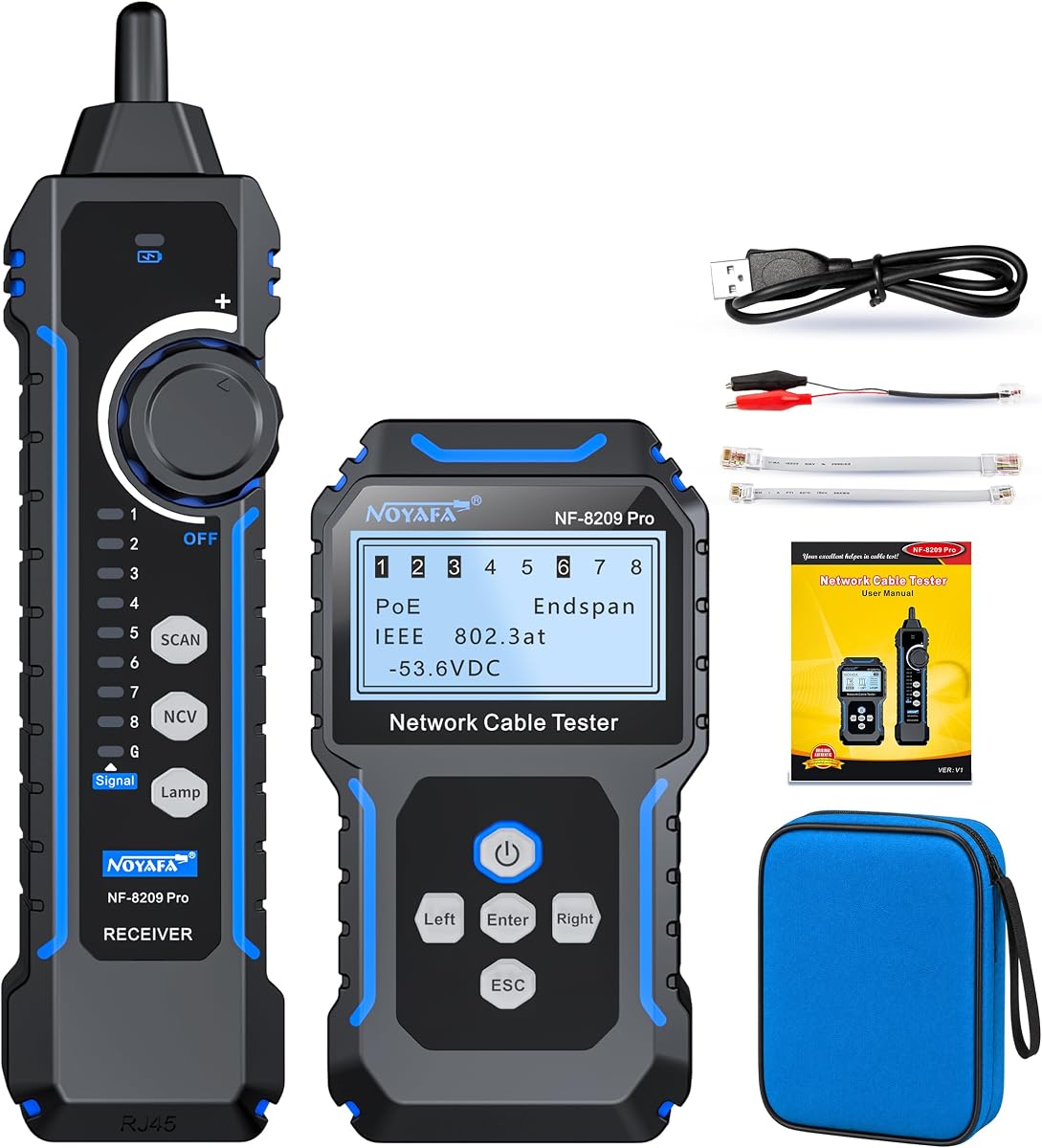
The NOYAFA NF-8209PRO integrates seven functions: wire tracking, cable mapping, length testing, PoE detection, port flashing, crimp testing, and non-contact voltage detection. With a 4.8 rating, it is the highest-rated option in this guide and offers the most balanced package of tracing and network diagnostics for modern cabling work.
We may earn a commission when you buy through this link, at no additional cost to you.
Digital signal technology is designed to minimize false alerts and improve tracing in busy environments. The unit tests open, short, and cross connections on RJ45 and RJ11 cables, with support stated for CAT5, CAT6, and both shielded and unshielded wiring. Its breakpoint location function can identify the approximate location of a fault, while length measurements extend from 5 to 350 meters.
PoE testing identifies power, voltage, and the relevant wire pairs, including support for standard and non-standard arrangements. Port flashing provides a direct way to match a cable to a switch port, and crimp-quality inspection checks the condition of an eight-core RJ45 connector. Together, these functions can shorten the process of moving from a reported network problem to a specific cable or port issue.
The built-in lithium-ion battery, Type-C charging, automatic shutdown, low-battery reminder, and flashlight make the device suitable for mobile work. The package includes a transmitter, receiver, 8P and 6P test cables, an alligator-clip line, a Type-C charging cable, and a manual. The NF-8209PRO is an excellent choice for IT technicians, installers, and facilities staff who want one comprehensive copper-cable diagnostic tool.
The combination of tracking, mapping, length, PoE, port flash, crimp, and NCV tests covers much of a copper-network diagnostic workflow. This broad scope reduces the need to carry several separate devices.
Type-C charging, automatic shutdown, a battery reminder, and a built-in flashlight support long field sessions. The included cable and accessory set makes the package ready for immediate deployment.
We may earn a commission when you buy through this link, at no additional cost to you.
The NOYAFA NF-8209 is a digital network cable tester with wire tracking, continuity testing, fault diagnosis, cable length measurement, PoE testing, port flashing, link testing, and non-contact voltage detection. Its 4.3 rating reflects a capable diagnostic package for CAT5, CAT6, RJ45, and telephone-related wiring tasks.
We may earn a commission when you buy through this link, at no additional cost to you.
Normal, Anti-Interference, and PoE modes give technicians different ways to approach a trace. Digital decoding is intended to produce accurate results with less noise, and live-cable tracing is stated to reach up to 600 meters. A remote adapter supports one-to-one testing of shielded and unshielded cables, including eight-pin network cables and nine-pin shielded configurations.
The tester can identify shorts, opens, and miswiring while measuring individual twisted pairs from 2.5 to 200 meters. Results can be shown in meters, feet, or yards, which is convenient for technicians who work to either unit system. PoE testing covers standard and non-standard power arrangements, including IEEE 802.3af and 802.3at, and displays power method, voltage, and polarity.
A 10M, 100M, and 1000M port-flash and link test adds useful network commissioning support. The kit includes a transmitter, receiver, remote adapter, cable set, tool bag, 9V battery, and Type-C cable, with the transmitter using a rechargeable battery and the receiver using a 9V battery. It is a good option for long installations where both route tracing and detailed copper-cable diagnostics are needed.
The claimed 600-meter live-cable range is particularly useful for larger campuses and buildings. Anti-Interference mode provides a specialized option when surrounding electrical activity could complicate detection.
Pair-level length readings, fault testing, and comprehensive PoE information go well beyond basic tone detection. The remote adapter broadens support for both standard and shielded cable arrangements.
We may earn a commission when you buy through this link, at no additional cost to you.
The NOYAFA NF-8508 combines copper-cable diagnostics with optical power measurement and a visual fault locator. Its 4.2 rating reflects a distinctive hybrid design, offering nine listed functions that include continuity testing, cable scanning, port flashing, length measurement, PoE testing, quality control, optical power testing, visual fault location, and non-contact voltage detection.
We may earn a commission when you buy through this link, at no additional cost to you.
The optical meter measures seven standard wavelengths: 850, 1300, 1310, 1490, 1550, 1625, and 1650 nanometers. Its power-detection range is listed from negative 70 to positive 10 dBm, and FC, SC, and ST connectors are supported. This makes it relevant to technicians who maintain both conventional network cable and fiber infrastructure rather than copper wiring alone.
A built-in visual fault locator at 650 nanometers helps identify fiber breakpoints, poor connections, bending, or cracking. The product also performs port flashing and displays information including operating speed, duplex mode, and negotiation settings. Copper-side features include PoE testing, cable mapping, polarity and voltage checks, short and open-circuit tests, and length measurement up to 200 meters.
The rechargeable 1,500mAh battery, adjustable backlight timeout, automatic shutdown, and Type-C charging make the tool adaptable to long work sessions. It is best for a mixed copper-and-fiber technician. The wider feature set requires more deliberate setup than a simple cable tester, and optical testing requires compatible connectors and suitable test conditions.
Optical power measurement and visual fault location distinguish this model from copper-only testers. Technicians responsible for mixed infrastructure can inspect signal strength and physical fiber condition without switching to a separate instrument.
Beyond flashing a port, the display can show operating speed, duplex mode, and negotiation settings. That information helps explain why a link may negotiate at a lower speed than expected.
We may earn a commission when you buy through this link, at no additional cost to you.
The TEMPO Communications 701K-G is a professional analog tone-generator and probe kit for voice, data, and video wiring. Its 4.5 rating reflects a strong focus on dependable identification, audible signal clarity, and practical field accessories rather than an expansive collection of electronic network measurements.
We may earn a commission when you buy through this link, at no additional cost to you.
The kit can identify wires within a bundle, monitor voltage passing through a circuit, check for breaks, and trace wiring through walls, floors, and ceilings made from non-conductive materials such as wood or drywall. A warbling tone is designed to remain distinguishable in noisy settings, while an LED proximity indicator brightens as the probe approaches the correct pair.
A work light provides additional visibility behind furniture and inside equipment racks. The professional package includes the 701K-G tone generator, 200EP-G tone probe amplifier, a modular plug, alligator test leads, an RJ11/45 socket adapter, and a nylon carrying case. That accessory assortment supports a range of conductor and connector arrangements during installation and service work.
This kit is ideal for technicians who primarily need a dependable analog method for following copper cables and checking basic circuit conditions. It offers fewer of the PoE, port-flash, and digital mapping functions found in multifunction network testers, but its specialized signal system and carrying case are well aligned with professional wire-tracing workflows.
The warbling tone gives the user a distinctive audio cue that can be recognized through moderate background noise. A visual proximity indicator provides a useful alternative when audio conditions are especially difficult.
Alligator leads, a modular plug, and an RJ11/45 socket adapter cover several common connection methods. The nylon case helps organize and protect the professional components between assignments.
We may earn a commission when you buy through this link, at no additional cost to you.
The Klein Tools VDV501-851 Scout Pro 3 is a cable-testing starter set with a backlit display, detailed fault detection, and substantial cable-length measurement. Its 4.7 rating reflects a strong tester for terminated voice, data, and video cables, particularly when diagnosis matters more than broad active-network analysis.
We may earn a commission when you buy through this link, at no additional cost to you.
The unit tests RJ11 and RJ12 voice cables, RJ45 data cables, and coax cables with F-connectors. It can identify open, short, miswire, and split-pair faults, and it measures cable length up to 2,000 feet, or 610 meters. The display presents cable length, wiremap, cable identification, and test results in a readable format.
The set also includes a multiple-style tone generator for tracing cables, wire pairs, and individual conductors. However, tone tracing requires Klein's separate VDV500-123 analog probe, which is not included. It is also not designed to test PoE, an important limitation for network technicians who routinely work with powered Ethernet devices.
This product is a good choice for installers and facilities staff who need reliable fault testing, mapping, and length measurement in one main unit. It can also serve as the foundation of a broader toolkit if the user later adds the compatible analog probe. Buyers wanting a self-contained tracing package should choose a kit that includes both a generator and receiver, while live-network and PoE users should look elsewhere.
A backlit LCD makes wiremaps and test outcomes easier to interpret in confined or poorly illuminated spaces. Identifying opens, shorts, miswires, and split pairs gives a more complete diagnosis than a simple pass-or-fail indicator.
The 2,000-foot measurement capability suits large runs, while support for RJ11, RJ12, RJ45, and coax broadens the set beyond Ethernet-only work. The separate probe requirement is the main purchasing consideration.
We may earn a commission when you buy through this link, at no additional cost to you.
The right cable tracer depends on the cable types you handle, the environment in which you work, and whether you need route identification alone or comprehensive fault and network diagnostics. The following factors help narrow the field before you choose a model.
Analog tone tracers inject an audible signal and use a probe to follow it, making them especially useful for identifying individual conductors in bundles and unfinished cables. Digital tracers encode a signal that can be distinguished from background noise, often supporting active-network tracing and clearer results in demanding environments. Some products combine both methods, allowing a technician to use broad route identification and precise pair isolation in the same job.
Choose the signal method that matches the work. Analog kits are favored for low-voltage installation and service, while digital testers are helpful around live equipment and large bundles.
A network-focused user should look for RJ45 support at minimum, with RJ11 and RJ12 providing additional telephone and data coverage. Coax compatibility matters for video and older communications wiring, while alligator clips or ABN attachments help when cables are unterminated. Fiber support is valuable for technicians who maintain mixed copper-and-fiber infrastructure.
Match the tester to the connectors already present in your work. A broad label such as Ethernet tester may conceal important limitations, so verify the exact standards and cable types supported.
Tracing tells a technician where a cable goes, but mapping confirms which conductor reaches which pin. Fault diagnostics identify opens, shorts, cross-connections, miswires, and split pairs. These capabilities are essential when a network problem persists despite a visually correct cable installation, and they turn a locator into a more complete diagnostic instrument.
Prioritize a readable wiremap and clear fault labels if installation quality or troubleshooting is a major part of your work. A simple tone-only tool is best reserved for quick identification.
Tracing an active network can prevent unnecessary service interruption, while PoE testing can verify power method, voltage, polarity, and pair assignments. These features are especially relevant to technicians supporting switches, cameras, access points, and VoIP equipment. Always verify whether a model handles PoE, and do not assume a tester designed for an unenergized cable is safe on a powered circuit.
Choose active-network tracing or PoE diagnostics when your work involves live infrastructure. Otherwise, a simpler non-energized cable tester may provide the features you actually need.
The advertised range indicates how far a signal can be followed, but actual performance depends on cable type, connections, interference, and how well the cable is grounded. Long-distance capability matters in campuses, warehouses, and multistory buildings. Accurate breakpoint location is a related feature that can shorten repairs by pointing directly to a damaged section.
Compare range against the scale of your typical installations. For short residential work, a compact tester may be sufficient, while professionals need dependable performance across longer runs.
LED indicators work well for simple pass-or-fail results, while an LCD is preferable for detailed wiremaps, cable length, port information, and fault categories. Digital testers may offer adjustable sensitivity, mode selection, and simulated results that need a short learning period. Audible tones remain useful when the screen is not directly visible, especially in dense wiring spaces.
Choose the interface that matches your workflow. Clear labeling and simple controls can be more valuable than extra features if you need fast, repeated answers in the field.
Rechargeable devices reduce battery expense, while standard batteries may be easier to replace in remote locations. A flashlight, work light, storage case, test cables, alligator leads, and modular adapters improve usability. Portability matters for mobile technicians, and a rugged or non-slip housing helps during daily handling.
Check what is actually included. A tone generator that requires a separately sold probe may cost less initially but offers less convenience than a complete generator-and-probe package.
Most cable tracers are designed for low-voltage communications wiring and should not be treated as instruments for energized mains circuits. A non-contact voltage detector can provide awareness of live AC wiring, but it does not remove the need for proper electrical safety procedures. Product specifications should define whether the tool is intended for active networks, unenergized cables, or both.
Read the stated operating limits before using any tracer. The best tool for the job is one whose safety and technical specifications align with the wiring you intend to test.
Begin by identifying the cable, connector type, and system under test. Confirm that the wiring is within the tool's stated voltage and signal limits, then select a tracing or diagnostic mode appropriate to the task. Connect the generator to the intended conductor with the appropriate plug, test lead, clip, or port, and begin from a point where the cable is accessible and easy to distinguish.
For tone tracing, move the receiver slowly along the expected route and watch both its audible signal and visual indicators. For digital testers, adjust sensitivity carefully and avoid placing the receiver directly beside unrelated high-current wiring. When mapping or fault testing is required, connect the remote unit to the far end and compare the displayed pin sequence and fault indication with the expected configuration before disconnecting anything.
After use, switch off the tester, remove connected leads, and wipe the housing and leads with a dry or lightly damp cloth. Keep battery compartments dry, protect optical ports and connectors from dust, and store the device in its case or a clean protective pouch. Charge rechargeable units as directed and replace disposable batteries with the specified type, especially if low-battery warnings or unreliable readings appear.
A cable tester checks connectivity, pin order, faults, and sometimes length, while a tracer is primarily used to follow a cable through a bundle or building. Many modern tools combine both functions, allowing a technician to locate a route and then verify its wiring. The right choice depends on whether you need path identification, detailed diagnostics, or both.
It depends on the construction and the tracer's method. Many models can locate cables through non-conductive surfaces such as drywall, wood, carpet, or ceiling material, as specified by the manufacturer. Dense barriers, metal sheathing, concrete, and other solid or conductive structures may substantially reduce or block the signal.
A complete set is generally more convenient because the receiver must be compatible with the generator's signal. Some starter sets include a generator but require an analog probe to be purchased separately, so check the package contents carefully. A matched bundle is usually the simplest way to obtain a ready-to-use tracing system.
Some digital models explicitly support active-network tracing, while many analog and basic continuity testers are intended for open-ended, non-active, low-voltage wires. Check the specifications before connecting the tool to a live system. Also verify whether it supports PoE, since a cable tester that is safe for ordinary Ethernet may not be designed for powered Ethernet.
A split pair occurs when two conductors belong to the same twisted pair but are connected to the wrong pins, such as the two pins of a color pair being swapped. Basic continuity can still pass because every conductor reaches the tester, yet the connection may produce errors or reduced performance. A tester with wire mapping and split-pair detection is more useful for diagnosing this problem.
Wire mapping, continuity and fault testing, cable-length measurement, and clear pin-sequence results are especially useful during installation. For networks carrying power, PoE detection and port flashing add value by confirming power compatibility and identifying the correct switch port. A tracer is still needed when the physical route of an existing cable is unknown.
No. An NCV function is an additional awareness tool and may not detect every energized conductor under every condition. It should not replace appropriate electrical testing, isolation procedures, or qualified-person requirements. Use it to gain awareness while following the manufacturer's instructions and applicable safety practices.
Turn it off, disconnect test leads, and keep the housing, connectors, and battery compartment clean and dry. Store rechargeable units in a protected location and follow their charging guidance, while keeping loose batteries away from short-circuit contacts. A carrying case, when included, helps prevent damage and keeps accessories organized.
The Klein Tools VDV500-820 is the strongest overall choice for professional analog tracing because it combines long stated reach, five tone cadences, secure wire attachment, and continuity and polarity testing. The NOYAFA NF-8209PRO is the most comprehensive digital option, while the TESMEN TLP-528C offers an approachable, portable solution for essential network and telephone cable work.
Prioritize the functions you will actually use rather than the longest feature list. Simple route identification may require only a compact tester, while installation and maintenance work benefit from wire mapping, fault detection, port flashing, PoE testing, and a visible display. Analog specialists should also consider the TEMPO 701K-G, and mixed fiber-and-copper technicians may prefer the NOYAFA NF-8508.
Before purchasing, verify connector support, tracing range, active-network capability, included accessories, and safety limitations. Current prices and product configurations can change, so compare the latest listing with the specification summary before deciding.