
NICE-POWER 200V 5A
5.0Editor score
200V and 5A capacity
1000W total power output
Intelligent temperature-controlled fan
High and low output cables
Our Power Supply for Electrolysis guide compares ten adjustable DC bench supplies for voltage control, current limits, protection, displays, portability, and
A power supply for electrolysis must deliver controlled DC voltage and current while remaining stable as the electrolytic cell changes load. The most useful models combine precise adjustment, readable measurements, effective cooling, and protection against overload, short circuits, overheating, and reverse connection.
The products in this guide were compared using their stated output ranges, display resolution, adjustment systems, protection features, dimensions, cooling arrangements, and electrolysis-related applications. The list covers compact 30V models, portable 150W units, and a substantially higher-power laboratory model for demanding setups.
Each review highlights the particular strengths and limitations of the power supply, from encoder controls and automatic constant-voltage and constant-current modes to input-voltage considerations and included accessories. Ratings and specifications reflect the supplied listings, while prices and availability can change frequently, so readers should confirm current details before buying.
5.0Editor score

4.6Editor score

4.5Editor score
The table below places all ten adjustable DC power supplies side by side, focusing on output capacity, adjustment precision, display type, and the features that most directly affect electrolysis work.
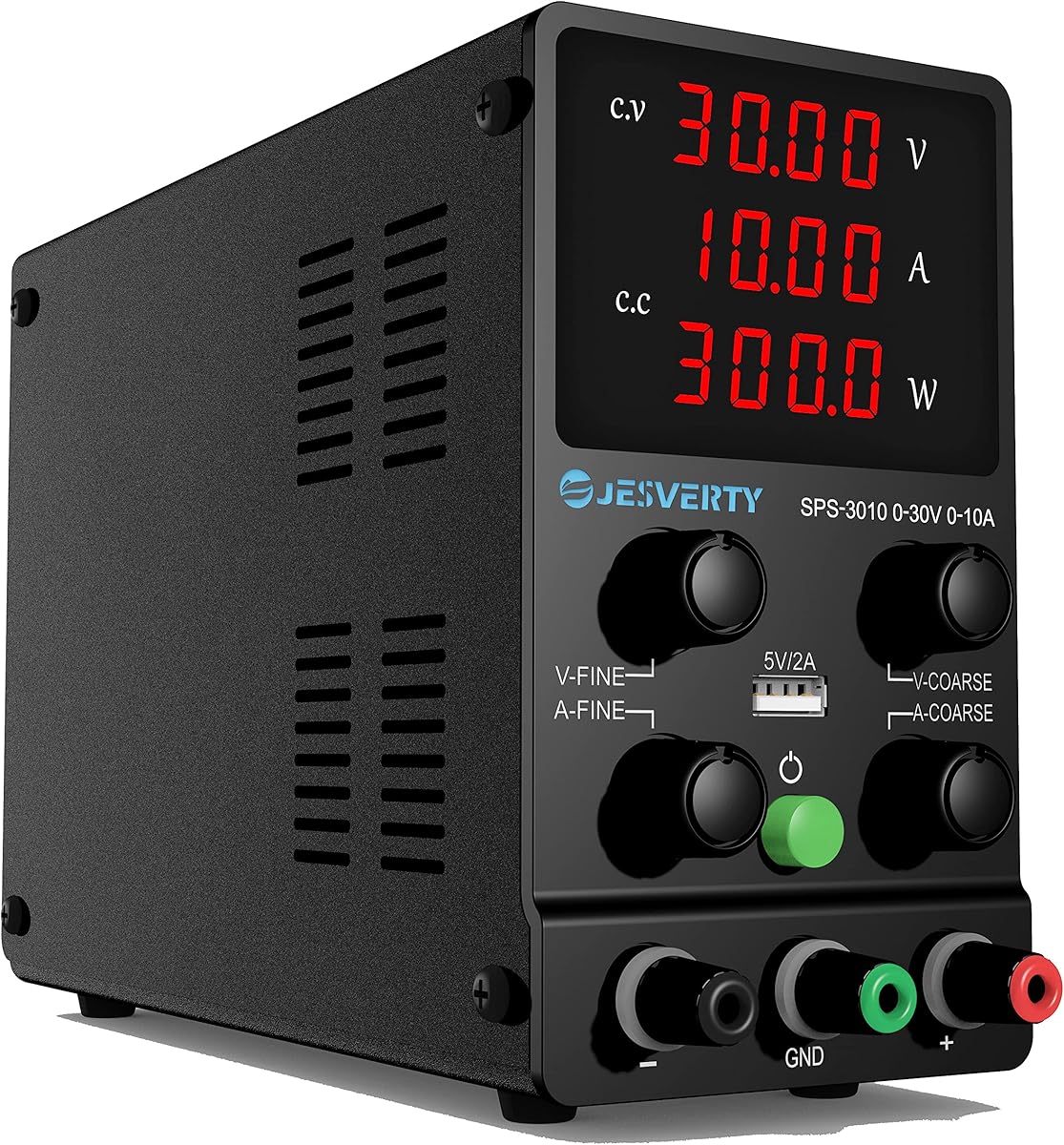


The Jesverty SPS-3010 is a compact adjustable switching bench supply with a stated 0-30V and 0-10A range. It carries a 4.5 rating and stands out for a bright four-digit display that presents measured voltage, current, and power. That combination gives electrolysis builders a useful view of both the electrical load and the power being drawn.
We may earn a commission when you buy through this link, at no additional cost to you.
The most important operational feature is automatic switching between constant-voltage and constant-current modes. As an electrolytic cell or other load changes, the supply can transition between the two modes, while the preset voltage and current serve as the crossover point. Protection features include short-circuit, overload, and thermal management, with a temperature-regulated fan and grounding terminal also listed.
The coarse and fine controls make it practical to establish a new operating point, and the real-time power calculation is a meaningful addition when comparing different electrolyte conditions. The enclosure measures 7.1 by 3.35 by 6.1 inches and weighs approximately 2.5 pounds, so it is easier to accommodate than a large laboratory supply. The USB port is rated at 5V and 2A rather than a high-current electrolysis output.
This is a strong general-purpose option for small laboratory cells, electroplating-style demonstrations, and educational electrolysis setups. Buyers should not treat the headline 10A rating as unlimited capacity in every mode, and they should use appropriately rated leads for sustained current. Subject to those considerations, it offers a capable display, flexible modes, and a practical combination of size and protection.
The four-digit display reports measured voltage, current, and power rather than showing only the selected value. This is especially useful when an electrolytic cell's resistance changes as the chemistry, electrode spacing, or solution temperature shifts.
Its small vertical enclosure and light weight make the unit easier to move between a workbench, classroom, or temporary project area. The built-in cooling system supports sustained operation without requiring a full-size rack enclosure.
We may earn a commission when you buy through this link, at no additional cost to you.
The NANKADF 30V 10A bench supply combines a 0-30V, 0-10A stated range with a high-precision encoder control. Its 4.5 rating reflects a well-liked general-purpose design, while the digital adjustment system differentiates it from supplies controlled by conventional potentiometers.
We may earn a commission when you buy through this link, at no additional cost to you.
Pressing the encoder selects an individual digit, and turning it changes that digit from zero through nine. This is useful when targeting a specific voltage or current limit for an electrolytic cell because it reduces the ambiguity of estimating knob positions. The four-digit display provides 0.01V and 0.001A resolution, and automatic constant-voltage and constant-current switching helps accommodate changing loads.
An output enable and disable button allows the user to preserve a setting while interrupting power to the load. The overcurrent protection function stops output and activates a buzzer if a short circuit occurs. Display brightness is also adjustable, which is convenient in bright labs or dim workspaces. The 18W USB fast-charging port is a convenience feature, not a substitute for the main adjustable output.
The NANKADF is well suited to precision-oriented hobby and laboratory electrolysis where repeatable settings matter. It is less obviously suited to very high-current work than the 1000W model in the list, but within its advertised range it provides useful controls, clear measurement, and meaningful short-circuit safeguards. Buyers should still verify the enclosure, cooling, and included cables against their particular cell.
Digit selection makes it easier to enter the same voltage and current limit again after changing experiments. This is a practical advantage over a continuously variable knob when documenting repeatable operating conditions.
The output button lets a user silence the load without losing the selected settings. That is useful when changing electrodes, disconnecting a cell, or correcting a wiring mistake before reapplying power.
We may earn a commission when you buy through this link, at no additional cost to you.
The LONGWEI LW-K3010D is a straightforward adjustable DC supply rated at 0-30V and 0-10A, with a 4.4 rating. It is built around a backlit three-digit display that shows voltage, current, and power, offering 0.1V and 0.01A stated resolution.
We may earn a commission when you buy through this link, at no additional cost to you.
Its main appeal is a familiar combination of broad adjustment range and essential laboratory functions. A temperature-controlled fan and heat-dissipation grooves help remove heat, while the protection list includes limited-current, overpower, over-temperature, and voltage-overload functions. A grounding wire and included alligator-clip output cable make it approachable for repair benches and classroom electrolysis demonstrations.
The lower display resolution is the main compromise. Compared with the four-digit models, it provides less visual precision, which matters when operating near a narrow voltage target or documenting small changes. The unit also weighs less than 2 kilograms and measures 2.7 by 8.6 by 6.3 inches, giving it a slim and portable profile that can be useful where bench depth is limited.
This LONGWEI model is a practical choice for general electrolysis, electronic repair, aging tests, and school projects. It is best suited to users who value straightforward operation, robust protection, and a broad range more than fine digital setting or extra charging ports. The included leads are convenient for initial setup, but prolonged high-current work may call for heavier wiring.
The backlit display keeps voltage, current, and power visible in low-light work areas. Its three digits are less detailed than four-digit alternatives, but they provide an immediately understandable view of the operating state.
A sensor-controlled fan and multiple side heat-radiation grooves support continuous operation. This matters for electrolysis runs lasting long enough that a less ventilated supply could overheat.
We may earn a commission when you buy through this link, at no additional cost to you.
This NANKADF model earns a 4.6 rating and offers a 0-30V, 0-10A adjustable output with a four-digit display. Its standout feature is the pair of encoder knobs, one for the value before the decimal point and another for the value after it. This coarse-and-fine approach makes rapid adjustment and precise correction straightforward.
We may earn a commission when you buy through this link, at no additional cost to you.
The unit also includes a 5V, 3.6A USB-C output in addition to a USB connection, plus overcurrent protection with an audible short-circuit alert. Grounding, leakage, overheat, voltage-overload, and power-overload protection are also listed. An intelligent temperature-controlled fan and heat sink support heat dissipation for laboratory, maintenance, production-line, and teaching applications.
Automatic voltage detection is an important practical feature. The unit adapts to 110V or 230V AC input within the stated tolerance, and the former rear-panel voltage toggle has been removed. That reduces setup friction for travelers, though users should still verify that the supplied power cord and local input match their location.
The combination of fine control, visible measurements, and audible fault feedback makes this a strong all-around electrolysis supply for small-to-medium projects. It is not the appropriate choice simply because it advertises 10A at every point; actual cell load and cooling requirements still determine performance. Within those limits, the controls and safeguards are particularly attractive.
The coarse encoder handles the leading digit, while the fine encoder handles the decimal digit. This lets a user move quickly to a target value and then make small corrections without fighting a single oversensitive control.
Removing the manual voltage toggle simplifies operation across different AC systems. The listed automatic adaptation still requires the correct regional cord and an appropriate grounded outlet.
We may earn a commission when you buy through this link, at no additional cost to you.
The Jesverty SPS-3010V is a compact 0-32V, 0-10A switching bench supply with a 4.6 rating. It upgrades to encoder-based coarse and fine adjustment, allowing settings to 0.01V and 0.001A. A four-digit display gives the user a clear numerical view of the operating state.
We may earn a commission when you buy through this link, at no additional cost to you.
Two charging ports support 20W USB-A and USB-C output, which is handy for phones and common electronics modules. The main unit also includes an output button, so users can interrupt or restore power without disconnecting the load or losing their settings. The optional OPN output-status setting can make the unit begin supplying voltage and current when switched on.
Protection features include overcurrent protection and temperature-regulated cooling, while selectable 115V and 230V AC input is listed. The enclosure measures 7.1 by 3.6 by 6.2 inches and weighs about 2.5 pounds. Applications cited for the product include anodizing, battery charging, laboratory work, manufacturing tests, and electronic repair.
This model is a strong candidate for electrolysis setups that need more adjustment finesse than a traditional knob provides without occupying much space. It also fits well into a mixed workbench where a phone or development board may need charging. The destination-dependent cord and input configuration should be confirmed, and sustained high-current cells should use properly rated test leads.
Separate coarse and fine encoders reduce the time spent moving between widely separated target values and fine operating points. That makes the supply convenient for comparing several electrolyte or electrode configurations.
The output button can remove power from the cell while retaining the selected settings. It reduces the need to unplug leads every time an electrode is repositioned or a test is paused.
We may earn a commission when you buy through this link, at no additional cost to you.
The NICE-POWER 30V 10A is the most broadly balanced unit in this guide, earning a 4.6 rating. It provides a 0-30V and 0-10A range, a bright four-digit display, and real-time voltage, current, and power readings. It is also one of the few listings that explicitly names electrolysis among its intended applications.
We may earn a commission when you buy through this link, at no additional cost to you.
Automatic constant-voltage and constant-current conversion allows the supply to continue operating as the load changes. The user can set a current ceiling and observe which mode is active, which is valuable when an electrolytic cell starts drawing differently as the reaction develops. An output key allows voltage and current to be adjusted without applying power to the load.
Safety is a major strength. The listing identifies leakage protection, a grounding terminal, over-voltage, over-current, over-power, over-load, over-temperature, and short-circuit protection. A temperature-controlled fan and heat sink activate when the working temperature rises above 122 degrees Fahrenheit, helping maintain output during long sessions. The front power switch, 0.01V resolution, 0.001A resolution, and automatic mode display add to ease of use.
The main constraint is the 110V-only AC input, which makes this model unsuitable for direct use on a 220V system. Its coarse and fine potentiometer controls are also less exact than digital encoder selection. Even so, the balance of measurement, mode control, protection, and compact size makes it the most versatile everyday pick for serious electrolysis work.
Automatic constant-voltage and constant-current conversion keeps the unit in an appropriate operating mode as demand changes. For electrolysis, this makes the current limit more meaningful than voltage alone.
Protection against leakage, overload, excessive temperature, over-voltage, over-current, over-power, and short circuits reduces the consequences of setup mistakes. The audible or visible operating-state indicators help users respond quickly.
We may earn a commission when you buy through this link, at no additional cost to you.
The NICE-POWER SPS-E3010 is a 150W switching supply with a 4.5 rating and a stated 0-30V, 0-10A operating range. Rather than offering every voltage-current combination freely, it provides two practical profiles: 15V at 10A or 30V at 5A, with 150W as the maximum output.
We may earn a commission when you buy through this link, at no additional cost to you.
This fixed-power approach can be an advantage because it makes the unit compact and portable while preserving useful high-current or high-voltage options. It weighs less than 1 kilogram and measures 10 by 18.5 by 8 centimeters. A cooling fan starts automatically, and the encoder controls let users select and set individual voltage and current digits. Display resolution is stated at 0.1V and 0.01A.
The input range of 100-240V AC at 50-60Hz, with a stated tolerance, makes the unit useful in many regions. The package includes the supply, an output cable, an input cord, and a manual. Buyers are instructed to stop using the unit if it becomes too hot and allow it to cool, an important caveat for extended electrolysis sessions.
This is a sensible portable and budget-conscious choice for plating, small electrolysis cells, and general electronics work. Its 150W ceiling means it is not appropriate for every arrangement that nominally falls within 30V and 10A, so the selected profile must match the cell. Within that limit, the compact size, broad input range, and encoder controls are compelling.
The sub-one-kilogram enclosure is easy to move between a classroom, home workshop, or shared lab. Its broad AC input range also reduces the need for a separate travel transformer.
Choosing between 15V at 10A and 30V at 5A makes the 150W limit easier to understand. This is useful for users who need one strong operating range rather than unrestricted combinations of voltage and current.
We may earn a commission when you buy through this link, at no additional cost to you.
The SKY TOPPOWER 30V 10A is a compact adjustable bench supply with a 4.3 rating. It covers 0-30V and 0-10A, displays voltage and current with stated accuracy of 0.01V and 0.001A, and includes a large backlit four-digit display for low-light visibility.
We may earn a commission when you buy through this link, at no additional cost to you.
Automatic constant-voltage and constant-current switching helps it adapt to changing loads. The display identifies the active mode, which gives useful feedback when the cell reaches its configured current ceiling. Smooth coarse and fine knobs are intended to make precise adjustments without visible looseness or wobble.
The protection list is extensive: leakage protection, thermal protection, voltage overload, current limit, short circuit, and a temperature-controlled fan. A grounding terminal and anti-reverse connection protection add further safeguards, which is especially relevant when electrodes and output leads are being changed frequently.
Electrolysis is explicitly listed among its applications, alongside battery charging, load testing, etching, and component testing. The enclosure is only 8.70 by 5.43 by 4.09 inches and weighs less than 1.5 kilograms. Its lower rating than the leaders and lack of convenience charging ports are modest drawbacks, but the measurement detail, compactness, and safety features make it a solid general-purpose choice.
Anti-reverse connection protection is particularly helpful in electrolysis because swapping electrode leads by mistake is a common beginner error. A grounding terminal and short-circuit protection further reduce setup risk.
The segmented red display is large and backlit, making operating values easy to read from different positions. Protective film on the display is intended to resist dirt and minor damage during transport.
We may earn a commission when you buy through this link, at no additional cost to you.
The NICE-POWER 200V 5A is the high-power selection in this guide, with a stated 200V, 5A, 1000W capacity and a 5.0 rating. It is built for laboratories, schools, aging tests, battery charging, solar testing, electronics maintenance, and electrolysis applications that exceed the practical range of conventional 30V bench units.
We may earn a commission when you buy through this link, at no additional cost to you.
A high-precision encoder replaces a traditional potentiometer, allowing voltage and current values to be set digit by digit. The backlit four-digit display shows voltage and current clearly in low-light conditions. Constant-current and constant-voltage lamps indicate the operating state, while internal over-voltage and over-current protection responds when the load approaches or exceeds the selected values.
The built-in intelligent fan turns on when the temperature reaches 50 degrees Celsius, helping protect the unit during extended high-power operation. The listed dimensions are 38 by 24 by 13 centimeters, and the weight is 3.3 kilograms. The package includes a low-power output cable and a high-power output cable, which is helpful for matching the connection to different load levels.
This supply is the premium choice for serious electrolysis work, multiple simultaneous loads, or a laboratory that needs flexibility across low-voltage, high-current, and high-voltage experiments. It is unnecessarily large for a small classroom cell, and buyers should assess ventilation, connector suitability, and safe handling at the intended power level. For a demanding shared laboratory, however, its output headroom is the key advantage.
The 1000W capacity provides room for setups that need more current or substantially higher voltage than a 30V unit can deliver. That flexibility also makes it useful for aging tests and other high-load laboratory work.
The intelligent fan activates at the stated 50-degree Celsius threshold. Combined with internal protection, it supports longer runs while giving the user feedback through the constant-current and constant-voltage indicators.
We may earn a commission when you buy through this link, at no additional cost to you.
The NICE-POWER 30V 5A is a small adjustable switching supply with a 4.6 rating. It offers a 0-30V and 0-5A range, which is sufficient for many small electrolysis cells, electroplating demonstrations, LED testing, and compact electronic projects.
We may earn a commission when you buy through this link, at no additional cost to you.
Voltage and current are adjusted with separate encoder knobs. Pressing a knob selects a digit, and rotating it enters the desired value, replacing the less exact operation associated with a conventional potentiometer. The backlit three-digit display provides 0.1V and 0.01A resolution, making the selected operating values easy to see in low light.
Protection features include over-voltage, over-current, over-power, over-temperature, and short-circuit protection. A fan handles heat dissipation, while the listing describes the output as low ripple and low noise. The 100-240V input range supports use with 110V and 230V conditions, making it more geographically flexible than the 110V-only NICE-POWER model.
The enclosure measures 6.5 by 4.0 by 3.2 inches and weighs only 1.54 pounds, making it one of the most portable choices. It is a good match for a compact desk, classroom, or small cell that does not need more than 5A. Users needing higher sustained current, finer display resolution, or a four-digit power readout should move up to a larger model.
A 5A ceiling and 30V maximum cover many small electrolytic experiments. The compact housing is particularly convenient where a full-sized 30V, 10A supply would occupy too much bench space.
The stated 100-240V AC input works with common 110V and 230V supplies. It reduces compatibility concerns for users who take equipment between workshops, schools, or laboratories.
We may earn a commission when you buy through this link, at no additional cost to you.
The best power supply for electrolysis is not simply the unit with the highest headline current. Voltage range, actual power limits, control precision, thermal performance, protection, wiring, and local input requirements all determine whether a supply can run a particular cell safely and repeatably.
Choose a supply whose voltage range covers the intended electrolysis voltage and whose current limit can satisfy the cell without becoming the limiting factor. A nominal 0-30V and 0-10A label does not always mean that 300W is available at every combination. Some products, including the 150W NICE-POWER SPS-E3010, explicitly limit operation to 15V at 10A or 30V at 5A. High-voltage units may also impose lower current limits at higher voltages.
Sum the cell voltage and any practical cable or electrode losses when establishing a working range. Match the supply's current ceiling to the load with sensible margin, but do not select a model solely for its largest printed current rating. The power limit and cooling system are equally important for sustained electrolysis.
Automatic constant-voltage and constant-current modes make an adjustable supply much more useful across changing electrolytic conditions. In constant-voltage mode, the supply holds the selected voltage while current varies with the cell. Once demand reaches the configured current limit, constant-current mode takes over and voltage may fall. This behavior helps control current density, which can influence plating quality, gas production, electrode wear, and overall experiment safety.
A clear mode indicator on the display is valuable because it shows when the cell is drawing more current than expected. Users should still understand that the selected voltage and current are crossover settings rather than two values that are independently guaranteed at all times.
The controls determine how easily a user can reproduce a working point. Coarse and fine potentiometers are simple and tactile, while encoder controls let the user select each digit for more repeatable entry. Four-digit displays often show voltage, current, and power, while three-digit models may provide less numerical detail. The most useful display also clearly identifies the active operating mode.
For basic demonstrations, a three-digit display and coarse-fine knobs may be sufficient. For research, plating work, or repeated comparisons, digit-selecting encoders and readings to 0.01V and 0.001A offer greater convenience and useful precision.
Short-circuit and overcurrent protection are especially important because electrolyte can spill, electrode leads can cross, and a cell can suddenly change resistance. Look for over-voltage, over-power, over-temperature, leakage, and overload protection as well. A visible or audible alarm gives immediate notification that output has stopped, helping prevent a user from repeatedly applying power to a faulty cell.
Grounding and anti-reverse connection protection add further safeguards. These features do not make mistakes harmless, so users should still inspect polarity, ventilation, wiring, and electrode placement before switching the output on.
Electrolysis can run for hours, making thermal management more important than a brief peak-current test. Temperature-controlled fans, heat sinks, and heat-radiation grooves help remove heat from switching components. The 200V 5A NICE-POWER activates its fan at a stated 50 degrees Celsius, while several smaller models use sensor-controlled cooling as well. Users should leave unobstructed space around the enclosure and follow the manufacturer's instructions.
If a supply becomes unusually hot, stop the experiment and allow it to cool. Continued operation despite overheating can reduce component life or lead to shutdown. Always treat the fan as part of the safety system rather than an optional accessory.
Check the AC input carefully before purchasing. The NICE-POWER 30V 10A SPS has a listed 110V-only input, while the NANKADF model uses automatic 110V and 230V detection, the 150W model accepts 100-240V, and the small NICE-POWER 30V 5A also lists 100-240V. Some units use a manual 115V or 230V selector, and others note that the input configuration may vary by destination. A compatible voltage range is not enough if the included cord or connector is unsuitable.
For the electrolytic cell, consider lead thickness, insulation, connector type, and the expected current. Included alligator clips or test leads are convenient for initial work, but sustained high-current runs may require heavier cables and a reliable connection between the supply and electrodes.
A compact supply leaves more room for tanks, electrodes, meters, and other experiment equipment. The smallest options in this guide weigh around 1.5 pounds or less, while the 30V, 10A models generally fall between approximately 2.5 and 2.6 pounds. The 200V, 5A laboratory supply weighs 3.3 kilograms and is intended to remain on a bench, so its size is justified by the much greater output capacity.
Choose a small model for portable teaching, hobby cells, and limited bench space. Choose a larger laboratory supply when several loads may be connected, high power is required, or the unit will be integrated into a permanent workstation.
The output-control button on several models allows power to be removed without losing the selected voltage and current. This is helpful when changing electrodes or pausing a reaction. A USB charging port may also be useful around the bench, but it does not add to the electrolysis output and should never be treated as a substitute for a suitably rated DC connection.
Included power cords, output leads, alligator clips, and a manual improve the initial setup experience. The 200V model includes separate low-power and high-power output cables, while most smaller units include a standard output lead set. Confirm that the supplied accessories match the current and connection style required by the project.
Begin by confirming the mains input, output settings, and cell wiring before energizing the supply. Connect the positive output to the appropriate anode and the negative output to the cathode, with the power supply output switched off. Check the rated voltage, current, and total wattage of the cell, and use cables whose insulation and current capacity are appropriate for the expected load. Keep the supply itself outside the tank or splash zone.
Set a conservative current limit and voltage before turning on the output. If the supply has an output-enable button, use it during pauses and electrode changes. Watch the voltage, current, power, and operating-mode indicators as the cell warms or its composition changes. If the unit enters constant-current mode, determine whether that behavior is expected for the intended cell or a sign that the load is too demanding for the selected settings.
Operate the supply in a ventilated area and do not block its fan, vents, or heat sink. Clean the surrounding bench, inspect connectors for corrosion, and replace damaged leads. Stop use if the enclosure becomes excessively hot, the display behaves unexpectedly, or repeated protection alarms occur. Periodic checks of the cell, electrodes, wiring, and cooling path will help maintain stable and safe electrolysis.
They are highly useful rather than strictly mandatory. Constant-voltage mode holds the selected voltage as the cell draws different current, while constant-current mode limits demand and may reduce voltage when the cell becomes difficult to drive. A current limit can protect the cell, electrodes, and wiring from unexpectedly high draw.
The correct current depends on the electrolyte, electrode area, cell geometry, and desired reaction rate. Start below the cell's recommended current density and increase only while monitoring the cell, electrodes, and temperature. Also verify the power supply's combined voltage-current limit, since some units cannot deliver maximum current at maximum voltage.
A 30V, 10A supply is suitable only if the cell's voltage, current, and total power fall within the unit's actual operating constraints. Some 30V and 10A supplies are limited to 150W, which means 30V can be paired with only 5A. Check the detailed output profile rather than relying on the two headline maximum ratings.
The appropriate voltage varies with the chemistry and electrode configuration. Some simple aqueous demonstrations work at low single-digit voltages, while plating, electrolysis, and specialized reactions may require considerably more. Use the lowest voltage that produces the intended result, and confirm that the cell and electrodes can safely tolerate the selected operating point.
They are usually intended for initial setup and ordinary bench use, but sustained high-current operation may require heavier leads. Verify current rating, connector compatibility, insulation condition, and secure attachment. Replace lightweight or damaged leads with properly rated cables before running a demanding cell.
The cell's demand has reached the configured current limit, so the supply reduces voltage to maintain that ceiling. This can be normal as electrode chemistry changes or as resistance falls. It can also indicate a short circuit, a wiring problem, or a cell that needs more supply capacity, so check the setup rather than simply raising the limit.
No, the USB ports are separate convenience outputs for phones or electronic modules and do not add capacity to the main electrolysis terminals. Use appropriately rated positive and negative DC output leads for the cell. A USB port may be useful for powering a control board, but it should not replace the main supply.
Many models are designed for sustained work and include temperature-controlled cooling, but continuous operation still requires ventilation and a load within the unit's power limits. Monitor temperature and allow the fan to operate freely. If the supply becomes excessively hot or repeatedly shuts down, pause the experiment and investigate the cell, connections, and cooling conditions.
The NICE-POWER 30V 10A SPS is the most balanced overall recommendation because it combines a detailed four-digit display, automatic constant-voltage and constant-current conversion, extensive protection, and a convenient 0-30V, 0-10A range. The NICE-POWER 200V 5A is the premium option for laboratories that need greater power headroom, while the 150W SPS-E3010 is the best portable value model.
For most small and medium projects, prioritize actual power limits, current control, accurate readings, protection, and correctly rated leads over convenience ports. Verify the local mains input, especially for the 110V-only NICE-POWER model, and make sure the cell's operating point fits the selected high-current or high-voltage profile.
Ratings, specifications, product availability, and prices can change, so confirm the latest listing before purchasing. Compare the current output range, included cables, protection functions, and electrical requirements with the cell you intend to run rather than choosing solely on the largest advertised current.