
Joinfworld Heavy Duty Remote Terminal Kit
4.7Editor score
Heavy duty steel bracket
4-gauge cable set
Protective positive and negative boots
Remote battery terminals make charging, jump-starting, and routine electrical service more convenient by moving the connection point away from a crowded or inaccessible battery. The best options combine durable conductive hardware, secure mounting, effective insulation, and enough current capacity for the vehicles and equipment they support.
This guide compares ten available listings using the supplied product information, focusing on material, amperage, mounting method, cable or stud size, protective features, intended applications, and included accessories. It covers complete relocation kits, panel-mounted posts, compact junction posts, and copper battery stud connectors for automotive and marine use.
Each numbered review explains the most useful features, practical limitations, and ideal buyer. The top selections represent the strongest combinations of convenience, construction, and versatility, while product details and availability can change; readers should verify current specifications and listings before purchasing.
4.7Editor score

4.7Editor score
4.8Editor score
As an Amazon Associate we earn from qualifying purchases.
The comparison below evaluates each listing by terminal type, construction, current handling, mounting arrangement, and intended vehicle or equipment use, including two entries for which no product details were supplied.


The Joinfworld Heavy Duty Kit is a complete remote battery relocation package with a 4.7 rating. It stands out for combining two battery posts, a steel mounting bracket, substantial four-gauge wiring, mounting hardware, insulated terminal boots, and heat-shrink tubing in one coordinated set.
We may earn a commission when you buy through this link, at no additional cost to you.
Its principal advantage is convenience. Moving the charging connection away from the battery makes routine charging and jump-starting far more accessible, particularly on recreational vehicles where the original battery may sit beneath a panel or inside a crowded compartment. The approximately 53-inch cable length gives an installer meaningful routing flexibility, while the supplied bracket simplifies attachment to a suitable surface.
There is an important distinction between the stated 250A terminal rating and the listed maximum current capacity of the four-gauge wire. The wiring is rated for up to 150A, so installers should treat that lower figure as the practical limit for the supplied cables rather than assuming the entire assembly performs identically at the post's higher rating.
This kit is the strongest choice for owners who want a ready-to-install relocation setup rather than individual terminals and separate cable hardware. It is especially relevant to Can-Am Maverick X3, UTV, ATV, marine, car, RV, and truck applications, provided the installer confirms panel space, cable routing, and electrical requirements beforehand.
Extending the battery connections to a more convenient location can eliminate the need to remove body panels or reach into a tight compartment. The result is a more practical charging and jump-starting arrangement for routine vehicle care.
The included bracket, four-gauge wires, hardware, heat-shrink tubing, and color-coded boots create a more cohesive installation than assembling each component independently. Buyers should still inspect connector fit, cable routing, and fuse requirements before use.
We may earn a commission when you buy through this link, at no additional cost to you.
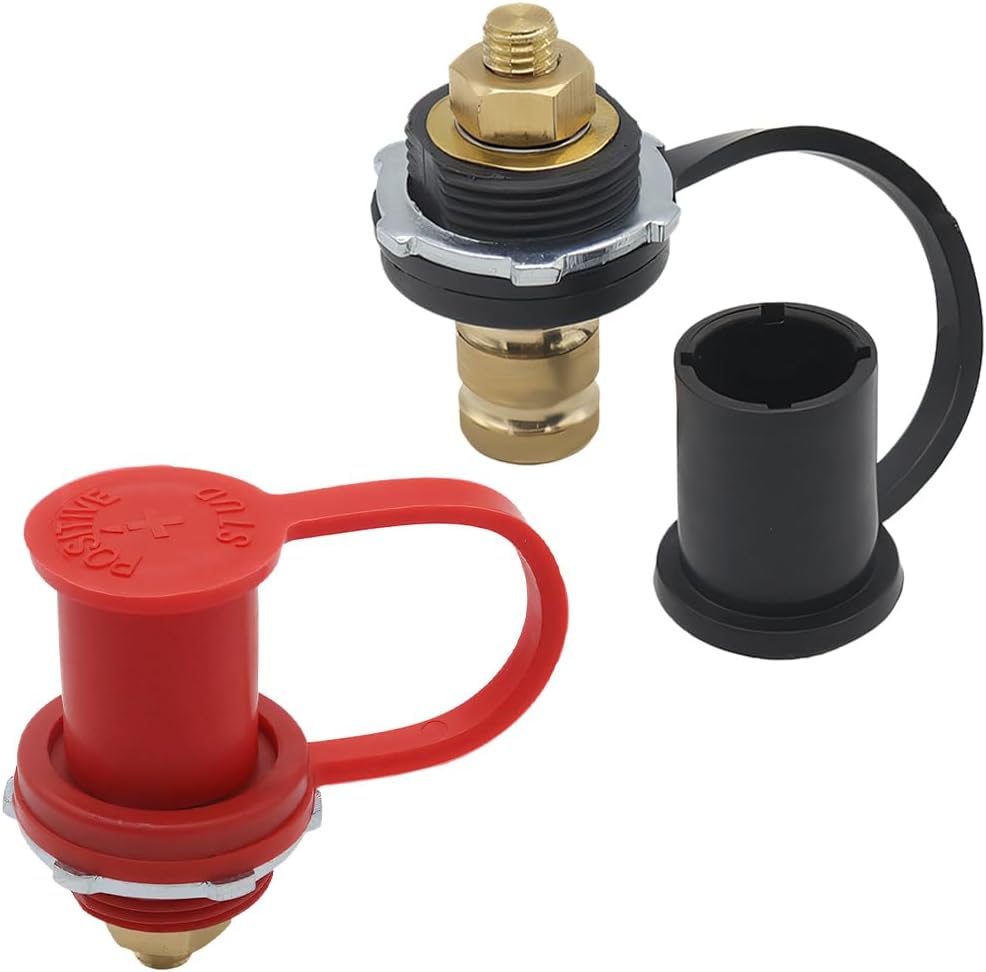
The Car Remote Battery Terminal 2-Pack holds a 4.8 rating and offers one of the strongest compact combinations in the guide. Each post combines a brass terminal section with a nylon exterior, a three-eighths-inch stud, and a protective PVC cap designed to reduce current leakage, short-circuit risk, and accidental contact.
We may earn a commission when you buy through this link, at no additional cost to you.
The two-pack format offers useful redundancy. A second post can serve as a reserve, support a separate connection point, or be installed where a second accessible terminal would improve workflow. Each unit is rated to carry up to 250A at 12V and can also be used for jump-start connections, battery charging, or cable bulkhead applications.
Installation is straightforward for a suitably prepared panel. The stated dimensions are approximately 2.68 by 3.39 by 1.73 inches, and the posts are designed to mount through a one-and-one-quarter-inch hole in panel material up to 0.3 inches thick. That limit makes careful measurement essential for sheet-metal, plastic, or composite panels.
This option is a compelling value for cars, trucks, ATVs, and RVs that need one or two accessible charging points. It is less convenient for full battery relocation because the package does not include long connecting cables, so many buyers will need to add appropriately rated wiring and ensure all connections are secure.
Two identical terminals can be positioned separately, held as a spare, or used for distinct positive and negative access points. That flexibility is useful for workshop setups and vehicles where a single exposed post may become inconvenient.
The flame-retardant PVC caps help shield external contacts when the posts are not connected. They also make the positive and negative sides easier for the owner to identify at a glance.
We may earn a commission when you buy through this link, at no additional cost to you.
The Joinfworld Covered Terminal has a 4.7 rating and provides a balanced combination of current capacity, protective design, and broad application support. Its brass construction and three-eighths-inch stud are intended to accommodate larger cables and carry substantial amperage for automotive, marine, and powersports use.
We may earn a commission when you buy through this link, at no additional cost to you.
The cover is a particularly useful feature. It helps shelter the exposed contact from dust and water while also reducing the chance of accidental contact when the terminal is not in use. That makes the post suitable for a vehicle body panel or another accessible but exposed mounting location.
Like many panel-mount designs, it has a defined installation envelope. The post is intended to fit through a one-and-one-quarter-inch hole in a panel no thicker than 0.3 inches. It also appears focused on the terminals themselves rather than providing a complete long-cable relocation kit, so additional wiring may be necessary.
The product is a strong recommendation for owners seeking a straightforward, protected, high-current charging post without a large accessory bundle. It suits cars, trucks, boats, ATVs, and Can-Am applications where the installer can create a sound panel connection and route suitable battery cables.
A cover offers more than visual polish: it helps limit exposure to dust and moisture and makes an unused conductive stud less accessible. The benefit is especially relevant on recreational vehicles stored outdoors or exposed to mud and splashes.
The three-eighths-inch stud gives installers a larger attachment point than smaller terminal hardware. That can suit robust charging leads, although cable size, crimping quality, and the vehicle's actual electrical requirements still need to be matched carefully.
We may earn a commission when you buy through this link, at no additional cost to you.
The Jiozermi Copper Studs carry a 4.8 rating and offer a simpler alternative to complete panel-mounted remote terminal kits. Each package includes two stud connectors, one red and one black, making it easy to establish clearly identified positive and negative connection points.
We may earn a commission when you buy through this link, at no additional cost to you.
Pure copper is the defining material choice. Copper provides strong electrical conductivity, while the accompanying bakelite insulating material separates the conductive parts from the mounting environment. The stated connector length is approximately 1.69 inches, with a one-quarter-inch screw diameter and a 0.39-inch threaded hole.
This product is more of a component than a turnkey remote terminal system. It does not list a maximum current rating, and the package does not describe a panel enclosure, long cable set, or complete mounting bracket. Buyers must therefore account for insulation, cable termination, strain relief, and environmental protection within their own installation.
The studs are appropriate for battery distribution, charging generators, welding machines, ships, vehicles, and solar-cell projects. They are best suited to technically confident installers who want a compact copper connection point and already have an appropriate mounting arrangement, enclosure, and wiring system.
The copper construction is well suited to projects where efficient current transfer is important. Proper cleaning, tightening, and cable termination remain necessary to preserve that performance over time.
Red and black components help reduce wiring confusion during installation. The color coding is especially useful in crowded engine compartments, mobile equipment, and custom electrical panels.
We may earn a commission when you buy through this link, at no additional cost to you.
The Joinfworld Relocation Kit has a 4.5 rating and focuses on the essentials needed to move a battery connection to a convenient location. It includes remote terminals, a mounting bracket, four-gauge wiring, and one red and one black protective cover.
We may earn a commission when you buy through this link, at no additional cost to you.
The included bracket is a meaningful convenience because it removes the need to design a separate support structure. The cable length of approximately 53 inches provides enough distance for many installations, allowing the remote posts to be placed on an accessible panel while the original battery remains mounted elsewhere.
The primary technical limitation is the stated 150A maximum capacity of the four-gauge wire. This is well above the needs of many routine charging tasks, but it becomes relevant for vehicles with substantial starting current, large accessory loads, or multiple simultaneous high-current connections.
The kit is a practical option for Can-Am Maverick X3, cars, UTVs, ATVs, and boats that benefit from remote battery access. It is especially useful for owners who want the convenience of a relocation package but may need to confirm wire gauge, bracket compatibility, and local fuse placement before installation.
Relocating the connection can make battery charging and jump-starting far easier when the battery is hidden. The posts become a dedicated service point rather than forcing the operator to reach deep into a compartment.
A supplied mounting bracket helps create a consistent and repeatable post installation. The installer should still check for sharp edges, vibration, moisture, and clearance around the connections.
We may earn a commission when you buy through this link, at no additional cost to you.
The GUMRA UTV Jump Post Kit receives a 4.6 rating and is designed primarily around accessible battery extension for powersports vehicles. Its stated compatibility includes Can-Am X3 and Polaris RZR configurations, while the product information also identifies trucks, race cars, travel trailers, RVs, tractors, lawn mowers, diesel vehicles, and boats as possible uses.
We may earn a commission when you buy through this link, at no additional cost to you.
Two 1.2-meter connecting wires move power between the battery and the remote posts. The listing cites an IP67 waterproof standard and seven-AWG cable, making environmental resistance a central selling point. Pure copper terminals, red and black wiring, and an insulating cap under the bracket improve conductivity, identification, and installation safety.
Compared with bulkier assemblies, the listing says the design was improved to occupy less space. That matters in UTVs and RVs where usable panel area is limited. However, no explicit current capacity is provided, and the very broad equipment compatibility claim should be treated as general guidance rather than a guarantee for every model.
This kit is most compelling for powersports owners who regularly charge or jump-start a Can-Am or Polaris and need weather-resistant access. Buyers should confirm frame or panel dimensions, cable routing, electrical specifications, and local safety requirements before modifying the vehicle.
The cited IP67 cable standard is relevant for machines that encounter rain, mud, dust, and washdown. Post placement and connector sealing still matter because the cable rating alone does not guarantee protection for every component.
The smaller stated layout helps preserve room in tightly packaged cabins and compartments. It can be a better fit than a large bracket-and-terminal assembly when every inch of accessible space counts.
We may earn a commission when you buy through this link, at no additional cost to you.
The MARSTEK Brass Junction Posts have a 4.5 rating and consist of eight detachable connection posts, including four red and four black units. The set uses quarter-inch M6 screws and is positioned as a general remote battery connector for distributing power in equipment and vehicles.
We may earn a commission when you buy through this link, at no additional cost to you.
Brass is used for the conductive screws, providing a durable contact surface with good conductivity and wear resistance. Flame-retardant insulation is used around the terminal assembly, and the detachable design allows repeated tightening and removal during setup or maintenance.
This is a component kit rather than a full remote battery relocation system. It does not provide long extension cables, a battery enclosure, or detailed panel dimensions. As a result, it is best suited to builders creating a custom junction panel, voltage stabilizer arrangement, welding machine connection, generator distribution point, or similar electrical system.
The eight-piece count offers flexibility for multiple connection points and a ready supply of red and black components. Shoppers should verify stud length, panel-hole size, current requirements, and whether the electrical design needs additional fusing, bus bars, strain relief, or environmental sealing.
Eight posts give builders more options than a simple positive-and-negative pair. The assortment can support several distribution points, but every post should still be installed with appropriate spacing and insulation.
The removable terminal design makes it easier to tighten, inspect, or swap connections. This serviceability is useful for mobile equipment and custom installations that may be adjusted over time.
We may earn a commission when you buy through this link, at no additional cost to you.
The Ampper M10 Remote Terminals have a 4.6 rating and provide a compact brass junction for battery relocation, jumper connections, and other high-current tasks. They carry a stated 250A rating at 12V and use an M10 terminal configuration.
We may earn a commission when you buy through this link, at no additional cost to you.
Two sets of nuts allow the terminals to be extended, tightened, and assembled with some flexibility. The posts can be mounted in a panel or battery box, with wires routed from the inside and outside. This makes them adaptable to custom enclosures where a dedicated remote access point is needed.
The main limitation is that the product is primarily a terminal assembly. It does not include extension cables, mounting hardware, or a complete enclosure, and the supplied information recommends professional installation. A technically capable DIY installer may still find it useful, but the instructions should be followed carefully.
The Ampper set is appropriate for cars, vehicles, RVs, boats, electrical equipment, solar-cell projects, and battery boxes. Buyers should match cable lugs to the M10 studs, clean the contact surfaces, prevent exposed metal from touching unintended components, and confirm that the enclosure and wiring are suited to the environment.
The paired nut system gives the installer flexibility when stacking a cable lug, terminal base, and external connection. Correct torque and clean contact surfaces are essential for reliable conductivity.
These posts can integrate into a battery box or panel where the wiring remains protected. Their compact format is useful for custom vehicle, marine, solar, and general electrical projects.
We may earn a commission when you buy through this link, at no additional cost to you.
The listing identified as B0CNYNYLP9 is included because it appears in the supplied product set, but no title, rating, image, description, or usable specifications were provided. It therefore cannot be compared on construction, current capacity, mounting method, or intended applications.
We may earn a commission when you buy through this link, at no additional cost to you.
The lack of information makes a confident recommendation inappropriate. A remote battery terminal should ideally disclose its conductive material, stud size, current rating, operating voltage, mounting-hole dimensions, and protective features. Without those details, buyers cannot judge whether the item is suitable for charging, jump-starting, marine use, or high-current equipment.
The absence of a visible product image also makes visual evaluation impossible. Buyers would not be able to verify whether the item is a complete relocation kit, a single panel post, a set of copper studs, or another type of electrical connector. The Amazon listing remains the appropriate place to check for any future information.
This entry should be treated as a placeholder rather than an endorsement. If the listing later gains a complete specification sheet, buyer reviews, clear imagery, and consistent application guidance, it could be reassessed. Until then, a listing with documented specifications offers a more dependable buying experience.
Check the current Amazon listing for materials, dimensions, ratings, and included parts. Any purchase should be based on those verified details rather than the product category alone.
A useful terminal listing should explain which vehicles, panels, and electrical loads it supports. Without that information, compatibility cannot be established with confidence.
We may earn a commission when you buy through this link, at no additional cost to you.
The listing associated with B0FJ1VHDLR has no supplied title, rating, image, description, or specifications beyond its Amazon identifier. As a result, it is not possible to establish whether it is a full remote terminal kit, a standalone binding post, a copper stud, or another product within the broader category.
We may earn a commission when you buy through this link, at no additional cost to you.
This missing information prevents meaningful analysis of the most important buying criteria. There is no stated current rating, operating voltage, material, stud size, panel requirement, protective cover, or cable arrangement. Without those details, the listing cannot be responsibly compared with the documented terminal kits and posts in this guide.
The listing is also impossible to evaluate visually. Buyers should not rely on a product image or compatibility assumption when the installation is likely to involve exposed electrical connections, substantial current, and vehicle-mounted equipment. A documented installation and electrical specification should take priority over appearance alone.
For now, this entry is a placeholder rather than a recommended choice. If the product page becomes complete, examine whether the terminals have protected contacts, whether the mounting system suits the intended panel, and whether the included conductors are rated for the expected load. Those checks should precede any purchase.
Review current capacity, voltage, stud dimensions, and material before considering this listing. These details determine whether the product can safely serve the intended battery connection.
Confirm the required panel thickness, hole diameter, included fasteners, and cable requirements. A complete listing helps prevent incompatible or incomplete installations.
We may earn a commission when you buy through this link, at no additional cost to you.
The right remote battery terminal depends on the vehicle, electrical load, mounting location, and level of protection needed. Comparing current ratings, conductor size, stud dimensions, materials, and installation requirements prevents an otherwise convenient accessory from becoming an installation compromise.
Begin with the electrical demand of the vehicle or equipment. A terminal advertised at 250A may support demanding starter-battery use, but the entire circuit must be rated for that load, including cables, crimp connectors, fuses, mounting hardware, and any intermediate connections. Some complete kits list a higher post rating than the supplied wire capacity, so the lower conductor figure should guide practical planning.
Choose a capacity that comfortably exceeds normal operating demand without treating the headline rating as permission to overload the installation.
Stud diameter determines which cable lugs can be installed without creating a loose or mismatched connection. Common options in the guide include three-eighths-inch, one-quarter-inch M6, and M10 configurations. Check both the stud diameter and length, then confirm that the cable lug's hole fits and that the assembled stack leaves sufficient thread engagement.
Match the lug to the stud and avoid improvising connections that require oversized washers or altered hardware.
Brass, copper, and heavy-gauge copper wiring are common in this category because they provide durable conductive contact surfaces. The broader assembly also includes nylon, PVC, bakelite, and other insulating materials. Buyers should look for a clear separation between conductive and insulated parts and should avoid exposed hardware that can contact the vehicle body.
Material claims are most useful when paired with corrosion resistance, secure fasteners, and a design that suits the installation environment.
Panel-mounted posts typically specify a required hole diameter and maximum panel thickness. For example, some listings call for a one-and-one-quarter-inch opening in material up to 0.3 inches thick. Measure the intended surface before ordering, accounting for the dimensions of the terminal body, nearby bodywork, trim, and the direction in which cables must enter.
A post that does not fit the available surface may require a custom bracket, additional drilling, or a different product entirely.
Covers, insulating caps, and IP-rated wiring can reduce exposure to dust, water, and accidental contact. Remote posts on marine vehicles, UTVs, and outdoor equipment should be positioned thoughtfully, because a protected cable does not automatically protect every connector. Look for positive and negative identification as well, making it easier to connect equipment correctly.
Where possible, use covered posts and seal cable entries without obstructing the terminal's intended operation.
A complete relocation kit can include terminals, a bracket, long cables, mounting hardware, protective boots, and heat-shrink tubing. A component-only purchase may provide just one post or a red-and-black stud pair, leaving the buyer responsible for wires, enclosure, fasteners, and electrical protection. Compare the included parts rather than relying on the broad phrase battery terminal.
Complete kits usually suit first-time installers, while component sets can be more useful for custom panels and specialized projects.
The products range from general 12V vehicle applications to kits specifically positioned for Can-Am Maverick X3, Polaris RZR, UTV, ATV, RV, marine, and specialized power-distribution uses. These claims should guide shortlisting rather than guarantee fit. Confirm model years, available panel space, factory wiring, battery location, grounding arrangements, and the requirements of any aftermarket accessories.
Avoid installing a post where it interferes with body panels, controls, sharp edges, heat sources, or moving components.
A credible installation requires a clean electrical connection, correctly sized conductors, sound crimps, secure fasteners, strain relief, and appropriate circuit protection. Some listings explicitly recommend professional installation, which is sensible when the work involves unfamiliar vehicle wiring, high-current starting systems, or safety-critical connections.
Follow the vehicle manufacturer's guidance, preserve factory grounding, avoid exposed conductive surfaces, and disconnect power appropriately during installation.
Begin installation by disconnecting the battery using the correct procedure for the vehicle, identify the positive and negative circuits, and plan the cable route before drilling any panel. Mount the bracket or posts in a stable, accessible location away from sharp edges, moving parts, excessive heat, and water traps. Use the specified hole size and ensure that each terminal has adequate clearance from unintended metal surfaces.
Connect the extension cables to the battery according to the vehicle's electrical requirements, using suitable cable gauges, correctly sized lugs, sound crimps, and the appropriate fuse or fusible link where required. Verify polarity before reconnecting power, then tighten the mounting hardware and terminal nuts evenly. Do not rely on a loose mechanical connection to compensate for undersized wiring or poor contact surfaces.
For routine care, keep the covers seated over unused posts, clean away dirt, salt, mud, and corrosion, and inspect cables for cracking, chafing, loose terminals, or damaged insulation. Check the connections periodically, particularly after hard off-road use, harsh weather, jump-starting events, or vibration-heavy travel. If a post becomes hot, discolored, wet inside, or difficult to tighten, disconnect it and investigate the cause before reuse.
Remote battery terminals extend a battery's positive and negative connections to a more accessible location. They are commonly used for convenient battery charging, jump-starting, temporary power connections, and routine electrical service. They can be especially useful when the original battery is hidden beneath body panels or located in a crowded compartment.
Yes, when the terminals, cables, and connections are rated for the vehicle's starting current and are installed correctly. A higher-rated terminal does not compensate for undersized extension cables or poor connections. Check polarity, ensure both vehicles are compatible, and follow the jump-starting instructions supplied with the vehicle or charger.
Measure or identify the diameter of the stud and compare it with the hole in your cable lug. The products in this guide use several sizes, including three-eighths-inch, one-quarter-inch M6, and M10 configurations. The cable lug must fit securely, and the full nut-and-washer stack should leave adequate thread engagement.
A stated 250A rating indicates terminal capability, not guaranteed performance for every installation. The connected cables, crimps, fasteners, circuit protection, and vehicle wiring must also support the intended load. Confirm voltage, cable capacity, dimensions, and grounding requirements before installing a high-current post.
Only if the product is designed for that panel material and thickness. The listing should specify the required hole diameter and maximum panel thickness. Some posts are intended for metal panels up to 0.3 inches thick, so attempting to mount them in a thicker or unsupported panel may compromise stability and cable strain relief.
It depends on the product. Complete relocation kits may include a heavy-duty steel bracket, while individual panel posts or stud connectors may require a separately designed support. A suitable bracket should hold the post securely, prevent cable movement, and keep conductive parts isolated from the vehicle body.
Keep protective covers installed when the terminals are unused, seal panel openings against water ingress, and periodically clean salt, mud, and oxidation from the contact surfaces. Use corrosion-resistant mounting hardware where appropriate and inspect the installation after exposure to saltwater, off-road mud, or severe weather.
It depends on the vehicle and the installer's experience. Professional help is advisable when modifying complex wiring, working with high-current starting systems, or dealing with unfamiliar marine or powersports electrical layouts. Simpler panel installations may be manageable for an experienced DIY owner, provided the manufacturer's guidance and correct safety procedures are followed.
The Joinfworld Heavy Duty Kit is the most complete premium selection, combining remote posts, a steel bracket, four-gauge wiring, protective boots, and mounting accessories. The Car Remote Terminal 2-Pack delivers strong value with two 250A-rated protected posts, while the Joinfworld Covered Terminal offers a balanced and versatile option for accessible charging.
Prioritize the entire electrical system rather than the post rating alone. Confirm stud compatibility, cable capacity, panel dimensions, environmental protection, and the vehicle's actual load. Larger complete kits are most convenient for full relocation, while individual studs and junction posts provide flexibility for custom panels and specialized equipment.
Product details, ratings, and listing availability can change, so confirm the current Amazon page and specifications before ordering. Check the included components and installation requirements carefully, and choose the terminal that best matches the vehicle, connection location, and electrical workload.
