
NZXT H5 Flow
4.7Editor score
Two quiet 120mm fans
Perforated PSU shroud intake
Large 360mm radiator support
Our Silent Airflow Case guide compares 10 quiet PC cases for cooling, noise control, radiator support, cable management, airflow, and easier building.
A Silent Airflow Case must balance two goals that can sometimes seem contradictory: moving plenty of cool air through a powerful PC and keeping that airflow from creating distracting fan noise. The right enclosure also needs to fit your components, support your preferred cooling hardware, and make cable routing and future maintenance manageable.
We compared these ten cases using the information supplied for each model, focusing on airflow architecture, included fans, radiator positions, sound-reduction features, motherboard and graphics-card compatibility, storage options, front connectivity, and ease of cable management. The list covers compact ATX builds, spacious mid-towers, wood-accented designs, modular frames, and dedicated silent models.
Each review identifies the strongest feature and also explains the compromises that may matter to a particular builder. The selections show which cases emphasize thermals, which prioritize acoustic treatment, and which are easiest to adapt as a system changes. Product details and availability can vary, so confirm the current listing and physical clearance before ordering.
4.7Editor score

4.7Editor score

4.7Editor score
The table below compares all ten cases by their most important design traits, including included cooling, radiator capacity, enclosure format, acoustic features, and practical expansion options.




The NZXT H5 Flow is a compact ATX mid-tower built around a simple idea: provide effective cooling without forcing builders to install a full fan set immediately. It carries a 4.7 rating, and its two included 120mm Quiet Airflow fans establish a useful baseline for both front intake and rear exhaust. The ultra-fine mesh panels help preserve airflow while filtering dust.
We may earn a commission when you buy through this link, at no additional cost to you.
Its most interesting thermal feature is the perforated PSU shroud. Openings on the side and bottom allow air to enter around the power supply and lower internal region, supplementing the main front-to-rear route. That design avoids the closed-off lower chamber found in many compact cases. The chassis can also accept a 360mm radiator in front and a 240mm radiator at the top, giving builders room to graduate from air cooling to a more substantial liquid-cooling arrangement.
The compromise is that the H5 Flow does not maximize every possible mounting position. Its side panel is primarily a mesh filter rather than a dedicated fan mount, and the product information specifically notes that the two fans recommended for lower intake are not included. It is also designed around ATX-class motherboards, so builders using only mATX or Mini-ITX boards will not gain additional space from the smaller format.
This is a strong recommendation for someone who wants a restrained, compact build without sacrificing airflow. It is particularly suitable for a gaming system with a moderately powerful CPU and GPU, provided the builder is willing to upgrade the cooling if operating temperatures demand more capacity. The NZXT H5 Flow delivers a rare combination of compact dimensions, useful default fans, and flexible radiator options.
Perforations in both the side and bottom of the PSU shroud bring outside air toward the lower chassis. This is especially useful in compact builds because component heat does not have to rely on a single, restricted path through the case.
The included front and rear 120mm Quiet Airflow fans provide immediate cooling and are designed for solid operation without requiring an extra installation step. Their placement also creates a straightforward front-to-rear airflow direction.
We may earn a commission when you buy through this link, at no additional cost to you.
The Fractal Design Pop Air Black Solid combines a compact mid-tower format with unusually expressive styling. Its 4.4 rating reflects a case that prioritizes appearance, straightforward component access, and adequate cooling over maximum radiator capacity. The tempered-glass side panel is designed for easy removal, giving builders a convenient way to view and reach internal components.
We may earn a commission when you buy through this link, at no additional cost to you.
Airflow is supported by three included 120mm Aspect 12 RGB fans, with room for two more. The case accepts a 280mm radiator at the front, 240mm at the top, and 120mm at the rear. That arrangement is suitable for many gaming builds, although it is less generous with large radiators than the NZXT H5 Flow, Fractal Design Pop XL Air, or dedicated 360mm-capable alternatives in this guide.
Storage capacity is another strength. The Pop Air can hold up to three hard drives and six solid-state drives, or two hard drives and five SSDs when an optical bay is occupied. That makes it a good fit for a system that combines a large game library with a separate media or work drive. The available motherboard formats include ATX, mATX, and Mini-ITX.
Choose the Pop Air when visual character and immediate RGB cooling matter as much as maximum thermal headroom. It is less appropriate for a heavily overclocked workstation that requires a 360mm liquid-cooling loop, but for many gaming PCs, its balance of style, storage support, and included fans makes it a persuasive all-around compact case.
Although the tempered-glass option is associated with the TG models, this solid version still uses color accents to make the enclosure more distinctive than a conventional all-black chassis. It suits builders who want visual personality but do not necessarily need a windowed view.
Support for multiple hard drives and SSDs makes the Pop Air practical for users who retain both large game files and smaller system or application drives. The option to rearrange drive positions also helps builders balance capacity with airflow.
We may earn a commission when you buy through this link, at no additional cost to you.
The CORSAIR 4000D RS ARGB Frame is the most versatile conventional mid-tower in this roundup. It earns a 4.7 rating and stands out through its modular FRAME system, three preinstalled RS ARGB PWM fans, and InfiniRail fan-mounting hardware. The design is aimed at builders who want strong airflow now and the ability to change components or expand the layout later.
We may earn a commission when you buy through this link, at no additional cost to you.
The 3D Y-pattern steel front panel is designed to provide a low-obstruction path for incoming air. At the same time, InfiniRail allows front fans to be placed at different points and permits roof fans up to 140mm. The three included fans support daisy-chained four-pin PWM connections and Zero RPM operation at low loads, which is valuable for a quiet setup because the fans can reduce speed when cooling demand is lower.
Cable management is unusually adaptable. The internal side panel beside the motherboard tray can remain in place as a cover, creating a clean appearance, or it can be removed to support side-mounted fans and greater cooling potential. That same flexibility introduces a small learning curve: owners should understand the available FRAME modules and fan positions before arranging the build.
This is our Editor's Choice because it covers the broadest range of builder priorities without requiring a specialized plan. It works well for a high-airflow gaming PC, a visually coordinated ARGB system, or a future-oriented build that may receive different components. Those wanting maximum acoustic treatment may prefer the Silent Base 802, but the 4000D RS ARGB Frame offers the stronger balance of cooling, modularity, and everyday convenience.
Sliding steel rails allow fans to be positioned at different locations, including configurations beyond the traditional top and bottom slots. This is useful when radiator thickness, cable routing, or a side intake changes the usable geometry of the chassis.
The included PWM fans can enter a Zero RPM state when the system does not need active cooling. This behavior supports quieter everyday operation while retaining responsive fan control when processor or graphics-card temperatures rise.
We may earn a commission when you buy through this link, at no additional cost to you.
The white CORSAIR 4000D RS Frame is a high-airflow alternative to the black ARGB version, and it may appeal to builders who want a clean white system without a wash of colored lighting. It shares the 4.7 rating, modular FRAME approach, three preinstalled RS PWM fans, InfiniRail mounting system, and 3D Y-pattern front panel.
We may earn a commission when you buy through this link, at no additional cost to you.
Its emphasis is cooling capacity. The chassis fits multiple 360mm radiators, making it suitable for builders planning a substantial liquid-cooling implementation. The three front fans provide a strong intake foundation, while the InfiniRail system allows roof and front fan positions to be adjusted rather than fixed. The internal side panel can also conceal cables or be removed when a side fan is needed for additional circulation.
Compared with the ARGB Frame, this model omits decorative lighting and instead focuses on a restrained white appearance. The included fans still use daisy-chainable four-pin PWM connections and support Zero RPM mode at low loads, making them appropriate for a quiet build. Reverse motherboard connector compatibility is another useful feature for flexible cable routing around the rear of the motherboard tray.
The 4000D RS White is a strong option for a white-themed workstation or gaming system where airflow, cable management, and future expansion matter more than synchronized lighting. It is less compelling for a builder specifically seeking ARGB, but for conventional cooling-focused use, it delivers the same flexible foundation in a more restrained appearance.
Support for multiple 360mm radiators provides substantial cooling headroom. This makes the case a practical foundation for a powerful CPU, a long graphics card, and a liquid-cooling loop that may grow as the system is upgraded.
The three included fans keep the internal lighting-free design visually restrained while providing standard four-pin PWM control. Zero RPM support at low loads further aligns the case with quiet-use priorities.
We may earn a commission when you buy through this link, at no additional cost to you.
The HYXN H2 2026 is the most aggressively equipped case in this guide. It has a 4.4 rating and arrives with eight non-ARGB fans, including six 140mm reverse fans and two 120mm forward fans. That installation provides a ready-made airflow solution for builders who do not want to purchase an entire cooling fan array at once.
We may earn a commission when you buy through this link, at no additional cost to you.
Its dual-chamber design separates the main hardware from the power supply and drive area. This arrangement supports cleaner cable routing and can reduce the influence of heat from the PSU and storage devices. The case accommodates a 360mm GPU, PSUs up to 220mm, E-ATX through Mini-ITX motherboards, two hard drives, and three SSDs. It also supports back-mounted motherboard layouts.
Cooling capacity is the headline. The chassis can accommodate either two 420mm radiators or three 360mm radiators simultaneously, including dual-layer fan configurations. Those are exceptional options for a high-power CPU or a heavily equipped system, though the huge fan and radiator capability also means the enclosure is physically large and could be overkill for modest hardware.
The H2 makes sense for a builder who wants maximum cooling flexibility, abundant included fans, and a spacious dual-chamber layout. It is less attractive when a small footprint, restrained appearance, or minimum fan count is the priority. Because a large cooling system can produce more sound than a modest one, quiet users should pair the H2 with a controlled fan configuration and suitable acoustic tuning.
The included 140mm and 120mm fans cover front, rear, and additional internal positions. Builders can use them as supplied or remove redundant units if their particular hardware generates less heat than the case's full cooling capacity.
Separating the power supply, storage, and cabling from the main hardware creates a cleaner internal arrangement. It also allows each area to be managed as a distinct thermal zone rather than forcing every component into one shared cavity.
We may earn a commission when you buy through this link, at no additional cost to you.
The Fractal Design Pop XL Air is the roomier counterpart to the Pop Air, offering a 4.7 rating and enough space for extended ATX builds. It accommodates E-ATX motherboards up to 280mm as well as ATX, mATX, and Mini-ITX formats. The tempered-glass side panel makes the interior visible and is designed for convenient mounting and removal.
We may earn a commission when you buy through this link, at no additional cost to you.
Four 120mm Aspect RGB fans are included, and the case supports two more for a total of six. Radiator positions extend to 360mm at the front, 280mm at the top, and 140mm at the rear, giving builders a broader range of liquid-cooling layouts than the smaller Pop Air. The result is a strong platform for a visually prominent gaming system with substantial cooling hardware.
Storage is also generous, with support for up to four hard drives and six SSDs. When an optical bay is used, the arrangement can become three hard drives and five SSDs. Two concealed 5.25-inch bays sit within a storage drawer with a magnetic cover, helping keep optical drives or related accessories tidy when they are not visible.
Choose the Pop XL Air when your hardware is too large for a standard compact mid-tower or when you want room for a 360mm radiator without giving up RGB lighting. Its trade-off is physical size. A system using the 5.25-inch storage drawer, long graphics card, and front cooling hardware can occupy substantial desk space, so builders should compare the full external dimensions with their available area.
E-ATX support up to 280mm and room for a 360mm graphics card make this a better fit for large motherboards and long graphics cards than the standard Pop Air. The extra volume also creates more flexibility around cable routing and storage.
The tempered-glass panel and four included RGB fans turn the enclosure into a display-oriented option. Six total fan positions provide additional cooling without requiring a major redesign of the internal layout.
We may earn a commission when you buy through this link, at no additional cost to you.
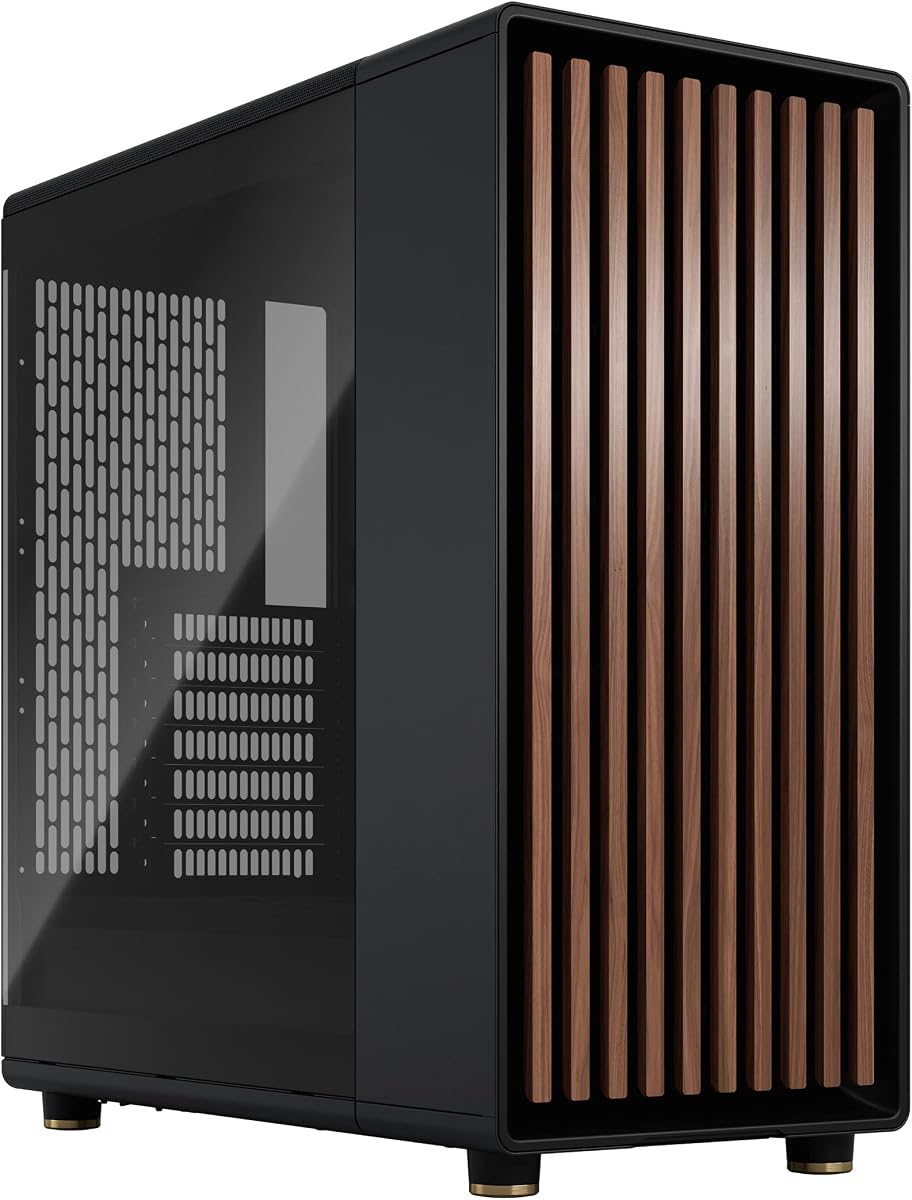
The Fractal Design North is the most distinctive design in the guide, combining a charcoal enclosure, tempered-glass side panel, and front bars made from sustainably sourced oak or walnut. It carries a 4.7 rating and offers an unusual combination of furniture-inspired styling and a genuinely open front intended to draw air into the system.
We may earn a commission when you buy through this link, at no additional cost to you.
Two 140mm Aspect PWM fans are included, giving the case strong airflow hardware without requiring a full bank of 120mm fans. The open front and integrated mesh encourage natural ventilation. The case supports ATX, mATX, and ITX motherboards, along with graphics cards up to 355mm. The smaller GPU allowance becomes 300mm when a 360mm radiator is installed at the front.
Seven bridgeless expansion slots create room for extensive customization beyond the usual first two or three positions. Storage provisions include two combined 3.5-inch and 2.5-inch mounts plus two dedicated 2.5-inch mounts. Front USB Type-C connectivity adds everyday convenience, while removable side panels and accessible top and front tabs simplify inspection and component access.
The North is ideal for a workstation or gaming system intended to sit on a desk where appearance matters. Its main limitation is that the front radiator and GPU clearance do not offer the same freedom as larger, conventional airflow cases. Buyers should therefore prioritize the design and prioritize components that fit within its considered envelope rather than treating it as a maximum-capacity chassis.
Instead of relying entirely on a sealed or heavily filtered front, the North exposes more of its intake path to the room. This design can make the enclosure feel less constrained and gives the included 140mm fans more space to move air.
The walnut front bars and metal details give the case a more natural appearance than the usual black, white, or RGB-focused computer chassis. The tempered-glass side preserves a view of the illuminated internal hardware.
We may earn a commission when you buy through this link, at no additional cost to you.
The CORSAIR AIR 5400 takes a different approach from conventional mid-towers by dividing the interior into three chambers. It is designed to isolate the CPU, graphics card, motherboard, power supply, storage, and cabling so that each major thermal source can receive a focused airflow path. The panoramic enclosure adds visual appeal to this more specialized internal architecture.
We may earn a commission when you buy through this link, at no additional cost to you.
The front CPU chamber can hold a 360mm radiator, keeping the processor cooler isolated from heat generated elsewhere. The central GPU and motherboard chamber is designed for massive vertical airflow, while the lower PSU and storage chamber has dedicated intake and exhaust locations. Separating the power supply and drives from the main chamber can also make cable routing and component organization more deliberate.
The major consideration is that the case does not include any PC fans. A buyer must therefore select and install every fan or radiator needed to use its architecture as intended. That makes the AIR 5400 less convenient for a first build and potentially more expensive to equip, but it also provides complete freedom over fan size, lighting, and budget.
Because no customer rating is supplied for this model, the evaluation here focuses on the documented design rather than a rating-based track record. It is a compelling choice for an experienced builder who wants a panoramic showcase system with isolated cooling zones. It is less suitable for a quick, quiet-ready build because the absence of included fans makes the initial setup more involved.
Each chamber has a defined role, preventing the CPU, GPU, and power supply from sharing one crowded airflow path. The approach is especially relevant to systems that use multiple high-heat components and benefit from dedicated exhaust or intake routes.
No fans are included, so builders can create a fully coordinated cooling system instead of removing unwanted bundled fans. This freedom is worthwhile when every fan must match a particular noise target, lighting standard, or radiator layout.
We may earn a commission when you buy through this link, at no additional cost to you.
The be quiet! Silent Base 802 is purpose-built for builders who want to control the balance between enclosure noise and airflow. It earns a 4.7 rating and includes three Pure Wings 2 140mm fans, extra-thick insulation mats, and a sophisticated front I/O panel with a fan controller and USB 3.2 Gen. 2 Type-C connectivity.
We may earn a commission when you buy through this link, at no additional cost to you.
Its defining feature is the interchangeable top cover and front panel. One configuration supports maximum airflow, while the other is intended for silent operation. This gives users a physical way to change the acoustic character of the case rather than relying exclusively on fan curves. The decoupled motherboard tray can also be relocated for an inverted layout, giving builders another way to tune the internal arrangement.
As a windowed model, it is intended to show internal components while retaining a more understated exterior than many RGB-heavy gaming cases. The three included 140mm fans are substantial airflow hardware, yet the enclosure's insulation is designed to reduce noise. That makes it suitable for a powerful workstation, a media PC in a living area, or a gaming system used in a shared room.
The main trade-off is the need to choose or swap panels as priorities change. A builder who constantly alternates between maximum cooling and silence should appreciate that flexibility. A buyer who wants a single configuration with no modification may find other cases simpler. For anyone who specifically wants quiet operation without giving up large fans and strong thermal capacity, the Silent Base 802 is the premium choice.
Interchangeable front and top covers let the owner favor reduced noise or greater ventilation according to the workload. This is unusually direct for a PC case and makes acoustic priorities visible in the build rather than hidden behind software controls.
Extra-thick insulation mats work alongside the included Pure Wings 2 fans to reduce sound transmission through the enclosure. Quiet fans alone cannot control every source of case resonance, so the physical damping adds another layer of acoustic refinement.
We may earn a commission when you buy through this link, at no additional cost to you.
The Fractal Design Pop Mini Silent is a compact mATX case that makes acoustic reduction its defining priority. It has a 4.3 rating, supports mATX and Mini-ITX motherboards, and combines a closed front, closed top, bitumen side panels, and sound-damping foam. These features make it a natural fit for a small office, media center, or space-conscious quiet gaming system.
We may earn a commission when you buy through this link, at no additional cost to you.
Three 120mm Aspect fans are included, providing cooling without requiring the owner to source a full set. The case supports up to two hard drives and six SSDs, or one hard drive and five SSDs when an optical bay is occupied. Its two concealed 5.25-inch bays sit behind a magnetic cover within a storage drawer, preserving a tidy exterior when those positions are not needed.
The tempered-glass side panel gives builders a view of the components despite the otherwise solid exterior. The tradeoff for quieter operation is that the closed front and top are less permissive than the mesh-heavy alternatives. This model is therefore most appropriate for moderately powerful components that do not require the aggressive intake of a dedicated high-airflow chassis.
The Pop Mini Silent is best for builders who know they will use mATX or Mini-ITX and place a high value on reducing noise. It is less appropriate if you need full-size ATX support, a large liquid-cooling radiator, or maximum front intake. Subject to those limits, it offers a convincing combination of compact dimensions, sound treatment, storage options, and included fans.
The closed front, closed top, bitumen side panels, and internal foam each reduce the way noise travels through the enclosure. Combining several treatments can be more effective than relying on a single closed panel.
Support for as many as six SSDs gives small-form-factor builders room to separate operating-system, application, and game data. The magnetic storage cover keeps the enclosed 5.25-inch bays visually tidy.
We may earn a commission when you buy through this link, at no additional cost to you.
A quiet-airflow case is best chosen by matching the chassis to the heat generated by the components, the cooling hardware you intend to install, and the amount of noise you are prepared to tolerate. The following factors help narrow the field before comparing exact dimensions and mounting positions.
Start with how air enters, moves through, and exits the enclosure. Mesh-fronted cases and cases with open fronts generally offer more intake options than models with closed acoustic panels. Look for perforated PSU shrouds, side intake positions, and a clearly defined front-to-rear path. A case can include several fans and still perform poorly if the front panel or internal cable route blocks the incoming stream. For high-heat systems, prioritize direct intake near the CPU cooler and graphics card, together with reliable exhaust near the rear.
Quiet operation depends on both the fans and the enclosure around them. Look for thick insulation, bitumen panels, closed or partially closed intake surfaces, and damping material around resonant areas. The be quiet! Silent Base 802 goes further by allowing its top cover and front panel to be exchanged according to whether silence or airflow is the priority. Cases such as the Pop Mini Silent use multiple sound-damping layers but accept a more restricted intake path in return.
Check every radiator position rather than focusing on the largest number printed in the specifications. Front, top, and rear positions can have different limits, and a large radiator may reduce GPU, memory, or cable clearance. The HYXN H2 supports exceptionally large 420mm and 360mm arrangements, while the Fractal Design North offers a more measured 360mm front option with a reduced GPU-length allowance. Included fan count is useful, but fan thickness and radiator orientation can make the practical layout different from a simple number comparison.
Match the case to the motherboard format and hardware dimensions before considering aesthetics. Some models support Mini-ITX, mATX, and ATX, while the Pop Mini Silent stops at mATX. The Pop XL Air accommodates E-ATX and longer graphics cards, whereas the North supports a GPU up to 355mm under normal conditions. Also check CPU cooler height, power-supply length, front I/O placement, and the number of drive bays. A technically capable case is not useful if the chosen components cannot fit comfortably.
Bundled fans can determine how quickly a case is ready to use and whether the first build needs another purchase. The NZXT H5 Flow includes two Quiet Airflow fans, the HYXN H2 includes eight non-ARGB fans, and the CORSAIR 4000D RS models include three PWM options. Pay attention to fan size, control type, and lighting rather than treating all included fans as equivalent. PWM control and zero-RPM support are particularly useful when the objective is quiet everyday operation.
A clean layout is not only visual; it also keeps cables from obstructing fans and reduces the amount of space occupied behind the motherboard tray. Look for dedicated routing channels, hooks, straps, a removable side cover, and space behind the tray. The H2 includes a large rear compartment with built-in straps and mounting points, while the CORSAIR FRAME cases let the user remove an internal side panel when an intake fan is more important than concealment. Consider whether you will want the cables hidden or easily accessible for future maintenance.
Storage needs vary between a clean gaming library and a workstation with several media drives. The Pop Air and Pop XL Air support multiple hard drives and SSDs, while the Pop Mini Silent can also hold up to six SSDs in a much smaller chassis. Modern front connectivity matters as well: USB-C, USB 3.x, microphone, and audio ports make the case more convenient for daily use. The North and Silent Base 802 include Type-C connectivity, while the H2 offers a Type-C 3.2 port alongside two additional USB ports.
Tool-free panels, removable filters, accessible drive trays, and generous spacing can make a case much easier to assemble. The North features removable side panels, an integrated tab for the top panel, and a pop-off front. Tempered-glass panels on several Fractal models are designed for easy mounting and removal. Builders should also account for the width of radiators, the route of coolant tubing, and the space required to connect front-panel cables. A case that supports excellent hardware but is frustrating to assemble may not suit a first-time builder.
Begin with the airflow direction recommended for the case. Install front or bottom fans as intake and rear or top fans as exhaust, then connect PWM fans to the appropriate motherboard or controller headers. A case controller, such as the one on the Silent Base 802, can provide a central place to adjust fan speeds. Connect front-panel cables before closing the case, and confirm that every fan spins freely without touching a cable, radiator, or dust filter.
After the operating system is installed, create a gradual fan curve rather than running every fan at maximum speed. Increase speed only as processor and graphics-card temperatures rise, and use software monitoring to identify components that need additional cooling. Clean dust filters regularly, especially in a room where the computer draws in a significant amount of air. Keep the intake and exhaust paths unobstructed, and avoid placing the case directly against a wall if it relies heavily on rear exhaust.
For a particularly quiet system, use a mix of acoustic panels, restrained fan curves, and high-quality thermal components. Lowering GPU power limits can reduce the need for aggressive case airflow, while undervolting or using efficient cooling can make a larger air path unnecessary. Inspect internal connections during routine maintenance, tighten loose screws if the chassis develops vibration, and replace filters or clean radiator fins as dust accumulates.
No. A well-designed air-cooled case can provide quiet and effective performance, especially with a cool processor and a graphics card whose power limits are well managed. The NZXT H5 Flow and Fractal Design Pop Mini Silent show that included air fans and thoughtful enclosure design can be sufficient for many systems. Water cooling becomes more useful when the CPU generates substantial heat, the case has less intake space, or the builder wants maximum flexibility with large radiators.
No. More fans can improve airflow, but they also create more potential sound sources. Quietness depends on fan quality, speed, motor acoustics, mounting, and whether each fan is actually needed. A system with three well-controlled 140mm fans can be quieter than one with numerous small fans running at high speeds. Use a fan curve to keep unused positions inactive and remove redundant fans when airflow tests show they are unnecessary.
Choose a mesh or open front for maximum intake, especially with powerful graphics cards or processors. A closed or insulated front can reduce noise and restrict dust but may require stronger internal fans or more carefully managed component temperatures. The Fractal Design North offers an open front, the NZXT H5 Flow uses filtered mesh, and the be quiet! Silent Base 802 lets the owner physically change between airflow and silent panels.
Confirm both the motherboard format and the case's full clearance. Mini-ITX, mATX, and ATX are widely supported, but E-ATX appears only in selected larger models. The Pop Mini Silent supports mATX and Mini-ITX rather than full-size ATX, while the Pop XL Air supports E-ATX boards up to 280mm. Also verify CPU cooler height, graphics-card length, and power-supply dimensions because motherboard support alone does not guarantee a complete fit.
You do not necessarily need every included fan installed immediately, but you should establish an intentional airflow direction. A case may arrive with enough fans for a balanced path, or it may provide extra capacity that can be activated later. The CORSAIR AIR 5400 includes no fans, while the HYXN H2 includes eight, so builders should check what the system needs rather than assuming every bundled position must be populated.
Yes. A front radiator consumes several inches of internal depth and can push the graphics card farther from the case front. It can also affect motherboard, drive, and cable-routing space. The Fractal Design North specifically lists a 300mm GPU limit with a 360mm front radiator, compared with up to 355mm otherwise. Always compare radiator thickness, fan thickness, and mounting direction with the dimensions of the longest component in the build.
Start by reducing unnecessary fan speed through a PWM curve, then remove any installed fans that do not contribute to the required airflow path. Acoustic case panels, properly seated components, and clean fan bearings also help. If temperatures rise after those changes, add targeted airflow rather than increasing every fan to maximum. A case with a well-designed front intake and a deliberate exhaust route is usually easier to tune than one with an indiscriminate fan layout.
A tempered-glass side panel is primarily a visual feature and is not inherently a better airflow solution than a filtered mesh panel. Mesh can permit more intake through the side, while glass provides a clear view of the components. Several cases, including the Pop Air, Pop XL Air, and Pop Mini Silent, pair tempered glass with cooling fans at other locations, so the overall design matters more than the window material alone.
The NZXT H5 Flow is the most straightforward starting point for a compact build because it combines filtered mesh, two quiet fans, lower-chamber intake, and flexible radiator support. The CORSAIR 4000D RS ARGB Frame offers the strongest all-around feature set through its modular FRAME system, InfiniRail mounts, three PWM-controlled fans, and adaptable side panel, while the be quiet! Silent Base 802 is the premium choice for builders who want physical control over silent and maximum-airflow configurations.
Prioritize the balance that matches your hardware. High-heat systems benefit from open intake, large radiator support, and targeted exhaust, while quiet systems should consider insulation, PWM control, and the possibility of reducing the number of active fans. Compact builds should verify motherboard format and GPU length, and style-focused systems can use tempered glass, RGB, or natural wood detailing without compromising the need for coherent airflow.
Before finalizing a choice, check the current product listing, component dimensions, included accessories, and supported mounting positions. Hardware specifications can change between case revisions, and current availability may differ from earlier listings. Once you confirm that the case fits the hardware and that its cooling architecture matches your noise priorities, it becomes much easier to build a system that stays cool, organized, and pleasantly quiet.