KODAK Slide N Scan Film & Slide Scanner
4.3Editor score
22-megapixel digital capture
Five-inch LCD preview
Multiple film formats supported
Slide projector film viewers make it easier to revisit 35mm slides, mounted transparencies, film strips, and positive negatives without relying on a full-size projector. The right model combines useful magnification, even LED illumination, straightforward loading, and a power setup that suits your space. Portable viewers work well for occasional nostalgia, while a scanner-based model offers a more complete path to preserving images digitally.
This guide compares ten slide projector film viewers using the specifications and features supplied for each product. The list covers compact personal viewers, desktop units with 3X magnification, battery-and-USB models, and one slide and film scanner. Magnification, lighting, supported media, power, screen size, and archival functions are the main criteria, while ratings provide an additional indication of customer reception.
Each review explains what distinguishes the product within the category, including its most useful features and practical limitations. The top picks highlight a versatile 3X viewer, a feature-rich scanner, and a compact budget option. Product availability, included accessories, and prices can change, so readers should confirm the current listing and specifications before purchasing.
4.3Editor score

4.5Editor score

4.3Editor score
As an Amazon Associate we earn from qualifying purchases.
The comparison below highlights the essential differences among the ten featured products, including magnification, illumination, power, supported media, and whether the device is intended for direct viewing or digital scanning.


The DIGITNOW! 35mm Slide and Film Viewer is a well-rounded choice for households that want to inspect slides, film strips, and positive negatives without setting up a large projection system. Its 3X built-in magnifier enlarges the small images found on traditional film, while the daylight LED backlight is intended to deliver bright, even illumination without a color cast. Its 4.5 rating reflects generally positive customer feedback.
We may earn a commission when you buy through this link, at no additional cost to you.
Media support is one of its strongest features. The viewer accommodates 2×2-inch mounted slides, 35mm film, and positive film negatives. Slides enter through the back of the unit, while the sliding tray and eject button make it possible to work through a collection with minimal interruption. The generous field of view and uniform backlighting help reveal fine details that are difficult to see in an ordinary bright room or under inconsistent ambient light.
Power flexibility adds to the appeal. Four AA batteries are included, allowing cordless operation, and a USB cable is also included for powered viewing. That means the unit can serve as a desktop light box at home or move to a family gathering without requiring a nearby outlet. The main limitation is that it is a viewer rather than a scanner, so preserving images digitally would require a separate device. The rear-loading arrangement for mounted slides may also take slightly more practice than a front slot.
This is a strong recommendation for a broad audience because it combines 3X magnification, portable construction, LED illumination, and two practical power methods in one straightforward package. Choose it if your collection includes a mixture of mounted slides, strips, and positives, and if your priority is inspecting originals rather than creating digital copies. For most general users, it offers the most balanced feature set in this roundup.
The 3X magnifier is paired with a large, evenly illuminated viewing field, which is especially useful for small frame numbers, fine color transitions, and dense negatives. USB power supports longer desktop sessions, while the included batteries make the viewer practical for sorting and sharing images away from an outlet.
Compatibility with 2×2-inch mounted slides, 35mm film, and positive negatives reduces the need to sort materials into separate devices. The sliding tray and eject control also make repeated viewing less cumbersome when working through many boxes or sleeves.
We may earn a commission when you buy through this link, at no additional cost to you.
The SV-3 35mm Slide & Film Viewer focuses on the same fundamentals that matter in a personal slide viewer: 3X magnification, bright and uniform lighting, and uncomplicated operation. It supports 2×2-inch mounted slides, 35mm film, and negatives, making it suitable for families with several kinds of analog material. Its 4.2 rating indicates a generally positive reception, though it does not lead the category in customer rating.
We may earn a commission when you buy through this link, at no additional cost to you.
The glass screen is designed to magnify tiny slide and negative details without the distortion, blur, or detail loss that can make archival images difficult to interpret. A daylight-style LED light box provides broad backlighting, while the large field of view helps the image remain evenly illuminated. The sliding tray and eject button streamline the basic workflow, and the product is positioned for both studio and home use.
The SV-3 can run from batteries or through its included USB cable. This gives users freedom to choose cordless viewing during family events or a stable powered setup on a desk. Its limitation is that it performs no scanning, so it cannot preserve frames as digital files. As with several other desktop viewers, mounted slides are inserted at the back, and buyers who only handle standard 2×2-inch slides should confirm that arrangement suits their storage system.
Overall, the SV-3 is a sensible choice for people who want a compact, illuminated viewer with 3X magnification and flexible power. It does not introduce a unique archival function, but it covers the essential requirements clearly. It is especially attractive for those who want a portable way to view common slide and negative formats without assembling a larger projector.
Even LED backlighting is particularly valuable when examining narrow film strips or dark negative frames. The 3X glass screen enlarges the image while supporting a more faithful view of fine details and color transitions.
Battery operation supports travel and shared viewing, while the included USB cable is convenient for a home desk or studio. Users can therefore change power methods without changing the viewing device.
We may earn a commission when you buy through this link, at no additional cost to you.
The DIGITNOW 35mm Slide and Film Viewer is a capable battery-powered option for enlarging and inspecting old photographs. It carries a 4.5 rating, matching one of the strongest customer-response levels among the viewers in this guide. Its 3X built-in magnifier is designed to enlarge small slide and film images without distortion, blur, or an obvious reduction in visible detail.
We may earn a commission when you buy through this link, at no additional cost to you.
The large viewing area uses ultra-bright daylight LED illumination to make frames appear vivid and clear. That backlighting is more useful than simply holding film toward a window because it provides a consistent source of light and avoids the eye strain associated with trying to inspect a tiny image against a variable outdoor background. The viewer accommodates 2×2-inch mounted slides, 35mm film strips, and negatives.
Its practical advantages are straightforward. Four AA batteries are included, so users can begin viewing without separately sourcing power. The desktop-portable format includes an eject button and slide tray for handling multiple images. The principal trade-off is that the listed power method is batteries only, without a stated USB option, which may be less convenient during extended sessions. It is also strictly a viewing device rather than a scanner.
This model suits buyers who want the 3X magnification and bright illumination associated with larger desktop viewers while retaining cordless convenience. It is especially attractive for sorting slides around the home or sharing them during a gathering. Buyers should include fresh batteries in their setup and choose this option when battery freedom matters more than plug-in operation or digital capture.
The daylight LED light box illuminates a broad viewing area evenly, helping the eye focus on small frames without repositioning the film. This is especially helpful for older or dimmer slides and for negative strips viewed one frame at a time.
The sliding tray and eject button support a steady viewing rhythm when moving through many slides. Portable battery operation then makes the device useful beyond a single desk or dedicated darkroom.
We may earn a commission when you buy through this link, at no additional cost to you.
The Kodak 35mm Slide & Film Viewer combines a familiar photographic brand with the practical features expected from a modern personal viewer. Its 3X magnifier helps make tiny 35mm images easier to inspect, and the bright LED backlight is designed to render slides and negatives in vivid, crystal-clear detail. The product's 4.2 rating places it among the well-regarded but slightly less highly rated options here.
We may earn a commission when you buy through this link, at no additional cost to you.
Loading is designed to be direct. A dedicated slide slot and film input allow users to load a frame and begin looking almost immediately, while the quick-eject button removes the slide for the next one. This makes the viewer practical for sorting a collection or sharing selected photographs with family members. The large illuminated area helps keep the viewing experience comfortable even when room lighting is inconsistent.
Battery operation provides freedom from a power cord, and the device can also run on DC power when a separate cable is obtained. That optional accessory is an important distinction from models that include a USB cable, so users should factor it into the setup. The viewer does not digitize or scan images, and some slide loading methods require positioning the frame behind the lens rather than in a front-facing slot.
This Kodak viewer is a good fit for buyers who value a recognizable brand, fast slide changes, and cordless use. Its 3X magnification makes it more useful than a simple loupe, while the LED backlight supports clearer inspection. It is best suited to direct viewing rather than preservation work, and current users should confirm their preferred DC cable is available if they want continuous powered operation.
A dedicated input and quick-eject control reduce the time spent changing frames. That quick workflow is useful for general sorting sessions, estate reviews, and family gatherings where many images may need to be checked in succession.
The Kodak name gives the device immediate visual familiarity, while the magnification and daylight LED lighting supply the functional benefits that matter most. Buyers still need to understand that the unit is a viewer and not a digital preservation device.
We may earn a commission when you buy through this link, at no additional cost to you.
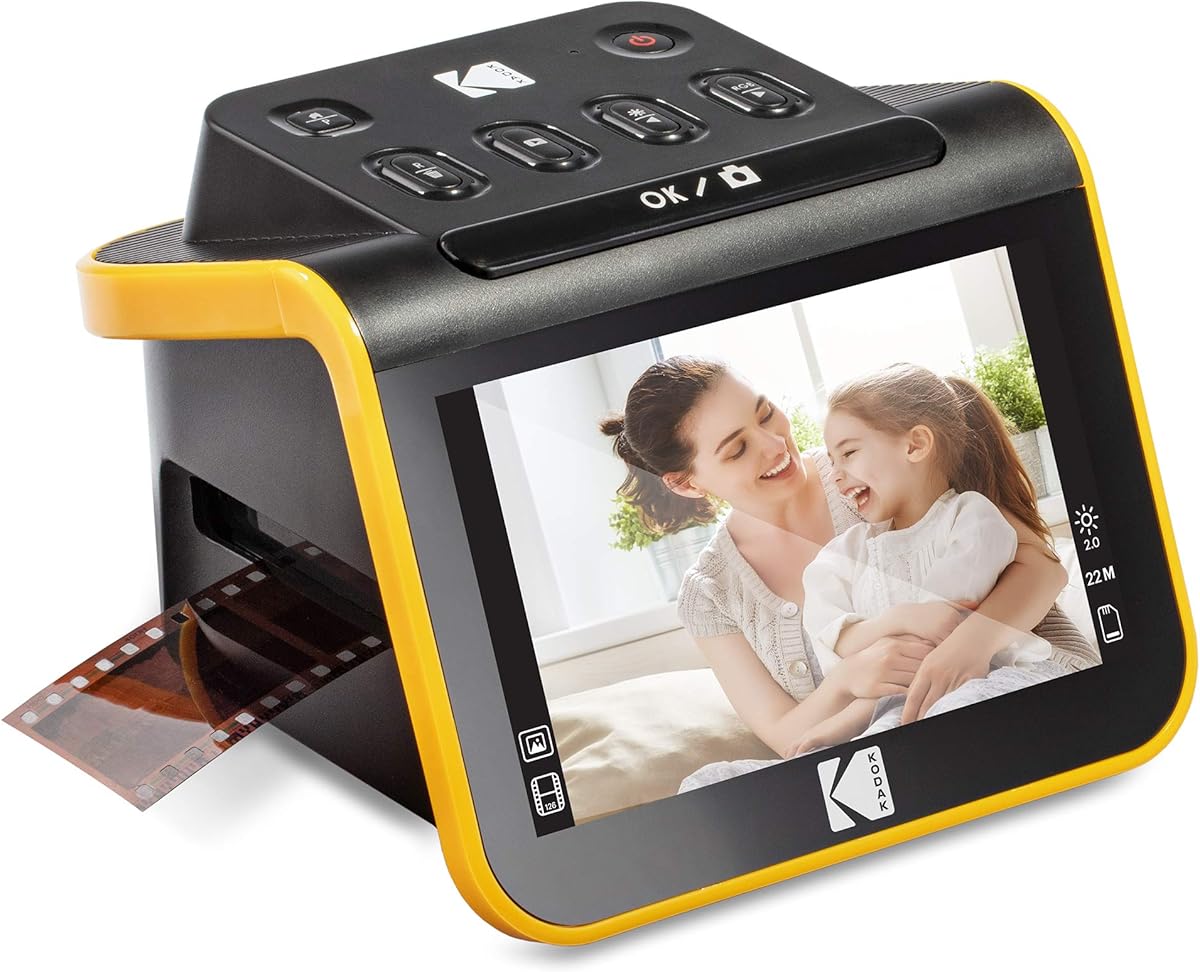
The KODAK Slide N Scan Film & Slide Scanner is the only scanner-focused product in this roundup, making it the strongest choice for buyers who want to preserve old photographs as digital files rather than merely inspect them. It provides 22-megapixel scanning, a five-inch LCD display, and compatibility with 135, 110, 126, and 50mm slides and negatives. Its 4.3 rating reflects a favorable balance of archival capability and ease of use.
We may earn a commission when you buy through this link, at no additional cost to you.
The display supports immediate previewing and editing, while gallery mode offers a convenient way to review captured images. Easy-load film inserts and continuous tray loading help streamline scanning sessions. The package includes a 50mm slide holder, adapters for 135, 110, and 126 film, a cleaning brush, and USB and HDMI cables, providing a more complete setup than a basic personal viewer.
Unlike a simple illuminated viewer, this product creates digital files that can be saved to an SD or SDHC card. It supports cards up to 32GB, although a card is not included. Capture software provides a straightforward scan button, options for film type, color and brightness adjustments, and date and time assignment. The need for compatible storage and the larger unit design make it less convenient for quick, spontaneous viewing, but far more capable for long-term preservation.
This scanner is the premium pick for families with large analog archives, collectors, or anyone who wants editable digital copies. The five-inch screen can also function as a digital picture frame, which broadens its usefulness beyond scanning. Buyers who only need occasional close inspection may find a dedicated viewer simpler, but for creating shareable and backed-up files, this is the most complete option in the guide.
Scanning converts 35mm slides and supported negative formats into digital files that can be stored on a memory card and shared more easily. The 22-megapixel specification also creates a more versatile digital record than a basic photograph taken with a phone.
The five-inch LCD provides enough space to preview, choose, and edit images without relying entirely on a computer display. Gallery mode is also useful for reviewing a newly scanned batch or displaying photographs in a home or office.
Included holders for 50mm slides and 135, 110, and 126 film reduce the need to source accessories separately. Buyers should still check the adapters against their particular collection before scanning a large archive.
We may earn a commission when you buy through this link, at no additional cost to you.
The DIGITNOW 35mm Slide Viewer combines a 3X built-in magnifier with broad, uniform daylight LED illumination. It supports 2×2-inch mounted slides, 35mm film, and negatives, and its 4.4 rating is among the strongest in the group. The result is a practical option for people who want to enlarge small images and examine their colors without moving a slide between multiple devices.
We may earn a commission when you buy through this link, at no additional cost to you.
The large field of view and bright backlight are designed to eliminate the uneven illumination that can make film difficult to judge. The product information specifically emphasizes uniform lighting without a color cast, supporting a more natural presentation. An eject button and sliding tray help users move through mounted slides, while the desktop-portable body keeps the unit relatively easy to relocate.
It can operate on four included AA batteries or through the included USB cable. That flexibility makes it useful both for extended desk use and for sharing images at another location. As a direct viewer rather than a scanner, it cannot create digital copies. The rear-entry method for 2×2-inch mounted slides is another detail to consider if front loading is a priority.
This DIGITNOW model is well suited to users who prioritize even illumination, solid magnification, and simple power choices. It is particularly useful for sorting mixed media and checking whether older slides have adequate color or detail. Among dedicated viewers, it delivers a balanced package without attempting to add scanning complexity.
Uniform LED backlighting helps eliminate hotspots and dark areas that can distract from the image. The stated absence of a color cast is also helpful when users want to judge faded slides and negative frames more accurately.
The sliding tray and eject control support regular browsing, while the compact portable format allows the unit to move to a family member's home. USB power and batteries cover both extended and cordless use.
We may earn a commission when you buy through this link, at no additional cost to you.
The DigitConvert 35mm Slide & Film Negatives Viewer is a well-equipped personal viewer for people who want clear magnification and the freedom to use batteries or a cable. It provides 3X magnification through a high-transmission built-in lens, bright daylight-balanced LED illumination, and compatibility with 35mm positive negatives, standard slides, and 2×2-inch mounted slides. Its 4.5 rating reflects strong customer feedback.
We may earn a commission when you buy through this link, at no additional cost to you.
The lighting is designed to be uniform across a broad viewing area, helping the viewer reveal fine image details without visible hotspots or dark corners. A dedicated slot and quick-eject control simplify loading, and the product guidance recommends holding the release until the slide is fully out. One-at-a-time insertion is advised for optimal performance and to protect delicate film.
Both the DC cable and four AA batteries are included, making the package ready for cordless or powered viewing. That is a meaningful convenience for someone who wants to share slides at a reunion, use the device in different rooms, or avoid carrying separate accessories. The trade-off is that it remains a direct viewer, with no scan function or digital file output.
The DigitConvert viewer is a strong all-around option for families and hobbyists with common 35mm collections. Its included accessories, 3X magnification, and 4.5 rating make it especially competitive. Those wanting to preserve originals should choose a scanner instead, but for immediate inspection and sharing, this model offers an approachable and complete package.
Four AA batteries and a DC cable are supplied, allowing users to choose their preferred power source from the outset. This avoids a separate purchase for basic cordless or plugged-in use.
Dedicated loading slots and a controlled quick-eject system help reduce the need to pull forcefully on small mounted slides. Following the one-at-a-time recommendation can protect film while preserving an efficient viewing pace.
We may earn a commission when you buy through this link, at no additional cost to you.
The 35mm Slide Viewer and Film Viewer is designed for people who want a steady desktop device with a durable viewing surface. Its 3X slide viewer uses scratch-resistant optical glass, while ultra-bright LEDs are intended to provide uniform illumination without hotspots or dark corners. It supports standard 2×2-inch slides and 35mm film strips, and its 4.2 rating indicates a generally positive reception.
We may earn a commission when you buy through this link, at no additional cost to you.
The non-slip base is a notable feature for prolonged sorting sessions because it helps keep the unit stable while slides and negatives are changed. An upgraded mechanical eject button and smooth slide slot are intended to support fast swaps without sticking. These details matter more to experienced collectors than the product's generic title may initially suggest, since repeated handling is part of viewing an archive.
The viewer accepts USB DC power or four AA batteries, and the batteries are included. This permits cordless use at home, during travel, or around a collection stored elsewhere. It does not scan or edit images, so its role is strictly visual inspection. Buyers seeking software controls or digital output should look to the KODAK Slide N Scan model instead.
This is a compelling choice for desktop archiving, family sorting, and users who want a stable optical window rather than a tiny handheld loupe. The 3X magnification, scratch-resistant glass, and non-slip base support repeated, careful use. It also earns a place for buyers who want a simple viewer without a built-in screen, while still requiring enough illumination to make analog frames comfortable to inspect.
The stable non-slip base and smooth loading slot are useful when working through many slides or film strips. A dedicated device that remains in place can be more comfortable than repeatedly holding tiny transparencies up to a light.
Scratch-resistant optical glass addresses a practical concern with mounted slides, which can be easily scratched while being handled. The lens combines that protective surface with 3X magnification for detailed inspection.
We may earn a commission when you buy through this link, at no additional cost to you.
The 35mm Film & Slide Viewer is a compact, approachable option for occasional viewing of mounted slides and 35mm film negatives. It offers 2X distortion-free magnification, a switchable warm LED light source, and a body that fits comfortably in one hand. Its 4.3 rating indicates positive customer feedback, and the simple battery-powered design makes it one of the most accessible products in the roundup.
We may earn a commission when you buy through this link, at no additional cost to you.
The integrated magnifier provides up to 2X enlargement with sharp, bright, even illumination and no color cast. That is less powerful than the 3X offered by many competing viewers, so very small details may not appear as prominently. Nevertheless, the device remains suitable for recognizing people, landscapes, and general image content in common 2×2-inch mounted slides, 35mm film, and negatives.
Setup is refreshingly uncomplicated: install the two included AAA batteries, place a slide in the viewer, and switch on the LED. The package includes the viewer, batteries, and user manual, while the listed dimensions are 12 by 8 by 7 centimeters and the weight is 210 grams. Its compact body and curved edges favor portability. The main limitation is that it offers neither USB power nor digital scanning.
This viewer is best for buyers who want a lightweight, uncomplicated way to inspect a modest slide collection or share selected frames at a family gathering. It is also a logical budget pick because the necessary batteries are included and there is little setup involved. Users with tiny details to inspect may prefer a 3X model, while those wanting permanent digital copies should consider a scanner.
The palm-sized housing and rounded edges make the viewer easy to hold, carry, and pass around. Its low weight is useful for collectors who want to inspect slides away from a dedicated desk.
A switchable warm LED light provides consistent illumination without requiring a separate lamp. With the batteries already included, setup can be as simple as inserting two cells and placing a slide inside.
We may earn a commission when you buy through this link, at no additional cost to you.
The KODAK Magnifying Lighted Slide Viewer is the smallest and most traditional personal viewer in the group. It combines a 1.8X magnifying window, an integrated LED backlight, and a slim handheld body designed primarily for 35mm film slides. Its 4.1 rating is the lowest numerical rating in the roundup, but it remains a practical option for quick viewing rather than close archival inspection.
We may earn a commission when you buy through this link, at no additional cost to you.
A flip-up lens cover protects the viewing window from cracks and scratches during travel. The built-in LED backlight removes the need to hold a slide toward the sky, which can cause eye strain and does not offer dependable illumination. The device measures 2.4 by 6.1 by 0.9 inches, making it easy to place in a drawer, bag, or carry around the neck using the included lanyard.
Four AA batteries are required, although they are not included. There is also no USB power option or digital capture function. The 1.8X magnification is the least powerful in the list, so it is better suited to casual viewing, selecting familiar photographs, and sharing nostalgic images than to examining minute details in dense negatives.
This Kodak viewer works best for travelers, casual collectors, and family members who want a minimal device for a small set of standard slides. The lanyard and protective cover add portability, while the integrated light improves convenience over unprotected handheld transparencies. Buyers seeking close inspection should move up to a 3X desktop viewer, and those wanting digital preservation should choose the scanner.
The flip-up cover helps keep the magnifying window away from dust, scratches, and accidental impacts while the viewer is carried. The included neck lanyard makes it convenient to keep close at hand during a gathering.
The built-in LED backlight provides a controlled way to examine slides without holding them up to the sky. It is a simple solution for casual use, though the smaller 1.8X magnification offers less detail than larger desktop viewers.
We may earn a commission when you buy through this link, at no additional cost to you.
The best slide projector film viewer depends on whether you need casual portability, detailed desktop inspection, or digital preservation. Compare magnification, illumination, supported formats, power methods, loading design, and the difference between a viewer and a scanner before choosing.
Magnification determines how large a small 35mm frame appears, but the highest number is not automatically the best choice for every user. The featured dedicated viewers range from 1.8X to 3X, with 3X being the most common specification. A built-in 3X magnifier is useful for recognizing fine details, checking color, and inspecting dense negatives, while 2X or 1.8X may be sufficient for casual viewing and familiar family photographs. Look for descriptions that specify magnification occurs through a viewing lens or glass screen, and check whether the image is presented without distortion or blur.
Even LED backlighting is one of the most important features in a slide viewer because many tiny frames become difficult to judge in ordinary room lighting. Look for a large viewing area, daylight-style illumination, and an even spread of light without hotspots, dark corners, or a color cast. This matters when comparing the appearance of slides from different decades or checking whether a negative has faded. Products that only mention an LED without describing the viewing field may still work, but uniform illumination provides a more useful basis for judging image detail and color.
The phrase slide projector film viewer can cover several kinds of media, so compatibility should be checked against the collection you own. The viewers in this guide generally support 2×2-inch mounted slides, 35mm film strips, and positive negatives. The KODAK Slide N Scan scanner goes further by supporting 135, 110, 126, and 50mm media. It also includes a 50mm slide holder and format adapters. Buyers should confirm both the physical format and whether the product can display strips as well as individual frames, rather than assuming every negative or mounted slide will load.
A personal viewer enlarges and lights the original so you can look at it, while a scanner captures a digital copy for storage, editing, and sharing. The KODAK Slide N Scan is the only scanner in the list, offering 22-megapixel capture, a five-inch LCD, editing controls, and direct saving to SD or SDHC cards. If your goal is simply to revisit photographs with family, a smaller viewer is simpler. If you want searchable files, backups, or images suitable for online sharing, a scanner offers a more complete preservation path.
Battery operation is common in this category, but the supported battery types and alternative power methods vary. Several 3X viewers include four AA batteries and accept USB power, while the compact 35mm Film & Slide Viewer uses two included AAA batteries, and the Kodak handheld viewer requires four AA batteries that are not included. Cordless operation makes sharing and travel convenient, whereas USB power is useful for longer sessions at a desk. Consider where the device will be used, whether outlets will be nearby, and whether included accessories match your preferred setup.
A smooth slot, sliding tray, and quick-eject mechanism can make a major difference when viewing many slides. Some units load mounted slides from the back, while others emphasize dedicated front or side inputs. There is no universally better arrangement, but the system should make sense for how your slides are stored. For delicate or vintage material, follow the loading and removal instructions and avoid bending or forcing mounted slides. When comparing products, pay attention to warnings about how the eject button should be held, since that guidance can reduce sticking and protect fragile media.
Dedicated viewers generally use a built-in magnifying screen rather than a large digital display, so their image size is linked to the physical lens. The scanner in this guide offers a different experience with a five-inch LCD that previews and edits captured images. A large screen is helpful for reviewing edits or displaying photographs, whereas a compact optical viewer is often better for quick lookups and passing around. Consider whether the device will be used mostly at a desk, carried during travel, or shared at a family event, and select the format that matches that routine.
A light box does not preserve a film strip by itself, so careful handling remains important. Look for a stable base, scratch-resistant viewing glass, dedicated slots, and straightforward ejection. The handheld Kodak includes a flip-up lens cover and lanyard, while the scanner includes a cleaning brush, film inserts, USB and HDMI cables, and a 50mm holder. The scanner also requires a compatible memory card, which is not included. Reviewing the package contents helps identify whether adapters, cables, batteries, or storage must be purchased separately for your intended use.
Begin by placing the viewer on a stable, clean surface and checking the loading instructions for the type of media you plan to use. Mounted slides may need to be inserted into a rear slot or tray, while film strips and negatives may enter through a separate input. Handle transparent mounts by their edges, avoid touching the emulsion or image surface, and insert only one piece at a time when the manufacturer recommends it. Turn on the LED after the media is positioned so the frame is illuminated evenly.
Allow the image to settle for a moment, then adjust your viewing distance and focus on the enlarged area rather than the frame edges. For film strips, work through the frames in order and avoid pulling the strip against the slot. When removing a mounted slide, hold the eject control as long as the product instructions specify and support the tray with your other hand. If a slide resists ejection, do not bend it or repeatedly press the button. Stop and consult the included instructions or use gentle, appropriate assistance rather than forcing the media.
For long-term care, switch off the viewer and remove the batteries if it will remain unused for an extended period. Keep the viewing lens and light box free from dust and fingerprints, and avoid cleaners that could seep around the optical surface. Store slides and negatives in a dry, protected collection away from direct heat and moisture. If you choose the scanner, insert a compatible memory card, keep the film holders clean using the included brush, and save each scanned batch to more than one location so digital files are not dependent on a single card or device.
A slide viewer magnifies and illuminates an original slide or negative so you can inspect it directly. A scanner also captures that image as a digital file that can be stored, edited, and shared. Choose a viewer for simple, immediate viewing and a scanner when creating long-term digital copies is the main goal.
Not always. Higher magnification makes small details easier to inspect, but a larger image is not necessary for every household. A 1.8X or 2X viewer can be sufficient for familiar photographs and casual sharing, while 3X is more useful for detailed examination of negatives, tiny frames, and archival collections.
Most of the featured viewers support standard 2×2-inch mounted slides, 35mm film strips, and positive negatives. The KODAK Slide N Scan scanner has broader support, including 135, 110, 126, and 50mm slides and negatives, and includes several format adapters. Always confirm the specific formats in your collection before purchasing.
Yes, and that is one of the main benefits of an illuminated viewer. A built-in LED backlight provides controlled, even illumination, while magnification makes the tiny frame easier to see. This is more comfortable and consistent than relying on sunlight, especially when inspecting details or color.
No. Several models include four AA batteries, and the compact 2X viewer includes two AAA batteries. The handheld KODAK Magnifying Lighted Slide Viewer requires four AA batteries, but the supplied information does not list them as included. Check the package contents before ordering so you can obtain the correct batteries immediately.
A viewer can reduce exposure to bright outdoor light and makes it easier to inspect images in a controlled setting, but it does not stop all forms of deterioration. Continue storing originals in a cool, dry, protected environment and make digital copies when preservation is important. A scanner is the more useful tool for creating those copies.
Do not bend the mounted slide or rapidly press the eject button. Hold the eject control for the period stated in the instructions, support the tray, and stop if the slide does not release. Some product guidance recommends gently shaking the viewer and, if necessary, using tweezers to remove a stuck slide carefully. Following the specific instructions for your model is safest.
It depends on how you plan to use the device. USB power is convenient for longer sessions at a desk and reduces ongoing battery use, while battery operation is better for travel and family gatherings. Models offering both provide more flexibility, while battery-only designs can still be highly portable and straightforward.
The DIGITNOW! 35mm Slide and Film Viewer stands out as the most balanced overall choice, combining 3X magnification, uniform LED lighting, support for common analog formats, and both USB and battery operation. The KODAK Slide N Scan is the best premium option for buyers who want to move beyond physical viewing and create edited digital files, while the compact 35mm Film & Slide Viewer offers a straightforward budget-friendly way to inspect slides away from a desk.
Prioritize the feature that matches your collection and intended use. Choose 3X magnification and a broad illuminated field for detailed inspection, 1.8X or 2X for casual portability, and a scanner when searchable, shareable copies are important. Also check media formats, power accessories, loading method, and included holders before ordering, since a device that appears similar on the surface may handle slides in very different ways.
Ratings and customer feedback can help narrow the field, but the final choice should reflect how you plan to use your photographs. Confirm the current product listing, included accessories, compatibility details, and price before purchasing, as availability and specifications can change. With those checks in place, you can choose a slide projector film viewer that makes your analog collection easier to see, organize, and share.