UMIDIGI G9A
3.6Editor score
3.5mm headphone jack
90Hz HD+ display
5,000mAh battery
Android 14
A smartphone for audiophile listening must do more than reproduce music: it should provide convenient access to your library, reliable connections, and a practical path to better sound. The right setup depends on whether you prioritize a wired headphone jack, compact portability, wireless flexibility, or the ability to connect a serious headphone system.
We compared the listed phones and mobile audio accessories based on their supplied specifications, including headphone connectivity, codec support, driver configuration, battery capacity, display size, carrier compatibility, included accessories, and intended listening environment. The list also covers IEMs, a portable DAC, a magnetic dongle holder, and stereo cables for home listening.
Each entry explains who the product is best suited for and any meaningful limitations visible in the available information. Ratings reflect the supplied customer feedback, while technical claims are limited to documented features. Product availability and prices change, so verify current details and compatibility before buying.
3.6Editor score

4.2Editor score

5.0Editor score
As an Amazon Associate we earn from qualifying purchases.
This comparison includes the only two phones in the supplied range that explicitly feature a 3.5mm headphone connection, along with mobile IEMs, a Bluetooth DAC, a dongle holder, and cables for connecting a phone to a home stereo. The categories serve different parts of a mobile listening setup, so the most useful choice depends on whether the priority is phone ownership, personal audio, or system integration.


The NUU X10 5G is an unlocked Android 16 smartphone built around a clean software experience, a 6.7-inch display, and 128GB of internal storage. Its supplied 4.2 rating reflects generally favorable customer feedback, although the product information does not identify a headphone jack, high-resolution codec support, or dedicated audio hardware.
We may earn a commission when you buy through this link, at no additional cost to you.
Its strongest appeal for music listeners is the combination of pure Android 16 and expandable storage. A microSD card of up to 512GB can expand the available space for lossless files, albums, videos, and apps without replacing the phone. NFC, Bluetooth, Wi-Fi, USB-C, and 5G also provide several practical ways to connect to headphones, car systems, and portable audio equipment.
The phone is unlocked for major U.S. carriers, including T-Mobile, AT&T, and Verizon, which makes it less restrictive than models tied to a particular network. A charger, USB cable, protective case, and screen protector are included, while U.S. customer support and one year of support add convenience. However, none of that confirms superior sound quality, so this is better viewed as a capable general-purpose phone than a dedicated audiophile handset.
Choose the NUU X10 5G if clean Android, expandable storage, broad carrier freedom, and a large display matter more than a confirmed analog headphone output. It is especially useful as a portable music library and control device when paired with Bluetooth headphones or a USB DAC. If direct wired IEM use is your priority, confirm the current headphone-port situation before buying.
The microSD expansion of up to 512GB provides ample room for high-resolution files, large music collections, and related media. That flexibility is particularly useful for listeners who prefer locally stored music over a streaming-only library.
Compatibility with major U.S. carriers allows the phone to work across common networks without tying it to one provider. It also supports Bluetooth, NFC, Wi-Fi, and USB-C connections to a range of listening devices.
We may earn a commission when you buy through this link, at no additional cost to you.
The BLU K2 is a large-screen unlocked smartphone with a 6.88-inch HD+ Infinity Display, Android 15, 64GB of storage, and a 5,000mAh battery. Its supplied 3.7 rating is more modest than the leading products in the guide, and the listing does not advertise a 3.5mm headphone output or specialized audio components.
We may earn a commission when you buy through this link, at no additional cost to you.
The large display makes the K2 convenient for browsing music services, reviewing playlists, reading album information, and watching music videos. Its octa-core processor is described as suitable for daily apps, social media, video, and multitasking, while the battery is intended to carry the phone from morning through evening. Fingerprint security adds a convenient way to unlock the device.
Carrier compatibility is an important limitation. The phone supports GSM networks such as T-Mobile, Metro PCS, and Mint, but the supplied information explicitly says it is not compatible with AT&T, Cricket, or Verizon. The SIM card is not included. For anyone moving carriers or using one of the excluded networks, that restriction outweighs the large display and long battery life.
The BLU K2 makes sense for buyers who want a straightforward Android phone with a large screen and substantial battery at a budget-oriented level. It can serve as a streaming controller or Bluetooth music hub, though its audiophile credentials depend on the accessories you add. Wired-headphone users should not assume analog support without verifying the final hardware specification.
The 6.88-inch HD+ Infinity Display gives music services, video, and album artwork plenty of visual space. It favors media consumption and playlist navigation rather than compact portability.
GSM support covers several common carriers, but the explicit exclusions for AT&T, Cricket, and Verizon require careful checking. Confirm that your intended network is supported before making a purchase.
We may earn a commission when you buy through this link, at no additional cost to you.
The Quatio Hi-Fi 2DD+2BA is a high-performance wired in-ear monitor with a supplied 4.2 rating. Rather than trying to replace the phone, it provides the critical listening component: a hybrid 10mm DLC dynamic driver, an 8mm PU+LCP dynamic driver, and two dedicated balanced-armature drivers for treble extension above 5kHz.
We may earn a commission when you buy through this link, at no additional cost to you.
One of its most useful features for audiophiles is the set of three interchangeable stainless-steel tuning nozzles. The silver nozzles are described as balanced, the gold nozzles emphasize transparency and resolution, and the black nozzles create a warmer, more relaxed presentation. Switching options can make the same earphone easier to match to different genres, source characteristics, and personal preferences.
The supplied cable combines 392-core silver-plated oxygen-free copper with both 3.5mm single-ended and 4.4mm balanced modular plugs. The universal detachable 0.78mm two-pin connection supports future cable changes. The package also includes 13 pairs of eartips across four shapes, two storage cases, and a rugged hard case. One consideration is that balanced output quality depends on the source and its implementation of the 4.4mm standard.
This is a strong choice for someone who already owns a suitable phone or digital audio player and wants a more expressive IEM at a moderate spending level. The tuning options and accessory package make it particularly flexible. For beginners, start with the balanced nozzle, establish a consistent volume level, and compare the included eartip sizes before changing the cable or source.
Interchangeable silver, gold, and black nozzles provide meaningful tonal choices without replacing the earphone. That flexibility is useful when you want to move between clearer detail, balanced output, and a warmer listening style.
The included 3.5mm and 4.4mm modular plugs accommodate both conventional headphone outputs and balanced sources. Check that your device supports the chosen connection and avoid assuming every 4.4mm implementation behaves identically.
We may earn a commission when you buy through this link, at no additional cost to you.
The BLU C5L MAX is a compact unlocked smartphone with a 5.7-inch high-resolution display, 16GB of storage, 2GB of memory, and Android 13 Go. Its supplied 3.6 rating is the second-lowest in this list, and its specifications emphasize basic everyday use rather than dedicated high-resolution audio.
We may earn a commission when you buy through this link, at no additional cost to you.
Its smaller display makes it easier to hold than the large-screen phones in the guide, and the supplied listing highlights an all-day battery proposition. Android 13 Go provides a relatively lightweight software environment, while the 5MP rear camera and 2MP selfie camera cover basic photography needs. A silicone case, charger, and quick guide are included in the box.
The phone is unlocked for preferred GSM carriers such as T-Mobile and Metro PCS. It is not compatible with AT&T, Cricket, Verizon, Sprint, Boost Mobile, or CDMA networks, so the buyer must confirm carrier support. As with the other entry-level phones here, the listing does not state that the C5L MAX includes a 3.5mm headphone jack or supports advanced Bluetooth codecs.
The C5L MAX is most appropriate for a buyer seeking an uncomplicated, compact secondary phone that can stream music and pair with wireless earbuds. It can also serve as a lightweight music controller in a larger system. If your goal is serious direct IEM listening, budget for a USB DAC or a DAC-equipped Bluetooth receiver and verify the phone's physical ports first.
The 5.7-inch screen gives the C5L MAX a smaller footprint than the other phones listed. That can make it more comfortable for portable everyday use and easier to use as a secondary music device.
The device is limited to supported GSM networks and excludes several widely used carriers. This restriction is the most important practical consideration for anyone considering it as a primary phone.
We may earn a commission when you buy through this link, at no additional cost to you.
The iFi GO blu is a portable Bluetooth 5.1 DAC and headphone amplifier with a supplied 4.2 rating. It acts as a bridge between wireless sources and wired headphones, making it a strong companion for a phone that lacks a headphone jack or for listeners who want to use a full-size pair of cans on the move.
We may earn a commission when you buy through this link, at no additional cost to you.
Its Qualcomm 5100 series Bluetooth system supports AAC, aptX, aptX HD, LDAC, and HWA. The supplied information highlights CD-quality aptX HD and AAC at up to 24 bits and 192kbps, along with separate Bluetooth, DAC, and amplifier stages. These are meaningful features for a portable DAC because the signal path is designed around the device rather than relying entirely on the phone's internal output.
The S-Balanced circuitry is described as reducing distortion by 50 percent with single-ended headphone connections. Separate output options include balanced and S-Balanced configurations, while the built-in microphone supports hands-free calls. The principal limitation is that Bluetooth is input only: the GO blu receives audio wirelessly and then sends it to headphones through its wired outputs.
Choose the GO blu if your main goal is a compact wireless-to-wired upgrade for a phone, tablet, laptop, or digital audio player. Source codec support can influence results, so use the highest-quality option both devices and files support. Headphone impedance and sensitivity still matter, and the product's included output details should be checked against the requirements of your chosen earphones.
Support for AAC, aptX, aptX HD, LDAC, and HWA gives the GO blu useful options across different phones and computers. The available codec depends on the transmitting device, so source compatibility remains essential.
Separate Bluetooth, DAC, and amplification stages distinguish the GO blu from a basic Bluetooth receiver. Balanced and S-Balanced outputs can also provide a cleaner starting point for compatible wired headphones.
We may earn a commission when you buy through this link, at no additional cost to you.
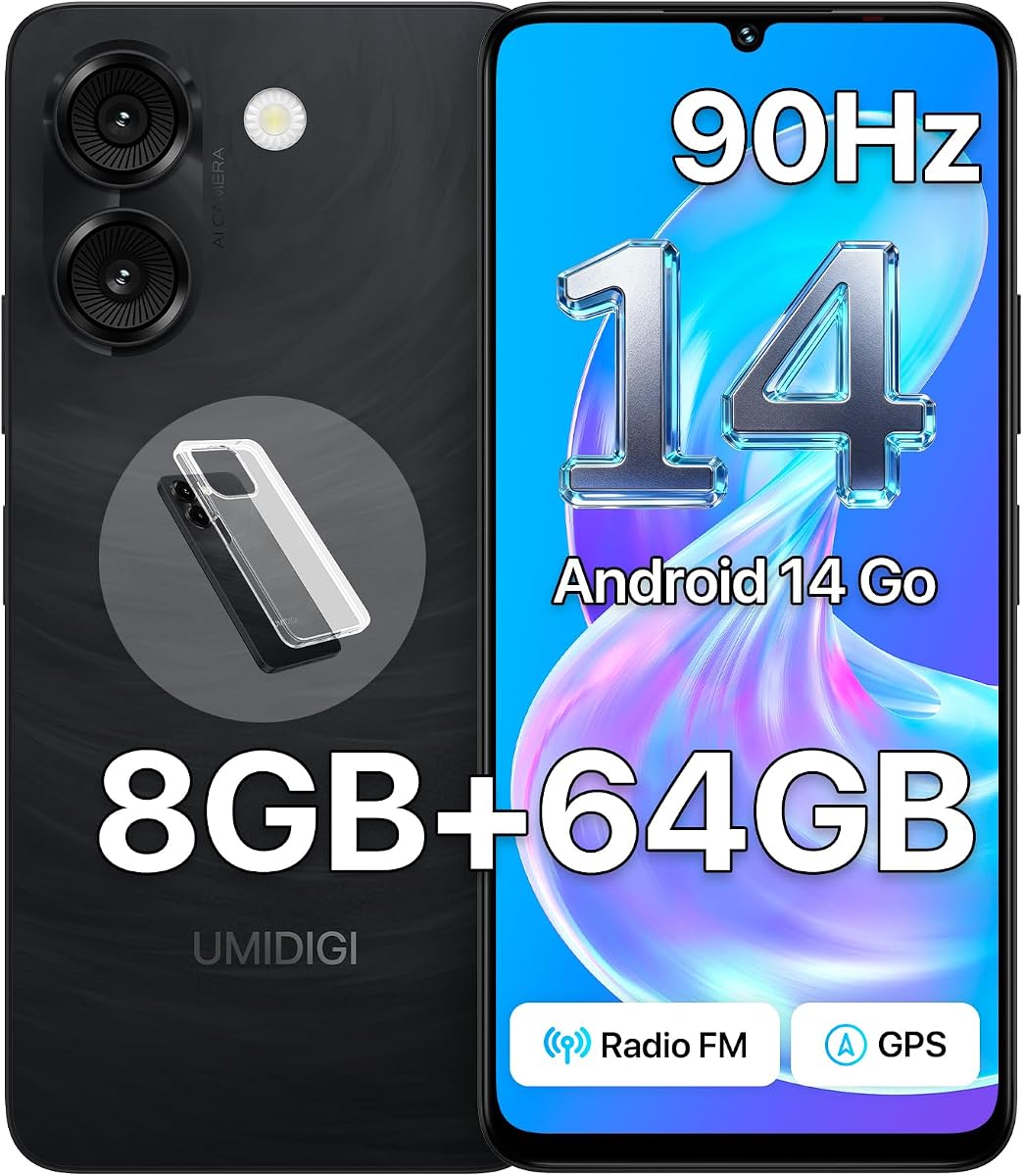
The UMIDIGI G9A is an unlocked Android 14 smartphone with a 3.5mm headphone jack, FM radio, 6.75-inch HD+ 90Hz display, 64GB of storage, and a 5,000mAh battery. Its supplied 3.6 rating is modest, but the built-in analog output makes it one of the most directly relevant phones for audiophile buyers in this guide.
We may earn a commission when you buy through this link, at no additional cost to you.
A 3.5mm jack removes the need to carry a dongle and allows compatible wired IEMs or headphones to connect immediately. That convenience matters for listeners who value reliability, low-latency playback, or simply want to avoid depending on Bluetooth pairing. The phone also includes live caption functionality for video, Bluetooth file transfer, face unlock, dual SIM support, and GPS.
The 90Hz display and octa-core processor are positioned for fluid everyday operation, while the large battery should support a full day of normal use. The listing does not provide details about supported high-resolution Bluetooth codecs, DAC hardware, output power, or audio-focused software. Those omissions matter if you want to distinguish the phone's internal DAC from a dedicated external unit.
The UMIDIGI G9A is the most practical phone in the list for a listener who wants direct wired connectivity without paying for a separate adapter. It is a sensible choice for commuters, students, and anyone building a first serious mobile IEM setup. To get more from the output, begin with sensitive easy-to-drive IEMs, keep the volume controlled, and consider a dedicated DAC if you later need higher power or more advanced format support.
The integrated 3.5mm output is the defining feature for mobile audiophiles. It supports immediate wired listening without a USB-C adapter and avoids the battery impact of a wireless connection.
A 6.75-inch 90Hz screen and 5,000mAh battery make the phone comfortable for browsing music and less dependent on frequent charging. Dual SIM support adds flexibility for travelers or users managing multiple lines.
We may earn a commission when you buy through this link, at no additional cost to you.
The Dac Pocket 2 is a magnetic holder for a dongle-style DAC, not a DAC or smartphone. With a supplied 3.8 rating, it fills a specific organizational gap: keeping a compact mobile audio accessory aligned with a MagSafe-compatible phone while reducing loose cables and accidental movement.
We may earn a commission when you buy through this link, at no additional cost to you.
The strong magnetic system holds the DAC against the phone while leaving its ports and controls accessible. The universal-fit design is intended for most dongle-style DACs, and the quick attach, remove, and reposition process suits users who switch between listening at a desk and traveling. A minimal black finish helps the setup blend into the phone rather than dominate it.
This holder does not improve the underlying digital-to-analog conversion or add headphone amplification. Those functions still belong to the DAC being held. Its value is mechanical: better alignment, less cable clutter, and a more organized way to carry a mobile hi-fi setup. Magnets should also be considered around cards, compasses, and other sensitive objects, and attachment stability can vary with the case and phone used.
The Dac Pocket 2 is best for listeners who already own a compatible dongle DAC and want a tidier mobile arrangement. It is not a starting-point purchase by itself, nor is it a substitute for a headphone connector. Before buying, check the dimensions and layout of your DAC and confirm that your phone or case supports the intended magnetic attachment.
The magnetic design keeps a dongle DAC aligned with the phone and reduces awkward dangling cables. It is especially useful when carrying a compact digital audio player and wired earphones together.
The product does not perform digital-to-analog conversion or amplification. Its purpose is physical organization, so it should complement a separately purchased compatible DAC rather than replace one.
We may earn a commission when you buy through this link, at no additional cost to you.
The Klanar 14.5mm Planar Magnetic IEM is a premium wired in-ear monitor with a supplied 5.0 rating, the highest among the listed products. Its custom-engineered 14.5mm planar driver uses a PET composite diaphragm and N55 magnets, combining impactful bass, natural mids, and extended treble in a compact housing.
We may earn a commission when you buy through this link, at no additional cost to you.
A sensitivity of 105dB and impedance of 16 ohms are especially important for phone use. Those figures support the claim that the Klanar can be driven directly from a smartphone without an external amplifier, making it one of the most relevant recommendations for a listener searching for an audiophile mobile setup. It also works with USB dongles and portable digital audio players.
The shells are milled from aviation-grade aluminum using five-axis CNC machining, and the 0.2mm wall thickness is designed to reduce weight and bulk. A four-strand hybrid Litz cable contains 216 conductors across oxygen-free copper and silver-plated copper Litz sections. Its detachable 0.78mm two-pin interface allows replacement or future upgrades, adding long-term value for cable-focused audiophiles.
This is the strongest premium IEM choice for smartphone listening in the supplied range. It suits listeners who want a dedicated planar presentation, care enough to manage a detachable cable, and prefer direct analog playback over Bluetooth. The 3.5mm connection is convenient, though a phone without a jack will require a compatible DAC. With the full 5.0 supplied rating, it also stands out for customer satisfaction, although ratings should not be confused with individual tonal preferences.
The 14.5mm planar magnetic driver gives the Klanar a distinctly different architecture from typical dynamic-driver IEMs. Its stated sensitivity and low impedance are designed to make direct smartphone driving practical.
The detachable 0.78mm two-pin cable can be replaced or upgraded without replacing the earphone body. The hybrid Litz construction also offers separate copper and silver-plated conductor sections for tonal flexibility.
We may earn a commission when you buy through this link, at no additional cost to you.
The right-angle 3.5mm to dual RCA cable is a 3.2-foot analog connection for smartphones, tablets, portable players, receivers, amplifiers, televisions, cars, and other equipment with a 3.5mm output and RCA inputs. Its supplied 4.8 rating indicates strong customer feedback within this list.
We may earn a commission when you buy through this link, at no additional cost to you.
AWG20 oxygen-free copper conductors carry the stereo signal, while high-density shielding is intended to reduce electromagnetic interference and unwanted noise. Gold-plated RCA connectors provide a corrosion-resistant connection, and the red-and-white identification makes stereo orientation straightforward. A soft cotton-braided outer jacket is designed to remain flexible and durable in daily use.
The right-angle connector is the main practical distinction from the straight cable in this guide. It keeps the plug profile lower and reduces strain where the cable meets a phone or player, particularly when the device rests on a surface. The trade-off is that the angled end may be less convenient in a narrow case or recessed connection area.
Choose this cable when your phone's headphone output will feed a home receiver, powered speakers, amplifier, or car stereo through RCA inputs. It does not improve a Bluetooth signal or bypass a digital-to-analog conversion, and quality can still be limited by the source's output stage. Nevertheless, it is a practical bridge that extends a mobile source into a larger analog system.
The right-angle 3.5mm plug reduces strain and bulk at the source connection. It is particularly helpful when a phone is propped up or placed flat on a desk.
AWG20 oxygen-free copper, shielding, and gold-plated RCA connectors form a conventional analog connection. These details help the cable maintain a stable signal between portable and home equipment.
We may earn a commission when you buy through this link, at no additional cost to you.
The straight 3.5mm to dual RCA cable provides a 6.5-foot analog path from a smartphone, tablet, or other 3.5mm source to stereo equipment with RCA inputs. Its supplied 4.9 rating is the second-highest in the guide and the highest among the two RCA cables.
We may earn a commission when you buy through this link, at no additional cost to you.
The straight phone-end plug is familiar, easy to insert, and works well when the source is mounted upright or positioned with generous space around its port. At 6.5 feet, the cable offers more reach than the 3.2-foot right-angle version, making it easier to place a phone on a desk while the connected receiver or speakers sit farther away.
The cable uses AWG20 oxygen-free copper conductors, dense shielding, and gold-plated RCA connectors. Its braided cotton exterior is soft, flexible, and resistant to the sort of tangling and repeated handling that can affect less robust jackets. The dual red-and-white connectors support conventional left-right stereo routing, while the shielding is intended to minimize interference.
This is the more convenient cable when distance matters more than a low-profile source connection. Choose it for a stationary phone-to-stereo setup, a tabletop audio system, or a car installation with adequate clearance. Like its right-angle counterpart, it cannot improve the source's DAC or headphone output and remains dependent on the electronics at both ends, but it is a straightforward and well-regarded way to move mobile audio into a larger system.
The 6.5-foot length provides enough separation between a phone and stereo equipment for comfortable placement. It is a better fit for a fixed desktop or furniture arrangement than a short pocket cable.
Color-coded red and white RCA connectors make stereo channel assignment easy to follow. The straight source plug also avoids the clearance issues that can arise with an angled connector.
We may earn a commission when you buy through this link, at no additional cost to you.
The best mobile listening setup balances source quality, headphone compatibility, wireless performance, storage, power, and portability. Because the supplied products span phones and dedicated audio accessories, the right decision starts with whether you need to buy the phone, the earphones, the converter, or the connection to a home system.
A built-in 3.5mm output is the simplest route to wired listening. The UMIDIGI G9A explicitly includes the connector, while the Klanar and Quatio IEMs use wired connections and can pair with the phone. If your preferred phone lacks a jack, budget for a compatible USB-C DAC and verify whether it supports the headphone impedance and format you plan to use.
A physical connection offers immediate playback and avoids wireless codec negotiation. It does not automatically guarantee better sound, because the phone's DAC and output stage still matter, but it removes one variable from the chain.
Bluetooth convenience should be considered alongside codec support. The iFi GO blu supports AAC, aptX, aptX HD, LDAC, and HWA through its Qualcomm 5100 series receiver, giving it several options for receiving audio from a phone or computer. Actual quality depends on the transmitter, file quality, wireless conditions, and the receiving device.
When choosing wireless earbuds for one of the phones, check the full codec chain rather than relying on a generic Bluetooth version. Wired and wireless comparisons also involve latency and battery use, so use the connection type that fits the setting.
Local high-resolution listening requires enough space for albums and compatible files. The NUU X10 5G provides 128GB internally and supports microSD expansion up to 512GB, while the UMIDIGI G9A and BLU K2 list 64GB. The remaining phone offers less listed storage, so stream-heavy use may be more practical there.
Storage capacity does not guarantee playback of every lossless format. Check the music player's supported file types, the source app's output options, and whether the phone can route a native player through a DAC or wired output.
The Quatio uses two dynamic drivers and two balanced-armature drivers, with three interchangeable tuning nozzle options. The Klanar relies on a 14.5mm planar magnetic driver and emphasizes a natural, balanced presentation. These choices matter because they can change tonal balance and instrument separation in ways that specifications alone cannot fully describe.
Consider both the advertised tuning and your preferred genres. Planar and hybrid designs offer alternatives to conventional single dynamic-driver earphones, but fit, seal, source quality, and personal taste remain decisive.
The Klanar's stated 105dB sensitivity and 16-ohm impedance are designed for easy driving from a smartphone, USB dongle, or portable player. More demanding headphones can require more output voltage, current, or controlled impedance matching. The iFi GO blu adds a dedicated portable amplification stage, which can be useful when a source cannot drive the chosen headphone properly.
Do not equate loudness with good sound. If distortion rises at the volume needed for your preferred level, the pairing may be inappropriate. Balanced outputs can also change compatibility requirements, so check the cable and source format before use.
Portable audio is easier to enjoy when power is not a constant concern. The NUU X10 5G, BLU K2, and UMIDIGI G9A each list a 5,000mAh battery, while the iFi GO blu is designed as a compact receiver and amplifier. The UMIDIGI also includes an FM radio, and the 6.75-inch display balances media space against portability.
Consider how often the phone is used for calls, video, navigation, or streaming at the same time as music. A larger screen is convenient, while a smaller phone and shorter cable are easier to carry in a pocket or bag.
A phone that supports your carrier and audio accessories should come before minor design preferences. The NUU X10 is unlocked across major U.S. carriers, while the BLU K2 and C5L MAX have specific GSM limitations. Android versions also differ, which can affect the availability of streaming apps, system features, and future software support.
Check unlocked status, supported network bands, app compatibility, and Bluetooth behavior. The iFi GO blu can receive from a phone, laptop, digital audio player, or other Bluetooth transmitter, but the source must support the codec you intend to use.
A phone becomes more useful as a source when it can feed a larger stereo system. The two RCA cables provide analog 3.5mm-to-stereo connections for receivers, amplifiers, speakers, televisions, and cars. The shorter right-angle version reduces strain near the phone, while the longer straight version offers more freedom when placing the source and stereo components.
A cable cannot repair poor source output or replace a good DAC. It is most effective when the phone's headphone stage is clean, the file quality is suitable, and both connected devices are physically compatible with the selected connector.
Start by choosing one primary connection method. For the UMIDIGI G9A, connect compatible wired headphones to the 3.5mm jack and begin at a moderate volume. With the Quatio or Klanar IEMs, use the supplied 3.5mm plug with a phone that has a headphone output, or select a compatible USB-C DAC when the phone requires an adapter. For the iFi GO blu, pair it with your phone and choose the highest-quality Bluetooth codec both devices support.
For the best start with the Quatio, try each of its three tuning nozzle sets at a similar volume, and experiment with the included eartip shapes to establish a secure seal. The Klanar's detachable cable should be removed by its connector rather than pulled from the earphone body. Keep contacts clean and dry, coil the cable loosely, and store the IEMs in their case to protect the shells and connections.
When connecting a phone to home audio with either RCA cable, power off or lower the volume on the receiver before plugging in the source. Connect the red plug to the right channel and white to the left, then raise levels gradually. Keep the Dac Pocket 2 aligned with its compatible DAC, check the attachment around cases or cards, and periodically clean phone ports and connector contacts with dry, nonabrasive materials.
A built-in 3.5mm jack is more convenient and avoids the need for a USB-C adapter. It can also provide a reliable direct connection for compatible wired headphones. However, the phone's DAC, output power, software support, and source quality still determine the final result, so a jack alone does not guarantee superior sound.
You do not need one if the phone includes a headphone jack and adequately drives your chosen earphones. A DAC becomes useful when the phone lacks an analog output, supports only Bluetooth, or cannot provide sufficient power or the desired output format. A dedicated unit may also offer controls and a more flexible wired connection.
Modern Bluetooth can provide enjoyable results, particularly with modern codecs and a strong transmitter. Quality still depends on the codec, source files, wireless conditions, and receiving hardware. Listeners who prioritize dependable wired performance, balanced output, or high power will often prefer a 3.5mm or USB DAC connection.
The Quatio offers a hybrid 2DD+2BA arrangement and three interchangeable tuning nozzles, making it a flexible choice for experimenting with tonal preferences. The Klanar uses a 14.5mm planar magnetic driver and a detachable premium cable, with a supplied 5.0 rating and specifications aimed at easy phone driving. Consider tuning, connector format, source, and personal sound preference.
The Klanar is explicitly designed for easy driving from smartphones, USB dongles, or portable players using its stated 105dB sensitivity and 16-ohm impedance. The Quatio also uses a wired connection, although its supplied information does not provide a specific sensitivity or impedance figure. Confirm those details for your exact model and source before driving it at high levels.
The UMIDIGI G9A is the clearest phone-based answer because it includes a 3.5mm headphone jack, allowing compatible wired earphones to connect without a dongle. The NUU X10 5G may appeal to listeners who prioritize clean Android and expandable storage, but its supplied information does not document an analog headphone output.
Storage capacity itself does not determine sound quality, but it determines how much locally stored high-resolution music you can keep. The NUU X10 5G combines 128GB of internal storage with microSD expansion up to 512GB. You must also confirm that the music player and output chain support the formats you intend to play.
Confirm that the phone or DAC has a 3.5mm output and that the receiver or amplifier has compatible red-and-white RCA inputs. Start with both volume levels low, connect the correct channels, and raise the volume gradually. The supplied cables can carry an analog signal, but they cannot improve the source electronics or bypass an inadequate DAC.
The UMIDIGI G9A is the most practical phone for direct wired listening because it includes a 3.5mm jack, a large 90Hz display, and a 5,000mAh battery. The Quatio Hi-Fi IEM stands out for its hybrid drivers and three tuning options, while the Klanar Planar IEM offers the most premium phone-friendly earphone specification set with its 5.0 supplied rating, 105dB sensitivity, and low 16-ohm impedance.
Your priorities should guide the rest of the purchase. Choose a clean, expandable Android phone if software and local storage matter most; choose an IEM if you already have a capable source; choose the iFi GO blu if wireless-to-wired convenience is essential; and choose an RCA cable if you want a phone to feed a larger home or car stereo. The Dac Pocket 2 is an organizer for a compatible dongle DAC, not a replacement for one.
Before ordering, verify the current connector layout, carrier support, codec compatibility, storage needs, and accessory requirements. Ratings and product configurations can evolve, and prices change over time. With those details confirmed, you can build a mobile audio setup around the connection style and listening habits that matter most to you.