
SOLUPUP 30W Solar Panel
4.4Editor score
23% conversion efficiency
Dual USB charging outputs
IPX5 weather resistance
This guide compares the best solar charger for fishing electronics, covering output, portability, weather resistance, battery support, and usability.
Keeping phones, GPS units, cameras, and marine electronics powered on the water requires a charger that balances usable solar output with portability and weather resistance. The right panel also needs connection options that fit your fishing electronics without adding unnecessary equipment.
We compared all 10 products by examining rated panel output, charging ports, conversion efficiency, folded size, weight, water resistance, battery-maintenance functions, and the included accessories. The list covers direct USB charging panels, higher-output models, and permanent or semi-permanent systems for 12V batteries.
Each pick highlights the use case it serves most effectively, from compact backup charging to powering multiple devices or maintaining a boat battery. Product availability and current pricing can change, so confirm the specifications and connector compatibility before making a final purchase.
4.4Editor score

4.5Editor score

4.4Editor score
The comparison below separates direct device chargers from 12V battery-maintenance systems and shows the most important differences in rated output, charging connections, portability, and environmental resistance.




The GEYOTO 45W Solar Panel Charger is the strongest general-purpose choice in this guide for anglers who need more than a basic emergency charger. It holds a 4.5 rating and combines a relatively capable 45W panel with up to 26% solar-cell conversion efficiency, three USB outputs, and an IP68-rated laminated surface. Its design suits a day on the lake, a multi-day fishing trip, or a compact emergency kit.
We may earn a commission when you buy through this link, at no additional cost to you.
Two USB-C ports and one USB-A port provide more flexibility than most portable panels. A compatible phone or tablet can use the 25W PD USB-C connection, while the other USB-C and USB-A outputs can serve a power bank, GPS unit, camera, or another supported device. The absence of an integrated battery makes it a direct charger rather than a stored-power unit, so useful output depends on sunlight, panel angle, temperature, and device behavior.
Portability is another important strength. The panel folds to 8.44 by 12.52 by 1.26 inches and weighs 1.65 pounds, giving it a recognizable iPad-sized footprint without adding excessive weight to a fishing bag. The package includes a USB-C extension cable, storage pouch, carabiners, and a manual. The IP68 construction improves confidence around spray and changing weather, although the exposed charging ports should always be kept dry.
This is the best fit for an angler who regularly charges several small electronics and wants a single portable panel rather than a permanently installed battery system. It may be excessive for someone who only needs an occasional phone top-up, and solar charging is not a substitute for bringing a charged power bank. Within that context, the combination of output, efficiency, port selection, portability, and weather resistance makes it the most complete fishing-oriented recommendation here.
Three outputs reduce the need to rotate devices or carry multiple wall adapters. The USB-C ports support compatible modern electronics, while USB-A expands compatibility with older accessories, conventional power banks, and smaller marine or angling devices.
The laminated panel and IP68 rating make the unit better suited to splashes and dust than a basic fabric-covered charger. Even so, the ports are not intended to be wet, so wiping the surface and storing the panel dry remains important.
We may earn a commission when you buy through this link, at no additional cost to you.
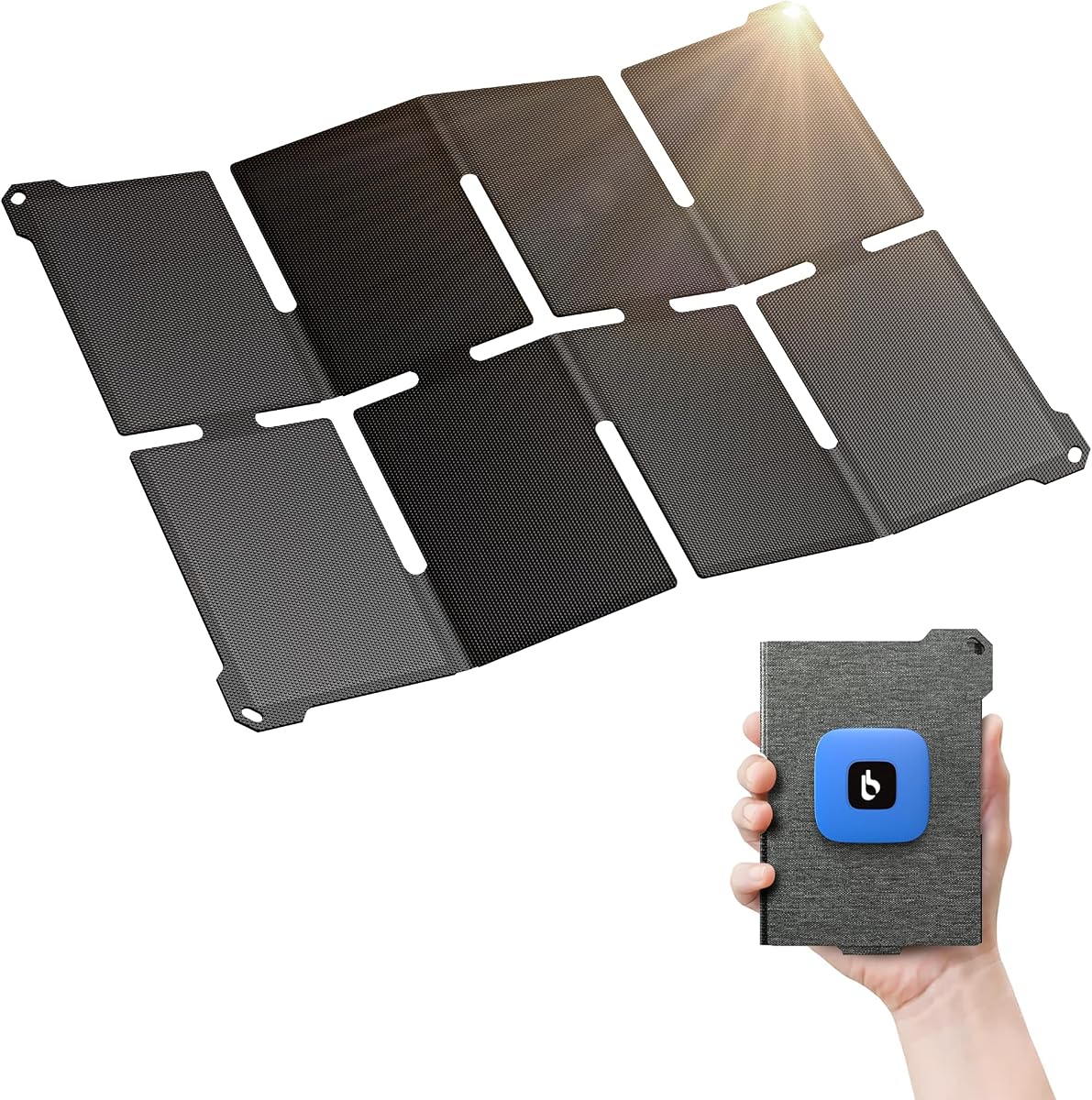
The SOLUPUP 30W Foldable Solar Charger offers a practical middle ground between pocket-sized emergency panels and larger systems designed for heavier electronics. Its 4.4 rating, 30W panel, and monocrystalline construction make it a sensible choice for anglers who want to replenish a phone, GPS unit, camera, or power bank without carrying a bulky setup.
We may earn a commission when you buy through this link, at no additional cost to you.
USB-A and USB-C outputs are rated at 5V and up to 3A, with a maximum combined output of 15W. The built-in smart chip identifies connected devices, optimizes charging, and includes protection against overcurrent, overvoltage, and short circuits. An automatic optimization function is also said to reconnect the system when sunlight returns after an interruption, which can be useful when clouds pass over a fishing boat.
The panel weighs 2.4 pounds and folds to a stated size of 10.63 inches. It includes two carabiners and an adjustable stand, so an angler can suspend it from a pack or position it on a deck. Its IPX5 rating is suitable for exposure to rain and dust, while the smart-chip features add confidence when connecting multiple devices. Actual production varies with season, temperature, panel placement, and cloud cover.
Choose this model if the goal is a straightforward folding panel with modern and legacy USB connections at a moderate capacity. It cannot match the GEYOTO's three-port flexibility or higher stated conversion efficiency, and its 15W charging output may be modest for power-hungry tablets. For typical fishing electronics, however, it delivers a convincing mix of portability, protection, and useful features.
The automatic reconnection function is particularly relevant on the water, where moving clouds can interrupt a direct solar session. Keeping the panel correctly oriented remains important because no controller can recover energy that the cells do not receive.
The folding design, integrated stand, and included carabiners make it easy to place the panel where it can receive unobstructed sunlight. A separate charging cable is included, allowing a phone or device to remain in a shaded, cooler location.
We may earn a commission when you buy through this link, at no additional cost to you.
The Flashfish 100W Foldable Solar Panel is the premium, high-output selection for anglers who need more charging flexibility than a conventional phone panel provides. It has a 4.4 rating and uses monocrystalline cells with stated conversion efficiency of 22–23%. Its nominal 100W output makes it better suited to tablets, cameras, drones, and other USB-powered equipment than most compact models.
We may earn a commission when you buy through this link, at no additional cost to you.
The primary outputs include USB-C PD up to 65W, USB-A QC3.0 up to 18W, and a direct 5521 DC connection. Two USB devices can be charged simultaneously. The USB-C output is especially relevant for modern phones, tablets, and compatible laptops, while the DC port opens possibilities for power stations or equipment requiring a specific input arrangement.
Four kickstands provide stable positioning on a deck, dock, picnic table, or ground. A TPE handle assists with carrying, and the folding construction allows the panel to be packed between trips. The package includes a DC5521 cable, four alternative barrel connectors, and a manual. Its footprint is understandably larger than that of 25W to 45W folding chargers, but the extra surface area can provide a meaningful advantage under strong sun.
This is the appropriate premium recommendation for a serious angler, film-focused outdoors user, or boater who regularly operates multiple higher-draw electronics. It is less attractive for someone needing the smallest possible pack item, and the 100W figure should not be interpreted as guaranteed wall-equivalent output in every condition. When placed properly in direct sunlight, it offers the broadest device support in this roundup.
The 65W USB-C PD connection offers substantially more headroom than the standard USB outputs found on small solar panels. That makes the model more relevant for tablets and demanding compatible USB-C devices, provided the sun is strong and the device accepts solar input.
The 5521 port and included barrel connectors broaden compatibility with compatible portable power stations and direct DC devices. Users should verify voltage, connector dimensions, and charging requirements before relying on a non-USB connection.
We may earn a commission when you buy through this link, at no additional cost to you.
The POWOXI 7.5W 12V Solar Battery Charger is built around a different fishing-electronics need: maintaining a 12V battery rather than directly charging a phone. Its 4.4 rating, low-profile solar surface, intelligent protection system, and simple installation make it relevant for anglers with a boat, trolling-motor battery, or vehicle that spends time away from shore power.
We may earn a commission when you buy through this link, at no additional cost to you.
Installation can be completed by inserting the unit into a suitable 12V cigarette-lighter socket or connecting it to a battery with the included alligator clips. A built-in controller and blocking-diode structure are intended to provide stable charging and guard against overvoltage, short circuits, and overcharging. Red and green indicator lights show when the panel is receiving sunlight and when it is connected to the battery.
The high-transparency solar glass, rigid ABS and PC frame, and claimed 25–30% conversion efficiency distinguish it from flexible budget panels. The stated compatibility covers common 12V battery categories, including lithium-ion, LiFePO4, motorcycle, boat, tractor, and ATV batteries. Because it is designed as a maintainer, its modest 7.5W output is best interpreted as a slow replenishment function rather than a rapid recovery solution.
Buy this product if the essential objective is keeping a compatible 12V battery maintained during storage or extended periods away from an outlet. It is not a substitute for a portable USB panel, and a deeply discharged battery may require more powerful charging equipment. For preventive battery care with minimal installation, it remains a focused and understandable option.
A small maintainer can help offset the drain associated with electronics, lighting, and parasitic loads during long absences. Positioning the panel in direct sunlight is essential, because otherwise the controller cannot replace the energy being consumed.
The socket and alligator-clip options make it possible to use the product with different 12V installations. Confirm polarity and battery compatibility, and follow the included instructions when connecting the leads.
We may earn a commission when you buy through this link, at no additional cost to you.
The FlexSolar 40W Foldable Solar Panel Charger combines three output types, a 24% stated conversion rate, and compact dimensions. Its 4.4 rating makes it an attractive middleweight option for fishing electronics that use USB, USB-C, or a compatible 19V DC connection. It is especially relevant to users who want more than a simple two-port phone charger.
We may earn a commission when you buy through this link, at no additional cost to you.
The QC3.0 USB-A and PD2.0 USB-C outputs each have a maximum of 18W, while the 19V DC port is rated up to 40W. Smart load distribution favors using a single port when peak efficiency is desired. An integrated IC detects connected devices, and the listed safeguards cover overcurrent, overheating, and short circuits. An LED indicator provides a quick visual check of charging status.
At 1.76 pounds and 8 by 11.1 by 1.8 inches folded, the panel is lighter than many similarly capable competitors. Its IP67 construction and ETFE laminate add abrasion and weather resistance, but the junction box is not fully waterproof and should be protected during heavy rain or immersion. The product has no internal energy storage.
This model suits an angler who wants flexible connections in a pack without moving to a large 100W setup. It may be unnecessary for someone charging only one low-draw phone, while those needing guaranteed full-day storage should pair it with a power bank. As a versatile direct charger, it offers a strong balance of output, protection, and pack size.
USB-A remains useful for conventional accessories and power banks, while USB-C supports newer compatible devices. The 19V DC output adds another route for selected equipment, making the panel adaptable to a mixed set of fishing electronics.
The folded size and 1.76-pound weight make the panel easier to carry than larger high-output models. Its stated 24% efficiency and protective laminate are helpful, but output still falls when the panel is shaded or poorly angled.
We may earn a commission when you buy through this link, at no additional cost to you.
The SOLPERK 20W Solar Panel Kit is a strong choice when a fishing boat or other 12V installation needs a mounted solar maintainer. It carries a 4.5 rating and pairs a 20W monocrystalline panel with a smart MPPT controller, an adjustable bracket, and installation accessories. The setup is more permanent in character than the folding direct chargers in this guide.
We may earn a commission when you buy through this link, at no additional cost to you.
The controller uses a three-stage charging design intended to prevent overcharging, overvoltage, and short circuits, while indicator lights show battery status. It supports rechargeable 12V battery types such as LiFePO4, lithium-ion, AGM, SLA, GEL, EFB, and MF. The manufacturer states that the MPPT controller improves charging efficiency by 30% compared with other controllers, although real results depend on installation and sunlight.
A low-iron tempered-glass surface and corrosion-resistant aluminum frame are designed for prolonged outdoor exposure. The listed resistance figures cover wind pressure and snow load, and the panel is described as waterproof and rustproof. The 360-degree bracket allows anglers to change the sun-facing angle as conditions change, while pre-drilled holes and plug-and-play connections simplify mounting.
Choose this kit for a boat, trolling system, trailer, RV, or vehicle that can accommodate a fixed solar panel and connected 12V battery. It is not the right tool for directly topping up a phone, and a 20W panel cannot restore a severely depleted battery quickly. Within the maintainer category, however, its controller, bracket, and rugged construction make it particularly adaptable for marine use.
The adjustable bracket is useful on a console, rail, or other mounting point where the sun angle changes throughout the day. A clearer installation and a stronger solar contribution than a small maintainer can reduce the risk of battery depletion.
The MPPT controller and three-stage approach are intended to manage common 12V rechargeable battery types safely. Because wiring mistakes can damage equipment, polarity and terminal requirements should be checked before connection.
We may earn a commission when you buy through this link, at no additional cost to you.
The BigBlue 28W High-Efficiency Solar Panel Charger is a portable three-port option built around N-type cells, a shadow-free front surface, and a stated 25.4% conversion efficiency. Its 4.3 rating is slightly below the leaders, but the design remains attractive for anglers who want to charge several small devices without carrying a larger panel.
We may earn a commission when you buy through this link, at no additional cost to you.
Two USB-C ports and one USB-A port each provide up to 5V and 3A, for a listed collective output of 5V and 4.8A. The panel can support compatible phones, tablets, power banks, GPS units, flashlights, and other small electronics. It does not store energy, so connected devices need direct sunlight for reliable charging, and the manufacturer states that its output is insufficient for laptops or large power stations.
The folding dimensions are 11 by 6 by 1.4 inches, and the panel weighs 1.5 pounds. That makes it easy to carry in a tight fishing bag or emergency kit. Its polymer surface resists rain, fog, and wear, but the USB junction box is not waterproof. A 50-centimeter USB-C cable and carabiners are included, while a cable for Apple devices is not included.
This is a sound pick for users who value efficient folding construction and multiple ports over battery-maintenance features. It is also suitable for an emergency kit, but it should not be treated as a stored-power system. Keep the electronics shaded and the panel in direct sun, and consider the GEYOTO if stronger weather protection around the ports is a higher priority.
The stated 25.4% efficiency and shadow-free front design help make the panel effective for its size. At only 1.5 pounds, it is practical for anglers who need a dependable daily top-up without dedicating substantial pack volume.
Two USB-C ports and a USB-A output accommodate modern phones and conventional accessories at the same time. The shared maximum output means device draw can still affect individual charging performance, so avoiding several high-draw devices is sensible.
We may earn a commission when you buy through this link, at no additional cost to you.
The BigBlue 25W Solar Panel Charger focuses on low weight and compact storage. Its 4.2 rating is not the highest in this roundup, but the 0.84-pound folded unit, 25W panel, and IP68 rating make it a credible choice for anglers who carry a minimal emergency kit or travel by small boat where every ounce matters.
We may earn a commission when you buy through this link, at no additional cost to you.
USB-A output is listed at 5V and 2.4A, while USB-C provides 5V and 3A. Two devices can be connected simultaneously, including a compatible cellphone, power bank, or camping light. Smart charging technology is intended to optimize power delivery and protect connected equipment. Like other direct panels, it stores no internal energy and depends on unobstructed sunlight.
The panel uses metal-free N-type cell fronts and a stated efficiency of up to 25.4%. Its ETFE coating, UV-resistant EVA, high-efficiency cells, and baseplate are designed to resist outdoor wear and hidden stress cracks. It folds to 4.65 by 6.42 by 1.38 inches and includes a USB-C cable, carabiners, and an elastic strap for attaching it to a backpack or tent.
This is the pick for a lightweight phone and power-bank charger rather than a high-output marine system. Its compact dimensions may require more direct positioning to receive strong sun, and its two-port design is less flexible than the three-port alternatives. For basic daily top-ups, emergency preparedness, or travel where low weight matters, it delivers a focused feature set.
At 0.84 pounds, the panel is among the easiest to carry for anglers moving between shore, boat, and campsites. The included carabiners and elastic strap make it easy to keep the panel accessible while the connected device remains shaded.
The ETFE coating, UV-resistant EVA, and baseplate provide a durable structure for regular outdoor use. The IP68 rating offers useful protection against splashes, spills, dust, and light rain.
We may earn a commission when you buy through this link, at no additional cost to you.
The SUNER POWER 12W 12V Solar Battery Charger is a dedicated maintainer for marine, automotive, RV, trailer, and power-sport batteries. Its 4.4 rating and built-in UltraSmart MPPT technology distinguish it from basic trickle chargers, with the manufacturer listing tracking efficiency up to 99% and peak conversion efficiency of 98%.
We may earn a commission when you buy through this link, at no additional cost to you.
The controller follows a three-stage charging process involving bulk, absorption, and float. It stops charging when the battery is full and resumes after a discharge, creating an automatic maintenance cycle. Listed protections include overcharge, overdischarge, overvoltage, overcurrent, overload, short circuit, reverse polarity, and overtemperature, along with waterproof and spark-proof construction.
Compatibility covers common sealed lead-acid, flooded, gel, AGM, SLA, maintenance-free, deep-cycle, and LiFePO4 batteries used in boats, trolling motors, cars, motorcycles, tractors, ATVs, and dump trailers. Grade A+ solar cells, tempered glass, and a corrosion-resistant frame are designed to resist UV exposure, erosion, rust, hail, and sandstorms. Pre-designed mounting holes and included suction cups help simplify installation.
This kit is best for keeping a compatible 12V battery healthy while an angler's boat or vehicle is stored or lightly used. Its 12W capacity is modest compared with the 20W and 100W panels here, and it does not directly charge a phone. For preventive maintenance with automatic regulation and broad protection, it is one of the most technically focused choices.
The full-charge cutoff and automatic restart remove the need to monitor a basic maintainer continuously. That convenience is useful for long-term storage, where preserving a battery may be more important than fast recovery.
The range of electrical safeguards and broad battery compatibility makes the unit useful across marine and automotive applications. Correct battery selection, polarity, and wiring remain essential even with built-in protection.
We may earn a commission when you buy through this link, at no additional cost to you.
The 15W Portable Small Solar Panel Charger is a lightweight, monitoring-focused option for anglers who want basic charging for a phone, camera, GPS unit, power bank, or small light. Its 4.2 rating is modest, and its 15W panel is the lowest nominal output here, but the built-in digital display adds useful visibility to an otherwise simple design.
We may earn a commission when you buy through this link, at no additional cost to you.
The display reports power, voltage, and current, allowing users to see how placement affects real-time production. That feedback can help an angler reposition the panel when it is partially shaded by a tackle box, boat canopy, or neighboring gear. The panel uses 23.5% stated-efficiency monocrystalline cells beneath an ETFE coating that resists scratches, heat, and outdoor wear.
USB-C and USB-A outputs support phones, power banks, cameras, GPS units, mini fans, and other USB-powered devices. Intelligent protection is listed against overcharging, overheating, and short circuits. At 0.82 pounds, the folding panel is easy to carry in a compact fishing bag, and the package includes two carabiners and a user manual.
This is the appropriate choice for emergency top-ups, lightweight travel, and users who value clear operating data more than maximum output. It may struggle with several power-hungry devices or prolonged heavy use, so bringing a precharged power bank remains sensible. For a small, uncomplicated panel with monitoring, it delivers a useful balance.
The real-time power, voltage, and current readings are more useful than a simple status light because they reveal whether shading or poor orientation is limiting output. This makes panel adjustment faster and more objective.
The combination of dual USB outputs and a 0.82-pound weight supports routine phone and accessory charging without adding much bulk. It is best treated as a supplemental charger for low-draw electronics rather than a primary energy source.
We may earn a commission when you buy through this link, at no additional cost to you.
The best choice depends on whether you need portable device charging, 12V battery maintenance, or a higher-output panel for demanding electronics. Evaluate the power path, expected solar conditions, connectors, weather exposure, and storage constraints before choosing.
A direct solar panel connects to phones, cameras, GPS units, tablets, and power banks through USB outputs. It does not usually store energy, so useful charging requires the panel to remain in direct sunlight. A solar battery maintainer, by contrast, uses a controller to replenish a connected 12V lead-acid, lithium-ion, AGM, GEL, EFB, MF, or LiFePO4 battery. The latter is better for preserving a boat battery during storage, while the former is more useful for powering devices during a fishing day.
Choose based on the problem you actually have. If your concern is a phone losing battery while navigating or taking photos, prioritize usable USB output and portability. If the concern is a trolling-motor, accessory, or boat battery sitting idle, prioritize a compatible MPPT or smart controller, mounting hardware, and dependable weather protection.
Panel wattage indicates the maximum rated solar capacity, not guaranteed real-time charging speed. The products here range from 7.5W battery maintainers to a 100W folding panel. Small direct chargers are sufficient for phones, GPS units, and cameras, while higher-output models can better support tablets and other higher-draw devices. USB output ratings also matter because a panel's total wattage is distributed among connected ports.
Match capacity to the electronics you expect to use and the amount of time available. For occasional emergency top-ups, a compact 15W to 30W panel may be enough. For extended trips or several demanding devices, consider a 40W to 45W panel or the 65W USB-C output of the 100W model. Also leave room for real-world losses caused by heat, angle, partial shade, and device behavior.
Conversion efficiency describes how effectively a panel turns received sunlight into electrical output. The listed products range from 21% to 26% at the cell level, with higher values generally allowing a smaller panel to produce more power under equivalent conditions. Efficiency is most meaningful when comparing similarly sized panels and when direct sunlight is consistent.
Do not choose on efficiency alone. A high-efficiency panel still performs poorly when shaded, wet with standing water, placed behind glass, or oriented away from the sun. Position, cleanliness, temperature, and unobstructed exposure can matter as much as the headline efficiency figure.
Most anglers will need USB-A, USB-C, or a proprietary DC connection. USB-C PD is useful for compatible modern phones and tablets, while USB-A supports conventional power banks and older accessories. Some larger panels also include a 19V or 5521 DC port for compatible portable power stations or direct-powered equipment. Check both the connector shape and the required voltage or protocol.
Bring the cable your device needs if it is not included. Several products specify a USB-C cable but do not include an Apple cable, and a wall adapter does not necessarily mean the panel can safely charge every device. Review device charging requirements before ordering, especially for a tablet, laptop, drone controller, or high-draw marine accessory.
A folding panel is easier to store in a boat console, tackle bag, or backpack than a fixed marine installation. Within the portable group, the products reviewed range from 0.82 and 0.84 pounds to 2.4 pounds. Larger panels generally offer more surface area and higher output, but they also occupy more space and can be harder to stabilize on a small deck.
Consider how you will carry and deploy the unit. A lightweight panel with carabiners is convenient for moving between locations, while a heavier model with kickstands may be better if it will be set up once and left in the sun. Dimensions should be checked against the available storage space as well as the weight.
Fishing gear is routinely exposed to spray, drizzle, dust, and changing humidity. A panel with IP67 or IP68 construction is better suited to those conditions than a basic unprotected model. Battery maintainers with glass surfaces and corrosion-resistant frames are also appropriate for fixed outdoor installations. However, a waterproof panel does not automatically mean every attached component is waterproof.
Read the exclusions carefully. The FlexSolar junction box is not fully waterproof, and the BigBlue 28W USB junction box also lacks waterproofing. The GEYOTO instructions specifically call for keeping its ports dry. After use, wipe away salt and moisture, allow the equipment to dry, and store it in a clean pouch or protected compartment.
For a 12V solar maintainer, the controller is as important as the panel. MPPT technology seeks the panel's maximum operating point, while multi-stage charging can manage bulk, absorption, and float phases. Built-in protection against reverse polarity, overcharging, overvoltage, short circuits, and excessive current adds a margin of safety during unattended use.
Confirm that the controller supports the exact battery chemistry and voltage used in your boat or vehicle. Also check whether the kit includes alligator clips, socket connections, mounting hardware, and appropriate cable lengths. A sophisticated controller cannot compensate for incompatible wiring or a battery that requires more current than the available panel can provide.
Most of the portable panels in this roundup convert sunlight directly and do not contain an internal battery. That keeps them lighter and simpler, but it also means they cannot provide power after sunset or when clouds obstruct the sun. An angler needing evening or overnight reserve should pair a direct panel with a compatible power bank or use a solar generator system with integrated storage.
A power bank gives the user control over when stored energy is used. Charge it during the brightest period, then connect fishing electronics as needed. This combination is often more dependable for a full day than treating a small direct panel as though it were a battery.
Begin by identifying the charging path. Connect a direct panel to a compatible device through the correct USB or DC port, or install a maintainer with the correct polarity and controller. Place the panel where it receives unobstructed direct sunlight, avoid placing it behind a window, and adjust its angle throughout the day. Keep the connected device in the shade when possible so that heat does not trigger its thermal protection.
For dependable results, clean the panel before use, remove fishing line, salt, mud, and debris from the surface, and check that no bag, canopy, or equipment blocks the cells. Keep devices connected only with compatible cables. If output drops, watch the current display where available, reposition the panel, and wait for sunlight to become stronger. For battery-maintenance models, follow the three-stage charging behavior and do not use the panel as a rapid charger for a severely depleted battery.
After the trip, disconnect the device or battery, wipe the panel with a clean damp cloth, and let it dry completely. Do not submerge a junction box or charging port unless the manufacturer expressly permits it. Store the panel in its pouch or a dry compartment, avoid placing heavy objects on the cells, and inspect cables and connectors for corrosion or damage before the next outing.
A 15W to 30W solar panel is generally sufficient for phones, cameras, GPS units, and small power banks when used in strong sunlight. A 40W to 45W panel provides more flexibility for tablets or several devices, while a 100W panel is better suited to demanding USB-C equipment. Actual charging speed also depends on the device's input limit, panel angle, temperature, and partial shading.
Yes, if the boat uses a compatible 12V rechargeable battery and the maintainer supports its chemistry. MPPT models such as the SOLPERK and SUNER POWER kits are designed to regulate charging automatically and protect against common electrical faults. A small maintainer helps prevent gradual discharge, but it is not intended to restore a deeply depleted battery rapidly.
Most portable panels reviewed here are direct chargers and do not store electricity. They convert available sunlight while a device is connected, so output stops or becomes unstable when the sun is blocked. Bringing a charged power bank is advisable when an angler needs reliable power after sunset or during prolonged cloudy conditions.
USB-C is useful for modern phones, tablets, GPS units, and other compatible accessories, especially on panels with Power Delivery. USB-A remains valuable for older devices and many power banks. The safest approach is to check the charging port and protocol required by each device rather than assuming every USB connection supports the same charging rate.
Direct outdoor sunlight is more effective because glass can reduce output and heat the panel. It can also create uneven illumination if part of the panel is shaded. Position the charger outside the windshield or canopy in an open, unobstructed location, and keep the connected device shaded so it does not overheat.
It depends on the product and the protected components. Panels with IP67 or IP68 ratings can handle substantial exposure, but junction boxes and USB ports may have lower protection. The FlexSolar and BigBlue 28W models specifically note that their junction boxes are not fully waterproof, and the GEYOTO requires its charging ports to remain dry.
An MPPT controller continuously seeks the panel's maximum power point and then manages charging for the connected battery. A basic trickle charger generally supplies a smaller, less precisely regulated current. MPPT systems can use available solar energy more efficiently and often include staged charging and broader electronic protections, making them preferable for a maintained 12V boat battery.
Only if the system, battery type, wiring, and charging protocol are compatible. A properly installed and regulated maintainer can be appropriate for supported 12V batteries, but it should not be connected incorrectly or used with incompatible battery chemistries. Follow the controller instructions, verify polarity, and use suitable mounting and cable connections.
The GEYOTO 45W panel is the most balanced overall choice because it combines three charging ports, strong stated efficiency, a manageable folded size, and IP68 protection. The SOLUPUP 30W panel provides a straightforward, moderately priced portable alternative, while the Flashfish 100W model stands out for anglers who need higher output, USB-C PD, and direct DC connectivity.
For boaters concerned about battery depletion rather than device charging, the SOLPERK and SUNER POWER MPPT kits provide a better path. Choose according to the electronics involved, available sunlight, connector requirements, and tolerance for permanent installation. In every case, direct sunlight, a clean panel surface, proper angle, and a shaded device will produce more consistent results than a larger nominal wattage figure alone.
Before purchasing, verify the latest specifications, included cables, battery compatibility, and current product availability. Pricing and promotions can change, so compare the complete feature set rather than focusing on cost alone. A high-quality charger should complement, not replace, a charged power bank or other reserve power for a long day offshore.