Solar Nocturnal Animal Repeller
5.0Editor score
Single-unit economical starting option
Solar charging without wiring
IP65 outdoor-rated construction
Flexible one-to-eight-foot mounting
Solar Predator Deterrent guide comparing 10 solar wildlife lights for coverage, weather resistance, nighttime visibility, easy mounting, and humane animal
Solar predator deterrents use flashing red lights to suggest the presence of a larger nocturnal hunter, discouraging animals from approaching chicken coops, gardens, orchards, livestock areas, and property boundaries. The best units combine automatic dusk operation, dependable solar charging, weather-resistant construction, and flexible mounting options.
We compared all ten products by examining their power systems, light patterns, pack sizes, weather ratings, mounting methods, intended animals, and coverage potential. The list includes compact dual-eye deterrents, multi-packs for several approach routes, and 360-degree night guard designs for larger properties.
Each review explains the product's most useful features, practical limitations, and ideal placement, helping you choose according to your property and the animals causing the problem. Product ratings and availability can change, so check the latest customer feedback and current listing details before buying.
5.0Editor score

5.0Editor score
4.4Editor score
The comparison below highlights each product's configuration, power source, light design, weather rating, and mounting approach so you can identify the most practical deterrent for your property.


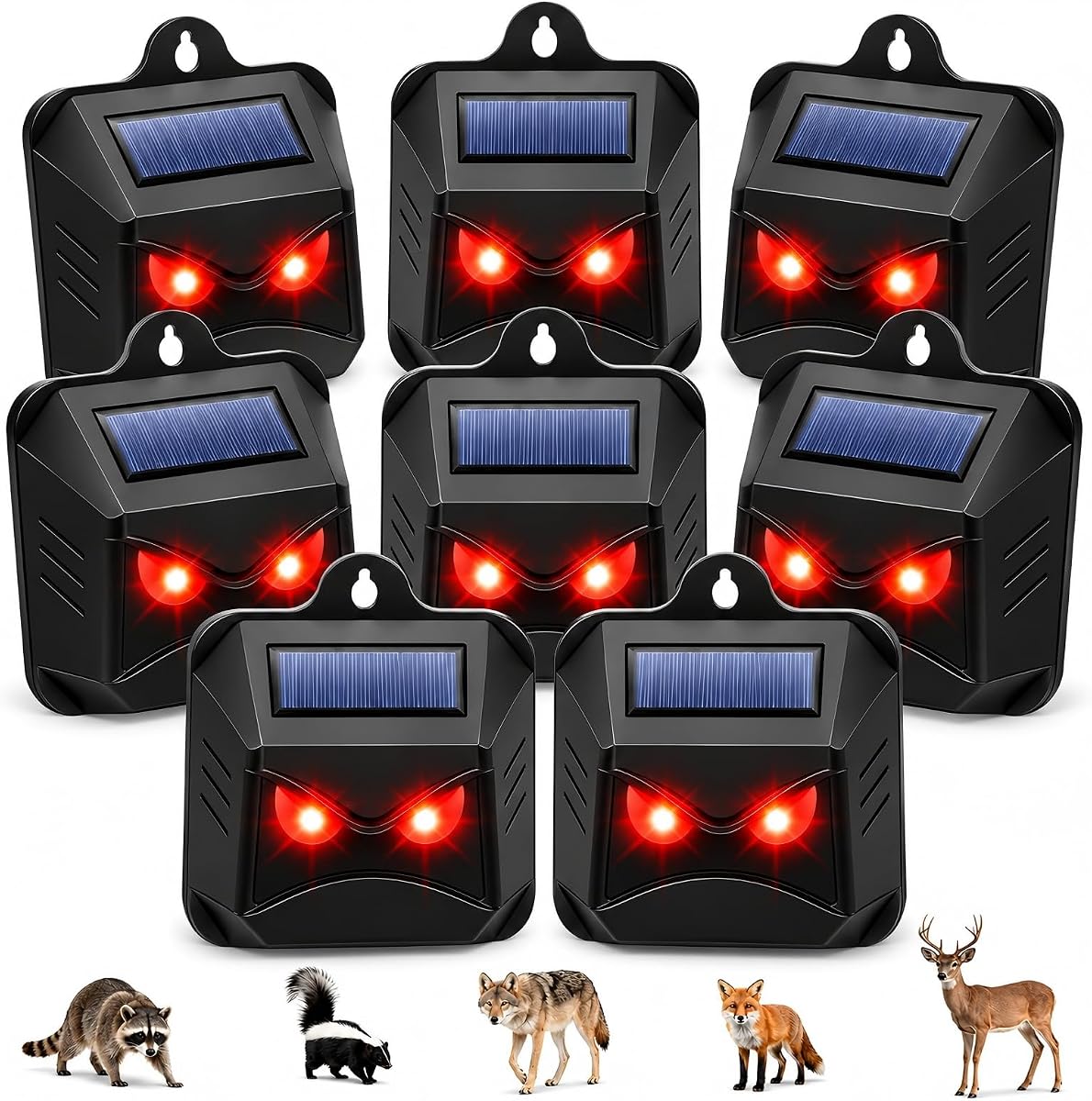
This eight-pack solar predator deterrent combines dual red flashing LEDs with automatic nighttime activation and a notably useful assortment of mounting locations. It carries a 5.0 rating, and its strongest feature is the ability to place a separate light at each of several entry points rather than expecting one unit to protect an entire property.
We may earn a commission when you buy through this link, at no additional cost to you.
The dual LEDs are designed to resemble the eyes of a nocturnal predator and can be aimed toward routes used by raccoons, coyotes, foxes, skunks, and deer. Solar charging removes the need for power cables, while the IP65 housing is appropriate for exposed fences, posts, walls, and coop exteriors. Mounting from approximately one to eight feet high also allows the lights to be positioned near the likely eye level of different animals.
The main trade-off is the effort involved in deploying eight units effectively. A scattered arrangement can leave gaps, while too many lights can become visually cluttered. Nighttime duration also depends on direct sunlight and charging conditions, so shaded locations may not sustain full performance. Despite those limitations, the pack provides more placement flexibility than the single-light alternatives.
This is the most balanced choice for a property with several vulnerable areas, such as a chicken coop, garden entrance, fruit tree, garbage enclosure, and orchard edge. It is especially suitable for buyers who want a broad, layered deterrent without installing wiring. Choose it as the overall pick when multi-point coverage and an IP65 housing matter more than a minimal number of components.
Eight lights make it possible to build a deliberate perimeter rather than placing one unit at an arbitrary location. Direct each pair of red eyes toward a known animal route and keep the LEDs visible above grass, branches, or stored objects.
The panel charges during daylight and the light activates automatically after dark. Choose an unobstructed sunny position, and periodically clear dirt and leaves from the panel to support dependable charging.
We may earn a commission when you buy through this link, at no additional cost to you.
This single-unit solar animal repeller provides a straightforward way to test predator-eye deterrence at a chicken coop, garden, or property edge. Its 5.0 rating reflects a product that covers the essential functions: solar charging, automatic nighttime activation, dual red LEDs, and an IP65-rated outdoor housing.
We may earn a commission when you buy through this link, at no additional cost to you.
The flashing lights are intended to frighten or disorient animals such as deer, raccoons, coyotes, foxes, and skunks without physical contact. Installation only requires switching the device on and mounting it on a post, fence, or wall. The suggested one-to-eight-foot range gives owners flexibility to match the light to the expected height of the target animal.
A single light cannot provide the same perimeter coverage as a multi-pack, and it may need to be repositioned as animals learn or change their routes. Sun exposure also determines how well the rechargeable battery performs at night. The solar panel should therefore receive direct light and remain clean.
This is a sensible choice for a small yard, one chicken run, a garden entrance, or a property where you have identified one especially active route. It is also a useful first test before investing in a larger system. Choose this budget pick when a portable, solar-powered unit is enough and you want simple installation without a large collection of components.
Begin where signs of disturbance are strongest, such as torn trash, damaged produce, or a frequently used coop entrance. A focused test is more useful than placing a single unit randomly in a location where animals rarely pass.
The device relies on flashing red light rather than poison, bait, or trapping. Its effectiveness still depends on visibility, placement, and the behavior of the animals in your area.
We may earn a commission when you buy through this link, at no additional cost to you.
This four-pack sits between the single-light and eight-unit options, offering a practical balance for small farms and yards with several separate points of concern. It has a 5.0 rating and uses the familiar dual red predator-eye design to create a visual warning after dark.
We may earn a commission when you buy through this link, at no additional cost to you.
Each unit charges through a solar panel and activates automatically as darkness falls. The IP65 waterproof materials are designed for year-round outdoor exposure, and the units can be mounted on posts, fences, or walls at heights from roughly one to eight feet. Four lights can be assigned to a coop, garden, tree line, and fence opening.
Its limitation is coverage scale. Four strategically placed lights may be excellent for a small property, but they will not create continuous protection around an extensive farm. Dense vegetation, blocked panels, and poorly chosen directions can also reduce the effect. Owners should inspect active routes and revise the arrangement as animal behavior changes.
This four-pack is a strong option for buyers who want more placement options than a single unit without deploying a large system. It suits chicken coops, vegetable gardens, orchards, and moderate residential yards. Select it when four known approach routes need attention and an IP65 housing is a priority.
Four units are enough to place a deterrent at the most active locations instead of stretching one unit's limited line of sight across an entire property. Map the routes before mounting.
Automatic dusk activation avoids daily manual switching and supports unattended operation. Keep each solar panel exposed to direct daylight for the strongest overnight performance.
We may earn a commission when you buy through this link, at no additional cost to you.
This four-pack distinguishes itself with a documented 4Hz flashing pattern and a built-in hanging hole for straightforward installation. It has a 5.0 rating and is designed to discourage deer, raccoons, foxes, skunks, and other nocturnal visitors through a visible predator-eye effect.
We may earn a commission when you buy through this link, at no additional cost to you.
Each light uses a rechargeable battery charged by its solar panel and turns on automatically after dark once switched on. The four units can be placed at a garden entrance, beside a coop, along a fence, and at a property boundary. Their red LEDs should face the routes animals regularly use rather than shining into an open field.
The IP44 housing is suitable for ordinary outdoor use, although it is less specialized for heavy splash exposure than the IP65 products in this guide. Visibility is another important constraint: tall grass, branches, walls, or stored materials can obscure the eyes and undermine the intended effect. A clear sightline matters more than simply having a unit nearby.
Choose this product when a specific, consistent flash pattern and easy hanging installation are priorities. The four-pack works well for medium-sized properties with four clearly defined routes. It is less suitable where units are likely to sit in heavily exposed or poorly sheltered positions without additional protection.
The stated 4Hz pattern adds noticeable movement to the paired red LEDs. Keep both eyes in view from the animal's expected direction, because a partially hidden light communicates a much weaker signal.
A four-unit configuration is most effective when every light has a specific purpose. Assign one to the coop, one to the garden, and the others to the two most active boundaries.
We may earn a commission when you buy through this link, at no additional cost to you.
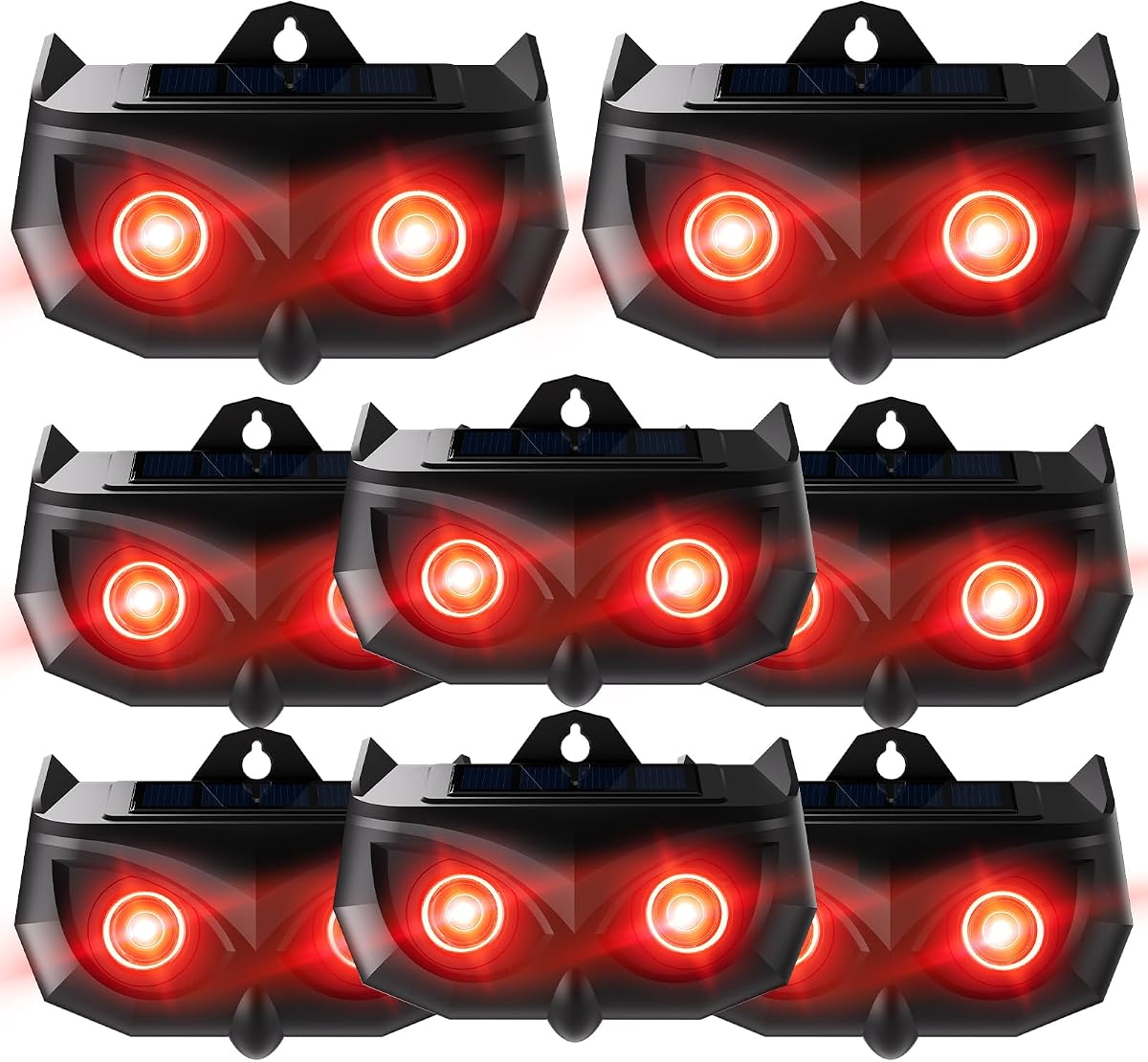
This eight-pack offers a more expansive deterrent layout with a monocrystalline silicon solar panel and dual red strobe technology. Its 4.4 rating is slightly below the leaders, but the specification set is attractive for buyers who want to build broad coverage around a farm, yard, or livestock area.
We may earn a commission when you buy through this link, at no additional cost to you.
The lights charge in daylight and activate automatically at dusk, while adjustable mounting from one to eight feet supports placement on trees, fences, and walls. The product description notes that multiple units can be combined to approach 360-degree coverage, reducing blind spots when the lights are correctly distributed.
The IP44 waterproof rating means it is designed for rain, snow, and changing outdoor temperatures, but it is not equivalent to the stronger IP65 designation used by several competitors. The seller also advises allowing three to four weeks to evaluate results and notes that initial activity may temporarily increase as animals alter their routines. This means patience is essential.
This is the premium pick for a property large enough to benefit from eight separately positioned lights. It is well suited to chicken coops, livestock enclosures, orchards, and large gardens with several entry points. Buy it when coordinated multi-light coverage matters and you can devote time to thoughtful placement and monitoring.
The monocrystalline panel is designed to collect daylight efficiently for nighttime operation. Mount it where it receives strong, unobstructed sun, and recharge under better conditions after extended cloudy or rainy weather.
Eight independently mounted units can cover more directions than a single central light. Space them around the property, face them along active routes, and monitor whether movement shifts to an unmonitored opening.
We may earn a commission when you buy through this link, at no additional cost to you.
This four-pack is a strong all-around option for buyers who prioritize weather resistance and flexible placement. It holds a 5.0 rating, and its IP65 housings are designed to resist rain and splashes around chicken coops, orchards, vegetable gardens, and property boundaries.
We may earn a commission when you buy through this link, at no additional cost to you.
The dual flashing red LEDs create a predator-eye appearance, while solar charging and automatic dusk activation remove the need for nighttime wiring or manual switching. The units can be mounted on trees, fences, walls, or posts at approximately one to eight feet high. Buyers are encouraged to observe activity for three to four weeks and reposition units as necessary.
The product is weather-resistant but not waterproof in the sense of being submersible. Mount it above locations where water collects, and do not place it in standing water. Its four-light pack can also become overwhelmed if a large property has many separate entries.
This is a good selection for moderate yards and gardens with several exposed vulnerable points. It is particularly attractive where rain and splashes are common but every unit can still be mounted above pooled water. Pair it with secure fencing, covered feed, and closed trash containers for a stronger overall wildlife-control plan.
The IP65 housing is a meaningful advantage for units mounted near muddy gardens, coop exteriors, and splash-prone boundaries. Weather resistance does not replace sensible placement, so avoid low spots that collect water.
The recommended three-to-four-week observation period allows you to see whether animals are avoiding a route or simply moving to another. Track changes and rotate or redirect lights accordingly.
We may earn a commission when you buy through this link, at no additional cost to you.
This four-pack uses rapid red strobes to imitate glowing predator eyes and fire-like warning signals. Its 5.0 rating and stated ability to discourage coyotes, foxes, raccoons, skunks, deer, wolves, and owls make it a versatile choice for mixed wildlife pressure.
We may earn a commission when you buy through this link, at no additional cost to you.
A high-efficiency solar panel and built-in rechargeable battery handle daytime charging, while a dusk-to-dawn sensor controls automatic activation. The units mount between one and eight feet above the ground on fences, posts, or exterior walls. The stated aim of eye-level placement helps make the predator effect more convincing.
The IP44 housing is rated for ordinary rain, snow, and outdoor use, although it is less robust on paper than the IP65 options. The seller also advises recharging under strong sunlight after extended cloudy or rainy periods. As with all light-based deterrents, results depend on clear visibility and consistent placement.
Choose this product for farms, orchards, chicken coops, and yards where several species may be active at different times. It is particularly helpful when a simple, humane visual deterrent is preferred over traps, poison, or chemical controls. Four units allow a useful but focused perimeter.
The paired red strobes are intended to create a general warning signal rather than imitate one narrow target. This makes the units useful where the species visiting a property changes from one season to the next.
The sensor removes the need to remember a manual switch. Verify that each unit is activated and that its panel receives enough daylight before relying on it through a long night.
We may earn a commission when you buy through this link, at no additional cost to you.
The Foxlights Non-Solar Predator Deterrent differs from the dual-eye products by using nine LEDs that project light in all directions. Its 4.2 rating makes it a compelling option for buyers prioritizing wide visibility and changing flash patterns rather than solar independence.
We may earn a commission when you buy through this link, at no additional cost to you.
Computerized LEDs vary their timing, intensity, and sequence to imitate human presence and make the source less predictable. The description states that the light can be seen from over a mile away, while the 360-degree arrangement helps protect chicken coops, barns, goat pens, orchards, and gardens from multiple directions.
Unlike the solar models, this unit requires a connection to power, so it is less convenient at a remote gate, field, or off-grid pasture. A centralized installation can still cover a broad area, but multiple units may be needed to protect separate locations. Its durable acrylic and waterproof materials are designed for outdoor exposure.
Choose the non-solar Foxlights when reliable electrical power is available and you want a conspicuous, multidirectional signal rather than a predator-eye pair. It is well suited to a fixed livestock area or farmyard where broad nighttime visibility matters. It should be complemented by secure fencing and sound animal-husbandry practices.
Nine LEDs project in every direction, making the unit less dependent on the exact angle of an approaching animal. This is advantageous in open yards where visitors may approach from several directions.
Changing timing, brightness, and sequences make the installation harder for nocturnal animals to become accustomed to. The effect depends on continued operation and the light remaining unobstructed.
We may earn a commission when you buy through this link, at no additional cost to you.
The ASPECTEK Predator Eye PRO is a compact two-pack built around the familiar idea of red eyes resembling a larger predator. It has a 4.0 rating and offers one of the simplest ways to add two solar visual deterrents to a garden, farm, or chicken property.
We may earn a commission when you buy through this link, at no additional cost to you.
The units flash continuously at night after the light-sensitive design turns them on at dusk and off during daylight. The built-in solar panel charges the lights, while a slight tilt and integrated hooks make placement straightforward on fences, posts, sheds, and similar structures. Positioning the light at the eye level of the intended animal improves visibility.
The pack has fewer units than most competitors, and the supplied information does not specify a formal IP weather-resistance rating. It is therefore more important to select a sheltered or suitably exposed mounting point and verify that water does not collect around the unit. A two-light system also offers less redundancy than larger packs.
Choose this option for a compact property, two specific access points, or a buyer who values straightforward placement over large-scale coverage. It can serve as a practical supplement around a small coop or garden. For extensive acreage or several widely separated routes, a four- or eight-pack would generally be more flexible.
The tilted back and built-in hooks make it easy to hang each light where the red eyes are visible. Avoid placing them behind dense plants or inside recesses that limit the line of sight.
Unlike motion-activated deterrents, the lights continue flashing throughout the night. That consistency may suit locations where the timing of animal visits is unpredictable.
We may earn a commission when you buy through this link, at no additional cost to you.
This Foxlights model combines nine omnidirectional LEDs with random red, blue, and white flashes. Its 4.0 rating suits buyers seeking wide coverage and power flexibility for farms, vineyards, orchards, gardens, and livestock enclosures.
We may earn a commission when you buy through this link, at no additional cost to you.
The computer-controlled lights vary their timing, intensity, and color sequence, creating an unpredictable presence rather than a fixed pair of red eyes. The description reports visibility from over one kilometer, although actual visibility varies with ambient light, weather, obstacles, and site conditions. A dusk-to-dawn sensor turns the unit on automatically at night.
Power options are a major strength because the product family includes solar and battery-operated versions, while the solar model also offers USB charging as an alternative. This makes it more adaptable to remote sites and changing layouts. The multicolor presentation is less literal than a predator-eye product, so buyers seeking a specific red-eye appearance should consider that difference.
Choose this model for a broad farm or vineyard where omnidirectional light, random patterns, and flexible power are the main priorities. It is particularly useful when one central installation can illuminate several approach angles. Pair it with physical barriers, secure nighttime animal housing, and proper waste management for layered protection.
Solar charging suits permanent off-grid locations, while battery power offers immediate deployment or an alternative when sunlight is limited. The solar version's USB port provides another charging route.
Changing red, blue, and white patterns create a more varied signal than fixed red LEDs. The changing display may help reduce predictability, although it may not appear as natural to animals accustomed to a particular predator's eye color.
We may earn a commission when you buy through this link, at no additional cost to you.
The most useful deterrent is one that is visible from the route animals actually use, receives adequate sunlight, and remains positioned long enough to influence their behavior. Compare coverage, power, weather resistance, installation, and target species before deciding.
Choose a multi-pack when several distinct entry points need attention.
Prioritize direct sunlight and verify charging conditions before installation.
Match the weather rating to exposure, then prioritize sound mounting.
Choose a visible pattern and confirm an unobstructed sightline.
Match mounting height to target eye level and available surfaces.
Match the advertised target species to the animals actually visiting.
Balance central coverage with targeted, repositionable light placement.
Combine lighting with barriers, covered food, and secure housing.
Before installation, identify where animals enter after dark and choose a mounting point with a clear view along that route. Switch on the unit as instructed, install it securely on a fence, post, tree, or wall, and aim the red LEDs toward the approach. Use the stated one-to-eight-foot range as a starting point, adjusting the height toward the eye level of the target species. Do not place the solar panel beneath eaves, dense foliage, or other structures that block daylight.
Maintain the panel by clearing dirt, leaves, and debris on a regular basis. Inspect the housing, mounting fasteners, and visible LEDs for damage after storms or severe weather, and make sure the unit sits above areas where water collects. Because the light must be conspicuous, trim or relocate vegetation that blocks the eyes. If animals begin using a different route, reposition a light or add another unit rather than assuming the original installation has failed.
Evaluate the setup over several weeks and keep a simple record of signs such as disturbed trash, damaged plants, digging, or damaged garden beds. Individual species and locations respond differently, so the absence of visible damage does not guarantee that every visit has stopped. Combine the deterrent with secure fencing, closed nighttime chicken housing, covered feed, and lidded trash containers. Remove any scattered feed or fallen fruit that encourages animals to return.
They can discourage some nocturnal animals by imitating a larger predator's eyes or suggesting human activity. Effectiveness varies by species, familiarity, placement, and visibility, so no light is a guaranteed barrier. Use multiple lights at known entry points and observe the property for several weeks to determine whether behavior changes.
Place it where animals repeatedly approach, with the LED eyes directed toward that route and visible from a distance. Mounting near chicken coops, garden entrances, trash areas, orchard edges, and fence openings is common. Avoid blocked sightlines and shaded solar panels, and adjust the height toward the target animal's eye level.
Operating time depends on sunlight exposure, the panel's charging condition, and the unit's battery. Direct, unobstructed sunlight generally supports the most dependable performance. Extended cloudy or rainy periods can reduce runtime, so keep the panel clean and recharge affected units under stronger light when possible.
These products use flashing lights as a visual deterrent and do not use traps, poison, chemicals, or ultrasonic sound. Nevertheless, proper placement and animal supervision remain important. Keep lights stable and visible, avoid flashing them directly into livestock housing, and use secure nighttime animal care as the primary protection.
A single light is sensible for one confirmed entry point or a small test area. A four- or eight-pack is more useful when a coop, garden, orchard, and trash area form separate parts of the property. Each unit should have a clear purpose and an unobstructed view of its assigned approach route.
IP44 indicates protection against solid objects greater than one millimeter and splashing water, while IP65 is dust-tight and protected against water jets. Neither rating means the unit can be submerged. Even an IP65 model should be mounted above pooled water and inspected periodically for damage or blocked solar charging.
Most units activate automatically after dark, so they are designed primarily for nocturnal activity. Daytime protection requires secure fencing, covered feed, protected crops, and proper waste management. The deterrent should complement these measures rather than act as the only line of defense.
The route may be poorly lit from the animal's perspective, another entry point may remain open, or the animal may not have encountered the light long enough to change its behavior. Check visibility, panel charging, and mounting height, then observe for several weeks. Secure fencing and removing food or trash attractants may be necessary.
The 8 Pack Solar Nocturnal Animal Repeller stands out as the overall choice because it combines eight placement points, automatic solar operation, dual red eyes, and an IP65 housing. The single Solar Nocturnal Animal Repeller is the most economical way to address one confirmed route, while the 2026 Solar Predator Eyes 8 Pack offers a premium multi-light setup with monocrystalline charging and dual strobe technology.
Prioritize the route over the unit count. A well-positioned light facing a confirmed approach is more useful than several poorly aimed lights, and solar charging requires a visible, sunny panel. Consider IP65 for exposed positions, nine-LED coverage for open central installations, and flexible mounting for properties where animals may shift between entry points.
Finally, check current ratings, customer feedback, availability, and the latest product details before purchasing, since features and product information can change. Never mention prices in the article body, and use the current listing as the final authority for specifications and purchase options.